

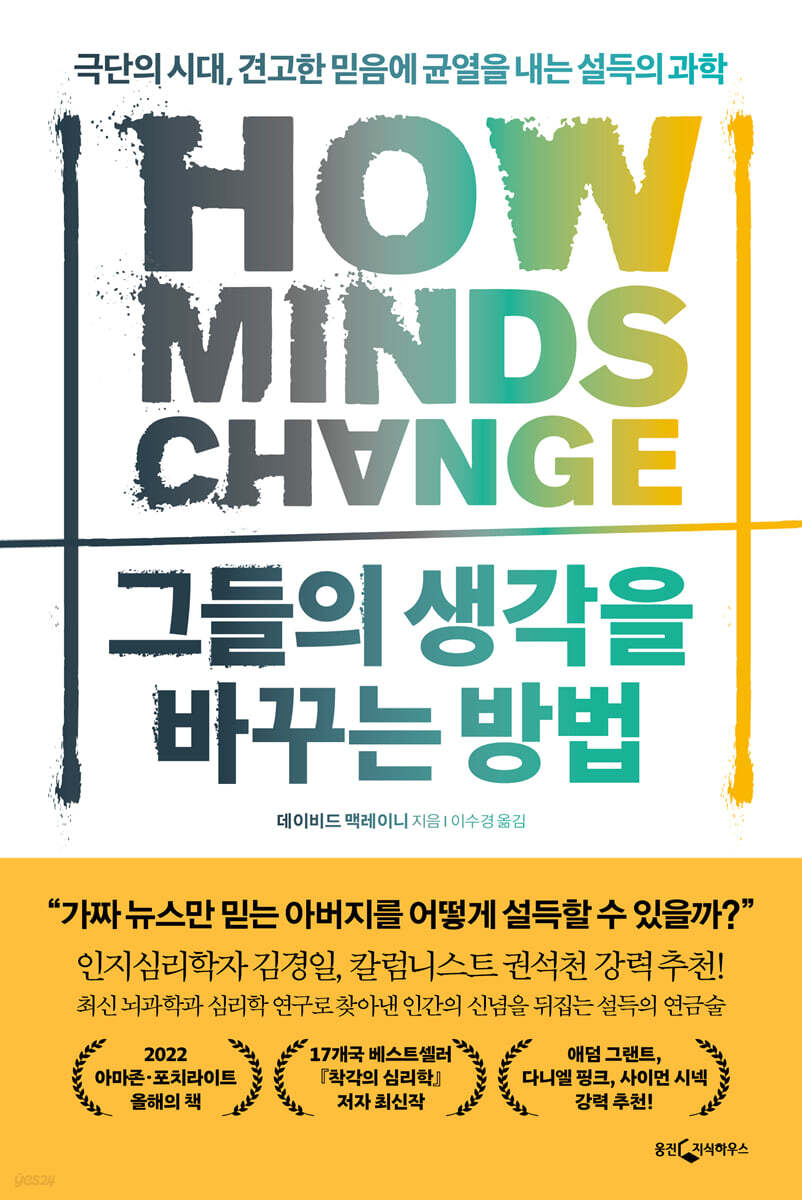
How to change their minds
 |
Description
Book Introduction
2022 Amazon Porchlight Book of the Year! Rave reviews from intellectuals around the world, including Adam Grant, Daniel Pink, Professor Kim Kyung-il, and reporter Kwon Seok-cheon! The latest work by the author of "The Psychology of Illusion," a bestseller in 17 countries. “How can I convince my father who believes fake news?” Conspiracy theories, extreme political blind faith, confirmation bias… In an era of post-truth where reason no longer prevails, A provocative scientific book that shatters the conventional wisdom that human beliefs are unchangeable. We feel a deep sense of helplessness when we can't convince even those closest to us, whether it's parents who blindly believe fake news or friends who are mired in political extremism. If even clear facts and evidence can't convince "them," what can we do to change their minds? Is it even possible to change minds? David McRaney, science journalist and author of "The Psychology of Illusion," a bestseller in 17 countries and a two-time winner of America's most prestigious journalism award, the William Randolph Hearst Award, asks. He breaks the stereotype that "people don't change" in this post-truth era where reason no longer works, and emphasizes that even the most stubborn beliefs and convictions of others can be sufficiently changed. McRaney captures the moment when the values of seemingly unchangeable people, including his father, 9/11 conspiracy theorists, political extremists, and cult fanatics, were suddenly turned upside down, and embarks on an epic journey to uncover the crucial principles that change human thinking. How Minds Change is the result of seven years of relentless reporting and research by the author, encompassing the latest psychological research, including 'deep canvassing' used in the 2020 US presidential election, 'street epistemology', 'motivational enhancement interviewing', and 'elaboration likelihood model', and collaborating with neuroscientists, brain scientists, and persuasion experts to uncover the most effective persuasion method to overcome division and conflict. In an age where everyone is trapped in their own algorithms, this book explores the potential for change and communication within the human mind, offering flexible and hopeful solutions. |
- You can preview some of the book's contents.
Preview
index
Praise for this book
As I was entering, I wanted to change my father's mind.
Chapter 1: The Post-Truth Era: Those Who Believe the 9/11 Terrorist Attacks Were Fabricated
A Conspiracy Theory Journey│Colleagues Seem Like 'Disgusting Beasts'│A Belief That Turned In an Instant to Madness│Is Truth Dead?
Chapter 2: Deep Canvasing: How to Change Voters' Minds in 20 Minutes
Persuasion techniques published in Science│Why 500,000 votes changed in the same-sex marriage referendum│Just 20 minutes, one conversation│There is no such thing as unfounded belief│Why memories from 50 years ago are recalled│Scientific verification of deep canvassing│People don't recognize when they change their minds
Chapter 3: Socks and Crocs: What the Dress Color Debate Left Us
The Dress Color Debate That Divided the World│The Human Brain Can't See the Truth│The SURFPAD Law: How the Brain Processes Ambiguous Information│Gray Crocs vs. Pink Crocs│The Illusion of Objectivity in My Beliefs│Frame Wars: Opinions Are the Same, But Interpretations Are Different
Chapter 4: Imbalance: What Happens in the Brain When Your Faith Is Shaky
A system of beliefs engraved like a ring│Knowledge and belief, the gap between them│People who believed in the 'Geese Tree' for hundreds of years│Disequilibrium, the pain of accepting change│The mechanism of 'post-traumatic growth'│The inconvenient truth about cognitive dissonance│The tipping point where opinions are accepted
Chapter 5: Westboro: Why Fanatics Leave Cults
"Homosexuals, well-dead"│Leaving Westboro│The kindness of 'them' who I thought were monsters│The hatred of ordinary, familiar neighbors│Self-contradiction faced on social media│Willingly falling into the pit of evil│Contact, exchange, and kindness│The air of the outside world
Chapter 6: Tribal Psychology: Committing Evil to Become a Good Member
Feeling like someone who 'knows something'│Feels like facing a bear when being refuted│Psychological experiment on 'us vs. them'│Social death is more feared than physical death│The power of belonging and group identity│The conspiracy theory loop: human instinct│The importance of self-confidence│Truth is social
Chapter 7: The Power of Argument and Debate: Our Biased and Lazy Brains
Not knowing that you don't know│The evolution of worldviews and dilemmas│Humans are optimized for argument│Persuasion, a product of evolution
Chapter 8: The Psychology of Persuasion: Psychological Strategies for Effectively Delivering Your Message
Beliefs, Attitudes, Opinions, and Values│Why Do Celebrities Appear in Razor Ads│We Are Attracted to Messages That Relate to Me│The Four Conditions for Persuasion
Chapter 9: Street Epistemology: One Conversation Is Enough
Street Epistemology Experiment│Ask 'How' and 'Why' They Believe│9 Steps of Street Epistemology│The Pyramid for Change│Conviction is a Product of Emotion│The Effectiveness of Listening and Storytelling│Techniques for a World That Believes Facts│Why Do You Want to Change Other People's Minds?
Chapter 10: Moments of Social Change: Conditions for a Network That Drives True Change
What the Ice Age's Chaos Left Humanity│The Same-Sex Marriage Debate: A Decade of Changes│Contact Creates Miracles at the Border│Better Explanations, Better Changes│The Cascade Effect on Vaccine Refusers│Anyone Can Be a Spark│Keep Knocking, It Will Open Soon
The seeds of change we sow as we go out
Acknowledgements
main
Search
As I was entering, I wanted to change my father's mind.
Chapter 1: The Post-Truth Era: Those Who Believe the 9/11 Terrorist Attacks Were Fabricated
A Conspiracy Theory Journey│Colleagues Seem Like 'Disgusting Beasts'│A Belief That Turned In an Instant to Madness│Is Truth Dead?
Chapter 2: Deep Canvasing: How to Change Voters' Minds in 20 Minutes
Persuasion techniques published in Science│Why 500,000 votes changed in the same-sex marriage referendum│Just 20 minutes, one conversation│There is no such thing as unfounded belief│Why memories from 50 years ago are recalled│Scientific verification of deep canvassing│People don't recognize when they change their minds
Chapter 3: Socks and Crocs: What the Dress Color Debate Left Us
The Dress Color Debate That Divided the World│The Human Brain Can't See the Truth│The SURFPAD Law: How the Brain Processes Ambiguous Information│Gray Crocs vs. Pink Crocs│The Illusion of Objectivity in My Beliefs│Frame Wars: Opinions Are the Same, But Interpretations Are Different
Chapter 4: Imbalance: What Happens in the Brain When Your Faith Is Shaky
A system of beliefs engraved like a ring│Knowledge and belief, the gap between them│People who believed in the 'Geese Tree' for hundreds of years│Disequilibrium, the pain of accepting change│The mechanism of 'post-traumatic growth'│The inconvenient truth about cognitive dissonance│The tipping point where opinions are accepted
Chapter 5: Westboro: Why Fanatics Leave Cults
"Homosexuals, well-dead"│Leaving Westboro│The kindness of 'them' who I thought were monsters│The hatred of ordinary, familiar neighbors│Self-contradiction faced on social media│Willingly falling into the pit of evil│Contact, exchange, and kindness│The air of the outside world
Chapter 6: Tribal Psychology: Committing Evil to Become a Good Member
Feeling like someone who 'knows something'│Feels like facing a bear when being refuted│Psychological experiment on 'us vs. them'│Social death is more feared than physical death│The power of belonging and group identity│The conspiracy theory loop: human instinct│The importance of self-confidence│Truth is social
Chapter 7: The Power of Argument and Debate: Our Biased and Lazy Brains
Not knowing that you don't know│The evolution of worldviews and dilemmas│Humans are optimized for argument│Persuasion, a product of evolution
Chapter 8: The Psychology of Persuasion: Psychological Strategies for Effectively Delivering Your Message
Beliefs, Attitudes, Opinions, and Values│Why Do Celebrities Appear in Razor Ads│We Are Attracted to Messages That Relate to Me│The Four Conditions for Persuasion
Chapter 9: Street Epistemology: One Conversation Is Enough
Street Epistemology Experiment│Ask 'How' and 'Why' They Believe│9 Steps of Street Epistemology│The Pyramid for Change│Conviction is a Product of Emotion│The Effectiveness of Listening and Storytelling│Techniques for a World That Believes Facts│Why Do You Want to Change Other People's Minds?
Chapter 10: Moments of Social Change: Conditions for a Network That Drives True Change
What the Ice Age's Chaos Left Humanity│The Same-Sex Marriage Debate: A Decade of Changes│Contact Creates Miracles at the Border│Better Explanations, Better Changes│The Cascade Effect on Vaccine Refusers│Anyone Can Be a Spark│Keep Knocking, It Will Open Soon
The seeds of change we sow as we go out
Acknowledgements
main
Search
Detailed image

Into the book
I took a deep breath and asked myself what I really wanted.
Why do I want to change my father's mind? I tell him, "I love you, Dad.
So I said, “I’m so upset that my father was fooled by misinformation,” and our argument ended right away.
My father and I started having a conversation on the Internet about who to trust.
(…) It is important to remember that it is important to state your intentions when challenging someone else’s ideas.
Otherwise, it will be difficult for both sides to escape the attitude of 'I'm right and you're wrong.'
---From "Entering"
Charlie described his moment of enlightenment as follows:
“It was like something inside me suddenly went, ‘Boom!’” Flight school experiences, building blueprints, construction companies, and demolition experts gradually dispelled his conviction in the conspiracy theory.
All these experiences suggested that his thinking might be wrong.
Above all, he saw the victim's family and was convinced that he was wrong.
But when Charlie returned to his lodgings, he was quite surprised to find that he was the only one who had experienced such a powerful awakening.
Other conspiracy theorists believed that Hoagland had been brainwashed by the FBI or that he was an actor hired by the BBC to fool them.
(…) Charlie told me that they were disgusting, that they “looked like disgusting animals.”
---From "Chapter 1: The Age of Post-Truth"
The organization has met with more than 15,000 citizens over a period of more than 10 years, recording and analyzing the conversations in detail to improve its communication methods.
Because the lab's method, developed and refined over such a long period of time, quickly demonstrated reliable results, many social scientists came here to observe it firsthand.
It is a technique called deep canvassing, which is a further development of the general canvassing, which is an election campaign that visits voters' homes.
Although it doesn't always work, most of the time this technique gets people to abandon long-held views and change their positions in less than 20 minutes.
---From "Chapter 2 Deep Canvasing"
When the truth is uncertain, the brain resolves that uncertainty by creating a reality that feels most correct based on past experiences.
People whose brains resolve uncertainty in similar ways agree.
Like people who perceived the dress as blue and black.
Meanwhile, there is agreement among people whose brains resolve uncertainty in different ways.
Like the people who saw the dress as white and gold. The core of the SURFPAD law is that these two groups are each convinced of their own opinions.
---From "Chapter 3 Socks and Crocs"
When we first sense that we might be wrong—that is, when our expectations and experiences don't match—we instinctively feel uncomfortable and resist adjusting our models.
It is an attempt to apply existing models to the situation at hand.
The brain must accept that its existing models can never resolve dissonance, and so it modifies them by creating new conceptual layers to accommodate the novelty.
As a result, you experience a sudden realization.
---From "Chapter 4 Imbalance"
Before I met Jack and Megan, I assumed they left Westborough because their views on homosexuality had changed.
He said that he eventually left the church because of conflicts with the church over his views on homosexuality.
But the truth was different.
Jack and Megan's thoughts on gays and Jews, their views on parenting, and even their own thoughts about themselves—all changed after leaving the church.
---From "Chapter 5 Westboro"
Anthony said that in that respect, street epistemology sets us free.
(…) Their goal is not to change other people’s minds.
The goal is to help people discover better ways to think more rigorously and accurately, and to reach certainty or doubt.
The focus of the conversation is not on what people believe, but on how and why they believe.
But it seemed to me that the process of getting people to change their epistemology actually changed their minds.
---From "Chapter 9: Street Epistemology"
As each group changes, the total number of people changing ultimately increases, and thus the influence of people increases.
This network effect, also known as the diffusion effect or the percolation effect, is the driving force behind all major public opinion shifts.
(…) Therefore, to change vaccine hesitancy, we must first identify who the hesitants are, find out which groups they trust the most, and then distribute the vaccine through the activities of those groups in a way that appeals to the most socially connected groups within that population.
This is true not only for vaccines, but for any issue.
Why do I want to change my father's mind? I tell him, "I love you, Dad.
So I said, “I’m so upset that my father was fooled by misinformation,” and our argument ended right away.
My father and I started having a conversation on the Internet about who to trust.
(…) It is important to remember that it is important to state your intentions when challenging someone else’s ideas.
Otherwise, it will be difficult for both sides to escape the attitude of 'I'm right and you're wrong.'
---From "Entering"
Charlie described his moment of enlightenment as follows:
“It was like something inside me suddenly went, ‘Boom!’” Flight school experiences, building blueprints, construction companies, and demolition experts gradually dispelled his conviction in the conspiracy theory.
All these experiences suggested that his thinking might be wrong.
Above all, he saw the victim's family and was convinced that he was wrong.
But when Charlie returned to his lodgings, he was quite surprised to find that he was the only one who had experienced such a powerful awakening.
Other conspiracy theorists believed that Hoagland had been brainwashed by the FBI or that he was an actor hired by the BBC to fool them.
(…) Charlie told me that they were disgusting, that they “looked like disgusting animals.”
---From "Chapter 1: The Age of Post-Truth"
The organization has met with more than 15,000 citizens over a period of more than 10 years, recording and analyzing the conversations in detail to improve its communication methods.
Because the lab's method, developed and refined over such a long period of time, quickly demonstrated reliable results, many social scientists came here to observe it firsthand.
It is a technique called deep canvassing, which is a further development of the general canvassing, which is an election campaign that visits voters' homes.
Although it doesn't always work, most of the time this technique gets people to abandon long-held views and change their positions in less than 20 minutes.
---From "Chapter 2 Deep Canvasing"
When the truth is uncertain, the brain resolves that uncertainty by creating a reality that feels most correct based on past experiences.
People whose brains resolve uncertainty in similar ways agree.
Like people who perceived the dress as blue and black.
Meanwhile, there is agreement among people whose brains resolve uncertainty in different ways.
Like the people who saw the dress as white and gold. The core of the SURFPAD law is that these two groups are each convinced of their own opinions.
---From "Chapter 3 Socks and Crocs"
When we first sense that we might be wrong—that is, when our expectations and experiences don't match—we instinctively feel uncomfortable and resist adjusting our models.
It is an attempt to apply existing models to the situation at hand.
The brain must accept that its existing models can never resolve dissonance, and so it modifies them by creating new conceptual layers to accommodate the novelty.
As a result, you experience a sudden realization.
---From "Chapter 4 Imbalance"
Before I met Jack and Megan, I assumed they left Westborough because their views on homosexuality had changed.
He said that he eventually left the church because of conflicts with the church over his views on homosexuality.
But the truth was different.
Jack and Megan's thoughts on gays and Jews, their views on parenting, and even their own thoughts about themselves—all changed after leaving the church.
---From "Chapter 5 Westboro"
Anthony said that in that respect, street epistemology sets us free.
(…) Their goal is not to change other people’s minds.
The goal is to help people discover better ways to think more rigorously and accurately, and to reach certainty or doubt.
The focus of the conversation is not on what people believe, but on how and why they believe.
But it seemed to me that the process of getting people to change their epistemology actually changed their minds.
---From "Chapter 9: Street Epistemology"
As each group changes, the total number of people changing ultimately increases, and thus the influence of people increases.
This network effect, also known as the diffusion effect or the percolation effect, is the driving force behind all major public opinion shifts.
(…) Therefore, to change vaccine hesitancy, we must first identify who the hesitants are, find out which groups they trust the most, and then distribute the vaccine through the activities of those groups in a way that appeals to the most socially connected groups within that population.
This is true not only for vaccines, but for any issue.
---From "Chapter 10: Moments of Social Change"
Publisher's Review
In this age where reason doesn't work, knowledge and logic can't persuade them.
In an age of post-truth, a provocative science book that shatters the conventional wisdom that human beliefs, convictions, and worldviews remain unchangeable.
There are increasing cases of children in their 20s and 30s intentionally changing their parents' YouTube algorithms, which are filled with conspiracy theories and fake news.
It is called 'middle-aged guard' after 'kids guard', which purifies the algorithm by blocking harmful channels and subscribing to irrelevant channels such as food and animals.
This is a self-help measure I found because I couldn't convince my parents no matter how clear the facts and evidence were.
In a post-truth era, where appeals to emotions and personal beliefs have greater influence than objective facts, we are left with a profound sense of powerlessness, unable to change even those closest to us.
Science journalist David McRaney, who received praise from intellectuals and media outlets around the world for his bestseller, "The Psychology of Illusion," which was exported to 17 countries, shakes our pessimism that "people don't change" with his new book, "How to Change Their Minds."
He captures the moment when the seemingly unchangeable beliefs of conspiracy theorists, political extremists, and fanatics are suddenly overturned, and through in-depth interviews and the latest research in brain science, neuroscience, and psychology, he presents the most effective persuasion methods to crack entrenched beliefs.
This book, which scientifically and solidly analyzes the decisive principles by which human thoughts are formed and changed, was selected as Amazon's Book of the Year in the Business and Science category after its publication, and has been highly praised by intellectuals around the world as "a prescription for these times of crisis" (Daniel Pink) and "a book that brilliantly analyzes how to open people's minds in an era when they are tightly closed" (Adam Grant).
"Why did conspiracy theorists, homophobes, and pro-lifers suddenly change their minds?"
Scientific persuasion captured at a critical moment when human confidence is shaken.
The author, who has been a 'psychology enthusiast' and has clearly exposed the errors in human perception through lectures and columns, was a pessimist who believed that people's thoughts could not be changed.
However, starting around 2010, we witnessed a rapid change in public opinion on same-sex marriage in the United States.
Within a year, more than half of Americans supported same-sex marriage, and George W. Bush, who opposed same-sex marriage, suddenly attended the wedding of two women.
McRaney focuses on the human psychology behind the sudden flip-flopping of people's views on major issues like same-sex marriage, racism, and smoking.
The author meets Charlie Veitch, a famous conspiracy YouTuber who suddenly recanted his 9/11 conspiracy theory, which he had believed for years.
Charlie described the moment of his change of faith as “like something inside me suddenly went, ‘Bam!’”
Meeting a mother who lost her son in a terrorist attack was a major turning point, and he began to see his conspiracy theory community compatriots, who even dismissed his mother as an FBI agent, as "disgusting beasts."
The intense emotion of grief over losing his son shook Charlie's firm convictions.
Through in-depth interviews with those who changed their minds, the author captures how emotions, not reason, are at work in those crucial moments when human convictions are shaken.
Reaffirming the Scottish philosopher David Hume's statement that "reason is the slave of passion," he explains why it is more advantageous to delve into vivid experiences rather than simply offering abstract explanations to persuade someone.
This book offers a robust scientific analysis of questions surrounding human conviction, such as why some people withdraw their beliefs when faced with the same evidence, while others strengthen theirs, how fanatics leave religious groups, and what happens in the brain when thoughts change.
The brain feels physically threatened when confronted, and a 20-minute conversation can change that.
Deep canvassing, motivational interviewing, street epistemology… Conversational techniques revealed at the forefront of persuasion research.
We often think we can persuade others with sound logic and objective facts.
But the more they confronted them with reason and logic, the more their convictions strengthened. The conditions for true persuasion were different.
The author explores "Deep Canvasing," a persuasion technique that can change voters' minds in just 20 minutes of conversation.
Deep Canvasing, which is considered a unique tool that can dramatically advance the art of persuasion in the United States and change politics and public discourse, has become a hot topic after a report in Science showed that it is 102 times more effective than traditional methods of encouraging voting, such as television advertisements and promotional materials, combined.
McRaney also introduces conversational techniques that move people's hearts, such as the 'Elaboration Likelihood Model' that analyzes persuasive messages, 'Motivational Enhancement Interviewing' used by psychotherapists, and 'Street Epistemology' experiments that suggest the right way to reach doubt, and suggests the most effective persuasion method as follows.
First, I have to change myself, not make others change.
Cognitive neuroscientist Sarah Gimbel has found that “people feel physically threatened when their opinions are challenged, like they would if they were confronted by a bear.”
Therefore, rather than refuting the argument, it is much more beneficial to look back on the process by which you reached your own conclusion and help yourself realize the contradictions within yourself.
Second, continue the conversation with specific experiences.
Martha, a woman in her 70s who opposed the legalization of abortion, recalled through deep canvassing a friend's experience 50 years ago when she almost lost her life due to an illegal abortion. After a conversation, she changed her opinion to support the legalization of abortion.
Real-life experiences that evoke strong emotions are an important key to changing minds.
Third, use storytelling.
Brookman and Josh Kalla found that “when we excluded the conversation where people were telling each other stories, the deep canvassing effect disappeared, and when we included it again, the effect returned.”
It didn't matter if the experience that served as the basis for the storytelling was that of a third party, and even video footage of a third party telling the story was effective.
Telling relatable stories and building rapport through listening to their stories played a major role in increasing the effectiveness of persuasion.
“We don’t know that we don’t know.”
The SURFPAD Law: A Blind Spot in Human Cognition Revealed by the Dress Color Debate
Controversy begins when there are different interpretations of a phenomenon.
However, there was an incident that reminded us that even an objective indicator called 'color' can be perceived differently by each person.
This is the 'dress color debate' that heated up social media in 2015.
The author reveals that this incident, which immediately became a hot topic due to the color debate over whether the dress was 'white and gold' or 'blue and black', was accepted as a historical event in the scientific community.
Why is that?
Neuroscientist Pascal Wallisch and cognitive scientist Michael Karlovich, who studied the dress color debate for two years, discovered that depending on whether the lighting we are usually exposed to is natural or artificial, we perceive the former as white-gold and the latter as blue-black.
And he explained that this is because of the 'SURFPAD law' (meaning that when substantial uncertainty meets ramified or forked prior probabilities or assumptions, disagreement occurs) that when the brain encounters uncertain information, it uses prior experience to create an illusion of something that 'should exist' but does not exist.
The lighting in the dress photo was ambiguous, and there were two opinions on how to resolve it.
The important thing is that the human brain reaches different conclusions depending on how it resolves ambiguity, and we are completely unaware of this.
So, you start to wonder, “How can you see that dress as blue?” and exclude the other person from your understanding.
It is at this point that the 'us vs. them' conflict begins.
Therefore, the author emphasizes that the starting point of true persuasion is not to focus solely on the other party's conclusions during an argument, but to ask about the process by which they reached their conclusions, and not just what views they held, but how and why they came to hold those views.
“Humanity evolved to change its mind.”
Dialogue and listening: the only way to overcome a divided society.
It seems impossible to change people's stubborn values, as well as social conventions and norms.
However, humanity has proven itself to be a flexible being capable of admitting that it is wrong, through changes in perception of slavery, discrimination against women, and same-sex marriage.
Some thoughts take a hundred years to change, while others can be overturned in an instant.
Cognitive psychologist Tom Stafford found that while 83% of people get at least one question wrong when reasoning alone on a cognitive response test, no one gets it wrong in a group of three or more.
While individual thinking and reasoning may have limitations, groups have evolved to ultimately reach the truth through a process of disagreement, evaluation, and discussion.
The author adds that if changing minds were impossible in the first place, the concepts of argument and discussion would have degenerated in our society.
In this age of extremes, where each person is caught up in their own algorithm, we will find a way to overcome this conflict, as we always have.
As the history of mankind proves, you will soon realize that the idea that 'people do not change' is wrong.
Just as countless cigarette butts thrown into the forest can one day become catalysts for a massive forest fire, the same type of shock applied a billion times can trigger a massive change with the very next shock.
The feeling of helplessness that comes from not being able to communicate with "them" who simply don't make sense, the effort to have another conversation, an attitude of respect and listening, and the constant questioning of "Why do you want to change them?" will eventually knock on that solid wall and crack it open.
As New York University professor Douglas Rushkoff recommends, “This book offers hope that the madness paralyzing our society will not last forever,” this book is full of hopeful and practical suggestions for our society to embrace true change.
A combination of solid explanations and practical strategies.
It contains compelling advice on timely issues.
_《Kirkus Review》
David McRaney's argument is persuasive.
A wonderful educational book full of love for humanity.
_Publisher's Weekly
In an age of post-truth, a provocative science book that shatters the conventional wisdom that human beliefs, convictions, and worldviews remain unchangeable.
There are increasing cases of children in their 20s and 30s intentionally changing their parents' YouTube algorithms, which are filled with conspiracy theories and fake news.
It is called 'middle-aged guard' after 'kids guard', which purifies the algorithm by blocking harmful channels and subscribing to irrelevant channels such as food and animals.
This is a self-help measure I found because I couldn't convince my parents no matter how clear the facts and evidence were.
In a post-truth era, where appeals to emotions and personal beliefs have greater influence than objective facts, we are left with a profound sense of powerlessness, unable to change even those closest to us.
Science journalist David McRaney, who received praise from intellectuals and media outlets around the world for his bestseller, "The Psychology of Illusion," which was exported to 17 countries, shakes our pessimism that "people don't change" with his new book, "How to Change Their Minds."
He captures the moment when the seemingly unchangeable beliefs of conspiracy theorists, political extremists, and fanatics are suddenly overturned, and through in-depth interviews and the latest research in brain science, neuroscience, and psychology, he presents the most effective persuasion methods to crack entrenched beliefs.
This book, which scientifically and solidly analyzes the decisive principles by which human thoughts are formed and changed, was selected as Amazon's Book of the Year in the Business and Science category after its publication, and has been highly praised by intellectuals around the world as "a prescription for these times of crisis" (Daniel Pink) and "a book that brilliantly analyzes how to open people's minds in an era when they are tightly closed" (Adam Grant).
"Why did conspiracy theorists, homophobes, and pro-lifers suddenly change their minds?"
Scientific persuasion captured at a critical moment when human confidence is shaken.
The author, who has been a 'psychology enthusiast' and has clearly exposed the errors in human perception through lectures and columns, was a pessimist who believed that people's thoughts could not be changed.
However, starting around 2010, we witnessed a rapid change in public opinion on same-sex marriage in the United States.
Within a year, more than half of Americans supported same-sex marriage, and George W. Bush, who opposed same-sex marriage, suddenly attended the wedding of two women.
McRaney focuses on the human psychology behind the sudden flip-flopping of people's views on major issues like same-sex marriage, racism, and smoking.
The author meets Charlie Veitch, a famous conspiracy YouTuber who suddenly recanted his 9/11 conspiracy theory, which he had believed for years.
Charlie described the moment of his change of faith as “like something inside me suddenly went, ‘Bam!’”
Meeting a mother who lost her son in a terrorist attack was a major turning point, and he began to see his conspiracy theory community compatriots, who even dismissed his mother as an FBI agent, as "disgusting beasts."
The intense emotion of grief over losing his son shook Charlie's firm convictions.
Through in-depth interviews with those who changed their minds, the author captures how emotions, not reason, are at work in those crucial moments when human convictions are shaken.
Reaffirming the Scottish philosopher David Hume's statement that "reason is the slave of passion," he explains why it is more advantageous to delve into vivid experiences rather than simply offering abstract explanations to persuade someone.
This book offers a robust scientific analysis of questions surrounding human conviction, such as why some people withdraw their beliefs when faced with the same evidence, while others strengthen theirs, how fanatics leave religious groups, and what happens in the brain when thoughts change.
The brain feels physically threatened when confronted, and a 20-minute conversation can change that.
Deep canvassing, motivational interviewing, street epistemology… Conversational techniques revealed at the forefront of persuasion research.
We often think we can persuade others with sound logic and objective facts.
But the more they confronted them with reason and logic, the more their convictions strengthened. The conditions for true persuasion were different.
The author explores "Deep Canvasing," a persuasion technique that can change voters' minds in just 20 minutes of conversation.
Deep Canvasing, which is considered a unique tool that can dramatically advance the art of persuasion in the United States and change politics and public discourse, has become a hot topic after a report in Science showed that it is 102 times more effective than traditional methods of encouraging voting, such as television advertisements and promotional materials, combined.
McRaney also introduces conversational techniques that move people's hearts, such as the 'Elaboration Likelihood Model' that analyzes persuasive messages, 'Motivational Enhancement Interviewing' used by psychotherapists, and 'Street Epistemology' experiments that suggest the right way to reach doubt, and suggests the most effective persuasion method as follows.
First, I have to change myself, not make others change.
Cognitive neuroscientist Sarah Gimbel has found that “people feel physically threatened when their opinions are challenged, like they would if they were confronted by a bear.”
Therefore, rather than refuting the argument, it is much more beneficial to look back on the process by which you reached your own conclusion and help yourself realize the contradictions within yourself.
Second, continue the conversation with specific experiences.
Martha, a woman in her 70s who opposed the legalization of abortion, recalled through deep canvassing a friend's experience 50 years ago when she almost lost her life due to an illegal abortion. After a conversation, she changed her opinion to support the legalization of abortion.
Real-life experiences that evoke strong emotions are an important key to changing minds.
Third, use storytelling.
Brookman and Josh Kalla found that “when we excluded the conversation where people were telling each other stories, the deep canvassing effect disappeared, and when we included it again, the effect returned.”
It didn't matter if the experience that served as the basis for the storytelling was that of a third party, and even video footage of a third party telling the story was effective.
Telling relatable stories and building rapport through listening to their stories played a major role in increasing the effectiveness of persuasion.
“We don’t know that we don’t know.”
The SURFPAD Law: A Blind Spot in Human Cognition Revealed by the Dress Color Debate
Controversy begins when there are different interpretations of a phenomenon.
However, there was an incident that reminded us that even an objective indicator called 'color' can be perceived differently by each person.
This is the 'dress color debate' that heated up social media in 2015.
The author reveals that this incident, which immediately became a hot topic due to the color debate over whether the dress was 'white and gold' or 'blue and black', was accepted as a historical event in the scientific community.
Why is that?
Neuroscientist Pascal Wallisch and cognitive scientist Michael Karlovich, who studied the dress color debate for two years, discovered that depending on whether the lighting we are usually exposed to is natural or artificial, we perceive the former as white-gold and the latter as blue-black.
And he explained that this is because of the 'SURFPAD law' (meaning that when substantial uncertainty meets ramified or forked prior probabilities or assumptions, disagreement occurs) that when the brain encounters uncertain information, it uses prior experience to create an illusion of something that 'should exist' but does not exist.
The lighting in the dress photo was ambiguous, and there were two opinions on how to resolve it.
The important thing is that the human brain reaches different conclusions depending on how it resolves ambiguity, and we are completely unaware of this.
So, you start to wonder, “How can you see that dress as blue?” and exclude the other person from your understanding.
It is at this point that the 'us vs. them' conflict begins.
Therefore, the author emphasizes that the starting point of true persuasion is not to focus solely on the other party's conclusions during an argument, but to ask about the process by which they reached their conclusions, and not just what views they held, but how and why they came to hold those views.
“Humanity evolved to change its mind.”
Dialogue and listening: the only way to overcome a divided society.
It seems impossible to change people's stubborn values, as well as social conventions and norms.
However, humanity has proven itself to be a flexible being capable of admitting that it is wrong, through changes in perception of slavery, discrimination against women, and same-sex marriage.
Some thoughts take a hundred years to change, while others can be overturned in an instant.
Cognitive psychologist Tom Stafford found that while 83% of people get at least one question wrong when reasoning alone on a cognitive response test, no one gets it wrong in a group of three or more.
While individual thinking and reasoning may have limitations, groups have evolved to ultimately reach the truth through a process of disagreement, evaluation, and discussion.
The author adds that if changing minds were impossible in the first place, the concepts of argument and discussion would have degenerated in our society.
In this age of extremes, where each person is caught up in their own algorithm, we will find a way to overcome this conflict, as we always have.
As the history of mankind proves, you will soon realize that the idea that 'people do not change' is wrong.
Just as countless cigarette butts thrown into the forest can one day become catalysts for a massive forest fire, the same type of shock applied a billion times can trigger a massive change with the very next shock.
The feeling of helplessness that comes from not being able to communicate with "them" who simply don't make sense, the effort to have another conversation, an attitude of respect and listening, and the constant questioning of "Why do you want to change them?" will eventually knock on that solid wall and crack it open.
As New York University professor Douglas Rushkoff recommends, “This book offers hope that the madness paralyzing our society will not last forever,” this book is full of hopeful and practical suggestions for our society to embrace true change.
A combination of solid explanations and practical strategies.
It contains compelling advice on timely issues.
_《Kirkus Review》
David McRaney's argument is persuasive.
A wonderful educational book full of love for humanity.
_Publisher's Weekly
GOODS SPECIFICS
- Date of issue: March 6, 2023
- Page count, weight, size: 444 pages | 594g | 145*217*23mm
- ISBN13: 9788901269405
- ISBN10: 8901269406
You may also like
카테고리
korean


korean

![GQ KOREA Mark (Monthly): December [2025]](http://librairie.coreenne.fr/cdn/shop/files/8ef265dbbfbf186523ed75ba7319009d.jpg?v=1765340328&width=3840)


