

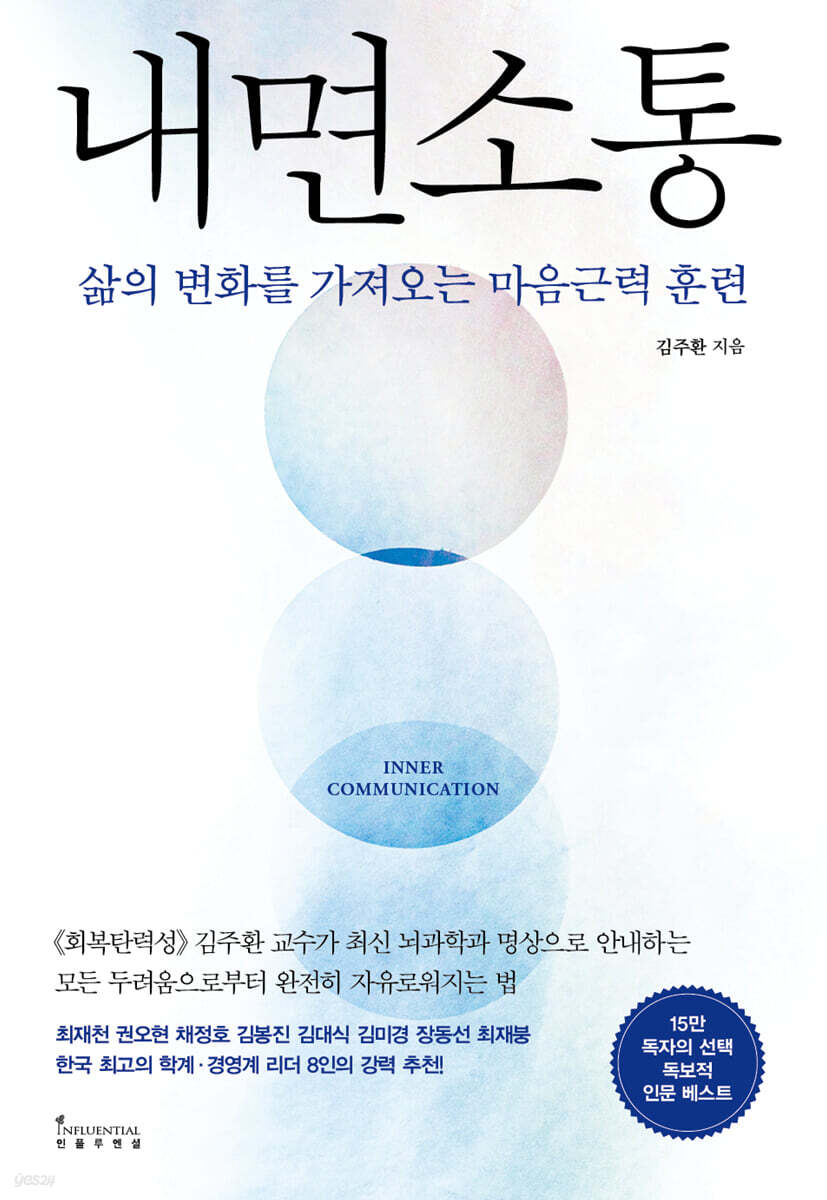
Inner communication
 |
Description
Book Introduction
- A word from MD
-
What matters is a strong mindProfessor Kim Joo-hwan of 『Resilience』 says that the mind also has muscles.
That means it can be trained and made strong.
To avoid being overcome by negative emotions like depression, lethargy, and anxiety, you must train your mind.
This book uses the latest brain science and meditation to help you maintain a healthy mind.
March 3, 2023. Humanities PD Son Min-gyu
★ Bestseller for 43 consecutive weeks
★ YouTube lectures have surpassed 36 million cumulative views.
“The power to change myself and the world is not an indomitable will,
“It comes from the mental strength to not be afraid of failure.”
Professor Kim Joo-hwan guides you through the latest brain science and meditation in “Resilience”
How to Be Completely Free from All Fear
★ Choi Jae-cheon, Kwon Oh-hyun, Chae Jeong-ho, Kim Bong-jin, Kim Dae-sik, Kim Mi-kyung, Jang Dong-seon, Choi Jae-boong
Highly recommended by 8 of Korea's top academic and business leaders!
The mind also has muscles.
Just like physical strength, mental strength also becomes stronger through systematic and repeated training.
Professor Kim Joo-hwan, who has been focusing even more deeply on mental strength research since publishing the best-selling book "Resilience," has revealed the most effective way to develop mental strength through his new book "Inner Communication."
'Inner communication' is the foundation of mental strength, and the best way to achieve proper inner communication is meditation.
To prove the effectiveness of 'inner communication meditation,' he conducted joint research with leading domestic neuroscientists and psychiatrists, and personally verified the results of the research in the field.
Currently, he lectures on inner communication meditation to psychiatrists, and also imparts meditation training to leaders and meditation instructors from all walks of life.
The author's meditation lecture, released to the public for the first time in November 2022 after years of writing, has amassed over 36 million views on YouTube in just over a year, transforming countless lives.
This is why you can trust the theory of inner communication and mental strength training method presented in this book.
Professor Choi Jae-cheon, who read the book before its publication, defined the author's meditation as "a comprehensive meditation based on cutting-edge brain science and physics."
It is not the religious and mystical meditation that is commonly thought of, but rather a meditation proven by the latest data and modern science.
This book, which entered the comprehensive bestseller list immediately after its publication, has been praised by numerous readers, such as “A must-read to live a healthy life,” “Worth reading at least three times,” and “A book like a light of the times,” and has been a bestseller for 43 consecutive weeks. It guides us, the digital humans, who have become more mentally weaker than ever, to a healthy and happy life.
The special edition, published to commemorate the book's 100,000th copy sales, includes a meditation training journal written by the author himself as an appendix.
If you practice consistently for 12 weeks, 10 minutes a day, you will experience changes in yourself, a different view of the world, and a change in your life.
★ YouTube lectures have surpassed 36 million cumulative views.
“The power to change myself and the world is not an indomitable will,
“It comes from the mental strength to not be afraid of failure.”
Professor Kim Joo-hwan guides you through the latest brain science and meditation in “Resilience”
How to Be Completely Free from All Fear
★ Choi Jae-cheon, Kwon Oh-hyun, Chae Jeong-ho, Kim Bong-jin, Kim Dae-sik, Kim Mi-kyung, Jang Dong-seon, Choi Jae-boong
Highly recommended by 8 of Korea's top academic and business leaders!
The mind also has muscles.
Just like physical strength, mental strength also becomes stronger through systematic and repeated training.
Professor Kim Joo-hwan, who has been focusing even more deeply on mental strength research since publishing the best-selling book "Resilience," has revealed the most effective way to develop mental strength through his new book "Inner Communication."
'Inner communication' is the foundation of mental strength, and the best way to achieve proper inner communication is meditation.
To prove the effectiveness of 'inner communication meditation,' he conducted joint research with leading domestic neuroscientists and psychiatrists, and personally verified the results of the research in the field.
Currently, he lectures on inner communication meditation to psychiatrists, and also imparts meditation training to leaders and meditation instructors from all walks of life.
The author's meditation lecture, released to the public for the first time in November 2022 after years of writing, has amassed over 36 million views on YouTube in just over a year, transforming countless lives.
This is why you can trust the theory of inner communication and mental strength training method presented in this book.
Professor Choi Jae-cheon, who read the book before its publication, defined the author's meditation as "a comprehensive meditation based on cutting-edge brain science and physics."
It is not the religious and mystical meditation that is commonly thought of, but rather a meditation proven by the latest data and modern science.
This book, which entered the comprehensive bestseller list immediately after its publication, has been praised by numerous readers, such as “A must-read to live a healthy life,” “Worth reading at least three times,” and “A book like a light of the times,” and has been a bestseller for 43 consecutive weeks. It guides us, the digital humans, who have become more mentally weaker than ever, to a healthy and happy life.
The special edition, published to commemorate the book's 100,000th copy sales, includes a meditation training journal written by the author himself as an appendix.
If you practice consistently for 12 weeks, 10 minutes a day, you will experience changes in yourself, a different view of the world, and a change in your life.
- You can preview some of the book's contents.
Preview
index
introduction
Chapter 1: Why Mental Strength Training is Necessary
The brain distorts the world to survive.
Modern people living with a primitive brain
Fear: How the Brain Copes with Emergencies
Why Zebras Don't Get Peptic Ulcers
The seesaw relationship between the amygdala and the prefrontal cortex
The Importance of Training to Strengthen Mental Strength
Chapter 2: The Neuroscientific Basis of the Three Mental Muscles
The Three Categories of Human Existence and the Power of the Mind
The ability to communicate with three categories is mental strength.
Self-regulation: the ability to communicate with oneself
Interpersonal skills: the ability to communicate with others
Self-motivation: The ability to communicate with the world
Neuroscientific Basis of Mental Strength
Chapter 3: Mental Strength Training
We must break free from the illusion of genetic determinism.
Environmental influences that seem almost genetic
Mental Strength Training from an Epigenetic Perspective
Neuroplasticity: The Changes That Mental Strength Training Brings
Chapter 4: That I Change Myself
Why it is possible for me to change myself
The illusion that 'I' am a single, fixed entity
Background self and inner communication
Consciousness as a continuous inner communication
Quantum mechanics insights into consciousness
The nature of consciousness and the illusions the brain creates: unity, simultaneity, continuity, embodiment, and passivity.
Chapter 5: How the Brain Works
Reasoning: How the Brain Fundamentally Works
Inductive reasoning: the logical structure of reasoning
Prediction Error and the Free Energy Principle
Markov Blanket: A Model for Active Inference Processes
Markov Blanket and Inner Communication
A New Understanding of Mental Illness and the Compensation System
The nested structure of the Markov blanket and inner communication training
Chapter 6: Inner Order and Inner Communication
Only by moving beyond a mechanistic worldview can we see inner communication.
The universe as a whole and its inherent order
Organic worldview and holistic movement
Immanent Order and Matter: The Problem of Mind Dualism
The triad of matter, meaning, and energy, and the three categories of self
Spring and Priston: Active Information and Active Reasoning
Creation order and inner communication
Chapter 7: Inner Communication and Meditation
All communication is internal communication.
The Importance of Inner Communication in Brain Development
Types and styles of inner communication
Specific examples of the power of inner communication: placebos, hypnosis, and Zen meditation.
Inner Communication Meditation as Mental Strength Training
Chapter 8: Inner Communication Meditation for Amygdala Stabilization
Fear and anger are essentially the same.
Emotions are a matter of the body, not the mind.
Emotions and pain are essentially the same.
Free from emotional dysregulation and chronic pain
Neuromuscular relaxation training to stabilize the amygdala
Inner Communication Meditation as a Training of the Inner Senses
Chapter 9: Proprioception Training and Movement Meditation
What is proprioceptive training?
Consciousness exists for movement: Emotions as fixed action patterns (FAPs)
Awake: Ready for Movement
Emotion regulation through movement meditation
Various forms of proprioceptive training
Chapter 10: Inner Communication Meditation for Prefrontal Cortex Activation
Awareness and Self-Reference Process
The Effects of Self-Reference Process Training and Meditation
Three stages of self-referential training
Six Positive Inner Communication Meditations: Forgiveness, Compassion, Love, Acceptance, Gratitude, and Respect
Chapter 11: Various Traditional Meditations for Improving Mental Strength
What is meditation practice?
Meditation techniques in the Buddhist tradition
Meditation in the Confucian Tradition: Sitting in Jeongja
Zhuangzi's meditation method
Breathing Meditation Tradition: Anapanasati
Illustration material
Americas
References
Chapter 1: Why Mental Strength Training is Necessary
The brain distorts the world to survive.
Modern people living with a primitive brain
Fear: How the Brain Copes with Emergencies
Why Zebras Don't Get Peptic Ulcers
The seesaw relationship between the amygdala and the prefrontal cortex
The Importance of Training to Strengthen Mental Strength
Chapter 2: The Neuroscientific Basis of the Three Mental Muscles
The Three Categories of Human Existence and the Power of the Mind
The ability to communicate with three categories is mental strength.
Self-regulation: the ability to communicate with oneself
Interpersonal skills: the ability to communicate with others
Self-motivation: The ability to communicate with the world
Neuroscientific Basis of Mental Strength
Chapter 3: Mental Strength Training
We must break free from the illusion of genetic determinism.
Environmental influences that seem almost genetic
Mental Strength Training from an Epigenetic Perspective
Neuroplasticity: The Changes That Mental Strength Training Brings
Chapter 4: That I Change Myself
Why it is possible for me to change myself
The illusion that 'I' am a single, fixed entity
Background self and inner communication
Consciousness as a continuous inner communication
Quantum mechanics insights into consciousness
The nature of consciousness and the illusions the brain creates: unity, simultaneity, continuity, embodiment, and passivity.
Chapter 5: How the Brain Works
Reasoning: How the Brain Fundamentally Works
Inductive reasoning: the logical structure of reasoning
Prediction Error and the Free Energy Principle
Markov Blanket: A Model for Active Inference Processes
Markov Blanket and Inner Communication
A New Understanding of Mental Illness and the Compensation System
The nested structure of the Markov blanket and inner communication training
Chapter 6: Inner Order and Inner Communication
Only by moving beyond a mechanistic worldview can we see inner communication.
The universe as a whole and its inherent order
Organic worldview and holistic movement
Immanent Order and Matter: The Problem of Mind Dualism
The triad of matter, meaning, and energy, and the three categories of self
Spring and Priston: Active Information and Active Reasoning
Creation order and inner communication
Chapter 7: Inner Communication and Meditation
All communication is internal communication.
The Importance of Inner Communication in Brain Development
Types and styles of inner communication
Specific examples of the power of inner communication: placebos, hypnosis, and Zen meditation.
Inner Communication Meditation as Mental Strength Training
Chapter 8: Inner Communication Meditation for Amygdala Stabilization
Fear and anger are essentially the same.
Emotions are a matter of the body, not the mind.
Emotions and pain are essentially the same.
Free from emotional dysregulation and chronic pain
Neuromuscular relaxation training to stabilize the amygdala
Inner Communication Meditation as a Training of the Inner Senses
Chapter 9: Proprioception Training and Movement Meditation
What is proprioceptive training?
Consciousness exists for movement: Emotions as fixed action patterns (FAPs)
Awake: Ready for Movement
Emotion regulation through movement meditation
Various forms of proprioceptive training
Chapter 10: Inner Communication Meditation for Prefrontal Cortex Activation
Awareness and Self-Reference Process
The Effects of Self-Reference Process Training and Meditation
Three stages of self-referential training
Six Positive Inner Communication Meditations: Forgiveness, Compassion, Love, Acceptance, Gratitude, and Respect
Chapter 11: Various Traditional Meditations for Improving Mental Strength
What is meditation practice?
Meditation techniques in the Buddhist tradition
Meditation in the Confucian Tradition: Sitting in Jeongja
Zhuangzi's meditation method
Breathing Meditation Tradition: Anapanasati
Illustration material
Americas
References
Detailed image

Into the book
The modern human brain reacts in the same way as a primitive man would when confronted with a wild boar when facing important moments in life, such as the college entrance exam, job interview, or project presentation.
To do well on a test or interview, you need to activate the prefrontal cortex to improve logical thinking and problem-solving skills. However, instead, the amygdala is activated, which tenses the body's muscles, increases the heart rate, makes you feel fear and dread, and reduces concentration and problem-solving skills.
We, who must live in modern society with such a primitive brain, must understand and control the basic workings of the brain to develop the ability to adapt to the environment.
This is the core goal of mental strength training.
---From "Modern People Living with a Primitive Brain" on page 38
The fact that we can improve non-cognitive abilities and achievement capabilities through mental strength training means that we can develop our own fundamental capabilities and, furthermore, proactively change our own environments.
That is, it instills the possibility that one can change the world by changing oneself.
This is a very new perspective in education.
Future education must teach that to change the world, we must first actively change ourselves, and that such change is possible.
---From “The Importance of Education for Strengthening Mental Strength” on page 61
Over the past decade, I've been conducting mental strength training for students, athletes, office workers, professionals, leaders, and executives, and I've realized one thing.
The fact is that even if you train your mental strength in the same way, the effects vary greatly from person to person.
There are many reasons for this, but the biggest reason is the difference in each person's perception of how much they can change.
The most powerful factor hindering the effectiveness of mental strength training is the fixed belief that one's ability to change is limited.
'I am originally this and that kind of person.
The fixed idea that 'it is difficult for me to change' is the biggest enemy of mental strength training.
---From "We must break free from the illusion of genetic determinism" on page 113
Changing myself means changing my habitual, automatic way of talking.
It means learning a new way of internal communication and making it a habit.
If the way and content of communication with me changes, the person I am will change.
Let me emphasize again that I am a lump of my memories, and those memories are a collection of episodic memories.
And the essence of episodic memory is my own storytelling about my experiences.
To be more precise, we only remember as 'experiences' what we can turn into 'stories' and save.
In this sense, the essence of all experiences and memories that make up 'me' is story.
So, if I change the way and content of the stories I constantly create within myself, I can change myself.
---Page 169, “Background Self and Inner Communication”
During the formation of the child's self, the loving voice that the caregiver continuously gives becomes the source of the child's self-worth.
The voice of love and care is interwoven into the child's self-consciousness as an internal order.
Children develop a habit of storytelling that says, "I am definitely valuable because I see someone caring for me and loving me like this."
This becomes the basis of the child's 'sense of self-worth'.
When the feeling of 'I am precious' becomes deeply ingrained in the child's self-consciousness, the child will have a foundation for developing strong mental strength.
---Page 357, “The Importance of Inner Communication in Brain Development”
Mental strength training is the process of repeatedly engaging in appropriate inner communication to steadily form the self you desire.
The intentional inner communication at this time is inner self-talk.
Depending on how I think about myself in my daily life, that is, depending on what kind of stories I tell myself over and over again, I can actually change who I am.
(…) Since the very existence of ‘I’ is a kind of storytelling, if I change the inner communication I have with myself, I myself will change.
What I say to myself honestly has an immediate and absolute impact.
If you truly think to yourself, "Ah! I'm strong," then you actually become strong.
Conversely, if a person says to himself, "Oh! I'm sure I'm in pain right now," he will actually feel pain.
---From "Pages 369-370, 〈Specific Cases on the Power of Inner Communication: Placebo, Hypnosis, Zen Questions and Answers〉"
The reason why neuroscientists have recently begun to pay great attention to the effects of meditation and have begun to produce numerous studies is because traditional meditation practices have systematically and well developed training elements for stabilizing the amygdala and activating the prefrontal cortex.
From a religious perspective, various meditation practices are intended to practice specific religious experiences or teachings.
However, from a neuroscientific perspective, meditation practice is a very effective training method with neuroscientific basis for strengthening mental strength.
---From "Inner Communication Meditation as Mental Strength Training" on page 381
Some people complain that they become anxious and have difficulty meditating afterward.
For people with anxiety disorders such as panic disorder or traumatic stress symptoms, simply sitting calmly and focusing on their breathing can be very difficult.
Being able to quietly look into your inner self for a while means you are already quite mentally healthy.
People with emotional dysregulation problems try to sit still and meditate.
When you do that, many negative thoughts tend to come to mind first.
Some people believe that meditation is supposed to give them some special experience.
These prejudices make meditation more difficult and challenging.
---From "Emotional Control through Movement Meditation" on page 513
There are many ways to cultivate positive inner communication with yourself and others, but some that have proven particularly effective include forgiveness, compassion, love, acceptance, gratitude, and respect.
These are all core themes of traditional meditation practice, and at the same time, teachings of saints that have been passed down for thousands of years.
They are also the research topics of the latest brain science.
Numerous neuroscience studies have reported positive effects: forgiveness, compassion, love, acceptance, gratitude, and respect activate the prefrontal cortex, increase happiness, enhance cognitive function, and strengthen the immune system.
---From page 583, “Six Positive Inner Communication Meditations: Forgiveness, Compassion, Love, Acceptance, Gratitude, Respect”
Our daily lives are always filled with noise.
The noisiest of them all is my mind.
The mind, which is the experiencing self, is constantly chattering.
It is the nature of the experiencing self to tell all kinds of stories.
An experienced self is essential to living everyday life in harmony with others.
However, if you leave everything to the experiencing self, pain, anxiety, and anger will inevitably come.
Obsession arises from the illusion that my mind, which is my experiencing self, is my real self, and fear arises from this obsession.
---From "What is Meditation Practice?" on page 630
One of the most effective ways to stabilize the amygdala through the body is through breathing.
This is because among the autonomic nervous system functions, the only one we can intentionally intervene in is breathing.
We cannot intentionally intervene in functions such as heartbeat or internal organ movement that are controlled by the autonomic nervous system.
We cannot force our heart rate to slow down to a constant rate or stop our internal organs from working for a while just because we want to.
However, while breathing is governed by the autonomic nervous system, it also allows for intentional intervention.
Breathing is the only thing.
Breathing is the only way to reach the deep unconscious within us.
This is why breathing has such a powerful ability to stabilize the amygdala and calm all kinds of negative emotions, such as anxiety and anger.
To do well on a test or interview, you need to activate the prefrontal cortex to improve logical thinking and problem-solving skills. However, instead, the amygdala is activated, which tenses the body's muscles, increases the heart rate, makes you feel fear and dread, and reduces concentration and problem-solving skills.
We, who must live in modern society with such a primitive brain, must understand and control the basic workings of the brain to develop the ability to adapt to the environment.
This is the core goal of mental strength training.
---From "Modern People Living with a Primitive Brain" on page 38
The fact that we can improve non-cognitive abilities and achievement capabilities through mental strength training means that we can develop our own fundamental capabilities and, furthermore, proactively change our own environments.
That is, it instills the possibility that one can change the world by changing oneself.
This is a very new perspective in education.
Future education must teach that to change the world, we must first actively change ourselves, and that such change is possible.
---From “The Importance of Education for Strengthening Mental Strength” on page 61
Over the past decade, I've been conducting mental strength training for students, athletes, office workers, professionals, leaders, and executives, and I've realized one thing.
The fact is that even if you train your mental strength in the same way, the effects vary greatly from person to person.
There are many reasons for this, but the biggest reason is the difference in each person's perception of how much they can change.
The most powerful factor hindering the effectiveness of mental strength training is the fixed belief that one's ability to change is limited.
'I am originally this and that kind of person.
The fixed idea that 'it is difficult for me to change' is the biggest enemy of mental strength training.
---From "We must break free from the illusion of genetic determinism" on page 113
Changing myself means changing my habitual, automatic way of talking.
It means learning a new way of internal communication and making it a habit.
If the way and content of communication with me changes, the person I am will change.
Let me emphasize again that I am a lump of my memories, and those memories are a collection of episodic memories.
And the essence of episodic memory is my own storytelling about my experiences.
To be more precise, we only remember as 'experiences' what we can turn into 'stories' and save.
In this sense, the essence of all experiences and memories that make up 'me' is story.
So, if I change the way and content of the stories I constantly create within myself, I can change myself.
---Page 169, “Background Self and Inner Communication”
During the formation of the child's self, the loving voice that the caregiver continuously gives becomes the source of the child's self-worth.
The voice of love and care is interwoven into the child's self-consciousness as an internal order.
Children develop a habit of storytelling that says, "I am definitely valuable because I see someone caring for me and loving me like this."
This becomes the basis of the child's 'sense of self-worth'.
When the feeling of 'I am precious' becomes deeply ingrained in the child's self-consciousness, the child will have a foundation for developing strong mental strength.
---Page 357, “The Importance of Inner Communication in Brain Development”
Mental strength training is the process of repeatedly engaging in appropriate inner communication to steadily form the self you desire.
The intentional inner communication at this time is inner self-talk.
Depending on how I think about myself in my daily life, that is, depending on what kind of stories I tell myself over and over again, I can actually change who I am.
(…) Since the very existence of ‘I’ is a kind of storytelling, if I change the inner communication I have with myself, I myself will change.
What I say to myself honestly has an immediate and absolute impact.
If you truly think to yourself, "Ah! I'm strong," then you actually become strong.
Conversely, if a person says to himself, "Oh! I'm sure I'm in pain right now," he will actually feel pain.
---From "Pages 369-370, 〈Specific Cases on the Power of Inner Communication: Placebo, Hypnosis, Zen Questions and Answers〉"
The reason why neuroscientists have recently begun to pay great attention to the effects of meditation and have begun to produce numerous studies is because traditional meditation practices have systematically and well developed training elements for stabilizing the amygdala and activating the prefrontal cortex.
From a religious perspective, various meditation practices are intended to practice specific religious experiences or teachings.
However, from a neuroscientific perspective, meditation practice is a very effective training method with neuroscientific basis for strengthening mental strength.
---From "Inner Communication Meditation as Mental Strength Training" on page 381
Some people complain that they become anxious and have difficulty meditating afterward.
For people with anxiety disorders such as panic disorder or traumatic stress symptoms, simply sitting calmly and focusing on their breathing can be very difficult.
Being able to quietly look into your inner self for a while means you are already quite mentally healthy.
People with emotional dysregulation problems try to sit still and meditate.
When you do that, many negative thoughts tend to come to mind first.
Some people believe that meditation is supposed to give them some special experience.
These prejudices make meditation more difficult and challenging.
---From "Emotional Control through Movement Meditation" on page 513
There are many ways to cultivate positive inner communication with yourself and others, but some that have proven particularly effective include forgiveness, compassion, love, acceptance, gratitude, and respect.
These are all core themes of traditional meditation practice, and at the same time, teachings of saints that have been passed down for thousands of years.
They are also the research topics of the latest brain science.
Numerous neuroscience studies have reported positive effects: forgiveness, compassion, love, acceptance, gratitude, and respect activate the prefrontal cortex, increase happiness, enhance cognitive function, and strengthen the immune system.
---From page 583, “Six Positive Inner Communication Meditations: Forgiveness, Compassion, Love, Acceptance, Gratitude, Respect”
Our daily lives are always filled with noise.
The noisiest of them all is my mind.
The mind, which is the experiencing self, is constantly chattering.
It is the nature of the experiencing self to tell all kinds of stories.
An experienced self is essential to living everyday life in harmony with others.
However, if you leave everything to the experiencing self, pain, anxiety, and anger will inevitably come.
Obsession arises from the illusion that my mind, which is my experiencing self, is my real self, and fear arises from this obsession.
---From "What is Meditation Practice?" on page 630
One of the most effective ways to stabilize the amygdala through the body is through breathing.
This is because among the autonomic nervous system functions, the only one we can intentionally intervene in is breathing.
We cannot intentionally intervene in functions such as heartbeat or internal organ movement that are controlled by the autonomic nervous system.
We cannot force our heart rate to slow down to a constant rate or stop our internal organs from working for a while just because we want to.
However, while breathing is governed by the autonomic nervous system, it also allows for intentional intervention.
Breathing is the only thing.
Breathing is the only way to reach the deep unconscious within us.
This is why breathing has such a powerful ability to stabilize the amygdala and calm all kinds of negative emotions, such as anxiety and anger.
---From "Page 673, 〈Breathing Meditation Tradition: Anapanasati〉"
Publisher's Review
Professor Kim Joo-hwan's best-selling book, "Resilience," is the result of over ten years of research!
We present a way to a healthy and happy life through the latest brain science and meditation!
“It’s not a formulaic meditation, but a comprehensive meditation based on cutting-edge brain science and physics.”
Choi Jae-cheon, Professor Emeritus, Department of Eco-Science, Ewha Womans University
“A valuable book that explores meditation from a scientific, rather than religious, perspective, drawing on numerous neuroscience theories!”
Kim Bong-jin | Chairman of Baedal Minjok
Professor Kim Joo-hwan (Department of Journalism and Mass Communication, Yonsei University), who first coined the term "resilience" and made it widely known, has further developed it and published "Inner Communication," which contains practical methods for improving mental strength.
After publishing 『Resilience』, he devoted himself to further research on mental strength based on brain science. In this book, he revealed that 'inner communication' is the foundation of mental strength and that the most effective way to properly achieve inner communication is meditation.
He conducted joint research with leading domestic neuroscientists and psychiatrists to prove the effectiveness of 'internal communication meditation', the most reliable training method for developing mental strength, and verified the results of the research directly in the field.
The inner communication meditation presented in this book is not the religious or mystical meditation commonly thought of.
Meditation is a mental strength training method verified by the latest data and modern science.
"Inner Communication," a book consistently developed through rigorous verification and experimentation, will serve as a guide for a healthy and happy life for us digital humans, whose mental strength has weakened more than ever.
The only way to change myself and the world: inner communication.
The most concrete and sure way to increase your ability to achieve and achieve true happiness.
Strengthening the mind is, in a word, changing myself.
The reason this is possible is because the entity called ‘I’ is not one.
The very fact that I communicate with myself, that is, that 'inner communication' occurs within me, means that there are already multiple selves within me.
Meanwhile, neuroscience and psychology have conceptualized various selves, proving that only by properly recognizing and cultivating the true self (I) can we overcome all kinds of obstacles, including anxiety, fear, and chronic pain, and achieve ultimate fulfillment and happiness.
In other words, the achievement and happiness that modern people so desire do not come from external conditions (money, status, appearance, social success, reputation, etc.), but from within.
Professor Kim Joo-hwan, a researcher in communication studies, a field within the humanities and social sciences, who has continuously studied human communication skills, stated that the foundation of mental strength lies in inner communication, and that true change can only be achieved when one recognizes one's true self through proper inner communication and shares a positive relationship with it.
Also, “If I face my inner self and change myself, the world will change too.
He emphasizes that “the world I perceive is ultimately produced as a result of the interaction between ‘me’ and ‘the environment I live in.’”
The reason the author's argument is persuasive is because all the theories in "Inner Communication," which compiles various academic fields including neuroscience, psychology, physics, and philosophy, are based on scientifically proven research results.
In particular, the author is not a theorist confined to a laboratory, but a practitioner who acts and proves. By designing experiments and proving their effectiveness in schools, sports stadiums, and business settings, he has added value not only as an academic book but also as a practical guide.
The efficacy of meditation proven through brain science
The miraculous brain changes brought about by mental strength training
Everyone in modern times knows the importance of exercise.
Especially for us digital humans who do everything through our phones or computer monitors from morning until we go to bed, we make time to exercise, or at least always have the thought that we should exercise.
But that's not the case with meditation.
The reason why the effectiveness of meditation or mental strength training is not recognized may be because of the religious and mystical feeling that the word meditation itself gives.
Starting with Silicon Valley, mental strength training through meditation has already been systematized in educational settings in Western countries. However, in Korea, the percentage of people who consistently meditate in their daily lives, as if exercising, is still remarkably low.
The inner communication meditations introduced in this book are ones that anyone can easily practice in their daily lives, regardless of religion or mysticism.
Over the past decade, the author has dedicated considerable effort to proving the principles and effectiveness of meditation in strengthening the mind. As a result, he has detailed a variety of training programs whose effectiveness has been scientifically proven.
After personally experiencing numerous traditional meditations, he thoroughly examined their effects from a neuroscientific perspective and presented a training method that even the general public can easily practice.
To this end, we first explain the basic workings of the brain as proven by the latest brain science, and then provide a detailed and specific explanation of meditation techniques that stabilize the amygdala, which amplifies negative emotions, and activate the prefrontal cortex, which expands mental strength.
Practicing the "inner communication meditation" suggested by the author can free you from anxiety and fear, improve immune and cardiovascular functions, and delay the aging of your body and brain.
Furthermore, by increasing your achievement and performance capabilities, you can do better in anything, including studying, sports, business, research, and creative activities.
A guide that overturns common sense and stereotypes and leads you to a new world.
Why the saying "People don't change" is wrong
The author, who has been teaching mental strength training to a small number of people, including psychiatrists, executives and employees of some large corporations, and meditation instructors, gave a YouTube lecture in November 2022 on the topic of inner communication meditation, which he personally designed and programmed.
Those who participated in this lecture, which has surpassed 3 million cumulative views, responded enthusiastically, saying things like, “Just being able to watch a lecture like this is a blessing in this day and age,” “My life changed after listening to this lecture,” “I was able to raise my self-esteem for the first time in 40 years,” “A lecture worth tens of millions of won,” “If only I had learned this in school,” and “This is the most valuable information I’ve seen in a video on YouTube.” They also expressed that their daily lives actually changed and that they realized potential they hadn’t even realized.
This proves that the countless books on brain science and meditation books titled “mindfulness” that have been published so far have only established themselves as superficial concepts and have not brought about any significant change in the lives of ordinary people.
To add value to this book as a useful tool for changing real lives, the author personally filmed and produced various meditation techniques and included QR codes with the photos so that readers can practice them themselves.
The numerous training methods he introduces in his videos are different from the commonly known meditation methods of 'sitting still and putting your thoughts to sleep'.
Professor Kim Joo-hwan says that all meditation is essentially 'movement meditation', paying attention to the movement of the body and mind.
Rather, it means that you need to actively use your body.
The author argues that only when we recognize our present self by recognizing even the smallest movements and becoming aware of our essential self can we achieve true inner communication, and through this, we can gain the best mental strength.
You can't change your innate intelligence, but if you consistently practice inner communication training to build mental strength, just like brushing your teeth, you will discover that you are different from yesterday and have transformed into the person you want to be.
We present a way to a healthy and happy life through the latest brain science and meditation!
“It’s not a formulaic meditation, but a comprehensive meditation based on cutting-edge brain science and physics.”
Choi Jae-cheon, Professor Emeritus, Department of Eco-Science, Ewha Womans University
“A valuable book that explores meditation from a scientific, rather than religious, perspective, drawing on numerous neuroscience theories!”
Kim Bong-jin | Chairman of Baedal Minjok
Professor Kim Joo-hwan (Department of Journalism and Mass Communication, Yonsei University), who first coined the term "resilience" and made it widely known, has further developed it and published "Inner Communication," which contains practical methods for improving mental strength.
After publishing 『Resilience』, he devoted himself to further research on mental strength based on brain science. In this book, he revealed that 'inner communication' is the foundation of mental strength and that the most effective way to properly achieve inner communication is meditation.
He conducted joint research with leading domestic neuroscientists and psychiatrists to prove the effectiveness of 'internal communication meditation', the most reliable training method for developing mental strength, and verified the results of the research directly in the field.
The inner communication meditation presented in this book is not the religious or mystical meditation commonly thought of.
Meditation is a mental strength training method verified by the latest data and modern science.
"Inner Communication," a book consistently developed through rigorous verification and experimentation, will serve as a guide for a healthy and happy life for us digital humans, whose mental strength has weakened more than ever.
The only way to change myself and the world: inner communication.
The most concrete and sure way to increase your ability to achieve and achieve true happiness.
Strengthening the mind is, in a word, changing myself.
The reason this is possible is because the entity called ‘I’ is not one.
The very fact that I communicate with myself, that is, that 'inner communication' occurs within me, means that there are already multiple selves within me.
Meanwhile, neuroscience and psychology have conceptualized various selves, proving that only by properly recognizing and cultivating the true self (I) can we overcome all kinds of obstacles, including anxiety, fear, and chronic pain, and achieve ultimate fulfillment and happiness.
In other words, the achievement and happiness that modern people so desire do not come from external conditions (money, status, appearance, social success, reputation, etc.), but from within.
Professor Kim Joo-hwan, a researcher in communication studies, a field within the humanities and social sciences, who has continuously studied human communication skills, stated that the foundation of mental strength lies in inner communication, and that true change can only be achieved when one recognizes one's true self through proper inner communication and shares a positive relationship with it.
Also, “If I face my inner self and change myself, the world will change too.
He emphasizes that “the world I perceive is ultimately produced as a result of the interaction between ‘me’ and ‘the environment I live in.’”
The reason the author's argument is persuasive is because all the theories in "Inner Communication," which compiles various academic fields including neuroscience, psychology, physics, and philosophy, are based on scientifically proven research results.
In particular, the author is not a theorist confined to a laboratory, but a practitioner who acts and proves. By designing experiments and proving their effectiveness in schools, sports stadiums, and business settings, he has added value not only as an academic book but also as a practical guide.
The efficacy of meditation proven through brain science
The miraculous brain changes brought about by mental strength training
Everyone in modern times knows the importance of exercise.
Especially for us digital humans who do everything through our phones or computer monitors from morning until we go to bed, we make time to exercise, or at least always have the thought that we should exercise.
But that's not the case with meditation.
The reason why the effectiveness of meditation or mental strength training is not recognized may be because of the religious and mystical feeling that the word meditation itself gives.
Starting with Silicon Valley, mental strength training through meditation has already been systematized in educational settings in Western countries. However, in Korea, the percentage of people who consistently meditate in their daily lives, as if exercising, is still remarkably low.
The inner communication meditations introduced in this book are ones that anyone can easily practice in their daily lives, regardless of religion or mysticism.
Over the past decade, the author has dedicated considerable effort to proving the principles and effectiveness of meditation in strengthening the mind. As a result, he has detailed a variety of training programs whose effectiveness has been scientifically proven.
After personally experiencing numerous traditional meditations, he thoroughly examined their effects from a neuroscientific perspective and presented a training method that even the general public can easily practice.
To this end, we first explain the basic workings of the brain as proven by the latest brain science, and then provide a detailed and specific explanation of meditation techniques that stabilize the amygdala, which amplifies negative emotions, and activate the prefrontal cortex, which expands mental strength.
Practicing the "inner communication meditation" suggested by the author can free you from anxiety and fear, improve immune and cardiovascular functions, and delay the aging of your body and brain.
Furthermore, by increasing your achievement and performance capabilities, you can do better in anything, including studying, sports, business, research, and creative activities.
A guide that overturns common sense and stereotypes and leads you to a new world.
Why the saying "People don't change" is wrong
The author, who has been teaching mental strength training to a small number of people, including psychiatrists, executives and employees of some large corporations, and meditation instructors, gave a YouTube lecture in November 2022 on the topic of inner communication meditation, which he personally designed and programmed.
Those who participated in this lecture, which has surpassed 3 million cumulative views, responded enthusiastically, saying things like, “Just being able to watch a lecture like this is a blessing in this day and age,” “My life changed after listening to this lecture,” “I was able to raise my self-esteem for the first time in 40 years,” “A lecture worth tens of millions of won,” “If only I had learned this in school,” and “This is the most valuable information I’ve seen in a video on YouTube.” They also expressed that their daily lives actually changed and that they realized potential they hadn’t even realized.
This proves that the countless books on brain science and meditation books titled “mindfulness” that have been published so far have only established themselves as superficial concepts and have not brought about any significant change in the lives of ordinary people.
To add value to this book as a useful tool for changing real lives, the author personally filmed and produced various meditation techniques and included QR codes with the photos so that readers can practice them themselves.
The numerous training methods he introduces in his videos are different from the commonly known meditation methods of 'sitting still and putting your thoughts to sleep'.
Professor Kim Joo-hwan says that all meditation is essentially 'movement meditation', paying attention to the movement of the body and mind.
Rather, it means that you need to actively use your body.
The author argues that only when we recognize our present self by recognizing even the smallest movements and becoming aware of our essential self can we achieve true inner communication, and through this, we can gain the best mental strength.
You can't change your innate intelligence, but if you consistently practice inner communication training to build mental strength, just like brushing your teeth, you will discover that you are different from yesterday and have transformed into the person you want to be.
GOODS SPECIFICS
- Date of issue: February 27, 2023
- Page count, weight, size: 763 pages | 1,212g | 162*235*37mm
- ISBN13: 9791168340855
- ISBN10: 1168340853
You may also like
카테고리
korean


korean

![GQ KOREA Mark (Monthly): December [2025]](http://librairie.coreenne.fr/cdn/shop/files/8ef265dbbfbf186523ed75ba7319009d.jpg?v=1765340328&width=3840)


