

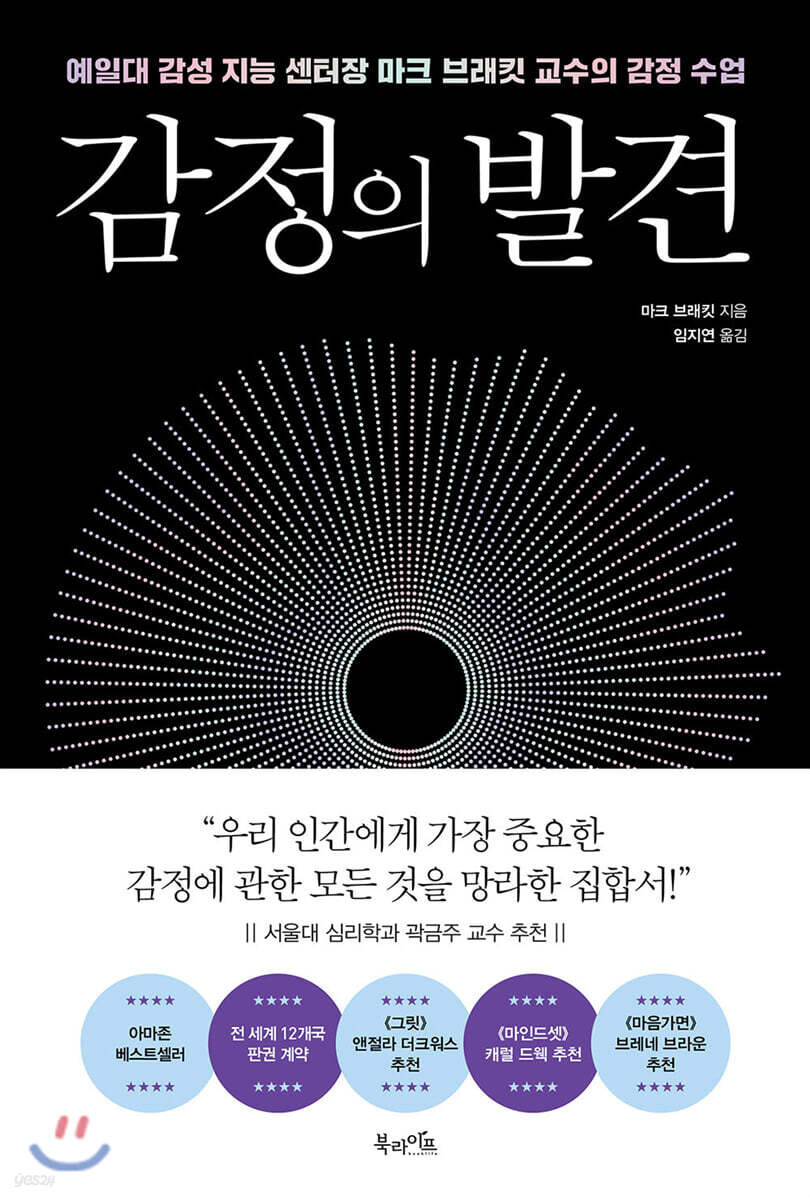
Discovery of Emotions
 |
Description
Book Introduction
- A word from MD
-
How are you feeling today? All about emotionsThe first book by the director of the Yale Center for Emotional Intelligence, who has been researching emotions for over 20 years, has been published.
In a time when words like depression and anger management are commonplace, we need to learn to manage our emotions for ourselves and those around us.
Let's stop pretending not to know, stop denying, and start 'studying' my precious feelings.
September 1, 2020. Self-Development PD Park Jeong-yoon
The one question that can change your life: “How are you feeling right now?”
In this age of chaos, the art of expressing emotions that will help you manage your unstable emotions and bring happiness and success!
The mental health of modern people today is at a serious level.
In an increasingly harsh reality, coupled with the spread of COVID-19 in 2020, the number of people complaining of severe depression and pain is increasing.
Words like 'anxiety disorder' and 'intermittent explosive disorder' are used in everyday speech, and related crimes are not uncommon in the news.
The lack of empathy and other acts of violence against the socially vulnerable are becoming a global problem.
The belief that subjective emotions can be suppressed and controlled by the power of objective reason no longer holds true.
Emotions are a natural part of human nature and something we must accept, understand, and regulate as they are.
Based on this perspective, Professor Mark Brackett, director of the Yale Center for Emotional Intelligence, who has been researching emotions and emotional intelligence for over 20 years, says this in his first book, “Discovering Emotions.”
“We are now facing a huge crisis.
And the biggest victims may be our children.”
In this book, the author candidly confesses to having suffered severe bullying and sexual abuse as a child.
He says that if his 'savior', Uncle Marvin, had not asked him, "Mark, how are you feeling?" and had not listened with 'empathy' and 'listening' to what he was feeling, his life might have been terrible.
He says that because someone truly listened to his honest story, he was able to accept, express, and manage his emotions as they are, and that he himself is a living proof of how important 'emotional training' is.
In this age of chaos, the art of expressing emotions that will help you manage your unstable emotions and bring happiness and success!
The mental health of modern people today is at a serious level.
In an increasingly harsh reality, coupled with the spread of COVID-19 in 2020, the number of people complaining of severe depression and pain is increasing.
Words like 'anxiety disorder' and 'intermittent explosive disorder' are used in everyday speech, and related crimes are not uncommon in the news.
The lack of empathy and other acts of violence against the socially vulnerable are becoming a global problem.
The belief that subjective emotions can be suppressed and controlled by the power of objective reason no longer holds true.
Emotions are a natural part of human nature and something we must accept, understand, and regulate as they are.
Based on this perspective, Professor Mark Brackett, director of the Yale Center for Emotional Intelligence, who has been researching emotions and emotional intelligence for over 20 years, says this in his first book, “Discovering Emotions.”
“We are now facing a huge crisis.
And the biggest victims may be our children.”
In this book, the author candidly confesses to having suffered severe bullying and sexual abuse as a child.
He says that if his 'savior', Uncle Marvin, had not asked him, "Mark, how are you feeling?" and had not listened with 'empathy' and 'listening' to what he was feeling, his life might have been terrible.
He says that because someone truly listened to his honest story, he was able to accept, express, and manage his emotions as they are, and that he himself is a living proof of how important 'emotional training' is.
- You can preview some of the book's contents.
Preview
index
Introduction | Why We Try to Hide Our Emotions
Part 1: We have the freedom to express our emotions.
Chapter 1: Expressing Your Feelings
Emotions Should Neither Be Ignored nor Suppressed | Evidence That We're Not Good at Managing Our Emotions | We All Need to Learn How to Manage Our Emotions | Why We Need to Share the Importance of Emotional Intelligence
Chapter 2: Emotions are Information
What is emotional intelligence? | Why are emotions necessary? | The correlation between emotions and learning ability | The correlation between emotions and decision-making | The correlation between emotions and relationships | The correlation between emotions and health | The correlation between emotions and creativity
Chapter 3: How to Become an Emotion Scientist
We are more influenced by our emotions than we think | Anyone can learn about emotions and improve their emotional intelligence | Five components of emotional competence | Emotional intelligence is as important as IQ in our lives | People with high emotional intelligence achieve superior results | The essential ingredient for success comes from emotional intelligence
Part 2: Five Skills for Dealing with Emotions
Chapter 4 Recognizing Emotions
Why it's so hard to express your "true" emotions | Mood Meters: Tools to Recognize and Measure Emotions | Our Emotions Are Constantly Misunderstood | Can We Really Detect Others' Emotions Based on Facial Expressions | The Countless Biases That Come into Play in the Process of Recognizing and Interpreting Emotions
Chapter 5: Understanding Emotions
What lies beneath our emotions? | To understand emotions, we must constantly ask questions. | Relentlessly ask about the causes of our emotions and listen truthfully to the answers. | Reading the signals our actions send reveals the meaning of our emotions.
Chapter 6: Naming Emotions
Saying "It's okay" means you're afraid to express your feelings | Labeling your emotions accurately can help you cope better | Don't lump your feelings together as "stress" when you're feeling difficult or distressed | The magical transformation that happens when you understand and name your emotions
Chapter 7: Expressing Emotions
Silence about emotions leads to endless repetition of pain | We all live with the lie that we are happy | You cannot have good relationships if you do not express your emotions | Can we reconcile the desire to hide and the desire to express emotions? | Both one-sided emotional outbursts and repressive emotional labor are harmful | The key to expressing emotions is unbiased 'listening' | The numerous social rules that hinder the expression of emotions, such as those of gender, race, and class | The difference in the freedom of emotional expression enjoyed by A and B is worlds apart | Expressing emotions also makes you healthier
Chapter 8: Regulating Emotions
Emotion regulation: the easiest yet most difficult skill | Emotions influence each other, so they must be managed "cooperatively." Emotion regulation is the act of allowing oneself to feel any emotion freely. A healthy body leads to healthy emotions.
Part 3: Applying Emotional Skills to Attract Happiness and Success
Chapter 9 Emotions at Home
When parents skillfully manage their emotions, children will naturally learn to follow suit | Don't run away to your cell phone to ignore your child's emotions | Think about the kind of family we grew up in | If parents can control their emotions, children can control their emotions too | Imagine your ideal 'best self' | Children constantly observe their parents | Create a 'charter' of what emotions you want them to feel at home | Why parents must first learn emotion regulation skills | When someone attacks me psychologically, I need a defense tool called emotional intelligence
Chapter 10: Emotions in School: From Kindergarten to College
To develop children's emotional abilities, schools and teachers must change | Learning becomes more effective when teachers and students develop emotionally close relationships | Emotional ability education is essential for growing into emotional scientists and caring citizens | Emotional ability helped me overcome severe bullying and loneliness | For children's emotional abilities to develop, the entire village, including adults, must learn together | Emotional education curriculum for everyone to build positive relationships | The competitive edge that today's college students need is socio-emotional ability | I gained peace of mind thanks to the emotional education program | Unleashing the wisdom of emotions can help raise healthy children.
Chapter 11 Emotions at Work
Today, emotional intelligence is especially crucial for business performance | Leaders must understand the role of emotions in organizations | Is there a correlation between lack of emotional intelligence and business failure? | Excessive work immersion and burnout syndrome always go hand in hand | What makes a truly great leader is emotional intelligence | Bad bosses have low emotional intelligence, while good bosses have high emotional intelligence | If your boss ignores your emotions, leave the company without looking back | The best employees are attracted to companies that recognize the power of emotions.
Conclusion | Let's Create an Emotional Revolution
Acknowledgements
References
Part 1: We have the freedom to express our emotions.
Chapter 1: Expressing Your Feelings
Emotions Should Neither Be Ignored nor Suppressed | Evidence That We're Not Good at Managing Our Emotions | We All Need to Learn How to Manage Our Emotions | Why We Need to Share the Importance of Emotional Intelligence
Chapter 2: Emotions are Information
What is emotional intelligence? | Why are emotions necessary? | The correlation between emotions and learning ability | The correlation between emotions and decision-making | The correlation between emotions and relationships | The correlation between emotions and health | The correlation between emotions and creativity
Chapter 3: How to Become an Emotion Scientist
We are more influenced by our emotions than we think | Anyone can learn about emotions and improve their emotional intelligence | Five components of emotional competence | Emotional intelligence is as important as IQ in our lives | People with high emotional intelligence achieve superior results | The essential ingredient for success comes from emotional intelligence
Part 2: Five Skills for Dealing with Emotions
Chapter 4 Recognizing Emotions
Why it's so hard to express your "true" emotions | Mood Meters: Tools to Recognize and Measure Emotions | Our Emotions Are Constantly Misunderstood | Can We Really Detect Others' Emotions Based on Facial Expressions | The Countless Biases That Come into Play in the Process of Recognizing and Interpreting Emotions
Chapter 5: Understanding Emotions
What lies beneath our emotions? | To understand emotions, we must constantly ask questions. | Relentlessly ask about the causes of our emotions and listen truthfully to the answers. | Reading the signals our actions send reveals the meaning of our emotions.
Chapter 6: Naming Emotions
Saying "It's okay" means you're afraid to express your feelings | Labeling your emotions accurately can help you cope better | Don't lump your feelings together as "stress" when you're feeling difficult or distressed | The magical transformation that happens when you understand and name your emotions
Chapter 7: Expressing Emotions
Silence about emotions leads to endless repetition of pain | We all live with the lie that we are happy | You cannot have good relationships if you do not express your emotions | Can we reconcile the desire to hide and the desire to express emotions? | Both one-sided emotional outbursts and repressive emotional labor are harmful | The key to expressing emotions is unbiased 'listening' | The numerous social rules that hinder the expression of emotions, such as those of gender, race, and class | The difference in the freedom of emotional expression enjoyed by A and B is worlds apart | Expressing emotions also makes you healthier
Chapter 8: Regulating Emotions
Emotion regulation: the easiest yet most difficult skill | Emotions influence each other, so they must be managed "cooperatively." Emotion regulation is the act of allowing oneself to feel any emotion freely. A healthy body leads to healthy emotions.
Part 3: Applying Emotional Skills to Attract Happiness and Success
Chapter 9 Emotions at Home
When parents skillfully manage their emotions, children will naturally learn to follow suit | Don't run away to your cell phone to ignore your child's emotions | Think about the kind of family we grew up in | If parents can control their emotions, children can control their emotions too | Imagine your ideal 'best self' | Children constantly observe their parents | Create a 'charter' of what emotions you want them to feel at home | Why parents must first learn emotion regulation skills | When someone attacks me psychologically, I need a defense tool called emotional intelligence
Chapter 10: Emotions in School: From Kindergarten to College
To develop children's emotional abilities, schools and teachers must change | Learning becomes more effective when teachers and students develop emotionally close relationships | Emotional ability education is essential for growing into emotional scientists and caring citizens | Emotional ability helped me overcome severe bullying and loneliness | For children's emotional abilities to develop, the entire village, including adults, must learn together | Emotional education curriculum for everyone to build positive relationships | The competitive edge that today's college students need is socio-emotional ability | I gained peace of mind thanks to the emotional education program | Unleashing the wisdom of emotions can help raise healthy children.
Chapter 11 Emotions at Work
Today, emotional intelligence is especially crucial for business performance | Leaders must understand the role of emotions in organizations | Is there a correlation between lack of emotional intelligence and business failure? | Excessive work immersion and burnout syndrome always go hand in hand | What makes a truly great leader is emotional intelligence | Bad bosses have low emotional intelligence, while good bosses have high emotional intelligence | If your boss ignores your emotions, leave the company without looking back | The best employees are attracted to companies that recognize the power of emotions.
Conclusion | Let's Create an Emotional Revolution
Acknowledgements
References
Into the book
Looking at our society today, it seems like we're spending more money and effort on dealing with the consequences of emotional problems than on preventing them.
I am personally interested in the negative consequences that occur when we suppress our emotions.
I too had similar issues, but I was able to recover thanks to the people who cared for me.
(……) Only a very small number of people with innate insight can handle emotions in the way presented in this book without separate learning.
I, who couldn't do that, had to work hard to learn.
This is literally a 'technology'.
Whether you're extroverted or introverted, romantic or practical, sensitive or easygoing, you can use the same techniques regardless of your personality type, and they can even change your life.
This technique has been proven to be simple, clear, and applicable to almost all age groups.
--- p.9~10, from the preface
If a generation of children could grow into emotionally capable adults, it would change the entire culture and create a better society.
However, learning emotional skills and improving how you respond to emotions won't lead to a happy everyday life overnight.
Eternal happiness is not a goal we pursue, nor is it achievable.
What we need is the ability to live better lives, make wise decisions, form meaningful relationships, and realize our potential.
To develop this ability, you must be able to experience and express all emotions, both pleasant and unpleasant, at will.
--- p.36, from “Chapter 1: Expressing Emotions”
Some people see talking about emotional intelligence or skills for managing emotions as being too vague and sentimental, or just escapism.
This is especially true from the perspective of the business world.
But the truth is quite the opposite.
Emotional intelligence leads to wise and creative thinking, helping you and those around you achieve better results.
There is no sentimentality at all.
Rather than letting emotions get in the way of your work, they actually do the opposite.
Emotional intelligence supports balanced thinking, prevents emotions from undue influence on behavior, and helps us recognize that there are reasons why we feel a certain way.
--- p.84, from “Chapter 3: How to Become an Emotional Scientist”
As you strive to become an emotional scientist, you must avoid the temptation to play the role of emotional judge.
Both emotion scientists and judges seek to recognize emotions and their sources and to predict how emotions will influence thoughts and behavior.
But emotional scientists don't make value judgments.
It doesn't even offer an opinion on whether any emotion is right, beneficial, or reflects objective reality.
He has only curiosity and a desire to listen and learn.
Emotional judges seek something else.
He evaluates his feelings (even his own, even though we are not immune to harsh self-judgment)—whether they are right or wrong, beneficial or harmful, realistic or imaginary.
Emotional judges seek the power to acknowledge or deny emotions, that is, the power to pass judgment.
--- p.94, from “Chapter 3: How to Become an Emotional Scientist”
The starting point of all this drama is just one word.
"Why?" Why do I feel this way? Why now? Understanding emotions begins with answering such questions.
Why do I feel this way? What's the underlying reason for this emotion? What makes me feel this way? These are not simple questions at all.
This is because one emotion can trigger another, and events and memories are intricately intertwined.
Usually, asking one question leads to more questions and allows you to dig deeper.
It's like peeling an onion.
It's natural to be afraid because once you start asking questions, there's no turning back.
Understanding emotions is like a journey.
It could be an adventure.
By the end of your journey, you will have arrived in a new and unexpected place, somewhere you never thought you would go.
And we will be wiser than before, no, wiser than we wish.
There is no other way to move forward.
--- p.131~132, from “Chapter 5 Understanding Emotions”
Looking back, I realize that at the heart of all the trauma I experienced as a child was the feeling that I couldn't express my emotions.
If I had confided in my parents the terrible fear, anxiety, and shame I was feeling, they would have discovered the source of those destructive emotions.
I endured sexual abuse without telling anyone and was bullied at school every day.
I wasn't just hiding my feelings.
Even the cause that caused such feelings was hidden.
Today, stories are often told of people—women, men, and children—who have suffered sexual abuse or harassment but have refused to speak out or identify their perpetrators.
It's obvious why they did that.
This is because many people believe that if they speak out about such things, they will feel shame or guilt, making it even more difficult to endure.
Sometimes people are reluctant to come forward because they feel no one will believe them or because they fear that the abuser will retaliate.
But if you can't express these feelings, the pain will continue unabated.
Silence is as damaging as assault.
--- p.179, from “Chapter 7 Expressing Emotions”
Allowing ourselves to express our emotions doesn't mean obsessing over every moment someone treats us badly or ignores us.
In fact, the opposite is true.
It's about overcoming those moments, learning from those experiences, and developing the strength to continue living a normal life.
Emotional intelligence provides a defense against anger, bullying, isolation, anxiety, and fear, which are especially prevalent among young people.
It also removes persistent obstacles that hinder creativity, interpersonal relationships, decision-making, and health.
--- p.247, from “Chapter 9 Emotions at Home”
Today's best employees will be drawn to companies that recognize the power of emotions to create a positive and productive environment.
They will leave their bad jobs behind, leaving behind miserable colleagues who are unwilling or unable to find another job for whatever reason.
Taking this into account, companies must take the cultivation of emotional capabilities seriously.
I am personally interested in the negative consequences that occur when we suppress our emotions.
I too had similar issues, but I was able to recover thanks to the people who cared for me.
(……) Only a very small number of people with innate insight can handle emotions in the way presented in this book without separate learning.
I, who couldn't do that, had to work hard to learn.
This is literally a 'technology'.
Whether you're extroverted or introverted, romantic or practical, sensitive or easygoing, you can use the same techniques regardless of your personality type, and they can even change your life.
This technique has been proven to be simple, clear, and applicable to almost all age groups.
--- p.9~10, from the preface
If a generation of children could grow into emotionally capable adults, it would change the entire culture and create a better society.
However, learning emotional skills and improving how you respond to emotions won't lead to a happy everyday life overnight.
Eternal happiness is not a goal we pursue, nor is it achievable.
What we need is the ability to live better lives, make wise decisions, form meaningful relationships, and realize our potential.
To develop this ability, you must be able to experience and express all emotions, both pleasant and unpleasant, at will.
--- p.36, from “Chapter 1: Expressing Emotions”
Some people see talking about emotional intelligence or skills for managing emotions as being too vague and sentimental, or just escapism.
This is especially true from the perspective of the business world.
But the truth is quite the opposite.
Emotional intelligence leads to wise and creative thinking, helping you and those around you achieve better results.
There is no sentimentality at all.
Rather than letting emotions get in the way of your work, they actually do the opposite.
Emotional intelligence supports balanced thinking, prevents emotions from undue influence on behavior, and helps us recognize that there are reasons why we feel a certain way.
--- p.84, from “Chapter 3: How to Become an Emotional Scientist”
As you strive to become an emotional scientist, you must avoid the temptation to play the role of emotional judge.
Both emotion scientists and judges seek to recognize emotions and their sources and to predict how emotions will influence thoughts and behavior.
But emotional scientists don't make value judgments.
It doesn't even offer an opinion on whether any emotion is right, beneficial, or reflects objective reality.
He has only curiosity and a desire to listen and learn.
Emotional judges seek something else.
He evaluates his feelings (even his own, even though we are not immune to harsh self-judgment)—whether they are right or wrong, beneficial or harmful, realistic or imaginary.
Emotional judges seek the power to acknowledge or deny emotions, that is, the power to pass judgment.
--- p.94, from “Chapter 3: How to Become an Emotional Scientist”
The starting point of all this drama is just one word.
"Why?" Why do I feel this way? Why now? Understanding emotions begins with answering such questions.
Why do I feel this way? What's the underlying reason for this emotion? What makes me feel this way? These are not simple questions at all.
This is because one emotion can trigger another, and events and memories are intricately intertwined.
Usually, asking one question leads to more questions and allows you to dig deeper.
It's like peeling an onion.
It's natural to be afraid because once you start asking questions, there's no turning back.
Understanding emotions is like a journey.
It could be an adventure.
By the end of your journey, you will have arrived in a new and unexpected place, somewhere you never thought you would go.
And we will be wiser than before, no, wiser than we wish.
There is no other way to move forward.
--- p.131~132, from “Chapter 5 Understanding Emotions”
Looking back, I realize that at the heart of all the trauma I experienced as a child was the feeling that I couldn't express my emotions.
If I had confided in my parents the terrible fear, anxiety, and shame I was feeling, they would have discovered the source of those destructive emotions.
I endured sexual abuse without telling anyone and was bullied at school every day.
I wasn't just hiding my feelings.
Even the cause that caused such feelings was hidden.
Today, stories are often told of people—women, men, and children—who have suffered sexual abuse or harassment but have refused to speak out or identify their perpetrators.
It's obvious why they did that.
This is because many people believe that if they speak out about such things, they will feel shame or guilt, making it even more difficult to endure.
Sometimes people are reluctant to come forward because they feel no one will believe them or because they fear that the abuser will retaliate.
But if you can't express these feelings, the pain will continue unabated.
Silence is as damaging as assault.
--- p.179, from “Chapter 7 Expressing Emotions”
Allowing ourselves to express our emotions doesn't mean obsessing over every moment someone treats us badly or ignores us.
In fact, the opposite is true.
It's about overcoming those moments, learning from those experiences, and developing the strength to continue living a normal life.
Emotional intelligence provides a defense against anger, bullying, isolation, anxiety, and fear, which are especially prevalent among young people.
It also removes persistent obstacles that hinder creativity, interpersonal relationships, decision-making, and health.
--- p.247, from “Chapter 9 Emotions at Home”
Today's best employees will be drawn to companies that recognize the power of emotions to create a positive and productive environment.
They will leave their bad jobs behind, leaving behind miserable colleagues who are unwilling or unable to find another job for whatever reason.
Taking this into account, companies must take the cultivation of emotional capabilities seriously.
--- p.347, from “Chapter 11 Emotions at Work”
Publisher's Review
Stop pretending you're okay, you're fine, you're happy!
The power of emotional science to transform emotional intelligence into a driving force for happiness and success.
Professor Mark Brackett, who calls himself an "emotion scientist," argues that we have been too busy hiding our emotions and that we need to use them wisely to be successful and happy.
It's not wrong to feel negative emotions like fear, alienation, or anger.
It is also a mistake to think that our daily lives must be filled with positive emotions like joy, cheerfulness, and liveliness.
What is important is the process of recognizing (Recognizing), accurately understanding (Understanding), and giving specific names (Labeling) to the complex and diverse emotions we feel.
Furthermore, we need to be able to honestly express such emotions and regulate them in a healthy way to create relationships and a society where people communicate in a desirable way.
The author's five techniques for dealing with emotions, known as the RULER technique, are the most influential and effective approach to dealing with emotions.
The three steps of recognizing emotions, understanding emotions, and naming emotions are the 'thinking skills' we use to recognize emotions.
As an aid to better learning and using this technique, the author suggests using the Mood Meter.
The Mood Meter is a graph that compiles the various emotions humans experience, and it greatly helps us to accurately segment and recognize our moods. (The Mood Meter is included as an insert in the book.) The next step, expressing and regulating emotions, is the "behavioral skills" that we use to express and manage our emotions in real life.
Regulating emotions is particularly difficult, and the author recommends constant practice and experimentation through specific strategies such as mindful breathing, perspective-taking, distraction, cognitive restructuring, and meta-moments.
You need to give yourself permission to express your emotions freely, while also giving yourself room to fail.
After you fail, you can try again.
Take a deep breath or two, recall your best self, and start again from the beginning.
In such moments, we need the courage to forgive ourselves as we would forgive others.
Courage also means seeking professional help when all else has failed.
(_p.239, from 'Chapter 8: Controlling Emotions')
Happy, sad, upset…
Our existence is too complex to be expressed in just three words.
It's a miracle that my life changed just by noticing my feelings properly!
Why do we need emotional skills education and training programs at home and in schools? Uncle Marvin, who saved Professor Mark Brackett's life as a child, realized something important during his 20 years as a middle school teacher in New York.
The curriculum for children to succeed was missing the ability to accept and use emotions wisely.
If all children grow up with emotional intelligence, they will naturally become better adults, able to live happy lives on their own, and contribute to creating a healthier world.
The author, who has focused on this area, is a professor at the Yale University Child Study Center and is working to establish an emotional intelligence center within the university to widely disseminate the RULER technique.
The RULER technique has been implemented in over 2,000 schools across the United States and around the world, and has shown results in reduced stress and burnout, improved school climate, and improved academic achievement.
Below are some reactions from students who actually experienced the emotional training workshop.
“I’ve found that showing my vulnerable side is a great opportunity to build deeper relationships, including friendships.
I also learned that sometimes you have to be as gentle with yourself as you are with others, and that you have to understand yourself as you understand others.”
“Calmness, tranquility, focus, and overall happiness are all within my reach.
“All you have to do is internalize the wisdom you gain from this workshop.” (p. 316, from Chapter 10, Emotions at School)
Many jobs today require advanced communication skills, making emotional intelligence especially important.
Ironically, however, as online connectivity intensifies, modern life is also burdened with all sorts of emotional labor and entirely new kinds of suffering.
If you want to solve this problem, you need to pay more attention to your own emotions and the emotions of others.
Acknowledging each other's weaknesses and being more open to expressing emotions is a way to improve the company atmosphere and attract top talent.
Jack Welch, the legendary management guru of General Electric, said this:
“People with emotional intelligence are much rarer than people with good grades in school, but in my experience, it’s what actually makes great leaders.
“You should never ignore it.” (p.337, from Chapter 11, Emotions at Work)
This book is the culmination of research on emotions, and is a result of sharing with readers around the world how to deal with and manage emotions.
The author addresses the countless people who constantly experience difficulties, big and small, due to emotional issues, urging them to break this vicious cycle and deal with emotional issues wisely and intelligently.
Regarding the harsh reality brought on by COVID-19, the author said the following in a recent interview with Publisher's Weekly:
“It’s a crazy and absurd situation, but we have to learn to live with these conditions.
Whether face-to-face or online, human relationships are human relationships.
Whether students are taking online classes at home or in a school classroom, they feel emotions.
As one principal once said, 'It's not the school, it's the people that are the environment.'
I believe we need to utilize the RULER technique even more in the virtual world. With the rapid increase in remote situations where face-to-face interaction is difficult, are our emotions safe? "The Discovery of Emotions" offers a comprehensive and engaging answer to that question.
The power of emotional science to transform emotional intelligence into a driving force for happiness and success.
Professor Mark Brackett, who calls himself an "emotion scientist," argues that we have been too busy hiding our emotions and that we need to use them wisely to be successful and happy.
It's not wrong to feel negative emotions like fear, alienation, or anger.
It is also a mistake to think that our daily lives must be filled with positive emotions like joy, cheerfulness, and liveliness.
What is important is the process of recognizing (Recognizing), accurately understanding (Understanding), and giving specific names (Labeling) to the complex and diverse emotions we feel.
Furthermore, we need to be able to honestly express such emotions and regulate them in a healthy way to create relationships and a society where people communicate in a desirable way.
The author's five techniques for dealing with emotions, known as the RULER technique, are the most influential and effective approach to dealing with emotions.
The three steps of recognizing emotions, understanding emotions, and naming emotions are the 'thinking skills' we use to recognize emotions.
As an aid to better learning and using this technique, the author suggests using the Mood Meter.
The Mood Meter is a graph that compiles the various emotions humans experience, and it greatly helps us to accurately segment and recognize our moods. (The Mood Meter is included as an insert in the book.) The next step, expressing and regulating emotions, is the "behavioral skills" that we use to express and manage our emotions in real life.
Regulating emotions is particularly difficult, and the author recommends constant practice and experimentation through specific strategies such as mindful breathing, perspective-taking, distraction, cognitive restructuring, and meta-moments.
You need to give yourself permission to express your emotions freely, while also giving yourself room to fail.
After you fail, you can try again.
Take a deep breath or two, recall your best self, and start again from the beginning.
In such moments, we need the courage to forgive ourselves as we would forgive others.
Courage also means seeking professional help when all else has failed.
(_p.239, from 'Chapter 8: Controlling Emotions')
Happy, sad, upset…
Our existence is too complex to be expressed in just three words.
It's a miracle that my life changed just by noticing my feelings properly!
Why do we need emotional skills education and training programs at home and in schools? Uncle Marvin, who saved Professor Mark Brackett's life as a child, realized something important during his 20 years as a middle school teacher in New York.
The curriculum for children to succeed was missing the ability to accept and use emotions wisely.
If all children grow up with emotional intelligence, they will naturally become better adults, able to live happy lives on their own, and contribute to creating a healthier world.
The author, who has focused on this area, is a professor at the Yale University Child Study Center and is working to establish an emotional intelligence center within the university to widely disseminate the RULER technique.
The RULER technique has been implemented in over 2,000 schools across the United States and around the world, and has shown results in reduced stress and burnout, improved school climate, and improved academic achievement.
Below are some reactions from students who actually experienced the emotional training workshop.
“I’ve found that showing my vulnerable side is a great opportunity to build deeper relationships, including friendships.
I also learned that sometimes you have to be as gentle with yourself as you are with others, and that you have to understand yourself as you understand others.”
“Calmness, tranquility, focus, and overall happiness are all within my reach.
“All you have to do is internalize the wisdom you gain from this workshop.” (p. 316, from Chapter 10, Emotions at School)
Many jobs today require advanced communication skills, making emotional intelligence especially important.
Ironically, however, as online connectivity intensifies, modern life is also burdened with all sorts of emotional labor and entirely new kinds of suffering.
If you want to solve this problem, you need to pay more attention to your own emotions and the emotions of others.
Acknowledging each other's weaknesses and being more open to expressing emotions is a way to improve the company atmosphere and attract top talent.
Jack Welch, the legendary management guru of General Electric, said this:
“People with emotional intelligence are much rarer than people with good grades in school, but in my experience, it’s what actually makes great leaders.
“You should never ignore it.” (p.337, from Chapter 11, Emotions at Work)
This book is the culmination of research on emotions, and is a result of sharing with readers around the world how to deal with and manage emotions.
The author addresses the countless people who constantly experience difficulties, big and small, due to emotional issues, urging them to break this vicious cycle and deal with emotional issues wisely and intelligently.
Regarding the harsh reality brought on by COVID-19, the author said the following in a recent interview with Publisher's Weekly:
“It’s a crazy and absurd situation, but we have to learn to live with these conditions.
Whether face-to-face or online, human relationships are human relationships.
Whether students are taking online classes at home or in a school classroom, they feel emotions.
As one principal once said, 'It's not the school, it's the people that are the environment.'
I believe we need to utilize the RULER technique even more in the virtual world. With the rapid increase in remote situations where face-to-face interaction is difficult, are our emotions safe? "The Discovery of Emotions" offers a comprehensive and engaging answer to that question.
GOODS SPECIFICS
- Date of issue: September 2, 2020
- Page count, weight, size: 408 pages | 626g | 152*225*20mm
- ISBN13: 9791188850983
- ISBN10: 1188850989
You may also like
카테고리
korean


korean

![GQ KOREA Mark (Monthly): December [2025]](http://librairie.coreenne.fr/cdn/shop/files/8ef265dbbfbf186523ed75ba7319009d.jpg?v=1765340328&width=3840)


