

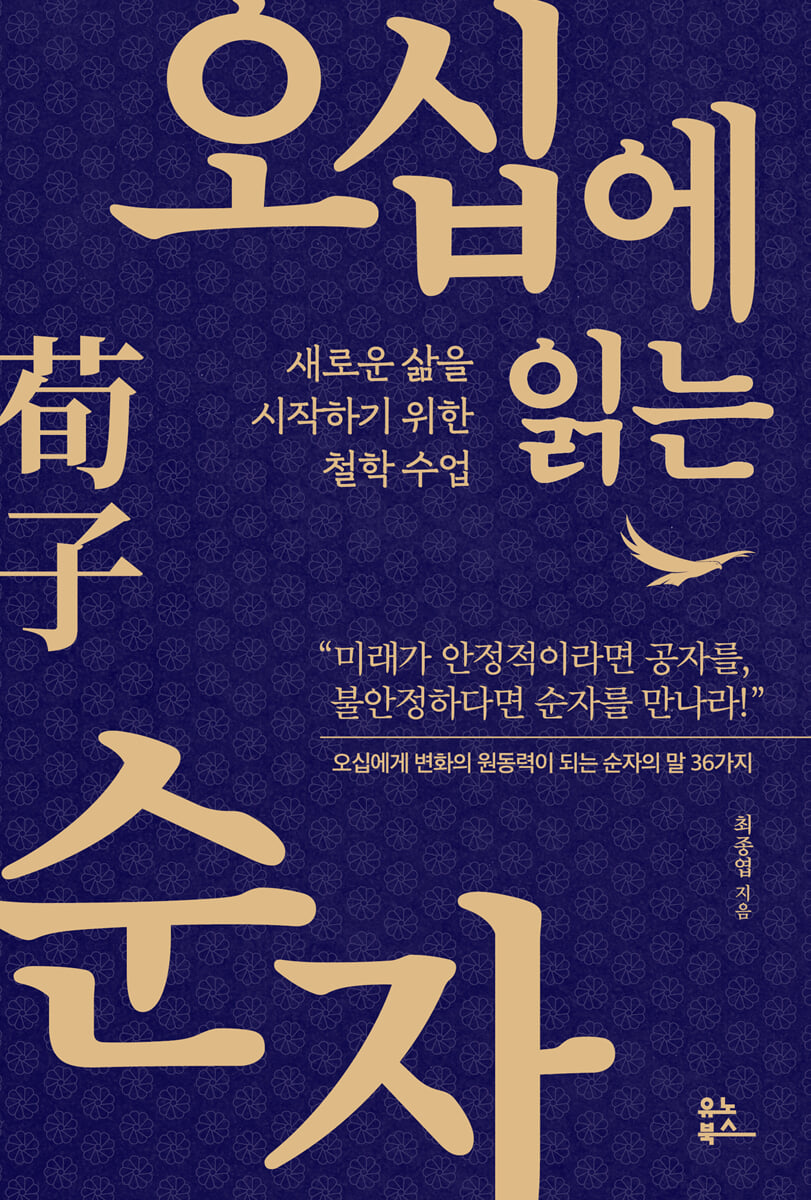
Sunja read at fifty
 |
Description
Book Introduction
“If the future is stable, Confucius, If you are unstable, meet Sunja!” 36 Words from Sunja That Motivate Change in Fifty A new book by Choi Jong-yeop, author of the 150,000-copy bestseller "Reading the Analects at Fifty"! A lot of changes happen in the 50s. Especially if you are an office worker, you may be thinking about or experiencing retirement. Even if you are proud of having prepared well for old age, you become anxious. Because I realized that I had only lived to be fifty, I had to figure out how to live out the remaining half-century. Reading Sunja's writings reveals ways to set and achieve new goals in the latter half of life. At the end of the Warring States period, in a turbulent time of war and Qin Shi Huang's attempts to establish a unified nation, the Confucian scholar Xun Zi questioned, "Is it truly wise for a ruler to continue to govern his people with the ideas and theories of previous Confucian scholars?" Here, we present a realistic governing ideology and method for national prosperity. The situation facing fifty people today is similar to that of the Warring States period. The environment suddenly changes, the values and standards we previously believed in no longer apply, and we must set a new destination and reach it. The author also recalls his fifties, which were no different. I thought there was only one way to make a living, I pursued what was profitable rather than what I wanted, and I lived a life that didn't feel like my own, following the demands of those in power. At the end of it all, only middle-aged people who didn't know how to change, let alone what they liked, were left. Only then did they realize the need for change and, through much trial and error, arrived at where they are today. 『Sunja』 begins with the sentence ‘靑出於藍’ (blue comes from indigo), which means “blue dye comes from indigo, but it is bluer than indigo, and ice is made of water, but it is colder than water.” If we compare this to life in your fifties, it can be interpreted as, 'Based on the past 50 years, you can live a better and happier 50 years than before.' "Reading Sunja at Fifty" suggests ways to gain momentum for the future from the past 50 years. Chapter 1 says that if you are anxious about the vagueness of the future, you need to change your perception of fifty. Just as Sunja rebelled against the existing Confucianism, he emphasizes that fifty is not an age to settle down but an age to begin. Chapter 2 tells you the thoughts and actions you must have before making a new start. Borrowing from Sunja's words, who emphasized 'lifelong learning', we organize the importance of studying, how to set goals, and how to manage time. Chapter 3 explains how to live the life you want. It explains why the name of a gentleman is widely known and suggests ways to find your own strengths and create a future brand. The author suggests writing, writing books, giving lectures, and speaking as good ways to explore and strengthen your strengths. Chapter 4 emphasizes the principle of "the blue bird comes from the blue" and urges us to expand our dreams beyond one achievement. There are many choices to make in the second half of life, but I just don't know, and learning one thing means that the next 50 years will be greener than the previous ones. Sunja was a thinker of change who proposed a new management philosophy that would lead the post-Warring States period. If you're in your fifties and need courage in an uncertain future, in your fifties and are looking for a new dream, or in your fifties and want to live the life you want, you can find confidence and realistic methods for living a new life after the Warring States period in Sun Tzu's philosophy. |
- You can preview some of the book's contents.
Preview
index
If you want to change an unstable future into a stable one, meet Sunja.
Chapter 1.
Is the future uncertain and uncertain?
: 《Sunja》: A Must-Read When You Need a Change
It's nothing_awareness
It is better to make it yourself than to hope for it in heaven_Transition
Good is only the result of learning_Nature
A dull iron must be sharpened with a whetstone to become sharp_Learning
Why are the people of my country, Lu, and Jin different?_Differences
Humans develop only when their desires are satisfied.
The orchid in the forest gives off its fragrance even when no one is looking_Change
Will you gain honor or shame?_Sunja
Chapter 2.
Are you ready to start anew?
: The Teachings of Sunja, Which Gives Courage
Resting is hard work_studying
If you only think about one side, there is nothing that is not covered_prejudice
Do you have the courage to tell right from wrong? _Wisdom
A gentleman enjoys what he desires, whether he gets it or not.
A good businessman does business even at a loss_Devoted
How to Deal with Unknowing and Doubt_Tools
People who are doomed love self-righteousness_Time
Even snow that piled up overnight melts when the sun rises in the morning_Strategy
Chapter 3.
How to create a more valuable life?
: How to live the life I want
A bright king knows the names of great scholars_Strengths
A gentleman puts justice first, while a petty man puts profit first._Ganghwa
A gentleman can be talented or not_Sincerity
A person knows ten thousand things based on one thing_Discernment
Align the arrowhead with the center of the target_Jeongseong
Make my words treasured_persuasion
How does the new monarch treat his subjects?_Know-how
If the big principles are right, the small ones will be right too._Nanum
Be a carpenter to yourself and a boatman to others_Gyeomsul
Words that go against the natural order bring disaster.
A gentleman must be well-balanced in both the inside and the outside_Reflection
The leaves of a tree always grow along the roots_Example
Chapter 4.
Will you be satisfied with just one achievement?
: How to keep dreaming and achieving it
Blue paint is bluer than indigo_Education
You have to climb high to see widely_Learning
A dull horse can only follow a slow horse_Continued
A gentleman studies for his own beauty_Purpose
Crossing the road is easy when you have a mentor.
If I can't get what I want, I'll follow what I like_Decision
If you plant beans, you will get beans. If you plant red beans, you will get red beans. Opportunity
To become an adult, you must practice what you learn. Development
Going Out_Sunja's Words That Led Me to a New Life
Original text of "Xunzi"
Chapter 1.
Is the future uncertain and uncertain?
: 《Sunja》: A Must-Read When You Need a Change
It's nothing_awareness
It is better to make it yourself than to hope for it in heaven_Transition
Good is only the result of learning_Nature
A dull iron must be sharpened with a whetstone to become sharp_Learning
Why are the people of my country, Lu, and Jin different?_Differences
Humans develop only when their desires are satisfied.
The orchid in the forest gives off its fragrance even when no one is looking_Change
Will you gain honor or shame?_Sunja
Chapter 2.
Are you ready to start anew?
: The Teachings of Sunja, Which Gives Courage
Resting is hard work_studying
If you only think about one side, there is nothing that is not covered_prejudice
Do you have the courage to tell right from wrong? _Wisdom
A gentleman enjoys what he desires, whether he gets it or not.
A good businessman does business even at a loss_Devoted
How to Deal with Unknowing and Doubt_Tools
People who are doomed love self-righteousness_Time
Even snow that piled up overnight melts when the sun rises in the morning_Strategy
Chapter 3.
How to create a more valuable life?
: How to live the life I want
A bright king knows the names of great scholars_Strengths
A gentleman puts justice first, while a petty man puts profit first._Ganghwa
A gentleman can be talented or not_Sincerity
A person knows ten thousand things based on one thing_Discernment
Align the arrowhead with the center of the target_Jeongseong
Make my words treasured_persuasion
How does the new monarch treat his subjects?_Know-how
If the big principles are right, the small ones will be right too._Nanum
Be a carpenter to yourself and a boatman to others_Gyeomsul
Words that go against the natural order bring disaster.
A gentleman must be well-balanced in both the inside and the outside_Reflection
The leaves of a tree always grow along the roots_Example
Chapter 4.
Will you be satisfied with just one achievement?
: How to keep dreaming and achieving it
Blue paint is bluer than indigo_Education
You have to climb high to see widely_Learning
A dull horse can only follow a slow horse_Continued
A gentleman studies for his own beauty_Purpose
Crossing the road is easy when you have a mentor.
If I can't get what I want, I'll follow what I like_Decision
If you plant beans, you will get beans. If you plant red beans, you will get red beans. Opportunity
To become an adult, you must practice what you learn. Development
Going Out_Sunja's Words That Led Me to a New Life
Original text of "Xunzi"
Detailed image
.jpg)
Into the book
“Rather than praising and thinking of Heaven as great, wouldn’t it be better to gather, nurture, and control the things that Heaven bestows? Rather than simply following and honoring Heaven, wouldn’t it be better to control and utilize what Heaven has bestowed upon us? Rather than waiting for the right time, wouldn’t it be better to take advantage of it? Rather than simply leaving things in place, hoping for their multiplication, wouldn’t it be better to exercise our abilities and transform them? Rather than thinking of possessions and assuming all things are ours, wouldn’t it be better to organize them so we don’t lose them? Rather than simply admiring the nature that creates things, wouldn’t it be better to create them? Therefore, if we abandon our human perspective and only consider Heaven, we will soon lose sight of the true nature of all things.”
---From page 31, 'It is better to make it yourself than to look to the sky'
As Confucius said, isn't a true leader like the pine and cedar trees in midwinter, enduring and overcoming adversity? Isn't a person who studies extensively, conducts himself virtuously, and bides his time like a gentleman, like the pine and cypress? Isn't a leader someone who perseveres in the face of adversity, steadfastly persevering and overcoming it?
---From "Page 65, 'Orchids in the Forest Give Off Their Fragrance Even When No One Sees'"
If the Analects speak of the fundamentals that humans should possess, the Xunzi speaks of a strategy that delves deeply.
During times of national stability, leaders adopted Confucianism, including the Analects of Confucius, as the foundational philosophy of state administration. During times of war or hegemony, such as the Warring States Period, leaders adopted the Legalist thought of Xun Zi and Han Feizi as the foundational philosophy of state administration.
If the Analects and Mencius speak of an ideal world, then Xunzi speaks of reality.
In times of peace, it's natural to talk about ideals, but in times of upheaval, we need more realistic philosophies and alternatives that can overcome reality.
When life is going well, it is a good idea to read the Analects or Mencius.
However, in a time of change and challenge, such as the Warring States period, it is better to read Xunzi.
Because the stories of the wise men of old, from over 2,000 years ago, are repeated even today.
---From page 77, 'Will You Be Honored or Shameful?'
Just because your first half of life is disappointing doesn't mean your second half will be disappointing, and just because your first half of life is satisfying doesn't mean your second half will be satisfying.
The past is just the past and the future is just the future.
Among those who think they can do it, there are those who do it.
Of all the people who think they can't do something, there isn't a single one who does.
This is wisdom.
---From page 101, "Do you have the courage to tell the difference between right and wrong?"
It is difficult for me to know myself properly.
It's the same with other people knowing me well.
Although my past self and my present self are clearly different, it is not easy to recognize this.
So, without realizing it, I might be living today like yesterday and tomorrow like today.
People write as a tool to strengthen their strengths.
If you want to let go of your past experiences, just stay still.
Because time erases everything.
If you want to make use of your experiences so far, you need to leave a record of them.
This is also why more and more people are writing and organizing their writing during their half-time.
If you worked for 10 years, you leave behind 10 years of records, and if you worked for 20 years, you leave behind 20 years of records.
One of the most important things to do during the half-time of your life is to keep records and organize them.
---From "The Bright King Knows the Names of Great Scholars" on pages 149-151
The 'Zhong' in 'Zhongyong' does not mean 'middle' or 'going in the middle', but should be interpreted as 'timely', 'on target', and 'focused'.
First of all, the word 'shijung' means 'there is a time for everything, so do it in due time.'
Timing is often crucial in life, so it's important to get the timing right.
Next, hitting the target means 'when the archer draws the bowstring, he aligns the arrowhead with the center of the target.'
In other words, it means the sincerity and effort to pursue work and goals in exact alignment.
Because any problem can be easily solved by grasping the core of the problem and shaking it.
Concentration also refers to 'the effort to get closer to the essence or core of the work.'
---From page 175, 'Aim the arrowhead at the center of the target'
Fifty is the turning point in becoming a mature adult.
If you look at life with a little more leeway, you will see beautiful aspects of life that you had not seen before.
If my life up until now has been a life of learning, I hope that my life from now on will be a life of teaching.
If you've lived your life saying what you want to say until now, I hope that from now on you can be happy saying what others want to hear.
If your life up until now has been a life of accumulation, your life from now on will be a life of sharing, and you will be happier.
If your life up until now has been a life of running, then from now on it can be a life of walking.
If life up until now has been a fast life, it's okay if life from now on is a slow life.
If you have lived a life of being pushed around until now, it would be good to start living a life of pushing forward from now on.
---From "Page 212, 'Be a carpenter to yourself and a boatman to others'"
The idiom "청추어람" means "The blue dye is taken from indigo, but it is bluer than indigo" and is a four-character idiom from the "Xunzi".
Blue dye is made from blue indigo, but is bluer than indigo, and it is made from crushed black wood ash, but is blacker than black ash.
Xun Zi is a Confucian scholar who cannot exist without Confucius.
He is a scholar who studied Confucius's Confucianism more deeply than anyone else and studied it from various perspectives.
He was a Confucian scholar who followed the path of Confucius and worked to put Confucianism into practice during the Warring States Period.
Sunja talks about the importance of education.
The first sentence of the "Xunzi" emphasizes that with proper and appropriate education and learning, one can become a better student than his teacher anytime and anywhere.
The Analects, written by Confucius' disciples, also begins with a passage about learning.
---From "Page 238, 'Blue Paint is Bluer than Indigo'"
In the “Book of Knowledge,” Xunzi used the example of a thousand-mile horse and a dull horse to say that if you study with a single-minded heart and perseverance, you can achieve great results regardless of your talent.
It would be great if you had the ability of a thousand-lima horse, but even a dull horse can follow a thousand-lima horse if you put in ten times the time and effort, so anyone can achieve academic success if they just work hard.
---From "Page 252, 'A dull horse can only follow a thousand-mile horse, though it is slow'"
You have to cross.
Once you see the stepping stones, you can cross them without difficulty by adjusting your stride.
But if the stepping stones were underwater and there was no one to tell you exactly where they were, you wouldn't be able to even think about taking a single step.
Sunja also emphasized the need for a teacher.
The Spring and Autumn Period and Warring States Period, when learning itself was nearly impossible without seeking out a teacher, may have played a role, but Xunzi said, “There is no more convenient way than getting close to a teacher, and there is no faster way than liking and following that teacher.”
---From page 31, 'It is better to make it yourself than to look to the sky'
As Confucius said, isn't a true leader like the pine and cedar trees in midwinter, enduring and overcoming adversity? Isn't a person who studies extensively, conducts himself virtuously, and bides his time like a gentleman, like the pine and cypress? Isn't a leader someone who perseveres in the face of adversity, steadfastly persevering and overcoming it?
---From "Page 65, 'Orchids in the Forest Give Off Their Fragrance Even When No One Sees'"
If the Analects speak of the fundamentals that humans should possess, the Xunzi speaks of a strategy that delves deeply.
During times of national stability, leaders adopted Confucianism, including the Analects of Confucius, as the foundational philosophy of state administration. During times of war or hegemony, such as the Warring States Period, leaders adopted the Legalist thought of Xun Zi and Han Feizi as the foundational philosophy of state administration.
If the Analects and Mencius speak of an ideal world, then Xunzi speaks of reality.
In times of peace, it's natural to talk about ideals, but in times of upheaval, we need more realistic philosophies and alternatives that can overcome reality.
When life is going well, it is a good idea to read the Analects or Mencius.
However, in a time of change and challenge, such as the Warring States period, it is better to read Xunzi.
Because the stories of the wise men of old, from over 2,000 years ago, are repeated even today.
---From page 77, 'Will You Be Honored or Shameful?'
Just because your first half of life is disappointing doesn't mean your second half will be disappointing, and just because your first half of life is satisfying doesn't mean your second half will be satisfying.
The past is just the past and the future is just the future.
Among those who think they can do it, there are those who do it.
Of all the people who think they can't do something, there isn't a single one who does.
This is wisdom.
---From page 101, "Do you have the courage to tell the difference between right and wrong?"
It is difficult for me to know myself properly.
It's the same with other people knowing me well.
Although my past self and my present self are clearly different, it is not easy to recognize this.
So, without realizing it, I might be living today like yesterday and tomorrow like today.
People write as a tool to strengthen their strengths.
If you want to let go of your past experiences, just stay still.
Because time erases everything.
If you want to make use of your experiences so far, you need to leave a record of them.
This is also why more and more people are writing and organizing their writing during their half-time.
If you worked for 10 years, you leave behind 10 years of records, and if you worked for 20 years, you leave behind 20 years of records.
One of the most important things to do during the half-time of your life is to keep records and organize them.
---From "The Bright King Knows the Names of Great Scholars" on pages 149-151
The 'Zhong' in 'Zhongyong' does not mean 'middle' or 'going in the middle', but should be interpreted as 'timely', 'on target', and 'focused'.
First of all, the word 'shijung' means 'there is a time for everything, so do it in due time.'
Timing is often crucial in life, so it's important to get the timing right.
Next, hitting the target means 'when the archer draws the bowstring, he aligns the arrowhead with the center of the target.'
In other words, it means the sincerity and effort to pursue work and goals in exact alignment.
Because any problem can be easily solved by grasping the core of the problem and shaking it.
Concentration also refers to 'the effort to get closer to the essence or core of the work.'
---From page 175, 'Aim the arrowhead at the center of the target'
Fifty is the turning point in becoming a mature adult.
If you look at life with a little more leeway, you will see beautiful aspects of life that you had not seen before.
If my life up until now has been a life of learning, I hope that my life from now on will be a life of teaching.
If you've lived your life saying what you want to say until now, I hope that from now on you can be happy saying what others want to hear.
If your life up until now has been a life of accumulation, your life from now on will be a life of sharing, and you will be happier.
If your life up until now has been a life of running, then from now on it can be a life of walking.
If life up until now has been a fast life, it's okay if life from now on is a slow life.
If you have lived a life of being pushed around until now, it would be good to start living a life of pushing forward from now on.
---From "Page 212, 'Be a carpenter to yourself and a boatman to others'"
The idiom "청추어람" means "The blue dye is taken from indigo, but it is bluer than indigo" and is a four-character idiom from the "Xunzi".
Blue dye is made from blue indigo, but is bluer than indigo, and it is made from crushed black wood ash, but is blacker than black ash.
Xun Zi is a Confucian scholar who cannot exist without Confucius.
He is a scholar who studied Confucius's Confucianism more deeply than anyone else and studied it from various perspectives.
He was a Confucian scholar who followed the path of Confucius and worked to put Confucianism into practice during the Warring States Period.
Sunja talks about the importance of education.
The first sentence of the "Xunzi" emphasizes that with proper and appropriate education and learning, one can become a better student than his teacher anytime and anywhere.
The Analects, written by Confucius' disciples, also begins with a passage about learning.
---From "Page 238, 'Blue Paint is Bluer than Indigo'"
In the “Book of Knowledge,” Xunzi used the example of a thousand-mile horse and a dull horse to say that if you study with a single-minded heart and perseverance, you can achieve great results regardless of your talent.
It would be great if you had the ability of a thousand-lima horse, but even a dull horse can follow a thousand-lima horse if you put in ten times the time and effort, so anyone can achieve academic success if they just work hard.
---From "Page 252, 'A dull horse can only follow a thousand-mile horse, though it is slow'"
You have to cross.
Once you see the stepping stones, you can cross them without difficulty by adjusting your stride.
But if the stepping stones were underwater and there was no one to tell you exactly where they were, you wouldn't be able to even think about taking a single step.
Sunja also emphasized the need for a teacher.
The Spring and Autumn Period and Warring States Period, when learning itself was nearly impossible without seeking out a teacher, may have played a role, but Xunzi said, “There is no more convenient way than getting close to a teacher, and there is no faster way than liking and following that teacher.”
---From "Page 267, 'If you get close to the teacher, you can cross the road easily'"
Publisher's Review
To the fifty who are at the center of change
A new way of life revealed by Sunja
★★★ New book by Choi Jong-yeop, author of the 150,000-copy bestseller "Reading the Analects at Fifty"!
In your fifties, you experience many changes, whether you want them or not.
In particular, many people leave their long-term jobs and face the realistic problem of making a living in old age.
I have more time, but I don't know what to do because my title, rank, and business card are gone, and I am overcome with a sense of helplessness that I am too old to start over.
As you worry, your bank balance decreases and your anxiety about the future snowballs.
Even after working hard for 50 years, I feel a sense of futility at the reality that I have to worry about making a living.
Sun Tzu was a Confucian scholar who was active at the end of the Warring States period, a period of extreme chaos due to constant war.
In a world where the more we preach traditional Confucianism, the more chaotic it becomes, Sun Tzu presents a Confucian governing ideology and method that takes reality into account.
In other words, it overturns the conventional wisdom that 'heaven controls everything' and asserts that 'human destiny depends on humans themselves' and that 'one can become a saint through learning.'
It declared the beginning of a new era of studying abroad by redefining the existing values and standards that everyone believed to be the best.
The age of fifty can be said to be the national era of one's life.
When faced with a new world, we must first acknowledge that the values and standards we previously held were not the best.
Only then can we put our anxieties to rest and find room to explore new ways of living.
From Sunja's words, which embraced the changes of the Warring States period and presented realistic solutions, those in their fifties can also learn the courage to adapt to change, dream of a new life, and how to create the life they desire.
I will be the driving force and assistant for your new start.
Sunja's 36 Tips
The author of 『Reading the Analects at Fifty』, which showed the direction of life that Ji Cheon-myeong should take through Confucius's saying, "I have one way to go," has returned with Xun Zi.
Why was Xunzi chosen among the many scholars and thinkers? In a time of war and uncertainty, Xunzi presented a practical approach to governance for a ruler to ensure the well-being of his subjects.
In other words, he is a thinker who has drawn up a concrete blueprint for calming the anxious world and living in stability.
Those in their fifties, at the center of change, must plan carefully and concretely enough to grasp the future.
Because I've already run halfway through my life, I can't guarantee that I'll ever get another chance to start anew.
Of course, even if you've lived for 50 years, it's your first time turning 60 or 70, so there's bound to be trial and error.
Still, wouldn't it be better to minimize mistakes and lead the future in a stable manner?
Sunja's philosophy does not stop at suggesting a direction to pursue, but also guides us through specific methods of change.
This book will teach you how to change the perception that fifty is too late for change, how to set goals, the thoughts and wisdom you must have before a new start, the actions you must practice, the things you must learn, and even how to create and strengthen your own brand. It will teach you how to overcome the daunting reality of fifty, take one steady step at a time, and finally live the life you want.
‘Cheongchuleoram(靑出於藍) Cheongeoram(靑於藍)’,
Live a greener life than before!
Sunja emphasizes the importance of constant learning for a more stable rule.
Thus, the first chapter of 『Sunja』 was written as 〈Kwonhakpyeon〉, which means ‘encouraging learning,’ and the famous saying ‘cheongchuleoram’ (a word that comes from the mouth of a person) appears here.
The phrase 'blue dye comes from indigo, but it is bluer than indigo' means 'blue dye comes from indigo, but it is bluer than indigo.'
It is widely used to mean that 'if you learn, a student who is better than the teacher will always appear', and when compared to life, it can be interpreted to mean 'if you learn, you can always live a better life than before'.
Just because you're over 50, 60, or 70 doesn't mean you can't live a better life than before.
As long as you dream, set goals, and learn what you need to achieve them, you can always start over and live a wonderful life, the life you've always dreamed of, the life you want.
Sunja also says, “It is better to take action to make good things happen rather than waiting for them to happen.”
There is no change that happens without thinking, doing, and learning.
Are you a fifty-something wondering how to live out your remaining fifty years? Are you a fifty-something with aspirations but feeling powerless before the age of fifty? Are you searching for a new dream? Are you worried about the vague future? If so, I recommend reading Sunja.
『Sunja』, read by the wise, will give you the courage to build a stable foundation for the unstable latter half of your life, and will provide practical teachings to live a life that is greener and higher than before.
A new way of life revealed by Sunja
★★★ New book by Choi Jong-yeop, author of the 150,000-copy bestseller "Reading the Analects at Fifty"!
In your fifties, you experience many changes, whether you want them or not.
In particular, many people leave their long-term jobs and face the realistic problem of making a living in old age.
I have more time, but I don't know what to do because my title, rank, and business card are gone, and I am overcome with a sense of helplessness that I am too old to start over.
As you worry, your bank balance decreases and your anxiety about the future snowballs.
Even after working hard for 50 years, I feel a sense of futility at the reality that I have to worry about making a living.
Sun Tzu was a Confucian scholar who was active at the end of the Warring States period, a period of extreme chaos due to constant war.
In a world where the more we preach traditional Confucianism, the more chaotic it becomes, Sun Tzu presents a Confucian governing ideology and method that takes reality into account.
In other words, it overturns the conventional wisdom that 'heaven controls everything' and asserts that 'human destiny depends on humans themselves' and that 'one can become a saint through learning.'
It declared the beginning of a new era of studying abroad by redefining the existing values and standards that everyone believed to be the best.
The age of fifty can be said to be the national era of one's life.
When faced with a new world, we must first acknowledge that the values and standards we previously held were not the best.
Only then can we put our anxieties to rest and find room to explore new ways of living.
From Sunja's words, which embraced the changes of the Warring States period and presented realistic solutions, those in their fifties can also learn the courage to adapt to change, dream of a new life, and how to create the life they desire.
I will be the driving force and assistant for your new start.
Sunja's 36 Tips
The author of 『Reading the Analects at Fifty』, which showed the direction of life that Ji Cheon-myeong should take through Confucius's saying, "I have one way to go," has returned with Xun Zi.
Why was Xunzi chosen among the many scholars and thinkers? In a time of war and uncertainty, Xunzi presented a practical approach to governance for a ruler to ensure the well-being of his subjects.
In other words, he is a thinker who has drawn up a concrete blueprint for calming the anxious world and living in stability.
Those in their fifties, at the center of change, must plan carefully and concretely enough to grasp the future.
Because I've already run halfway through my life, I can't guarantee that I'll ever get another chance to start anew.
Of course, even if you've lived for 50 years, it's your first time turning 60 or 70, so there's bound to be trial and error.
Still, wouldn't it be better to minimize mistakes and lead the future in a stable manner?
Sunja's philosophy does not stop at suggesting a direction to pursue, but also guides us through specific methods of change.
This book will teach you how to change the perception that fifty is too late for change, how to set goals, the thoughts and wisdom you must have before a new start, the actions you must practice, the things you must learn, and even how to create and strengthen your own brand. It will teach you how to overcome the daunting reality of fifty, take one steady step at a time, and finally live the life you want.
‘Cheongchuleoram(靑出於藍) Cheongeoram(靑於藍)’,
Live a greener life than before!
Sunja emphasizes the importance of constant learning for a more stable rule.
Thus, the first chapter of 『Sunja』 was written as 〈Kwonhakpyeon〉, which means ‘encouraging learning,’ and the famous saying ‘cheongchuleoram’ (a word that comes from the mouth of a person) appears here.
The phrase 'blue dye comes from indigo, but it is bluer than indigo' means 'blue dye comes from indigo, but it is bluer than indigo.'
It is widely used to mean that 'if you learn, a student who is better than the teacher will always appear', and when compared to life, it can be interpreted to mean 'if you learn, you can always live a better life than before'.
Just because you're over 50, 60, or 70 doesn't mean you can't live a better life than before.
As long as you dream, set goals, and learn what you need to achieve them, you can always start over and live a wonderful life, the life you've always dreamed of, the life you want.
Sunja also says, “It is better to take action to make good things happen rather than waiting for them to happen.”
There is no change that happens without thinking, doing, and learning.
Are you a fifty-something wondering how to live out your remaining fifty years? Are you a fifty-something with aspirations but feeling powerless before the age of fifty? Are you searching for a new dream? Are you worried about the vague future? If so, I recommend reading Sunja.
『Sunja』, read by the wise, will give you the courage to build a stable foundation for the unstable latter half of your life, and will provide practical teachings to live a life that is greener and higher than before.
GOODS SPECIFICS
- Date of issue: March 2, 2023
- Page count, weight, size: 304 pages | 470g | 142*210*18mm
- ISBN13: 9791192300528
- ISBN10: 1192300521
You may also like
카테고리
korean


korean

![GQ KOREA Mark (Monthly): December [2025]](http://librairie.coreenne.fr/cdn/shop/files/8ef265dbbfbf186523ed75ba7319009d.jpg?v=1765340328&width=3840)


