

Embarrassing Classical Lesson 7
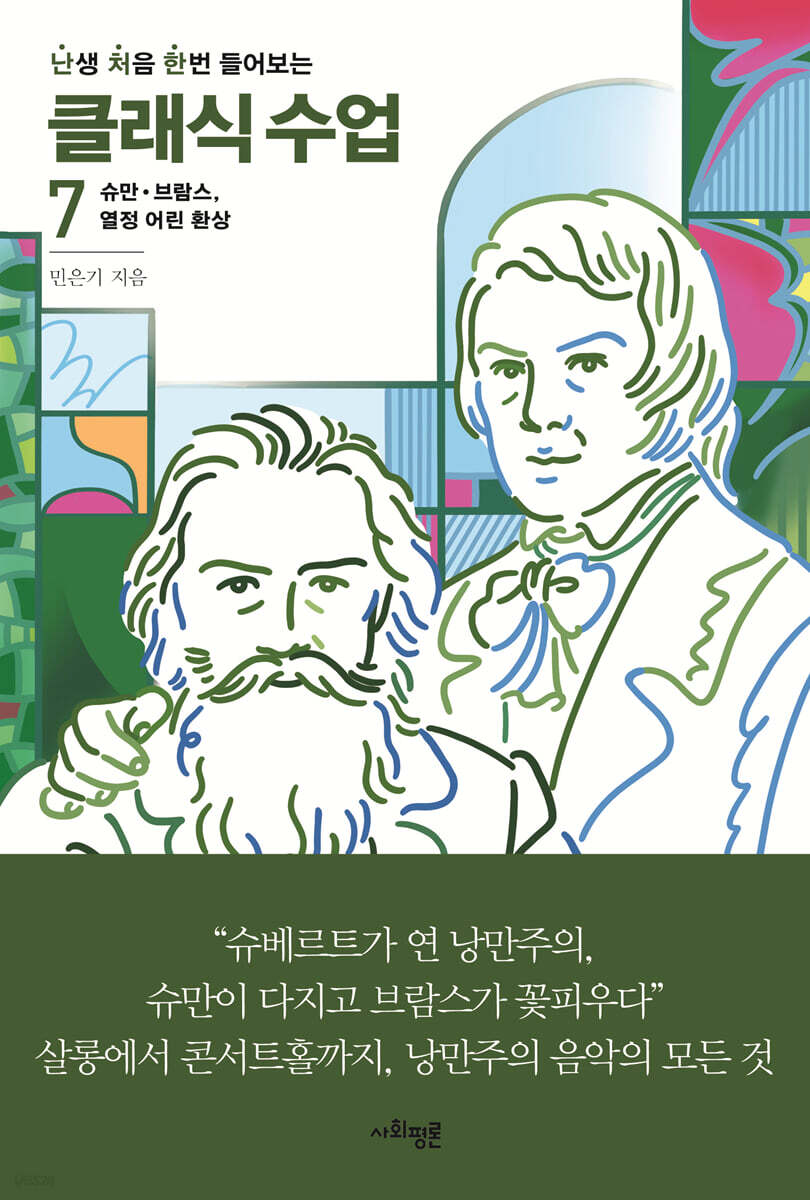 |
Description
Book Introduction
"My First Classical Music Lesson" (hereafter "The Embarrassing Classical Music Lesson") is an easy and fun introduction to classical music for those who have found classical music "embarrassing." This seventh volume contains the lives and works of Schumann and Brahms, composers who lived and breathed the Romantic era.
Despite the large age difference, the two colleagues understood each other better than anyone else, and both expressed broad and complex emotions on top of a solid form.
Schumann and Brahms, who were connected through music, loved the same person their entire lives.
Traces of this bittersweet love remain throughout the two people's works.
The book begins by defining what Romanticism is.
‘Romance,’ which can be quite ambiguous, comes to life in vivid form through 19th century art.
The 'Awkward Classical Music Class' series has covered various aspects of Romantic music, from Volume 5 on Chopin and Liszt to Volume 6 on Verdi and Wagner.
This seventh volume can be said to be the final destination and the final 'definitive edition' of the journey to understand the Romantic era.
It delves deeply into the essence of Romanticism and enhances our understanding of the music of this era.
In an era when the gap between ideals and reality was greater than ever, the music of the Romantics, captivated by dreamlike worlds, still stirs our hearts.
- You can preview some of the book's contents.
Preview
index
Ⅰ The Most Romantic Art - German Romanticism and Music
01 Between Strangeness and Beauty
02 Schubert's Way
Ⅱ A Musician in Love - Schumann's Growth and Marriage
01 The boy who dreamed of being a poet
02 Musician's Love
03 Year of the Symphony
04 Uphill and downhill
III The Rise of the Young Eagle - Brahms's Growth
01 Hamburg's prodigy
02 Schumann, Brahms, Clara
03 The Age of Werther
IV The Eagle's Flight - Brahms' Leap
01 The most Brahms-like thing
02 Conquering the Bin
V.
The Great Brahms - Brahms's Triumph
01 Become History
02 The Triumph of the Symphony
03 The Eagle's Last Flight
Detailed image

Into the book
The topic of this lecture is romantic music, that is, 19th century romantic music.
People of the Romantic era were much more sentimental and imaginative than we are today.
They expressed intense and deep human emotions in detail and sensed the slightest changes in nature more delicately than people of any other era.
With a burning passion for art, especially music, he expressed his unique sensibility and creativity in his works.
This is probably the secret behind the creation of so many great masterpieces during the Romantic era.
---From "Opening Volume 7"
The word 'romance' is not a difficult concept in itself, as it is often used in everyday life.
But let's just think about the strange nuance that those words carry.
It's passionate like a first love that blooms in an instant, yet fantastical and exaggerated, and at the same time, it feels a little empty.
Romance is strangely unrealistic.
That's because the word 'romantic' comes from 'romance', a medieval chivalric literature that mainly pursues love or chivalry.
Romance is fundamentally unrealistic and sentimental because it deals with a world created by imagination.
The essence of Romanticism, an artistic movement, is similar to this.
---From "Between Strangeness and Beauty"
Because Schubert knows how to handle emotions more delicately and dramatically than any other composer.
It is said that Schubert's songs are not just pleasant to listen to, but also enjoyable to play, because the mood of the poem and the music fit perfectly together.
This is why Schubert's works have been loved by audiences and musicians alike from the past to the present.
---From "Schubert's Road"
In the end, it was because he was immersed in literature that Schumann was able to create music with his own unique color.
In fact, music and literature are not as far apart as you might think.
In the days before writing, people would have sung songs instead of writing and reading poetry, so strictly speaking, the prototype of literature can be said to be music.
And among the Romantic writers of that time, there were many who loved music.
Jean Paul, who was especially fond of Schumann, described music as the highest art form, saying, “Only music can open the last door to eternity.”
---From "The Boy Who Dreamed of Being a Poet"
When you love, joy, frustration, and sadness coexist.
Schumann expressed various aspects of love, including pain, in his songs.
While singing brilliantly about a loving heart, in another song, it captures the sadness of a heart being torn into a thousand and ten thousand pieces, in another song, it captures the deep joy that can be felt when confirming one's feelings for another, and even the moments when everything seems futile.
---From "A Musician's Love"
Brahms was a great perfectionist.
Unlike other people, I didn't release the work right after I finished composing it. I thought about it carefully and revised it repeatedly, and if I felt it wasn't up to standard, I would discard it.
That is why Brahms is famous for having a small number of surviving works compared to the time he lived and the passion he had.
---From "The Prodigy of Hamburg"
At that time, Clara had no one to rely on other than Brahms.
What initially moved Brahms was his love, gratitude, and respect for Schumann, who cherished him, but the two became irreplaceable to each other.
At the same time, Brahms gradually began to experience feelings he had never experienced before.
It was a fever called love.
---From "Schumann, Brahms, Clara"
If Schumann was a composer who expressed his inner fantasies through music like a poet, Brahms could be said to be a composer who found inspiration in his study.
Brahms' music was basically based on what he read and learned in his library.
---From "Schumann, Brahms, Clara"
In the late 19th century, Viennese people turned to music and art to fill their sense of emptiness and futility.
It is an irony of history that art could develop because of a rigid political situation.
---From "The Most Brahms-Like Thing"
It's difficult to describe Brahms in a single word, but one thing is certain: he never stopped growing while dealing with music.
---From "Becoming History"
Brahms could not avoid comparisons with the old masters as he introduced new elements into the legacy of traditional forms he had inherited.
But he won that fight with flying colors.
If I had to describe Brahms in one word, I would say he was a 'conservative pioneer.'
---From "The Eagle's Last Flight"
Publisher's Review
★ Learn music through books! The "Embarrassing Series" raises the quality of knowledge and lowers the barrier to learning.
★ The best introductory book that teaches the works of Schumann and Brahms from a solid foundation in music!
★ Insert a QR code into the text, and create a YouTube playlist. With just the book and your smartphone, you can enjoy a personalized classical music lecture anywhere! No need to search for music separately!
The world of splendidly beautiful romanticism
What kind of music moves you the most? Many people would probably say Romantic music.
Romantic music appeals above all to emotions.
If you have a heart that can feel the melody, you will be deeply moved by the music of Schumann and Brahms.
During the 19th century Romantic era, people placed the greatest importance on the emotions and individuality contained within art when evaluating it.
As such, the music of this era colorfully expresses the emotions that humans experience in life, from the darkest despair to joy that shines brighter than the sun.
In Volume 7, which features Schumann and Brahms as the main characters, you will be able to encounter glimpses of various forms of sparkling emotions through the lives and music of Schumann and Brahms.
During the Romantic era, when many musicians were active and met and interacted with each other, creating tremendous synergy, musicians built a long story of friendship and love.
The author faithfully reproduces the 19th century by drawing on extensive research and transcribing letters exchanged between musicians and diaries containing their daily lives.
Schumann and Brahms, as well as Clara and Joseph Joachim, Mendelssohn, Liszt and Wagner, Anton Rubinstein and Sarasate, and many other Romantic musicians appear and form various relationships, creating a novel-like story.
In this seventh volume of the 'Awkward Classical Music Class' series, there is another protagonist besides Schumann and Brahms.
Schubert is the master who is considered to have opened the door to Romantic music.
Although he sadly passed away at the age of thirty-one, Schubert left behind hundreds of pieces in various genres, from lieder to symphonies.
Schubert, who boasted such natural talent that he was often compared to Mozart, was the first composer to express his feelings without being tied down to any particular organization.
Schubert's beautiful yet sad works, including "Winter Journey," are still greatly loved today.
Schumann and Brahms greatly admired Schubert and actively tried to follow in his footsteps.
This book covers Schubert's life and music in detail, especially the outstanding art songs he left behind.
Listening to Professor Min Eun-ki's explanation, you will be captivated by the charm of art songs, which contain deep emotions within a simple form.
During the Romantic era, when music was loved more than any other era, classical music culture was firmly established.
Unlike Chopin and Liszt, who focused on piano pieces in Volume 5, or Verdi and Wagner, who focused on opera in Volume 6, Schumann and Brahms, the protagonists of Volume 7, successfully covered a wide range of genres, from solo songs to choral pieces, as well as small-scale chamber music, considered a traditional genre, to symphonies, the pinnacle of music that can be achieved by an orchestra.
By following the lives of musicians, you will be able to enjoy the various musical buds that they bloom, sometimes with laughter and sometimes with tears.
“With Nancheohan, classical music isn’t difficult at all.”
"The Awkward Classical Music Class" is a series that was first released in late 2018 after extensive preparation by Professor Min Eun-ki and Social Criticism Publishing, who shared the same concern that there was no easy-to-pick-up introductory classical music textbook.
From the most basic of basics, Do-Re-Mi-Fa-So-La-Si, to the symphony, the flower of instrumental music, from the first song of mankind to today's popular pop songs, it leads you step by step to the world of classical music, transcending time, space, and genre.
This is the reason why it was able to quickly establish itself as a 'bible' for beginners in classical music, with favorable reviews such as 'a classics textbook that is easy to read', 'a friendly introduction to classical music that explains it step by step so that even those who have been away from music since elementary school can understand it', and 'a book that balances musical works and background knowledge'.
Professor Min Eun-ki, the first female professor in the Department of Composition at Seoul National University, is a first-generation Korean musicologist who, while a true researcher, has never strayed from the real world. However, she is also a social intellectual who has always met people outside of the university through numerous public lectures and writings.
There is probably no other scholar who has worked as hard as Professor Min Eun-ki to introduce the wonderful world of classical music.
The author begins Volume 1 by explaining why the classics are so important.
“Classical music is a type of music that moves you more deeply the more you listen to it.
You can listen to it for a long time without getting tired of it.
As is often the case with other things that bear the name of classic.”
Classical music is the result of the pursuit of the highest level of beauty in the 18th and 19th centuries, when enormous effort was put into music. It is a cultural heritage shared by all of humanity, created in an era that will never return.
If we are beings who have to listen to something to survive, then classic music, which is not influenced by trends, is probably the music genre that we can listen to for the longest time.
You can listen to music and take lectures anytime, anywhere with just a smartphone.
While 『The Story of Studying Art for the First Time in My Life』, which opened the door to the 'Embarrassing Series' with unprecedented success as a domestically planned art textbook, allowed readers to comfortably read the pictures without turning the pages, 『Embarrassing Classical Class』 connected music with QR codes to save readers the trouble of having to search for the music and compiled the links into a YouTube playlist.
The advantages were maintained in other areas as well.
It is structured in a conversational format where the professor lectures and the reader responds, making it readable as if receiving one-on-one tutoring. The book is enriched with illustrator Kang Han's sensual illustrations and photographs that add a sense of realism, making it even more enjoyable to read.
It can be said that the composition was designed with the generation in mind who is more familiar with spoken language than written language and with images than with print.
In particular, the 7th volume of 『Embarrassing Classical Music Class』, which is being published this time, introduces over 200 images, 20 scores, and 93 pieces of music, conveying the world of Romantic music with greater depth and richness than ever before.
The eight volumes to be published in the future will cover Tchaikovsky, who is greatly loved in Korea.
GOODS SPECIFICS
- Publication date: November 8, 2022
- Page count, weight, size: 524 pages | 822g | 152*225*34mm
- ISBN13: 9791162732540
- ISBN10: 1162732547
You may also like
카테고리
korean


korean


