

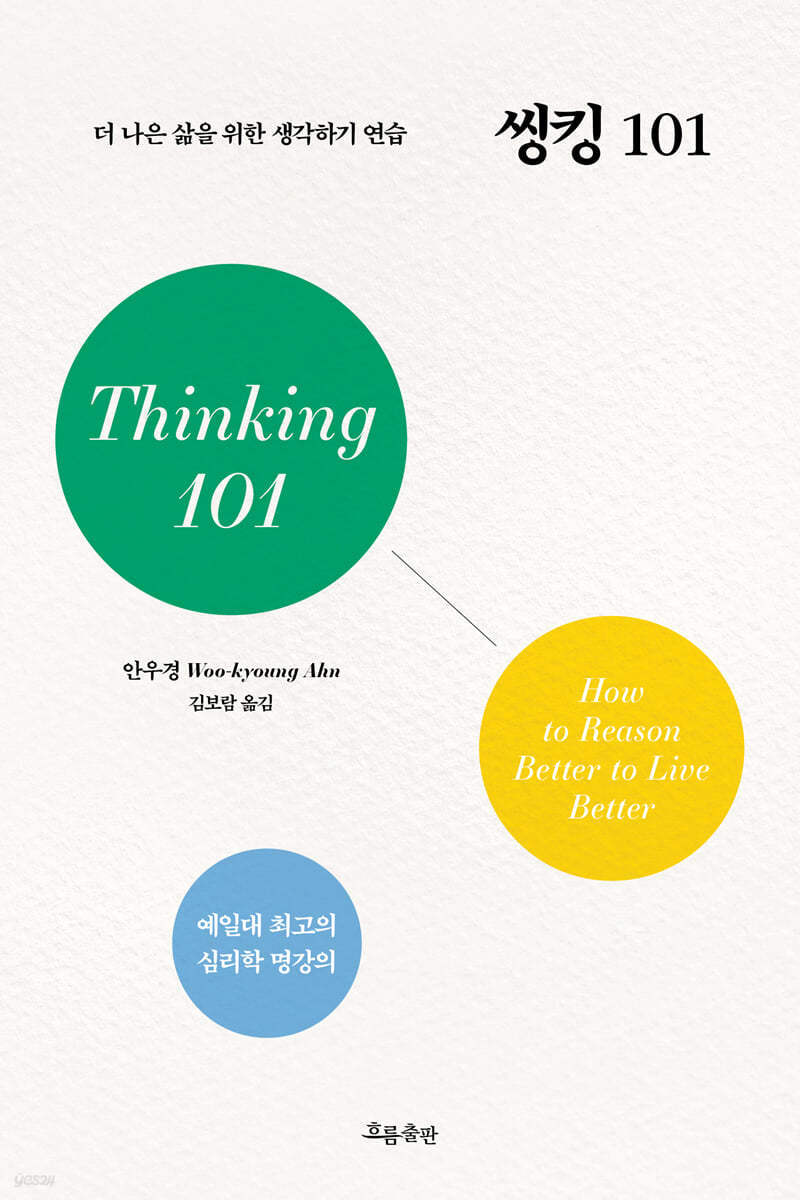
Thinking 101
 |
Description
Book Introduction
- A word from MD
-
Psychology classes for correct perceptionHow good would you say your driving skills are? I'd say above average.
Have you ever considered buying something after reading 99 positive reviews, only to give up after reading just one negative one? Human perception is often imperfect.
This book analyzes common cognitive errors to help you make better decisions.
January 26, 2023. Humanities PD Son Min-gyu
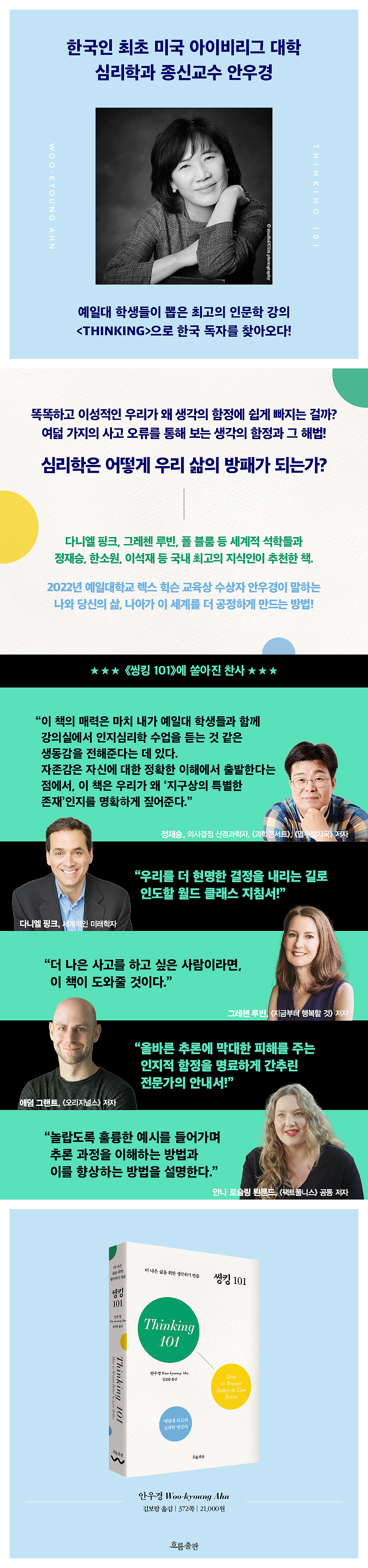
How does psychology become a shield in our lives?
With world-renowned scholars such as Daniel Pink, Robert Cialdini, Gretchen Rubin, and Paul Bloom
Recommended by Korea's top intellectuals, including Jeong Jae-seung, Han So-won, and Lee Seok-jae.
Woo-kyung Ahn, winner of the 2022 Yale University Lex Hixon Prize in Education, speaks
A smart way to make our lives and the world a better place!
The Lex Hixon Prize for Teaching is the most prestigious award in the Social Sciences Department, awarded at Yale University, a prestigious university in the United States, to a professor who has delivered the best lectures over several years based solely on student evaluations.
Professor Woo-Kyung Ahn, the 2022 recipient of this award, is the first Korean scholar to become a full professor in any Ivy League psychology department.
Professor Ahn Woo-kyung's [Thinking] lecture is one of the most popular classes at Yale University, offering not only humanities knowledge but also life wisdom, and is well-known for being loved by many.
Professor Ahn Woo-kyung's [Thinking] lecture was published in January 2023 as a book titled "Thinking 101: Thinking Practice for a Better Life."
This book, which received praise from world-renowned scholars and thinkers such as Adam Grant, Marjirene Banaj, Gretchen Rubin, Daniel Pink, Paul Bloom, Robert Cialdini, Anna Rosling Rönlund, Laurie Santos, and Danny Oppenheyer when it was published in the United States, is filled with various illustrations and incidents that readers frequently encounter in daily life to the point where they wonder if they are writing their own story.
Furthermore, through large-scale experiments and research, historical events, and examples from popular culture, it helps us understand why we, who are usually intelligent and infinitely rational, fall into absurd thinking errors.
Professor Ahn Woo-kyung offers a solution to escape the trap of thinking, which is an invaluable joy and valuable wisdom for us living today and preparing for tomorrow.
Psychological errors and the reasons we fall into them are closely related to our 'thinking' habits and direction.
If we study the process of recognizing and solving problems within the realm of psychology, in other words, simply by changing our thoughts, we can live a slightly better life and our world can change for the better.
With world-renowned scholars such as Daniel Pink, Robert Cialdini, Gretchen Rubin, and Paul Bloom
Recommended by Korea's top intellectuals, including Jeong Jae-seung, Han So-won, and Lee Seok-jae.
Woo-kyung Ahn, winner of the 2022 Yale University Lex Hixon Prize in Education, speaks
A smart way to make our lives and the world a better place!
The Lex Hixon Prize for Teaching is the most prestigious award in the Social Sciences Department, awarded at Yale University, a prestigious university in the United States, to a professor who has delivered the best lectures over several years based solely on student evaluations.
Professor Woo-Kyung Ahn, the 2022 recipient of this award, is the first Korean scholar to become a full professor in any Ivy League psychology department.
Professor Ahn Woo-kyung's [Thinking] lecture is one of the most popular classes at Yale University, offering not only humanities knowledge but also life wisdom, and is well-known for being loved by many.
Professor Ahn Woo-kyung's [Thinking] lecture was published in January 2023 as a book titled "Thinking 101: Thinking Practice for a Better Life."
This book, which received praise from world-renowned scholars and thinkers such as Adam Grant, Marjirene Banaj, Gretchen Rubin, Daniel Pink, Paul Bloom, Robert Cialdini, Anna Rosling Rönlund, Laurie Santos, and Danny Oppenheyer when it was published in the United States, is filled with various illustrations and incidents that readers frequently encounter in daily life to the point where they wonder if they are writing their own story.
Furthermore, through large-scale experiments and research, historical events, and examples from popular culture, it helps us understand why we, who are usually intelligent and infinitely rational, fall into absurd thinking errors.
Professor Ahn Woo-kyung offers a solution to escape the trap of thinking, which is an invaluable joy and valuable wisdom for us living today and preparing for tomorrow.
Psychological errors and the reasons we fall into them are closely related to our 'thinking' habits and direction.
If we study the process of recognizing and solving problems within the realm of psychology, in other words, simply by changing our thoughts, we can live a slightly better life and our world can change for the better.
- You can preview some of the book's contents.
Preview
index
A post for Korean readers
prolog
Chapter 1: The Illusion of Fluency
It looks easy, but it's not that easy, right?
Chapter 2: Confirmation Bias
I'm right, right, right, huh? Wrong?
Chapter 3: The Difficulty of Finding the Cause
It is not right to praise or blame carelessly.
Chapter 4: The Temptation of Concrete Examples
If you fall for someone's words,
Chapter 5: Negativity Bias
What we lose because of the fear of losing
Chapter 6: Bias Interpretation
The yellow traffic light isn't yellow?
Chapter 7: The Limits of Perspective Acceptance
Why don't you know something so obvious?
Chapter 8: The Confusion Caused by Waiting for Rewards
The present 'me' misunderstanding the future 'me'
Epilogue
Acknowledgements
annotation
Search
prolog
Chapter 1: The Illusion of Fluency
It looks easy, but it's not that easy, right?
Chapter 2: Confirmation Bias
I'm right, right, right, huh? Wrong?
Chapter 3: The Difficulty of Finding the Cause
It is not right to praise or blame carelessly.
Chapter 4: The Temptation of Concrete Examples
If you fall for someone's words,
Chapter 5: Negativity Bias
What we lose because of the fear of losing
Chapter 6: Bias Interpretation
The yellow traffic light isn't yellow?
Chapter 7: The Limits of Perspective Acceptance
Why don't you know something so obvious?
Chapter 8: The Confusion Caused by Waiting for Rewards
The present 'me' misunderstanding the future 'me'
Epilogue
Acknowledgements
annotation
Search
Detailed image
Into the book
Show students a six-second clip cut from BTS's "Boy With Luv" music video, which has over 1.4 billion views on YouTube.
I intentionally chose a part where the choreography wasn't too difficult.
After playing the video once, tell the students that if they can dance the part that appears in this section, they will receive a prize.
And watch this section ten more times.
We even watch a slow-down version of the video made for learning choreography.
Then, he asks if there are any students who would like to come out and dance.
As ten brave students dreaming of becoming popular stars walk towards the podium, the students sitting in their seats cheer them on with thunderous cheers.
At least a few hundred of the cheering students will probably think they can do it too.
I've watched the video so many times that I even think I could do it myself.
Even so, it's only 6 seconds.
How difficult can it be?
Students in the audience shout to the students on stage to stand facing the audience and dance instead of looking at the screen.
Soon music starts playing.
The students are waving their arms, jumping, and kicking all over the place, but their timing is completely off.
Some students create entirely new dances, while others give up after just three seconds with both hands and feet up.
Everyone in the auditorium, including you and me, laughs like crazy.
When we visualize the process in our heads, we tend to become overconfident without even realizing it.
The fluency effect, which makes us think, "I think I can do this too," penetrates us in various ways.
---From "The Illusion of Fluency"
Why on earth do we continue to fall prey to confirmation bias? Ironically, this tendency to seek only evidence that supports a single hypothesis has actually helped us survive.
This bias makes us cognitive misers (a trait that discourages complex thinking that expends a lot of cognitive energy and favors quick, intuitive judgments).
When it comes to survival, it's far more beneficial to conserve energy for emergencies than to always strive for the right answer.
If a primitive man discovered a delicious fruit in the northern mountains, why bother checking to see if there were good ones in the southern mountains when there were already delicious ones there? As long as he could find enough good fruit in the northern mountains, whether good fruit was found only there or in every forest was irrelevant to his survival.
Confirmation bias may be a side effect that occurs when, in a world with infinite choices, we find something good enough and then stop looking and settle for something we find.
But life is filled with far more possibilities than the number of atoms in existence, both observable and unobservable.
It is entirely up to you to discover it.
I intentionally chose a part where the choreography wasn't too difficult.
After playing the video once, tell the students that if they can dance the part that appears in this section, they will receive a prize.
And watch this section ten more times.
We even watch a slow-down version of the video made for learning choreography.
Then, he asks if there are any students who would like to come out and dance.
As ten brave students dreaming of becoming popular stars walk towards the podium, the students sitting in their seats cheer them on with thunderous cheers.
At least a few hundred of the cheering students will probably think they can do it too.
I've watched the video so many times that I even think I could do it myself.
Even so, it's only 6 seconds.
How difficult can it be?
Students in the audience shout to the students on stage to stand facing the audience and dance instead of looking at the screen.
Soon music starts playing.
The students are waving their arms, jumping, and kicking all over the place, but their timing is completely off.
Some students create entirely new dances, while others give up after just three seconds with both hands and feet up.
Everyone in the auditorium, including you and me, laughs like crazy.
When we visualize the process in our heads, we tend to become overconfident without even realizing it.
The fluency effect, which makes us think, "I think I can do this too," penetrates us in various ways.
---From "The Illusion of Fluency"
Why on earth do we continue to fall prey to confirmation bias? Ironically, this tendency to seek only evidence that supports a single hypothesis has actually helped us survive.
This bias makes us cognitive misers (a trait that discourages complex thinking that expends a lot of cognitive energy and favors quick, intuitive judgments).
When it comes to survival, it's far more beneficial to conserve energy for emergencies than to always strive for the right answer.
If a primitive man discovered a delicious fruit in the northern mountains, why bother checking to see if there were good ones in the southern mountains when there were already delicious ones there? As long as he could find enough good fruit in the northern mountains, whether good fruit was found only there or in every forest was irrelevant to his survival.
Confirmation bias may be a side effect that occurs when, in a world with infinite choices, we find something good enough and then stop looking and settle for something we find.
But life is filled with far more possibilities than the number of atoms in existence, both observable and unobservable.
It is entirely up to you to discover it.
---From "Confirmation Bias"
Publisher's Review
Easy and popular solution
A new masterpiece in the field of cognitive psychology!
“A world-class guide to making wiser decisions!”
- Daniel H.
Pink (world-renowned futurist)
Cognitive psychology, broadly speaking, is the study of 'how the human mind works.'
But as we all know, there is no mind that is born with us.
Our minds are shaped by the countless environments we encounter as we grow up, and the knowledge of that mind becomes the standard for our actions and judgments throughout our lives.
There are countless environments and countless people on Earth, so these actions and judgments lead to diverse outcomes. Addressing these issues can be called cognitive psychology in a narrow sense.
This book, Thinking 101: Thinking Practice for a Better Life, was started by Professor Woo-Kyung Ahn from a single question.
“Can cognitive psychology really make the world a better place?”
The answer, as you might expect when reading this, is “of course, yes.”
I researched which biases could be leading us astray and developed strategies to address them in ways that people can directly apply to situations they encounter in their daily lives.
'Thinking errors' are problematic even at a level that goes far beyond individual lives.
Fundamental errors and biases in our thinking contribute to political polarization, climate change, racial profiling, police shootings, and virtually every other social problem that stems from stereotypes and biases.
I wanted to show students how studying psychology could help them recognize and deal with real-world problems and make better decisions in their lives.
So the class I opened was called 'Thinking'.
- 〈From the text〉
Why do we, who are smart and rational, easily fall into the trap of thinking?
Thinking Traps and Their Solutions: Eight Thinking Errors
This book is composed of a total of eight chapters.
Each chapter explores the errors and biases inherent in our thought processes, which are closely related to the real-world problems we face in our daily lives. After watching BTS's choreography video twenty times, we begin to feel like we could dance as well as Jimin or J-Hope, or that we could sing the three-step high notes of "Good Day" with a smile like IU. This is due to the "fluency effect" (Chapter 1), which occurs when the process becomes easily visualized when we visualize it in our minds.
This fluency effect stems from simple rules we use in a cognitive process that psychologists call metacognition.
Metacognition is knowing what you know you can do, for example, knowing that you can swim.
This metacognition drives our behavior, but the problem is that we often mistakenly believe we can do things well (even when we actually can't) that are familiar or comfortable to us.
These misconceptions lead us to make wrong judgments or hasty decisions.
Chapter 2 discusses confirmation bias, our tendency to seek confirmation only of what we already believe.
Here's a woman who started walking 10,000 steps a day to lose weight.
I walked 10,000 steps every day for six months without missing a single day, but instead of losing weight, I gained more.
She decided that exercise was useless to her and that she would figure out other ways to lose weight.
But this woman's conclusion was flawed, as it overlooked the fact that she had been working from home for the past six months, had been less active, had taken short naps after lunch, and had been eating home-cooked meals in comfortable clothes.
If she hadn't even walked 10,000 steps, she would have definitely gained more weight, so while exercise definitely helped her diet, she made the wrong choice because she didn't consider other factors at all.
In Chapter 3, we explore some clues that can prevent us from finding the real cause of the problem.
To give one example, let's assume that two people, Mr. Hana and Mr. Duri, take turns flipping a coin.
If both people get the same side, either heads or tails, they each win 1 million won.
If different sides come out, neither person gets a penny.
Mr. Hana decided to flip the coin first, and it landed on heads.
Then Mr. Doori flipped a coin, and oh no, it landed tails.
This is how 1 million won evaporates.
If you ask who should be blamed in this situation, almost everyone points to Mr. Doori.
Even when asked, "Who feels more guilty, Hana or Doori?", the majority of people pointed to Doori.
If I were Mr. Doori, I would be upset, but on the other hand, if I were Ms. Hana, I would have gotten angry and told Mr. Doori that he should take responsibility for messing things up, and would have demanded at least 500,000 won.
But in fact, it is absurd to criticize Mr. Doori in this situation.
If we look at it that way, Hana should also be blamed for not being able to toss the coin so that it landed on tails.
Of course, it would be best if no one was blamed.
A coin toss is random in that no one can flip it so that it lands on a desired side, and individual in that no one remembers which side the coin landed on before.
Even in situations like coin tossing, where chronological order is completely irrelevant, we tend to blame what happened more recently.
- 〈From the text〉
Even in situations where the order of events is not important, the clue to attributing the most recent event to the cause of all results is 'recency'.
This chapter also covers 'similarity' (the tendency to group similar things into causes and effects), 'sufficiency and necessity' (the tendency to believe that something must have a necessary and sufficient cause for it to happen), and 'controllability' (the tendency to blame things we can control more than things we cannot control).
Chapter 4 explains the powerful power of concrete examples.
In the early days of COVID-19, many people underestimated the severity of the virus.
Stories from people around us, such as “My grandfather tested positive for COVID-19, but recovered in a week,” or “My friend never wore a mask, but he didn’t get COVID-19,” can be considered special cases.
But there are a great many people in this world who trust one or two anecdotes from their acquaintances more than scientific evidence derived from large samples.
In addition, readers will learn about the tendency to cancel a purchase because of 3 bad comments rather than 99 good ones (negativity bias error_Chapter 5), the tendency to think that maintaining a $6.99 a month membership is not a loss just because you can binge-watch the Star Wars series again (endowment effect error_Chapter 5), the tendency to draw distorted and unfounded conclusions instead of accepting accurate information due to incorrect stereotypes or knowledge (biased interpretation error_Chapter 6), the tendency to assume that others know what only you know (Limits of perspective taking_Chapter 7), and the tendency for most people to choose 340,000 won if someone asks them to choose between receiving 340,000 won now or 390,000 won in 6 months (delay discounting error_Chapter 8).
A wish for a better me and a better world
“Now we must be fairer to ourselves!”
Readers of this book will encounter examples of potential thinking errors with every page they turn.
These range from the simple but challenging problem of unraveling the rules applied to three sequential numbers, to questions like whether gun violence is caused by an individual's fault or by the state's negligence in enforcing gun control, or whether it is more efficient to give employees incentives at the beginning of the year and deduct them based on year-end performance, or to pay incentives at the end of the year based on performance.
Before reading the answer, I recommend that you think about how you would have chosen and then turn to the next page.
You will realize what kind of thinking errors you are trapped in.
Everyone wants to make the right judgments and decisions.
However, 'thought errors' are a byproduct of the cognition that has allowed humans to evolve, survive, and thrive to where we are today.
Therefore, it is nearly impossible to completely eliminate any bias in thinking.
Nonetheless, we must constantly strive to escape from the traps of thinking and do our best to understand the errors of thinking.
Because it is certain that it will change not only our individual lives, but also the lives of others and the world we live in for the better.
By freeing ourselves from the errors of thought, we can see ourselves without bias and thus be more fair to ourselves.
As we develop better thinking skills, we become less biased toward others, which becomes the cornerstone of creating a fairer society.
This book, "Thinking 101: A Thinking Practice for a Better Life," is a compass for good thoughts that ultimately aim to make this world a better place than it is today, not just for personal happiness but for the happiness of all of us.
A new masterpiece in the field of cognitive psychology!
“A world-class guide to making wiser decisions!”
- Daniel H.
Pink (world-renowned futurist)
Cognitive psychology, broadly speaking, is the study of 'how the human mind works.'
But as we all know, there is no mind that is born with us.
Our minds are shaped by the countless environments we encounter as we grow up, and the knowledge of that mind becomes the standard for our actions and judgments throughout our lives.
There are countless environments and countless people on Earth, so these actions and judgments lead to diverse outcomes. Addressing these issues can be called cognitive psychology in a narrow sense.
This book, Thinking 101: Thinking Practice for a Better Life, was started by Professor Woo-Kyung Ahn from a single question.
“Can cognitive psychology really make the world a better place?”
The answer, as you might expect when reading this, is “of course, yes.”
I researched which biases could be leading us astray and developed strategies to address them in ways that people can directly apply to situations they encounter in their daily lives.
'Thinking errors' are problematic even at a level that goes far beyond individual lives.
Fundamental errors and biases in our thinking contribute to political polarization, climate change, racial profiling, police shootings, and virtually every other social problem that stems from stereotypes and biases.
I wanted to show students how studying psychology could help them recognize and deal with real-world problems and make better decisions in their lives.
So the class I opened was called 'Thinking'.
- 〈From the text〉
Why do we, who are smart and rational, easily fall into the trap of thinking?
Thinking Traps and Their Solutions: Eight Thinking Errors
This book is composed of a total of eight chapters.
Each chapter explores the errors and biases inherent in our thought processes, which are closely related to the real-world problems we face in our daily lives. After watching BTS's choreography video twenty times, we begin to feel like we could dance as well as Jimin or J-Hope, or that we could sing the three-step high notes of "Good Day" with a smile like IU. This is due to the "fluency effect" (Chapter 1), which occurs when the process becomes easily visualized when we visualize it in our minds.
This fluency effect stems from simple rules we use in a cognitive process that psychologists call metacognition.
Metacognition is knowing what you know you can do, for example, knowing that you can swim.
This metacognition drives our behavior, but the problem is that we often mistakenly believe we can do things well (even when we actually can't) that are familiar or comfortable to us.
These misconceptions lead us to make wrong judgments or hasty decisions.
Chapter 2 discusses confirmation bias, our tendency to seek confirmation only of what we already believe.
Here's a woman who started walking 10,000 steps a day to lose weight.
I walked 10,000 steps every day for six months without missing a single day, but instead of losing weight, I gained more.
She decided that exercise was useless to her and that she would figure out other ways to lose weight.
But this woman's conclusion was flawed, as it overlooked the fact that she had been working from home for the past six months, had been less active, had taken short naps after lunch, and had been eating home-cooked meals in comfortable clothes.
If she hadn't even walked 10,000 steps, she would have definitely gained more weight, so while exercise definitely helped her diet, she made the wrong choice because she didn't consider other factors at all.
In Chapter 3, we explore some clues that can prevent us from finding the real cause of the problem.
To give one example, let's assume that two people, Mr. Hana and Mr. Duri, take turns flipping a coin.
If both people get the same side, either heads or tails, they each win 1 million won.
If different sides come out, neither person gets a penny.
Mr. Hana decided to flip the coin first, and it landed on heads.
Then Mr. Doori flipped a coin, and oh no, it landed tails.
This is how 1 million won evaporates.
If you ask who should be blamed in this situation, almost everyone points to Mr. Doori.
Even when asked, "Who feels more guilty, Hana or Doori?", the majority of people pointed to Doori.
If I were Mr. Doori, I would be upset, but on the other hand, if I were Ms. Hana, I would have gotten angry and told Mr. Doori that he should take responsibility for messing things up, and would have demanded at least 500,000 won.
But in fact, it is absurd to criticize Mr. Doori in this situation.
If we look at it that way, Hana should also be blamed for not being able to toss the coin so that it landed on tails.
Of course, it would be best if no one was blamed.
A coin toss is random in that no one can flip it so that it lands on a desired side, and individual in that no one remembers which side the coin landed on before.
Even in situations like coin tossing, where chronological order is completely irrelevant, we tend to blame what happened more recently.
- 〈From the text〉
Even in situations where the order of events is not important, the clue to attributing the most recent event to the cause of all results is 'recency'.
This chapter also covers 'similarity' (the tendency to group similar things into causes and effects), 'sufficiency and necessity' (the tendency to believe that something must have a necessary and sufficient cause for it to happen), and 'controllability' (the tendency to blame things we can control more than things we cannot control).
Chapter 4 explains the powerful power of concrete examples.
In the early days of COVID-19, many people underestimated the severity of the virus.
Stories from people around us, such as “My grandfather tested positive for COVID-19, but recovered in a week,” or “My friend never wore a mask, but he didn’t get COVID-19,” can be considered special cases.
But there are a great many people in this world who trust one or two anecdotes from their acquaintances more than scientific evidence derived from large samples.
In addition, readers will learn about the tendency to cancel a purchase because of 3 bad comments rather than 99 good ones (negativity bias error_Chapter 5), the tendency to think that maintaining a $6.99 a month membership is not a loss just because you can binge-watch the Star Wars series again (endowment effect error_Chapter 5), the tendency to draw distorted and unfounded conclusions instead of accepting accurate information due to incorrect stereotypes or knowledge (biased interpretation error_Chapter 6), the tendency to assume that others know what only you know (Limits of perspective taking_Chapter 7), and the tendency for most people to choose 340,000 won if someone asks them to choose between receiving 340,000 won now or 390,000 won in 6 months (delay discounting error_Chapter 8).
A wish for a better me and a better world
“Now we must be fairer to ourselves!”
Readers of this book will encounter examples of potential thinking errors with every page they turn.
These range from the simple but challenging problem of unraveling the rules applied to three sequential numbers, to questions like whether gun violence is caused by an individual's fault or by the state's negligence in enforcing gun control, or whether it is more efficient to give employees incentives at the beginning of the year and deduct them based on year-end performance, or to pay incentives at the end of the year based on performance.
Before reading the answer, I recommend that you think about how you would have chosen and then turn to the next page.
You will realize what kind of thinking errors you are trapped in.
Everyone wants to make the right judgments and decisions.
However, 'thought errors' are a byproduct of the cognition that has allowed humans to evolve, survive, and thrive to where we are today.
Therefore, it is nearly impossible to completely eliminate any bias in thinking.
Nonetheless, we must constantly strive to escape from the traps of thinking and do our best to understand the errors of thinking.
Because it is certain that it will change not only our individual lives, but also the lives of others and the world we live in for the better.
By freeing ourselves from the errors of thought, we can see ourselves without bias and thus be more fair to ourselves.
As we develop better thinking skills, we become less biased toward others, which becomes the cornerstone of creating a fairer society.
This book, "Thinking 101: A Thinking Practice for a Better Life," is a compass for good thoughts that ultimately aim to make this world a better place than it is today, not just for personal happiness but for the happiness of all of us.
GOODS SPECIFICS
- Date of issue: January 5, 2023
- Page count, weight, size: 372 pages | 514g | 140*210*23mm
- ISBN13: 9788965965466
- ISBN10: 8965965462
You may also like
카테고리
korean


korean

![ELLE 엘르 스페셜 에디션 A형 : 12월 [2025]](http://librairie.coreenne.fr/cdn/shop/files/b8e27a3de6c9538896439686c6b0e8fb.jpg?v=1766436872&width=3840)


