

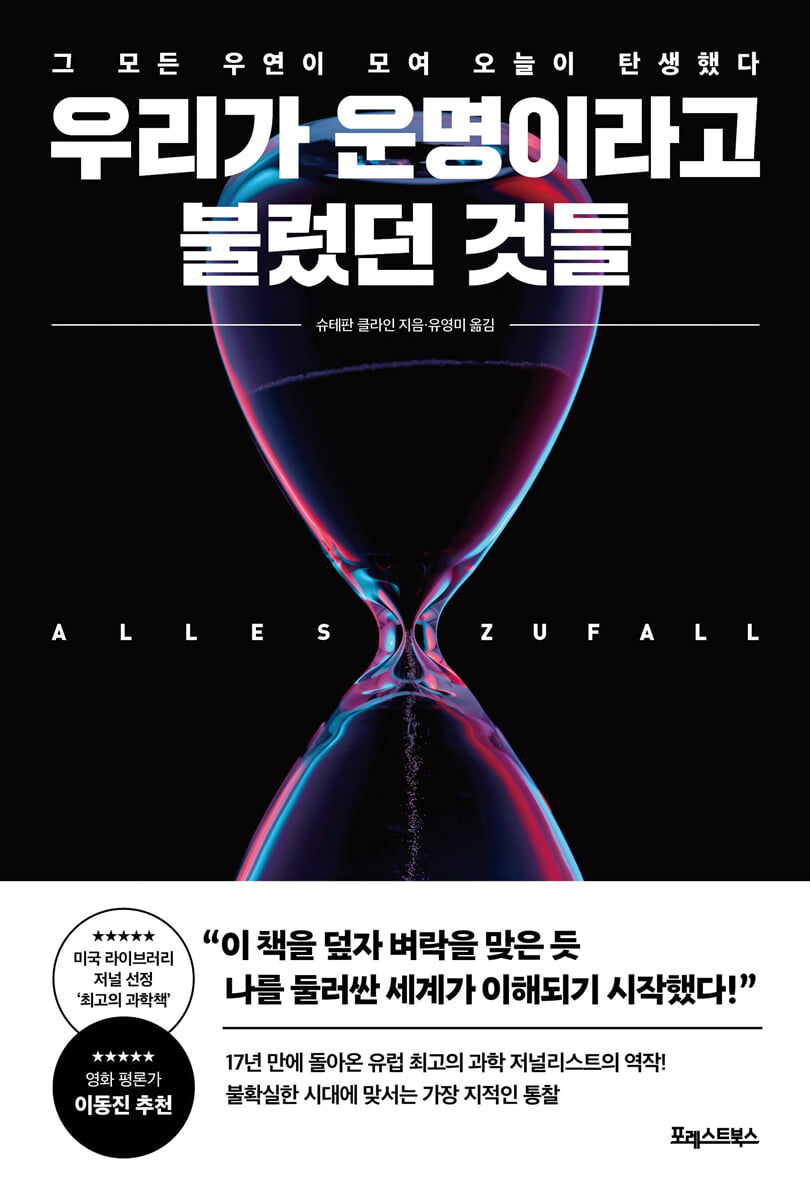
What we called destiny
 |
Description
Book Introduction
- A word from MD
- Things I believed were fateThe essential force that has governed our lives, as well as the history of mankind, is not fate, but chance.
Science journalist Stefan Klein explores all the coincidences that shaped our present day, drawing on biology, philosophy, and psychology, and offers solutions to break free from the shackles of fate and make chance your life's companion.
February 28, 2023. Natural Science PD Ahn Hyun-jae
★★★ Recommended by film critic Lee Dong-jin
★★★ The most intelligent insight to face uncertain times.
★★★ Stefan Klein's masterpiece reissued after 17 years
“All those coincidences came together to create today!”
Surrounding humans who believe in fate and a world ruled by chance
A surprisingly interesting and fascinating story
Since time immemorial, humanity has instinctively rejected uncertain situations with unknown causes in order to survive and has sought to somehow find rules for the world.
These attempts led to the development of physics and statistics, and on the other hand, they developed a fatalistic worldview that the world proceeds according to a predetermined 'fate'.
But regardless of human effort, the world continues to be plagued by increasingly unpredictable variables, such as a sudden earthquake that shakes a nation to its core and the COVID-19 pandemic that kills millions.
Can we still trust in fate, or should we resign ourselves to this uncertain and chance world?
Stefan Klein, a world-renowned science journalist and author of What We Call Fate (original title: Alles zufall), says that human life is nothing more than a sum of events created by chance, and that the belief that this world will roll along according to some rules or fate is nothing more than a “lovely illusion.”
But that doesn't mean you have to feel like you're left defenseless to the whims of life.
In fact, coincidence holds infinite possibilities that are more mysterious and romantic than fate.
In fact, chance gives us 'freedom' rather than anxiety, and provides a chance for survival not only to the strong but also to the weak and various species.
Is that all?
If we knew that countless historical events and fateful loves were possible thanks to 'coincidence', this world full of coincidences would look different.
Film critic Lee Dong-jin, who recommended this book, said in his review of a film, “Fate is the rhetoric of chance, and chance is the physics of destiny.”
This means that if you interpret coincidence by adding meaning to it, it becomes 'fate', and if you analyze fate through physics, it becomes 'coincidence'.
In the end, chance and fate are like two sides of a coin, and the difference is only determined by how you view the same event.
As we explore the layers of illusion and misunderstanding surrounding fate and chance, crossing over from neuroscience to biology, philosophy, and psychology, this book will eventually lead us to these questions.
“Is it God or I who turns coincidence into fate?” “Am I not living trapped in the framework of fate, trying to avoid the occasional rain?” After its publication, this book received favorable reviews for “breaking everyday conventions and shattering collective errors” and was selected as one of the “Best Science Books” by the American Library Journal. It provides a broad perspective on the world and will deliver an unexpected gift of comfort to those who feel endless anxiety and emptiness in uncertain times.
★★★ The most intelligent insight to face uncertain times.
★★★ Stefan Klein's masterpiece reissued after 17 years
“All those coincidences came together to create today!”
Surrounding humans who believe in fate and a world ruled by chance
A surprisingly interesting and fascinating story
Since time immemorial, humanity has instinctively rejected uncertain situations with unknown causes in order to survive and has sought to somehow find rules for the world.
These attempts led to the development of physics and statistics, and on the other hand, they developed a fatalistic worldview that the world proceeds according to a predetermined 'fate'.
But regardless of human effort, the world continues to be plagued by increasingly unpredictable variables, such as a sudden earthquake that shakes a nation to its core and the COVID-19 pandemic that kills millions.
Can we still trust in fate, or should we resign ourselves to this uncertain and chance world?
Stefan Klein, a world-renowned science journalist and author of What We Call Fate (original title: Alles zufall), says that human life is nothing more than a sum of events created by chance, and that the belief that this world will roll along according to some rules or fate is nothing more than a “lovely illusion.”
But that doesn't mean you have to feel like you're left defenseless to the whims of life.
In fact, coincidence holds infinite possibilities that are more mysterious and romantic than fate.
In fact, chance gives us 'freedom' rather than anxiety, and provides a chance for survival not only to the strong but also to the weak and various species.
Is that all?
If we knew that countless historical events and fateful loves were possible thanks to 'coincidence', this world full of coincidences would look different.
Film critic Lee Dong-jin, who recommended this book, said in his review of a film, “Fate is the rhetoric of chance, and chance is the physics of destiny.”
This means that if you interpret coincidence by adding meaning to it, it becomes 'fate', and if you analyze fate through physics, it becomes 'coincidence'.
In the end, chance and fate are like two sides of a coin, and the difference is only determined by how you view the same event.
As we explore the layers of illusion and misunderstanding surrounding fate and chance, crossing over from neuroscience to biology, philosophy, and psychology, this book will eventually lead us to these questions.
“Is it God or I who turns coincidence into fate?” “Am I not living trapped in the framework of fate, trying to avoid the occasional rain?” After its publication, this book received favorable reviews for “breaking everyday conventions and shattering collective errors” and was selected as one of the “Best Science Books” by the American Library Journal. It provides a broad perspective on the world and will deliver an unexpected gift of comfort to those who feel endless anxiety and emptiness in uncertain times.
- You can preview some of the book's contents.
Preview
index
Introductory remarks.
To you who opened this book as if by fate
Part 1.
The illusion of fate
Chapter 1.
Unbelievable twists of fate
Chapter 2.
Someone is bound to win the lottery
Chapter 3.
God doesn't play dice?
Chapter 4.
All those prophecies are impossible
Chapter 5.
Why I believe coincidence is fate
Part 2.
A world created by chance
Chapter 6.
Everything in human history is due to chance.
Chapter 7.
A chance victory over superiority
Chapter 8.
An unexpected stroke of luck created by chance
Chapter 9.
Parenting, Love, and Chance Relationships
Part 3.
People who are afraid of coincidences
Chapter 10.
The illusion that everything happens for a reason
Chapter 11.
The brain rejects chance
Chapter 12.
Why Last Place is More Comfortable than First Place
Chapter 13.
The only place that is completely safe is prison.
Part 4.
How to survive in an uncertain world
Chapter 14.
How to protect myself from accidental accidents
Chapter 15.
How to Make Good Choices in an Uncertain World
Chapter 16.
How to Turn Chance into Opportunity
To you who opened this book as if by fate
Part 1.
The illusion of fate
Chapter 1.
Unbelievable twists of fate
Chapter 2.
Someone is bound to win the lottery
Chapter 3.
God doesn't play dice?
Chapter 4.
All those prophecies are impossible
Chapter 5.
Why I believe coincidence is fate
Part 2.
A world created by chance
Chapter 6.
Everything in human history is due to chance.
Chapter 7.
A chance victory over superiority
Chapter 8.
An unexpected stroke of luck created by chance
Chapter 9.
Parenting, Love, and Chance Relationships
Part 3.
People who are afraid of coincidences
Chapter 10.
The illusion that everything happens for a reason
Chapter 11.
The brain rejects chance
Chapter 12.
Why Last Place is More Comfortable than First Place
Chapter 13.
The only place that is completely safe is prison.
Part 4.
How to survive in an uncertain world
Chapter 14.
How to protect myself from accidental accidents
Chapter 15.
How to Make Good Choices in an Uncertain World
Chapter 16.
How to Turn Chance into Opportunity
Detailed image

Into the book
The effect of chance is similar to stacking stones to build a hill.
You can't get a decent shape by just stacking a few stones.
However, if you collect a lot of stones, even if the surface is still jagged and full of holes when viewed up close, when viewed from a distance, those unevenness will disappear and a fairly smooth hill will form.
Likewise, when we observe countless individual coincidences from a distance, that is, when we observe numerous similar events, they blend together into a harmonious whole.
--- p.39
We create our own future, we can influence it with our decisions, and because of that, we can only make limited statements about the future.
The more we get involved in something and the greater our influence, the more unpredictable the outcome becomes.
Therefore, paradoxically, our inability to plan our lives arbitrarily is the price we pay for the freedom we enjoy.
Because our brains are not designed to see the future, but rather, as French writer Paul Valéry put it, “to create the future.”
--- p.75
In unstable circumstances, chance can drive out innovation before it even arrives, just as a antelope is devoured by a lion.
But that very coincidence may help something new.
Unpredictable changes, such as a pandemic wiping out the establishment, can push out established ideas and empower spurred by burgeoning inventions.
Chance often fights on the side of the weak, granting them opportunities that would otherwise be impossible.
Consider the case of the lame antelope.
Under normal circumstances, a small number of lame antelopes would become prey to natural enemies and deprive the existing antelopes of tasty grass.
But if a virus wipes out half the herd, the tables can turn.
--- p.144
What strategies can you employ to win at rock-paper-scissors? The simplest way is to keep playing the same moves, but this strategy is quickly exposed after just a few rounds.
So what if we kept repeating the same sequence, playing rock after rock, then scissors after rock, and so on? This also didn't last long.
The opponent will quickly figure out our strategy.
It is also not a good strategy to follow a specific formula related to your opponent's actions, such as never playing what your opponent played just before.
So what's the best strategy? Ultimately, the answer is to leave it to chance.
The idea is to be unpredictable and random in order to get ahead of your opponent or at least not fall behind.
Like a rabbit zigzagging across a field.
--- p.161
People with paranoia look for hidden meanings everywhere.
Overconfident in one's own knowledge and distrustful of others.
Looking at this aspect alone, it is clear that he has a very bad personality.
But paranoid thinking has its benefits too.
Isn't it precisely this very characteristic that gives birth to great writers? Throughout history, writers have been those who keenly perceive what others overlook.
It's not just artists.
Strindbergian thoughts and feelings are actually familiar to all of us.
He gives a somewhat exaggerated, but concise, look at how we deal with chance.
How difficult it is to recognize coincidence as coincidence.
Who wouldn't be angry and ask, "How can this be?" if they left their umbrella at home for a single day and it started pouring rain? And who hasn't had a precognitive dream? We may at best verbally acknowledge coincidence, but deep down, we firmly believe that none of this is coincidence.
--- p.201
When a crisis hits in life, the desire to explain it becomes so strong that we often turn the blame on ourselves.
When something traumatic happens, trying to interpret it can be even more damaging.
For example, someone who has survived a plane crash, witnessed violence unfold before their eyes, or experienced the death of a loved one wants answers to why they survived and others did not, and most importantly, why these unfortunate events occurred.
But there is no answer.
But the brain is not satisfied with no answer.
So, they start making up groundless excuses for themselves.
And that often leads to guilt.
Even though he could not undo it or influence it at all.
--- p.243
Coincidence guides us out of the castle of our thoughts and into reality.
Therefore, allowing more room for the unexpected is not only a transformative adventure, it sharpens our perception and gives us a completely different feeling about time.
Chance teaches us caution.
This is the greatest gift that chance gives us.
Coincidence makes us sensitive to the present.
Isn't the present moment all we have? Being open to chance is living vibrantly.
You can't get a decent shape by just stacking a few stones.
However, if you collect a lot of stones, even if the surface is still jagged and full of holes when viewed up close, when viewed from a distance, those unevenness will disappear and a fairly smooth hill will form.
Likewise, when we observe countless individual coincidences from a distance, that is, when we observe numerous similar events, they blend together into a harmonious whole.
--- p.39
We create our own future, we can influence it with our decisions, and because of that, we can only make limited statements about the future.
The more we get involved in something and the greater our influence, the more unpredictable the outcome becomes.
Therefore, paradoxically, our inability to plan our lives arbitrarily is the price we pay for the freedom we enjoy.
Because our brains are not designed to see the future, but rather, as French writer Paul Valéry put it, “to create the future.”
--- p.75
In unstable circumstances, chance can drive out innovation before it even arrives, just as a antelope is devoured by a lion.
But that very coincidence may help something new.
Unpredictable changes, such as a pandemic wiping out the establishment, can push out established ideas and empower spurred by burgeoning inventions.
Chance often fights on the side of the weak, granting them opportunities that would otherwise be impossible.
Consider the case of the lame antelope.
Under normal circumstances, a small number of lame antelopes would become prey to natural enemies and deprive the existing antelopes of tasty grass.
But if a virus wipes out half the herd, the tables can turn.
--- p.144
What strategies can you employ to win at rock-paper-scissors? The simplest way is to keep playing the same moves, but this strategy is quickly exposed after just a few rounds.
So what if we kept repeating the same sequence, playing rock after rock, then scissors after rock, and so on? This also didn't last long.
The opponent will quickly figure out our strategy.
It is also not a good strategy to follow a specific formula related to your opponent's actions, such as never playing what your opponent played just before.
So what's the best strategy? Ultimately, the answer is to leave it to chance.
The idea is to be unpredictable and random in order to get ahead of your opponent or at least not fall behind.
Like a rabbit zigzagging across a field.
--- p.161
People with paranoia look for hidden meanings everywhere.
Overconfident in one's own knowledge and distrustful of others.
Looking at this aspect alone, it is clear that he has a very bad personality.
But paranoid thinking has its benefits too.
Isn't it precisely this very characteristic that gives birth to great writers? Throughout history, writers have been those who keenly perceive what others overlook.
It's not just artists.
Strindbergian thoughts and feelings are actually familiar to all of us.
He gives a somewhat exaggerated, but concise, look at how we deal with chance.
How difficult it is to recognize coincidence as coincidence.
Who wouldn't be angry and ask, "How can this be?" if they left their umbrella at home for a single day and it started pouring rain? And who hasn't had a precognitive dream? We may at best verbally acknowledge coincidence, but deep down, we firmly believe that none of this is coincidence.
--- p.201
When a crisis hits in life, the desire to explain it becomes so strong that we often turn the blame on ourselves.
When something traumatic happens, trying to interpret it can be even more damaging.
For example, someone who has survived a plane crash, witnessed violence unfold before their eyes, or experienced the death of a loved one wants answers to why they survived and others did not, and most importantly, why these unfortunate events occurred.
But there is no answer.
But the brain is not satisfied with no answer.
So, they start making up groundless excuses for themselves.
And that often leads to guilt.
Even though he could not undo it or influence it at all.
--- p.243
Coincidence guides us out of the castle of our thoughts and into reality.
Therefore, allowing more room for the unexpected is not only a transformative adventure, it sharpens our perception and gives us a completely different feeling about time.
Chance teaches us caution.
This is the greatest gift that chance gives us.
Coincidence makes us sensitive to the present.
Isn't the present moment all we have? Being open to chance is living vibrantly.
--- p.349
Publisher's Review
“Humanity is governed by only two things:
“One is time, and the other is chance.”
·Are natural disasters really a revelation from God?
·The brain that wants a safe prison rather than an uneasy freedom
·Characteristics of people who choose their own lottery numbers
·Why the weaker one has the advantage when things are left to chance
·The more you predict, the more the laws of quantum mechanics break down
A world where unbelievable tragedy and miraculous luck coexist.
About all the 'coincidences' we wanted to believe were fate.
“On September 10, 2001, a man left his job to start his own business.
And the next day, September 11th.
He saw that the building where he had been working until yesterday had been reduced to rubble by a terrorist attack.
He miraculously survived by a day's difference.
And on the morning of November 12th, he boarded a plane heading home, but the plane crashed shortly after takeoff.
“Were the series of unfortunate accidents he suffered really a twist of fate, or just a freak coincidence?”
Why does nature claim tens of thousands of lives without warning? Why do house prices and stocks plummet the moment I buy them? How did dinosaurs go extinct, while humans, much smaller and weaker than dinosaurs, survive? Why do some people win the lottery, while others are struck by lightning? Sometimes, life feels like a giant dice game.
This is because we often see cases where some people are chosen at random without any specific rules or rational reasons, and some people experience unexpected misfortune while others experience unexpected luck.
The dictionary defines something that is unpredictable and has no known cause as 'coincidence'.
But something feels off about believing that everything in the world just happens by chance.
Yet, there are too many absurd events to believe that everything is governed by some unknowable fate or inevitability. When we hear that a kind and honest neighbor lost his life in an accident on his wedding anniversary, or that a sex offender won the lottery, we're even more reluctant to believe that all of this is fate.
Stefan Klein, the author of this book, has been paying attention to this dilemma for a long time.
As a science journalist, he began his research to find his way through a complex world.
As a result, we discovered that there is no place where the power of 'chance' does not extend, from the birth of mankind to its evolution, to the extinction of dinosaurs and the changes of the Earth, to various historical events and even the emotion of love.
He, who received praise for his international bestseller, “The Formula for Happiness, Explained as Easily as Possible,” saying, “He packs enough knowledge into one book to fill an entire library shelf,” has also compiled interesting research and experiments, historical events, and everyday examples in this book to delve into the “fate” we believed in and the essential force that has ruled the world, “chance.”
“I closed this book and it was like I was struck by lightning.
“The world around me began to make sense!”
From brain science to biology, philosophy, and psychology,
A captivating story that breaks everyday conventions
Spanning physics, biology, neuroscience, philosophy, and even literature, this book offers a captivating intellectual exploration, brimming with a surprisingly vast body of knowledge and case studies more compelling than any detective novel.
Part 1, "The Illusion of Fate," introduces the strange events we have called the tricks of fate, and explores attempts to understand the laws of the world and control chance through physics and statistics.
And in Part 2, “A World Created by Chance,” it talks about chance as the creator who made the birth and evolution of various life forms possible.
It also examines the influence of chance on an individual's personality development and even on choosing a spouse.
Part 3, “People Who Are Afraid of Chance,” analyzes the human psychology and behavior of avoiding uncertain situations through brain science and various experimental results.
And finally, Part 4, “How to Survive in an Uncertain World,” teaches us how to make the “best choice” in an unpredictable world and how to let go of the obsession with controlling our lives and live by allowing luck to intervene.
The study of chance, like the study of the origins of the universe or life, is a task that uncovers great mysteries of scholarship, but it is ultimately closely connected to the journey of life.
Beyond simply explaining the human belief in fate and the world ruled by chance, this book guides us to the attitudes we need to adopt to bridge the gap between them. It will provide readers with an opportunity to seriously reflect on life, beyond just an interesting intellectual pursuit.
"If you don't allow for chance, you can't achieve 'miracles'."
The most intellectual and scientific consolation for understanding an absurd and uncertain world.
Just as 'time' flows regardless of our will, 'coincidence' also exists by our side anytime, anywhere, regardless of our expectations or wishes.
So, even if we look at our fortunes and weather forecasts countless times every year, we can never completely control our lives.
But that doesn't mean you have to give up or fall into doubt.
Anyway, the world we live in is divided into two.
A world that individuals can control and a world that they cannot control.
Distinguishing between these two is the most essential task and weapon for living in this world.
So, rather than wasting your life trying to control everything that's uncertain, or wasting your energy trying to explain away the many things that just happened by chance, why not live today, in the present?
“Time does not move in a straight line.
Time is not an arrow that moves towards a goal.
Rather, it is similar to a tree whose branches are becoming more and more lush.
Nature moves forward with haphazard steps, and sometimes retreats.
Nature produces more variety in this way.
Therefore, can we expect that only our lives will proceed according to plan without any curves?” - p. 347
Chance is not a distraction that interferes with your life.
Just as the word 'chance' means coincidence, but also 'opportunity' or 'luck', coincidence can bring anxiety and danger, but depending on how we think about it, it can be turned into unexpected 'luck'.
If you feel endless anxiety in an age where you can't see even an inch ahead, open this book.
You will learn a wise attitude toward navigating an uncertain world and how to seize the luck that comes your way.
“One is time, and the other is chance.”
·Are natural disasters really a revelation from God?
·The brain that wants a safe prison rather than an uneasy freedom
·Characteristics of people who choose their own lottery numbers
·Why the weaker one has the advantage when things are left to chance
·The more you predict, the more the laws of quantum mechanics break down
A world where unbelievable tragedy and miraculous luck coexist.
About all the 'coincidences' we wanted to believe were fate.
“On September 10, 2001, a man left his job to start his own business.
And the next day, September 11th.
He saw that the building where he had been working until yesterday had been reduced to rubble by a terrorist attack.
He miraculously survived by a day's difference.
And on the morning of November 12th, he boarded a plane heading home, but the plane crashed shortly after takeoff.
“Were the series of unfortunate accidents he suffered really a twist of fate, or just a freak coincidence?”
Why does nature claim tens of thousands of lives without warning? Why do house prices and stocks plummet the moment I buy them? How did dinosaurs go extinct, while humans, much smaller and weaker than dinosaurs, survive? Why do some people win the lottery, while others are struck by lightning? Sometimes, life feels like a giant dice game.
This is because we often see cases where some people are chosen at random without any specific rules or rational reasons, and some people experience unexpected misfortune while others experience unexpected luck.
The dictionary defines something that is unpredictable and has no known cause as 'coincidence'.
But something feels off about believing that everything in the world just happens by chance.
Yet, there are too many absurd events to believe that everything is governed by some unknowable fate or inevitability. When we hear that a kind and honest neighbor lost his life in an accident on his wedding anniversary, or that a sex offender won the lottery, we're even more reluctant to believe that all of this is fate.
Stefan Klein, the author of this book, has been paying attention to this dilemma for a long time.
As a science journalist, he began his research to find his way through a complex world.
As a result, we discovered that there is no place where the power of 'chance' does not extend, from the birth of mankind to its evolution, to the extinction of dinosaurs and the changes of the Earth, to various historical events and even the emotion of love.
He, who received praise for his international bestseller, “The Formula for Happiness, Explained as Easily as Possible,” saying, “He packs enough knowledge into one book to fill an entire library shelf,” has also compiled interesting research and experiments, historical events, and everyday examples in this book to delve into the “fate” we believed in and the essential force that has ruled the world, “chance.”
“I closed this book and it was like I was struck by lightning.
“The world around me began to make sense!”
From brain science to biology, philosophy, and psychology,
A captivating story that breaks everyday conventions
Spanning physics, biology, neuroscience, philosophy, and even literature, this book offers a captivating intellectual exploration, brimming with a surprisingly vast body of knowledge and case studies more compelling than any detective novel.
Part 1, "The Illusion of Fate," introduces the strange events we have called the tricks of fate, and explores attempts to understand the laws of the world and control chance through physics and statistics.
And in Part 2, “A World Created by Chance,” it talks about chance as the creator who made the birth and evolution of various life forms possible.
It also examines the influence of chance on an individual's personality development and even on choosing a spouse.
Part 3, “People Who Are Afraid of Chance,” analyzes the human psychology and behavior of avoiding uncertain situations through brain science and various experimental results.
And finally, Part 4, “How to Survive in an Uncertain World,” teaches us how to make the “best choice” in an unpredictable world and how to let go of the obsession with controlling our lives and live by allowing luck to intervene.
The study of chance, like the study of the origins of the universe or life, is a task that uncovers great mysteries of scholarship, but it is ultimately closely connected to the journey of life.
Beyond simply explaining the human belief in fate and the world ruled by chance, this book guides us to the attitudes we need to adopt to bridge the gap between them. It will provide readers with an opportunity to seriously reflect on life, beyond just an interesting intellectual pursuit.
"If you don't allow for chance, you can't achieve 'miracles'."
The most intellectual and scientific consolation for understanding an absurd and uncertain world.
Just as 'time' flows regardless of our will, 'coincidence' also exists by our side anytime, anywhere, regardless of our expectations or wishes.
So, even if we look at our fortunes and weather forecasts countless times every year, we can never completely control our lives.
But that doesn't mean you have to give up or fall into doubt.
Anyway, the world we live in is divided into two.
A world that individuals can control and a world that they cannot control.
Distinguishing between these two is the most essential task and weapon for living in this world.
So, rather than wasting your life trying to control everything that's uncertain, or wasting your energy trying to explain away the many things that just happened by chance, why not live today, in the present?
“Time does not move in a straight line.
Time is not an arrow that moves towards a goal.
Rather, it is similar to a tree whose branches are becoming more and more lush.
Nature moves forward with haphazard steps, and sometimes retreats.
Nature produces more variety in this way.
Therefore, can we expect that only our lives will proceed according to plan without any curves?” - p. 347
Chance is not a distraction that interferes with your life.
Just as the word 'chance' means coincidence, but also 'opportunity' or 'luck', coincidence can bring anxiety and danger, but depending on how we think about it, it can be turned into unexpected 'luck'.
If you feel endless anxiety in an age where you can't see even an inch ahead, open this book.
You will learn a wise attitude toward navigating an uncertain world and how to seize the luck that comes your way.
GOODS SPECIFICS
- Date of issue: February 22, 2023
- Page count, weight, size: 352 pages | 582g | 152*225*20mm
- ISBN13: 9791192625270
- ISBN10: 1192625277
You may also like
카테고리
korean


korean

![GQ KOREA Mark (Monthly): December [2025]](http://librairie.coreenne.fr/cdn/shop/files/8ef265dbbfbf186523ed75ba7319009d.jpg?v=1765340328&width=3840)


