

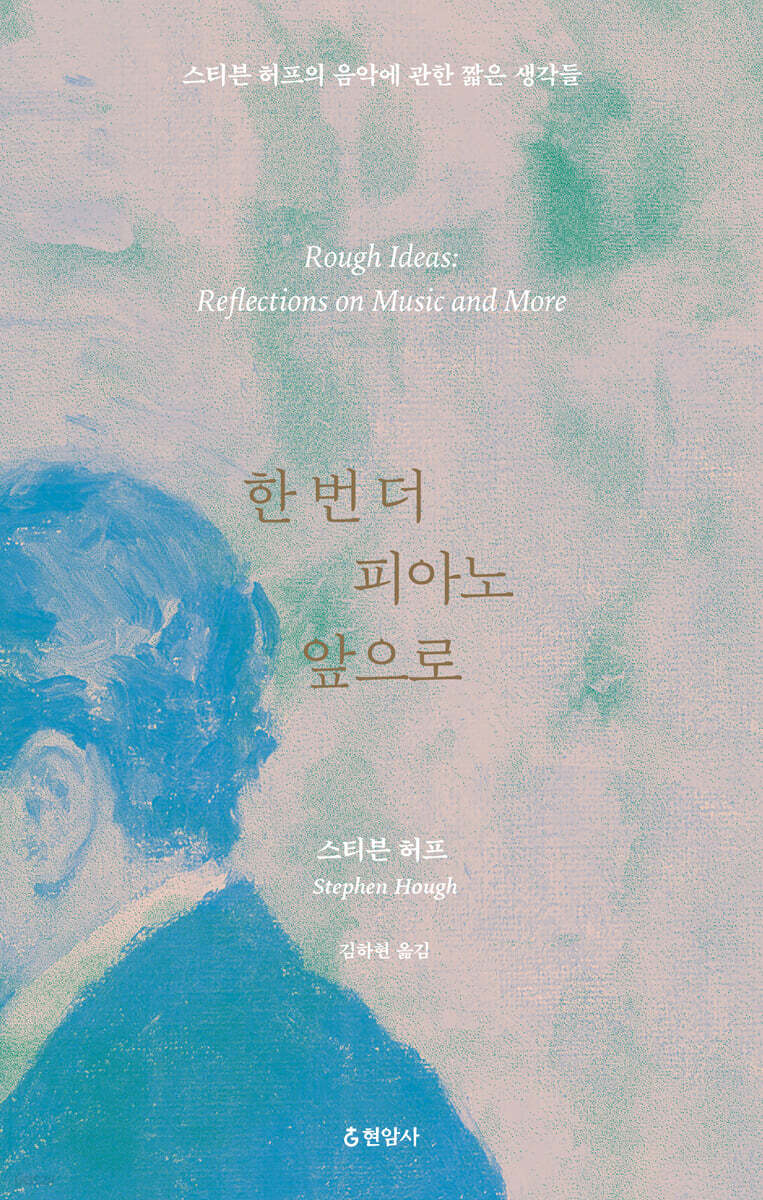
One more time in front of the piano
 |
Description
Book Introduction
Sentences written like melodies by world-renowned concert pianist Stephen Hough
Become the most honest language that tells the story of a musician's life.
Financial Times Book of the Year
World-renowned pianist and composer Stephen Hough meets Korean readers through “Back to the Piano.”
He is a concert pianist who has released over 60 albums and continues to perform around the world. He also teaches piano at the Juilliard School of Music and is an author who writes books in between performing and teaching.
Stephen Hough, who was selected by The Economist as one of the '20 most influential intellectuals' along with Umberto Eco, Jared Diamond, and Oliver Sacks, is an active musician loved by world-class orchestras. He has been invited to festivals such as Salzburg, Mostly Mozart, Edinburgh, and the BBC Proms more than 25 times, and has performed at London's Royal Festival Hall, New York's Carnegie Hall, Lincoln Center, and the Kennedy Center.
He has won the Diapason d'Or and the Grammy Award (Best Chamber Music Performance) and eight other awards from the Gramophone Awards, including Album of the Year and Gold Disc, and is considered one of the greatest pianists of our time.
In Korea, Lim Yun-chan is well known as a judge at the Van Cliburn Competition, where he won the gold medal, and as the composer of the compulsory piece for contestants, "Fanfare Toccata."
His writing, written in simple language and without pretense, is surprising in that it reveals his views on music, education, and religion without reservation.
Stories encompassing his life and values, including episodes from his performances, his (not glamorous) life as a concert pianist, his unique and honest thoughts on music and musicians, messages to his students and juniors, and his concerns as a religious person, have emerged into the world in a unique way that cannot be defined by a single genre.
Written in honest language about music, "One More Piano" will serve as a guidebook, like sheet music, for those who dream of performing, collaborating, and touring and aspiring to become musicians.
For classical music lovers, it will be a music book full of reading material told by experts, and for new essay readers, it will be a collection of essays that provide a glimpse into the lives of musicians.
- You can preview some of the book's contents.
Preview
index
Opening remarks
Discussion board
One more time on stage
Concert pianist in the studio
To music and musicians
And more
Brief Thoughts on Religion
At the end of thought
Acknowledgements
Stephen Hough: Discography 1985–2018
Search
Detailed image

Into the book
Classical music should be equal for everyone.
This is true not only socially but also intergenerationally.
The Beethoven concerto I played that day in Canada was composed 200 years ago.
There must have been someone in the audience that day who was approaching 100 years old, and at dinner after the concert, the conductor and the concertmaster showed me pictures of their babies.
Classical music transcends generations.
Timeless, universal, and ageless.
--- p.24
When I was contemplating becoming a priest, I was drawn to the idea that it was better to save souls than to win arguments.
Indeed, losing an argument with humility, patience, and thoughtful hesitation may be a way to 'fully listen' to the person's soul.
I feel this religious meaning strongly in the concert.
When you walk onto the stage, face the audience, then turn to the side and take your seat.
Most of the audience at this point are complete strangers to me, and their opinions are as varied as the number of butts sitting on the chairs.
I want to be friends with my audience.
I don't want to preach or judge them.
I hope that through the composer's outstanding voice, everyone can overcome controversy and conflict.
If I were to speak directly (and speaking about politics or religion to an audience that is forced to listen to me is always a sermon), some would agree and some would disagree, and an irreducible divide would arise.
--- p.44
Let's compare it to an athlete.
People wouldn't say to tennis player Roger Federer, "What? You're training again? But you already know how to hold a racket, you've played a ton of matches, and you're in great shape."
Of course, replaying a complex piece doesn't take as much time and effort as learning it for the first time.
Just as a great tennis player never forgets how to hit the ball over the net.
However, I think that the effort required to memorize and play a piece you are learning for the first time is similar to the effort required to make a piece you already know truly 'ready'.
Mastering the torrent of 32nd notes in the middle of the third movement is a daunting task, but equally important is working to create the tone, shape, balance, and pedaling I desire from each note.
This is something I sometimes say to a student who has performed a piece accurately and brilliantly in a public class.
'That's great.
But this is just the foundation needed to create a real performance.'
--- p.71
Classical music has a special talent for looking at things from a distance.
Listening to or playing music written 500 years ago and still feeling its voice contemporary is like condensing human experience and experiencing firsthand the wisdom and passion of the past.
Moreover, unlike some entertainments, classical music is not an escape from reality.
As the concert continues, we do not leave behind the deepest human longings.
Rather, it explores the most profound parts of human existence together with the composer.
Music heals us.
Music is not a painkiller, it's an antibiotic.
--- p.98
You don't always have to practice the entire song every day.
For example, for a large sonata, it might be helpful to practice the first movement on Tuesday and the rest on Thursday.
This method can be useful even for short songs.
If you play Chopin's Ballade No. 4 (a difficult piece for any pianist), you only practice the last three pages a day.
Focus on a particularly difficult part, practice calmly and coolly for about an hour, then put it aside and practice another piece.
Then you won't be overwhelmed by the thought that there is too much to practice.
If you carefully practice the tricky coda out of context, you'll feel more at ease when the lights are on and the microphone is poked in next to the piano.
--- p.166
Considering that Liszt had as much influence on 20th-century musical life as he did on 19th-century music, the statement that Franz Liszt was born over 200 years ago seems like a typo.
Born amidst the sounds of the harpsichord, Liszt was the figure who had the greatest inspiration and influence on the emergence and development of the modern piano.
Liszt, who grew up in a world where pianists played just one piece from a jumbled concert program, eventually invented the piano recital (a word he coined), the star pianist performing in the center of the stage with an enthusiastic audience focused on him all evening.
Liszt, one of the greatest composers and pianists of all time, always included music by other composers in his concert programs.
We tend to forget that in the old days composers usually played their own music and that what they didn't played wasn't played at all, but in terms of generosity towards his colleagues, few could match Liszt, and none surpassed him.
--- p.268
I've walked by the Opera House countless times, but I've never once felt like I'd changed (even if only temporarily).
I've been looking at this building from every possible angle, watching the tiles change color as the sun and clouds move.
I've run my hand over its cold, concise outlines many times, and I've looked out at the harbor dozens of times from the waiting room and cafeteria.
The Opera House is an example of how a remarkable building can almost uniquely produce repeated eureka moments.
These buildings extend time into the space in which they are located.
Painting pushes the air around it in a way that it cannot.
Even the most intimate of pieces, no matter how heavy or massive, can somehow be moved.
A piece can be placed anywhere, but a building is itself 'that place'.
--- p.353
God allows death.
God may be able to prevent death, but every second countless lungs stop breathing, hearts stop beating, and vital organs atrophy and decay.
We want to prolong life by any means necessary, and God points to destruction in heaven.
Sometimes these acts of God may seem completely arbitrary and random.
It's a cruel world of chance.
But if we believe in a God who gave us life, we must also accept a God who deals with death on a scale far greater than we can imagine.
At the core of God lies a black hole of slaughter.
--- p.413
The baptism of art, an eternal dialogue between music and other things.
--- p.479
Publisher's Review
A journey to find the reason for music's existence
Classic, perhaps entirely for the listener
Even at the top of his game, master Stephen Hough begins his book by returning to the most fundamental idea about music: who is listening?
He opens the book by revisiting Wigmore Hall and the church where he auditioned as performance spaces, and then turns to the audience.
To say that classical music should be equal for everyone.
“Classical music transcends generations.
“Timeless, universal, and ageless.” Then he reveals that classical music is not for everyone.
There is a logic of social and economic exclusion, and it is an “effort-requiring” appreciation activity that cannot be easily enjoyed.
This is not the fault of people who do not enjoy classical music, nor is it the fault of difficult pieces.
There is just a time difference.
The author's efforts to overcome jet lag and continue touring consistently, not just through writing, are deeply moving.
Huff concludes his discussion of the audience by emphasizing that attending a classical concert is not a passive experience; the audience is an essential part of the performance.
His efforts to continue working on the album without being discouraged by the series of concert cancellations due to the pandemic are an expression of his strong will to respond to the listeners, the reason for the existence of music.
A story born from boundless love for music and humanity
Stephen Hough, musician and writer
In 『One More Time in Front of the Piano』, the author candidly reveals his love for classical music.
Starting with the affection for Tchaikovsky and Rachmaninoff, which were presented in Korea this August, the performance continues with numerous themes, ranging from Elgar and religion, Beethoven and cadenzas, Brahms' music reminiscent of Dickens, Schubert's human genius, Bowen's stubbornness, Mompou's music with great freedom, his taste for Bach, the realm of performance techniques ignited by Chopin and Liszt, Debussy's influence on jazz and Asian music, and Glenn Gould and modern recordings.
As you read the book, you'll feel like you're on tour with Stephen Huff throughout the season.
His numerous writings, honest, open, and engaging, using simple and clear words, show why the Wall Street Journal called him “a brilliant classical interpreter.”
'One More Time in Front of the Piano' is a variation of the original title 'Rough Ideas' with the author's permission, emphasizing his will to show his love for music through consistent recording and contributions despite the pandemic.
Through the perspective that says that the audience is the reason for the existence of music and that the value of music is the restoration of humanity, the realization of equality, and the encounter with religious good, we encounter an entirely new pianist who speaks fluently not only in performance but also in writing.
A pianist who loved Korea
A message of support to Lim Yoon-chan and the Korean audience.
Stephen Huff, who seeks to connect with the world through his friendly demeanor and comprehensive writing, has been visiting Korea regularly since his first visit in 2007.
Even after the COVID-19 pandemic, they continued to perform in Korea and have a deep connection to Korea, performing without an interpreter or manager.
This August, he presented his performance to Korean fans through collaborations with the Daejeon City Orchestra and Changwon City Orchestra.
He sent a warm reply to his Korean readers through a written interview.
This is a message of great gratitude and envy to Korea, which has such a wonderful audience.
"I just love visiting Korea! Korea has the best audience—young, passionate, focused, and eager to hear great music.
Being so far from home, I feel so blessed to be with this audience through music.
“When I play, it feels like there are a lot of friends in the concert hall.” He also shared his thoughts and encouragement about his relationship with Lim Yoon-chan in the interview.
“I loved Yoon Chan’s performance from the first round and always hoped he would advance to the finals.
And then when Yoon Chan played the list in the semifinals, I felt that he had truly reached a transcendental level.
It was not so much his quick fingers (many people can do that) as his understanding of the rhetoric, vision, and character of the list.
It's not about speed, it's about a kind of inner charisma.
And when we looked at this much more clearly, it appeared to be a slower gait.
Advice for young pianists will vary from person to person.
The biggest risk is that someone at that age could burn out.
This has happened many times.
Even Liszt had to leave the concert because he had too much work to do.
And Van Cliburn himself suffered a similar fate! I hope Yoon Chan-gun feels he has ample time to discover what he seeks.
The young pianist, who has taken his first powerful steps, can now choose where and what he wants to play.
It is a rare luxury.
And he still has decades ahead of him.”
GOODS SPECIFICS
- Publication date: September 21, 2022
- Page count, weight, size: 520 pages | 692g | 140*220*30mm
- ISBN13: 9788932322438
- ISBN10: 8932322430
You may also like
카테고리
korean


korean


