

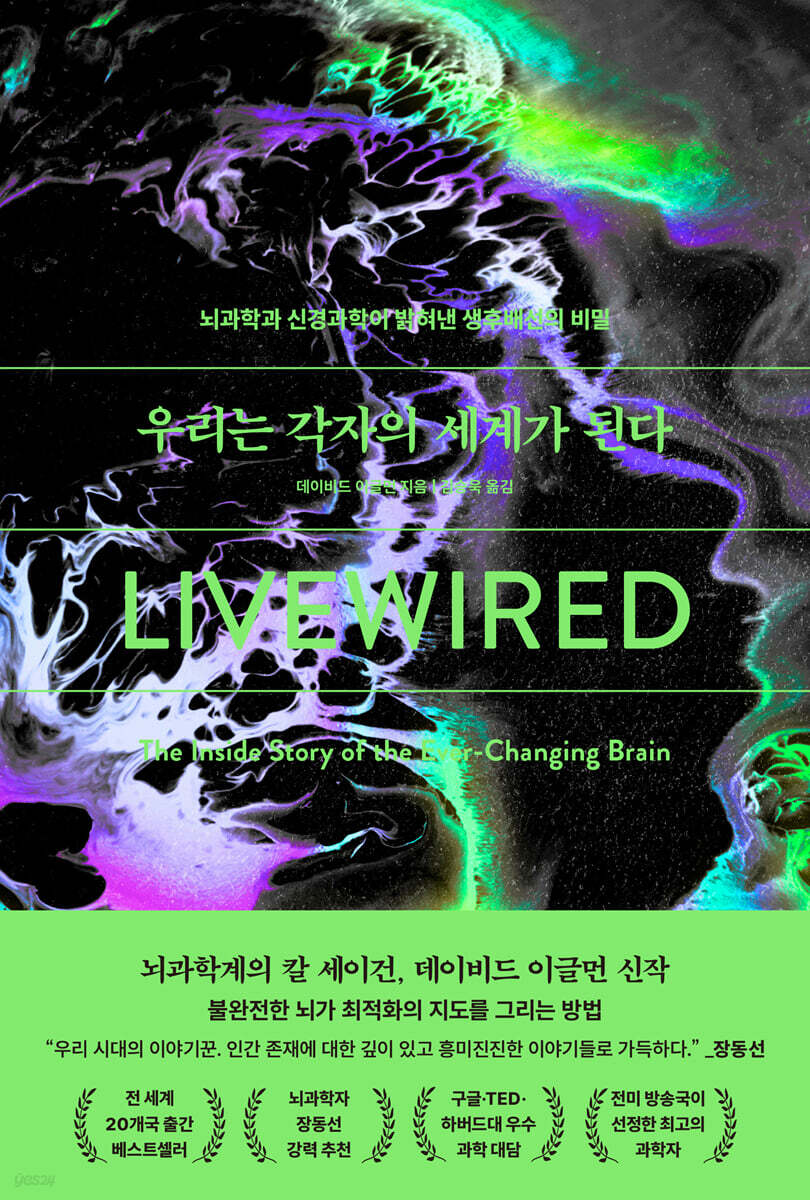
We become our own world
 |
Description
Book Introduction
- A word from MD
-
Our own world, created by the possibilities of our brainsIs there no end to brain development? David Eagleman, a rising young neuroscientist, explores the brain through the concept of "postnatal wiring," which holds that our brains are born incomplete and that connections are crucial.
Numerous studies on how the brain changes depending on the situation show the limitless possibilities of the brain that create our world.
January 3, 2023. Natural Science PD Ahn Hyun-jae
A new book by David Eagleman, the Carl Sagan of neuroscience!
You've only read a few pages of this book, and your brain has changed.
“My favorite neuroscientist.
“The storyteller of our time!” Jang Dong-seon
A new book by David Eagleman, a world-renowned young neuroscientist and bestselling author.
He is currently an associate professor of neuroscience at Stanford University, and has earned the nickname "Carl Sagan of the neuroscience world" for his ability to introduce cutting-edge issues in neuroscience to the general public in an accessible manner.
This book has received rave reviews from leading international media outlets, including The New York Times, The Wall Street Journal, Publisher's Weekly, and The Boston Globe, and is scheduled for publication in over 20 countries around the world.
Dr. Dong-seon Jang, a neuroscientist and director of the Curious Brain Institute, said, “My favorite neuroscientist is David Eagleman,” and wrote about this book, “It is full of deep and fascinating stories about human existence.”
The title of the original book and the theme that runs through the entire book, 'LIVEWIRED', is a new term created by the author after feeling the limitations of the meaning of brain plasticity.
This expression, which translates to 'birth wiring' in Korean, means that just as electrical wires must be connected to turn on a light bulb, our brains are born in an incomplete state and have infinite potential to change, connect, develop, and grow according to the situation.
The key is that the brain is not mapped, but rather shaped by life experiences.
If the previous work, "The Brain," which dealt with the story of the brain, was an introductory book to brain science, this book, "We Become Our Own World," is a sequel that goes one step further and focuses specifically on the characteristics of the "developing and changing brain."
In short, this book stands at a point where it continues to prove the world of human possibility that can change infinitely.
Through various examples, such as how a child with half of his brain removed was able to return to normal life, why appropriate socialization and interaction in childhood are important, and why blind people have developed hearing, it explores how the brain finds a path to optimization according to efficiency.
As Martin Heidegger said, “All men are born many and die as one,” the title contains the meaning that each person’s universe is determined by which of the many possibilities in life they choose, and that my world is ultimately completed at the last moment.
You've only read a few pages of this book, and your brain has changed.
“My favorite neuroscientist.
“The storyteller of our time!” Jang Dong-seon
A new book by David Eagleman, a world-renowned young neuroscientist and bestselling author.
He is currently an associate professor of neuroscience at Stanford University, and has earned the nickname "Carl Sagan of the neuroscience world" for his ability to introduce cutting-edge issues in neuroscience to the general public in an accessible manner.
This book has received rave reviews from leading international media outlets, including The New York Times, The Wall Street Journal, Publisher's Weekly, and The Boston Globe, and is scheduled for publication in over 20 countries around the world.
Dr. Dong-seon Jang, a neuroscientist and director of the Curious Brain Institute, said, “My favorite neuroscientist is David Eagleman,” and wrote about this book, “It is full of deep and fascinating stories about human existence.”
The title of the original book and the theme that runs through the entire book, 'LIVEWIRED', is a new term created by the author after feeling the limitations of the meaning of brain plasticity.
This expression, which translates to 'birth wiring' in Korean, means that just as electrical wires must be connected to turn on a light bulb, our brains are born in an incomplete state and have infinite potential to change, connect, develop, and grow according to the situation.
The key is that the brain is not mapped, but rather shaped by life experiences.
If the previous work, "The Brain," which dealt with the story of the brain, was an introductory book to brain science, this book, "We Become Our Own World," is a sequel that goes one step further and focuses specifically on the characteristics of the "developing and changing brain."
In short, this book stands at a point where it continues to prove the world of human possibility that can change infinitely.
Through various examples, such as how a child with half of his brain removed was able to return to normal life, why appropriate socialization and interaction in childhood are important, and why blind people have developed hearing, it explores how the brain finds a path to optimization according to efficiency.
As Martin Heidegger said, “All men are born many and die as one,” the title contains the meaning that each person’s universe is determined by which of the many possibilities in life they choose, and that my world is ultimately completed at the last moment.
- You can preview some of the book's contents.
Preview
index
Chapter 1: The Delicate Pink Conductor
The Half-Brained Child | Another Secret of Life | If You Don't Have a Tool, Make One | The Always-Changing System
Chapter 2: A World of Addition Only
How to Develop a Great Brain | Experience Requires | Nature's Great Gamble
Chapter 3: The Inner World is a Mirror of the Outer World
The Case of the Silver Spring Monkey | Sir Horatio Nelson's Right Hand Man | Timing is Everything | Colonization is a Work of All Time | The More the Better | Too Fast to Be Seen | What Does Dreaming Have to Do with the Rotation of a Planet? | If It's Like That on the Outside, It's Like That on the Inside
Chapter 4 Using Input Data
Potato Head Technology Takes Over the Planet | Sense Replacement | One-Trick | iTunes | Great Vibrations | Peripheral Augmentation | Imagine a New Sensory Center | Imagine a New Color | Are You Ready for a New Sense?
Chapter 5: How to Get a Better Body
Will the real Dr. Oak raise his hand? | There is no standard blueprint | Motor babble | Motor cortex, marshmallows, and the moon | Ego and control | Toys are our selves | One brain, infinite body forms
Chapter 6: Why What Matters
Perlman's motor cortex vs.
The Ashkenazi Motor Cortex | Shaping the Landscape | The Secret to Success | Allowing Domain Change | The Digital Native Brain
Chapter 7: Why does love only realize its depth at the moment of separation?
A horse in the river | From the unseen to the expected | The difference between what you expect to happen and what actually happens | Where are we headed: light, sugar, or data | Adapting to anticipate the unexpected
Chapter 8: Balancing on the Edge of Change
When Haiti Disappears | How to Evenly Distribute Drug Dealers | How Neurons Expand Their Social Networks | The Great Death Advantage | Is Cancer a Cause of Twisted Plasticity? | Saving the Brain Forest
Chapter 9: Why It's Harder to Teach Older Dogs New Tricks
Born as multiple | Sensitive period | Doors closing at different speeds | Still changing even after all this time
Do you remember chapter 10?
Talking to Your Future Self | The enemy of memory is not time, but other memories | Parts of the brain teach other parts | Beyond the synapse | Layers of different speeds | Different types of memory | Modification by history
Chapter 11: The Wolf and the Mars Exploration Robot
Chapter 12: In Search of the Long-Lost Love of Otto
We have already met the shapeshifters.
It's us.
Acknowledgements | Note | Photo Credit | Search
The Half-Brained Child | Another Secret of Life | If You Don't Have a Tool, Make One | The Always-Changing System
Chapter 2: A World of Addition Only
How to Develop a Great Brain | Experience Requires | Nature's Great Gamble
Chapter 3: The Inner World is a Mirror of the Outer World
The Case of the Silver Spring Monkey | Sir Horatio Nelson's Right Hand Man | Timing is Everything | Colonization is a Work of All Time | The More the Better | Too Fast to Be Seen | What Does Dreaming Have to Do with the Rotation of a Planet? | If It's Like That on the Outside, It's Like That on the Inside
Chapter 4 Using Input Data
Potato Head Technology Takes Over the Planet | Sense Replacement | One-Trick | iTunes | Great Vibrations | Peripheral Augmentation | Imagine a New Sensory Center | Imagine a New Color | Are You Ready for a New Sense?
Chapter 5: How to Get a Better Body
Will the real Dr. Oak raise his hand? | There is no standard blueprint | Motor babble | Motor cortex, marshmallows, and the moon | Ego and control | Toys are our selves | One brain, infinite body forms
Chapter 6: Why What Matters
Perlman's motor cortex vs.
The Ashkenazi Motor Cortex | Shaping the Landscape | The Secret to Success | Allowing Domain Change | The Digital Native Brain
Chapter 7: Why does love only realize its depth at the moment of separation?
A horse in the river | From the unseen to the expected | The difference between what you expect to happen and what actually happens | Where are we headed: light, sugar, or data | Adapting to anticipate the unexpected
Chapter 8: Balancing on the Edge of Change
When Haiti Disappears | How to Evenly Distribute Drug Dealers | How Neurons Expand Their Social Networks | The Great Death Advantage | Is Cancer a Cause of Twisted Plasticity? | Saving the Brain Forest
Chapter 9: Why It's Harder to Teach Older Dogs New Tricks
Born as multiple | Sensitive period | Doors closing at different speeds | Still changing even after all this time
Do you remember chapter 10?
Talking to Your Future Self | The enemy of memory is not time, but other memories | Parts of the brain teach other parts | Beyond the synapse | Layers of different speeds | Different types of memory | Modification by history
Chapter 11: The Wolf and the Mars Exploration Robot
Chapter 12: In Search of the Long-Lost Love of Otto
We have already met the shapeshifters.
It's us.
Acknowledgements | Note | Photo Credit | Search
Detailed image

Into the book
The thrill of life lies not in who we are, but in who we are becoming.
--- p.30
The newborn human brain is surprisingly immature and must interact with the world to develop fully.
--- p.35
Mother Nature uses a strategy of unpacking the brain's bundle by relying on worldly experiences.
Without worldly experience, the brain cannot develop properly and becomes sick.
Just as a tree grows its branches in fertile soil, the brain also needs fertile soil for social and sensory interaction.
--- p.41
The brain's body map is not pre-imprinted in our genes, but is formed based on input information.
This means that it is experience-dependent.
The brain's body maps are formed as a result of local territorial competition rather than following a predetermined blueprint.
Because neurons that fire signals together form a circuit, areas that are activated together can be seen as adjacent in the brain.
No matter how the body's shape changes, the results are naturally reflected in the brain map.
--- p.76
That in order to become good at one thing, you have to close the door to other things.
Since we only have one life, we follow a certain path depending on what we dedicate ourselves to, and all other paths will forever remain 'roads not taken'.
That's why I started this book with my favorite quote from the philosopher Martin Heidegger:
“All men are born many and die one.”
--- p.275~276
Because of our birth lineage, each of us becomes a vessel of space and time.
--- p.30
The newborn human brain is surprisingly immature and must interact with the world to develop fully.
--- p.35
Mother Nature uses a strategy of unpacking the brain's bundle by relying on worldly experiences.
Without worldly experience, the brain cannot develop properly and becomes sick.
Just as a tree grows its branches in fertile soil, the brain also needs fertile soil for social and sensory interaction.
--- p.41
The brain's body map is not pre-imprinted in our genes, but is formed based on input information.
This means that it is experience-dependent.
The brain's body maps are formed as a result of local territorial competition rather than following a predetermined blueprint.
Because neurons that fire signals together form a circuit, areas that are activated together can be seen as adjacent in the brain.
No matter how the body's shape changes, the results are naturally reflected in the brain map.
--- p.76
That in order to become good at one thing, you have to close the door to other things.
Since we only have one life, we follow a certain path depending on what we dedicate ourselves to, and all other paths will forever remain 'roads not taken'.
That's why I started this book with my favorite quote from the philosopher Martin Heidegger:
“All men are born many and die one.”
--- p.275~276
Because of our birth lineage, each of us becomes a vessel of space and time.
--- p.347
Publisher's Review
The world of possibility already exists within us.
How an Imperfect Brain Maps Optimization
Humans are born into the world with a complete metabolic system.
But unlike the body, the human brain is not born programmed; rather, it interacts with the world and refines its neural circuits.
The brain's map is not drawn, but is completed one by one through experiences we have in life.
As we walk through a world full of possibilities, we will encounter many questions.
How did someone without an arm become the world's greatest archer? Why do we dream while we sleep, and what does dreaming have to do with the rotation of the planet? Why is it said that memories are not a result of time, but of other memories? Why do blind people have more developed senses like touch and hearing? Why can children with savant syndrome solve Rubik's Cubes but not have normal conversations with friends? Can a child with half a brain survive in the world?
What author David Eagleman wants to talk about in this book is, in a word, the infinite possibilities of the brain.
Brain plasticity is a term often used in the field of neuroscience, but Eagleman feels limited by the term brain plasticity, which means that once a shape is formed, it is maintained forever, and proposes a more expanded concept called 'livewired'.
This book's unique point is that it delves deeper into the brain's infinite potential to transform itself throughout life.
'The brain has no end point.'
In a word, “We Become Our Own World” is a process that continues to prove the world of infinite human possibilities.
This book, which connects the brain's constant circuit reconfiguration to real life and the future, suggests that if the brain can find a path to optimization through reorganization of neural circuits, it is possible to apply this principle directly to our future technologies.
The reason why the brains of amateurs are crazy while those of experts are surprisingly quiet has to do with brain optimization.
Experts' brains already have specialized neural circuits, so they don't need to think much.
The brain's map isn't pre-drawn.
Can a child with half a brain survive in this world? Matthew was diagnosed with a rare, chronic inflammatory disease and underwent a hemispherectomy, removing half his brain, at the age of six.
Although he had no control over his body immediately after the surgery, Matthew gradually recovered and returned to a developmental level appropriate for his age through physical and speech therapy.
Now that he's an adult, he can't use his right hand very well and has a slight limp, but other than that, he leads a normal life.
Anyone who sees him for the first time would never guess that he is missing one hemisphere of his brain.
There is also the case of Alice, who was born without one side of her brain.
Alice was born with only the left hemisphere of her brain, and aside from the inability to use her left hand with dexterity, she had normal vision and no other abnormalities.
When we looked at how the neural circuits that are normally distributed across the two hemispheres were connected, we found that fibers extending from both the left and right sides were all connected to the left hemisphere.
In both cases, the brain's remarkable postnatal wiring ability allowed only half the brain to handle all remaining functions.
This is where the brain differs from a computer.
If you cut half the electronics out of a smartphone, it wouldn't work, but our brains can rewire their circuits to compensate for the missing functions.
Also, the most important thing in drawing a new brain map is experience and the surrounding environment.
Just as not everyone born with genes similar to Einstein becomes Einstein, the brain needs a good environment to develop properly.
For the brain to develop, it must be provided with appropriate information at the appropriate time.
The brains of those who did not receive proper parental care in childhood and suffered from social deprivation due to isolation are derailed from the normal developmental path.
If you miss this period when the door closes very quickly, it will be difficult or impossible to open it again.
How to draw the future with a birth chart
As is commonly known, visually impaired people have excellent hearing.
When one sense disappears, another quickly takes its place.
What's even more surprising is that this neural rewiring happens very quickly.
The brain may seem calm, but inside it there is a competition to occupy more space.
Empowered by this, Eagleman puts forward a very interesting hypothesis.
That's why we dream.
When night falls, vision is thrown into darkness.
There is no effect on the senses of touch, hearing, taste, or smell except for sight.
As a result, the visual cortex is at risk of being taken over by other senses every night, and dreams are created to consciously use vision during REM sleep to protect its territory.
Considering the reallocation of territory and its speed, this is a plausible hypothesis.
So if the cortex is that flexible, what are its limits? How can we apply this in the future?
The key lies in ‘sensory substitution.’
If you have a hearing problem, it's common to study how to fix your auditory system.
David Eagleman took a slightly different approach and studied sensory substitution methods from the perspective of postnatal development.
For example, the idea was to allow hearing-impaired people to perceive the world through touch rather than hearing, and they invented vests and wristbands that capture surrounding sounds and allow them to feel them with vibration motors attached to the skin.
The key to all these technologies is brain flexibility.
The brain can dynamically reorganize itself, provided there is a human-made computer device.
Through this, we can give our brain new abilities.
The thrill of life
It depends on what kind of person we are becoming.
So, does age really matter when it comes to brain development? Yes, it does.
The visual cortex of a person who is blind from birth is completely occupied by other senses.
If you lost your sight at age five, your range of vision is less, and if you lost your sight after age ten, your range of vision is much smaller.
This is because as the brain ages, it becomes less flexible and more difficult to rearrange.
There is no need to despair though.
These life trajectories tell us one important truth.
Babies are born with few skills and are extremely malleable, whereas adults sacrifice flexibility to become proficient at specific tasks.
There's a trade-off between adaptability and efficiency: our brains become good at certain tasks, but lose some of their ability to do other things.
As violinist Itzhak Perlman once said when a fan told him he would dedicate his life to achieving such a level of playing, “I did,” to become good at one thing, you have to close the doors to other things.
Since you only live once, depending on what you dedicate yourself to, you will go down a certain path, and all other paths will remain untaken forever.
In this way, we each branch out into our own world.
As expected from a science expert.
An excellent popular science book.
- [Kirkus Review (starred review)]
A book that stands out for its vivid descriptions.
Since Isaac Asimov, no scientist has captured our attention in as many ways as David Eagleman.
It's so surprising that you might be confused as to whether this book was written by Oliver Sacks and William Gibson.
- [Wall Street Journal]
A refreshing look at neuroplasticity.
David Eagleman's skill as a professor, his bold ambitions, and his knowledge of ongoing research will make this excellent work a delight for the curious reader.
- [Publisher's Weekly]
Eagleman's research is vibrant in a way that previous writers failed to do.
- [New Scientist]
There is much to read in this amazing work.
This book is for readers interested in neuroscience, science and technology, and the intersection of the two.
- [Library Journal]
Best public speaker.
Study the mind as Copernicus studied the stars.
- [New York Observer]
David Eagleman provides an accessible summary of the latest research on the unconscious processes that govern our mental lives.
When I see him, the job of a neuroscientist seems so interesting that it makes me want to become a neuroscientist.
- [New York Times]
By presenting the future in a very concrete and vivid way, it reassures us that neuroscience is and will continue to be challenging.
- [Boston Globe]
How an Imperfect Brain Maps Optimization
Humans are born into the world with a complete metabolic system.
But unlike the body, the human brain is not born programmed; rather, it interacts with the world and refines its neural circuits.
The brain's map is not drawn, but is completed one by one through experiences we have in life.
As we walk through a world full of possibilities, we will encounter many questions.
How did someone without an arm become the world's greatest archer? Why do we dream while we sleep, and what does dreaming have to do with the rotation of the planet? Why is it said that memories are not a result of time, but of other memories? Why do blind people have more developed senses like touch and hearing? Why can children with savant syndrome solve Rubik's Cubes but not have normal conversations with friends? Can a child with half a brain survive in the world?
What author David Eagleman wants to talk about in this book is, in a word, the infinite possibilities of the brain.
Brain plasticity is a term often used in the field of neuroscience, but Eagleman feels limited by the term brain plasticity, which means that once a shape is formed, it is maintained forever, and proposes a more expanded concept called 'livewired'.
This book's unique point is that it delves deeper into the brain's infinite potential to transform itself throughout life.
'The brain has no end point.'
In a word, “We Become Our Own World” is a process that continues to prove the world of infinite human possibilities.
This book, which connects the brain's constant circuit reconfiguration to real life and the future, suggests that if the brain can find a path to optimization through reorganization of neural circuits, it is possible to apply this principle directly to our future technologies.
The reason why the brains of amateurs are crazy while those of experts are surprisingly quiet has to do with brain optimization.
Experts' brains already have specialized neural circuits, so they don't need to think much.
The brain's map isn't pre-drawn.
Can a child with half a brain survive in this world? Matthew was diagnosed with a rare, chronic inflammatory disease and underwent a hemispherectomy, removing half his brain, at the age of six.
Although he had no control over his body immediately after the surgery, Matthew gradually recovered and returned to a developmental level appropriate for his age through physical and speech therapy.
Now that he's an adult, he can't use his right hand very well and has a slight limp, but other than that, he leads a normal life.
Anyone who sees him for the first time would never guess that he is missing one hemisphere of his brain.
There is also the case of Alice, who was born without one side of her brain.
Alice was born with only the left hemisphere of her brain, and aside from the inability to use her left hand with dexterity, she had normal vision and no other abnormalities.
When we looked at how the neural circuits that are normally distributed across the two hemispheres were connected, we found that fibers extending from both the left and right sides were all connected to the left hemisphere.
In both cases, the brain's remarkable postnatal wiring ability allowed only half the brain to handle all remaining functions.
This is where the brain differs from a computer.
If you cut half the electronics out of a smartphone, it wouldn't work, but our brains can rewire their circuits to compensate for the missing functions.
Also, the most important thing in drawing a new brain map is experience and the surrounding environment.
Just as not everyone born with genes similar to Einstein becomes Einstein, the brain needs a good environment to develop properly.
For the brain to develop, it must be provided with appropriate information at the appropriate time.
The brains of those who did not receive proper parental care in childhood and suffered from social deprivation due to isolation are derailed from the normal developmental path.
If you miss this period when the door closes very quickly, it will be difficult or impossible to open it again.
How to draw the future with a birth chart
As is commonly known, visually impaired people have excellent hearing.
When one sense disappears, another quickly takes its place.
What's even more surprising is that this neural rewiring happens very quickly.
The brain may seem calm, but inside it there is a competition to occupy more space.
Empowered by this, Eagleman puts forward a very interesting hypothesis.
That's why we dream.
When night falls, vision is thrown into darkness.
There is no effect on the senses of touch, hearing, taste, or smell except for sight.
As a result, the visual cortex is at risk of being taken over by other senses every night, and dreams are created to consciously use vision during REM sleep to protect its territory.
Considering the reallocation of territory and its speed, this is a plausible hypothesis.
So if the cortex is that flexible, what are its limits? How can we apply this in the future?
The key lies in ‘sensory substitution.’
If you have a hearing problem, it's common to study how to fix your auditory system.
David Eagleman took a slightly different approach and studied sensory substitution methods from the perspective of postnatal development.
For example, the idea was to allow hearing-impaired people to perceive the world through touch rather than hearing, and they invented vests and wristbands that capture surrounding sounds and allow them to feel them with vibration motors attached to the skin.
The key to all these technologies is brain flexibility.
The brain can dynamically reorganize itself, provided there is a human-made computer device.
Through this, we can give our brain new abilities.
The thrill of life
It depends on what kind of person we are becoming.
So, does age really matter when it comes to brain development? Yes, it does.
The visual cortex of a person who is blind from birth is completely occupied by other senses.
If you lost your sight at age five, your range of vision is less, and if you lost your sight after age ten, your range of vision is much smaller.
This is because as the brain ages, it becomes less flexible and more difficult to rearrange.
There is no need to despair though.
These life trajectories tell us one important truth.
Babies are born with few skills and are extremely malleable, whereas adults sacrifice flexibility to become proficient at specific tasks.
There's a trade-off between adaptability and efficiency: our brains become good at certain tasks, but lose some of their ability to do other things.
As violinist Itzhak Perlman once said when a fan told him he would dedicate his life to achieving such a level of playing, “I did,” to become good at one thing, you have to close the doors to other things.
Since you only live once, depending on what you dedicate yourself to, you will go down a certain path, and all other paths will remain untaken forever.
In this way, we each branch out into our own world.
As expected from a science expert.
An excellent popular science book.
- [Kirkus Review (starred review)]
A book that stands out for its vivid descriptions.
Since Isaac Asimov, no scientist has captured our attention in as many ways as David Eagleman.
It's so surprising that you might be confused as to whether this book was written by Oliver Sacks and William Gibson.
- [Wall Street Journal]
A refreshing look at neuroplasticity.
David Eagleman's skill as a professor, his bold ambitions, and his knowledge of ongoing research will make this excellent work a delight for the curious reader.
- [Publisher's Weekly]
Eagleman's research is vibrant in a way that previous writers failed to do.
- [New Scientist]
There is much to read in this amazing work.
This book is for readers interested in neuroscience, science and technology, and the intersection of the two.
- [Library Journal]
Best public speaker.
Study the mind as Copernicus studied the stars.
- [New York Observer]
David Eagleman provides an accessible summary of the latest research on the unconscious processes that govern our mental lives.
When I see him, the job of a neuroscientist seems so interesting that it makes me want to become a neuroscientist.
- [New York Times]
By presenting the future in a very concrete and vivid way, it reassures us that neuroscience is and will continue to be challenging.
- [Boston Globe]
GOODS SPECIFICS
- Publication date: December 22, 2022
- Page count, weight, size: 408 pages | 582g | 145*215*25mm
- ISBN13: 9788925577227
- ISBN10: 8925577224
You may also like
카테고리
korean


korean

![GQ KOREA Mark (Monthly): December [2025]](http://librairie.coreenne.fr/cdn/shop/files/8ef265dbbfbf186523ed75ba7319009d.jpg?v=1765340328&width=3840)


