

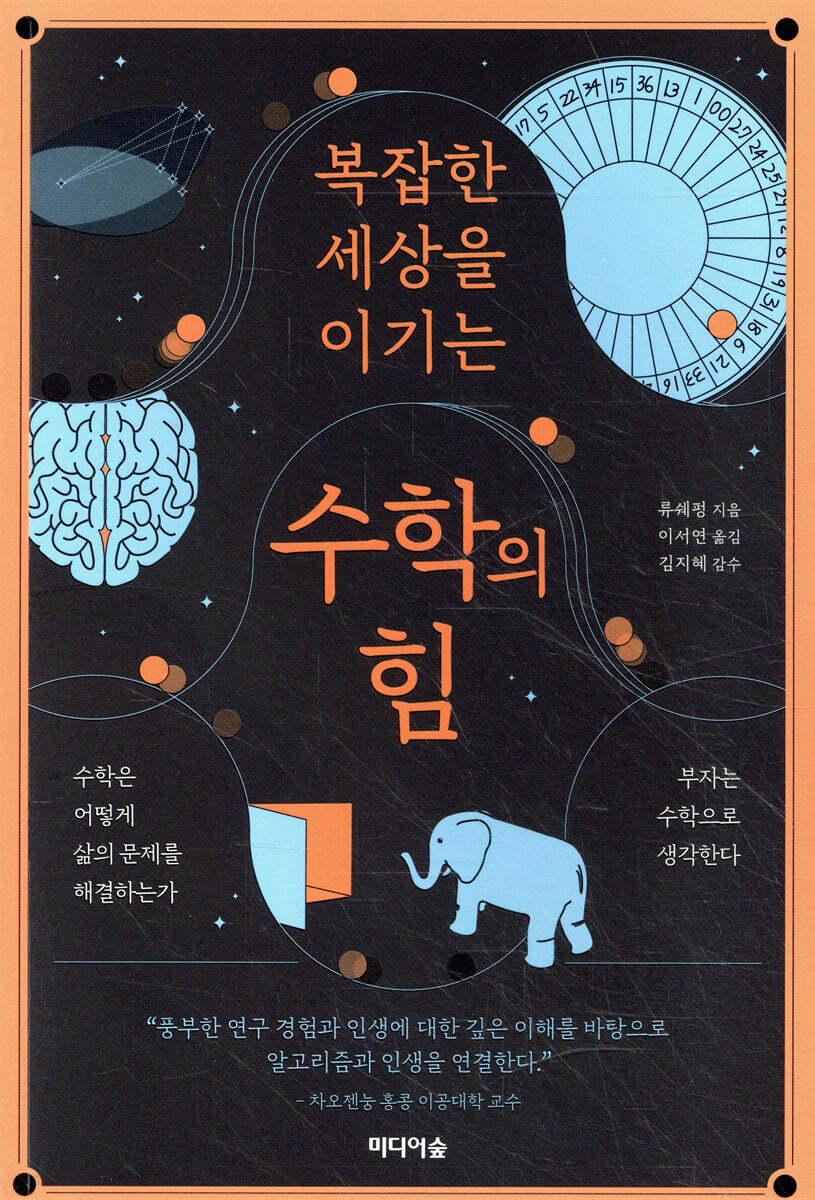
The power of mathematics to overcome a complex world
 |
Description
Book Introduction
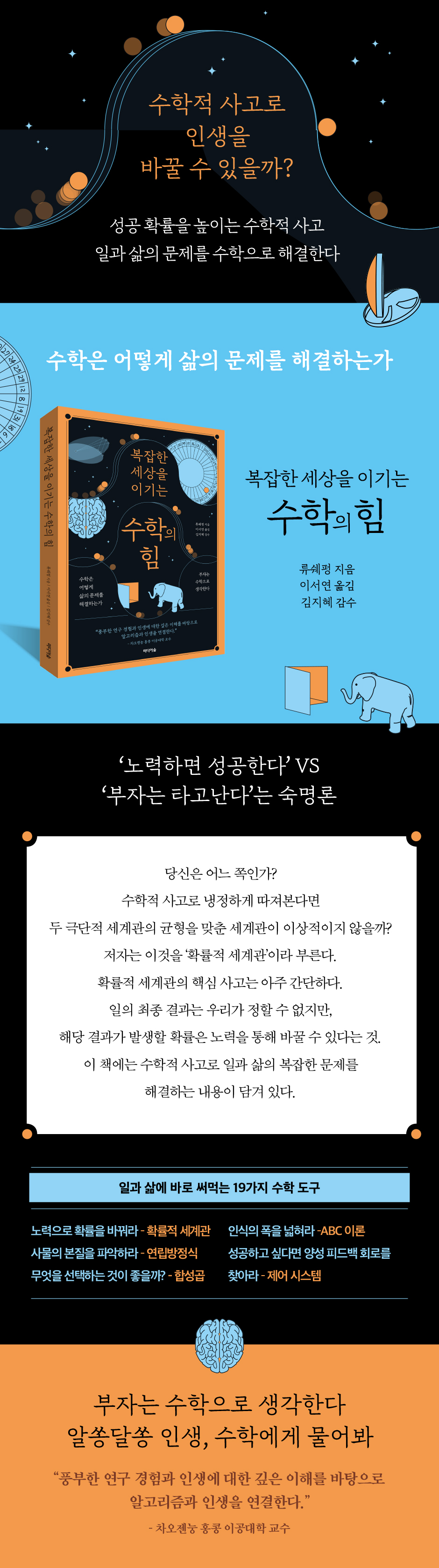
Can mathematical thinking change your life? Mathematical thinking that increases your chances of success Solving work and life problems with mathematics Professor Liu Xuefeng, the author of this book, emphasizes that mathematical thinking can change one's life. By comparing people who believe that "if you work hard, you will succeed" with people who believe that "fate is predetermined," he explains that both people's values are incorrect. People who work hard but don't get the results they want are easily discouraged, and people who think that their fate is predetermined and that there's no need to work hard are far from having a chance of success. The author says that we must have a probabilistic worldview through mathematical thinking. Although the results cannot be guaranteed, it proves that those who believe that they can increase their chances of success through effort can eventually cross the threshold of success without being easily discouraged. Many people think that mathematical concepts are just formulas in a book and have no relevance to our lives. But there is a sparkling wisdom hidden in mathematical concepts. This wisdom helps us see complex societies more clearly and make better choices and decisions. This book contains such mathematical wisdom. From trivial matters like why rice cookers don't burn rice and how to eat peas that are difficult to pick up with chopsticks to larger ones like how to get along with others and how to choose a career, it shows readers how mathematical thinking can help solve a variety of problems in work and life. There is a four-character idiom called 'what is in your heart?' It is interpreted as 'there are numbers in the mind', but in reality it is used to mean 'there is a chance of winning, there is confidence, there is an ulterior motive'. On the other hand, 'mind is numberless' means 'there is no plan, no confidence, no idea what's what's what'. Through this book, many readers will be able to increase their chances of success in life by incorporating mathematical thinking into their minds. |
- You can preview some of the book's contents.
Preview
index
Recommendation
prolog
PART 1: How to Understand the World with Rational Thinking_Thinking
.
Accept the harsh reality and challenge the 99% chance with effort.
.
Make a prediction that no one knows, rather than an interpretation that everyone knows.
.
The showdown between three stupid shoemakers and Zhuge Liang
.
Small but frequent happiness and great but occasional happiness
.
In-depth analysis of the pros and cons
.
Simple rules hidden behind complex phenomena
.
Find the mastermind behind the incident who hid behind the scenes.
.
Air purifier and Kalman filter
PART 2: Strategies and Techniques for Solving Challenges_Methods
.
Positive feedback is better than negative feedback is worse than positive feedback
.
Even the skyscrapers of the century are built from a perfect foundation design.
.
Capture the essence and break free from constraints.
.
The law of large numbers, which increases the probability with repetition
.
The wisdom of moderation to minimize errors
.
The joy of trial and error that is rather a medicine
.
When you can't solve a problem, transform the shape of the object.
.
Gain diverse experiences while you're young
PART 3 Learning Well and Expressing Clearly_Learning Edition
.
Learning through proactive prediction and deviation
.
Find your own optimal learning model!
.
Express yourself clearly and simply from the core.
prolog
PART 1: How to Understand the World with Rational Thinking_Thinking
.
Accept the harsh reality and challenge the 99% chance with effort.
.
Make a prediction that no one knows, rather than an interpretation that everyone knows.
.
The showdown between three stupid shoemakers and Zhuge Liang
.
Small but frequent happiness and great but occasional happiness
.
In-depth analysis of the pros and cons
.
Simple rules hidden behind complex phenomena
.
Find the mastermind behind the incident who hid behind the scenes.
.
Air purifier and Kalman filter
PART 2: Strategies and Techniques for Solving Challenges_Methods
.
Positive feedback is better than negative feedback is worse than positive feedback
.
Even the skyscrapers of the century are built from a perfect foundation design.
.
Capture the essence and break free from constraints.
.
The law of large numbers, which increases the probability with repetition
.
The wisdom of moderation to minimize errors
.
The joy of trial and error that is rather a medicine
.
When you can't solve a problem, transform the shape of the object.
.
Gain diverse experiences while you're young
PART 3 Learning Well and Expressing Clearly_Learning Edition
.
Learning through proactive prediction and deviation
.
Find your own optimal learning model!
.
Express yourself clearly and simply from the core.
Detailed image
Into the book
** George Cayley, who pioneered a new field of aerodynamics, understood the principles of bird flight and proposed a principle that could create upward lift in the form of a fixed wing.
And later, the Wright brothers developed this principle, and mankind was finally able to realize the dream of flying.
This is the thinking that captures the essence and removes limitations.
In order for humans to fly in the sky by imitating the flight of birds, they must first understand the principles of bird flight, that is, aerodynamics.
And based on aerodynamics, it must generate the lift necessary for flight.
If you understand aerodynamics, you'll know that flapping wings is just one way to generate lift, and while it works well for birds, it doesn't work for humans.
** Here we will discuss probability and algorithms using gambling as an example.
Let's talk about how casino operators make money from a mathematical perspective.
If you understand this, you will understand why people who become addicted to gambling end up losing all their money.
And there may be lessons to be learned from this.
** 'Perfect solutions to some equations' and 'incomplete solutions to all equations' represent two different ways of thinking.
First of all, people with the first mindset have the characteristic of being 'narrow-minded'.
So, any logic must be perfectly aligned with one's own perspective before it can be accepted.
These people don't care if what they believe is right isn't actually true.
The problem with perfectionism is that it only accepts what it believes to be right and rejects any viewpoint that conflicts with it, deeming it problematic.
Expressing this as an equation, we can assume that there is a 'unique solution to the system of equations', while only considering some of the equations in the system and ignoring or even eliminating the others.
** The probabilistic worldview has something in common with the old saying, "People plan things, but success is up to Heaven."
We can probably understand this idiom more clearly.
The saying, 'It's people who make things happen' means, 'You can increase your chances of success through effort.'
And the fact that success or failure depends on heaven means that even if you work hard and make all the preparations, there is no guarantee that you will succeed.
If we look at the previously mentioned "effort leads to success" and "fatalism" from the perspective of a probabilistic worldview, we can more clearly understand the problems with both worldviews.
** In this respect, we need to revise the saying, 'Even three stupid cobblers can rival Zhuge Liang when they get together.'
If three dull cobblers were to come together and try to rival Zhuge Liang, their abilities and perspectives on the problem would have to be different.
If three shoemakers have similar perspectives on a problem, no matter how hard they try, they will not be able to defeat Zhuge Liang alone.
** In fact, there are many cases where two events that appear to be related are actually conditionally independent of one another.
So, if we don't dig into the 'other incident' behind it, we can easily mistake 'relevance' for 'causality'.
** Let's go back to the very first problem.
Why should we gain diverse experiences and try out different jobs in a big city when we're young? Because life is really about finding the optimal solution.
No one is perfect from the start.
However, we can constantly strive to improve ourselves and make it our ultimate goal to reach the highest level we can achieve.
This process is consistent with the thinking behind the slope and hill climbing discussed earlier.
And later, the Wright brothers developed this principle, and mankind was finally able to realize the dream of flying.
This is the thinking that captures the essence and removes limitations.
In order for humans to fly in the sky by imitating the flight of birds, they must first understand the principles of bird flight, that is, aerodynamics.
And based on aerodynamics, it must generate the lift necessary for flight.
If you understand aerodynamics, you'll know that flapping wings is just one way to generate lift, and while it works well for birds, it doesn't work for humans.
** Here we will discuss probability and algorithms using gambling as an example.
Let's talk about how casino operators make money from a mathematical perspective.
If you understand this, you will understand why people who become addicted to gambling end up losing all their money.
And there may be lessons to be learned from this.
** 'Perfect solutions to some equations' and 'incomplete solutions to all equations' represent two different ways of thinking.
First of all, people with the first mindset have the characteristic of being 'narrow-minded'.
So, any logic must be perfectly aligned with one's own perspective before it can be accepted.
These people don't care if what they believe is right isn't actually true.
The problem with perfectionism is that it only accepts what it believes to be right and rejects any viewpoint that conflicts with it, deeming it problematic.
Expressing this as an equation, we can assume that there is a 'unique solution to the system of equations', while only considering some of the equations in the system and ignoring or even eliminating the others.
** The probabilistic worldview has something in common with the old saying, "People plan things, but success is up to Heaven."
We can probably understand this idiom more clearly.
The saying, 'It's people who make things happen' means, 'You can increase your chances of success through effort.'
And the fact that success or failure depends on heaven means that even if you work hard and make all the preparations, there is no guarantee that you will succeed.
If we look at the previously mentioned "effort leads to success" and "fatalism" from the perspective of a probabilistic worldview, we can more clearly understand the problems with both worldviews.
** In this respect, we need to revise the saying, 'Even three stupid cobblers can rival Zhuge Liang when they get together.'
If three dull cobblers were to come together and try to rival Zhuge Liang, their abilities and perspectives on the problem would have to be different.
If three shoemakers have similar perspectives on a problem, no matter how hard they try, they will not be able to defeat Zhuge Liang alone.
** In fact, there are many cases where two events that appear to be related are actually conditionally independent of one another.
So, if we don't dig into the 'other incident' behind it, we can easily mistake 'relevance' for 'causality'.
** Let's go back to the very first problem.
Why should we gain diverse experiences and try out different jobs in a big city when we're young? Because life is really about finding the optimal solution.
No one is perfect from the start.
However, we can constantly strive to improve ourselves and make it our ultimate goal to reach the highest level we can achieve.
This process is consistent with the thinking behind the slope and hill climbing discussed earlier.
---From the text
Publisher's Review
19 Math Tools to Understand the Complexities of the World
The world is complicated.
The lives of those who have to live in it cannot be easy, of course.
There are many times when things get so tangled up that it's hard to figure out what's going on or where to start unraveling the mystery.
This is why we need mathematical thinking.
No matter how complex the situation, if you systematically examine it according to mathematical logic, the answer will surface.
And the complex world begins to look simple and clear.
One day, an email arrives at the Pontiac Motor Company from a customer.
The story was that every weekend, a family event was to go for a drive and buy ice cream, but if you buy vanilla ice cream, the car won't start.
It may sound crazy at first, but it's true, so I asked you to please solve the problem.
It didn't make sense, but the engineer checked and found it to be true.
So how can we solve this problem? It all comes down to a mathematical concept called "conditional independence."
The cause of the incomprehensible phenomenon was revealed through simple mathematical thinking, and the car could be easily repaired.
There was once a law passed to prevent London taxi drivers from wearing jackets.
This is because research results show that the probability of a traffic accident increases significantly on days when taxi drivers wear jackets.
However, further research has shown that there is no significant correlation between wearing a jacket and the likelihood of being involved in a traffic accident.
This is also a case where a huge social cost was incurred due to the failure to consider the simple mathematical concept of 'conditional independence'.
The same goes for personal life.
People who have not trained their mathematical thinking are prone to misinterpreting the problems they face and making useless efforts.
This book, "The Power of Mathematics to Conquer a Complex World," helps you internalize mathematical thinking through easy-to-understand examples from everyday life.
You can experience simplifying the complex world, clarifying ambiguous human relationships, and easily solving intractable economic problems using 19 mathematical tools.
This book is not intended to teach mathematical theory.
I can confidently say that after you finish the last chapter of this book, many of the seemingly complex issues and problems in life will seem much simpler.
Interpreting the world and solving problems with mathematical thinking
“Among the numerous stock investment theories and success theories, which are right and which are wrong?”
“Which will make us happier: occasional great happiness or frequent small happiness?”
This book is largely divided into three parts.
Part 1, Thinking, explains how to view the world with rational thinking.
Learn a worldview that allows you to move beyond deterministic or fatalistic thinking and accept reality as it is, increasing your chances of success through effort.
It covers why prediction is more important than interpretation, simple rules hidden behind complex phenomena, and conditional independence, which identifies causes that appear to be related but are actually independent.
Part 2, Methods, explains strategies and techniques for solving difficult problems.
You will learn strategies such as the importance of accurately finding the fundamentals, how to break free from constraints by capturing the essence, basic probability that distinguishes when to protect and when to challenge, the wisdom of moderation explained by the least squares method, and transformational thinking that transforms the form of things when you cannot solve a problem.
Part 3, Learning, covers how to effectively learn mathematical thinking.
We explain how to learn from machine learning models and express them clearly through matrix singular value decomposition.
The part that explains how to read and understand the book quickly using mathematical thinking will make readers slap their knees.
The world is complicated.
The lives of those who have to live in it cannot be easy, of course.
There are many times when things get so tangled up that it's hard to figure out what's going on or where to start unraveling the mystery.
This is why we need mathematical thinking.
No matter how complex the situation, if you systematically examine it according to mathematical logic, the answer will surface.
And the complex world begins to look simple and clear.
One day, an email arrives at the Pontiac Motor Company from a customer.
The story was that every weekend, a family event was to go for a drive and buy ice cream, but if you buy vanilla ice cream, the car won't start.
It may sound crazy at first, but it's true, so I asked you to please solve the problem.
It didn't make sense, but the engineer checked and found it to be true.
So how can we solve this problem? It all comes down to a mathematical concept called "conditional independence."
The cause of the incomprehensible phenomenon was revealed through simple mathematical thinking, and the car could be easily repaired.
There was once a law passed to prevent London taxi drivers from wearing jackets.
This is because research results show that the probability of a traffic accident increases significantly on days when taxi drivers wear jackets.
However, further research has shown that there is no significant correlation between wearing a jacket and the likelihood of being involved in a traffic accident.
This is also a case where a huge social cost was incurred due to the failure to consider the simple mathematical concept of 'conditional independence'.
The same goes for personal life.
People who have not trained their mathematical thinking are prone to misinterpreting the problems they face and making useless efforts.
This book, "The Power of Mathematics to Conquer a Complex World," helps you internalize mathematical thinking through easy-to-understand examples from everyday life.
You can experience simplifying the complex world, clarifying ambiguous human relationships, and easily solving intractable economic problems using 19 mathematical tools.
This book is not intended to teach mathematical theory.
I can confidently say that after you finish the last chapter of this book, many of the seemingly complex issues and problems in life will seem much simpler.
Interpreting the world and solving problems with mathematical thinking
“Among the numerous stock investment theories and success theories, which are right and which are wrong?”
“Which will make us happier: occasional great happiness or frequent small happiness?”
This book is largely divided into three parts.
Part 1, Thinking, explains how to view the world with rational thinking.
Learn a worldview that allows you to move beyond deterministic or fatalistic thinking and accept reality as it is, increasing your chances of success through effort.
It covers why prediction is more important than interpretation, simple rules hidden behind complex phenomena, and conditional independence, which identifies causes that appear to be related but are actually independent.
Part 2, Methods, explains strategies and techniques for solving difficult problems.
You will learn strategies such as the importance of accurately finding the fundamentals, how to break free from constraints by capturing the essence, basic probability that distinguishes when to protect and when to challenge, the wisdom of moderation explained by the least squares method, and transformational thinking that transforms the form of things when you cannot solve a problem.
Part 3, Learning, covers how to effectively learn mathematical thinking.
We explain how to learn from machine learning models and express them clearly through matrix singular value decomposition.
The part that explains how to read and understand the book quickly using mathematical thinking will make readers slap their knees.
GOODS SPECIFICS
- Date of issue: January 20, 2023
- Page count, weight, size: 272 pages | 492g | 153*225*16mm
- ISBN13: 9791158741754
- ISBN10: 1158741758
You may also like
카테고리
korean


korean

![GQ KOREA Mark (Monthly): December [2025]](http://librairie.coreenne.fr/cdn/shop/files/8ef265dbbfbf186523ed75ba7319009d.jpg?v=1765340328&width=3840)


