

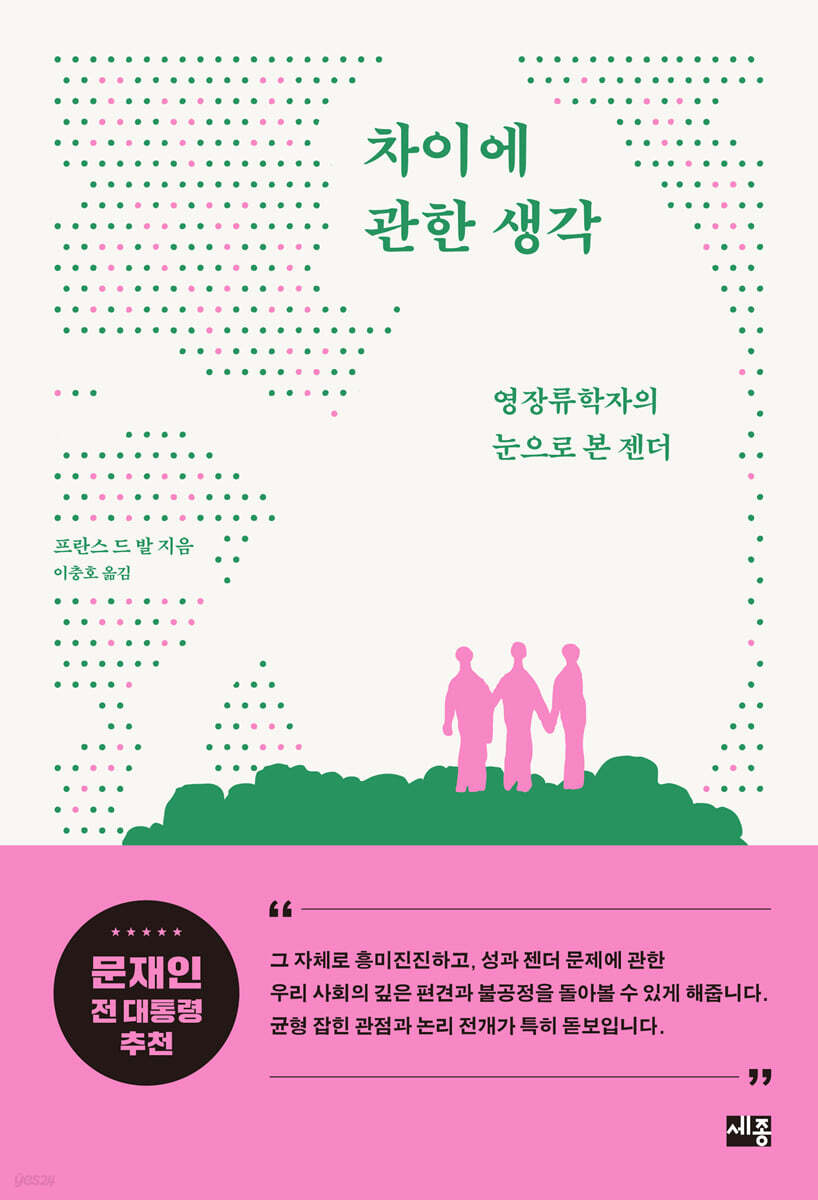
Thoughts on Differences
 |
Description
Book Introduction
- Highly recommended by Yuval Harari and Professor Choi Jae-cheon “When I talk about chimpanzees, men get cocky and When you mention bonobos, women cheer. “Writing this book may turn out to be one of my most foolish decisions!” World-renowned primatologist Frans de Waal, drawing on decades of research into human and animal behavior, argues that biology offers no justification for existing gender inequality. Although gender and biological sex are related, biology does not automatically support traditional male and female roles in human society. The author argues that this doesn't mean we should deny the differences between men and women. But if so, what are the innate differences between men and women, and how can we know that they are determined by biology, not culture? This book seeks answers to these questions in primate research. Although there have been various approaches to sexual differences, this book, unlike previous studies or other books, seeks to uncover the secrets of sexual differences through primates. The author compares human behavior to that of our closest evolutionary cousins, chimpanzees and bonobos. It challenges widely accepted beliefs about femininity and masculinity, as well as universal assumptions about authority, leadership, cooperation, competition, parent-child bonds, and sexual behavior. |
- You can preview some of the book's contents.
Preview
index
Recommendation · 06
Preface · 14
Chapter 1 Toys
Chimpanzees and Toys 40 | Anthropologists and Biologists 49 | Play and Instinct 55
Chapter 2 Gender
Raising a Boy Like a Girl! 68 | What is Gender? 74 | Culture vs. Instinct 82
Chimpanzee Donna's Story 85 | Gender Identity and the Brain 93
Chapter 3 Six Boys
The Fourth of Six Brothers 102 | Three Different Cultures 117 | Observing Ape Behavior 121
A World Without Power Struggles? 127
Chapter 4: False Analogies
The Tragedy of Monkey Hill 134 | The Selfish Gene? 140 | The Rediscovery of the Baboons 145
Gender and Primatology 157
Chapter 5: Bonobos' Sisterhood
Bonobo Paradise 166 | Breaking Old Stereotypes 174 | Female Dominance 189 | Back to the Wild 196
Chapter 6 Sexual Signals
The Evolutionary Psychology of "Jeokbalnam" 202 | Faces and Buttocks 209 | Shifting Female Status 225
Chapter 7: The Mating Game
Special Triangle 232 | The Veil of Evolution 243 | The Bateman Principle Broken 253
Alpha Male Secrets 256 | Strategies to Prevent Infanticide 264
Chapter 8 Violence
Exploring Violence 270 | Bad Chimpanzee Goblin? 280 | Taming the Violent Male 285
False Beliefs 293 | Creating the Right Culture 298
Chapter 9 Alpha Males and Alpha Females
Alpha Female Mama 304 | Power Misconceptions 307 | True Power and Leadership 314
The Female Power Struggle 330 | Female and Male Leaders 335
Chapter 10 Maintaining the Peace
Competition and Cooperation 344 | Male Base 353 | Conflict and Reconciliation in Apes 360
Managing Human Conflict 370 | Voices of Men and Women 377
Chapter 11 Parenting
Maternal Attachment to Offspring 386 | The Origins of Sociality and Altruistic Behavior 392
Attraction to Babies 399 | Male Parenting Potential 407 | Nuclear Families and Cooperative Parents 414
Chapter 12: Same-Sex Sex
Penguin Romance 428 | The Love That Cannot Be Named 434 | The Gay Brain? 445 | The Autonomy of Motives 455
Chapter 13: The Problem of Dualism
Complex Problems 460 | Beyond Creationism 463 | Mind, Brain, and Body Are One 468
The Path to Love and Respect 472
Acknowledgments · 476
Week 480
Appendix: The Lives of Female and Male Apes in Pictures · 497
References · 510
Search · 546
Preface · 14
Chapter 1 Toys
Chimpanzees and Toys 40 | Anthropologists and Biologists 49 | Play and Instinct 55
Chapter 2 Gender
Raising a Boy Like a Girl! 68 | What is Gender? 74 | Culture vs. Instinct 82
Chimpanzee Donna's Story 85 | Gender Identity and the Brain 93
Chapter 3 Six Boys
The Fourth of Six Brothers 102 | Three Different Cultures 117 | Observing Ape Behavior 121
A World Without Power Struggles? 127
Chapter 4: False Analogies
The Tragedy of Monkey Hill 134 | The Selfish Gene? 140 | The Rediscovery of the Baboons 145
Gender and Primatology 157
Chapter 5: Bonobos' Sisterhood
Bonobo Paradise 166 | Breaking Old Stereotypes 174 | Female Dominance 189 | Back to the Wild 196
Chapter 6 Sexual Signals
The Evolutionary Psychology of "Jeokbalnam" 202 | Faces and Buttocks 209 | Shifting Female Status 225
Chapter 7: The Mating Game
Special Triangle 232 | The Veil of Evolution 243 | The Bateman Principle Broken 253
Alpha Male Secrets 256 | Strategies to Prevent Infanticide 264
Chapter 8 Violence
Exploring Violence 270 | Bad Chimpanzee Goblin? 280 | Taming the Violent Male 285
False Beliefs 293 | Creating the Right Culture 298
Chapter 9 Alpha Males and Alpha Females
Alpha Female Mama 304 | Power Misconceptions 307 | True Power and Leadership 314
The Female Power Struggle 330 | Female and Male Leaders 335
Chapter 10 Maintaining the Peace
Competition and Cooperation 344 | Male Base 353 | Conflict and Reconciliation in Apes 360
Managing Human Conflict 370 | Voices of Men and Women 377
Chapter 11 Parenting
Maternal Attachment to Offspring 386 | The Origins of Sociality and Altruistic Behavior 392
Attraction to Babies 399 | Male Parenting Potential 407 | Nuclear Families and Cooperative Parents 414
Chapter 12: Same-Sex Sex
Penguin Romance 428 | The Love That Cannot Be Named 434 | The Gay Brain? 445 | The Autonomy of Motives 455
Chapter 13: The Problem of Dualism
Complex Problems 460 | Beyond Creationism 463 | Mind, Brain, and Body Are One 468
The Path to Love and Respect 472
Acknowledgments · 476
Week 480
Appendix: The Lives of Female and Male Apes in Pictures · 497
References · 510
Search · 546
Detailed image

Into the book
The topic of gender differences is emotionally charged, no matter what.
Everyone has strong opinions in this field, which is a very unfamiliar situation for us who study animals.
Primatologists try not to judge.
Although we don't always succeed, we never categorize actions as right or wrong.
While research inevitably involves interpretation, we would never describe a male's behavior as "disgusting" or call a female of any species "gross."
We accept behavior as it is.
This attitude has a long tradition among museum historians.
Although male praying mantises literally lose their heads during mating, no one blames the females.
And for the same reason, we don't judge the behavior of a male hornbill who brings a lump of mud to his mate so that she can stay in the enclosed nest for weeks.
We just wonder why nature works the way it does.
---From the "Preface"
Primatologists have no reason to downplay sex.
I've been to about a thousand talks at primatological conferences, and I've never heard anyone say, "You know, I was tracking a male and female orangutan in the forest and I noticed that their behavior was remarkably similar."
Given how striking the behavioral differences between males and females are in most primates, any speaker who makes such a statement would be laughed at.
Besides, primatologists love these differences.
For us it is our daily bread.
That makes primate social life very interesting.
There are different agendas that males prioritize, and different agendas that females prioritize.
Our task is to infer and understand the interactions between the two.
Males and females sometimes have conflicting interests, but since neither can win the evolutionary race without the other, their agendas intersect at some point.
---From the "Preface"
The preference for human children by gender was also observed in monkeys.
Toys like cars, which were vehicles, were mainly played with by males while moving around on the ground.
The male also liked the ball.
On the other hand, females carried dolls more often, hugging them tightly or examining their genital area closely.
The latter behavior is consistent with the monkey's curiosity in showing interest in the genitals of newborn offspring.
It is common to see females gathering around a newly-born mother, making loud grunting and licking sounds while spreading the legs of the wriggling chicks, poking, pulling, and sticking their noses between their legs to sniff them.
Primates were doing this long before we invented "gender reveal" parties.
(...)
Male monkeys chose the toy with wheels.
Males showed more extroverted tendencies compared to females, who liked all the toys.
Since the males showed no interest in the stuffed toys, these toys mostly ended up in the hands of the females.
Children show a similar pattern, with boys showing more pronounced toy preferences.
A common explanation is that boys are afraid of looking like girls, while girls are not afraid of looking like boys.
But if there is no evidence that monkeys are aware of gender perception, it is unlikely that they experience the same anxiety that boys are supposed to experience.
The truth may be simpler.
That is, most boys and male primates may not be attracted to dolls.
---From "Chapter 1 Toys"
Gender is like a cultural cloak that each sex wears.
It has to do with our expectations of men and women, which vary across societies and change over time.
But some definitions are more radical than this, attempting to change the very nature of gender.
These definitions view gender as an arbitrary construct, completely separate from biological sex.
So to speak, the coat moves around on its own, and it's up to us how we decorate it.
---From "Chapter 2 Gender"
Money, who has tracked Brenda's growth through regular meetings, claims it has been a complete success.
And then, with great pride, he declared that gender was purely a matter of upbringing.
It was claimed that until a certain age, a boy could be changed into a girl and a girl into a boy.
Many people welcomed this news because it suggested that we can control our own destiny.
Money became a hero of the women's movement.
In 1973, Time magazine praised his research for providing "strong support for the main claim of feminists: that traditional male and female behavior patterns can be changed."
But everything came crashing down in an instant, so miserably, that Money became a controversial figure.
Even though he has been dead for a long time, Money is still being vilified by some as a charlatan and a fraud.
The boy, who was considered to have transitioned into a female, vehemently rejected his new gender.
Although she was dressed in girl's clothes and given a doll, Brenda walked and talked like a boy, tore her frilly dress and stole her brother's truck.
Brenda wanted to play with the boys, build forts, and have snowball fights together.
---From "Chapter 2 Gender"
In the old days, people were thought to be infinitely flexible beings.
The concept has been particularly popular among anthropologists, who have traditionally emphasized culture over biology.
In the 1970s, Ashley Montagu wrote that our species has no innate tendencies at all, arguing that “humans have no instincts at all.”
But a decade or so before that, the same Montague had praised women as inherently more loving and caring than men.
There is an obvious contradiction here.
It is contradictory to assume natural differences between the sexes while simultaneously considering the human mind as a blank slate on which culture inscribes gender norms.
This may be why anthropologist Melvin Konner, who agreed with Montague's views on female superiority, distanced himself from his field's slogan that culture is everything.
"Boys and girls are different, and the men and women they grow up to become are also different.
This is a profound biological and philosophical insight, and although I initially resisted it—"in my youth I was a strong cultural determinist"—"I now willingly embrace and defend it."
But we don't have to choose between culture and biology.
The only position that seems plausible is to be an 'interactionist'.
Interactionism assumes that there is a dynamic interaction between genes and the environment.
The genes themselves are like seeds that have fallen on the pavement.
It cannot create anything by itself.
Similarly, the environment has no meaning in itself, because it requires living things to function within it.
The interactions between the two are so complex that we often cannot discern the extent of each individual's contribution.
---From "Chapter 2 Gender"
Female chimpanzees appear to follow many of the male strategies.
When a female appears in the forest with her genitals swollen, many males entice her.
Several adult males follow the female and take turns mating throughout the day.
In wild chimpanzees, these gatherings can become quite large if there are several females with swollen genitals present at the same time.
These festival-like 'sex jamborees' take place without much competition.
At the Würchers Zoo I spoke of 'sexual bargaining' because there was an atmosphere of intense negotiation.
The males gathered in groups near the females and groomed each other.
In exchange for a long grooming session, one of them would gain the right to mate undisturbed, and grooming was especially effective when it was done to the alpha male.
Every mating came with a price.
As the female chimpanzee's genitals reach their final swell, competition among males becomes intense.
Females reach their peak reproductive capacity at this stage.
Higher-ranking males lure females away or force them to a distant location in order to monopolize the females.
But the important thing here is that females mate with far more males and more frequently than would be necessary if the sole purpose were pregnancy.
It is estimated that a wild female chimpanzee will mate with more than 12 males approximately 6,000 times in her lifetime.
However, only 5 to 6 offspring survive from a female.
Doesn't that sound like too much sex? It actually is—at least from a fertilization standpoint.
But if we assume that when the pups are born eight months later, the females will try to have sex with many males to prevent the males from harming the pups, then it is not at all excessive.
---From "Chapter 7 Matching Game"
To understand the evolution of homosexuality, we obviously need more evidence than just the behavior of a few captive penguins.
However, it is important to note that, as far as we know, there are no 'gay penguins'.
There is no evidence that any of these aquatic birds have an exclusive or dominant orientation towards members of their own sex.
For example, the relationship between Silo and Roy did not last.
Six years later, Silo left his mate and began hanging out with Scrappy, a female from California.
The breakup shocked Manhattan's gay community.
Many were disappointed, especially Rob Gramzay, a senior penguin keeper at the zoo, who recalled with regret that the two males "looked like a good pair."
Among penguins, partner relationships and partner sex change so frequently that penguins are better considered bisexual rather than homosexual.
Moreover, these fluctuations do not only occur in zoos, where the cause can be attributed to an occasional imbalance in the sex ratio between males and females.
A study of over 100,000 king penguin pairs in the Kerguelen Islands in Subantarctic waters found that homosexual behavior was frequent, particularly among males.
French ethologist Gwenaelle Pincemy described two penguins as “turning their heads back and forth together, with their heads stretched out towards the sky and their eyes closed, until when their heads are furthest apart they ‘glance’ at each other.”
While about a quarter of all pairs engaging in this display were male-male pairs, only a small minority progressed to the next stage of mating, where partners recognized each other's vocalizations.
They need to move on to the next stage to be able to find a mate again after breaking up, and this ability is very important in a flock of thousands.
Although same-sex pairs that reach this stage of mating are rare, it is significant that such pairs do indeed exist in the wild.
Everyone has strong opinions in this field, which is a very unfamiliar situation for us who study animals.
Primatologists try not to judge.
Although we don't always succeed, we never categorize actions as right or wrong.
While research inevitably involves interpretation, we would never describe a male's behavior as "disgusting" or call a female of any species "gross."
We accept behavior as it is.
This attitude has a long tradition among museum historians.
Although male praying mantises literally lose their heads during mating, no one blames the females.
And for the same reason, we don't judge the behavior of a male hornbill who brings a lump of mud to his mate so that she can stay in the enclosed nest for weeks.
We just wonder why nature works the way it does.
---From the "Preface"
Primatologists have no reason to downplay sex.
I've been to about a thousand talks at primatological conferences, and I've never heard anyone say, "You know, I was tracking a male and female orangutan in the forest and I noticed that their behavior was remarkably similar."
Given how striking the behavioral differences between males and females are in most primates, any speaker who makes such a statement would be laughed at.
Besides, primatologists love these differences.
For us it is our daily bread.
That makes primate social life very interesting.
There are different agendas that males prioritize, and different agendas that females prioritize.
Our task is to infer and understand the interactions between the two.
Males and females sometimes have conflicting interests, but since neither can win the evolutionary race without the other, their agendas intersect at some point.
---From the "Preface"
The preference for human children by gender was also observed in monkeys.
Toys like cars, which were vehicles, were mainly played with by males while moving around on the ground.
The male also liked the ball.
On the other hand, females carried dolls more often, hugging them tightly or examining their genital area closely.
The latter behavior is consistent with the monkey's curiosity in showing interest in the genitals of newborn offspring.
It is common to see females gathering around a newly-born mother, making loud grunting and licking sounds while spreading the legs of the wriggling chicks, poking, pulling, and sticking their noses between their legs to sniff them.
Primates were doing this long before we invented "gender reveal" parties.
(...)
Male monkeys chose the toy with wheels.
Males showed more extroverted tendencies compared to females, who liked all the toys.
Since the males showed no interest in the stuffed toys, these toys mostly ended up in the hands of the females.
Children show a similar pattern, with boys showing more pronounced toy preferences.
A common explanation is that boys are afraid of looking like girls, while girls are not afraid of looking like boys.
But if there is no evidence that monkeys are aware of gender perception, it is unlikely that they experience the same anxiety that boys are supposed to experience.
The truth may be simpler.
That is, most boys and male primates may not be attracted to dolls.
---From "Chapter 1 Toys"
Gender is like a cultural cloak that each sex wears.
It has to do with our expectations of men and women, which vary across societies and change over time.
But some definitions are more radical than this, attempting to change the very nature of gender.
These definitions view gender as an arbitrary construct, completely separate from biological sex.
So to speak, the coat moves around on its own, and it's up to us how we decorate it.
---From "Chapter 2 Gender"
Money, who has tracked Brenda's growth through regular meetings, claims it has been a complete success.
And then, with great pride, he declared that gender was purely a matter of upbringing.
It was claimed that until a certain age, a boy could be changed into a girl and a girl into a boy.
Many people welcomed this news because it suggested that we can control our own destiny.
Money became a hero of the women's movement.
In 1973, Time magazine praised his research for providing "strong support for the main claim of feminists: that traditional male and female behavior patterns can be changed."
But everything came crashing down in an instant, so miserably, that Money became a controversial figure.
Even though he has been dead for a long time, Money is still being vilified by some as a charlatan and a fraud.
The boy, who was considered to have transitioned into a female, vehemently rejected his new gender.
Although she was dressed in girl's clothes and given a doll, Brenda walked and talked like a boy, tore her frilly dress and stole her brother's truck.
Brenda wanted to play with the boys, build forts, and have snowball fights together.
---From "Chapter 2 Gender"
In the old days, people were thought to be infinitely flexible beings.
The concept has been particularly popular among anthropologists, who have traditionally emphasized culture over biology.
In the 1970s, Ashley Montagu wrote that our species has no innate tendencies at all, arguing that “humans have no instincts at all.”
But a decade or so before that, the same Montague had praised women as inherently more loving and caring than men.
There is an obvious contradiction here.
It is contradictory to assume natural differences between the sexes while simultaneously considering the human mind as a blank slate on which culture inscribes gender norms.
This may be why anthropologist Melvin Konner, who agreed with Montague's views on female superiority, distanced himself from his field's slogan that culture is everything.
"Boys and girls are different, and the men and women they grow up to become are also different.
This is a profound biological and philosophical insight, and although I initially resisted it—"in my youth I was a strong cultural determinist"—"I now willingly embrace and defend it."
But we don't have to choose between culture and biology.
The only position that seems plausible is to be an 'interactionist'.
Interactionism assumes that there is a dynamic interaction between genes and the environment.
The genes themselves are like seeds that have fallen on the pavement.
It cannot create anything by itself.
Similarly, the environment has no meaning in itself, because it requires living things to function within it.
The interactions between the two are so complex that we often cannot discern the extent of each individual's contribution.
---From "Chapter 2 Gender"
Female chimpanzees appear to follow many of the male strategies.
When a female appears in the forest with her genitals swollen, many males entice her.
Several adult males follow the female and take turns mating throughout the day.
In wild chimpanzees, these gatherings can become quite large if there are several females with swollen genitals present at the same time.
These festival-like 'sex jamborees' take place without much competition.
At the Würchers Zoo I spoke of 'sexual bargaining' because there was an atmosphere of intense negotiation.
The males gathered in groups near the females and groomed each other.
In exchange for a long grooming session, one of them would gain the right to mate undisturbed, and grooming was especially effective when it was done to the alpha male.
Every mating came with a price.
As the female chimpanzee's genitals reach their final swell, competition among males becomes intense.
Females reach their peak reproductive capacity at this stage.
Higher-ranking males lure females away or force them to a distant location in order to monopolize the females.
But the important thing here is that females mate with far more males and more frequently than would be necessary if the sole purpose were pregnancy.
It is estimated that a wild female chimpanzee will mate with more than 12 males approximately 6,000 times in her lifetime.
However, only 5 to 6 offspring survive from a female.
Doesn't that sound like too much sex? It actually is—at least from a fertilization standpoint.
But if we assume that when the pups are born eight months later, the females will try to have sex with many males to prevent the males from harming the pups, then it is not at all excessive.
---From "Chapter 7 Matching Game"
To understand the evolution of homosexuality, we obviously need more evidence than just the behavior of a few captive penguins.
However, it is important to note that, as far as we know, there are no 'gay penguins'.
There is no evidence that any of these aquatic birds have an exclusive or dominant orientation towards members of their own sex.
For example, the relationship between Silo and Roy did not last.
Six years later, Silo left his mate and began hanging out with Scrappy, a female from California.
The breakup shocked Manhattan's gay community.
Many were disappointed, especially Rob Gramzay, a senior penguin keeper at the zoo, who recalled with regret that the two males "looked like a good pair."
Among penguins, partner relationships and partner sex change so frequently that penguins are better considered bisexual rather than homosexual.
Moreover, these fluctuations do not only occur in zoos, where the cause can be attributed to an occasional imbalance in the sex ratio between males and females.
A study of over 100,000 king penguin pairs in the Kerguelen Islands in Subantarctic waters found that homosexual behavior was frequent, particularly among males.
French ethologist Gwenaelle Pincemy described two penguins as “turning their heads back and forth together, with their heads stretched out towards the sky and their eyes closed, until when their heads are furthest apart they ‘glance’ at each other.”
While about a quarter of all pairs engaging in this display were male-male pairs, only a small minority progressed to the next stage of mating, where partners recognized each other's vocalizations.
They need to move on to the next stage to be able to find a mate again after breaking up, and this ability is very important in a flock of thousands.
Although same-sex pairs that reach this stage of mating are rare, it is significant that such pairs do indeed exist in the wild.
---From "Chapter 12 Homosexual Sex"
Publisher's Review
The world's leading primatologist
Uncovering the secrets of human sexual differences.
When applying animal research to humans, it is inevitable that the opposing camp, which always emphasizes the nobility of humans, will criticize it for overlooking the influence of human culture.
If humans and animals aren't so different, what about the gender issue? Is patriarchy a legacy from our animal ancestors? Is male aggression an insurmountable instinct? Were our chimpanzee-descent ancestors murderous? Many feared that Frans de Waal's attempt would undoubtedly offend and unsettle many.
But despite these concerns and doubts, Frans de Waal tackles the problem head-on.
And this book again clearly presents the answer to that question.
In short, this book appears to be about animals, but it is actually about humans.
Conventional biology has been attacked by feminists as a representative example of 'conservative science'.
This is because, based on poor biology, they made the wrong argument that “male flirting is a product of evolution that has gone through a selective adaptation process, so women should understand this.”
At a time when women were increasing their social influence and raising their voices, there was no way they could remain silent.
He immediately strongly criticized sociobiology, and more broadly, evolutionary theory, for being used as a tool to justify sexism.
However, the author of this book, Frans de Waal, refutes one by one the wrong ideas that have been formed due to the mistakes that biology has made so far.
In the introduction to this book, Frans de Waal considers herself a feminist, saying, “Sexual differences in animal and human behavior raise all the questions that are at the heart of almost every debate about human gender.”
He constantly challenges the common assumptions we've made about relationships between men and women: violence, authority, competition, gender differences, trust, cooperation, and bonds.
Genetics vs. Culture,
Power Struggle vs. Cooperation
One of the most fascinating questions that fascinates us is whether sexual differences are determined by genetics or culture (biology vs. environment).
This topic has quite a lot of implications.
This is why this question has generated so much controversy, and when we emphasize the relative influence of one side or the other, the ramifications are much larger and more complex than we might think.
According to this book, anyone who takes an extreme position in either direction is almost certainly wrong.
We are not, as some right-wing writers would like us to be, puppets whose actions are entirely dictated by the laws of biology.
They have primarily rationalized the power dynamics that favor men through biology.
Likewise, our behavior is not entirely socially 'constructed', and there are clear differences in the innate preferences of each sex.
It's no coincidence that male monkeys prefer toys that allow them to release energy, like cars, and female monkeys prefer toys that stimulate their maternal instinct, like dolls.
Another interesting question is, 'Are animals by nature selfish and violent, and are they beings that prioritize survival over cooperation?'
We have always thought of animals as selfish and violent beings based on the theory of the 'selfish gene'.
But contrary to popular belief, alpha status in the natural world isn't achieved simply by being big, strong, and aggressive.
The status of Alpha is more of a title given to an outstanding coordinator.
This is also why females (or women) are highlighted as leaders.
The alpha male elephant acts as a deterrent to the aggression of other male elephants, and when the alpha elephant is present, the testosterone levels of other male elephants drop sharply.
A herd of elephants without an alpha male elephant loses the ability to mediate fights, cannot maintain peace, and descends into utter chaos.
Alpha female Mama was the center and rock of the large chimpanzee troop at the Würchers Zoo.
Mama had better leadership skills than the males and played a maternal role in the group.
Mama has reigned as the alpha female for over 40 years, dealing with many alpha males who have risen and fallen from the throne.
Mama cared not only about her privileged position in the hierarchy, but also about the entire herd.
There have been many instances where Mama has reconciled fighting males or where the males have sought her out for help.
Frans de Waal was impressed by the sight of the adult males, unable to resolve their fight, running to Mama, sitting one on each of her long arms, and shouting at each other like baby apes, which he described in his book.
Females are not only capable of leadership and leading the entire pack to peace, nor are they passive beings who only look to one male.
He is also very enterprising sexually.
Female chimpanzees interact with multiple males to protect their young.
This is so that they do not get attacked by males.
The pigeon that always wins in pigeon racing is the female pigeon that is hungry for males.
We must have thought about it at least once
About things related to gender differences
Biological Answer
This book provides answers to the following questions and curiosities:
●Are human sexual differences due to culture or nature?
●As we commonly believe, is male sexual desire much stronger than female? Is there some exaggeration in this?
●Do the different gender roles and preferences between men and women have biological origins?
●Are humans really just 'blank slates', beings whose content is filled in by culture and environment?
●Is gender something bad and should disappear?
●Is gender simply something culturally determined? Is it therefore a matter of personal choice?
●If you raise a boy like a girl, will he grow up to be a girl?
●How does biology view transgender people?
●Are women more emotional beings than men?
●Is human nature selfish, and are humans beings who prefer competition over cooperation?
●Can animal behavior serve as a basis for human behavior?
●Isn't research on primates lacking objective reality and merely a matter of perspective?
Should we trust what people say? Or are actions more reliable than words?
●Is patriarchy a universal law that encompasses all animals, and is inequality between men and women of biological origin?
●Are our ancestors only violent, competitive, and male-dominated chimpanzees?
●Why do bonobos love sex so much? Are they simply hedonistic animals?
●How much does the tone of voice influence people's decision-making?
●Why is parenting solely the responsibility of one sex? Are males lacking the potential to care for their young?
●How much is the brain involved in sexual orientation, such as homosexuality or heterosexuality?
●Is sexual orientation based on a dichotomy of only ‘heterosexuality’ and ‘homosexuality’?
●Why do women need a clitoris, which doesn't help with reproduction? What about the peacock's colorful feathers? What about the male nipples?
Transgender people too
It is determined by biological laws.
People once believed that gender was purely a matter of upbringing.
In particular, American psychologist Money argued that boys can be turned into girls and girls can be turned into boys until a certain age.
Many people welcomed this news because it suggested they could take control of their own destiny.
Many women's movements, in particular, have supported this concept.
This was because it aligned well with the main argument of feminists that traditional male and female behavior patterns could be changed.
However, it soon became clear that this claim was wrong.
Money was involved in an experiment where a boy who lost his genitals in an accident was raised as a woman.
However, as the boy grew up, he asserted his identity as a man and eventually took his own life, resenting his parents for raising him as a woman.
This experiment clearly demonstrated that even sex reassignment surgery followed by years of estrogen therapy and intensive socialization did not change a boy's gender identity.
It was a merciless consequence of defying the laws of biology.
It turns out that biological laws are also involved in determining transgender.
The book argues that a small region in the brain with a long name, the nucleus accumbens, is involved in gender identity.
So what about homosexuality? Does homosexuality also originate in the brain? Is there really such a thing as a "gay brain"? How does biology view homosexuality? Two male penguins reportedly hatched an egg together, resulting in a baby penguin named "Tango."
The zoo was reportedly concerned that the bond between the male penguins was so strong.
However, according to the Kinsey Report, sexual orientation is not simply a matter of homosexuality or heterosexuality, but rather a spectrum.
All animals move across this spectrum, sometimes liking the opposite sex, sometimes the same sex, and sometimes both sexes.
Donna the chimpanzee was a gender-nonconforming chimpanzee with the body and habits of a male but the sex of a female.
Donna often displayed her hair on end with the adult males.
However, Donna was not aggressive and got along well socially with other chimpanzees.
Animals do not treat individuals different from themselves as hostilely as humans do, and they do not treat them with special favors, either positive or negative.
People are different.
Just like race, there are so many labels we attach to gender characteristics and sexual orientation.
Why 'Bonobo' of all things?
Is it a 'chimpanzee'?
In his predecessor to this book, "Thoughts Concerning Animal Thought," Frans de Waal argues that animal and human minds are fundamentally similar, and that the difference in intelligence between animals and humans is simply a matter of degree.
Animals and humans are similar creatures that lie on a continuum of a spectrum.
The book ends by clearly proving this claim through several examples.
However, after closing the book, one question remains.
So, to what extent can observations made in animals be applied to humans? This is a question that is difficult to reach a consensus on and remains unclear.
However, in his book, Thoughts on Difference, Frans de Waal clearly demonstrates the extent to which animal observations can be applied to humans and provides a clear rationale for this.
The basis for this is that animals provide clues to human instincts that have broken free from the inertia of culture.
There are three ways to determine whether a behavior is innate and determined by the laws of biology.
The first is to compare different human cultures to find universals in behavior (cultural anthropology).
The second is the study of the behavior of infants and children who have not yet been cultivated (developmental psychology).
The third is to compare human behavior with that of our closest evolutionary cousins, chimpanzees and bonobos.
Through one of these three methods, we can clearly identify which elements are free from cultural influence.
Primatologist Frans de Waal clearly favors the last approach, but in this book he uses all three to some extent.
In doing so, he persuasively demonstrates that there are in fact some distinct differences between the biologically determined genders of men and women.
《Thinking About Difference》corrects some of the misconceptions we have about gender.
Richard Dawkins's "selfish gene" overstated the human struggle for survival, and many male scientists have taken a flawed approach that has overstated the patriarchy.
On the other hand, many modern theorists, including feminists, have expanded the interpretation of the influence of culture on gender differences.
Frans de Waal also points out the limitations of the human-created binary framework regarding sexual orientation and gender identity.
This book, with humor and scholarly clarity, provides a landmark in all the conflicts and debates surrounding gender.
Through an evolutionary approach, "Thinking About Difference" opens up a dialogue about the dynamics of male and female relationships by embracing, rather than denying, differences.
Uncovering the secrets of human sexual differences.
When applying animal research to humans, it is inevitable that the opposing camp, which always emphasizes the nobility of humans, will criticize it for overlooking the influence of human culture.
If humans and animals aren't so different, what about the gender issue? Is patriarchy a legacy from our animal ancestors? Is male aggression an insurmountable instinct? Were our chimpanzee-descent ancestors murderous? Many feared that Frans de Waal's attempt would undoubtedly offend and unsettle many.
But despite these concerns and doubts, Frans de Waal tackles the problem head-on.
And this book again clearly presents the answer to that question.
In short, this book appears to be about animals, but it is actually about humans.
Conventional biology has been attacked by feminists as a representative example of 'conservative science'.
This is because, based on poor biology, they made the wrong argument that “male flirting is a product of evolution that has gone through a selective adaptation process, so women should understand this.”
At a time when women were increasing their social influence and raising their voices, there was no way they could remain silent.
He immediately strongly criticized sociobiology, and more broadly, evolutionary theory, for being used as a tool to justify sexism.
However, the author of this book, Frans de Waal, refutes one by one the wrong ideas that have been formed due to the mistakes that biology has made so far.
In the introduction to this book, Frans de Waal considers herself a feminist, saying, “Sexual differences in animal and human behavior raise all the questions that are at the heart of almost every debate about human gender.”
He constantly challenges the common assumptions we've made about relationships between men and women: violence, authority, competition, gender differences, trust, cooperation, and bonds.
Genetics vs. Culture,
Power Struggle vs. Cooperation
One of the most fascinating questions that fascinates us is whether sexual differences are determined by genetics or culture (biology vs. environment).
This topic has quite a lot of implications.
This is why this question has generated so much controversy, and when we emphasize the relative influence of one side or the other, the ramifications are much larger and more complex than we might think.
According to this book, anyone who takes an extreme position in either direction is almost certainly wrong.
We are not, as some right-wing writers would like us to be, puppets whose actions are entirely dictated by the laws of biology.
They have primarily rationalized the power dynamics that favor men through biology.
Likewise, our behavior is not entirely socially 'constructed', and there are clear differences in the innate preferences of each sex.
It's no coincidence that male monkeys prefer toys that allow them to release energy, like cars, and female monkeys prefer toys that stimulate their maternal instinct, like dolls.
Another interesting question is, 'Are animals by nature selfish and violent, and are they beings that prioritize survival over cooperation?'
We have always thought of animals as selfish and violent beings based on the theory of the 'selfish gene'.
But contrary to popular belief, alpha status in the natural world isn't achieved simply by being big, strong, and aggressive.
The status of Alpha is more of a title given to an outstanding coordinator.
This is also why females (or women) are highlighted as leaders.
The alpha male elephant acts as a deterrent to the aggression of other male elephants, and when the alpha elephant is present, the testosterone levels of other male elephants drop sharply.
A herd of elephants without an alpha male elephant loses the ability to mediate fights, cannot maintain peace, and descends into utter chaos.
Alpha female Mama was the center and rock of the large chimpanzee troop at the Würchers Zoo.
Mama had better leadership skills than the males and played a maternal role in the group.
Mama has reigned as the alpha female for over 40 years, dealing with many alpha males who have risen and fallen from the throne.
Mama cared not only about her privileged position in the hierarchy, but also about the entire herd.
There have been many instances where Mama has reconciled fighting males or where the males have sought her out for help.
Frans de Waal was impressed by the sight of the adult males, unable to resolve their fight, running to Mama, sitting one on each of her long arms, and shouting at each other like baby apes, which he described in his book.
Females are not only capable of leadership and leading the entire pack to peace, nor are they passive beings who only look to one male.
He is also very enterprising sexually.
Female chimpanzees interact with multiple males to protect their young.
This is so that they do not get attacked by males.
The pigeon that always wins in pigeon racing is the female pigeon that is hungry for males.
We must have thought about it at least once
About things related to gender differences
Biological Answer
This book provides answers to the following questions and curiosities:
●Are human sexual differences due to culture or nature?
●As we commonly believe, is male sexual desire much stronger than female? Is there some exaggeration in this?
●Do the different gender roles and preferences between men and women have biological origins?
●Are humans really just 'blank slates', beings whose content is filled in by culture and environment?
●Is gender something bad and should disappear?
●Is gender simply something culturally determined? Is it therefore a matter of personal choice?
●If you raise a boy like a girl, will he grow up to be a girl?
●How does biology view transgender people?
●Are women more emotional beings than men?
●Is human nature selfish, and are humans beings who prefer competition over cooperation?
●Can animal behavior serve as a basis for human behavior?
●Isn't research on primates lacking objective reality and merely a matter of perspective?
Should we trust what people say? Or are actions more reliable than words?
●Is patriarchy a universal law that encompasses all animals, and is inequality between men and women of biological origin?
●Are our ancestors only violent, competitive, and male-dominated chimpanzees?
●Why do bonobos love sex so much? Are they simply hedonistic animals?
●How much does the tone of voice influence people's decision-making?
●Why is parenting solely the responsibility of one sex? Are males lacking the potential to care for their young?
●How much is the brain involved in sexual orientation, such as homosexuality or heterosexuality?
●Is sexual orientation based on a dichotomy of only ‘heterosexuality’ and ‘homosexuality’?
●Why do women need a clitoris, which doesn't help with reproduction? What about the peacock's colorful feathers? What about the male nipples?
Transgender people too
It is determined by biological laws.
People once believed that gender was purely a matter of upbringing.
In particular, American psychologist Money argued that boys can be turned into girls and girls can be turned into boys until a certain age.
Many people welcomed this news because it suggested they could take control of their own destiny.
Many women's movements, in particular, have supported this concept.
This was because it aligned well with the main argument of feminists that traditional male and female behavior patterns could be changed.
However, it soon became clear that this claim was wrong.
Money was involved in an experiment where a boy who lost his genitals in an accident was raised as a woman.
However, as the boy grew up, he asserted his identity as a man and eventually took his own life, resenting his parents for raising him as a woman.
This experiment clearly demonstrated that even sex reassignment surgery followed by years of estrogen therapy and intensive socialization did not change a boy's gender identity.
It was a merciless consequence of defying the laws of biology.
It turns out that biological laws are also involved in determining transgender.
The book argues that a small region in the brain with a long name, the nucleus accumbens, is involved in gender identity.
So what about homosexuality? Does homosexuality also originate in the brain? Is there really such a thing as a "gay brain"? How does biology view homosexuality? Two male penguins reportedly hatched an egg together, resulting in a baby penguin named "Tango."
The zoo was reportedly concerned that the bond between the male penguins was so strong.
However, according to the Kinsey Report, sexual orientation is not simply a matter of homosexuality or heterosexuality, but rather a spectrum.
All animals move across this spectrum, sometimes liking the opposite sex, sometimes the same sex, and sometimes both sexes.
Donna the chimpanzee was a gender-nonconforming chimpanzee with the body and habits of a male but the sex of a female.
Donna often displayed her hair on end with the adult males.
However, Donna was not aggressive and got along well socially with other chimpanzees.
Animals do not treat individuals different from themselves as hostilely as humans do, and they do not treat them with special favors, either positive or negative.
People are different.
Just like race, there are so many labels we attach to gender characteristics and sexual orientation.
Why 'Bonobo' of all things?
Is it a 'chimpanzee'?
In his predecessor to this book, "Thoughts Concerning Animal Thought," Frans de Waal argues that animal and human minds are fundamentally similar, and that the difference in intelligence between animals and humans is simply a matter of degree.
Animals and humans are similar creatures that lie on a continuum of a spectrum.
The book ends by clearly proving this claim through several examples.
However, after closing the book, one question remains.
So, to what extent can observations made in animals be applied to humans? This is a question that is difficult to reach a consensus on and remains unclear.
However, in his book, Thoughts on Difference, Frans de Waal clearly demonstrates the extent to which animal observations can be applied to humans and provides a clear rationale for this.
The basis for this is that animals provide clues to human instincts that have broken free from the inertia of culture.
There are three ways to determine whether a behavior is innate and determined by the laws of biology.
The first is to compare different human cultures to find universals in behavior (cultural anthropology).
The second is the study of the behavior of infants and children who have not yet been cultivated (developmental psychology).
The third is to compare human behavior with that of our closest evolutionary cousins, chimpanzees and bonobos.
Through one of these three methods, we can clearly identify which elements are free from cultural influence.
Primatologist Frans de Waal clearly favors the last approach, but in this book he uses all three to some extent.
In doing so, he persuasively demonstrates that there are in fact some distinct differences between the biologically determined genders of men and women.
《Thinking About Difference》corrects some of the misconceptions we have about gender.
Richard Dawkins's "selfish gene" overstated the human struggle for survival, and many male scientists have taken a flawed approach that has overstated the patriarchy.
On the other hand, many modern theorists, including feminists, have expanded the interpretation of the influence of culture on gender differences.
Frans de Waal also points out the limitations of the human-created binary framework regarding sexual orientation and gender identity.
This book, with humor and scholarly clarity, provides a landmark in all the conflicts and debates surrounding gender.
Through an evolutionary approach, "Thinking About Difference" opens up a dialogue about the dynamics of male and female relationships by embracing, rather than denying, differences.
GOODS SPECIFICS
- Publication date: November 7, 2022
- Page count, weight, size: 568 pages | 788g | 150*220*28mm
- ISBN13: 9788984079946
- ISBN10: 8984079944
You may also like
카테고리
korean


korean

![GQ KOREA Mark (Monthly): December [2025]](http://librairie.coreenne.fr/cdn/shop/files/8ef265dbbfbf186523ed75ba7319009d.jpg?v=1765340328&width=3840)


