

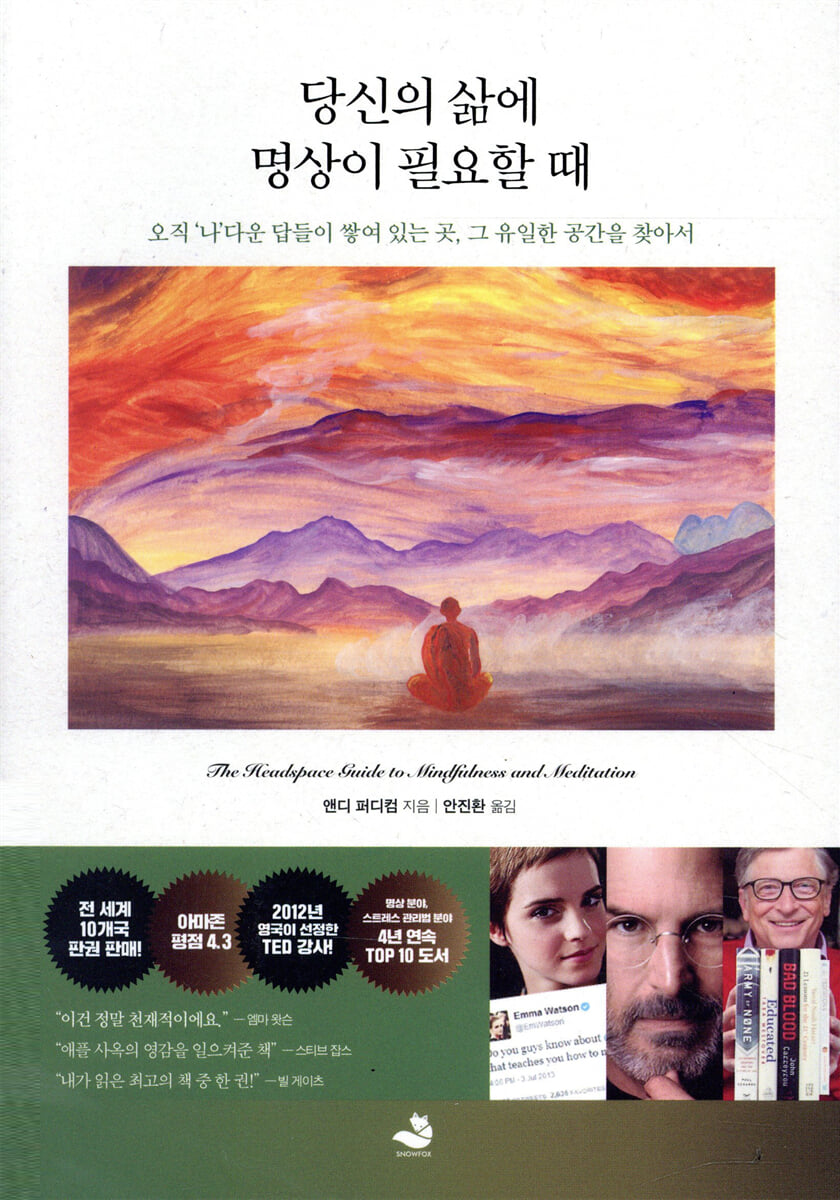
When you need meditation in your life
 |
Description
Book Introduction
The last time I did nothing for 10 minutes
Do you remember when it was? "When You Need Meditation in Your Life" is a book by the blue-eyed monk Andy Puddicombe, recognized as the leading authority on meditation in the English-speaking world. He wrote this book for those who know that all the answers to life lie within themselves, that is, for those who want to learn meditation techniques. Bill Gates and Emma Watson were the ones who brought this book, published in 10 countries, to the attention of the international media. They wanted to face their own inner answers, their own path, and they knew that meditation was the surest way. This book is excellent in that respect, as it contains the easiest and most accurate method of meditation that the author himself learned through trial and error while becoming a monk and practicing meditation. In particular, Bill Gates introduced it as 'one of the best books I've ever read' and encouraged everyone to focus more on their inner selves, The Guardian said it was a book that should be read by those who want to live a simple and clear life, and The Times said it was a book that should be read by giants who want to live their best lives, stimulating public interest. This book introduces 10 meditation techniques, and the author's characteristic wit and humorous storytelling overcome the potentially boring subject matter. The author, who is currently a non-monk and an active guru who develops meditation apps, asks the readers this question through the book. 'Do you remember the last time you did nothing for 10 minutes?' The question is intended to make us aware that most of us are in a kind of thought addiction, unable to stop thinking for even 10 minutes a day. It points out the simplest truth that I have never stopped thinking about, even in the moment I thought it was unconscious, but in that state, I can never find my own answer. Meditation helps me step away from the hustle and bustle, look inside myself, and make serious life decisions. Anyone who has ever recognized the need for meditation will find solutions in this book. |
- You can preview some of the book's contents.
Preview
index
tribute
Introduction_The Blue-Eyed Monk on the Wall
Chapter 1: Standing Close to Meditation
Something that doesn't control your thoughts
Non-judgment
Buried emotions tend to bubble up
Finding the Location of Emotions
fleeting feelings
Headspace
gentle curiosity
Chapter 2_When practicing meditation
10-minute meditation
Just as a spectator
[Headspace Practice] 10-Minute Meditation
Chapter 3: Integrating into Daily Life
The practice of mindfulness
A day connected by dots
distracted man
Juggling Monk
Mindfulness Meditation for Everyday Life
Five star temple
Walking with Mindfulness
zombi
Exercise with Meditation
Five-body prostration
To sleep better
Chapter 4_Before Departure
For a more efficient state
optimal time
Repetition above all else
Remember to remember what you must remember
What to do when you feel anxious
Chapter 5: Ten Suggestions for Meditation
Chapter 6: How did they practice meditation?
Appendix_Meditation Diary
10 Meditation Practices
Meditation Exercise 1: Doing Nothing
Meditation Exercise 2: Perception
Meditation Exercise 3: Body Senses
Meditation Exercise 4: Focusing on Pleasant or Unpleasant Emotions
Meditation Exercise 5: Awareness of Emotions
Meditation Exercise 6: Conscious Observation of the Body
Meditation Exercise 7: Eating Meditation
Meditation Exercise 8: Walking Meditation
Meditation Exercise 9: Running Meditation
Meditation Exercise 10: Sleep Meditation
Introduction_The Blue-Eyed Monk on the Wall
Chapter 1: Standing Close to Meditation
Something that doesn't control your thoughts
Non-judgment
Buried emotions tend to bubble up
Finding the Location of Emotions
fleeting feelings
Headspace
gentle curiosity
Chapter 2_When practicing meditation
10-minute meditation
Just as a spectator
[Headspace Practice] 10-Minute Meditation
Chapter 3: Integrating into Daily Life
The practice of mindfulness
A day connected by dots
distracted man
Juggling Monk
Mindfulness Meditation for Everyday Life
Five star temple
Walking with Mindfulness
zombi
Exercise with Meditation
Five-body prostration
To sleep better
Chapter 4_Before Departure
For a more efficient state
optimal time
Repetition above all else
Remember to remember what you must remember
What to do when you feel anxious
Chapter 5: Ten Suggestions for Meditation
Chapter 6: How did they practice meditation?
Appendix_Meditation Diary
10 Meditation Practices
Meditation Exercise 1: Doing Nothing
Meditation Exercise 2: Perception
Meditation Exercise 3: Body Senses
Meditation Exercise 4: Focusing on Pleasant or Unpleasant Emotions
Meditation Exercise 5: Awareness of Emotions
Meditation Exercise 6: Conscious Observation of the Body
Meditation Exercise 7: Eating Meditation
Meditation Exercise 8: Walking Meditation
Meditation Exercise 9: Running Meditation
Meditation Exercise 10: Sleep Meditation
Detailed image

Into the book
Mindfulness is a core element of almost all meditation techniques and goes far beyond the formal aspects of closed-eye sitting meditation.
Mindfulness means focusing your attention and being present only in the present moment.
It refers to resting the mind and reaching a natural state of awareness, in which case the mind becomes free of preconceptions and judgments.
--- p.31
In that one short session, I learned that meditation, in the context of mindfulness, is neither stopping thoughts nor controlling the mind.
Meditation was a process of learning to step back and passively focus attention without trying to control the mind, while at the same time leaving the mind in a natural state of awareness.
--- p.69
When I was feeling intense emotions or feeling unwell, it was difficult to even sit still.
In such a situation, it was almost impossible to maintain a calm attitude.
When I was happy and joyful, I tried to stay in that feeling for as long as possible.
But when unpleasant feelings arose, I had no choice but to resist them.
I had heard countless times that resistance was useless and would only make the situation worse, but I couldn't help it.
--- p.83
Until now, I wanted to understand pleasant feelings in more detail, and I was always afraid of unpleasant feelings.
But now everything has changed.
It felt like I was finally able to see and understand a part of my mind that I had never seen before.
Of course, the reason I didn't see it was because I was always trying to run away from it in a hurry.
--- p.88
When I first started meditating, I took an optimistic and reckless approach.
I wasn't really interested in the process itself, I just wanted to taste the ultimate fruit of meditation.
The fruit of enlightenment.
My approach was like asking for enlightenment or destruction.
During meditation, I was always focused on future goals, not staying in the present moment and enjoying all that life has to offer.
A common mistake people make when practicing meditation is to seek out specific experiences or to expect rewards in the form of specific signs of progress or fruition.
Peace of mind or insight always becomes an illusion when we put too much effort into finding it.
--- p.115
To meditate for 10 minutes, you first need something to focus your mind on, something to concentrate on.
Traditionally, it is called the object of meditation or the basis of meditation, and is divided into external and internal.
Meditation that focuses on external objects includes techniques such as gazing at specific objects, listening to specific sounds, and repeating specific words or phrases.
--- p.133
“If your mind is distracted, it is not meditation.
Meditation can only be achieved when the mind is not distracted.
There is no such thing as good meditation or bad meditation.
“There is only whether the mind is disturbed or not, whether one is aware of the mind or not.” --- p.148
Mindfulness means 'being present in the present moment by concentrating the mind.'
It is a state of mind that is the opposite of being lost in thought or swept away by emotions.
By learning how to meditate in all four postures—sitting, walking, standing, and lying down—we can learn to be mindful at all times, no matter what posture we are in.
--- p.184
By applying mindfulness, we can see that we can maintain the same state of mind no matter what we are doing.
It doesn't matter whether you focus on physical or mental activities.
Whether you're sitting in a chair at home or riding a bike down the road, the amount of time you notice is the same.
The type of job doesn't matter either.
We live 24 hours a day without exception.
Therefore, everyone is given equal time to practice awareness.
Whether you are aware of bodily sensations, or of emotions or thoughts, or of the content of those thoughts, it is all awareness.
It means there is always time to notice.
Mindfulness means focusing your attention and being present only in the present moment.
It refers to resting the mind and reaching a natural state of awareness, in which case the mind becomes free of preconceptions and judgments.
--- p.31
In that one short session, I learned that meditation, in the context of mindfulness, is neither stopping thoughts nor controlling the mind.
Meditation was a process of learning to step back and passively focus attention without trying to control the mind, while at the same time leaving the mind in a natural state of awareness.
--- p.69
When I was feeling intense emotions or feeling unwell, it was difficult to even sit still.
In such a situation, it was almost impossible to maintain a calm attitude.
When I was happy and joyful, I tried to stay in that feeling for as long as possible.
But when unpleasant feelings arose, I had no choice but to resist them.
I had heard countless times that resistance was useless and would only make the situation worse, but I couldn't help it.
--- p.83
Until now, I wanted to understand pleasant feelings in more detail, and I was always afraid of unpleasant feelings.
But now everything has changed.
It felt like I was finally able to see and understand a part of my mind that I had never seen before.
Of course, the reason I didn't see it was because I was always trying to run away from it in a hurry.
--- p.88
When I first started meditating, I took an optimistic and reckless approach.
I wasn't really interested in the process itself, I just wanted to taste the ultimate fruit of meditation.
The fruit of enlightenment.
My approach was like asking for enlightenment or destruction.
During meditation, I was always focused on future goals, not staying in the present moment and enjoying all that life has to offer.
A common mistake people make when practicing meditation is to seek out specific experiences or to expect rewards in the form of specific signs of progress or fruition.
Peace of mind or insight always becomes an illusion when we put too much effort into finding it.
--- p.115
To meditate for 10 minutes, you first need something to focus your mind on, something to concentrate on.
Traditionally, it is called the object of meditation or the basis of meditation, and is divided into external and internal.
Meditation that focuses on external objects includes techniques such as gazing at specific objects, listening to specific sounds, and repeating specific words or phrases.
--- p.133
“If your mind is distracted, it is not meditation.
Meditation can only be achieved when the mind is not distracted.
There is no such thing as good meditation or bad meditation.
“There is only whether the mind is disturbed or not, whether one is aware of the mind or not.” --- p.148
Mindfulness means 'being present in the present moment by concentrating the mind.'
It is a state of mind that is the opposite of being lost in thought or swept away by emotions.
By learning how to meditate in all four postures—sitting, walking, standing, and lying down—we can learn to be mindful at all times, no matter what posture we are in.
--- p.184
By applying mindfulness, we can see that we can maintain the same state of mind no matter what we are doing.
It doesn't matter whether you focus on physical or mental activities.
Whether you're sitting in a chair at home or riding a bike down the road, the amount of time you notice is the same.
The type of job doesn't matter either.
We live 24 hours a day without exception.
Therefore, everyone is given equal time to practice awareness.
Whether you are aware of bodily sensations, or of emotions or thoughts, or of the content of those thoughts, it is all awareness.
It means there is always time to notice.
--- p.196
Publisher's Review
In search of that one and only space where only my own answers are piled up
“It was well past midnight.
I sat down on the wall and looked down.
The pitch-black darkness and the tall pine trees kept me from being spotted, but I couldn't resist the urge to look back one last time, wondering if someone was chasing me.
How did I end up in this situation?
The book begins like this:
This is a passage from the author's writing that gives us an idea of what a cheerful person he is.
He was a really ordinary person.
However, he was just a strange person who happened to come across meditation once and went to Tibet to learn meditation during his college years.
The author begins by stimulating the reader's curiosity with the moment when he runs away from the temple where he entered to learn meditation.
Through the book, you will come to understand that the reason was to make people understand the assumption that 'meditation is really difficult!'
In fact, if you look at the faces of people who have decided to meditate, you can see that they have an intention to think about life more seriously than they do now.
But no matter what your intentions, meditation is really difficult.
The reason meditation is difficult is because the body can rest, but the mind has never learned how to rest.
Even though I'm sitting on the bus and looking out the window, my eyes are fixed on something, but my head is filled with all kinds of thoughts.
Thinking about things that haven't even happened yet, things you might need in a few minutes or hours.
Even thoughts like, 'Will it rain this weekend?', 'Will the weather clear up?', 'When will that building be completed?'
But if you get used to living a life flooded with these thoughts, you will end up living without ever realizing the truly important values, such as 'what I truly want', 'whether the decisions I have made are right or wrong', and 'what is my life like'.
Because what I truly want and what my values in life lie deep within my heart, not in my eyes or head.
Just waiting for me to figure it out.
If meditation is about finding peace of mind when you get home from work, or how to sleep well at night, or how to improve your relationships, or how to learn to worry less, grieve less, and be less angry, or how to control your desires, break free from addictions, and above all, how to manage the feeling that things or situations are not going your way, that there must be a better life than this, then shouldn't we be taking meditation more seriously than we are now?
Life skills that help me find myself: meditation and breathing
What may have been the path to success for someone else may not be right for me, and the decisions I have to make in my circumstances may not be beneficial to me.
I'm doing my best with the decisions I've made, but it's not easy to feel happy or joyful.
Sometimes the goals and desires we work so hard for don't align with our deepest inner desires.
That's why all self-help books unanimously advise us to find 'what is true to ourselves' and 'what is uniquely us'.
In the field of meditation, the beginning of the path is defined as 'breathing'.
Meditation isn't something you can do by just sitting cross-legged.
Meditation is deeply connected to breathing.
Breathing is something that no one is conscious of while living, but it plays an important role in stopping actual thoughts.
Among meditation techniques, there are many that are compatible with various actions, such as focusing on a specific part of the body, walking, or eating, but generally, the most important thing is to deal with breathing.
One day, all the gods of the universe gathered together to discuss how to prevent humans from becoming wiser.
No matter how many days I pondered it, there seemed to be no clear solution.
Just then someone shouted:
"Let's hide the truth of the world in the hearts of humans! Surely they won't even look that far!"
Only then did the gods all return to their dwellings in peace.
It's a fable that shows why our inner selves are so important.
Breathing is the art of opening and entering the door deep within the chest by breathing in and out.
Proper breathing allows us to better look into our inner selves.
“It was well past midnight.
I sat down on the wall and looked down.
The pitch-black darkness and the tall pine trees kept me from being spotted, but I couldn't resist the urge to look back one last time, wondering if someone was chasing me.
How did I end up in this situation?
The book begins like this:
This is a passage from the author's writing that gives us an idea of what a cheerful person he is.
He was a really ordinary person.
However, he was just a strange person who happened to come across meditation once and went to Tibet to learn meditation during his college years.
The author begins by stimulating the reader's curiosity with the moment when he runs away from the temple where he entered to learn meditation.
Through the book, you will come to understand that the reason was to make people understand the assumption that 'meditation is really difficult!'
In fact, if you look at the faces of people who have decided to meditate, you can see that they have an intention to think about life more seriously than they do now.
But no matter what your intentions, meditation is really difficult.
The reason meditation is difficult is because the body can rest, but the mind has never learned how to rest.
Even though I'm sitting on the bus and looking out the window, my eyes are fixed on something, but my head is filled with all kinds of thoughts.
Thinking about things that haven't even happened yet, things you might need in a few minutes or hours.
Even thoughts like, 'Will it rain this weekend?', 'Will the weather clear up?', 'When will that building be completed?'
But if you get used to living a life flooded with these thoughts, you will end up living without ever realizing the truly important values, such as 'what I truly want', 'whether the decisions I have made are right or wrong', and 'what is my life like'.
Because what I truly want and what my values in life lie deep within my heart, not in my eyes or head.
Just waiting for me to figure it out.
If meditation is about finding peace of mind when you get home from work, or how to sleep well at night, or how to improve your relationships, or how to learn to worry less, grieve less, and be less angry, or how to control your desires, break free from addictions, and above all, how to manage the feeling that things or situations are not going your way, that there must be a better life than this, then shouldn't we be taking meditation more seriously than we are now?
Life skills that help me find myself: meditation and breathing
What may have been the path to success for someone else may not be right for me, and the decisions I have to make in my circumstances may not be beneficial to me.
I'm doing my best with the decisions I've made, but it's not easy to feel happy or joyful.
Sometimes the goals and desires we work so hard for don't align with our deepest inner desires.
That's why all self-help books unanimously advise us to find 'what is true to ourselves' and 'what is uniquely us'.
In the field of meditation, the beginning of the path is defined as 'breathing'.
Meditation isn't something you can do by just sitting cross-legged.
Meditation is deeply connected to breathing.
Breathing is something that no one is conscious of while living, but it plays an important role in stopping actual thoughts.
Among meditation techniques, there are many that are compatible with various actions, such as focusing on a specific part of the body, walking, or eating, but generally, the most important thing is to deal with breathing.
One day, all the gods of the universe gathered together to discuss how to prevent humans from becoming wiser.
No matter how many days I pondered it, there seemed to be no clear solution.
Just then someone shouted:
"Let's hide the truth of the world in the hearts of humans! Surely they won't even look that far!"
Only then did the gods all return to their dwellings in peace.
It's a fable that shows why our inner selves are so important.
Breathing is the art of opening and entering the door deep within the chest by breathing in and out.
Proper breathing allows us to better look into our inner selves.
GOODS SPECIFICS
- Date of issue: March 5, 2020
- Page count, weight, size: 363 pages | 526g | 140*200*22mm
- ISBN13: 9791188331826
- ISBN10: 1188331825
You may also like
카테고리
korean


korean

![GQ KOREA Mark (Monthly): December [2025]](http://librairie.coreenne.fr/cdn/shop/files/8ef265dbbfbf186523ed75ba7319009d.jpg?v=1765340328&width=3840)


