

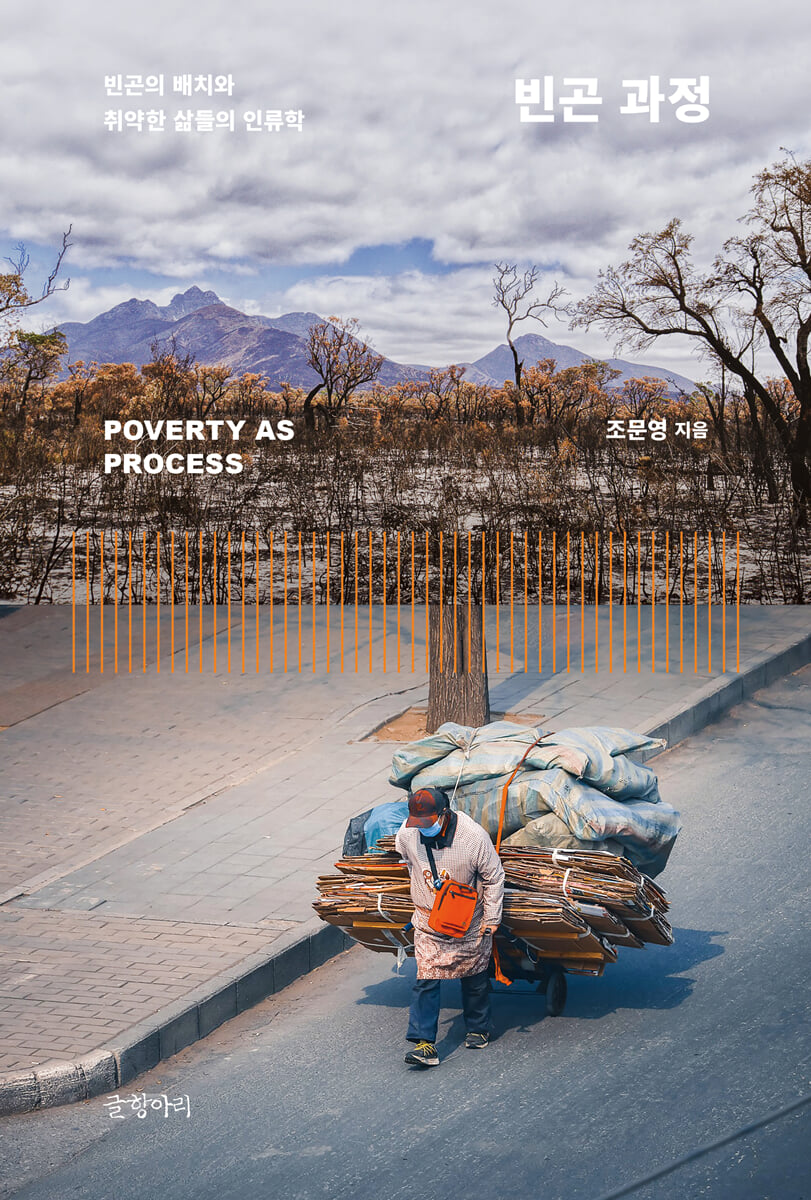
Poverty process
 |
Description
Book Introduction
- A word from MD
-
The Process of Poverty Accompanied by AnthropologistsProfessor Moon-Young Cho, a poverty researcher and anthropologist, says poverty is a continuous process and a arduous struggle.
The author documented the process of poverty by accompanying factory workers, beneficiaries, youth, and immigrants.
By expanding the scope of analysis to include non-humans exploited by humanity, we explored the possibility of going beyond the current structure.
November 25, 2022. Humanities PD Son Min-gyu
“In a cultural technology where the poor individual becomes the world in itself,
Poverty appears as a continuous process and a arduous struggle.”
It questions our dependence on others and surrounds our lives with endless anxiety.
In search of a world and possibilities hidden by poverty rule
―The Process of Poverty and the Expanding Perspective of the Poor Accompanied by Anthropologists
All life on Earth is connected to poverty.
It can first and foremost stick to my life and that of my family.
The fear, anger, and helplessness that emerge from a life of hunger and no prospects lead to self-deprecation and violence against one's own family.
Living in shantytowns, goshiwon, multi-family housing, and rental apartment complexes, I see, hear, and smell poverty right around my neck.
(…) Is it only humans?
The cries of non-human life, caused by the exploitation and plunder of nature, are translated into human-capable forms such as epidemics, floods, and forest fires, revealing only a small part of their true form.
This book is a record of the process by which I, an anthropologist, have raised poverty as an academic and practical topic through empirical research.
Over the past 20 years, while visiting various sites in Korea and China, I have dedicated myself to rediscovering and highlighting the poverty issues that deserve our attention.
In places where typical forms of poverty stand out, such as unauthorized shantytowns, industrial zones, and slum-like worker housing, I focused on the atypical history and relationships of poverty, and captured the commonality of poverty manifesting as existential anxiety in such heterogeneous places as university classes, immigrant spaces, and international development and volunteer settings.
(…) In an era of "boundaryless inequality," where the majority of the population identifies themselves as victims of structural inequality, and where wealth polarization is rapidly accelerating due to financial capitalism and pandemics, what approach is needed to raise poverty as a pressing political and ethical issue? _「Introduction」
Poverty appears as a continuous process and a arduous struggle.”
It questions our dependence on others and surrounds our lives with endless anxiety.
In search of a world and possibilities hidden by poverty rule
―The Process of Poverty and the Expanding Perspective of the Poor Accompanied by Anthropologists
All life on Earth is connected to poverty.
It can first and foremost stick to my life and that of my family.
The fear, anger, and helplessness that emerge from a life of hunger and no prospects lead to self-deprecation and violence against one's own family.
Living in shantytowns, goshiwon, multi-family housing, and rental apartment complexes, I see, hear, and smell poverty right around my neck.
(…) Is it only humans?
The cries of non-human life, caused by the exploitation and plunder of nature, are translated into human-capable forms such as epidemics, floods, and forest fires, revealing only a small part of their true form.
This book is a record of the process by which I, an anthropologist, have raised poverty as an academic and practical topic through empirical research.
Over the past 20 years, while visiting various sites in Korea and China, I have dedicated myself to rediscovering and highlighting the poverty issues that deserve our attention.
In places where typical forms of poverty stand out, such as unauthorized shantytowns, industrial zones, and slum-like worker housing, I focused on the atypical history and relationships of poverty, and captured the commonality of poverty manifesting as existential anxiety in such heterogeneous places as university classes, immigrant spaces, and international development and volunteer settings.
(…) In an era of "boundaryless inequality," where the majority of the population identifies themselves as victims of structural inequality, and where wealth polarization is rapidly accelerating due to financial capitalism and pandemics, what approach is needed to raise poverty as a pressing political and ethical issue? _「Introduction」
- You can preview some of the book's contents.
Preview
index
introduction
Part 1
Chapter 1: The Poverty of the Deceased
Chapter 2: Problematizing Dependence
Chapter 3: The Weight of Labor
Chapter 4: The Way Home
Part 2
Chapter 5: Youth Connected to Global Poverty
Chapter 6: Filling the Gap of Existence
Chapter 7: The Fear of Poverty Contagion
Chapter 8: The Precariat That Can Speak
Part 3
Chapter 9: Poverty in the Anthropocene
main
References
Search
Part 1
Chapter 1: The Poverty of the Deceased
Chapter 2: Problematizing Dependence
Chapter 3: The Weight of Labor
Chapter 4: The Way Home
Part 2
Chapter 5: Youth Connected to Global Poverty
Chapter 6: Filling the Gap of Existence
Chapter 7: The Fear of Poverty Contagion
Chapter 8: The Precariat That Can Speak
Part 3
Chapter 9: Poverty in the Anthropocene
main
References
Search
Into the book
In fact, there is nothing in life that is as natural as dependence.
(…) Is a healthy adult free from dependence? If his life seems free from dependence, it means he has had more opportunities and resources to depend on others than anyone else.
If he feels independent, it is likely because he has been indifferent to his own experiences of dependence.
(…) If we look at the history of welfare ‘growing’ through professionalization, institutionalization, and industrialization, it is a history of workers involved in building the social welfare system ‘depending’ on the poor.
Just as parents in group homes rely on Youngjae while simultaneously labeling him, welfare workers also rely on the poor while simultaneously setting themselves up as their judges.
---From "The Problematization of Dependence"
“Let’s go back home now” (…) As I accompanied Sun Weifen on his journey, there was a time when I kept getting confused about his ‘home’.
Was it his birthplace, Binh County, where his in-laws live, or Harbin, where his family gathers? A house with farmland nearby, or a convenient, modern apartment? When Sun Yufen went to Binh County to look for land, he said, "I want to go home." And when he gave up his land and returned to Harbin, he said, "Let's go home."
Ultimately, a home is not a 'where' that can be designated as a specific location, nor is it a 'something' that can be designated as a building, but rather a continuous process of creating one's own 'place' in the world.
A place to lie down comfortably, free from the fear of being torn down or kicked out at any moment, a comfortable place where you don't have to go to a public restroom in -20 degrees Celsius to do your business, (...) a place where it's okay to be sick and broke, a place where you have someone by your side to look after and rely on… … .
But the process of Sun Weifen creating a position was a process of having his qualifications questioned (even by himself) and internalizing the feeling of being ‘unqualified.’
(…) The judgment of unworthiness continued to be made by those close to me, even those closest to me.
Even I, who had repeatedly hesitated while accompanying him, and Sun Weifen himself, who had gradually withdrawn as he tried repeatedly and repeatedly confirmed that he was an 'inappropriate' being, could not be an exception.
---From "The Way Home"
“Subtle but unmissable phenomena,” “petty details,” “private, intimate, and internal aspects” are too difficult for outsiders to handle, ethically or methodologically.
Yet, if we can seriously examine the concrete lives of these viscous beings, (…) I hope that our public sphere will begin by acknowledging our fellow citizens not as distant strangers, fearful monsters, or hopeless mainstreams, but as vulnerable and imperfect beings (like myself) within the Earth.
As the sum total of the senses, worldviews, and aspirations of the Earthlings-Destroyer, we need a public forum where we can speak, write, read, and discuss, starting from our own life experiences, how the dream of development is so intense that it is equated with the very being of "him"; how culture, symbols, ideology, institutions, policies, education, media, jobs, and social security are intricately intertwined and exert synergy, blocking and stigmatizing dreams other than the dream of development; what unbearable norms and orders have been imposed and stigmatized; and how the dream so tenaciously pursued has become reality and then been frustrated.
(…) Is a healthy adult free from dependence? If his life seems free from dependence, it means he has had more opportunities and resources to depend on others than anyone else.
If he feels independent, it is likely because he has been indifferent to his own experiences of dependence.
(…) If we look at the history of welfare ‘growing’ through professionalization, institutionalization, and industrialization, it is a history of workers involved in building the social welfare system ‘depending’ on the poor.
Just as parents in group homes rely on Youngjae while simultaneously labeling him, welfare workers also rely on the poor while simultaneously setting themselves up as their judges.
---From "The Problematization of Dependence"
“Let’s go back home now” (…) As I accompanied Sun Weifen on his journey, there was a time when I kept getting confused about his ‘home’.
Was it his birthplace, Binh County, where his in-laws live, or Harbin, where his family gathers? A house with farmland nearby, or a convenient, modern apartment? When Sun Yufen went to Binh County to look for land, he said, "I want to go home." And when he gave up his land and returned to Harbin, he said, "Let's go home."
Ultimately, a home is not a 'where' that can be designated as a specific location, nor is it a 'something' that can be designated as a building, but rather a continuous process of creating one's own 'place' in the world.
A place to lie down comfortably, free from the fear of being torn down or kicked out at any moment, a comfortable place where you don't have to go to a public restroom in -20 degrees Celsius to do your business, (...) a place where it's okay to be sick and broke, a place where you have someone by your side to look after and rely on… … .
But the process of Sun Weifen creating a position was a process of having his qualifications questioned (even by himself) and internalizing the feeling of being ‘unqualified.’
(…) The judgment of unworthiness continued to be made by those close to me, even those closest to me.
Even I, who had repeatedly hesitated while accompanying him, and Sun Weifen himself, who had gradually withdrawn as he tried repeatedly and repeatedly confirmed that he was an 'inappropriate' being, could not be an exception.
---From "The Way Home"
“Subtle but unmissable phenomena,” “petty details,” “private, intimate, and internal aspects” are too difficult for outsiders to handle, ethically or methodologically.
Yet, if we can seriously examine the concrete lives of these viscous beings, (…) I hope that our public sphere will begin by acknowledging our fellow citizens not as distant strangers, fearful monsters, or hopeless mainstreams, but as vulnerable and imperfect beings (like myself) within the Earth.
As the sum total of the senses, worldviews, and aspirations of the Earthlings-Destroyer, we need a public forum where we can speak, write, read, and discuss, starting from our own life experiences, how the dream of development is so intense that it is equated with the very being of "him"; how culture, symbols, ideology, institutions, policies, education, media, jobs, and social security are intricately intertwined and exert synergy, blocking and stigmatizing dreams other than the dream of development; what unbearable norms and orders have been imposed and stigmatized; and how the dream so tenaciously pursued has become reality and then been frustrated.
---From "Poverty in the Anthropocene"
Publisher's Review
Poverty as a process
―Finding one's place in the labyrinth and mire
This book views poverty as a process.
In the process, the answer to the question, “What is poverty? Who are the poor?” always remains unresolved.
Poverty, which was said to be “everywhere,” becomes “nowhere” again when we look around.
Poverty becomes a process for the reader as well as for the poor, as it fails to answer this question simply, which has been answered with typical categories such as having no money, no home, nothing to eat, and no one to care for one, material deprivation and economic isolation, the weak, victims, beneficiaries, and dependents, and the answers are repeatedly reversed.
What is the process?
The urban poor, factory workers, beneficiaries, precarious youth, migrant workers, immigrants, women, indigenous peoples, slaves, and even the non-humans who have been exploited since before history… … The poor summoned in this book have no boundaries.
The scope of poverty continues to expand within the governance of this society and the relationships among those involved.
If you observe the life of a poor person for a certain period of time and follow his or her steps, you will realize that poverty, which is symbolized by material deprivation, is actually an endless struggle to fill the lack of existence.
The author, who has studied poverty for 20 years, says that poverty is the process by which vulnerable beings constantly strive to find their true place in the world, regardless of the given conditions.
“This country doesn’t want to know what kind of person I really am.” (117)
The words of a young worker who appears in the cultural technology section of this book accurately capture the essence of the poverty process.
In this society, it is more important to be interested in what kind of person he is than to identify who is poor and deal with his poverty—to turn his dependence into independence.
Participation in the poverty process begins there, and “enduring the insignificant everyday life together, yet learning from each other that everyone deserves a better place in the world than they have now” is the way the author, an anthropologist, has lived with poverty and summoned it to the political agenda.
Constituting the poor and distributing poverty
Poverty governance and poverty industries
The belief that there is real poverty and fake poverty has long fueled the poverty debate.
In a 2019 survey, 11 percent of those who responded, “I am poor,” had an annual salary of over 60 million won, and 52 percent owned their own homes. A post about someone who owned a house worth 2 billion won but called themselves a “typical middle-class house poor” became a hot topic online.
Everyone, including you and me, says that they are poor.
From Park Wan-seo's short story "Stolen Poverty" to the film "I, Daniel Blake" and the Netflix series "Squid Game," if we know what poverty is, it's not that difficult for us to empathize with the fabricated narrative of poverty.
Many people may feel aggrieved by the world's narrative of poverty, may feel a sense of relative deprivation, and may even become frustrated or even enthralled.
Yet, the poverty of others, which exists so openly in reality, remains something that is difficult to encounter and connect with.
“I have never seen poverty in my life.” (6)
“The story of a family that took their own life out of despair over the hardships of life, the residents of a small room who cannot comfortably bring in an electric blanket even in the bitter cold, and the migrants who suffer more from hunger than from the virus because they cannot find work due to the lockdown caused by COVID-19”… … The poverty conveyed through the media is nothing special, but rather distances itself from the complex and difficult reality of the poor, defining the world and refining the narrative to present poverty as the result.
The result does not reveal who is the party responsible for the poverty.
Rather than that one world, the solution to the 'poverty problem' that bundles individual narratives is prioritized.
As the ruling system treats poverty as a problem to be categorized and managed, putting poverty on everyone's agenda and engaging in criticism and resistance against it becomes a distant task.
Behind this situation are the poverty rule and poverty industry that question the natural state of existence called 'dependence'.
“Poverty is a phenomenon that has existed throughout the East and the West, past and present, but it was only after the modern era that we began to problematize it with the concept of ‘poverty’ and to construct ‘the poor’ as a target for intervention,” this book points out.
If we think of poverty as a lack of material goods, then human history is a history of poverty and a history of survival, of escaping poverty and trying to preserve our lives.
The war of survival of the fittest and the sharing of efforts to survive together are also part of this history.
In the sense that we long to escape, poverty is deeply imbued with negativity.
Should we consider voluntary poverty due to religious beliefs as an exception?
Scholars who study medieval Europe say that while the rise of Christianity brought about a shift in perception by giving religious value to poverty and charity, the perspective on poverty remained ambivalent even in this era.
“Poverty as a religious practice was praised, but poverty, which was unavoidable in reality, was regarded as the price of sin and a punishment from God.” (28-29)
In short, poverty is constructed.
Even as the basic livelihood security system is established and the level of social security improves, poverty remains something that must be proven, and the realities of a vulnerable life such as unemployment, illness, and aging become the burden of “loss of work ability,” dependence is stigmatized as a “weary defect,” and change is fixed at a “controllable level.”
Here, labor often becomes the absolute standard for value judgment.
The dichotomy of labor versus poverty, workers versus the poor, “justifies the inferiority of the latter” in this configuration.
The history of poverty rule is a process of building a series of knowledge and institutions to force people to work. (105)
It is noteworthy in this context that “paradoxically, the group of mediators and interlocutors who represent and make poverty a topic of debate—volunteers, activists, policymakers, researchers, artists, journalists, and others—increased as the solution to the problem of poverty seemed distant.”
Even those who call themselves officials, assistants, and performers ultimately depend on the poor.
The community of the poor and the movement of the poor (residents) have long embodied and practiced interdependence as a natural state of existence.
In a world where everyone is deeply entangled in the web of poverty, the author's words, "No one can be in a position to just watch the myriad aspects of poverty from afar," urge us to have a sense of poverty, a recognition of poverty, that is a little different from the way we position our own anxieties in this "era of borderless inequality" where everyone claims to be a victim of inequality.
To do so, what the author focuses on is the arrangement of poverty, the assemblage of poverty.
After outlining the governance of poverty and the composition of the poor, he writes a cultural history that accompanies the poverty process of two Chinese women in a completely different way.
As a Foxconn factory worker, a volunteer at a community center, an insurance salesperson, and a spouse and breadwinner, she “continuously created value” in a “social factory” by doing wage labor, housework, care work, and distributed labor, but at the same time, experiences of alienation also accumulated,” and “the creation and severance of relationships (…) and the process of expectation and resignation being repeated and intertwined” are depicted through Zuomei’s daily life.
The following is Sun Weifen's journey of anxious wandering between her in-laws' village, her parents' city, government offices, and model houses in an attempt to reclaim her land.
In the process, Sun Weifen, who is constantly questioned about his 'qualifications', internalizes a sense of unworthiness amid the disregard of the system and the market, and the vigilance and indifference of his family, cannot find a home in either.
As the scene shifts and vulnerable inner selves are confronted with the wider world, the book focuses on the sense of poverty experienced by young people connected to global poverty.
“The key link connecting the poor and the outside world” is existential poverty.
Despite their own poverty, they call themselves “exorcists of global poverty” and support the poverty industry by investing in development and aid projects.
As poverty emerges as a medium for a global order that masks structural inequality and forms an increasingly complex landscape in response to the dynamics of international politics, international organizations and "ethical corporations" reinforce this order by distributing knowledge, values, ethics, and institutions.
In this field, “young people who have been complaining about existential deprivation become the most paradoxical warriors, burning with passionate and creative labor to fight to eradicate global poverty.”
After my activities, I don't just want to be moved by them; I want to return and share my experiences with the children who regularly volunteer nearby, and I also want to contribute to the broader community. (235)
In a global poverty regime where the desire for self-affirmation, existential anxiety and the need for recognition, and the game of authenticity intersect, young people are freed from the stigma of anxiety, resignation, and denial, such as the 880,000 Won Generation and the N-Po Generation, and the return of neoliberal restructuring, and are reborn as “frontiers who create new knowledge, ideas, and emotions” as global citizens.
This is the background to the growth of overseas volunteer work, multinational youth volunteer groups, and overseas cultural exploration programs since the global foreign exchange crisis of the late 1990s.
“The narrative of ‘overseas’ that young people who grew up in a country where jobless growth is the norm evokes is a vague mix of demands for volunteer work, travel, and employment.
(…) Overseas travel can be an asset that will enhance your global competitiveness, or it can be an opportunity to discover new possibilities beyond the closed domestic job market.
Many young people imagine going abroad as a glimpse into a world beyond endless competition, a place where they can temporarily relinquish their worries about their future career path.
The desire to find rest, a career, an alternative lifestyle, and social recognition by taking the detour of traveling abroad overlaps with the desperation to avoid becoming surplus in a society where development does not guarantee employment.”
Where should contemporary poverty go? Here, the author once again broadens the horizon of understanding poverty and concludes his discussion with "poverty in the Anthropocene."
More precisely, about the vulnerable lives of the non-human poor.
Life on Earth other than humans, and even the planet itself, is not exempt from the poverty rule and exploitation structure, and the history of poverty rule experienced by the human-poor is repeated in an even harsher way (“by making nature work as cheaply as possible”).
The suffering of the non-human poor, which has continued since before history, has become so enormous that it is linked to the human poor as a crisis that cannot be dealt with by classifying it into labor and supply, dependence and self-reliance.
The need to perceive and perceive poverty as a process is further emphasized in our increasingly intimate relationship with nature, which has become more pronounced than before.
If you want to create another poverty
I need to create another batch
As the author states in the “Preface,” in this book, “by focusing on the discrepancy between the condition of material deprivation and the perception and sense of poverty (which sometimes create friction between them), the author unravels the layers of poverty experience and expands the scope of the poor” (8).
The first two chapters of this book address the problems that arise when poverty is captured by the regime of 'welfare'.
It captures the process by which poverty, when combined with welfare, reproduces dominant norms regarding labor, development, self-reliance, and dependence, and reinforces stigmatization and violence against the poor.
Chapter 1, "The Poverty of the Deceased," examines the history of social security and, based on the case of the Nangok district in Seoul, which the author has researched since 2001, examines how the basic law and the system of welfare provision function as bureaucratic machines, stifling the sense, perception, narrative, debate, and struggle of poverty and jeopardizing the political agenda of poverty.
Chapter 2, “The Problematization of Dependence,” examines the context in which dependence, despite being an inherent aspect of life, has come to function as a social “problem” and a mechanism for monitoring and managing the behavior and customs of the poor.
The stigma of dependence was neither a natural nor inevitable consequence of history.
The meaning of dependence in the living world continues to change, and self-reliance was translated as interdependence in the history of the Korean poverty movement.
Chapters 3 and 4 are ethnographies about two Chinese women with whom the author spent a long time.
These essays illuminate the individual as a world in itself and examine how poverty becomes a process of social and existential struggle.
Those who bear the weight of poverty more heavily in the process of connecting with others, institutions, knowledge, and media, and those who desperately try to resist alienation and then face new alienation, are not easily categorized or labeled as weak or victims.
Part 2 expands the scope of poverty from physical deprivation to existential deprivation in the field of poverty industry and poverty governance.
Chapters 5 and 6 examine how the global governance of poverty operates in the 21st century, discussing the paradox of young people, who complain of existential anxiety, taking on the role of exorcists of poverty in development projects around the world.
The tangled web of corporations obsessed with strategic gain, practitioners repeatedly playing the "authenticity game," Korean students seeking to heal their own anxieties rather than the poverty of others, and Chinese students claiming to be whistleblowers in the poverty industry defies a well-organized critique of the regime's governance.
Chapters 7-8 expand this existential lack into a discussion of instability.
Chapter 7, “Fear of Poverty Contagion,” is a cultural technology journal about Korean immigrants living in the Koreatown of Shenyang, Dongbei Province, China, with the fear of downward mobility and failure.
The context in which dependence emerged as a sign of contamination among migrants desperate for interdependence is examined through the ups and downs of relationships between small Korean business owners, ethnic Koreans of China, and North Korean defectors.
Chapter 8, “The Precariat That Can Speak,” contains the friction and hierarchy among vulnerable beings that the author encountered with students in university classes.
The anxiety and aspirations of young people with educational and cultural capital are met with the vulnerability and tension of the urban poor.
Finally, Chapter 9, “Poverty in the Anthropocene,” returns to the understanding of poverty as a process and asks, “Where will poverty in our time go?”
Contrasting the "dream of development" fiercely held by the Earth's inhabitants and destroyers with the common fate of human vulnerability and finiteness, the author proposes coexistence in a sense of slow time.
The way, paradoxically, would be to simply participate in the process while refusing to answer the question.
20 years of poverty research,
In the tension of encounter
The author began to study poverty as a topic of anthropological research in 2001, when he published his master's thesis, "Creating a 'Culture of Poverty': A Study on the Relationship between 'Poverty' and 'Welfare' in Slum Areas" (which is still widely read).
However, the beginning of that interest may go back to my study room activities in a redevelopment area during my college days in the mid-1990s, which served as the impetus for this article, or even earlier, to my experience witnessing a demolition site during my elementary school days in the mid-1980s.
He recalls a vague scene as he asks himself when he first became seriously aware of the problem of poverty.
It was when I was attending elementary school near Gimpo Airport.
My classmates decided to collect 1,000 won each to make a collection of poems, but even after vacation, the money wasn't collected.
Under the pretext of collecting money, I visited the shepherd village where some of my friends lived.
I got off the bus at Mokdong Intersection and walked for a while.
Asura unfolded through the acrid dust.
The sight of that day—a tangle of dust-covered baskets, pots strewn across the alley, a child's cries, a mother's wailing, and the demolition crew's curses—was a hazy remnant, a vivid shock that haunted me for a long time. (15-16)
This is an event remembered in the history of the democratization movement and the poor people's movement as the 'Mokdong Demolition Opposition Struggle'.
Ten years later, the farmers he encountered in the Three Gorges of the Yangtze River gave him a similar feeling.
“People who had been sleeping in a daze were now chatting earnestly and exploring the landscape,” and “there was no room for the language of anthropology to intrude,” “bright lights, tall spires, the sound of machinery, the excitement and trembling of bodies.” Describing the scene at that time, the author explains in more concrete terms the sensation that had long been lingering.
Looking back, what led me to the world of anthropology was neither my interest in distant regions nor my ambition to discover universal human laws, but rather the experience of others' actions shaking my classification system. (376)
The word he often mentions when recalling these experiences is 'tension'.
The tension that arises when one world in a multiplicity of worlds confronts another—the author seems to regard this moment as an “anthropological moment”—by constantly maintaining a tense posture, discovering tense structures, and attempting to create conditions for tension.
While he rearranges what is displaced, dismantles classifications, and dismantles stigmas to reveal possibilities, he, as an anthropologist, wishes to cultivate his senses as a “participant-involved rather than remaining a detached observer”, disobeying the established arguments that are stale, absurd, and uncomfortable.
Even when that world is your own.
It has been over 20 years since poverty and the poor have been addressed in the unique discipline of anthropology, and the "Anthropology of Poverty" course, which has been taught at the undergraduate level since 2012, has also been in session for 10 years.
While addressing contemporary poverty through diverse topics such as labor, distribution, welfare, migration, demolition, shantytowns, the homeless, youth, movements, and the climate crisis, various issues from both reality and academia, including basic income, feminist reboot, pandemics, and actor-network theory, have continued to be reflected in this long-standing sense and thought of poverty.
He worries that the resulting book will “look like a patchwork,” but he once again makes this a tense chapter.
The book, which begins its introduction by stating that “this patchwork (which is inherently incomplete and will remain so) is an attempt to reposition research conducted in different fields at different times under different questions as a prelude to expanding our thinking about poverty in our time,” ends with the words, “It still makes me nervous.”
―Finding one's place in the labyrinth and mire
This book views poverty as a process.
In the process, the answer to the question, “What is poverty? Who are the poor?” always remains unresolved.
Poverty, which was said to be “everywhere,” becomes “nowhere” again when we look around.
Poverty becomes a process for the reader as well as for the poor, as it fails to answer this question simply, which has been answered with typical categories such as having no money, no home, nothing to eat, and no one to care for one, material deprivation and economic isolation, the weak, victims, beneficiaries, and dependents, and the answers are repeatedly reversed.
What is the process?
The urban poor, factory workers, beneficiaries, precarious youth, migrant workers, immigrants, women, indigenous peoples, slaves, and even the non-humans who have been exploited since before history… … The poor summoned in this book have no boundaries.
The scope of poverty continues to expand within the governance of this society and the relationships among those involved.
If you observe the life of a poor person for a certain period of time and follow his or her steps, you will realize that poverty, which is symbolized by material deprivation, is actually an endless struggle to fill the lack of existence.
The author, who has studied poverty for 20 years, says that poverty is the process by which vulnerable beings constantly strive to find their true place in the world, regardless of the given conditions.
“This country doesn’t want to know what kind of person I really am.” (117)
The words of a young worker who appears in the cultural technology section of this book accurately capture the essence of the poverty process.
In this society, it is more important to be interested in what kind of person he is than to identify who is poor and deal with his poverty—to turn his dependence into independence.
Participation in the poverty process begins there, and “enduring the insignificant everyday life together, yet learning from each other that everyone deserves a better place in the world than they have now” is the way the author, an anthropologist, has lived with poverty and summoned it to the political agenda.
Constituting the poor and distributing poverty
Poverty governance and poverty industries
The belief that there is real poverty and fake poverty has long fueled the poverty debate.
In a 2019 survey, 11 percent of those who responded, “I am poor,” had an annual salary of over 60 million won, and 52 percent owned their own homes. A post about someone who owned a house worth 2 billion won but called themselves a “typical middle-class house poor” became a hot topic online.
Everyone, including you and me, says that they are poor.
From Park Wan-seo's short story "Stolen Poverty" to the film "I, Daniel Blake" and the Netflix series "Squid Game," if we know what poverty is, it's not that difficult for us to empathize with the fabricated narrative of poverty.
Many people may feel aggrieved by the world's narrative of poverty, may feel a sense of relative deprivation, and may even become frustrated or even enthralled.
Yet, the poverty of others, which exists so openly in reality, remains something that is difficult to encounter and connect with.
“I have never seen poverty in my life.” (6)
“The story of a family that took their own life out of despair over the hardships of life, the residents of a small room who cannot comfortably bring in an electric blanket even in the bitter cold, and the migrants who suffer more from hunger than from the virus because they cannot find work due to the lockdown caused by COVID-19”… … The poverty conveyed through the media is nothing special, but rather distances itself from the complex and difficult reality of the poor, defining the world and refining the narrative to present poverty as the result.
The result does not reveal who is the party responsible for the poverty.
Rather than that one world, the solution to the 'poverty problem' that bundles individual narratives is prioritized.
As the ruling system treats poverty as a problem to be categorized and managed, putting poverty on everyone's agenda and engaging in criticism and resistance against it becomes a distant task.
Behind this situation are the poverty rule and poverty industry that question the natural state of existence called 'dependence'.
“Poverty is a phenomenon that has existed throughout the East and the West, past and present, but it was only after the modern era that we began to problematize it with the concept of ‘poverty’ and to construct ‘the poor’ as a target for intervention,” this book points out.
If we think of poverty as a lack of material goods, then human history is a history of poverty and a history of survival, of escaping poverty and trying to preserve our lives.
The war of survival of the fittest and the sharing of efforts to survive together are also part of this history.
In the sense that we long to escape, poverty is deeply imbued with negativity.
Should we consider voluntary poverty due to religious beliefs as an exception?
Scholars who study medieval Europe say that while the rise of Christianity brought about a shift in perception by giving religious value to poverty and charity, the perspective on poverty remained ambivalent even in this era.
“Poverty as a religious practice was praised, but poverty, which was unavoidable in reality, was regarded as the price of sin and a punishment from God.” (28-29)
In short, poverty is constructed.
Even as the basic livelihood security system is established and the level of social security improves, poverty remains something that must be proven, and the realities of a vulnerable life such as unemployment, illness, and aging become the burden of “loss of work ability,” dependence is stigmatized as a “weary defect,” and change is fixed at a “controllable level.”
Here, labor often becomes the absolute standard for value judgment.
The dichotomy of labor versus poverty, workers versus the poor, “justifies the inferiority of the latter” in this configuration.
The history of poverty rule is a process of building a series of knowledge and institutions to force people to work. (105)
It is noteworthy in this context that “paradoxically, the group of mediators and interlocutors who represent and make poverty a topic of debate—volunteers, activists, policymakers, researchers, artists, journalists, and others—increased as the solution to the problem of poverty seemed distant.”
Even those who call themselves officials, assistants, and performers ultimately depend on the poor.
The community of the poor and the movement of the poor (residents) have long embodied and practiced interdependence as a natural state of existence.
In a world where everyone is deeply entangled in the web of poverty, the author's words, "No one can be in a position to just watch the myriad aspects of poverty from afar," urge us to have a sense of poverty, a recognition of poverty, that is a little different from the way we position our own anxieties in this "era of borderless inequality" where everyone claims to be a victim of inequality.
To do so, what the author focuses on is the arrangement of poverty, the assemblage of poverty.
After outlining the governance of poverty and the composition of the poor, he writes a cultural history that accompanies the poverty process of two Chinese women in a completely different way.
As a Foxconn factory worker, a volunteer at a community center, an insurance salesperson, and a spouse and breadwinner, she “continuously created value” in a “social factory” by doing wage labor, housework, care work, and distributed labor, but at the same time, experiences of alienation also accumulated,” and “the creation and severance of relationships (…) and the process of expectation and resignation being repeated and intertwined” are depicted through Zuomei’s daily life.
The following is Sun Weifen's journey of anxious wandering between her in-laws' village, her parents' city, government offices, and model houses in an attempt to reclaim her land.
In the process, Sun Weifen, who is constantly questioned about his 'qualifications', internalizes a sense of unworthiness amid the disregard of the system and the market, and the vigilance and indifference of his family, cannot find a home in either.
As the scene shifts and vulnerable inner selves are confronted with the wider world, the book focuses on the sense of poverty experienced by young people connected to global poverty.
“The key link connecting the poor and the outside world” is existential poverty.
Despite their own poverty, they call themselves “exorcists of global poverty” and support the poverty industry by investing in development and aid projects.
As poverty emerges as a medium for a global order that masks structural inequality and forms an increasingly complex landscape in response to the dynamics of international politics, international organizations and "ethical corporations" reinforce this order by distributing knowledge, values, ethics, and institutions.
In this field, “young people who have been complaining about existential deprivation become the most paradoxical warriors, burning with passionate and creative labor to fight to eradicate global poverty.”
After my activities, I don't just want to be moved by them; I want to return and share my experiences with the children who regularly volunteer nearby, and I also want to contribute to the broader community. (235)
In a global poverty regime where the desire for self-affirmation, existential anxiety and the need for recognition, and the game of authenticity intersect, young people are freed from the stigma of anxiety, resignation, and denial, such as the 880,000 Won Generation and the N-Po Generation, and the return of neoliberal restructuring, and are reborn as “frontiers who create new knowledge, ideas, and emotions” as global citizens.
This is the background to the growth of overseas volunteer work, multinational youth volunteer groups, and overseas cultural exploration programs since the global foreign exchange crisis of the late 1990s.
“The narrative of ‘overseas’ that young people who grew up in a country where jobless growth is the norm evokes is a vague mix of demands for volunteer work, travel, and employment.
(…) Overseas travel can be an asset that will enhance your global competitiveness, or it can be an opportunity to discover new possibilities beyond the closed domestic job market.
Many young people imagine going abroad as a glimpse into a world beyond endless competition, a place where they can temporarily relinquish their worries about their future career path.
The desire to find rest, a career, an alternative lifestyle, and social recognition by taking the detour of traveling abroad overlaps with the desperation to avoid becoming surplus in a society where development does not guarantee employment.”
Where should contemporary poverty go? Here, the author once again broadens the horizon of understanding poverty and concludes his discussion with "poverty in the Anthropocene."
More precisely, about the vulnerable lives of the non-human poor.
Life on Earth other than humans, and even the planet itself, is not exempt from the poverty rule and exploitation structure, and the history of poverty rule experienced by the human-poor is repeated in an even harsher way (“by making nature work as cheaply as possible”).
The suffering of the non-human poor, which has continued since before history, has become so enormous that it is linked to the human poor as a crisis that cannot be dealt with by classifying it into labor and supply, dependence and self-reliance.
The need to perceive and perceive poverty as a process is further emphasized in our increasingly intimate relationship with nature, which has become more pronounced than before.
If you want to create another poverty
I need to create another batch
As the author states in the “Preface,” in this book, “by focusing on the discrepancy between the condition of material deprivation and the perception and sense of poverty (which sometimes create friction between them), the author unravels the layers of poverty experience and expands the scope of the poor” (8).
The first two chapters of this book address the problems that arise when poverty is captured by the regime of 'welfare'.
It captures the process by which poverty, when combined with welfare, reproduces dominant norms regarding labor, development, self-reliance, and dependence, and reinforces stigmatization and violence against the poor.
Chapter 1, "The Poverty of the Deceased," examines the history of social security and, based on the case of the Nangok district in Seoul, which the author has researched since 2001, examines how the basic law and the system of welfare provision function as bureaucratic machines, stifling the sense, perception, narrative, debate, and struggle of poverty and jeopardizing the political agenda of poverty.
Chapter 2, “The Problematization of Dependence,” examines the context in which dependence, despite being an inherent aspect of life, has come to function as a social “problem” and a mechanism for monitoring and managing the behavior and customs of the poor.
The stigma of dependence was neither a natural nor inevitable consequence of history.
The meaning of dependence in the living world continues to change, and self-reliance was translated as interdependence in the history of the Korean poverty movement.
Chapters 3 and 4 are ethnographies about two Chinese women with whom the author spent a long time.
These essays illuminate the individual as a world in itself and examine how poverty becomes a process of social and existential struggle.
Those who bear the weight of poverty more heavily in the process of connecting with others, institutions, knowledge, and media, and those who desperately try to resist alienation and then face new alienation, are not easily categorized or labeled as weak or victims.
Part 2 expands the scope of poverty from physical deprivation to existential deprivation in the field of poverty industry and poverty governance.
Chapters 5 and 6 examine how the global governance of poverty operates in the 21st century, discussing the paradox of young people, who complain of existential anxiety, taking on the role of exorcists of poverty in development projects around the world.
The tangled web of corporations obsessed with strategic gain, practitioners repeatedly playing the "authenticity game," Korean students seeking to heal their own anxieties rather than the poverty of others, and Chinese students claiming to be whistleblowers in the poverty industry defies a well-organized critique of the regime's governance.
Chapters 7-8 expand this existential lack into a discussion of instability.
Chapter 7, “Fear of Poverty Contagion,” is a cultural technology journal about Korean immigrants living in the Koreatown of Shenyang, Dongbei Province, China, with the fear of downward mobility and failure.
The context in which dependence emerged as a sign of contamination among migrants desperate for interdependence is examined through the ups and downs of relationships between small Korean business owners, ethnic Koreans of China, and North Korean defectors.
Chapter 8, “The Precariat That Can Speak,” contains the friction and hierarchy among vulnerable beings that the author encountered with students in university classes.
The anxiety and aspirations of young people with educational and cultural capital are met with the vulnerability and tension of the urban poor.
Finally, Chapter 9, “Poverty in the Anthropocene,” returns to the understanding of poverty as a process and asks, “Where will poverty in our time go?”
Contrasting the "dream of development" fiercely held by the Earth's inhabitants and destroyers with the common fate of human vulnerability and finiteness, the author proposes coexistence in a sense of slow time.
The way, paradoxically, would be to simply participate in the process while refusing to answer the question.
20 years of poverty research,
In the tension of encounter
The author began to study poverty as a topic of anthropological research in 2001, when he published his master's thesis, "Creating a 'Culture of Poverty': A Study on the Relationship between 'Poverty' and 'Welfare' in Slum Areas" (which is still widely read).
However, the beginning of that interest may go back to my study room activities in a redevelopment area during my college days in the mid-1990s, which served as the impetus for this article, or even earlier, to my experience witnessing a demolition site during my elementary school days in the mid-1980s.
He recalls a vague scene as he asks himself when he first became seriously aware of the problem of poverty.
It was when I was attending elementary school near Gimpo Airport.
My classmates decided to collect 1,000 won each to make a collection of poems, but even after vacation, the money wasn't collected.
Under the pretext of collecting money, I visited the shepherd village where some of my friends lived.
I got off the bus at Mokdong Intersection and walked for a while.
Asura unfolded through the acrid dust.
The sight of that day—a tangle of dust-covered baskets, pots strewn across the alley, a child's cries, a mother's wailing, and the demolition crew's curses—was a hazy remnant, a vivid shock that haunted me for a long time. (15-16)
This is an event remembered in the history of the democratization movement and the poor people's movement as the 'Mokdong Demolition Opposition Struggle'.
Ten years later, the farmers he encountered in the Three Gorges of the Yangtze River gave him a similar feeling.
“People who had been sleeping in a daze were now chatting earnestly and exploring the landscape,” and “there was no room for the language of anthropology to intrude,” “bright lights, tall spires, the sound of machinery, the excitement and trembling of bodies.” Describing the scene at that time, the author explains in more concrete terms the sensation that had long been lingering.
Looking back, what led me to the world of anthropology was neither my interest in distant regions nor my ambition to discover universal human laws, but rather the experience of others' actions shaking my classification system. (376)
The word he often mentions when recalling these experiences is 'tension'.
The tension that arises when one world in a multiplicity of worlds confronts another—the author seems to regard this moment as an “anthropological moment”—by constantly maintaining a tense posture, discovering tense structures, and attempting to create conditions for tension.
While he rearranges what is displaced, dismantles classifications, and dismantles stigmas to reveal possibilities, he, as an anthropologist, wishes to cultivate his senses as a “participant-involved rather than remaining a detached observer”, disobeying the established arguments that are stale, absurd, and uncomfortable.
Even when that world is your own.
It has been over 20 years since poverty and the poor have been addressed in the unique discipline of anthropology, and the "Anthropology of Poverty" course, which has been taught at the undergraduate level since 2012, has also been in session for 10 years.
While addressing contemporary poverty through diverse topics such as labor, distribution, welfare, migration, demolition, shantytowns, the homeless, youth, movements, and the climate crisis, various issues from both reality and academia, including basic income, feminist reboot, pandemics, and actor-network theory, have continued to be reflected in this long-standing sense and thought of poverty.
He worries that the resulting book will “look like a patchwork,” but he once again makes this a tense chapter.
The book, which begins its introduction by stating that “this patchwork (which is inherently incomplete and will remain so) is an attempt to reposition research conducted in different fields at different times under different questions as a prelude to expanding our thinking about poverty in our time,” ends with the words, “It still makes me nervous.”
GOODS SPECIFICS
- Publication date: November 7, 2022
- Format: Hardcover book binding method guide
- Page count, weight, size: 428 pages | 672g | 135*200*30mm
- ISBN13: 9791169090490
- ISBN10: 1169090494
You may also like
카테고리
korean


korean

![ELLE 엘르 스페셜 에디션 A형 : 12월 [2025]](http://librairie.coreenne.fr/cdn/shop/files/b8e27a3de6c9538896439686c6b0e8fb.jpg?v=1766436872&width=3840)


