

Choi Jun-seok's Science Chronicles
 |
Description
Book Introduction
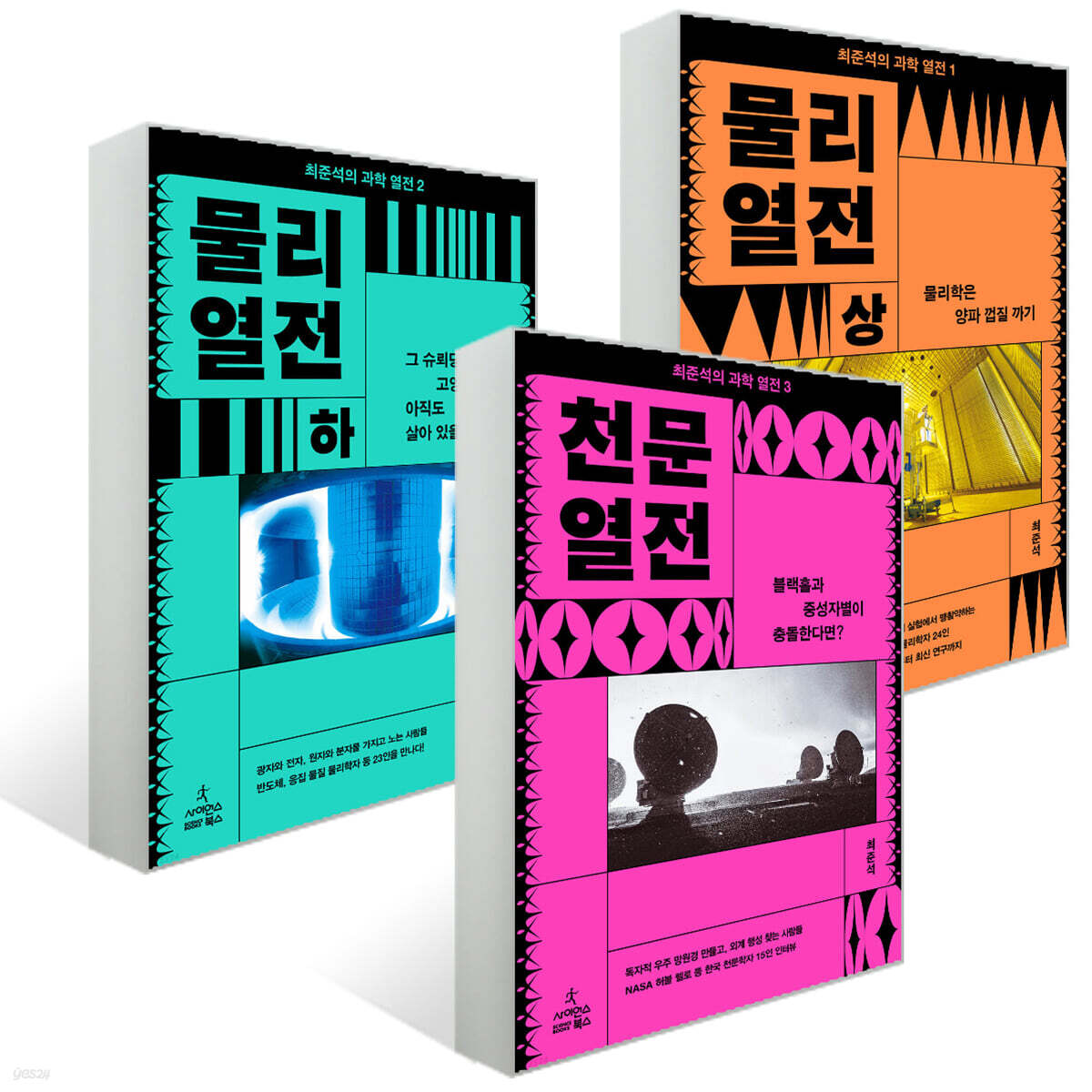
This product is a product made by YES24. (Individual returns are not possible.) [Book] Physics: Peeling an Onion We've found the best particle physicists! And we've heard from them! The vivid reality of research in South Korea. "Thermoelectric Physics" consists of 24 chapters in 4 parts. Part 1 features scientists exploring dark matter, while Part 2 features scientists conducting experiments using particle accelerators. Part 3 is filled with scientists exploring neutrinos, and Part 4 is filled with scientists trying to fill in the gaps in the Standard Model. [Book] Physics Chronicles (Part 2): Is Schrödinger's cat still alive? Seven out of ten physicists study matter! The true matter shrouded in mystery, the true story of physics. It's filled with surprisingly vivid voices from the field. The second book in the series, "Thermoelectric Physics," consists of four parts and 23 chapters. Part 1 is about scientists studying quantum technology, Part 2 is about scientists studying matter at the subatomic level, Part 3 is about scientists studying the various states of matter, and Part 4 is about scientists studying nuclear fusion technology, which is considered a challenging problem, and scientists who are combining it with biology. [Book] Astronomy: What if a Black Hole and a Neutron Star Collided? Observational equipment, facilities, and researchers are insufficient! The path of Korean astronomy, pioneered by an unwavering will. The third book in the series, "Now is the time to rise as a space power," "Astronomy Chronicles," consists of 4 parts and 15 chapters. Part 1 features astronomers studying the early universe, while Part 2 features astronomers searching for mysterious celestial bodies in the universe and the reasons behind them. Part 3 features interviews with astronomers observing the universe in various ways, including gravitational waves, satellites, and new telescopes, while Part 4 features interviews with astronomers investigating high-energy astronomical phenomena. |
index
Beginning the Book: Now Learning Science as a Human 007
Part 1: Those Who See the Invisible
Chapter 1: Creating Korea's First Dark Matter Experiment 019
Chapter 2: Descending to the Yangyang Underground Power Plant in Search of Wimps 033
Chapter 3: Finding the Axion, the Two Leading Dark Matter Candidates 047
Chapter 4: Many Ways to Find Dark Matter 061
Chapter 5: WIMPs, Axions, and Symps? What is the Real Dark Matter? 077
Chapter 6: Three Frontiers in Particle Physics 091
Part 2: Physicists Conducting Earth's Largest Scientific Experiment
Chapter 7: The Next Generation Particle Collider: Build it 105
Chapter 8: Where Did All That Antimatter Go? 119
Chapter 9: How Were Elementary Particles Created After the Big Bang? 133
Chapter 10: What Does Nuclear Material Created in Extreme Environments Look Like? 143
Chapter 11: Building the Mechanical Devices for CERN's Particle Detector 157
Chapter 12: Finding New Symmetry in the Quantum Universe 171
Chapter 13: Building an Ultra-High-Speed Camera for Particle Detectors 185
Chapter 14: Developing the Next Generation Particle Accelerator 197
Part 3: Physicists Chasing Ghostly Neutrinos
Chapter 15: The Renault Experiment Unlocks the Final Key to Neutrino Oscillations 213
Chapter 16: A Physics Laboratory 1,000 Meters Underground
Chapter 17: Building a Neutrino Detector, a Field Cage 241
Chapter 18: Where Did the Right-Handed Neutrinos Go? 253
Part 4: In Search of the Ultimate Particle and the Ultimate Force
Chapter 19: Building a Valid Theory of Heavy Quarks 267
Chapter 20: Lattice QCD Physics Explaining the Strong Force 279
Chapter 21: How many dimensions does the universe have? 291
Chapter 22: Black Holes as Tools for Solving Quantum Gravity Problems 305
Chapter 23: Finding Dark Matter with Gravitational Waves 317
Chapter 24: Precision Higgs Physics Opens New Paths 331
Further Reading 343
Copyright 351
Search 352
Part 1: Those Who See the Invisible
Chapter 1: Creating Korea's First Dark Matter Experiment 019
Chapter 2: Descending to the Yangyang Underground Power Plant in Search of Wimps 033
Chapter 3: Finding the Axion, the Two Leading Dark Matter Candidates 047
Chapter 4: Many Ways to Find Dark Matter 061
Chapter 5: WIMPs, Axions, and Symps? What is the Real Dark Matter? 077
Chapter 6: Three Frontiers in Particle Physics 091
Part 2: Physicists Conducting Earth's Largest Scientific Experiment
Chapter 7: The Next Generation Particle Collider: Build it 105
Chapter 8: Where Did All That Antimatter Go? 119
Chapter 9: How Were Elementary Particles Created After the Big Bang? 133
Chapter 10: What Does Nuclear Material Created in Extreme Environments Look Like? 143
Chapter 11: Building the Mechanical Devices for CERN's Particle Detector 157
Chapter 12: Finding New Symmetry in the Quantum Universe 171
Chapter 13: Building an Ultra-High-Speed Camera for Particle Detectors 185
Chapter 14: Developing the Next Generation Particle Accelerator 197
Part 3: Physicists Chasing Ghostly Neutrinos
Chapter 15: The Renault Experiment Unlocks the Final Key to Neutrino Oscillations 213
Chapter 16: A Physics Laboratory 1,000 Meters Underground
Chapter 17: Building a Neutrino Detector, a Field Cage 241
Chapter 18: Where Did the Right-Handed Neutrinos Go? 253
Part 4: In Search of the Ultimate Particle and the Ultimate Force
Chapter 19: Building a Valid Theory of Heavy Quarks 267
Chapter 20: Lattice QCD Physics Explaining the Strong Force 279
Chapter 21: How many dimensions does the universe have? 291
Chapter 22: Black Holes as Tools for Solving Quantum Gravity Problems 305
Chapter 23: Finding Dark Matter with Gravitational Waves 317
Chapter 24: Precision Higgs Physics Opens New Paths 331
Further Reading 343
Copyright 351
Search 352
Beginning the Book: Now Learning Science as a Human 007
Part 1: Can we understand and utilize the quantum world?
Chapter 1: Is Quantum Computer Development Impossible?! 019
Chapter 2: My 40s: I Turned It Into a Quantum Computer! 033
Chapter 3: Creating a Quantum Sensor that Measures Micromagnetic Fields 047
Chapter 4: Can Schrödinger's Cat Really Be Made? 059
Chapter 5: Creating Entangled Photons Using Atoms 073
Part 2: Physicists Manipulating Light and Atoms
Chapter 6: The Principle of Complete Irreflection, Implemented Experimentally 087
Chapter 7: Converging Nano-Optics and Neuroscience 099
Chapter 8: Single-Crystal Researchers Create Rust-Free Copper 113
Chapter 9: Experimental Fields for Creating Matter Waves 127
Chapter 10: A Look Inside Superfluids Made by Frozen Atoms 139
Part 3: What Really Is Matter?
Chapter 11: A New Physics Platform for Explaining Correlations 155
Chapter 12: Samsung Electronics' Top Secret: The Leading Expert in Organic Semiconductors 169
Chapter 13: World-Class Equipment Requires Korean Physics to Advance 181
Chapter 14: Focusing on Post-Graphene 'Black Phosphorus' 201
Chapter 15: Unraveling the Spin Vortex Particle 'Commion' 213
Chapter 16: Topological Matter Physics and the Future of Semiconductors 227
Chapter 17: Quantum Spin Ice and the Quantum Physics of Twisting 241
Chapter 18: Complex Physics: How Working Together Changes 253
Part 4: Physicists Tackling the Challenges of Nuclear Fusion and Life
Chapter 19: The Dream of Future Energy: Securing Nuclear Fusion Technology 269
Chapter 20: Taming the Wild Horse, Plasma 285
Chapter 21: The Future of Nuclear Fusion Depends on Him 297
Chapter 22: Physicists Observing the Molecules of Life 307
Chapter 23: Physicists at the Forefront of Brain Imaging 321
Further Reading 334
Copyright 342
Browse 343 Getting Started with Book: Now Learning Science as a Human 007
Part 1: Can we understand and utilize the quantum world?
Chapter 1: Is Quantum Computer Development Impossible?! 019
Chapter 2: My 40s: I Turned It Into a Quantum Computer! 033
Chapter 3: Creating a Quantum Sensor that Measures Micromagnetic Fields 047
Chapter 4: Can Schrödinger's Cat Really Be Made? 059
Chapter 5: Creating Entangled Photons Using Atoms 073
Part 2: Physicists Manipulating Light and Atoms
Chapter 6: The Principle of Complete Irreflection, Implemented Experimentally 087
Chapter 7: Converging Nano-Optics and Neuroscience 099
Chapter 8: Single-Crystal Researchers Create Rust-Free Copper 113
Chapter 9: Experimental Fields for Creating Matter Waves 127
Chapter 10: A Look Inside Superfluids Made by Frozen Atoms 139
Part 3: What Really Is Matter?
Chapter 11: A New Physics Platform for Explaining Correlations 155
Chapter 12: Samsung Electronics' Top Secret: The Leading Expert in Organic Semiconductors 169
Chapter 13: World-Class Equipment Requires Korean Physics to Advance 181
Chapter 14: Focusing on Post-Graphene 'Black Phosphorus' 201
Chapter 15: Unraveling the Spin Vortex Particle 'Commion' 213
Chapter 16: Topological Matter Physics and the Future of Semiconductors 227
Chapter 17: Quantum Spin Ice and the Quantum Physics of Twisting 241
Chapter 18: Complex Physics: How Working Together Changes 253
Part 4: Physicists Tackling the Challenges of Nuclear Fusion and Life
Chapter 19: The Dream of Future Energy: Securing Nuclear Fusion Technology 269
Chapter 20: Taming the Wild Horse, Plasma 285
Chapter 21: The Future of Nuclear Fusion Depends on Him 297
Chapter 22: Physicists Observing the Molecules of Life 307
Chapter 23: Physicists at the Forefront of Brain Imaging 321
Further Reading 334
Copyright 342
Search 343
Part 1: Can we understand and utilize the quantum world?
Chapter 1: Is Quantum Computer Development Impossible?! 019
Chapter 2: My 40s: I Turned It Into a Quantum Computer! 033
Chapter 3: Creating a Quantum Sensor that Measures Micromagnetic Fields 047
Chapter 4: Can Schrödinger's Cat Really Be Made? 059
Chapter 5: Creating Entangled Photons Using Atoms 073
Part 2: Physicists Manipulating Light and Atoms
Chapter 6: The Principle of Complete Irreflection, Implemented Experimentally 087
Chapter 7: Converging Nano-Optics and Neuroscience 099
Chapter 8: Single-Crystal Researchers Create Rust-Free Copper 113
Chapter 9: Experimental Fields for Creating Matter Waves 127
Chapter 10: A Look Inside Superfluids Made by Frozen Atoms 139
Part 3: What Really Is Matter?
Chapter 11: A New Physics Platform for Explaining Correlations 155
Chapter 12: Samsung Electronics' Top Secret: The Leading Expert in Organic Semiconductors 169
Chapter 13: World-Class Equipment Requires Korean Physics to Advance 181
Chapter 14: Focusing on Post-Graphene 'Black Phosphorus' 201
Chapter 15: Unraveling the Spin Vortex Particle 'Commion' 213
Chapter 16: Topological Matter Physics and the Future of Semiconductors 227
Chapter 17: Quantum Spin Ice and the Quantum Physics of Twisting 241
Chapter 18: Complex Physics: How Working Together Changes 253
Part 4: Physicists Tackling the Challenges of Nuclear Fusion and Life
Chapter 19: The Dream of Future Energy: Securing Nuclear Fusion Technology 269
Chapter 20: Taming the Wild Horse, Plasma 285
Chapter 21: The Future of Nuclear Fusion Depends on Him 297
Chapter 22: Physicists Observing the Molecules of Life 307
Chapter 23: Physicists at the Forefront of Brain Imaging 321
Further Reading 334
Copyright 342
Browse 343 Getting Started with Book: Now Learning Science as a Human 007
Part 1: Can we understand and utilize the quantum world?
Chapter 1: Is Quantum Computer Development Impossible?! 019
Chapter 2: My 40s: I Turned It Into a Quantum Computer! 033
Chapter 3: Creating a Quantum Sensor that Measures Micromagnetic Fields 047
Chapter 4: Can Schrödinger's Cat Really Be Made? 059
Chapter 5: Creating Entangled Photons Using Atoms 073
Part 2: Physicists Manipulating Light and Atoms
Chapter 6: The Principle of Complete Irreflection, Implemented Experimentally 087
Chapter 7: Converging Nano-Optics and Neuroscience 099
Chapter 8: Single-Crystal Researchers Create Rust-Free Copper 113
Chapter 9: Experimental Fields for Creating Matter Waves 127
Chapter 10: A Look Inside Superfluids Made by Frozen Atoms 139
Part 3: What Really Is Matter?
Chapter 11: A New Physics Platform for Explaining Correlations 155
Chapter 12: Samsung Electronics' Top Secret: The Leading Expert in Organic Semiconductors 169
Chapter 13: World-Class Equipment Requires Korean Physics to Advance 181
Chapter 14: Focusing on Post-Graphene 'Black Phosphorus' 201
Chapter 15: Unraveling the Spin Vortex Particle 'Commion' 213
Chapter 16: Topological Matter Physics and the Future of Semiconductors 227
Chapter 17: Quantum Spin Ice and the Quantum Physics of Twisting 241
Chapter 18: Complex Physics: How Working Together Changes 253
Part 4: Physicists Tackling the Challenges of Nuclear Fusion and Life
Chapter 19: The Dream of Future Energy: Securing Nuclear Fusion Technology 269
Chapter 20: Taming the Wild Horse, Plasma 285
Chapter 21: The Future of Nuclear Fusion Depends on Him 297
Chapter 22: Physicists Observing the Molecules of Life 307
Chapter 23: Physicists at the Forefront of Brain Imaging 321
Further Reading 334
Copyright 342
Search 343
Beginning the Book: Now Learning Science as a Human 007
Part 1: People Who Go Back in Space History
Chapter 1: The Nobel Prize Was Wrong: Dark Energy Doesn't Exist 017
Chapter 2: Why Do Galaxies Look This Way? 031
Chapter 3: What Reionized the Neutral Universe? 045
Chapter 4: Finding Direct Evidence of Cosmic Inflation 059
Part 2: Mysterious Celestial Objects in the Cosmos
Chapter 5: When two neutron stars collide, a gold nugget the size of Earth is created.
Chapter 6: Jets from Supermassive Black Holes: A Mystery 087
Chapter 7: Supermassive Black Holes and Galactic Evolution 101
Chapter 8: Discovering Organic Molecules in the Cradle of Planets 115
Part 3: Seeing the Universe with New Eyes
Chapter 9: Finding the Second Earth with KMTNet 133
Chapter 10: Gravitational Waves Rewrite the History of Astrophysics 145
Chapter 11: Building a Space Telescope with Our Own Hands 157
Chapter 12: The World's First Four-Satellite Formation Flight Challenge 167
Part 4: A Message from the Cosmic Superstructure
Chapter 13: Is the Universe a Giant Particle Accelerator?! 181
Chapter 14: Where Did Ultra-High-Energy Spaceships Come From? 195
Chapter 15: Discovering the Effects Created by Galaxy Cluster Shock Waves 207
Concluding the Book: Astronomy Now 219
Further Reading 227
Copyright 233
Browse 234 Getting Started with Book: Now Learning Science as a Human 007
Part 1: People Who Go Back in Space History
Chapter 1: The Nobel Prize Was Wrong: Dark Energy Doesn't Exist 017
Chapter 2: Why Do Galaxies Look This Way? 031
Chapter 3: What Reionized the Neutral Universe? 045
Chapter 4: Finding Direct Evidence of Cosmic Inflation 059
Part 2: Mysterious Celestial Objects in the Cosmos
Chapter 5: When two neutron stars collide, a gold nugget the size of Earth is created.
Chapter 6: Jets from Supermassive Black Holes: A Mystery 087
Chapter 7: Supermassive Black Holes and Galactic Evolution 101
Chapter 8: Discovering Organic Molecules in the Cradle of Planets 115
Part 3: Seeing the Universe with New Eyes
Chapter 9: Finding the Second Earth with KMTNet 133
Chapter 10: Gravitational Waves Rewrite the History of Astrophysics 145
Chapter 11: Building a Space Telescope with Our Own Hands 157
Chapter 12: The World's First Four-Satellite Formation Flight Challenge 167
Part 4: A Message from the Cosmic Superstructure
Chapter 13: Is the Universe a Giant Particle Accelerator?! 181
Chapter 14: Where Did Ultra-High-Energy Spaceships Come From? 195
Chapter 15: Discovering the Effects Created by Galaxy Cluster Shock Waves 207
Concluding the Book: Astronomy Now 219
Further Reading 227
Copyright 233
Search 234
Part 1: People Who Go Back in Space History
Chapter 1: The Nobel Prize Was Wrong: Dark Energy Doesn't Exist 017
Chapter 2: Why Do Galaxies Look This Way? 031
Chapter 3: What Reionized the Neutral Universe? 045
Chapter 4: Finding Direct Evidence of Cosmic Inflation 059
Part 2: Mysterious Celestial Objects in the Cosmos
Chapter 5: When two neutron stars collide, a gold nugget the size of Earth is created.
Chapter 6: Jets from Supermassive Black Holes: A Mystery 087
Chapter 7: Supermassive Black Holes and Galactic Evolution 101
Chapter 8: Discovering Organic Molecules in the Cradle of Planets 115
Part 3: Seeing the Universe with New Eyes
Chapter 9: Finding the Second Earth with KMTNet 133
Chapter 10: Gravitational Waves Rewrite the History of Astrophysics 145
Chapter 11: Building a Space Telescope with Our Own Hands 157
Chapter 12: The World's First Four-Satellite Formation Flight Challenge 167
Part 4: A Message from the Cosmic Superstructure
Chapter 13: Is the Universe a Giant Particle Accelerator?! 181
Chapter 14: Where Did Ultra-High-Energy Spaceships Come From? 195
Chapter 15: Discovering the Effects Created by Galaxy Cluster Shock Waves 207
Concluding the Book: Astronomy Now 219
Further Reading 227
Copyright 233
Browse 234 Getting Started with Book: Now Learning Science as a Human 007
Part 1: People Who Go Back in Space History
Chapter 1: The Nobel Prize Was Wrong: Dark Energy Doesn't Exist 017
Chapter 2: Why Do Galaxies Look This Way? 031
Chapter 3: What Reionized the Neutral Universe? 045
Chapter 4: Finding Direct Evidence of Cosmic Inflation 059
Part 2: Mysterious Celestial Objects in the Cosmos
Chapter 5: When two neutron stars collide, a gold nugget the size of Earth is created.
Chapter 6: Jets from Supermassive Black Holes: A Mystery 087
Chapter 7: Supermassive Black Holes and Galactic Evolution 101
Chapter 8: Discovering Organic Molecules in the Cradle of Planets 115
Part 3: Seeing the Universe with New Eyes
Chapter 9: Finding the Second Earth with KMTNet 133
Chapter 10: Gravitational Waves Rewrite the History of Astrophysics 145
Chapter 11: Building a Space Telescope with Our Own Hands 157
Chapter 12: The World's First Four-Satellite Formation Flight Challenge 167
Part 4: A Message from the Cosmic Superstructure
Chapter 13: Is the Universe a Giant Particle Accelerator?! 181
Chapter 14: Where Did Ultra-High-Energy Spaceships Come From? 195
Chapter 15: Discovering the Effects Created by Galaxy Cluster Shock Waves 207
Concluding the Book: Astronomy Now 219
Further Reading 227
Copyright 233
Search 234
Publisher's Review
You can see the landscape of Korean science!
The lineage, present, and future of our science
The first step in a massive interview project that shows everything at a glance.
A journalist with a liberal arts background who is passionate about science reports
The Lives of Real 'Scientists' You Never Knew
In 2022, when the phrase "I'm sorry for being a liberal arts major" (문송합니다.), meaning "I'm sorry for being a liberal arts major," became popular, a book by a journalist with a liberal arts background was published by Science Books, a science publishing company.
These are the first and second volumes of 『Physics Chronicles』 and 『Astronomy Chronicles』 by reporter Choi Jun-seok, who served as editor-in-chief of Weekly Chosun and is currently the editor-in-chief of The Medical, a health and medical policy journal.
These are volumes 1, 2, and 3 of the series “Choi Jun-seok’s Science Chronicles.”
This book is a record of interviews and reports conducted by 62 physicists and astronomers representing the scientific community of the Republic of Korea, conducted by a veteran reporter who has wielded his sharp pen in the field for nearly 40 years as a political reporter, foreign correspondent, international expert reporter, and editor-in-chief of a weekly current affairs magazine.
The list of interviewees is impressive.
Starting with Professor Kim Young-ki of the University of Chicago, a Korean-born female physicist who is currently the president of the American Physical Society, which is considered the top organization in the global physics community, to Director Yoo Seok-jae of the Korea Institute of Fusion Energy, Korea's top expert in nuclear fusion research, which will be a key energy source of the future, and Professor Lee Young-wook of Yonsei University, who boldly raised objections to dark energy research that most scholars in the global astrophysics community agree on and is raising issues with the Nobel Prize committee that awarded the Nobel Prize for that research, we met physicists and astronomers who are asking the ultimate questions at the forefront of modern science, regardless of gender, age, generation, or region.
Reporter Choi Jun-seok confessed his unrequited love for science in his previous work, “I Learned About the World Again Through Science Books,” which is a collection of reading notes on popular science books, after falling in love with science late in life.
After that, he serialized interviews with scientists in the Weekly Chosun under the title “The Front Line of Scientific Research” until his retirement in June 2022.
It started with physicists and astronomers, but expanded its field to include chemists, mathematicians, and biologists.
Even after retirement, he continues to serialize “Biographies of Mathematicians” in the online science journal “Hello DD” (Daedeoknet).
Reporter Choi Jun-seok, who goes around saying, “Science is fun!”, reads science books, reports on science, and meets scientists. The more he does this, the more strange things he encounters.
Who comes to mind when you think of scientists?
Albert Einstein, Stephen Hawking, etc. are all foreign scientists.
So what about science in Korea?
Who are the scientists in Korea, and what are they researching? The first three books in the "Choi Jun-seok's Science Chronicles" series are a record of a journey to address these two questions.
Being a scientific outsider was a barrier to reporting, but it was also a lever that allowed me to grasp the fundamental research motivations that field researchers had long forgotten, the ultimate questions that were their starting point.
The bold questions and rigorous fact-checking from the perspective of the general public, as well as the bold reporting ability to visit and meet with figures who are hot topics in the academic world, whether they are overseas or locked up in an underground laboratory 1,000 meters underground, vividly show not only our scientists and research sites that science popular content has not shown so far, but also the point where science in Korea has reached.
Korean particle physicists who are proudly working at world-renowned research institutes like CERN and Fermilab, the European Organization for Nuclear Research; physicists who are developing semiconductors and quantum technologies while competing with Google and Apple at the forefront of material physics, which will determine the future of Korea's semiconductor powerhouse; and Korean astronomers who are changing the paradigm of astronomy and searching for exoplanets and the origins of the universe in new and unique ways.
We introduce Korean scientists who sometimes compete with each other, sometimes collaborate in research, and sometimes stand shoulder to shoulder with world-renowned scholars.
In addition, it shows world-class domestic research facilities such as the dark matter and neutrino detection laboratory 'Yemi Lab' built 1,000 meters underground in Yemi Mountain, Jeongseon, Gangwon-do, the construction site of the heavy ion accelerator RAON under construction in Daejeon, and the KMTNet telescope project that has shown the world's best results in exploring exoplanets and is searching for a 'second Earth'. You can find out who the scientists are preparing for these experiments, what kind of research can be done here, and the genealogy of the various research and experiments currently being conducted in Korea, as well as the past and future research prepared, all of which can be found in the first books of the "Choi Jun-seok's Science Chronicles" series, Volumes 1 and 2 of "Physics Chronicles" and "Astronomy Chronicles."
In a place that is not visible
To find the invisible and the future
The Dreams and Realities of Struggling Scientists
The first books in the "Choi Jun-seok's Science Chronicles" series mainly deal with scientists in the fields of physics and astronomy.
Volume 1, "Thermoelectric Physics," contains interviews with 24 particle physicists who are working to find the fundamental particles that make up all things in the world and to overcome the limitations of the Standard Model.
Interviews with 23 material physicists who study and experiment with the properties of materials such as semiconductors based on quantum mechanics are collected in the second volume, "Physics of Thermoelectricity."
In Volume 3, "Astronomy Chronicles," 15 astronomers who are pursuing the origin of the universe and the secrets of black holes appear, telling us about the reality and hopes of the astronomy world.
47 physicists and 15 astronomers.
Average interview time per person: 4 hours.
A total of 248 hours of question-and-answer sessions with working scientists are included in this book.
The author's perspective, having lived a life unrelated to science, is similar to that of the general public living ordinary lives.
Because the author was unaware of the scientific community, he was able to ask questions more objectively and view the scientific landscape from the perspective of the world.
The author did not hesitate to travel anywhere in the country, from Seoul to Daejeon, Pohang, Ulsan, and Busan, to meet a single scientist.
I also boarded a plane to Japan to meet Professor Kim Yun-ho, who was in Kyoto, Japan, for a research year.
When the first interview was too short, we scheduled a second or third interview, and in difficult cases, we contacted the scientists through various methods such as video conferencing, phone interviews, and email.
The book also includes materials such as photos and diagrams that scientists provided to explain to reporter Choi Jun-seok.
It also includes the first doctoral theses of the scientists interviewed, as well as papers containing their main research results and brief introductions.
The 'equations' that Professor Han Jeong-hoon wrote in his notebook to explain the concepts, the blackboard that Professor Lee Seong-bin filled to explain his research, and the photos taken during a visit to the site to tour the Yemi Lab, which is currently under construction, add to the vivid sense of presence.
This book is expected to quench the thirst for knowledge about the previously unknown reality of Korea's scientific community by putting Korean scientists at the forefront.
In particular, it focuses on Korean scientists, who are lacking in the domestic science book market, and even allows for an examination of the organic relationships between researchers in each field of study.
Through the people who make up the scientific community and the relationships between them, we can indirectly experience how research is conducted and what the research culture is like.
The lineage, present, and future of our science
The first step in a massive interview project that shows everything at a glance.
A journalist with a liberal arts background who is passionate about science reports
The Lives of Real 'Scientists' You Never Knew
In 2022, when the phrase "I'm sorry for being a liberal arts major" (문송합니다.), meaning "I'm sorry for being a liberal arts major," became popular, a book by a journalist with a liberal arts background was published by Science Books, a science publishing company.
These are the first and second volumes of 『Physics Chronicles』 and 『Astronomy Chronicles』 by reporter Choi Jun-seok, who served as editor-in-chief of Weekly Chosun and is currently the editor-in-chief of The Medical, a health and medical policy journal.
These are volumes 1, 2, and 3 of the series “Choi Jun-seok’s Science Chronicles.”
This book is a record of interviews and reports conducted by 62 physicists and astronomers representing the scientific community of the Republic of Korea, conducted by a veteran reporter who has wielded his sharp pen in the field for nearly 40 years as a political reporter, foreign correspondent, international expert reporter, and editor-in-chief of a weekly current affairs magazine.
The list of interviewees is impressive.
Starting with Professor Kim Young-ki of the University of Chicago, a Korean-born female physicist who is currently the president of the American Physical Society, which is considered the top organization in the global physics community, to Director Yoo Seok-jae of the Korea Institute of Fusion Energy, Korea's top expert in nuclear fusion research, which will be a key energy source of the future, and Professor Lee Young-wook of Yonsei University, who boldly raised objections to dark energy research that most scholars in the global astrophysics community agree on and is raising issues with the Nobel Prize committee that awarded the Nobel Prize for that research, we met physicists and astronomers who are asking the ultimate questions at the forefront of modern science, regardless of gender, age, generation, or region.
Reporter Choi Jun-seok confessed his unrequited love for science in his previous work, “I Learned About the World Again Through Science Books,” which is a collection of reading notes on popular science books, after falling in love with science late in life.
After that, he serialized interviews with scientists in the Weekly Chosun under the title “The Front Line of Scientific Research” until his retirement in June 2022.
It started with physicists and astronomers, but expanded its field to include chemists, mathematicians, and biologists.
Even after retirement, he continues to serialize “Biographies of Mathematicians” in the online science journal “Hello DD” (Daedeoknet).
Reporter Choi Jun-seok, who goes around saying, “Science is fun!”, reads science books, reports on science, and meets scientists. The more he does this, the more strange things he encounters.
Who comes to mind when you think of scientists?
Albert Einstein, Stephen Hawking, etc. are all foreign scientists.
So what about science in Korea?
Who are the scientists in Korea, and what are they researching? The first three books in the "Choi Jun-seok's Science Chronicles" series are a record of a journey to address these two questions.
Being a scientific outsider was a barrier to reporting, but it was also a lever that allowed me to grasp the fundamental research motivations that field researchers had long forgotten, the ultimate questions that were their starting point.
The bold questions and rigorous fact-checking from the perspective of the general public, as well as the bold reporting ability to visit and meet with figures who are hot topics in the academic world, whether they are overseas or locked up in an underground laboratory 1,000 meters underground, vividly show not only our scientists and research sites that science popular content has not shown so far, but also the point where science in Korea has reached.
Korean particle physicists who are proudly working at world-renowned research institutes like CERN and Fermilab, the European Organization for Nuclear Research; physicists who are developing semiconductors and quantum technologies while competing with Google and Apple at the forefront of material physics, which will determine the future of Korea's semiconductor powerhouse; and Korean astronomers who are changing the paradigm of astronomy and searching for exoplanets and the origins of the universe in new and unique ways.
We introduce Korean scientists who sometimes compete with each other, sometimes collaborate in research, and sometimes stand shoulder to shoulder with world-renowned scholars.
In addition, it shows world-class domestic research facilities such as the dark matter and neutrino detection laboratory 'Yemi Lab' built 1,000 meters underground in Yemi Mountain, Jeongseon, Gangwon-do, the construction site of the heavy ion accelerator RAON under construction in Daejeon, and the KMTNet telescope project that has shown the world's best results in exploring exoplanets and is searching for a 'second Earth'. You can find out who the scientists are preparing for these experiments, what kind of research can be done here, and the genealogy of the various research and experiments currently being conducted in Korea, as well as the past and future research prepared, all of which can be found in the first books of the "Choi Jun-seok's Science Chronicles" series, Volumes 1 and 2 of "Physics Chronicles" and "Astronomy Chronicles."
In a place that is not visible
To find the invisible and the future
The Dreams and Realities of Struggling Scientists
The first books in the "Choi Jun-seok's Science Chronicles" series mainly deal with scientists in the fields of physics and astronomy.
Volume 1, "Thermoelectric Physics," contains interviews with 24 particle physicists who are working to find the fundamental particles that make up all things in the world and to overcome the limitations of the Standard Model.
Interviews with 23 material physicists who study and experiment with the properties of materials such as semiconductors based on quantum mechanics are collected in the second volume, "Physics of Thermoelectricity."
In Volume 3, "Astronomy Chronicles," 15 astronomers who are pursuing the origin of the universe and the secrets of black holes appear, telling us about the reality and hopes of the astronomy world.
47 physicists and 15 astronomers.
Average interview time per person: 4 hours.
A total of 248 hours of question-and-answer sessions with working scientists are included in this book.
The author's perspective, having lived a life unrelated to science, is similar to that of the general public living ordinary lives.
Because the author was unaware of the scientific community, he was able to ask questions more objectively and view the scientific landscape from the perspective of the world.
The author did not hesitate to travel anywhere in the country, from Seoul to Daejeon, Pohang, Ulsan, and Busan, to meet a single scientist.
I also boarded a plane to Japan to meet Professor Kim Yun-ho, who was in Kyoto, Japan, for a research year.
When the first interview was too short, we scheduled a second or third interview, and in difficult cases, we contacted the scientists through various methods such as video conferencing, phone interviews, and email.
The book also includes materials such as photos and diagrams that scientists provided to explain to reporter Choi Jun-seok.
It also includes the first doctoral theses of the scientists interviewed, as well as papers containing their main research results and brief introductions.
The 'equations' that Professor Han Jeong-hoon wrote in his notebook to explain the concepts, the blackboard that Professor Lee Seong-bin filled to explain his research, and the photos taken during a visit to the site to tour the Yemi Lab, which is currently under construction, add to the vivid sense of presence.
This book is expected to quench the thirst for knowledge about the previously unknown reality of Korea's scientific community by putting Korean scientists at the forefront.
In particular, it focuses on Korean scientists, who are lacking in the domestic science book market, and even allows for an examination of the organic relationships between researchers in each field of study.
Through the people who make up the scientific community and the relationships between them, we can indirectly experience how research is conducted and what the research culture is like.
GOODS SPECIFICS
- Publication date: August 30, 2022
- Page count, weight, size: 952 pages | 148*220*40mm
You may also like
카테고리
korean


korean

![GQ KOREA Mark (Monthly): December [2025]](http://librairie.coreenne.fr/cdn/shop/files/8ef265dbbfbf186523ed75ba7319009d.jpg?v=1765340328&width=3840)


