

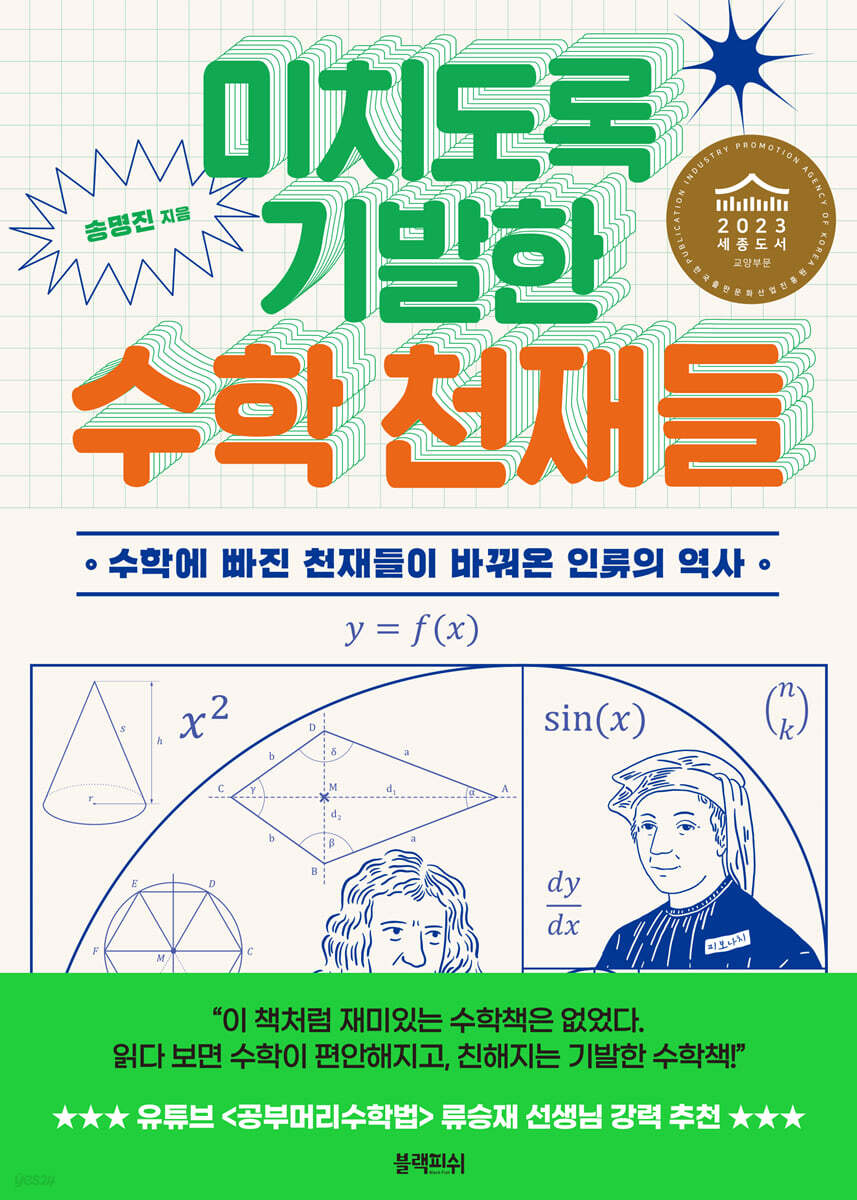
Crazy and Ingenious Math Geniuses
 |
Description
Book Introduction
From ancient Pythagoras to modern Alan Turing, A story about geniuses who changed the world by falling in love with 'number'. Get one step closer to the 'brain of science and engineering'! Meet the episodes to make the world of mathematics easier and more fun. In the era of the Fourth Industrial Revolution and artificial intelligence, Korea's mathematical standing in the world is growing by the day. Since the COVID-19 outbreak, Korea has maintained successful quarantine policies through mathematical modeling, and in February 2022, the International Mathematical Union upgraded Korea to the highest level, Level 5. In July, Princeton University professor Heo Jun became the first Korean to win the Fields Medal, the Nobel Prize in mathematics, and in the same month, Korea took second place in the International Mathematical Olympiad. The level of mathematics in Korea is rising, but in reality, there are too many students who fail. In an age where mathematics is essential for acquiring scientific imagination and knowledge, how can we immerse ourselves in the fun of mathematics? "Madly Ingenious Math Geniuses" is a book that awakens the forgotten joy of mathematics by tracing the amazing birth of mathematics in world history, one by one. It traces the lives of 12 representative mathematicians who changed the world and unfolds interesting episodes related to 'numbers'. What if da Vinci's masterpiece, "The Last Supper," which he completed using "perspective," was all thanks to his math teacher, Pacioli? What if Pythagoras was actually the leader of a religious sect that worshipped numbers as a god? The book secretly reveals the twists and turns of the mathematician's life, piqueing interest in mathematics. It also explores the theory of probability, which began with a gambler's question about dividing the stakes accurately, and the rise of commerce and trade, leading to the development of cubic equations for calculating interest. This book takes us on a remarkable journey of how mathematics, discovered sometimes by chance and sometimes naturally within the flow of history, has expanded the world. As you read through the extraordinary mathematical discoveries in world history, one by one, with over 150 rich visuals, you will have the thrilling experience of seeing mathematics become part of your daily life, rather than just a boring subject in a textbook. Let's embark on a journey into the mystical world of mathematics, a world that both math dropouts and liberal arts students can enjoy, with storytelling that inspires the humanities imagination. |
- You can preview some of the book's contents.
Preview
index
prolog
PART 01 Pythagoras Reveals the Secret of Right Triangles
In fact, he was the head of a religious group that worshipped mathematics as a 'god'?
PART 02 Euclid, who made mathematics a 'scholarship'
The best-selling author of all time?
PART 03 Al-Khwarizmi's method of solving equations using a balance scale
Turns out he's the father of 'algorithm'?
PART 04 Fibonacci, who spread the practical application of Hindu-Arabic numerals to Europe
Discovering the Golden Ratio with the 'Rabbit Problem'?
PART 05 Pacioli, the Mathematics Teacher of Great Artists
Meet Da Vinci and complete a masterpiece!
PART 06 The Lazy Genius, Descartes
Thanks to that, Einstein's theory of relativity was able to come about?
PART 07 Fermat, the amateur mathematician who beat the pros
Entering the Guinness Book of World Records as 'the world's most difficult math problem'?
PART 08 Leibniz, the creator of calculus and binary system
Turns out, the main culprit behind the mass production of 'water droppers'?
PART 09 Euler, who created 'the most beautiful formula in the world'
You published more papers after you became anonymous?
PART 10 Gauss Creates New Geometry
You were a huge perfectionist?
PART 11 Cantor, the man who opened the way to infinity
Unable to bear the world's criticism, he was admitted to a mental hospital?
PART 12: Alan Turing, the Father of Artificial Intelligence
Decryption won the war!
References
index
PART 01 Pythagoras Reveals the Secret of Right Triangles
In fact, he was the head of a religious group that worshipped mathematics as a 'god'?
PART 02 Euclid, who made mathematics a 'scholarship'
The best-selling author of all time?
PART 03 Al-Khwarizmi's method of solving equations using a balance scale
Turns out he's the father of 'algorithm'?
PART 04 Fibonacci, who spread the practical application of Hindu-Arabic numerals to Europe
Discovering the Golden Ratio with the 'Rabbit Problem'?
PART 05 Pacioli, the Mathematics Teacher of Great Artists
Meet Da Vinci and complete a masterpiece!
PART 06 The Lazy Genius, Descartes
Thanks to that, Einstein's theory of relativity was able to come about?
PART 07 Fermat, the amateur mathematician who beat the pros
Entering the Guinness Book of World Records as 'the world's most difficult math problem'?
PART 08 Leibniz, the creator of calculus and binary system
Turns out, the main culprit behind the mass production of 'water droppers'?
PART 09 Euler, who created 'the most beautiful formula in the world'
You published more papers after you became anonymous?
PART 10 Gauss Creates New Geometry
You were a huge perfectionist?
PART 11 Cantor, the man who opened the way to infinity
Unable to bear the world's criticism, he was admitted to a mental hospital?
PART 12: Alan Turing, the Father of Artificial Intelligence
Decryption won the war!
References
index
Detailed image
.jpg)
Into the book
During his time studying in Egypt, it must have been the pyramids that caught Pythagoras' eye.
The pyramids, the tombs of kings who were considered incarnations of the sun god, provide a glimpse into the religion and architectural style of ancient Egypt.
Among them, the pyramid of King Khufu of ancient Egypt is considered one of the Seven Wonders of the World.
It was built around 2560 BC and is approximately 147 meters high, made up of over 2.3 million stones weighing an average of 2.5 tons.
It is surprising that each ridge was made to point east, west, south, and north, and the error is very small.
It would have been impossible to build such a structure roughly by eye.
If you were to stack stones from the bottom up and have them meet at the very top, it would have been impossible to do it with rule of thumb, so you would have needed mathematics, specifically geometry, which deals with the properties of shapes.
Among the geometries, knowledge of right triangles was essential for architecture.
Why are right triangles important? When building a building, tamping the ground is important, but erecting the building straight is paramount.
We use a protractor to make sure that our stones are at right angles when stacking them on the ground, but the ancient Egyptians had something else.
It is 'harpedonopta', which means 'rope puller'.
Hapedonopta is a method of measuring right angles by having three slaves pull a rope. If they tie 12 knots for a given length, they can obtain a right angle.
If you pull the rope so that the number of knots on one side is 3, 4, or 5, a right angle is created between the side with 3 knots and the side with 4 knots.
Because a triangle with sides 3, 4, and 5 is a right triangle.
Just looking at this, we can see that the ancient Egyptians already had knowledge of the lengths of the three sides of a right triangle.
---「PART 01.
Pythagoras, who discovered the secret of the right triangle, was actually the leader of a religious group that worshipped mathematics as a 'god'?
Fermat's Last Theorem became widely known to the public thanks to the German businessman and amateur mathematician Paul Wolfskehl.
He donated 100,000 marks to the Royal Academy of Sciences of Göttingen as a prize for the first person to completely prove Fermat's Last Theorem.
In accordance with his wishes, the Wolfskell Prize was established in 1908, and the prize is to be awarded to anyone who presents a complete proof within 100 years.
There is a story about why Wolfskell donated the prize money.
Deeply heartbroken after being rejected by the woman he had a crush on, Wolfskell decided to commit suicide.
After choosing a suitable day to end my life, I decided to pull the trigger of my pistol at midnight that day.
He had finished putting his affairs in order and had even written a will to his friends and family, but there were still hours left until midnight, so he went to his study and started flipping through books.
The book he happened to be holding in his hands was a treatise on Fermat's Last Theorem.
As he was examining the calculations, Wolfskell discovered a calculation error and fell into deep thought, trying to figure out how to correct it.
Meanwhile, it was well past midnight, and Wolfskell, realizing that he had forgotten the pain of his heartbreak while engrossed in his math problems, tore up the will and decided to live again.
It is said that Wolfskell, who was given a new life thanks to Fermat's Last Theorem, donated a prize of 100,000 marks to thank his benefactor.
With a large prize at stake for a seemingly easy problem, numerous amateur mathematicians sent their own logical but flawed proofs to the Göttingen Academy of Sciences.
In the first year of the Wolfskell Prize, 621 proofs were received, and incorrect proofs continued to arrive.
It is said that when the received evidence was collected and piled up, it became 3 meters high.
So Fermat's Last Theorem became the 'problem with the most incorrect solutions' and was even listed in the Guinness Book of World Records as the 'world's most difficult math problem'.
Fortunately, in 1995, less than 100 years after the Wolfskell Prize was established, Fermat's Last Theorem was proven by Andrew Wiles.
After the proof was published and went through a rigorous two-year verification process, Wiles was awarded the Wolfskell Prize in 1997.
---「PART 07.
"Fermat, an amateur mathematician who beat a professional, enters the Guinness Book of World Records for solving the world's most difficult math problem"
Although Gauss achieved great success in mathematics, most of his life was actually spent studying astronomy and physics.
In fact, he was a professor of astronomy, not mathematics, for nearly 50 years and even served as director of the Göttingen Observatory.
It was an asteroid discovered on the first day of the 19th century that allowed him to take up his post at the Göttingen Observatory.
On January 1, 1801, Giuseppe Piazzi, an Italian monk, mathematician, and astronomer, discovered the asteroid Ceres.
After only a few weeks of observation, the asteroid passed close enough to the Sun to disappear into the bright sunlight.
Gauss, then twenty-four, applied new mathematical theories to just a few weeks of observations and predicted the asteroid's orbit a year later.
In December 1801, the asteroid Ceres was observed again, very close to where Gauss had predicted.
This work made Gauss's name widely known, and in 1807 he was appointed professor of astronomy and director of the observatory at the University of Göttingen.
During his 48-year tenure as director of the Göttingen Observatory, Gauss published 65 books and papers on astronomy and pioneered new fields of mathematics.
In 1831, he was appointed professor of physics and achieved many results through joint research with fellow professors.
He also contributed to the field of electromagnetism, including research on the Earth's magnetic field and the creation of the first electric telegraph.
The gauss (G), one of the units used today to measure the strength of a magnetic field, is named after Gauss to commemorate his achievements in this field.
The pyramids, the tombs of kings who were considered incarnations of the sun god, provide a glimpse into the religion and architectural style of ancient Egypt.
Among them, the pyramid of King Khufu of ancient Egypt is considered one of the Seven Wonders of the World.
It was built around 2560 BC and is approximately 147 meters high, made up of over 2.3 million stones weighing an average of 2.5 tons.
It is surprising that each ridge was made to point east, west, south, and north, and the error is very small.
It would have been impossible to build such a structure roughly by eye.
If you were to stack stones from the bottom up and have them meet at the very top, it would have been impossible to do it with rule of thumb, so you would have needed mathematics, specifically geometry, which deals with the properties of shapes.
Among the geometries, knowledge of right triangles was essential for architecture.
Why are right triangles important? When building a building, tamping the ground is important, but erecting the building straight is paramount.
We use a protractor to make sure that our stones are at right angles when stacking them on the ground, but the ancient Egyptians had something else.
It is 'harpedonopta', which means 'rope puller'.
Hapedonopta is a method of measuring right angles by having three slaves pull a rope. If they tie 12 knots for a given length, they can obtain a right angle.
If you pull the rope so that the number of knots on one side is 3, 4, or 5, a right angle is created between the side with 3 knots and the side with 4 knots.
Because a triangle with sides 3, 4, and 5 is a right triangle.
Just looking at this, we can see that the ancient Egyptians already had knowledge of the lengths of the three sides of a right triangle.
---「PART 01.
Pythagoras, who discovered the secret of the right triangle, was actually the leader of a religious group that worshipped mathematics as a 'god'?
Fermat's Last Theorem became widely known to the public thanks to the German businessman and amateur mathematician Paul Wolfskehl.
He donated 100,000 marks to the Royal Academy of Sciences of Göttingen as a prize for the first person to completely prove Fermat's Last Theorem.
In accordance with his wishes, the Wolfskell Prize was established in 1908, and the prize is to be awarded to anyone who presents a complete proof within 100 years.
There is a story about why Wolfskell donated the prize money.
Deeply heartbroken after being rejected by the woman he had a crush on, Wolfskell decided to commit suicide.
After choosing a suitable day to end my life, I decided to pull the trigger of my pistol at midnight that day.
He had finished putting his affairs in order and had even written a will to his friends and family, but there were still hours left until midnight, so he went to his study and started flipping through books.
The book he happened to be holding in his hands was a treatise on Fermat's Last Theorem.
As he was examining the calculations, Wolfskell discovered a calculation error and fell into deep thought, trying to figure out how to correct it.
Meanwhile, it was well past midnight, and Wolfskell, realizing that he had forgotten the pain of his heartbreak while engrossed in his math problems, tore up the will and decided to live again.
It is said that Wolfskell, who was given a new life thanks to Fermat's Last Theorem, donated a prize of 100,000 marks to thank his benefactor.
With a large prize at stake for a seemingly easy problem, numerous amateur mathematicians sent their own logical but flawed proofs to the Göttingen Academy of Sciences.
In the first year of the Wolfskell Prize, 621 proofs were received, and incorrect proofs continued to arrive.
It is said that when the received evidence was collected and piled up, it became 3 meters high.
So Fermat's Last Theorem became the 'problem with the most incorrect solutions' and was even listed in the Guinness Book of World Records as the 'world's most difficult math problem'.
Fortunately, in 1995, less than 100 years after the Wolfskell Prize was established, Fermat's Last Theorem was proven by Andrew Wiles.
After the proof was published and went through a rigorous two-year verification process, Wiles was awarded the Wolfskell Prize in 1997.
---「PART 07.
"Fermat, an amateur mathematician who beat a professional, enters the Guinness Book of World Records for solving the world's most difficult math problem"
Although Gauss achieved great success in mathematics, most of his life was actually spent studying astronomy and physics.
In fact, he was a professor of astronomy, not mathematics, for nearly 50 years and even served as director of the Göttingen Observatory.
It was an asteroid discovered on the first day of the 19th century that allowed him to take up his post at the Göttingen Observatory.
On January 1, 1801, Giuseppe Piazzi, an Italian monk, mathematician, and astronomer, discovered the asteroid Ceres.
After only a few weeks of observation, the asteroid passed close enough to the Sun to disappear into the bright sunlight.
Gauss, then twenty-four, applied new mathematical theories to just a few weeks of observations and predicted the asteroid's orbit a year later.
In December 1801, the asteroid Ceres was observed again, very close to where Gauss had predicted.
This work made Gauss's name widely known, and in 1807 he was appointed professor of astronomy and director of the observatory at the University of Göttingen.
During his 48-year tenure as director of the Göttingen Observatory, Gauss published 65 books and papers on astronomy and pioneered new fields of mathematics.
In 1831, he was appointed professor of physics and achieved many results through joint research with fellow professors.
He also contributed to the field of electromagnetism, including research on the Earth's magnetic field and the creation of the first electric telegraph.
The gauss (G), one of the units used today to measure the strength of a magnetic field, is named after Gauss to commemorate his achievements in this field.
---「PART 10.
"Gauss, who created a new geometry, was a great perfectionist?"
"Gauss, who created a new geometry, was a great perfectionist?"
Publisher's Review
From Pythagoras, the leader of a religious group obsessed with numbers,
Fermat, listed in the Guinness Book of World Records as the 'world's most difficult mathematical problem'
Even Alan Turing, who brought the war to an end early and saved countless lives.
A more fun math story with episodes
What if Pythagoras, the genius mathematician who unlocked the secrets of right triangles, was actually the leader of a religious sect that worshipped numbers as a deity? What if Fermat, an amateur mathematician, posed a problem that earned him a place in the Guinness Book of World Records as "the world's most difficult mathematical problem," tormenting mathematicians for 350 years? What if Alan Turing, oppressed for his sexual orientation, deciphered the Enigma code, accelerating the end of the war and saving countless lives?
"Madly Ingenious Math Geniuses" is a book that tenaciously traces the lives of mathematicians and unfolds interesting episodes related to 'numbers'. It summons 12 mathematicians who changed the world with groundbreaking ideas and looks into their thoughts.
Although this book covers quite a few familiar mathematicians, from ancient Pythagoras to modern-day Alan Turing, what makes it particularly engaging is its friendly storytelling that delves into the human side of mathematicians who were so great that they often felt distant.
From the lazy Descartes, to the perfectionist Gauss, to Euler who published more papers after becoming blind, to Leibniz who lost the 'original calculus debate' with Newton, the stories of mathematicians who, despite their eventful lives, immersed themselves in the mystery and beauty of mathematics and brought about great changes in human history will deeply move readers who love mathematics as well as those who find it difficult.
Gambling and probability, stocks and the Fibonacci sequence,
From architecture and the Pythagorean theorem to Cartesian coordinates and cosmological physics…
How to understand the world we live in through mathematics
The development of mankind has influenced mathematics.
As commerce and trade flourished, the solution of the 'cubic equation' to calculate interest emerged, 'geometry' to measure land area to properly collect taxes developed, and 'probability theory' was established, starting from a question from a gambler who wanted to win more.
Meanwhile, new discoveries in mathematics have also had a significant impact on human history.
Thanks to the Fibonacci sequence, the Elliott Wave Theory, which predicts the stock market, was developed, and da Vinci was able to create his masterpiece, The Last Supper, which incorporated perspective and the golden ratio.
In a time when the concept of physics was not clear, Newton explained the movement of the Earth based on mathematics, and thanks to Descartes' coordinates, Einstein's theory of relativity and other sophisticated cosmic studies became possible.
Without mathematics, we would not be able to enjoy many of the riches of modern times.
This book brings mathematics, which was previously confined to textbook knowledge, closer to the world we live in.
Just knowing that architecture as we know it today would not exist without the Pythagorean theorem, or even thinking about computers, the internet, and YouTube algorithms, shows us how closely mathematics is intertwined with our daily lives.
Furthermore, this book simultaneously examines the development of mathematics and the advancement of humanity, helping readers understand the world more organically.
Let's dive into the fascinating story of how the mathematical discoveries of an era are reborn as new mathematics over a long period of time, from the story that the term 'algorithm' today originated from the simple and easy calculation technique revealed by Al-Khwarizmi, the 'father of algebra', in his book, to the story of Leibniz, whose ideas about binary and universal language later made the invention of computers possible.
Maps, timelines, and over 150 visual aids are included as a bonus!
A special humanities book that combines mathematics and world history.
Each chapter in this book includes maps and a timeline, allowing you to see the flow of mathematics at a glance.
This is a special humanities book that allows readers to encounter the history and movement of civilizations that have been in line with the history of mathematics, from the Greek era before Christ through the Hellenistic, Islamic, and Renaissance periods to the present day.
Are you curious about why the center of learning shifted to the "House of Wisdom" of Islamic civilization after the burning of the Library of Alexandria? Are you curious about why British mathematics lagged a century behind continental Europe after the Calculus Debate? If math books are too daunting, why not consider this a history book and read it?
For readers who find math difficult and boring, the book includes devices throughout to make math easy and fun.
The book, titled “Extras on Mathematics,” contains anecdotes about the birth of mathematics and practical knowledge, including “The Origins of Frequently Used Mathematical Symbols,” “Renaissance Schools of Calculation,” “Single-Entry and Double-Entry Bookkeeping,” “Projective Geometry Used in 3D Games,” and “War and Mathematics,” in the form of short reading materials called “Extras on Mathematics.” It also includes over 150 visual aids, including drawings and photographs.
Let's take a break from complex symbols, formulas, and calculations and enjoy the intuitive fun of mathematics.
Fermat, listed in the Guinness Book of World Records as the 'world's most difficult mathematical problem'
Even Alan Turing, who brought the war to an end early and saved countless lives.
A more fun math story with episodes
What if Pythagoras, the genius mathematician who unlocked the secrets of right triangles, was actually the leader of a religious sect that worshipped numbers as a deity? What if Fermat, an amateur mathematician, posed a problem that earned him a place in the Guinness Book of World Records as "the world's most difficult mathematical problem," tormenting mathematicians for 350 years? What if Alan Turing, oppressed for his sexual orientation, deciphered the Enigma code, accelerating the end of the war and saving countless lives?
"Madly Ingenious Math Geniuses" is a book that tenaciously traces the lives of mathematicians and unfolds interesting episodes related to 'numbers'. It summons 12 mathematicians who changed the world with groundbreaking ideas and looks into their thoughts.
Although this book covers quite a few familiar mathematicians, from ancient Pythagoras to modern-day Alan Turing, what makes it particularly engaging is its friendly storytelling that delves into the human side of mathematicians who were so great that they often felt distant.
From the lazy Descartes, to the perfectionist Gauss, to Euler who published more papers after becoming blind, to Leibniz who lost the 'original calculus debate' with Newton, the stories of mathematicians who, despite their eventful lives, immersed themselves in the mystery and beauty of mathematics and brought about great changes in human history will deeply move readers who love mathematics as well as those who find it difficult.
Gambling and probability, stocks and the Fibonacci sequence,
From architecture and the Pythagorean theorem to Cartesian coordinates and cosmological physics…
How to understand the world we live in through mathematics
The development of mankind has influenced mathematics.
As commerce and trade flourished, the solution of the 'cubic equation' to calculate interest emerged, 'geometry' to measure land area to properly collect taxes developed, and 'probability theory' was established, starting from a question from a gambler who wanted to win more.
Meanwhile, new discoveries in mathematics have also had a significant impact on human history.
Thanks to the Fibonacci sequence, the Elliott Wave Theory, which predicts the stock market, was developed, and da Vinci was able to create his masterpiece, The Last Supper, which incorporated perspective and the golden ratio.
In a time when the concept of physics was not clear, Newton explained the movement of the Earth based on mathematics, and thanks to Descartes' coordinates, Einstein's theory of relativity and other sophisticated cosmic studies became possible.
Without mathematics, we would not be able to enjoy many of the riches of modern times.
This book brings mathematics, which was previously confined to textbook knowledge, closer to the world we live in.
Just knowing that architecture as we know it today would not exist without the Pythagorean theorem, or even thinking about computers, the internet, and YouTube algorithms, shows us how closely mathematics is intertwined with our daily lives.
Furthermore, this book simultaneously examines the development of mathematics and the advancement of humanity, helping readers understand the world more organically.
Let's dive into the fascinating story of how the mathematical discoveries of an era are reborn as new mathematics over a long period of time, from the story that the term 'algorithm' today originated from the simple and easy calculation technique revealed by Al-Khwarizmi, the 'father of algebra', in his book, to the story of Leibniz, whose ideas about binary and universal language later made the invention of computers possible.
Maps, timelines, and over 150 visual aids are included as a bonus!
A special humanities book that combines mathematics and world history.
Each chapter in this book includes maps and a timeline, allowing you to see the flow of mathematics at a glance.
This is a special humanities book that allows readers to encounter the history and movement of civilizations that have been in line with the history of mathematics, from the Greek era before Christ through the Hellenistic, Islamic, and Renaissance periods to the present day.
Are you curious about why the center of learning shifted to the "House of Wisdom" of Islamic civilization after the burning of the Library of Alexandria? Are you curious about why British mathematics lagged a century behind continental Europe after the Calculus Debate? If math books are too daunting, why not consider this a history book and read it?
For readers who find math difficult and boring, the book includes devices throughout to make math easy and fun.
The book, titled “Extras on Mathematics,” contains anecdotes about the birth of mathematics and practical knowledge, including “The Origins of Frequently Used Mathematical Symbols,” “Renaissance Schools of Calculation,” “Single-Entry and Double-Entry Bookkeeping,” “Projective Geometry Used in 3D Games,” and “War and Mathematics,” in the form of short reading materials called “Extras on Mathematics.” It also includes over 150 visual aids, including drawings and photographs.
Let's take a break from complex symbols, formulas, and calculations and enjoy the intuitive fun of mathematics.
GOODS SPECIFICS
- Publication date: July 25, 2022
- Page count, weight, size: 384 pages | 552g | 152*210*24mm
- ISBN13: 9788968333866
- ISBN10: 8968333866
You may also like
카테고리
korean


korean

![GQ KOREA Mark (Monthly): December [2025]](http://librairie.coreenne.fr/cdn/shop/files/8ef265dbbfbf186523ed75ba7319009d.jpg?v=1765340328&width=3840)


