

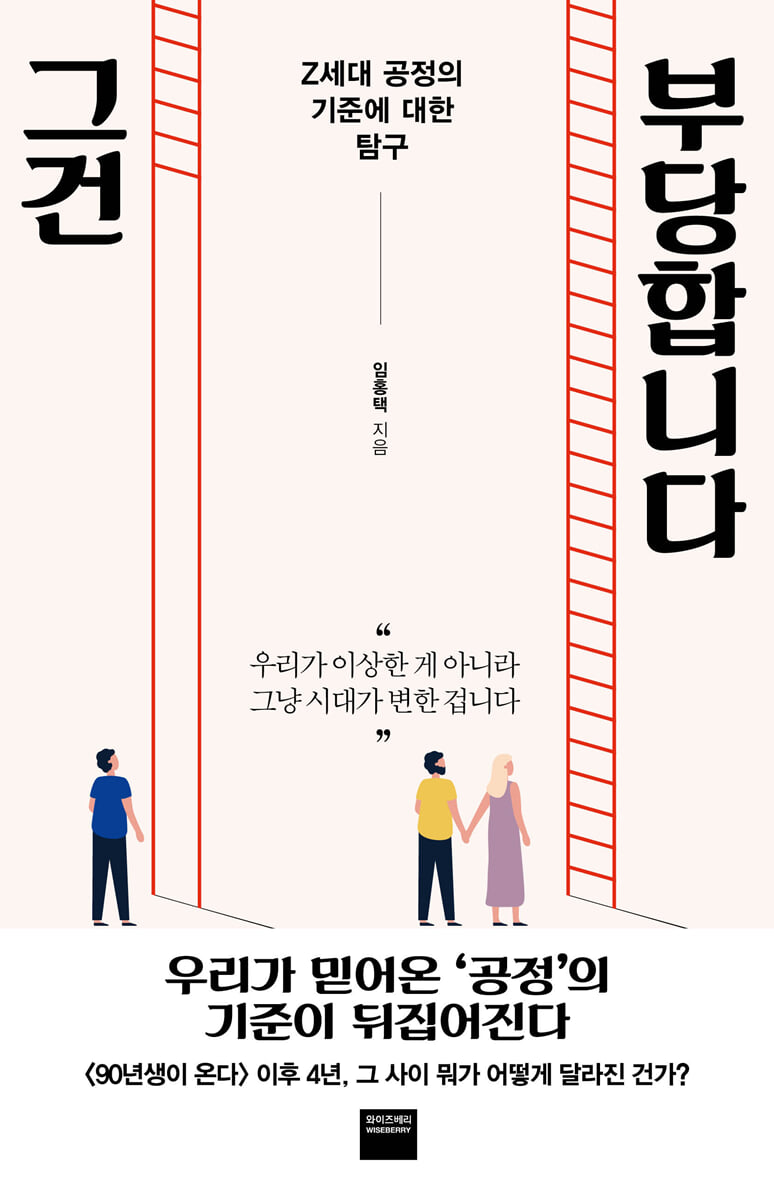
That's unfair
 |
Description
Book Introduction
“The standards of ‘fairness’ we have believed in are being overturned!” Four years have passed since "The 90s Generation is Coming." What has changed in that time? Years ago, the bestseller "The 90s Generation is Coming" provided food for thought on "generational theory" to millions of readers, including the then-president. In fact, the purpose of the book was not to observe the habits of the rare species born in the 90s, the first to be observed in human history, and to explain, “This is what they do.” The author of the book himself says that the very classification of 'a culture exclusive to a certain person' is a prejudice. The point is that it deals with generations, but it is not intended to divide generations. Rather, it was intended to bring to the surface the deepening rift between generations that has been neglected. ‘Healthy discussion’ was the ultimate goal of the book. But over the past four years, the rift between the two has deepened without end. The fact that we are different has become a source of conflict rather than an object of understanding. In truth, there's no real solution to generational conflict other than mutual understanding. The fact that a Sumerian stone tablet from around 1700 BC bore the familiar inscription, "(To your children) Grow up, why are you so rude?" proves that humanity, over the millennia of development, has failed to find a solution to generational conflict. |
- You can preview some of the book's contents.
Preview
index
PART 1.
The illusion that this is a generation that wants fairness
Is your process truly fair?
The concept of a perfect process that is impossible from the beginning
Their language is simply 'unfair'
PART 2.
Rereading the Fairness Issue from the Perspective of Injustice
Common Reasons Why the Current Generation Doesn't Want Civil Servants and Small Businesses
A New Cry Within Organizations: "It's Unfair"
The cry of injustice that has reached the level of national policy
Why don't you have children? It's unfair!
PART 3.
Why do I feel particularly unfair?
The changing times that made us feel a sense of injustice
Controllability and Fairness in the Digital Age
What changes when you look at everything from a zero perspective
Asking about qualifications, something no one has asked about before
People who need to have two hearts
Compensation for innate inequality (fate)
How to Become a Generation That Doesn't End Up Poorer Than Their Parents
PART 4.
The basic principles of a just world
Finding a system that is not unfair
The moment I discovered a new rule for queuing
Another way they accept queuing
PART 5.
The balance point of a new generation and era
As a system, not as a moral one
A law for all, not just ten thousand
How to Reduce Controversies About Injustice in Organizations
The total unfair practice of custom
The illusion that this is a generation that wants fairness
Is your process truly fair?
The concept of a perfect process that is impossible from the beginning
Their language is simply 'unfair'
PART 2.
Rereading the Fairness Issue from the Perspective of Injustice
Common Reasons Why the Current Generation Doesn't Want Civil Servants and Small Businesses
A New Cry Within Organizations: "It's Unfair"
The cry of injustice that has reached the level of national policy
Why don't you have children? It's unfair!
PART 3.
Why do I feel particularly unfair?
The changing times that made us feel a sense of injustice
Controllability and Fairness in the Digital Age
What changes when you look at everything from a zero perspective
Asking about qualifications, something no one has asked about before
People who need to have two hearts
Compensation for innate inequality (fate)
How to Become a Generation That Doesn't End Up Poorer Than Their Parents
PART 4.
The basic principles of a just world
Finding a system that is not unfair
The moment I discovered a new rule for queuing
Another way they accept queuing
PART 5.
The balance point of a new generation and era
As a system, not as a moral one
A law for all, not just ten thousand
How to Reduce Controversies About Injustice in Organizations
The total unfair practice of custom
Detailed image
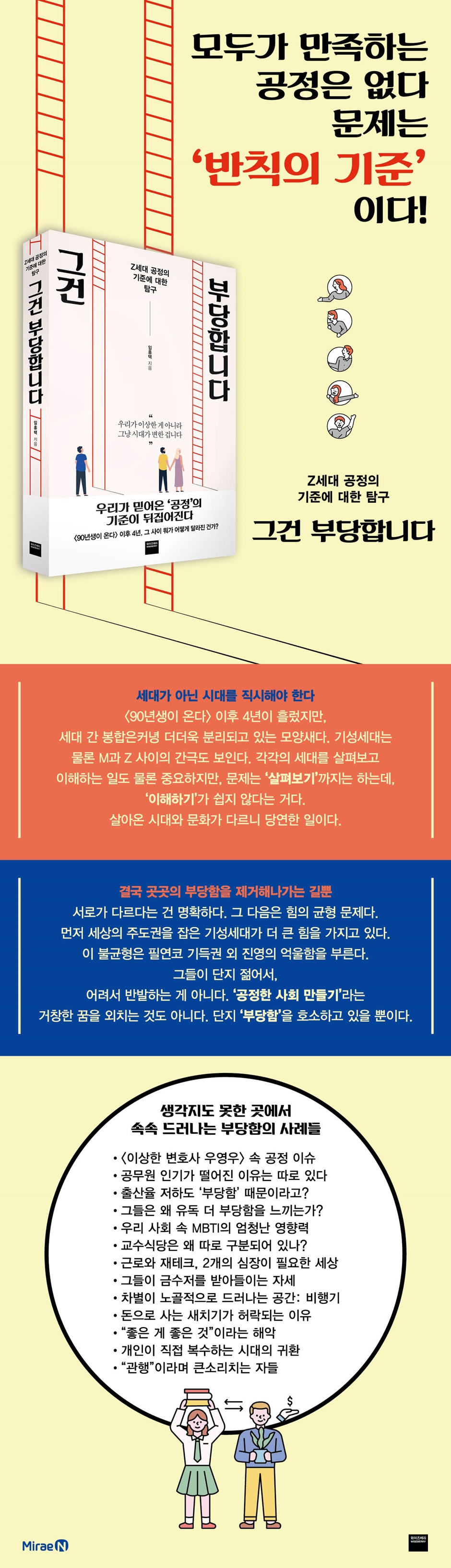
Into the book
[Fairness, Equity, and Equality in Drama]
He knows that Woo Young-woo has autism spectrum disorder, but he neither mentions it to attack him personally nor tries to show any special sympathy or goodwill.
He believes that both disabled and able-bodied people should compete by the same rules and be treated equally.
In the beginning of the drama, Kwon Min-woo's appearance was evaluated as showing a person who does not have any discrimination or prejudice against people with disabilities.
However, after the middle of the play, he commits an unfair act of not sharing the data of the case he was in charge of with his competitor, Woo Young-woo, and is depicted as feeling uncomfortable about guaranteeing the right to easy mobility for the disabled.
(Omitted) As the issue of fairness was once again brought to public attention through “The Strange Lawyer Woo Young-woo,” criticism emerged that the fairness that Kwon Min-woo speaks of is not true fairness, but merely mechanical equality or fairness.
---From "The Illusion of a Generation Desiring Fairness"
Why has the popularity of civil service declined?
It's not just low salaries that make it difficult for young civil servants.
What makes it even harder for them is the reality that the workload is concentrated more on lower-ranking employees.
I realized that the idea of a civil servant life where I could maintain a work-life balance, which I had heard about when I was preparing for the civil service exam, was far removed from today's reality.
Even if you work hard and achieve results, what you get in return is not a huge reward or promotion, but more work.
In the meantime, I can't easily refuse the instructions of my seniors who (like me) are absolutely unstoppable.
Moreover, perhaps because of the belief that "one must dedicate oneself to the country and serve the people," there is no system in place to protect me, a public servant, from unreasonable demands or aggressive actions by citizens.
Nowadays, even in regular restaurants, you can often see (although a bit exaggerated) phrases like “If you order informally, we will take your order informally” to protect your employees, but this is not something that can be easily achieved in the civil service society.
---From "2 Rereading the Fairness Issue from the Perspective of Injustice"
[Compensation and personnel are unfair]
The generation born in the 1990s began to enter society in earnest in the mid-2010s, and at the same time, they officially raised issues about unfair compensation and personnel issues in organizations, including corporations.
They are also actively exercising their power in the political and social fields.
However, from the perspective of the older generation who lived in the world before the current younger generation, it is easy to think that things were more difficult in the past than they are now, not less.
These thoughts make the younger generation perceive the older generation as uncomfortable.
Conversely, it is not surprising that the older generations born before the 1980s feel a sense of injustice.
(syncopation)
In today's labor market, workers have a wider range of choices than in the past.
About 10 years ago, workers considering a job change typically searched within the same industry group.
For example, if you are an employee working at SK Hynix, the scope of your job transfer is usually limited to considering moving to the semiconductor division of Samsung Electronics, a similar company.
But these days, it doesn't matter if the company is not the same as the job as long as the job title and scope of work are right.
For example, if you are a developer working at SK Hynix, all places where you can do development work, including Naver, Kakao, Line, Coupang, and Baedal Minjok, are compared.
---From "3 Why do I feel particularly unfair?"
[Secure and Controllable 'Queueing']
The thing about today's queueing phenomenon is that it tends to be limited to cases where a goal can be achieved.
For example, in 2018-2019, a pork cutlet restaurant in Pobang Market limited the number of servings to 35 teams on a first-come, first-served basis each day.
Considering the number of people in the group, only about 70 people were standing.
Also, when people line up in front of a store to buy Pokémon bread, they are not just waiting around for fear of not getting it, but they are mostly people who know in advance how much they will have in stock and are lining up knowing that they can buy it for sure.
The queues we see today are also a reflection of the times in which controllability is increasingly valued.
But on the other hand, the sight of people standing in line to get what they want is also proof that today, there are very few variables we can control with certainty other than standing in line.
---From “4 Basic Principles of an Unjust World”
[The total injustice of custom]
When I asked a friend who was hired as a local police officer, “Did you make a shibo-tteok too?” he replied that he had made a more expensive walnut cookie and that there was no need to incur unnecessarily bad feelings when starting work.
This is where the saying, "good is good" comes into play.
Everyone is just following along, and it's not a big deal when you think about it, so there's no need to take up arms in a place like this.
Of course, this choice cannot be seen as irrational.
When comparing the risk of rebelling against convention and returning to it with the loss of doing the same thing as before, the former is by far the greater risk.
But these rational choices ultimately fail to break the chain of injustice called custom.
He knows that Woo Young-woo has autism spectrum disorder, but he neither mentions it to attack him personally nor tries to show any special sympathy or goodwill.
He believes that both disabled and able-bodied people should compete by the same rules and be treated equally.
In the beginning of the drama, Kwon Min-woo's appearance was evaluated as showing a person who does not have any discrimination or prejudice against people with disabilities.
However, after the middle of the play, he commits an unfair act of not sharing the data of the case he was in charge of with his competitor, Woo Young-woo, and is depicted as feeling uncomfortable about guaranteeing the right to easy mobility for the disabled.
(Omitted) As the issue of fairness was once again brought to public attention through “The Strange Lawyer Woo Young-woo,” criticism emerged that the fairness that Kwon Min-woo speaks of is not true fairness, but merely mechanical equality or fairness.
---From "The Illusion of a Generation Desiring Fairness"
Why has the popularity of civil service declined?
It's not just low salaries that make it difficult for young civil servants.
What makes it even harder for them is the reality that the workload is concentrated more on lower-ranking employees.
I realized that the idea of a civil servant life where I could maintain a work-life balance, which I had heard about when I was preparing for the civil service exam, was far removed from today's reality.
Even if you work hard and achieve results, what you get in return is not a huge reward or promotion, but more work.
In the meantime, I can't easily refuse the instructions of my seniors who (like me) are absolutely unstoppable.
Moreover, perhaps because of the belief that "one must dedicate oneself to the country and serve the people," there is no system in place to protect me, a public servant, from unreasonable demands or aggressive actions by citizens.
Nowadays, even in regular restaurants, you can often see (although a bit exaggerated) phrases like “If you order informally, we will take your order informally” to protect your employees, but this is not something that can be easily achieved in the civil service society.
---From "2 Rereading the Fairness Issue from the Perspective of Injustice"
[Compensation and personnel are unfair]
The generation born in the 1990s began to enter society in earnest in the mid-2010s, and at the same time, they officially raised issues about unfair compensation and personnel issues in organizations, including corporations.
They are also actively exercising their power in the political and social fields.
However, from the perspective of the older generation who lived in the world before the current younger generation, it is easy to think that things were more difficult in the past than they are now, not less.
These thoughts make the younger generation perceive the older generation as uncomfortable.
Conversely, it is not surprising that the older generations born before the 1980s feel a sense of injustice.
(syncopation)
In today's labor market, workers have a wider range of choices than in the past.
About 10 years ago, workers considering a job change typically searched within the same industry group.
For example, if you are an employee working at SK Hynix, the scope of your job transfer is usually limited to considering moving to the semiconductor division of Samsung Electronics, a similar company.
But these days, it doesn't matter if the company is not the same as the job as long as the job title and scope of work are right.
For example, if you are a developer working at SK Hynix, all places where you can do development work, including Naver, Kakao, Line, Coupang, and Baedal Minjok, are compared.
---From "3 Why do I feel particularly unfair?"
[Secure and Controllable 'Queueing']
The thing about today's queueing phenomenon is that it tends to be limited to cases where a goal can be achieved.
For example, in 2018-2019, a pork cutlet restaurant in Pobang Market limited the number of servings to 35 teams on a first-come, first-served basis each day.
Considering the number of people in the group, only about 70 people were standing.
Also, when people line up in front of a store to buy Pokémon bread, they are not just waiting around for fear of not getting it, but they are mostly people who know in advance how much they will have in stock and are lining up knowing that they can buy it for sure.
The queues we see today are also a reflection of the times in which controllability is increasingly valued.
But on the other hand, the sight of people standing in line to get what they want is also proof that today, there are very few variables we can control with certainty other than standing in line.
---From “4 Basic Principles of an Unjust World”
[The total injustice of custom]
When I asked a friend who was hired as a local police officer, “Did you make a shibo-tteok too?” he replied that he had made a more expensive walnut cookie and that there was no need to incur unnecessarily bad feelings when starting work.
This is where the saying, "good is good" comes into play.
Everyone is just following along, and it's not a big deal when you think about it, so there's no need to take up arms in a place like this.
Of course, this choice cannot be seen as irrational.
When comparing the risk of rebelling against convention and returning to it with the loss of doing the same thing as before, the former is by far the greater risk.
But these rational choices ultimately fail to break the chain of injustice called custom.
---From "5 Balance Points of a New Generation and Era"
Publisher's Review
Does ‘fairness for all’ exist?
How we, as different people, face injustice
Hong-taek Lim, author of “The 90s Generation is Coming,” has returned with a new book, “That’s Unfair.”
Seeing the current generation still treated as a mysterious entity, the author shifted the debate beyond simple age differences to a more fundamental area of 'fairness and unfairness.'
I also looked at those born in 2000, who had recently entered adulthood after being born in 1990.
In recent years, they have rapidly spread to the center of society and have begun to give their voices physical force.
A series of major elections has further increased their influence.
But can their growing voices simply be interpreted as "the unique resistance of youth trying to break free from inertia"? Can they simply be categorized as "young people born in the 90s and 00s, who endured the rigors of private and public education, went on to college with a rate of over 80%, earned degrees, endured arduous job hunting, and now find themselves causing trouble for the established generation?" One keyword that makes them appear in society in different ways and make people wonder, "Hey, this is a bit strange?"
It is 'unfairness'.
The world is running more unfairly than you might think.
Things that are considered fair are actually considered unfair, and when it comes to some issues that are so unbearably unfair, the older generation often says, "Realistically," that's okay.
What the hell is wrong? Is it me or are you?
Through this book, the author looks back at the countless unfair practices that we have overlooked while feeling uncomfortable, and points out the injustices of our society as a whole, not just a specific generation.
The more we look into it, the more we realize that the cause of many of these problems is not a 'generational gap' but a 'difference in principles'.
Is it so strange to say that we shouldn't cheat?
I believe we should strive to incorporate a basic level of 'fairness' into our society, similar to what is applied to sports events.
Here are two important points to highlight: first, we must create a 'competitive process without foul play', and second, we must 'continue to change'.
Let's think about why fairness became a hot topic in our society in the first place.
That's because the parties playing on the field reported the 'foul play'.
Or perhaps it is because it is not clearly defined whether a particular act that caused the problem is right or wrong in light of the current era.
Athletes competing in the Olympic Games don't stand at the starting line and worry about things like, "Will this competition really be fair?"
They just learn the rules and participate in the game to achieve their goals.
(Omitted) It is difficult to define fairness in one language, but it is certainly possible to make the world a little more fair.
The first thing he needs to do is to acknowledge those who have different opinions from him, rather than unconditionally rejecting them.
- From the concluding remarks
How we, as different people, face injustice
Hong-taek Lim, author of “The 90s Generation is Coming,” has returned with a new book, “That’s Unfair.”
Seeing the current generation still treated as a mysterious entity, the author shifted the debate beyond simple age differences to a more fundamental area of 'fairness and unfairness.'
I also looked at those born in 2000, who had recently entered adulthood after being born in 1990.
In recent years, they have rapidly spread to the center of society and have begun to give their voices physical force.
A series of major elections has further increased their influence.
But can their growing voices simply be interpreted as "the unique resistance of youth trying to break free from inertia"? Can they simply be categorized as "young people born in the 90s and 00s, who endured the rigors of private and public education, went on to college with a rate of over 80%, earned degrees, endured arduous job hunting, and now find themselves causing trouble for the established generation?" One keyword that makes them appear in society in different ways and make people wonder, "Hey, this is a bit strange?"
It is 'unfairness'.
The world is running more unfairly than you might think.
Things that are considered fair are actually considered unfair, and when it comes to some issues that are so unbearably unfair, the older generation often says, "Realistically," that's okay.
What the hell is wrong? Is it me or are you?
Through this book, the author looks back at the countless unfair practices that we have overlooked while feeling uncomfortable, and points out the injustices of our society as a whole, not just a specific generation.
The more we look into it, the more we realize that the cause of many of these problems is not a 'generational gap' but a 'difference in principles'.
Is it so strange to say that we shouldn't cheat?
I believe we should strive to incorporate a basic level of 'fairness' into our society, similar to what is applied to sports events.
Here are two important points to highlight: first, we must create a 'competitive process without foul play', and second, we must 'continue to change'.
Let's think about why fairness became a hot topic in our society in the first place.
That's because the parties playing on the field reported the 'foul play'.
Or perhaps it is because it is not clearly defined whether a particular act that caused the problem is right or wrong in light of the current era.
Athletes competing in the Olympic Games don't stand at the starting line and worry about things like, "Will this competition really be fair?"
They just learn the rules and participate in the game to achieve their goals.
(Omitted) It is difficult to define fairness in one language, but it is certainly possible to make the world a little more fair.
The first thing he needs to do is to acknowledge those who have different opinions from him, rather than unconditionally rejecting them.
- From the concluding remarks
GOODS SPECIFICS
- Publication date: November 20, 2022
- Page count, weight, size: 372 pages | 612g | 142*220*22mm
- ISBN13: 9791168414150
- ISBN10: 1168414156
You may also like
카테고리
korean


korean

![GQ KOREA Mark (Monthly): December [2025]](http://librairie.coreenne.fr/cdn/shop/files/8ef265dbbfbf186523ed75ba7319009d.jpg?v=1765340328&width=3840)


