

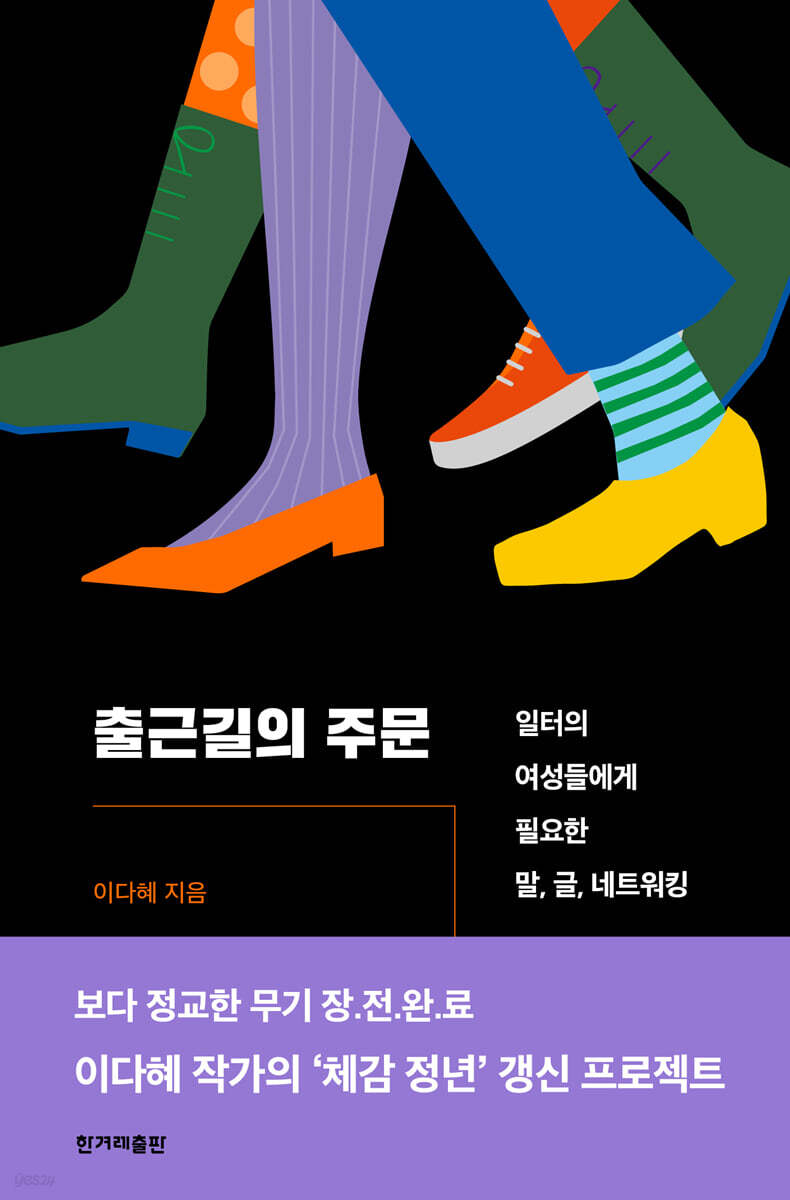
Order on the way to work
 |
Description
Book Introduction
- A word from MD
-
Author Dahye Lee's "Weapon" for Women in the WorkplaceI hope that the next generation of women won't have to ask themselves, "Am I too old to be working as a woman?"
For me, and for many women, there is one thing I can do to encourage you.
Please continue.
Please make a way there.
Please stay in sight.
- AmongOctober 8, 2019. Self-Development PD Park Jeong-yoon
When you turn forty, your job security becomes unstable.
Save the women who work hard in the workplace around the world!
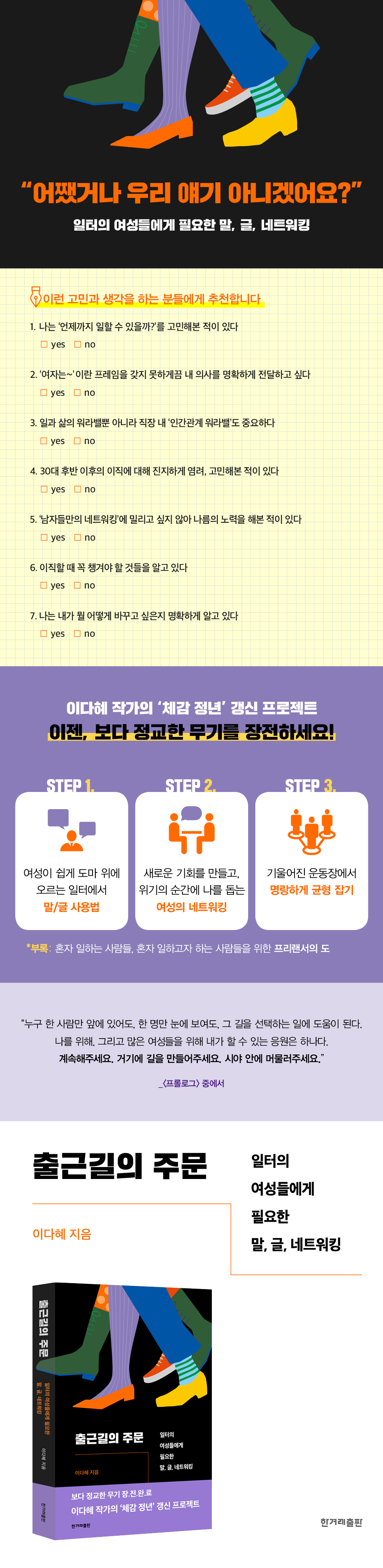
Author Dahye Lee's "Perceived Retirement Age" Renewal Project
Speaking, writing, and networking for women in the workplace
Now, more sophisticated weapons are loaded!
- The first book women who want to climb higher should read
- This book and the confident voice and tone of speech, that's perfect.
Da-Hye Lee, a writer who never stops speaking and writing about women's rights and life.
"Commuting Spells" is a new work by author Dahye Lee, written for working women. It is filled with insightful comments on society and relatable sentences that echo her work in books and broadcasts.
The author prepared this book by listening to the stories she experienced over 20 years of social life and the concerns of countless women she met in the workplace.
Beyond discussing a society that is tilted (in a way that is unfavorable to women), it is full of speaking, writing, and networking methods that can be applied in real life (workplace).
The 'perceived retirement age' of Korean women is different from that of men or from what society says about retirement age.
Many women say that the countdown to their "effective retirement age" begins around their mid-to-late 30s, the moment they get married and have children.
(There are also statistical survey results that show that women's perceived retirement age is actually shorter than men's.) For women who worry about 'how long can I work', who have made efforts in their own way because they don't want to be pushed out by men's networking, and who work hard but have vague feelings of anxiety, this book gives them more sophisticated weapons called 'speech, writing, and networking' and awakens their fighting spirit.
Armed with concrete methods you can put into practice right away, this book will help you confidently head to work tomorrow.
* Detailed structure of this book
Part 1 discusses how women should use their 'speech and writing' in the workplace, where they are easily criticized, and what speech and writing habits are necessary for women to express and achieve what they want.
Rather than simply providing advice on worldly matters, there are many anecdotes of experience told through the sharp and humorous wit of author Dahye Lee.
Part 2 talks about ‘human relationships’ in social life.
I discovered what it means to network with women who create new opportunities and help me in times of crisis.
In Part 3, we discuss how women can move to better jobs and work longer and healthier in a social structure that still disadvantages them.
Additionally, the appendix contains a separate section for freelancers, containing practical information such as the 10 Commandments for those who work (or want to work) alone.
Save the women who work hard in the workplace around the world!
Author Dahye Lee's "Perceived Retirement Age" Renewal Project
Speaking, writing, and networking for women in the workplace
Now, more sophisticated weapons are loaded!
- The first book women who want to climb higher should read
- This book and the confident voice and tone of speech, that's perfect.
Da-Hye Lee, a writer who never stops speaking and writing about women's rights and life.
"Commuting Spells" is a new work by author Dahye Lee, written for working women. It is filled with insightful comments on society and relatable sentences that echo her work in books and broadcasts.
The author prepared this book by listening to the stories she experienced over 20 years of social life and the concerns of countless women she met in the workplace.
Beyond discussing a society that is tilted (in a way that is unfavorable to women), it is full of speaking, writing, and networking methods that can be applied in real life (workplace).
The 'perceived retirement age' of Korean women is different from that of men or from what society says about retirement age.
Many women say that the countdown to their "effective retirement age" begins around their mid-to-late 30s, the moment they get married and have children.
(There are also statistical survey results that show that women's perceived retirement age is actually shorter than men's.) For women who worry about 'how long can I work', who have made efforts in their own way because they don't want to be pushed out by men's networking, and who work hard but have vague feelings of anxiety, this book gives them more sophisticated weapons called 'speech, writing, and networking' and awakens their fighting spirit.
Armed with concrete methods you can put into practice right away, this book will help you confidently head to work tomorrow.
* Detailed structure of this book
Part 1 discusses how women should use their 'speech and writing' in the workplace, where they are easily criticized, and what speech and writing habits are necessary for women to express and achieve what they want.
Rather than simply providing advice on worldly matters, there are many anecdotes of experience told through the sharp and humorous wit of author Dahye Lee.
Part 2 talks about ‘human relationships’ in social life.
I discovered what it means to network with women who create new opportunities and help me in times of crisis.
In Part 3, we discuss how women can move to better jobs and work longer and healthier in a social structure that still disadvantages them.
Additionally, the appendix contains a separate section for freelancers, containing practical information such as the 10 Commandments for those who work (or want to work) alone.
- You can preview some of the book's contents.
Preview
index
Prologue: We broke the record again today.
Part 1: In a workplace where women are easily put on the chopping block
How to use speech/writing
-Feminism and Writing
-Cushion language, feminine language
-I ask the question first and I finish my sentences clearly.
- Women under attack and the controversy over character
-Control your excitement
-Considering the title
- Silent practice
-Accept things as they are
-Write specifically what you want
-My own dictionary
-Teacher, you speak too fast.
-'Because' conversational technique
-Writing and reading a self-introduction
-The way of small talk
Things you shouldn't say to your teammates
-Life is feedback
-Let's become problem solvers
Part 2 Creating new opportunities and helping me in times of crisis
Women's Networking
-Feminine leadership
-Women's quota
-Workplace ego
-A story that women must share among themselves
-Let's be good people to work with.
-Reference check
-Networking (1)
-Social Week
-Networking (2)
- Supporting men
-acquaintance
-Drinking Dilemma
-It can't be explained just by mother and daughter.
-What kind of work-life balance
-When does work become fun?
-About human relationships
-Respect other women
-People my friends hate
-Relationships that need to be broken
-Fighting (or running away from) evil
-Standards for doing work
-I like people who are good at their jobs.
-To Senior L
Part 3: On the tilted playground
Balance it out cheerfully
-Wage gap
-Regarding re-employment after the late 30s
-Order on the way to work
- Feeling afraid of success
-Women are confident
-When starting a new job, is it better to work at a large company or a small company?
Things to keep in mind when changing jobs
-When changing jobs helps, but doesn't work as planned
-Office worker vs. freelancer
- Other people's lives seem smooth.
-How to use vacation
- Managing your daughter's money
-Different is different
-The End of a Workaholic
-Feedback to myself
Appendix: The Tao of Freelancers
-People who work alone
-KMN method
-10 Commandments for Working Alone (or Wanting to Work Alone)
Epilogue: Thank you
Part 1: In a workplace where women are easily put on the chopping block
How to use speech/writing
-Feminism and Writing
-Cushion language, feminine language
-I ask the question first and I finish my sentences clearly.
- Women under attack and the controversy over character
-Control your excitement
-Considering the title
- Silent practice
-Accept things as they are
-Write specifically what you want
-My own dictionary
-Teacher, you speak too fast.
-'Because' conversational technique
-Writing and reading a self-introduction
-The way of small talk
Things you shouldn't say to your teammates
-Life is feedback
-Let's become problem solvers
Part 2 Creating new opportunities and helping me in times of crisis
Women's Networking
-Feminine leadership
-Women's quota
-Workplace ego
-A story that women must share among themselves
-Let's be good people to work with.
-Reference check
-Networking (1)
-Social Week
-Networking (2)
- Supporting men
-acquaintance
-Drinking Dilemma
-It can't be explained just by mother and daughter.
-What kind of work-life balance
-When does work become fun?
-About human relationships
-Respect other women
-People my friends hate
-Relationships that need to be broken
-Fighting (or running away from) evil
-Standards for doing work
-I like people who are good at their jobs.
-To Senior L
Part 3: On the tilted playground
Balance it out cheerfully
-Wage gap
-Regarding re-employment after the late 30s
-Order on the way to work
- Feeling afraid of success
-Women are confident
-When starting a new job, is it better to work at a large company or a small company?
Things to keep in mind when changing jobs
-When changing jobs helps, but doesn't work as planned
-Office worker vs. freelancer
- Other people's lives seem smooth.
-How to use vacation
- Managing your daughter's money
-Different is different
-The End of a Workaholic
-Feedback to myself
Appendix: The Tao of Freelancers
-People who work alone
-KMN method
-10 Commandments for Working Alone (or Wanting to Work Alone)
Epilogue: Thank you
Detailed image
Into the book
Does a woman's place belong only to women? No.
Eventually, they will all be replaced by the next generation, but I hope that the next generation of women will one day be working at our age and not have to ask, "Am I too old to be working as a woman?"
I know that people who are one year older, two years older, have worked hard, been recognized for their abilities, and maintained their positions, and that's how we got here.
(Omitted) Even if there is just one person in front of you, even if there is just one person in sight, it helps you choose that path.
When I started working, there were very few women who stayed in organizations until they were in their 40s without getting married, but now that number is increasing.
In every company, the number of older women rising to management and executive positions is increasing, and the number of women who marry but do not have children, as well as women who remain unmarried, is also increasing.
A woman's place is not fixed.
--- p.9~10
The same goes for speaking.
This is a private and public expression at the same time.
They want to persuade and be understood.
And you soon learn that if you write and say exactly what you want, you will fail to persuade and be understood.
To put it bluntly, if you write properly, everything will work out? If so, feminism would have already succeeded and become a forgotten name.
In reality, the more honest you are, the lonelier you become.
If you actually write and speak, you may be surprised to find that your thoughts on the specifics of feminism differ from those around you.
So speaking and writing training is necessary.
To identify differences and confirm common goals.
We can't fight or join forces with what's in each other's heads.
--- p.15~16
I think one of the reasons women need to learn to express themselves clearly is so they don't feel wronged.
I hope you don't pile up 'requests that were hinted at but not fulfilled'.
I would like you to be clear about what you want.
Since we are connected, since that person is smart, let's not assume that if we treat them well, they will treat us well, and then be disappointed by giving them too much.
Even if you don't know what you want, if you speak and write clearly, what was vaguely in your heart will become clear.
That's where it all begins.
To value myself more as a woman.
Let me make my words heard.
Put your doubts aside.
--- p.17
Women tend to feel asked to fill in silences even when they are not asked to do so.
The call to 'soften the atmosphere' is particularly focused on the most junior women in the organization.
Even random comments like “Don’t you like soft girls?” can happen at times like this.
If you are like that, please show us a soft taste.
When someone brought up something like that, the women present, regardless of age, instantly became quiet.
Instead of protesting, everyone was silent, and the person who spoke up laughed in embarrassment, and no one else laughed along.
Later, when the place was cleared and he said with a laugh, “I’m too scared to speak,” I said, “It seems like you weren’t that scared when you said that. Why are you so scared that you can’t speak?” and laughed.
Then the man became quiet.
I know.
Later, when I went to my company and home, I would have said it again.
And someone would have responded by singing “Women these days” from verse 1 to verse 4.
But not in front of me.
--- p.43-44
For me, there are at least a lot of people I 'know' and 'people I used to know'.
I completely lost contact with many female colleagues who quit their jobs because of pregnancy, childbirth, or childcare.
I thought it was because I wasn't married, but even married people don't contact each other after they quit their jobs.
Men meet people at school or in society and they are still in society 10, 20, or 30 years later, and they even rise in the ranks, while women quit their jobs or leave their companies.
There are many cases where people cannot survive in an organization once they reach a certain age.
After that, I gradually lost contact with people I knew.
There are even rumors that he went into the mountains.
A tilted playground tilts more and more as you get older.
Even if you grew up without discrimination at home and were recognized for your grades without discrimination at school, things change as you enter society.
--- p.145~146
The more I read about the mask phenomenon, the more I realized that even those who have achieved success with seemingly unquestionable abilities are not free from this mentality.
And it's also an emotional state that women often experience because being recognized and standing out in front of others wasn't something that came naturally to them during their upbringing.
There were times when I worked hard but didn't get recognized, and when I started getting recognized, instead of happily welcoming my success, I felt fear.
'The world is starting to acknowledge me.
Anyone who has the mindset of, 'You must know my true value more!' will not experience such pain.
Only those who look back with a fearful heart wondering why recognition that was not given before is now being given, are struggling in this quagmire.
(Omitted) I will try to keep this one thing in mind.
The good opportunities I get are the result of my past performance (not my future performance).
My past self worked hard to become who I am today, and if my present self is not afraid, my future self will have better opportunities.
If there is anyone I should be grateful to in the present, it is my past self.
Future me, be grateful to present me.
--- p.207~208
If you can't distinguish between these 'other' things, you'll get angry when you should be resting, feel anxious about things you don't need to be anxious about, and try to trample on the other person's knowledge when you should be researching and thinking.
If I experience any sudden emotions, I need to figure out exactly what they are.
When I need to be angry, I need to be angry, and if anyone dismisses my anger as "womanly whining," I need to resist that perception.
When I'm tired in the afternoon and everything feels like a chore, I sometimes just drink a glass of water and think, "That was just because I was thirsty." Or, when I go shopping and feel bored and distracted, I regret it and think, "I should have just gone for a walk."
To experience good things as good and to properly solve problems, we need to distinguish between these seemingly similar but different emotions.
It also has to do with the country's understanding of the human body and mind.
Eventually, they will all be replaced by the next generation, but I hope that the next generation of women will one day be working at our age and not have to ask, "Am I too old to be working as a woman?"
I know that people who are one year older, two years older, have worked hard, been recognized for their abilities, and maintained their positions, and that's how we got here.
(Omitted) Even if there is just one person in front of you, even if there is just one person in sight, it helps you choose that path.
When I started working, there were very few women who stayed in organizations until they were in their 40s without getting married, but now that number is increasing.
In every company, the number of older women rising to management and executive positions is increasing, and the number of women who marry but do not have children, as well as women who remain unmarried, is also increasing.
A woman's place is not fixed.
--- p.9~10
The same goes for speaking.
This is a private and public expression at the same time.
They want to persuade and be understood.
And you soon learn that if you write and say exactly what you want, you will fail to persuade and be understood.
To put it bluntly, if you write properly, everything will work out? If so, feminism would have already succeeded and become a forgotten name.
In reality, the more honest you are, the lonelier you become.
If you actually write and speak, you may be surprised to find that your thoughts on the specifics of feminism differ from those around you.
So speaking and writing training is necessary.
To identify differences and confirm common goals.
We can't fight or join forces with what's in each other's heads.
--- p.15~16
I think one of the reasons women need to learn to express themselves clearly is so they don't feel wronged.
I hope you don't pile up 'requests that were hinted at but not fulfilled'.
I would like you to be clear about what you want.
Since we are connected, since that person is smart, let's not assume that if we treat them well, they will treat us well, and then be disappointed by giving them too much.
Even if you don't know what you want, if you speak and write clearly, what was vaguely in your heart will become clear.
That's where it all begins.
To value myself more as a woman.
Let me make my words heard.
Put your doubts aside.
--- p.17
Women tend to feel asked to fill in silences even when they are not asked to do so.
The call to 'soften the atmosphere' is particularly focused on the most junior women in the organization.
Even random comments like “Don’t you like soft girls?” can happen at times like this.
If you are like that, please show us a soft taste.
When someone brought up something like that, the women present, regardless of age, instantly became quiet.
Instead of protesting, everyone was silent, and the person who spoke up laughed in embarrassment, and no one else laughed along.
Later, when the place was cleared and he said with a laugh, “I’m too scared to speak,” I said, “It seems like you weren’t that scared when you said that. Why are you so scared that you can’t speak?” and laughed.
Then the man became quiet.
I know.
Later, when I went to my company and home, I would have said it again.
And someone would have responded by singing “Women these days” from verse 1 to verse 4.
But not in front of me.
--- p.43-44
For me, there are at least a lot of people I 'know' and 'people I used to know'.
I completely lost contact with many female colleagues who quit their jobs because of pregnancy, childbirth, or childcare.
I thought it was because I wasn't married, but even married people don't contact each other after they quit their jobs.
Men meet people at school or in society and they are still in society 10, 20, or 30 years later, and they even rise in the ranks, while women quit their jobs or leave their companies.
There are many cases where people cannot survive in an organization once they reach a certain age.
After that, I gradually lost contact with people I knew.
There are even rumors that he went into the mountains.
A tilted playground tilts more and more as you get older.
Even if you grew up without discrimination at home and were recognized for your grades without discrimination at school, things change as you enter society.
--- p.145~146
The more I read about the mask phenomenon, the more I realized that even those who have achieved success with seemingly unquestionable abilities are not free from this mentality.
And it's also an emotional state that women often experience because being recognized and standing out in front of others wasn't something that came naturally to them during their upbringing.
There were times when I worked hard but didn't get recognized, and when I started getting recognized, instead of happily welcoming my success, I felt fear.
'The world is starting to acknowledge me.
Anyone who has the mindset of, 'You must know my true value more!' will not experience such pain.
Only those who look back with a fearful heart wondering why recognition that was not given before is now being given, are struggling in this quagmire.
(Omitted) I will try to keep this one thing in mind.
The good opportunities I get are the result of my past performance (not my future performance).
My past self worked hard to become who I am today, and if my present self is not afraid, my future self will have better opportunities.
If there is anyone I should be grateful to in the present, it is my past self.
Future me, be grateful to present me.
--- p.207~208
If you can't distinguish between these 'other' things, you'll get angry when you should be resting, feel anxious about things you don't need to be anxious about, and try to trample on the other person's knowledge when you should be researching and thinking.
If I experience any sudden emotions, I need to figure out exactly what they are.
When I need to be angry, I need to be angry, and if anyone dismisses my anger as "womanly whining," I need to resist that perception.
When I'm tired in the afternoon and everything feels like a chore, I sometimes just drink a glass of water and think, "That was just because I was thirsty." Or, when I go shopping and feel bored and distracted, I regret it and think, "I should have just gone for a walk."
To experience good things as good and to properly solve problems, we need to distinguish between these seemingly similar but different emotions.
It also has to do with the country's understanding of the human body and mind.
--- p.247~248
Publisher's Review
Why Working Women Need Speaking and Writing Training
How to use appropriate titles in ambiguous relationships? What things shouldn't be said to teammates? Why are so many women so vulnerable to attack? And why are their work often labeled "character controversy" and "attitude controversy" when men aren't? What speaking and writing styles allow women to express themselves as they are, without the "women" mold? How many stories and concerns do women want to share with each other? This book explores these nuanced areas with specific examples of situations and expressions, offering practical and clear ways to use language and writing.
One of them is the cushion language, feminine language, which is often requested of women.
This is a way of making women feel uncomfortable when they express themselves clearly and demanding that they express themselves indirectly, and it is also a way of expecting women to be the only ones to understand the underlying meaning of someone's indirect expressions.
For example, when asking a young woman to run an errand for him, he says, “It’s cold outside,” and expects her to respond, “Would you like a cup of warm tea?”
I may be tempted to be too provocative or too honest, but ultimately, I am responsible for my words.
The author says, “There is no case where someone without power talks indirectly and is understood,” and that the other person later responds, “If you needed it that much, why didn’t you say it clearly?”
And he points out that we need to stop teaching women to speak indirectly, as much as we try to avoid using feminine language.
The author describes writing as “taking the thoughts in your head and making them visible, and speaking is making them audible so that anyone can hear them,” and says that it is an act of bringing things that “I could have just endured alone” into the realm of public opinion.
What does it mean for women to open their eyes to discrimination, expose its injustice, and clearly express their desires? It could be "the answer to the problems of countless women—passing over promotions, early retirement, low wages, and easy dismissals—that have never been diagnosed."
Rather than only a few exceptional women succeeding,
For a society where many women with average performances rise to the top
There is something called a women's quota.
And usually it doesn't exceed 30% of the total population.
Even when people say “It’s a woman’s wind,” women are not the majority.
The author points out that “there should be 7 or 8 women in a group, but in many cases there are only 2 or 3 at most,” and that it is easy for women to pretend to have a numerical advantage by just pretending to include one or two people.
He also recalls the times when he went to various evaluation positions, saying, “If you ask what a retired male professor is doing, he’s in a place like that.
“It’s difficult to meet a retired female professor unless it’s in private,” he points out.
What about the company? In a women's field, simply ensuring proper "promotions" would inevitably lead to a majority of female executives. But when the transfer season comes, men suddenly appear out of nowhere, like migratory birds.
Even in this skewed environment, networking among women is still valuable and important.
What Women's Networking Should and Shouldn't Do
The women's quota is one of the first things that needs to be eliminated for women's networking and solidarity.
So what can individual women do to unite and build strength?
Specifically, it can be divided into what to do and what not to do.
One example of what not to do is to demand that women have a 'nice, work-life balance.'
Men should not demand any ego from women other than doing their work properly, and female seniors should not be the first to bring out their affable work selves.
The beginning of women's solidarity is to clearly establish respect and a clear path among women.
One important example of what should be done is for women to share a lot of information with each other.
In the section titled “Talking to Women: What Women Need to Talk About,” the author points out that when many women share information and empathize with the severity of the problem while men do not take action, the next step is to act.
The author also discusses emotions to watch out for in professional relationships, relationships to break off, the importance of loose relationships, how to have a social week, and how to avoid becoming a man's secret helper.
And finally, I ask you this:
Let's respect other women.
While men's career peak is around 50 years old, women's career peak is around 40 years old, which is hard to believe.
“Respect the woman sitting next to you, the woman above you, the woman below you, the woman next door, the woman who works for you, the woman you don’t know, even if you don’t necessarily like her.” This is the essence of networking.
If I am not afraid now, my future self will have better opportunities.
Things are going well, and it seems like things will definitely get better, but there are times when I feel unnecessarily anxious and uneasy.
What the author calls “the fear of success” is a feeling often experienced by women who, growing up, were not naturally given the opportunity to receive recognition from others or to stand out in front of others.
Just as important as how we use our words, writing, and networking is how we manage our minds, bodies, and hearts.
Part 3 deals with structural issues such as the wage gap and re-employment after the late 30s, as well as the mind.
The author clearly states that “the good opportunities I get are the result of my past performance (not my future performance)” and that because my past self worked hard to become who I am now, my present self should be grateful to my past self and have confidence in myself.
Of course, I must believe that “if I am not afraid now, my future self will have better opportunities.”
Ultimately, this is our intention to help women work as long as they want and climb as high as their ambitions allow.
Don't stop at the barricades you've built yourself. Be confident that the world will change as you change yourself and your surroundings so that you can survive.
This book is packed with stories and useful information that working women can relate to, such as "The Art of Small Talk," "When Does Work Become Fun?" and "When Changing Jobs Is Helpful, but Not When It Doesn't Work the Way You Want."
It also raises productive questions that we need to address.
This book, which you'll read while kneeling down, thinking together, patting each other on the back, and empathizing with one another, will give you the courage and positivity to stand up when you feel like giving up.
Cheers to your commute!
How to use appropriate titles in ambiguous relationships? What things shouldn't be said to teammates? Why are so many women so vulnerable to attack? And why are their work often labeled "character controversy" and "attitude controversy" when men aren't? What speaking and writing styles allow women to express themselves as they are, without the "women" mold? How many stories and concerns do women want to share with each other? This book explores these nuanced areas with specific examples of situations and expressions, offering practical and clear ways to use language and writing.
One of them is the cushion language, feminine language, which is often requested of women.
This is a way of making women feel uncomfortable when they express themselves clearly and demanding that they express themselves indirectly, and it is also a way of expecting women to be the only ones to understand the underlying meaning of someone's indirect expressions.
For example, when asking a young woman to run an errand for him, he says, “It’s cold outside,” and expects her to respond, “Would you like a cup of warm tea?”
I may be tempted to be too provocative or too honest, but ultimately, I am responsible for my words.
The author says, “There is no case where someone without power talks indirectly and is understood,” and that the other person later responds, “If you needed it that much, why didn’t you say it clearly?”
And he points out that we need to stop teaching women to speak indirectly, as much as we try to avoid using feminine language.
The author describes writing as “taking the thoughts in your head and making them visible, and speaking is making them audible so that anyone can hear them,” and says that it is an act of bringing things that “I could have just endured alone” into the realm of public opinion.
What does it mean for women to open their eyes to discrimination, expose its injustice, and clearly express their desires? It could be "the answer to the problems of countless women—passing over promotions, early retirement, low wages, and easy dismissals—that have never been diagnosed."
Rather than only a few exceptional women succeeding,
For a society where many women with average performances rise to the top
There is something called a women's quota.
And usually it doesn't exceed 30% of the total population.
Even when people say “It’s a woman’s wind,” women are not the majority.
The author points out that “there should be 7 or 8 women in a group, but in many cases there are only 2 or 3 at most,” and that it is easy for women to pretend to have a numerical advantage by just pretending to include one or two people.
He also recalls the times when he went to various evaluation positions, saying, “If you ask what a retired male professor is doing, he’s in a place like that.
“It’s difficult to meet a retired female professor unless it’s in private,” he points out.
What about the company? In a women's field, simply ensuring proper "promotions" would inevitably lead to a majority of female executives. But when the transfer season comes, men suddenly appear out of nowhere, like migratory birds.
Even in this skewed environment, networking among women is still valuable and important.
What Women's Networking Should and Shouldn't Do
The women's quota is one of the first things that needs to be eliminated for women's networking and solidarity.
So what can individual women do to unite and build strength?
Specifically, it can be divided into what to do and what not to do.
One example of what not to do is to demand that women have a 'nice, work-life balance.'
Men should not demand any ego from women other than doing their work properly, and female seniors should not be the first to bring out their affable work selves.
The beginning of women's solidarity is to clearly establish respect and a clear path among women.
One important example of what should be done is for women to share a lot of information with each other.
In the section titled “Talking to Women: What Women Need to Talk About,” the author points out that when many women share information and empathize with the severity of the problem while men do not take action, the next step is to act.
The author also discusses emotions to watch out for in professional relationships, relationships to break off, the importance of loose relationships, how to have a social week, and how to avoid becoming a man's secret helper.
And finally, I ask you this:
Let's respect other women.
While men's career peak is around 50 years old, women's career peak is around 40 years old, which is hard to believe.
“Respect the woman sitting next to you, the woman above you, the woman below you, the woman next door, the woman who works for you, the woman you don’t know, even if you don’t necessarily like her.” This is the essence of networking.
If I am not afraid now, my future self will have better opportunities.
Things are going well, and it seems like things will definitely get better, but there are times when I feel unnecessarily anxious and uneasy.
What the author calls “the fear of success” is a feeling often experienced by women who, growing up, were not naturally given the opportunity to receive recognition from others or to stand out in front of others.
Just as important as how we use our words, writing, and networking is how we manage our minds, bodies, and hearts.
Part 3 deals with structural issues such as the wage gap and re-employment after the late 30s, as well as the mind.
The author clearly states that “the good opportunities I get are the result of my past performance (not my future performance)” and that because my past self worked hard to become who I am now, my present self should be grateful to my past self and have confidence in myself.
Of course, I must believe that “if I am not afraid now, my future self will have better opportunities.”
Ultimately, this is our intention to help women work as long as they want and climb as high as their ambitions allow.
Don't stop at the barricades you've built yourself. Be confident that the world will change as you change yourself and your surroundings so that you can survive.
This book is packed with stories and useful information that working women can relate to, such as "The Art of Small Talk," "When Does Work Become Fun?" and "When Changing Jobs Is Helpful, but Not When It Doesn't Work the Way You Want."
It also raises productive questions that we need to address.
This book, which you'll read while kneeling down, thinking together, patting each other on the back, and empathizing with one another, will give you the courage and positivity to stand up when you feel like giving up.
Cheers to your commute!
GOODS SPECIFICS
- Date of issue: August 8, 2025
- Page count, weight, size: 288 pages | 334g | 120*182*18mm
- ISBN13: 9791172133092
- ISBN10: 1172133093
You may also like
카테고리
korean


korean

![GQ KOREA Mark (Monthly): December [2025]](http://librairie.coreenne.fr/cdn/shop/files/8ef265dbbfbf186523ed75ba7319009d.jpg?v=1765340328&width=3840)


