

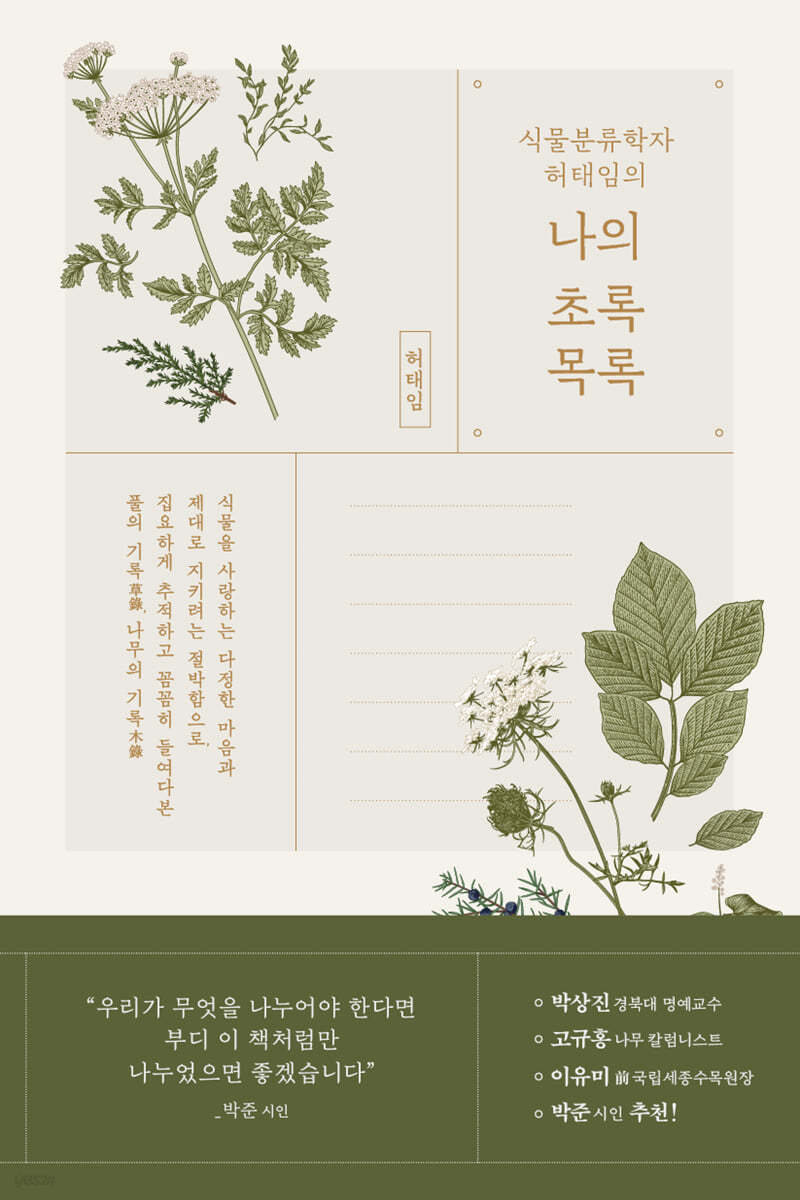
My Abstract List by Plant Taxonomist Heo Tae-im
 |
Description
Book Introduction
With a tender heart that loves plants and a desperate desire to protect them properly, Records of grass (草錄) and trees (木錄) that were persistently tracked and meticulously examined “If we must share anything, I hope it will be like this book.” _Park Jun (poet, author of “I Made Up Your Name and Ate It for Several Days”) - Recommended by Park Sang-jin (Professor Emeritus of Kyungpook National University), Go Gyu-hong (Tree Columnist), Lee Yu-mi (Former Director of the National Arboretum of Sejong), and Park Jun (Poet)! Dr. Tae-im Heo, a plant taxonomist who defines himself as a 'green record worker', compiled records obtained while following grass and trees. The author, who is working hard at the Baekdudaegan National Arboretum to research and protect the disappearing plants of this land, believes that "to properly protect them, you must know them in detail." He continues to travel the mountains, fields, and rivers of the country to find plants, listen to their stories, and meticulously translate them into human language. The amazing survival strategies of plants such as winter buds, which are like the heart of a tree, and 'anoemes', which produce seeds that can produce offspring only on female plants, and 'functionally dioecious', which is neither monoecious nor dioecious, as well as the fact that plants such as modemipul, dogwood, and arborvitae, which only grow on the Korean Peninsula on Earth, are in danger of extinction, and as the surprising and desperate stories of our land's plants unfold, you can also get a glimpse into the work and dreams of plant taxonomists who go to the DMZ, national security areas, and uninhabited islands, wandering through forests and climbing rocks and old trees just to meet plants. As readers follow the author's gentle voice as he explains, they will soon find themselves empathizing with the author's love for plants and laughing and crying along with them. |
- You can preview some of the book's contents.
Preview
index
Preface: A Love Affair with Plants
1.
A plant taxonomist's daily routine
Plant exploration ship
The northward advance of spring flowers
Wild vegetable story
Azaleas that hold your footsteps
Night-blooming sky lilies
In the fall, fragrance oil
Octopus legs and beef knees
Botanists Tracking the Reality
Plant class
2.
Green's strategy
Winter buds, the heart of the tree
Hydrangea's Time
Summer sari
The mysterious world of Cheon Seon-gwa
The pine tree is old, big, and alone
Bulbous plants that mature underground
Naturalized plants are not guilty
Small but elegant moss
The Back Side of the Succulent Crush
Symbiosis of water parsley and wetlands
A world where only female persimmon trees live
3.
For the green
Surviving Modemiful
The Discovery of Reading
Old Future, Danggang Tree
Ulleungdo Secret Forest
Beautiful flower apricot
Our lagoon
Do you know the Korean azalea?
There are no wild chrysanthemums
Conifer massacre
The more you develop, the more it disappears.
References
Recommendation
1.
A plant taxonomist's daily routine
Plant exploration ship
The northward advance of spring flowers
Wild vegetable story
Azaleas that hold your footsteps
Night-blooming sky lilies
In the fall, fragrance oil
Octopus legs and beef knees
Botanists Tracking the Reality
Plant class
2.
Green's strategy
Winter buds, the heart of the tree
Hydrangea's Time
Summer sari
The mysterious world of Cheon Seon-gwa
The pine tree is old, big, and alone
Bulbous plants that mature underground
Naturalized plants are not guilty
Small but elegant moss
The Back Side of the Succulent Crush
Symbiosis of water parsley and wetlands
A world where only female persimmon trees live
3.
For the green
Surviving Modemiful
The Discovery of Reading
Old Future, Danggang Tree
Ulleungdo Secret Forest
Beautiful flower apricot
Our lagoon
Do you know the Korean azalea?
There are no wild chrysanthemums
Conifer massacre
The more you develop, the more it disappears.
References
Recommendation
Detailed image

Publisher's Review
With a tender heart that loves plants and a desperate desire to protect them properly,
Records of grass (草錄) and trees (木錄) that were persistently tracked and meticulously examined
“If we must share anything, I hope it will be like this book.” _Park Jun (poet, author of “I Made Up Your Name and Ate It for Several Days”)
★★★ Recommended by Park Sang-jin (Professor Emeritus, Kyungpook National University), Ko Gyu-hong (Tree Columnist), Lee Yu-mi (Former Director of the National Arboretum, Sejong), and Park Jun (Poet)!
Dr. Tae-im Heo, a plant taxonomist who defines himself as a 'green record worker', compiled records obtained while following grass and trees.
The author, who is working hard at the Baekdudaegan National Arboretum to research and protect the disappearing plants of this land, believes that "to properly protect them, you must know them in detail." He continues to travel the mountains, fields, and rivers of the country to find plants, listen to their stories, and meticulously translate them into human language.
The amazing survival strategies of plants such as winter buds, which are like the heart of a tree, and 'anoemes', which produce seeds that can produce offspring only on female plants, and 'functionally dioecious', which is neither monoecious nor dioecious, as well as the fact that plants such as modemipul, dogwood, and arborvitae, which only grow on the Korean Peninsula on Earth, are in danger of extinction, and as the surprising and desperate stories of our land's plants unfold, you can also get a glimpse into the work and dreams of plant taxonomists who go to the DMZ, national security areas, and uninhabited islands, wandering through forests and climbing rocks and old trees just to meet plants.
As readers follow the author's gentle voice as he explains, they will soon find themselves empathizing with the author's love for plants and laughing and crying along with them.
Today, we trace the reality of plants
A plant taxonomist struggling in the mountains, fields, rivers, and labs
“I work and study for this taste.”
The purpose of plant taxonomy is to name all the plants in the world and to elucidate the relationships among them.
For that purpose, even today, plant taxonomists encounter plants in mountains, fields, and rivers.
From grandmothers in remote villages in Gangwon Province, they gain wisdom about wild vegetables that cannot be learned in school classes, and they visit military protection facilities, water source protection areas, national security areas that are difficult to access, and forest genetic resource protection areas. They also climb rocks and old trees on uninhabited islands and enter the demilitarized zone dressed like soldiers who detect landmines.
There are many ways to encounter plants in the lab.
“They measure the external shape of each part in detail and record it in writing and pictures, or they cut and divide it to examine the anatomical characteristics that are not visible externally in detail, or they examine the microstructure at the nanometer level under a microscope, or they even crush the plant body and put it in a vacuum machine to artificially amplify the DNA chain to reveal the genetic structure.” (pp. 75-76)
The author calls this study of plants a 'love affair with plants' and expresses his love that deepens day by day.
Finding the plant you're looking for and taking just one step forward, forgetting that it's a cliff and stamping your feet with joy; running a distance of over 1,000 kilometers in a day from Bonghwa to Geoje, then to Byeonsan Peninsula, and back to Bonghwa to see the spring flowers first; wearing a mask in the sweltering heat, pushing through the forest and climbing up and down the mountain, confirming that the plant is alive and saying that everything is okay as long as you can smell its pink flowers and scent just once; praying for the plants' survival and praying again for a reunion in the place where they have disappeared is definitely 'love'.
“Looking back, there were always plants around me.
Plants have become a source of income for me, who has no special abilities, and they have also become friends and lovers for me, who prefers to be alone.
And sometimes, it was the strength that supported me when I was wavering, it was the friend that supported my life, and it was the medicine that soothed my pain.
Having spent my childhood surrounded by nature and my twenties surrounded by plants, I am now in my thirties, still filled with questions about plants.
My love for plants seems to deepen every day, and sometimes I get scared, but I still want to learn more about them.
Because I am a plant lover.” _Page 11
A botanist from the National Baekdudaegan Arboretum tells us
The wondrous wisdom of the grasses and trees that have lived with us
“There is still so much to learn from them.”
“Just as there are bamboo trees, cotton trees, and deciduous trees, but no tree called ‘bamboo,’ and there are oak trees, hornbeam trees, and zelkova trees, but no tree called ‘oak,’” there is no plant called ‘wild chrysanthemum.’
This book contains stories about plants at various levels, from common sense like this to more specialized botanical knowledge, such as “a unique breeding method called ‘functional dioecious plant’ that is neither monoecious like a pine tree nor dioecious like a willow tree.”
The story of the names of 'Eolreji' (a modified name of 'Eolreo' and 'Chwi', which mean 'mottled leaves' and 'edible vegetables'), 'Chuljak' (a modified name of 'Meogeul-gil Cheok?' and 'Meogeul-gil Chok?'), 'Nakjidari' and 'Soemurneup' (named for their resemblance to octopus legs and cow knees, respectively), stories about the uses and efficacy of various plants that appear in our traditional medical books such as 'Donguibogam', 'Hyangyakjipseongbang', and 'Euibangyuchui', and stories about habitats such as back marshes, Ulleungdo, limestone areas, and lagoons are all interwoven and colorfully unfolded.
In particular, it is noteworthy that attention was paid to native plants that grow naturally on our land.
The background is the Nagoya Protocol, which came into effect in October 2014 and aims to ensure that the benefits derived from each country's organisms and their genetic resources are shared fairly and equitably in their countries of origin.
Countries that utilize genetic resources of living organisms are now subject to many restrictions on growing and using foreign-origin cultivated plants, such as having to obtain approval from the country providing them and paying separate royalties.
The author hints that it is time to take a closer look at native plants: the uses of the native plant 'Hyangyu', which may become a substitute for the imported plant lemongrass; the value of the native plant 'Sansuhyang', which is gradually being revealed even though we depend on Japanese hydrangeas for both flowers and tea; the potential of the 'Gamtae tree' as a street tree instead of the North American native oak, which is widely planted as a street tree in Korea, as it keeps all its leaves straight even in winter, never bending or twisting, and even has a mysterious reproductive ability called 'anopogon japonicus'; and the mystery of the 'Cheonseon-gwa tree', which is less sweet than figs but has resistance to certain diseases.
Plants that may disappear forever due to climate change, development, and overexploitation
“All I can do is follow them
“Listening to their stories and translating them into human language”
Since the COVID-19 outbreak, there has been a significant increase in the number of people seeking emotional stability through growing plants.
'Companion plant', 'plant butler', and 'planterior' have become everyday words, and new words such as 'sikdeok' (plant enthusiast), 'pulchin' (friends made through plants), 'pulmong' (looking at plants), and 'siktech' (plant + investment) are no longer unfamiliar.
The author is both pleased and concerned about this recent plant craze.
It is a welcome development that interest in plants is growing and the culture of incorporating them into human life is spreading. However, if plants, whose survival is already threatened by climate change and development, are viewed only as objects of consumption and enjoyment, or even as a means for economic gain, it is easy for this to ultimately lead to habitat destruction.
Throughout this book, readers can see the landscape of plants disappearing due to climate change and other human activities, and the author's sorrowful heart as he watches it.
A ski resort was built on Mt. Gariwang, which has been designated as a “Forest Genetic Resources Protection Area” and is covered in a forest of conifers such as arborvitae, fir, and yew, under the spur of the moment conditions of “ecological restoration,” a road expansion project that has been carried out without any measures to the habitats of endangered species that would disappear forever from the Earth if they disappear from the Korean Peninsula, including the modemi grass and the dogwood, and a arborvitae tree in the limestone area of Danyang that stands shabbyly covered only in dust from vehicles going to and from a nearby cement factory, belying its name as a natural monument. These things make us think about the relationship between plants and humans and the state of the Earth, beyond specific individuals or species.
While sharing the wisdom of plants gained from searching for individual plants, the author also delivers a gentle but firm 'warning from the forest': "Humans are probably the most clumsy creatures on this planet Earth when it comes to protecting their own habitat."
This book helps you see not just the trees, but also the forest, along with the trees.
Records of grass (草錄) and trees (木錄) that were persistently tracked and meticulously examined
“If we must share anything, I hope it will be like this book.” _Park Jun (poet, author of “I Made Up Your Name and Ate It for Several Days”)
★★★ Recommended by Park Sang-jin (Professor Emeritus, Kyungpook National University), Ko Gyu-hong (Tree Columnist), Lee Yu-mi (Former Director of the National Arboretum, Sejong), and Park Jun (Poet)!
Dr. Tae-im Heo, a plant taxonomist who defines himself as a 'green record worker', compiled records obtained while following grass and trees.
The author, who is working hard at the Baekdudaegan National Arboretum to research and protect the disappearing plants of this land, believes that "to properly protect them, you must know them in detail." He continues to travel the mountains, fields, and rivers of the country to find plants, listen to their stories, and meticulously translate them into human language.
The amazing survival strategies of plants such as winter buds, which are like the heart of a tree, and 'anoemes', which produce seeds that can produce offspring only on female plants, and 'functionally dioecious', which is neither monoecious nor dioecious, as well as the fact that plants such as modemipul, dogwood, and arborvitae, which only grow on the Korean Peninsula on Earth, are in danger of extinction, and as the surprising and desperate stories of our land's plants unfold, you can also get a glimpse into the work and dreams of plant taxonomists who go to the DMZ, national security areas, and uninhabited islands, wandering through forests and climbing rocks and old trees just to meet plants.
As readers follow the author's gentle voice as he explains, they will soon find themselves empathizing with the author's love for plants and laughing and crying along with them.
Today, we trace the reality of plants
A plant taxonomist struggling in the mountains, fields, rivers, and labs
“I work and study for this taste.”
The purpose of plant taxonomy is to name all the plants in the world and to elucidate the relationships among them.
For that purpose, even today, plant taxonomists encounter plants in mountains, fields, and rivers.
From grandmothers in remote villages in Gangwon Province, they gain wisdom about wild vegetables that cannot be learned in school classes, and they visit military protection facilities, water source protection areas, national security areas that are difficult to access, and forest genetic resource protection areas. They also climb rocks and old trees on uninhabited islands and enter the demilitarized zone dressed like soldiers who detect landmines.
There are many ways to encounter plants in the lab.
“They measure the external shape of each part in detail and record it in writing and pictures, or they cut and divide it to examine the anatomical characteristics that are not visible externally in detail, or they examine the microstructure at the nanometer level under a microscope, or they even crush the plant body and put it in a vacuum machine to artificially amplify the DNA chain to reveal the genetic structure.” (pp. 75-76)
The author calls this study of plants a 'love affair with plants' and expresses his love that deepens day by day.
Finding the plant you're looking for and taking just one step forward, forgetting that it's a cliff and stamping your feet with joy; running a distance of over 1,000 kilometers in a day from Bonghwa to Geoje, then to Byeonsan Peninsula, and back to Bonghwa to see the spring flowers first; wearing a mask in the sweltering heat, pushing through the forest and climbing up and down the mountain, confirming that the plant is alive and saying that everything is okay as long as you can smell its pink flowers and scent just once; praying for the plants' survival and praying again for a reunion in the place where they have disappeared is definitely 'love'.
“Looking back, there were always plants around me.
Plants have become a source of income for me, who has no special abilities, and they have also become friends and lovers for me, who prefers to be alone.
And sometimes, it was the strength that supported me when I was wavering, it was the friend that supported my life, and it was the medicine that soothed my pain.
Having spent my childhood surrounded by nature and my twenties surrounded by plants, I am now in my thirties, still filled with questions about plants.
My love for plants seems to deepen every day, and sometimes I get scared, but I still want to learn more about them.
Because I am a plant lover.” _Page 11
A botanist from the National Baekdudaegan Arboretum tells us
The wondrous wisdom of the grasses and trees that have lived with us
“There is still so much to learn from them.”
“Just as there are bamboo trees, cotton trees, and deciduous trees, but no tree called ‘bamboo,’ and there are oak trees, hornbeam trees, and zelkova trees, but no tree called ‘oak,’” there is no plant called ‘wild chrysanthemum.’
This book contains stories about plants at various levels, from common sense like this to more specialized botanical knowledge, such as “a unique breeding method called ‘functional dioecious plant’ that is neither monoecious like a pine tree nor dioecious like a willow tree.”
The story of the names of 'Eolreji' (a modified name of 'Eolreo' and 'Chwi', which mean 'mottled leaves' and 'edible vegetables'), 'Chuljak' (a modified name of 'Meogeul-gil Cheok?' and 'Meogeul-gil Chok?'), 'Nakjidari' and 'Soemurneup' (named for their resemblance to octopus legs and cow knees, respectively), stories about the uses and efficacy of various plants that appear in our traditional medical books such as 'Donguibogam', 'Hyangyakjipseongbang', and 'Euibangyuchui', and stories about habitats such as back marshes, Ulleungdo, limestone areas, and lagoons are all interwoven and colorfully unfolded.
In particular, it is noteworthy that attention was paid to native plants that grow naturally on our land.
The background is the Nagoya Protocol, which came into effect in October 2014 and aims to ensure that the benefits derived from each country's organisms and their genetic resources are shared fairly and equitably in their countries of origin.
Countries that utilize genetic resources of living organisms are now subject to many restrictions on growing and using foreign-origin cultivated plants, such as having to obtain approval from the country providing them and paying separate royalties.
The author hints that it is time to take a closer look at native plants: the uses of the native plant 'Hyangyu', which may become a substitute for the imported plant lemongrass; the value of the native plant 'Sansuhyang', which is gradually being revealed even though we depend on Japanese hydrangeas for both flowers and tea; the potential of the 'Gamtae tree' as a street tree instead of the North American native oak, which is widely planted as a street tree in Korea, as it keeps all its leaves straight even in winter, never bending or twisting, and even has a mysterious reproductive ability called 'anopogon japonicus'; and the mystery of the 'Cheonseon-gwa tree', which is less sweet than figs but has resistance to certain diseases.
Plants that may disappear forever due to climate change, development, and overexploitation
“All I can do is follow them
“Listening to their stories and translating them into human language”
Since the COVID-19 outbreak, there has been a significant increase in the number of people seeking emotional stability through growing plants.
'Companion plant', 'plant butler', and 'planterior' have become everyday words, and new words such as 'sikdeok' (plant enthusiast), 'pulchin' (friends made through plants), 'pulmong' (looking at plants), and 'siktech' (plant + investment) are no longer unfamiliar.
The author is both pleased and concerned about this recent plant craze.
It is a welcome development that interest in plants is growing and the culture of incorporating them into human life is spreading. However, if plants, whose survival is already threatened by climate change and development, are viewed only as objects of consumption and enjoyment, or even as a means for economic gain, it is easy for this to ultimately lead to habitat destruction.
Throughout this book, readers can see the landscape of plants disappearing due to climate change and other human activities, and the author's sorrowful heart as he watches it.
A ski resort was built on Mt. Gariwang, which has been designated as a “Forest Genetic Resources Protection Area” and is covered in a forest of conifers such as arborvitae, fir, and yew, under the spur of the moment conditions of “ecological restoration,” a road expansion project that has been carried out without any measures to the habitats of endangered species that would disappear forever from the Earth if they disappear from the Korean Peninsula, including the modemi grass and the dogwood, and a arborvitae tree in the limestone area of Danyang that stands shabbyly covered only in dust from vehicles going to and from a nearby cement factory, belying its name as a natural monument. These things make us think about the relationship between plants and humans and the state of the Earth, beyond specific individuals or species.
While sharing the wisdom of plants gained from searching for individual plants, the author also delivers a gentle but firm 'warning from the forest': "Humans are probably the most clumsy creatures on this planet Earth when it comes to protecting their own habitat."
This book helps you see not just the trees, but also the forest, along with the trees.
GOODS SPECIFICS
- Publication date: July 25, 2022
- Page count, weight, size: 292 pages | 446g | 140*210*18mm
- ISBN13: 9788934943440
- ISBN10: 8934943440
You may also like
카테고리
korean


korean

![GQ KOREA Mark (Monthly): December [2025]](http://librairie.coreenne.fr/cdn/shop/files/8ef265dbbfbf186523ed75ba7319009d.jpg?v=1765340328&width=3840)


