

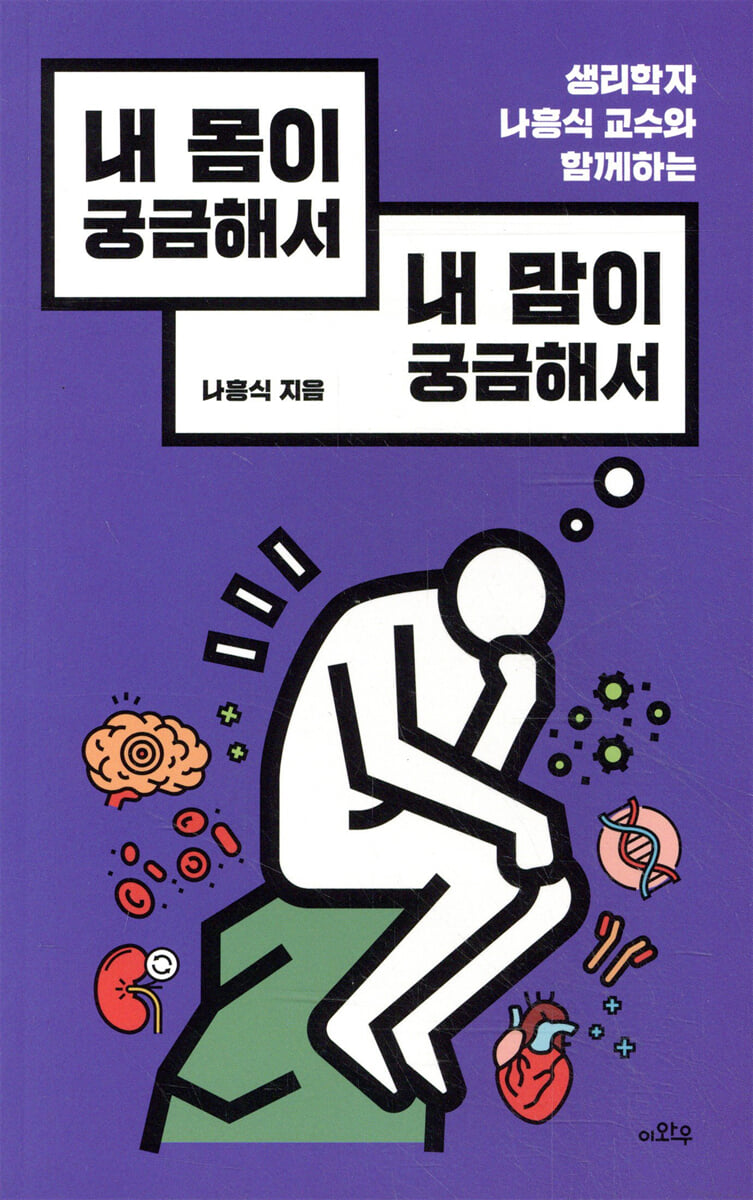
I'm curious about my body, I'm curious about my mind
 |
Description
Book Introduction
The country's top physiologist tells us
My Body, My Mind Manual
Why do I crave spicy food when I'm stressed?
Why does passionate love cool off over time?
Why do we adopt only humans among all the different creatures?
Why can't I remember anything from before I was three years old?
These are interesting questions that everyone has probably asked themselves at least once.
Professor Na Heung-sik, a physiologist known as the "King of Lectures" at Korea University College of Medicine, answers questions about our bodies, minds, and the world through the tool of science.
Living up to the title of 'King of Lectures,' he combines science, humanities, and philosophy to provide interesting and entertaining answers to questions.
For example, this is how humans explain when they feel 'happiness'.
Our body contains the four so-called happy hormones: endorphins, serotonin, dopamine, and oxytocin.
We feel 'happiness' thanks to these four happiness hormones that are released in our daily lives through exercise, meditation, and laughter.
But these happiness hormones aren't only released during happy moments.
It also comes out when we are having a hard time and in pain.
Why? To alleviate the pain.
It's like a kind of pain-relieving drug.
But here, these happiness hormones are strangely linked to spicy foods like tteokbokki.
This is because happiness hormones are released even when eating spicy food.
When spicy food enters our body, it perceives it as a kind of pain.
And to relieve this pain, it starts secreting happiness hormones.
“It’s spicy, but I keep wanting to eat it.
“Spicy food is addictive.” This experience was not just a matter of feeling, but a scientific fact.
There is also a tempting story for those who are crazy about foods that boost the immune system.
As many people know, immunity is like an army that protects our body, and the basics of this immune system begin with distinguishing between 'self' and 'non-self'.
But sometimes this immune system goes wrong.
And when the body mistakes its own cells for invaders and attacks them, this is called an autoimmune disease.
Rheumatoid arthritis, psoriasis, and allergies are representative autoimmune diseases, and these symptoms can be alleviated through immunosuppressants.
In other words, immune enhancement is the main cause of autoimmune diseases.
As COVID-19 spread, the number of patients whose lives were threatened by cytokine storms increased. This was also because excessive cytokine secretion killed all invading viruses and even attacked normal body cells.
It is a kind of immune hyperactivity phenomenon.
In other words, it is not always good to have strong immunity, and normalizing immunity is most important.
“At the same time as understanding humans as living beings, we attempted to reinterpret the structure and function of the human body from a humanistic perspective.
As the author said, “I hope that through this book, many people will have the opportunity to think about not only human nature but also issues related to the future of humanity, such as nature conservation and environmental destruction,” I hope that this will be a good opportunity to look back on the ‘biological me and us’ through the tool of science, and at the same time think about issues such as the future of humanity.
You'll find yourself casually flipping through the pages, captivated by the academic benefits and unexpected fun this book offers.
My Body, My Mind Manual
Why do I crave spicy food when I'm stressed?
Why does passionate love cool off over time?
Why do we adopt only humans among all the different creatures?
Why can't I remember anything from before I was three years old?
These are interesting questions that everyone has probably asked themselves at least once.
Professor Na Heung-sik, a physiologist known as the "King of Lectures" at Korea University College of Medicine, answers questions about our bodies, minds, and the world through the tool of science.
Living up to the title of 'King of Lectures,' he combines science, humanities, and philosophy to provide interesting and entertaining answers to questions.
For example, this is how humans explain when they feel 'happiness'.
Our body contains the four so-called happy hormones: endorphins, serotonin, dopamine, and oxytocin.
We feel 'happiness' thanks to these four happiness hormones that are released in our daily lives through exercise, meditation, and laughter.
But these happiness hormones aren't only released during happy moments.
It also comes out when we are having a hard time and in pain.
Why? To alleviate the pain.
It's like a kind of pain-relieving drug.
But here, these happiness hormones are strangely linked to spicy foods like tteokbokki.
This is because happiness hormones are released even when eating spicy food.
When spicy food enters our body, it perceives it as a kind of pain.
And to relieve this pain, it starts secreting happiness hormones.
“It’s spicy, but I keep wanting to eat it.
“Spicy food is addictive.” This experience was not just a matter of feeling, but a scientific fact.
There is also a tempting story for those who are crazy about foods that boost the immune system.
As many people know, immunity is like an army that protects our body, and the basics of this immune system begin with distinguishing between 'self' and 'non-self'.
But sometimes this immune system goes wrong.
And when the body mistakes its own cells for invaders and attacks them, this is called an autoimmune disease.
Rheumatoid arthritis, psoriasis, and allergies are representative autoimmune diseases, and these symptoms can be alleviated through immunosuppressants.
In other words, immune enhancement is the main cause of autoimmune diseases.
As COVID-19 spread, the number of patients whose lives were threatened by cytokine storms increased. This was also because excessive cytokine secretion killed all invading viruses and even attacked normal body cells.
It is a kind of immune hyperactivity phenomenon.
In other words, it is not always good to have strong immunity, and normalizing immunity is most important.
“At the same time as understanding humans as living beings, we attempted to reinterpret the structure and function of the human body from a humanistic perspective.
As the author said, “I hope that through this book, many people will have the opportunity to think about not only human nature but also issues related to the future of humanity, such as nature conservation and environmental destruction,” I hope that this will be a good opportunity to look back on the ‘biological me and us’ through the tool of science, and at the same time think about issues such as the future of humanity.
You'll find yourself casually flipping through the pages, captivated by the academic benefits and unexpected fun this book offers.
- You can preview some of the book's contents.
Preview
index
preface
1 Hormones that determine our mood
2 Plants have brains too
3 Why is a man's ring finger longer than his index finger?
4 Octopuses feel pain too
5 Lessons Learned from Online Classes
6 Gut bacteria are the key to health
7 Exercise is a natural pain reliever
8. Why Red Blood Cells Hide in the Bone Marrow
9 Why do women spend so much time shopping?
10 If your immunity is strong, you will get sick.
11 The cooperative instinct that sperm also possesses
12 Obesity Treatments Revealed by Sleep
13 Roundworms that help you get pregnant
14 Why Only Homo Sapiens Survived
15 Why can't I remember things from when I was a baby?
16 The most primitive sense: smell
17 Bonobos adopt babies like humans
18 Why Wide-set Eyebrows Make You Look Kind
19 Moderate stress is medicine
20 How do you find a partner?
21 Reasons to go to Gangnam with friends
22 Why Carnivores Are More Likely to Get Cancer
23 Why do women live longer than men?
24 If AI is introduced to hospitals and courts
25 Our senses are still underwater
26 Why the Highland People Survived
27 Scientific Reasons Why Greed Is Bad
28 Corona is our fault
29 Commonalities Between Dementia and Immunoaging
30 Can we trust our judgment?
31 Why the human brain grew larger
32 Biological Secrets to Building Good Relationships
33 All About Abdominal Breathing
34 People Obsessed with Saving
35 Is the current population policy good?
Conclusion
1 Hormones that determine our mood
2 Plants have brains too
3 Why is a man's ring finger longer than his index finger?
4 Octopuses feel pain too
5 Lessons Learned from Online Classes
6 Gut bacteria are the key to health
7 Exercise is a natural pain reliever
8. Why Red Blood Cells Hide in the Bone Marrow
9 Why do women spend so much time shopping?
10 If your immunity is strong, you will get sick.
11 The cooperative instinct that sperm also possesses
12 Obesity Treatments Revealed by Sleep
13 Roundworms that help you get pregnant
14 Why Only Homo Sapiens Survived
15 Why can't I remember things from when I was a baby?
16 The most primitive sense: smell
17 Bonobos adopt babies like humans
18 Why Wide-set Eyebrows Make You Look Kind
19 Moderate stress is medicine
20 How do you find a partner?
21 Reasons to go to Gangnam with friends
22 Why Carnivores Are More Likely to Get Cancer
23 Why do women live longer than men?
24 If AI is introduced to hospitals and courts
25 Our senses are still underwater
26 Why the Highland People Survived
27 Scientific Reasons Why Greed Is Bad
28 Corona is our fault
29 Commonalities Between Dementia and Immunoaging
30 Can we trust our judgment?
31 Why the human brain grew larger
32 Biological Secrets to Building Good Relationships
33 All About Abdominal Breathing
34 People Obsessed with Saving
35 Is the current population policy good?
Conclusion
GOODS SPECIFICS
- Date of issue: August 8, 2022
- Page count, weight, size: 255 pages | 262g | 120*188*16mm
- ISBN13: 9788998933449
- ISBN10: 8998933446
You may also like
카테고리
korean


korean

![GQ KOREA Mark (Monthly): December [2025]](http://librairie.coreenne.fr/cdn/shop/files/8ef265dbbfbf186523ed75ba7319009d.jpg?v=1765340328&width=3840)


