

Attention practice
 |
Description
Book Introduction
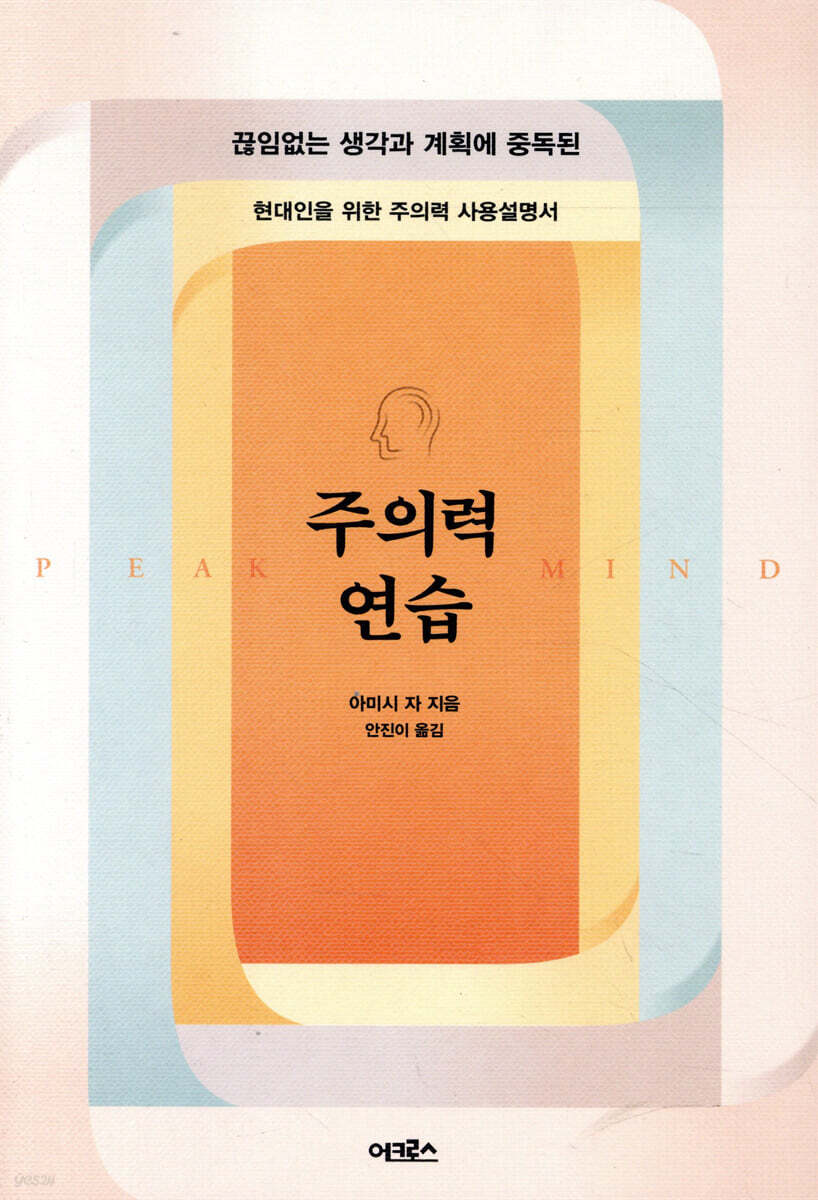
In this day and age, there are so many things to worry about and do. Even when important tasks are right in front of us, we are easily distracted by things that don't need to be done right away, such as sensational news or shopping lists. The problem is that we are so distracted by trivial things that we cannot pay attention to what is truly important. So how do we focus our attention where we want it? Since the latest brain science revealed that the brain changes based on behavior and experience, unproven methods under the guise of “brain development” have begun to tempt people by claiming they can “change the brain.” But not every method is effective. The scientific community is focusing on 'mindfulness,' an age-old wisdom of mankind, as the most effective way to train the brain. “I study attention to help people make good decisions,” says neuroscientist Amish Jha, who brought the topic to her lab to see whether mindfulness practitioners remain effective even in situations where they feel a high psychological burden. I started researching mindfulness as a 'brain training tool' for attention. The author explains how the attentional system works and reminds us that the 'distracted brain' is an inevitable human fate. That's why they say it's more important to notice when you lose focus than to force yourself to focus. Since 'will' alone cannot change the way the brain operates, which is distracted by external stimuli and internal wanderings, 'practice' is needed to become aware of where we are paying attention at every moment and to return our attention to where we want it to be. |
- You can preview some of the book's contents.
Preview
index
Preface: You're Missing Half Your Life
Chapter 1: What Happens in Your Brain When You Focus
"It's really changing your brain" / Have you seen the gorilla? / Brain bias / Our brains are at war, follow 'attention'! / The three subsystems of attention / Sorting out relevant information
Chapter 2: Things That Steal Our Attention
If attention is wasted like money / When does our attention decline / Why don't we notice when our attention is broken? / "I don't get stressed out" / Attention is used for everything / Moments of 'high conflict' / We're using failed strategies
Chapter 3: The Mind Needs Strength Training Too
Neuroplasticity: How Can We Change Our Brains? / The Beginning of the Experiment / The Key to Attention Training / People Who Need High Concentration / Testing Mindfulness on Soldiers / Be Aware, Observe, and Be Present
Chapter 4: The Art of Staying Focused in a Distracted World
Where Your Attention Goes / Neuroscience Reveals the Nature of Attention / Recognizing Mind Wandering / Is the Attention Crisis Really Digital? / Exercise One: Finding the Flash
Chapter 5: Working Memory: The Mental Whiteboard
What's written on the whiteboard / Discovering the 'default mode network' / Securing working memory space / Memory capacity and limits / The close collaboration between attention and working memory / Cleaning the mental whiteboard / There's a reason for our flaws / What's actually stored / 'Career suicide'
Chapter 6: 'Memory Problems' are mostly 'Attention Problems'
Is memory a real-time recording? / Attention creates memories / Why we have memories / “Forget that” / The relationship between recording methods and memory / The gateway to long-term memory / The occurrence of the problem: Encoding failure / The expansion of the problem: Retrieval failure / How are memories made? / What interferes with the formation of memories / Second exercise: Body scan / Pull the ‘zoom lens’ of the mind / Tools for dealing with unpleasant memories
Chapter 7: Staying centered and not being swayed by prejudices in your mind
The Power of Story / Why Great Stories Are More Dangerous / The Simulation Always Returns /
Sexism in My Mental Model / Eliminating Mental Bias / De-Centering / The Importance of a Bird's Eye View / "Don't Believe Everything You Think" / Observing Your Mind
Chapter 8: Meta-Awareness: Paying Attention to Attention
A firefighter caught in a small fire right before his eyes / Beyond situational awareness / Meta-awareness and metacognition /
The Difference Between "Dazed" and "Looking Away" / The Judge Who Won't Judge / Why Meta-Awareness Is Effective / Attention Is Like a Moving Ball / Third Exercise: The River of Thought / The Point of Choice
Chapter 9: How to Focus on the Person in Front of You
Sharing 'Mental Models' / Complex Interactions / Some Emotions Suddenly Overwhelm Us / Staying in the Present / Listening Practice / Focus is the Best Expression of Affection / Uncomfortable Connections Exist / Fourth Exercise: Connection Meditation / Thinking and Thinking About Someone Again
Chapter 10 It will get better as you do it
STRONG Test / Mindfulness and Attention Enhancement / 12 Minutes a Day, the 'Minimum Dose' for Change / Things Even the Busiest People Don't Give Up on / All You Need is Body and Mind / How to Start? / When is the Best Time to Do It? / Our Attention Capacities Are All Different / The Boredom That Lies Beneath Humanity / The True Meaning of 'Feeling Good' / Now You Know How
Conclusion: The Best State of Mind
Appendix: Mind Core Exercises for Focus
main
Chapter 1: What Happens in Your Brain When You Focus
"It's really changing your brain" / Have you seen the gorilla? / Brain bias / Our brains are at war, follow 'attention'! / The three subsystems of attention / Sorting out relevant information
Chapter 2: Things That Steal Our Attention
If attention is wasted like money / When does our attention decline / Why don't we notice when our attention is broken? / "I don't get stressed out" / Attention is used for everything / Moments of 'high conflict' / We're using failed strategies
Chapter 3: The Mind Needs Strength Training Too
Neuroplasticity: How Can We Change Our Brains? / The Beginning of the Experiment / The Key to Attention Training / People Who Need High Concentration / Testing Mindfulness on Soldiers / Be Aware, Observe, and Be Present
Chapter 4: The Art of Staying Focused in a Distracted World
Where Your Attention Goes / Neuroscience Reveals the Nature of Attention / Recognizing Mind Wandering / Is the Attention Crisis Really Digital? / Exercise One: Finding the Flash
Chapter 5: Working Memory: The Mental Whiteboard
What's written on the whiteboard / Discovering the 'default mode network' / Securing working memory space / Memory capacity and limits / The close collaboration between attention and working memory / Cleaning the mental whiteboard / There's a reason for our flaws / What's actually stored / 'Career suicide'
Chapter 6: 'Memory Problems' are mostly 'Attention Problems'
Is memory a real-time recording? / Attention creates memories / Why we have memories / “Forget that” / The relationship between recording methods and memory / The gateway to long-term memory / The occurrence of the problem: Encoding failure / The expansion of the problem: Retrieval failure / How are memories made? / What interferes with the formation of memories / Second exercise: Body scan / Pull the ‘zoom lens’ of the mind / Tools for dealing with unpleasant memories
Chapter 7: Staying centered and not being swayed by prejudices in your mind
The Power of Story / Why Great Stories Are More Dangerous / The Simulation Always Returns /
Sexism in My Mental Model / Eliminating Mental Bias / De-Centering / The Importance of a Bird's Eye View / "Don't Believe Everything You Think" / Observing Your Mind
Chapter 8: Meta-Awareness: Paying Attention to Attention
A firefighter caught in a small fire right before his eyes / Beyond situational awareness / Meta-awareness and metacognition /
The Difference Between "Dazed" and "Looking Away" / The Judge Who Won't Judge / Why Meta-Awareness Is Effective / Attention Is Like a Moving Ball / Third Exercise: The River of Thought / The Point of Choice
Chapter 9: How to Focus on the Person in Front of You
Sharing 'Mental Models' / Complex Interactions / Some Emotions Suddenly Overwhelm Us / Staying in the Present / Listening Practice / Focus is the Best Expression of Affection / Uncomfortable Connections Exist / Fourth Exercise: Connection Meditation / Thinking and Thinking About Someone Again
Chapter 10 It will get better as you do it
STRONG Test / Mindfulness and Attention Enhancement / 12 Minutes a Day, the 'Minimum Dose' for Change / Things Even the Busiest People Don't Give Up on / All You Need is Body and Mind / How to Start? / When is the Best Time to Do It? / Our Attention Capacities Are All Different / The Boredom That Lies Beneath Humanity / The True Meaning of 'Feeling Good' / Now You Know How
Conclusion: The Best State of Mind
Appendix: Mind Core Exercises for Focus
main
Detailed image

Into the book
As someone who has studied attention scientifically for 25 years, I can answer these questions.
In many ways, distraction is part of being alive.
Because our brains evolved under specific threats to survival, our attention fluctuates and our focus is easily distracted.
When predators were lurking everywhere, the distraction worked to our advantage.
But in our modern, high-tech, fast-paced, and ever-changing society, we feel more distracted than ever before, and we're encountering new predators who rely on and exploit our distraction.
---From the "Preface"
Remember that attention doesn't just affect your performance at work.
Attention is a versatile resource used in everything you do.
In other words, when our attention span starts to wane, it's not just our ability to write emails or finish reports that's at risk.
We have problems in our relationships with people who are important to us.
Whatever your important goals in life, you may not be able to move towards them.
Those goals may be far away, but if we want to get there someday, we must start closing the distance now, and when our attention is slackened, we end up going in the wrong direction or wandering.
And your ability to react at crucial moments may be impaired.
A defining moment could be a life-threatening situation, an emotional crisis, or a relationship crisis that determines whether a significant event or relationship will move forward.
---From "Chapter 2: Things That Steal Our Attention"
Working memory allows us to keep our goals in mind and move toward them.
Here, the 'goal' is different from winning a soccer match (although of course you want to win in soccer).
It refers to the subtle intention and conscious goal of achieving good results in every task we undertake.
Every decision, plan, thought, action, and behavior we make throughout the day has a purpose.
We decide to read a book, shop for groceries to prepare dinner, think about our favorite online content, create a presentation, learn how to use a new electronic device, and wait for all the cars to pass before crossing the street.
As we move from one task to another, we rely on working memory to maintain goals and subgoals, update those goals, and discard goals we've already accomplished in order to set new ones.
---From "Chapter 5 Working Memory, the Whiteboard in Your Head"
Attention is one of the fundamental foundations of all social relationships.
Attention determines our interactions with others at every moment.
The English word attention comes from the Latin word attendere, meaning 'to bring forward.'
In that sense, attention is connection.
In many ways, distraction is part of being alive.
Because our brains evolved under specific threats to survival, our attention fluctuates and our focus is easily distracted.
When predators were lurking everywhere, the distraction worked to our advantage.
But in our modern, high-tech, fast-paced, and ever-changing society, we feel more distracted than ever before, and we're encountering new predators who rely on and exploit our distraction.
---From the "Preface"
Remember that attention doesn't just affect your performance at work.
Attention is a versatile resource used in everything you do.
In other words, when our attention span starts to wane, it's not just our ability to write emails or finish reports that's at risk.
We have problems in our relationships with people who are important to us.
Whatever your important goals in life, you may not be able to move towards them.
Those goals may be far away, but if we want to get there someday, we must start closing the distance now, and when our attention is slackened, we end up going in the wrong direction or wandering.
And your ability to react at crucial moments may be impaired.
A defining moment could be a life-threatening situation, an emotional crisis, or a relationship crisis that determines whether a significant event or relationship will move forward.
---From "Chapter 2: Things That Steal Our Attention"
Working memory allows us to keep our goals in mind and move toward them.
Here, the 'goal' is different from winning a soccer match (although of course you want to win in soccer).
It refers to the subtle intention and conscious goal of achieving good results in every task we undertake.
Every decision, plan, thought, action, and behavior we make throughout the day has a purpose.
We decide to read a book, shop for groceries to prepare dinner, think about our favorite online content, create a presentation, learn how to use a new electronic device, and wait for all the cars to pass before crossing the street.
As we move from one task to another, we rely on working memory to maintain goals and subgoals, update those goals, and discard goals we've already accomplished in order to set new ones.
---From "Chapter 5 Working Memory, the Whiteboard in Your Head"
Attention is one of the fundamental foundations of all social relationships.
Attention determines our interactions with others at every moment.
The English word attention comes from the Latin word attendere, meaning 'to bring forward.'
In that sense, attention is connection.
---From "Chapter 9: How to Focus on the Person in Front of You"
Publisher's Review
“Why do we spend 50% of our lives lost in thought?”
Brain science tips to calm your inner distractions and achieve 'maximum focus'
★TED 5 million views "Tame Your Mind to Wander"
★National bestseller, Amazon cognitive psychology bestseller
★Lectures given at the World Economic Forum, Aspen Institute, and New York Academy
"Essential Reading for a Distracted Age" (Daniel Goleman)
“How to train your tired brain and regain focus” (The Guardian)
In this day and age, there are so many things to worry about and do.
Even when important tasks are right in front of us, we are easily distracted by things that don't need to be done right away, such as sensational news or shopping lists.
The problem is that we are so distracted by trivial things that we cannot pay attention to what is truly important.
So how do we focus our attention where we want it?
Since the latest brain science revealed that the brain changes based on behavior and experience, unproven methods under the guise of “brain development” have begun to tempt people by claiming they can “change the brain.”
But not every method is effective.
The scientific community is focusing on 'mindfulness,' an age-old wisdom of mankind, as the most effective way to train the brain.
“I study attention to help people make good decisions,” says neuroscientist Amish Jha, who brought the topic to her lab to see whether mindfulness practitioners remain effective even in situations where they feel a high psychological burden.
I started researching mindfulness as a 'brain training tool' for attention.
The author explains how the attentional system works and reminds us that the 'distracted brain' is an inevitable human fate.
That's why they say it's more important to notice when you lose focus than to force yourself to focus.
Since 'will' alone cannot change the way the brain operates, which is distracted by external stimuli and internal wanderings, 'practice' is needed to become aware of where we are paying attention at every moment and to return our attention to where we want it to be.
Why did a neuroscientist who was skeptical of meditation come to study mindfulness?
- The most important key to attention training is to be 'aware' of where our attention is.
Professor Amish Jha, who studies the mechanisms of human attention, has long been interested in finding ways to prevent attentional decline in occupations where split-second decisions can have a profound impact on others, such as firefighters, soldiers, and doctors, and who work under extreme pressure.
One day, after seeing two fMRI brain images that were clearly different during a lecture by renowned neuroscientist Richard Davidson, the author asked Davidson how to change a negative brain into a positive one, and unexpectedly heard the answer, 'meditation.'
The author, who confessed that "bringing up meditation in a brain science class felt as absurd as talking about astrology while lecturing to astrophysicists," had a skeptical view of meditation after experiencing discrimination in Hinduism during her childhood, where only girls were allowed to practice meditation.
Her research team tested methods like focused music, high-tech gadgets, and various brain training games to see if they could actually improve attention, but none of them produced significant or lasting effects.
The author, who got the clue to 'meditation' through Davidson, realized that the methods he had experimented with were missing the most important aspect of attention training.
It is about becoming 'aware' of where our attention is.
The author observes that many people find themselves distracted by other things they mistakenly believe are "more important and more urgent," even when they are not, and finds that it takes practice to keep our minds present and aware of where our attention is directed.
As a scientist, professor, and mother of two, the author, who didn't want to neglect either, went through an attention crisis that left her teeth numb, and ultimately decided to practice mindfulness meditation herself.
After experiencing changes in one's own attentional system through meditation, one begins to bring this topic into the laboratory and conduct research to address the relationship between attention and mindfulness practice academically.
A distracted mind is an undeniable human fate.
The Secret of the Attentional System: The More You Control It, the More Distracted You Get
Attention is a system for selecting what is necessary from excessive information, and it has a powerful authority to decide how the brain processes information.
But we are not utilizing this important system as much as we would like.
This is because the human brain is extremely distracting.
Neuroscience tells us that humans had to evolve a "distractable brain" that is alert to even the slightest external stimulus to protect themselves from predators.
That's why the author suggests that instead of wasting energy fighting an "unwinnable battle" against things that steal our attention, we should instead train ourselves to change the "default" way our brains work.
Moreover, our attention is extremely vulnerable not only to external stimuli but also to stress and bad moods.
At this time, many people choose strategies such as 'relaxing activities' or 'positive thinking' to recover their attention, but the author says that these methods are failed strategies that actually eat away at our attention.
As we expend more cognitive resources trying to cope with stressful situations, we fall into a vicious cycle where our attention, which should be used to focus on the task at hand, is diverted elsewhere.
The author also explains the surprising properties of attention revealed by neuroscience, guiding us to the forefront of brain science regarding attention, including how our attentional system works and how it depletes, why meta-awareness, which focuses on paying attention to "attention," is important, and how our mental biases negatively affect attention.
“When we have trouble concentrating or can’t concentrate at all, it feels like our attention is running out.
But attention doesn't run out.
As our attention declines or we begin to tire, it becomes more difficult to focus our attention where we want it, but attention itself does not disappear.
In cognitive neuroscience, this is explained by load theory.
The load theory can be summarized as follows:
The total amount of attention we have is constant.
“It’s just that attention is used differently at different times, and it can be used in ways we don’t want.” (p. 141)
Pay attention to what's written on the whiteboard in your head.
- “Our life is the sum total of everything we pay attention to.”
Modern society demands of us multiple roles simultaneously.
We constantly think about what we need to do now and what we need to do next, and we revise our plans.
At this time, what is as important as attention is ‘working memory.’
Working memory is a close collaborating partner of attention, serving as a temporary workspace for processing information we receive.
The author likens working memory to a "mental whiteboard," where attention determines what gets written on it.
We don't remember everything that actually happened, we only remember what we wrote down on the whiteboard in our heads.
And these memories soon create the pieces of our lives.
In this way, attention means not only the ability to solve tasks, but also the ability to be aware of one's own state of mind and the ability to control one's life.
The specific mindfulness exercises suggested in this book, such as "Finding the Flash," "Body Scan," and "River of Thoughts," help us clear the whiteboard in our heads and become aware of what's written on it.
The author also shares episodes of attention crises he experienced, as well as practical advice, to motivate us to practice attention.
One time, I decided to spend some time alone with my daughter and we were baking together. Being a first-time cookie baker, I was so absorbed in checking the recipe on my phone that I was completely absorbed in it.
The child grumbled strangely at his mother, raising his voice.
If it were me, I would have questioned the child's attitude or focused on baking cookies, but the author suddenly realized that she had been busy with work the past few days and had not paid enough attention to the child, and asked herself a question.
“What’s important right now, at this moment?” It was spending time with my daughter, focusing on her, not the cookies.
Attention is a powerful force that allows us to focus on the important people in front of us and restores our sense of connection with those around us.
12 Minutes a Day: "Mind Core Exercise" to Train Your Mind Like Your Body
- Gain the "best mind" to focus on the task at hand and face the present.
We make time to exercise even in our busy daily lives to maintain our physical health.
Just as we train our bodies, consistently training our minds can change our brains, and one form of mental training that has been proven to improve concentration is mindfulness.
The author has repeatedly implemented mindfulness training programs for various groups, including soldiers and athletes, and has finally proposed the most efficient and effective structure, 12 minutes a day of 'Mindfulness-Based Attention Training (MBAT),' which he describes in detail in this book.
Here, the number '12 minutes' per day corresponds to the 'minimum dosage' for enjoying the effects of improving attention, which has been verified through various studies.
A study we conducted in collaboration with the Marine Corps in West Palm Beach found that longer mindfulness training sessions were more effective, but since soldiers cannot devote long hours to meditation, we needed data on the minimum training time needed before benefits began to be seen.
The author dedicated himself to finding a prescription that even those pressed for time could implement in real life through repeated experiments, and finally arrived at the numbers: 4 weeks, 5 days a week, 12 minutes a day.
The program is currently used widely by organizations ranging from military agencies such as the US Army and the New Zealand Defence Force, to professional sports teams and corporations.
Amish says that when we can skillfully move between two states—receptive attention, where we can be aware of where our attention is going, and focused attention, where we can focus it wherever we want—we can reach “peak mind,” where we can live fully while facing all that we have to face as human beings.
Beyond providing scientific advice on how to focus on the task at hand, this book, "Attention Practice," will help you cultivate the power to face the present without wavering even in the face of stress and anxiety. It will be the most scientific and effective tool to protect you from those things that steal your attention.
Brain science tips to calm your inner distractions and achieve 'maximum focus'
★TED 5 million views "Tame Your Mind to Wander"
★National bestseller, Amazon cognitive psychology bestseller
★Lectures given at the World Economic Forum, Aspen Institute, and New York Academy
"Essential Reading for a Distracted Age" (Daniel Goleman)
“How to train your tired brain and regain focus” (The Guardian)
In this day and age, there are so many things to worry about and do.
Even when important tasks are right in front of us, we are easily distracted by things that don't need to be done right away, such as sensational news or shopping lists.
The problem is that we are so distracted by trivial things that we cannot pay attention to what is truly important.
So how do we focus our attention where we want it?
Since the latest brain science revealed that the brain changes based on behavior and experience, unproven methods under the guise of “brain development” have begun to tempt people by claiming they can “change the brain.”
But not every method is effective.
The scientific community is focusing on 'mindfulness,' an age-old wisdom of mankind, as the most effective way to train the brain.
“I study attention to help people make good decisions,” says neuroscientist Amish Jha, who brought the topic to her lab to see whether mindfulness practitioners remain effective even in situations where they feel a high psychological burden.
I started researching mindfulness as a 'brain training tool' for attention.
The author explains how the attentional system works and reminds us that the 'distracted brain' is an inevitable human fate.
That's why they say it's more important to notice when you lose focus than to force yourself to focus.
Since 'will' alone cannot change the way the brain operates, which is distracted by external stimuli and internal wanderings, 'practice' is needed to become aware of where we are paying attention at every moment and to return our attention to where we want it to be.
Why did a neuroscientist who was skeptical of meditation come to study mindfulness?
- The most important key to attention training is to be 'aware' of where our attention is.
Professor Amish Jha, who studies the mechanisms of human attention, has long been interested in finding ways to prevent attentional decline in occupations where split-second decisions can have a profound impact on others, such as firefighters, soldiers, and doctors, and who work under extreme pressure.
One day, after seeing two fMRI brain images that were clearly different during a lecture by renowned neuroscientist Richard Davidson, the author asked Davidson how to change a negative brain into a positive one, and unexpectedly heard the answer, 'meditation.'
The author, who confessed that "bringing up meditation in a brain science class felt as absurd as talking about astrology while lecturing to astrophysicists," had a skeptical view of meditation after experiencing discrimination in Hinduism during her childhood, where only girls were allowed to practice meditation.
Her research team tested methods like focused music, high-tech gadgets, and various brain training games to see if they could actually improve attention, but none of them produced significant or lasting effects.
The author, who got the clue to 'meditation' through Davidson, realized that the methods he had experimented with were missing the most important aspect of attention training.
It is about becoming 'aware' of where our attention is.
The author observes that many people find themselves distracted by other things they mistakenly believe are "more important and more urgent," even when they are not, and finds that it takes practice to keep our minds present and aware of where our attention is directed.
As a scientist, professor, and mother of two, the author, who didn't want to neglect either, went through an attention crisis that left her teeth numb, and ultimately decided to practice mindfulness meditation herself.
After experiencing changes in one's own attentional system through meditation, one begins to bring this topic into the laboratory and conduct research to address the relationship between attention and mindfulness practice academically.
A distracted mind is an undeniable human fate.
The Secret of the Attentional System: The More You Control It, the More Distracted You Get
Attention is a system for selecting what is necessary from excessive information, and it has a powerful authority to decide how the brain processes information.
But we are not utilizing this important system as much as we would like.
This is because the human brain is extremely distracting.
Neuroscience tells us that humans had to evolve a "distractable brain" that is alert to even the slightest external stimulus to protect themselves from predators.
That's why the author suggests that instead of wasting energy fighting an "unwinnable battle" against things that steal our attention, we should instead train ourselves to change the "default" way our brains work.
Moreover, our attention is extremely vulnerable not only to external stimuli but also to stress and bad moods.
At this time, many people choose strategies such as 'relaxing activities' or 'positive thinking' to recover their attention, but the author says that these methods are failed strategies that actually eat away at our attention.
As we expend more cognitive resources trying to cope with stressful situations, we fall into a vicious cycle where our attention, which should be used to focus on the task at hand, is diverted elsewhere.
The author also explains the surprising properties of attention revealed by neuroscience, guiding us to the forefront of brain science regarding attention, including how our attentional system works and how it depletes, why meta-awareness, which focuses on paying attention to "attention," is important, and how our mental biases negatively affect attention.
“When we have trouble concentrating or can’t concentrate at all, it feels like our attention is running out.
But attention doesn't run out.
As our attention declines or we begin to tire, it becomes more difficult to focus our attention where we want it, but attention itself does not disappear.
In cognitive neuroscience, this is explained by load theory.
The load theory can be summarized as follows:
The total amount of attention we have is constant.
“It’s just that attention is used differently at different times, and it can be used in ways we don’t want.” (p. 141)
Pay attention to what's written on the whiteboard in your head.
- “Our life is the sum total of everything we pay attention to.”
Modern society demands of us multiple roles simultaneously.
We constantly think about what we need to do now and what we need to do next, and we revise our plans.
At this time, what is as important as attention is ‘working memory.’
Working memory is a close collaborating partner of attention, serving as a temporary workspace for processing information we receive.
The author likens working memory to a "mental whiteboard," where attention determines what gets written on it.
We don't remember everything that actually happened, we only remember what we wrote down on the whiteboard in our heads.
And these memories soon create the pieces of our lives.
In this way, attention means not only the ability to solve tasks, but also the ability to be aware of one's own state of mind and the ability to control one's life.
The specific mindfulness exercises suggested in this book, such as "Finding the Flash," "Body Scan," and "River of Thoughts," help us clear the whiteboard in our heads and become aware of what's written on it.
The author also shares episodes of attention crises he experienced, as well as practical advice, to motivate us to practice attention.
One time, I decided to spend some time alone with my daughter and we were baking together. Being a first-time cookie baker, I was so absorbed in checking the recipe on my phone that I was completely absorbed in it.
The child grumbled strangely at his mother, raising his voice.
If it were me, I would have questioned the child's attitude or focused on baking cookies, but the author suddenly realized that she had been busy with work the past few days and had not paid enough attention to the child, and asked herself a question.
“What’s important right now, at this moment?” It was spending time with my daughter, focusing on her, not the cookies.
Attention is a powerful force that allows us to focus on the important people in front of us and restores our sense of connection with those around us.
12 Minutes a Day: "Mind Core Exercise" to Train Your Mind Like Your Body
- Gain the "best mind" to focus on the task at hand and face the present.
We make time to exercise even in our busy daily lives to maintain our physical health.
Just as we train our bodies, consistently training our minds can change our brains, and one form of mental training that has been proven to improve concentration is mindfulness.
The author has repeatedly implemented mindfulness training programs for various groups, including soldiers and athletes, and has finally proposed the most efficient and effective structure, 12 minutes a day of 'Mindfulness-Based Attention Training (MBAT),' which he describes in detail in this book.
Here, the number '12 minutes' per day corresponds to the 'minimum dosage' for enjoying the effects of improving attention, which has been verified through various studies.
A study we conducted in collaboration with the Marine Corps in West Palm Beach found that longer mindfulness training sessions were more effective, but since soldiers cannot devote long hours to meditation, we needed data on the minimum training time needed before benefits began to be seen.
The author dedicated himself to finding a prescription that even those pressed for time could implement in real life through repeated experiments, and finally arrived at the numbers: 4 weeks, 5 days a week, 12 minutes a day.
The program is currently used widely by organizations ranging from military agencies such as the US Army and the New Zealand Defence Force, to professional sports teams and corporations.
Amish says that when we can skillfully move between two states—receptive attention, where we can be aware of where our attention is going, and focused attention, where we can focus it wherever we want—we can reach “peak mind,” where we can live fully while facing all that we have to face as human beings.
Beyond providing scientific advice on how to focus on the task at hand, this book, "Attention Practice," will help you cultivate the power to face the present without wavering even in the face of stress and anxiety. It will be the most scientific and effective tool to protect you from those things that steal your attention.
GOODS SPECIFICS
- Publication date: October 17, 2022
- Page count, weight, size: 464 pages | 596g | 145*210*24mm
- ISBN13: 9791167740588
- ISBN10: 1167740580
You may also like
카테고리
korean


korean

![ELLE 엘르 스페셜 에디션 A형 : 12월 [2025]](http://librairie.coreenne.fr/cdn/shop/files/b8e27a3de6c9538896439686c6b0e8fb.jpg?v=1766436872&width=3840)


