

resilience
 |
Description
Book Introduction
The Answer to Mental Recovery Discovered by Psychology, Neuroscience, Philosophy, Social Science, and Religion
“What we need now is resilience!”
In 2011, the book "Resilience," which first introduced the concept of "resilience" in Korea and garnered attention from the media, education, and psychology circles, has already been loved by over 200,000 readers.
Professor Kim Joo-hwan, the author, has added a new article to the existing book on why we need resilience now, making it even more valuable.
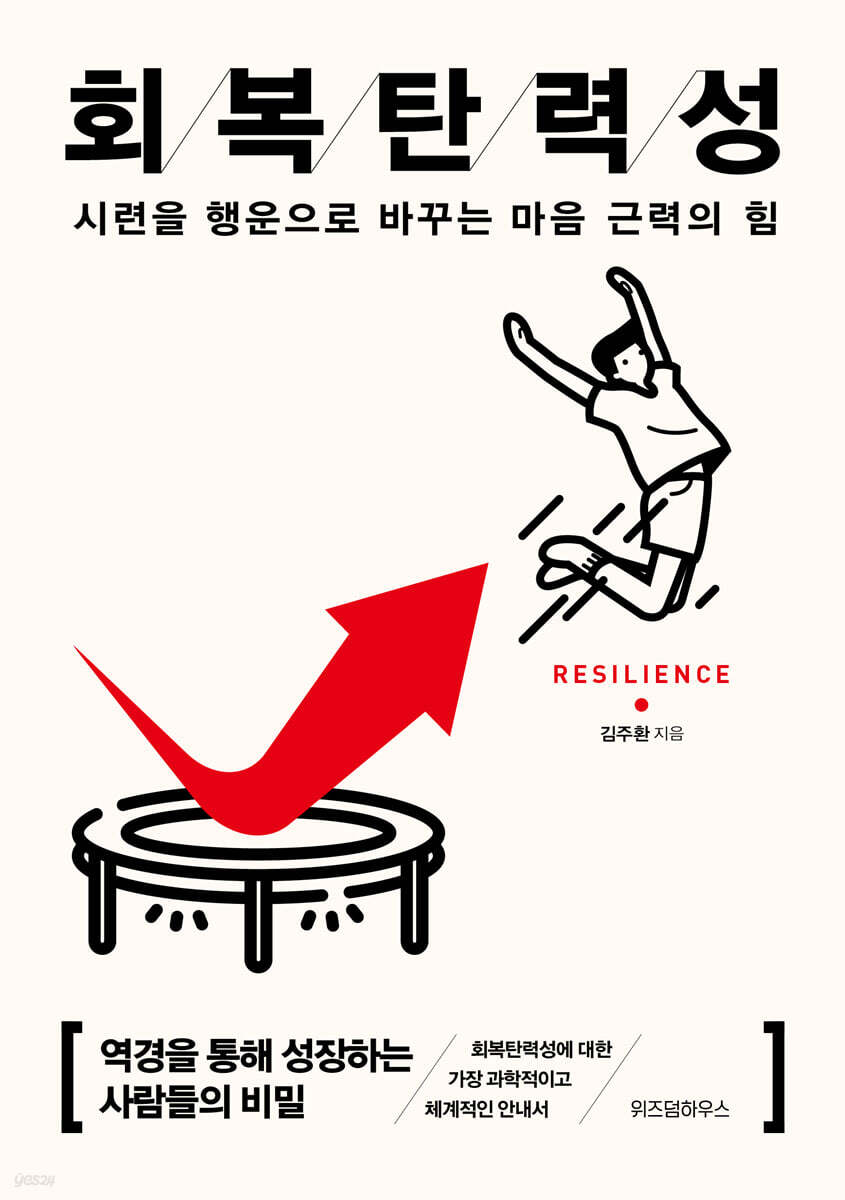
Resilience originally referred to the power to bounce back, and in psychology it is mainly used to mean the positive power to overcome trials or hardships.
Professor Kim Joo-hwan of Yonsei University presents examples of people who overcame adversity through resilience, and adds persuasiveness by presenting decades of research on resilience.
And it guides all readers to diagnose their own resilience index and develop resilience.
“What we need now is resilience!”
In 2011, the book "Resilience," which first introduced the concept of "resilience" in Korea and garnered attention from the media, education, and psychology circles, has already been loved by over 200,000 readers.
Professor Kim Joo-hwan, the author, has added a new article to the existing book on why we need resilience now, making it even more valuable.
Resilience originally referred to the power to bounce back, and in psychology it is mainly used to mean the positive power to overcome trials or hardships.
Professor Kim Joo-hwan of Yonsei University presents examples of people who overcame adversity through resilience, and adds persuasiveness by presenting decades of research on resilience.
And it guides all readers to diagnose their own resilience index and develop resilience.
- You can preview some of the book's contents.
Preview
index
| Prologue | Resilience Comes from Communication Skills and True Happiness
PART 01 Mental Strength and Resilience
What is resilience?
-The power to overcome adversity
People who cope with adversity
-The case of Professor Lee Sang-mook of Seoul National University
-SBS I Want to Know That
-In the case of Amy Mullins
-Patricia Whitway, J.K. Rowling, Andersen
-If you have been sentenced to a limited lifespan
Discovering Resilience
Professor Daniel Kaneman's colonoscopy experiment
-What happened on the island of Kauai, Hawaii
PART 02 What is my resilience index?
Development of a Korean Resilience Index
- Interest in resilience
My resilience index is
-[KRQ-53 Test]
How Do the Brains of High and Low Resilient People Differ?
- A positive attitude toward mistakes
How Can I Increase My Brain's Resilience?
-Practice engraving happiness into the brain
-The Secret of the Duchenne Smile
PART 03 The First Element of Resilience: Self-Regulation
The power to understand oneself, the ability to self-regulate
-How to understand others through myself
- Howard Gardner's experience
-Discovery of the theory of multiple intelligences
-The importance of self-understanding intelligence
Habits that evoke positive emotions
-Candlelight problem and candy
-Effect of improving positive emotions
Don't hold back, enjoy it
-Study instead of playing?
-Autonomy brings happiness
Identify the exact cause of what is happening
-The ABCs of Storytelling
-Humans are animals that live by stories.
PART 04 The Second Element of Resilience: Interpersonal Skills
A happier life together, interpersonal skills
-When you need a supporter of the heart
Conversation skills that attract the other person's favor
-Communication is a skill
-Two dimensions of communication
-Overcoming communication anxiety
-Two ways to express myself
Understand the principles of empathy and practice listening.
-The brain's mirror neuron system
-Theory of mind, ability to think from another's perspective
-Gender differences in empathy
Maintain deep and broad human relationships
-Positive emotions and self-expanding abilities
-The fundamental nature of social relations
Professor Gottman's Divorce Equation and Soap Opera
-The key to improving self-expanding abilities
PART 05 What We Need to Do to Increase Resilience
Change your brain to a positive one
-Is South Korea happy?
We need to raise our baseline level of happiness.
-The thermostat of happiness
Can the basic level of happiness be improved?
Discover your signature strengths
-Why focus on your strengths?
-Improving resilience by leveraging your strengths
Two Habits to Boost Resilience
-A sure and direct way to increase positivity in the brain
-The Amazing Power of Gratitude
Regular exercise changes your life.
| References |
PART 01 Mental Strength and Resilience
What is resilience?
-The power to overcome adversity
People who cope with adversity
-The case of Professor Lee Sang-mook of Seoul National University
-SBS I Want to Know That
-In the case of Amy Mullins
-Patricia Whitway, J.K. Rowling, Andersen
-If you have been sentenced to a limited lifespan
Discovering Resilience
Professor Daniel Kaneman's colonoscopy experiment
-What happened on the island of Kauai, Hawaii
PART 02 What is my resilience index?
Development of a Korean Resilience Index
- Interest in resilience
My resilience index is
-[KRQ-53 Test]
How Do the Brains of High and Low Resilient People Differ?
- A positive attitude toward mistakes
How Can I Increase My Brain's Resilience?
-Practice engraving happiness into the brain
-The Secret of the Duchenne Smile
PART 03 The First Element of Resilience: Self-Regulation
The power to understand oneself, the ability to self-regulate
-How to understand others through myself
- Howard Gardner's experience
-Discovery of the theory of multiple intelligences
-The importance of self-understanding intelligence
Habits that evoke positive emotions
-Candlelight problem and candy
-Effect of improving positive emotions
Don't hold back, enjoy it
-Study instead of playing?
-Autonomy brings happiness
Identify the exact cause of what is happening
-The ABCs of Storytelling
-Humans are animals that live by stories.
PART 04 The Second Element of Resilience: Interpersonal Skills
A happier life together, interpersonal skills
-When you need a supporter of the heart
Conversation skills that attract the other person's favor
-Communication is a skill
-Two dimensions of communication
-Overcoming communication anxiety
-Two ways to express myself
Understand the principles of empathy and practice listening.
-The brain's mirror neuron system
-Theory of mind, ability to think from another's perspective
-Gender differences in empathy
Maintain deep and broad human relationships
-Positive emotions and self-expanding abilities
-The fundamental nature of social relations
Professor Gottman's Divorce Equation and Soap Opera
-The key to improving self-expanding abilities
PART 05 What We Need to Do to Increase Resilience
Change your brain to a positive one
-Is South Korea happy?
We need to raise our baseline level of happiness.
-The thermostat of happiness
Can the basic level of happiness be improved?
Discover your signature strengths
-Why focus on your strengths?
-Improving resilience by leveraging your strengths
Two Habits to Boost Resilience
-A sure and direct way to increase positivity in the brain
-The Amazing Power of Gratitude
Regular exercise changes your life.
| References |
Detailed image

Into the book
People who believe that happiness depends on certain conditions (money, power, status, fame, success, social reputation, looks, etc.) are worshipping those certain conditions.
People who worship money always feel that the more money they earn, the less they have.
People who worship power feel that the more power they acquire, the weaker their power becomes.
People who worship status become obsessed with climbing higher and higher, looking only at those higher than themselves.
People who worship appearances are always comparing themselves to others, only seeing their own shortcomings, and suffering from anxiety about their own lack of attractiveness.
In this way, the conditions for happiness can be said to be the conditions for unhappiness.
--- p.9
It's remarkable how children, despite facing hardships like extreme poverty, parental absence, violent neighbors, and growing up in high-crime areas, can thrive and adapt to society.
Of course, not all children can do that.
Only resilient children demonstrate such abilities.
You can't teach resilience itself to children.
It is not knowledge or information.
However, since the elements of resilience have been identified by many scholars, there is plenty to teach about how to improve resilience.
--- p.60
Through positivity training, a negative and pessimistic brain can be rewired into a positive and optimistic brain.
A positive brain is a brain in which positive information processing routes are activated, and conversely, a negative brain is a brain in which negative information processing routes are activated.
When it comes to the same event or person, a positive brain automatically processes information positively, and a negative brain automatically accepts it negatively.
This happens so quickly that it is difficult to consciously control it.
In other words, in order for a negative person to become a positive person, he or she must constantly make an effort to activate the brain's positive information processing route.
--- p.90
The level of happiness felt by children and adolescents in our country is the lowest among OECD countries.
It is no exaggeration to say that our country's youth and children are currently experiencing pathological levels of unhappiness and are suffering from collective depression.
They absolutely need the confidence and resilience to overcome whatever comes their way.
To ensure that young people's lives are vibrant and enjoyable, we must foster their resilience.
We need to insure our children's lives against adversity by building resilience.
--- p.128
There are many ways to practice gratitude, but some of the most effective include:
First, before going to bed every night, look back on the day's events and write down in a notebook at least five things you are grateful for.
Rather than just vague gratitude for life, you should write down specific things that happened during the day.
It is not enough to just recall it in your head.
Be sure to write it down before going to bed.
This way, our brain carefully recalls the events of the day and selects the things we are grateful for.
In other words, you fall asleep after looking back on the day with a grateful heart.
The reason it's effective to do it before bed is because most memory consolidation occurs while you sleep.
In other words, it is effective in making the brain's function of recalling the day's events with a positive mind a kind of habit.
--- p.251
Harvard psychiatrist John Ratti explains, “Exercise has a similar effect to taking antidepressants like Prozac and Ritalin, increasing focus and calmness and decreasing impulsivity.”
Researchers also say that if you stop exercising midway, your nerve cells won't work as well, so you need to keep doing it to maintain the effects.
In fact, in the UK, more and more doctors are prescribing exercise instead of antidepressants for mild depression.
People who worship money always feel that the more money they earn, the less they have.
People who worship power feel that the more power they acquire, the weaker their power becomes.
People who worship status become obsessed with climbing higher and higher, looking only at those higher than themselves.
People who worship appearances are always comparing themselves to others, only seeing their own shortcomings, and suffering from anxiety about their own lack of attractiveness.
In this way, the conditions for happiness can be said to be the conditions for unhappiness.
--- p.9
It's remarkable how children, despite facing hardships like extreme poverty, parental absence, violent neighbors, and growing up in high-crime areas, can thrive and adapt to society.
Of course, not all children can do that.
Only resilient children demonstrate such abilities.
You can't teach resilience itself to children.
It is not knowledge or information.
However, since the elements of resilience have been identified by many scholars, there is plenty to teach about how to improve resilience.
--- p.60
Through positivity training, a negative and pessimistic brain can be rewired into a positive and optimistic brain.
A positive brain is a brain in which positive information processing routes are activated, and conversely, a negative brain is a brain in which negative information processing routes are activated.
When it comes to the same event or person, a positive brain automatically processes information positively, and a negative brain automatically accepts it negatively.
This happens so quickly that it is difficult to consciously control it.
In other words, in order for a negative person to become a positive person, he or she must constantly make an effort to activate the brain's positive information processing route.
--- p.90
The level of happiness felt by children and adolescents in our country is the lowest among OECD countries.
It is no exaggeration to say that our country's youth and children are currently experiencing pathological levels of unhappiness and are suffering from collective depression.
They absolutely need the confidence and resilience to overcome whatever comes their way.
To ensure that young people's lives are vibrant and enjoyable, we must foster their resilience.
We need to insure our children's lives against adversity by building resilience.
--- p.128
There are many ways to practice gratitude, but some of the most effective include:
First, before going to bed every night, look back on the day's events and write down in a notebook at least five things you are grateful for.
Rather than just vague gratitude for life, you should write down specific things that happened during the day.
It is not enough to just recall it in your head.
Be sure to write it down before going to bed.
This way, our brain carefully recalls the events of the day and selects the things we are grateful for.
In other words, you fall asleep after looking back on the day with a grateful heart.
The reason it's effective to do it before bed is because most memory consolidation occurs while you sleep.
In other words, it is effective in making the brain's function of recalling the day's events with a positive mind a kind of habit.
--- p.251
Harvard psychiatrist John Ratti explains, “Exercise has a similar effect to taking antidepressants like Prozac and Ritalin, increasing focus and calmness and decreasing impulsivity.”
Researchers also say that if you stop exercising midway, your nerve cells won't work as well, so you need to keep doing it to maintain the effects.
In fact, in the UK, more and more doctors are prescribing exercise instead of antidepressants for mild depression.
--- p.252
Publisher's Review
The Secret of People Who Grow Through Adversity: Resilience
The very book that 200,000 readers were crazy about!
“Resilience” is a concept first introduced in South Korea by Professor Kim Joo-hwan in 2011.
But now it has become a common, everyday term used by many people, as if such a word originally existed in our language.
Since the publication of "Resilience," dozens of books with the word "resilience" in their titles have been published.
In 2015, the JoongAng Ilbo reported that 『Resilience』 ranked second in the social sciences category of the ‘Most Cited Authors and Translated Books by Academic Field.’
This means that scholars have frequently cited this book in their academic papers over the short period of four years, and that this book has been recognized as a citation-worthy academic work among scholars.
Moreover, this book has been loved by more than 200,000 readers so far.
This is also evidence that our society still desperately needs resilience.
Resilience is one of the most topical concepts in positive psychology research.
Because it is a mysterious inner strength of human beings that allows them to overcome misfortune and adversity and stand up again like a rock.
Positive psychology begins with a reflection on the fact that psychology has so far focused only on curing pathological psychological states.
Professor Martin Seligman, known as the founder of positive psychology, proposed positive psychology, arguing that we should now also focus on further elevating and developing normal people.
Relationship conflicts, mistakes, illness, accidents, divorce, bankruptcy, death…
“What is different about people who have overcome despair?”
Professor Kim Joo-hwan, who has long focused on resilience, participated as a key researcher in the SBS program "I Want to Know That - 7 Secrets of People Who Overcame Despair," and met people who had faced major challenges in life, such as unexpected accidents or business failures.
Professor Lee Sang-mook of the Department of Earth and Environmental Sciences at Seoul National University, who became a quadriplegic in a car accident; top street dancer Woo Jung-hoon, who became a paraplegic in a car accident; Ryu Chun-min, who ran a meat restaurant with annual sales of over 5 billion won but ended up in debt of 10 billion won due to the IMF crisis and mad cow disease scare…
But surprisingly, they did not give up in the face of life's great trials, but rather overcame adversity and succeeded in recovering.
How did they overcome life's greatest trials? What strengths do they possess?
Through this broadcast, Professor Kim Joo-hwan introduced the new and surprising concept of "resilience," and empirically proved through brainwave experiments that people who have overcome hardships have significantly higher and more robust resilience than the average person.
After the broadcast, people's interest in 'resilience' exploded.
The resilience index measurement items introduced through broadcasts and newspaper articles began to spread rapidly on the Internet, and inquiries about ways to improve resilience continued.
However, the 'resilience index items' introduced at that time were not developed for Koreans.
Professor Kim Joo-hwan conducted repeated surveys of over 2,000 people, ranging from middle school students, high school students, college students, and adults over 60 years of age, and used rigorous statistical analysis techniques to develop the 53-item 'Korean Resilience Index (KRQ-53),' which was included in 'Resilience.'
This article identifies six elements of resilience and suggests specific ways to develop resilience.
We also added a question asking you to identify your ‘own strengths.’
Let's check our personal resilience through tests, plan specific action plans, and work steadily toward them.
Professor Kim Joo-hwan's refreshing solutions, designed to help ordinary people find positive emotions and embark on the path to happiness, will help you increase your resilience.
The most scientific and systematic guide to resilience
Just as exercise builds muscle, training can build mental strength.
It is a well-known fact that when a glass is half full, a negative person thinks 'it is half empty', while a positive person thinks 'it is half full'.
However, just because you decide to think positively, saying, "From now on, there's half a glass left," doesn't mean you'll immediately become a positive person.
Just like seeing a muscular body and deciding that you want to have a nice body with abs in the future doesn't mean you'll get that right away.
To have a muscular body, you need to lose body fat and build muscle.
To become a positive person, you must develop habits that weaken the negative pathways in your brain and strengthen the positive pathways.
Positivity is like a muscle; the amount varies from person to person, and the amount of load it can withstand over a certain period of time is also set.
Therefore, in order to develop this 'muscle', you must 'train' it so that it receives an appropriate load, but be careful not to overdo it and cause 'mental muscle fatigue or injury'.
Because the human brain is plastic, it can change with repeated training no matter how old you are.
People who have developed positive emotions as a habit have higher baseline levels of happiness and greater resilience.
“People with high resilience are tolerant of their own mistakes, and are bold and adventurous.
“A positive brain is one that is sensitive to its own mistakes, but not afraid of making them.” (p. 82)
“Anyone can become a happy person through this training!”
A surefire way to increase your resilience index
Everyone experiences adversity and difficulties in life.
Resilience is a strength that is especially desperately needed by modern people living a tough life.
Therefore, it is necessary to examine the factors that constitute resilience and, furthermore, to identify and implement specific methods for developing resilience.
Just as a person with a weak constitution can become healthy through consistent exercise, and a tone-deaf person can become a better singer through training, resilience can also be improved through consistent effort.
Some of the specific training methods introduced in the text are as follows:
- Smile like a fool.
The human brain can even detect pleasure from its own facial expressions.
In other words, it is true that laughing makes you happy.
Let's make it a habit to smile positively.
(The Secret of the Duchenne Smile_Page 88)
- Get into the habit of telling stories positively.
Depending on how we interpret adversity and how we tell the story, we can become unhappy or happy.
(The Secret of Storytelling_Page 139)
- Work to improve your empathy.
Empathy can be improved through training such as active listening or mimicking facial expressions.
(The brain's mirror neuron system_p. 178)
- Maintain deep and broad human relationships.
Work to improve your positive emotions. Positive emotions are the driving force that strengthens the feeling of unity between me and others.
(Positive Emotions and Self-Expansion_p. 192)
- Discover your key strengths.
A truly happy life is one where you find joy, fulfillment, and satisfaction through doing what you are good at.
(Why Focus on Your Strengths_Page 235)
- Being grateful is a good habit for the mind, and exercising is a good habit for the body.
If you combine gratitude with regular exercise, even the most negative and pessimistic person will notice a clear shift in their brain to a more positive one after three months, and their resilience will also increase.
(A sure and direct way to increase your brain's positivity_p. 245)
If you check your own resilience using the 53 KRQ questions included in this book, which measure your "resilience index," and plan specific action plans and work consistently, you will undoubtedly feel yourself changing.
The very book that 200,000 readers were crazy about!
“Resilience” is a concept first introduced in South Korea by Professor Kim Joo-hwan in 2011.
But now it has become a common, everyday term used by many people, as if such a word originally existed in our language.
Since the publication of "Resilience," dozens of books with the word "resilience" in their titles have been published.
In 2015, the JoongAng Ilbo reported that 『Resilience』 ranked second in the social sciences category of the ‘Most Cited Authors and Translated Books by Academic Field.’
This means that scholars have frequently cited this book in their academic papers over the short period of four years, and that this book has been recognized as a citation-worthy academic work among scholars.
Moreover, this book has been loved by more than 200,000 readers so far.
This is also evidence that our society still desperately needs resilience.
Resilience is one of the most topical concepts in positive psychology research.
Because it is a mysterious inner strength of human beings that allows them to overcome misfortune and adversity and stand up again like a rock.
Positive psychology begins with a reflection on the fact that psychology has so far focused only on curing pathological psychological states.
Professor Martin Seligman, known as the founder of positive psychology, proposed positive psychology, arguing that we should now also focus on further elevating and developing normal people.
Relationship conflicts, mistakes, illness, accidents, divorce, bankruptcy, death…
“What is different about people who have overcome despair?”
Professor Kim Joo-hwan, who has long focused on resilience, participated as a key researcher in the SBS program "I Want to Know That - 7 Secrets of People Who Overcame Despair," and met people who had faced major challenges in life, such as unexpected accidents or business failures.
Professor Lee Sang-mook of the Department of Earth and Environmental Sciences at Seoul National University, who became a quadriplegic in a car accident; top street dancer Woo Jung-hoon, who became a paraplegic in a car accident; Ryu Chun-min, who ran a meat restaurant with annual sales of over 5 billion won but ended up in debt of 10 billion won due to the IMF crisis and mad cow disease scare…
But surprisingly, they did not give up in the face of life's great trials, but rather overcame adversity and succeeded in recovering.
How did they overcome life's greatest trials? What strengths do they possess?
Through this broadcast, Professor Kim Joo-hwan introduced the new and surprising concept of "resilience," and empirically proved through brainwave experiments that people who have overcome hardships have significantly higher and more robust resilience than the average person.
After the broadcast, people's interest in 'resilience' exploded.
The resilience index measurement items introduced through broadcasts and newspaper articles began to spread rapidly on the Internet, and inquiries about ways to improve resilience continued.
However, the 'resilience index items' introduced at that time were not developed for Koreans.
Professor Kim Joo-hwan conducted repeated surveys of over 2,000 people, ranging from middle school students, high school students, college students, and adults over 60 years of age, and used rigorous statistical analysis techniques to develop the 53-item 'Korean Resilience Index (KRQ-53),' which was included in 'Resilience.'
This article identifies six elements of resilience and suggests specific ways to develop resilience.
We also added a question asking you to identify your ‘own strengths.’
Let's check our personal resilience through tests, plan specific action plans, and work steadily toward them.
Professor Kim Joo-hwan's refreshing solutions, designed to help ordinary people find positive emotions and embark on the path to happiness, will help you increase your resilience.
The most scientific and systematic guide to resilience
Just as exercise builds muscle, training can build mental strength.
It is a well-known fact that when a glass is half full, a negative person thinks 'it is half empty', while a positive person thinks 'it is half full'.
However, just because you decide to think positively, saying, "From now on, there's half a glass left," doesn't mean you'll immediately become a positive person.
Just like seeing a muscular body and deciding that you want to have a nice body with abs in the future doesn't mean you'll get that right away.
To have a muscular body, you need to lose body fat and build muscle.
To become a positive person, you must develop habits that weaken the negative pathways in your brain and strengthen the positive pathways.
Positivity is like a muscle; the amount varies from person to person, and the amount of load it can withstand over a certain period of time is also set.
Therefore, in order to develop this 'muscle', you must 'train' it so that it receives an appropriate load, but be careful not to overdo it and cause 'mental muscle fatigue or injury'.
Because the human brain is plastic, it can change with repeated training no matter how old you are.
People who have developed positive emotions as a habit have higher baseline levels of happiness and greater resilience.
“People with high resilience are tolerant of their own mistakes, and are bold and adventurous.
“A positive brain is one that is sensitive to its own mistakes, but not afraid of making them.” (p. 82)
“Anyone can become a happy person through this training!”
A surefire way to increase your resilience index
Everyone experiences adversity and difficulties in life.
Resilience is a strength that is especially desperately needed by modern people living a tough life.
Therefore, it is necessary to examine the factors that constitute resilience and, furthermore, to identify and implement specific methods for developing resilience.
Just as a person with a weak constitution can become healthy through consistent exercise, and a tone-deaf person can become a better singer through training, resilience can also be improved through consistent effort.
Some of the specific training methods introduced in the text are as follows:
- Smile like a fool.
The human brain can even detect pleasure from its own facial expressions.
In other words, it is true that laughing makes you happy.
Let's make it a habit to smile positively.
(The Secret of the Duchenne Smile_Page 88)
- Get into the habit of telling stories positively.
Depending on how we interpret adversity and how we tell the story, we can become unhappy or happy.
(The Secret of Storytelling_Page 139)
- Work to improve your empathy.
Empathy can be improved through training such as active listening or mimicking facial expressions.
(The brain's mirror neuron system_p. 178)
- Maintain deep and broad human relationships.
Work to improve your positive emotions. Positive emotions are the driving force that strengthens the feeling of unity between me and others.
(Positive Emotions and Self-Expansion_p. 192)
- Discover your key strengths.
A truly happy life is one where you find joy, fulfillment, and satisfaction through doing what you are good at.
(Why Focus on Your Strengths_Page 235)
- Being grateful is a good habit for the mind, and exercising is a good habit for the body.
If you combine gratitude with regular exercise, even the most negative and pessimistic person will notice a clear shift in their brain to a more positive one after three months, and their resilience will also increase.
(A sure and direct way to increase your brain's positivity_p. 245)
If you check your own resilience using the 53 KRQ questions included in this book, which measure your "resilience index," and plan specific action plans and work consistently, you will undoubtedly feel yourself changing.
GOODS SPECIFICS
- Date of issue: March 29, 2019
- Page count, weight, size: 268 pages | 372g | 148*210*17mm
- ISBN13: 9791189938772
- ISBN10: 1189938774
You may also like
카테고리
korean


korean

![GQ KOREA Mark (Monthly): December [2025]](http://librairie.coreenne.fr/cdn/shop/files/8ef265dbbfbf186523ed75ba7319009d.jpg?v=1765340328&width=3840)


