

Malsense
 |
Description
Book Introduction
- The most viewed TED talk ever (15 million views)!
- The alchemist of conversation, following in the footsteps of Larry King, the emperor of talk!
The author of this book, Celeste Headley, is a veteran broadcaster who has hosted news and various programs for nearly 20 years on various famous broadcasting stations, including CNN, BBC, and MSNBC.
Her TED talk has been viewed over 15 million times worldwide, making it the most-viewed talk on conversation skills.
She has always considered the broadcasting studio to be a place for conversational experimentation, researching how to communicate better with people.
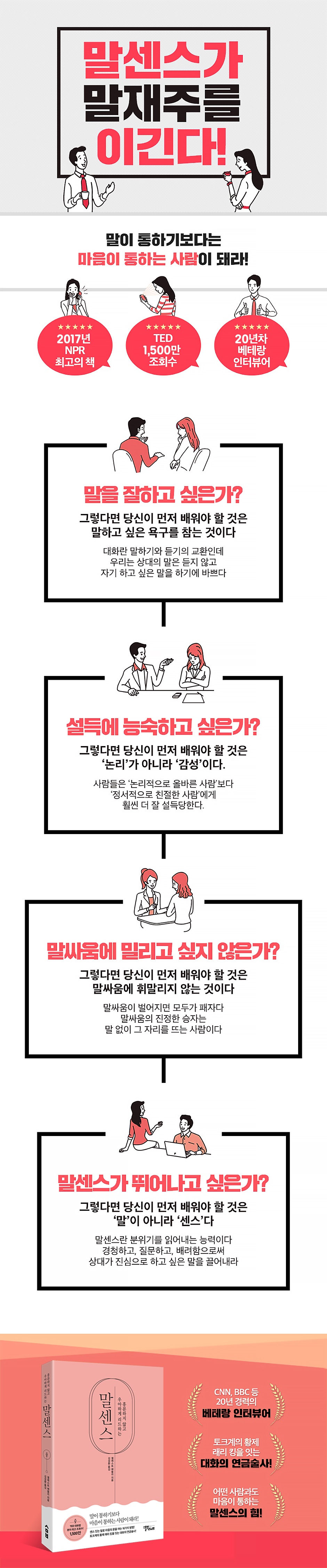
What she presents in this book is not simply conversational skills to improve speaking skills or eloquence.
Instead, the author presents principles of conversation that must be followed regardless of who the other person is or what the conversation situation is.
If you follow these principles of conversation, you will be able to have genuine and excellent conversations even if you lack eloquence, and you will be able to communicate pleasantly and enjoyably.
- The alchemist of conversation, following in the footsteps of Larry King, the emperor of talk!
The author of this book, Celeste Headley, is a veteran broadcaster who has hosted news and various programs for nearly 20 years on various famous broadcasting stations, including CNN, BBC, and MSNBC.
Her TED talk has been viewed over 15 million times worldwide, making it the most-viewed talk on conversation skills.
She has always considered the broadcasting studio to be a place for conversational experimentation, researching how to communicate better with people.
What she presents in this book is not simply conversational skills to improve speaking skills or eloquence.
Instead, the author presents principles of conversation that must be followed regardless of who the other person is or what the conversation situation is.
If you follow these principles of conversation, you will be able to have genuine and excellent conversations even if you lack eloquence, and you will be able to communicate pleasantly and enjoyably.
- You can preview some of the book's contents.
Preview
index
Prologue: Sense Beats Talent
[Slang 01] Resisting the urge to be the protagonist
We are busy saying what we want to say rather than having a conversation with the other person.
It is always talking about what the other person sees, feels, and thinks in relation to me.
You can't properly understand the other person like this.
In a story about myself, I am the main character, but in a story about someone else, the other person should be the main character.
[Speaking Sense 02] Don't be greedy about becoming a teacher.
Why do people insist on explaining things at length, even when the other person doesn't ask? There are two reasons: one is a desire to control the other person by giving them advice or suggestions (control disorder), and the other is a desire to gain their attention or recognition by doing so (attention disorder).
[Speaking Sense 03] Expressing Interest and Love Through Questions
Ask your partner a question.
What book was the most impressive you've read, where do you want to travel, what movie did you enjoy, what singer do you like, what do you want to do the most, and what do you hate to do the least?
Expressing curiosity about someone is the greatest proof that I love them.
[Speaking Sense 04] Don't pretend to know things you only vaguely know.
Don't talk as if you've been to a place you've never been to, and don't talk as if you've seen a movie you haven't seen.
That pretense of knowing something can get the other person into trouble.
There is no shame in not knowing.
The truly shameful thing is to pretend to know what you don't.
[Malsens 05] Listen with your heart, not your ears.
True listening must be ‘active’, not ‘passive’.
Passive listening is listening simply to respond to what the other person is saying, while active listening is listening to understand the other person's position.
Observe not only what the other person says, but also his tone and gestures.
Don't just listen with your ears, listen with your heart.
[Sense of Words 06] Set up your antenna to the signal the other person is sending.
Does the person you're talking to yawn, look away, or try to change the subject? If so, they're probably bored with what you're saying.
If you keep saying what you want to say even though the other person has sent you such signals several times, it is no different from saying that you want to cut off the relationship with the other person.
[Slang 07] Don't wander into the weed field.
In conversation, a weed field is a place where unnecessary things are talked about.
When you get caught up in the weeds, the conversation loses focus and becomes a whirlwind of pointless stories.
Don't try to talk about everything you know.
The opponent will want to burn down the weed field at that moment.
[Malsens 08] Let the thoughts in your head flow away.
During a conversation, we keep getting distracted by other thoughts.
You keep thinking things like, ‘If it were me, I would have done this,’ ‘I should have done this back then,’ ‘Why do I insist on thinking that way?’
This is ultimately an instinct to insert my own story into the other person's words.
Let go of that instinct.
Only then can a real conversation be possible.
[Speaking Sense 09] Good words become bad words when repeated.
When someone makes a mistake, we feel anxious that they might repeat the same mistake.
So, we unconsciously point out that mistake over and over again.
However, no matter how right something is, repeating it too many times will only have the negative effect of creating resentment.
Mistakes must be pointed out.
But only once!
[Speaking Sense 10] Don't jump from one story to another.
We change the subject of conversation here and there, as if clicking on links on the Internet during a conversation.
Even the other person's serious words are treated as if they were light news.
It's better not to have this conversation.
If you find it difficult to have a conversation, it's best to be honest.
It's difficult to talk right now because of other important matters.
[Malsens 11] Time spent alone increases empathy.
A study conducted at Harvard found that the ability to empathize with others is enhanced after experiencing loneliness.
Just taking some time alone can improve your relationships with others.
If you want to maintain a more faithful relationship, take time for solitude.
[Speech Sense 12] Words speak louder than words.
We write even when we should speak.
Because it is uncomfortable to have a conversation while looking at each other's faces.
But words have emotions, sensations, and nuances that cannot be felt in writing.
If you want to become more intimate with someone, you need to communicate verbally.
[Sense of Words 13] Don't Sacrifice Emotions for Convenience
Communication through devices like smartphones is very efficient and convenient.
There are fewer mistakes to be made than with words.
But how inhuman is efficient, error-free communication? Sometimes, communication that's riddled with errors, messy, and chaotic is the most human.
[Speaking Sense 14] Speaking tact and speaking sense are different.
Do you want to become a better speaker? If so, you must first learn to suppress your urge to speak.
Surprisingly, many of the communication masters we know are not very fluent.
Their speech is restrained, they do not use excessive gestures, and they are rather good at listening.
[Speaking Sense 15] Choose 'Kindness' Over 'Righteousness'
The purpose of everyday conversation is not to find out what is right.
There is no right thing for everyone.
The standards for what is right vary depending on age, gender, nationality, and race.
If you want to have a real conversation with someone, you have to be kind rather than looking for the right thing.
[MalSense 16] There is no mistake that cannot be corrected.
Have you ever said something you regretted? Have you ever regretted not saying it? If so, let's do this from now on.
It's an apology right away.
There is nothing that is impossible to apologize for.
Rather, apology is the only way to make the impossible possible.
[Slang 01] Resisting the urge to be the protagonist
We are busy saying what we want to say rather than having a conversation with the other person.
It is always talking about what the other person sees, feels, and thinks in relation to me.
You can't properly understand the other person like this.
In a story about myself, I am the main character, but in a story about someone else, the other person should be the main character.
[Speaking Sense 02] Don't be greedy about becoming a teacher.
Why do people insist on explaining things at length, even when the other person doesn't ask? There are two reasons: one is a desire to control the other person by giving them advice or suggestions (control disorder), and the other is a desire to gain their attention or recognition by doing so (attention disorder).
[Speaking Sense 03] Expressing Interest and Love Through Questions
Ask your partner a question.
What book was the most impressive you've read, where do you want to travel, what movie did you enjoy, what singer do you like, what do you want to do the most, and what do you hate to do the least?
Expressing curiosity about someone is the greatest proof that I love them.
[Speaking Sense 04] Don't pretend to know things you only vaguely know.
Don't talk as if you've been to a place you've never been to, and don't talk as if you've seen a movie you haven't seen.
That pretense of knowing something can get the other person into trouble.
There is no shame in not knowing.
The truly shameful thing is to pretend to know what you don't.
[Malsens 05] Listen with your heart, not your ears.
True listening must be ‘active’, not ‘passive’.
Passive listening is listening simply to respond to what the other person is saying, while active listening is listening to understand the other person's position.
Observe not only what the other person says, but also his tone and gestures.
Don't just listen with your ears, listen with your heart.
[Sense of Words 06] Set up your antenna to the signal the other person is sending.
Does the person you're talking to yawn, look away, or try to change the subject? If so, they're probably bored with what you're saying.
If you keep saying what you want to say even though the other person has sent you such signals several times, it is no different from saying that you want to cut off the relationship with the other person.
[Slang 07] Don't wander into the weed field.
In conversation, a weed field is a place where unnecessary things are talked about.
When you get caught up in the weeds, the conversation loses focus and becomes a whirlwind of pointless stories.
Don't try to talk about everything you know.
The opponent will want to burn down the weed field at that moment.
[Malsens 08] Let the thoughts in your head flow away.
During a conversation, we keep getting distracted by other thoughts.
You keep thinking things like, ‘If it were me, I would have done this,’ ‘I should have done this back then,’ ‘Why do I insist on thinking that way?’
This is ultimately an instinct to insert my own story into the other person's words.
Let go of that instinct.
Only then can a real conversation be possible.
[Speaking Sense 09] Good words become bad words when repeated.
When someone makes a mistake, we feel anxious that they might repeat the same mistake.
So, we unconsciously point out that mistake over and over again.
However, no matter how right something is, repeating it too many times will only have the negative effect of creating resentment.
Mistakes must be pointed out.
But only once!
[Speaking Sense 10] Don't jump from one story to another.
We change the subject of conversation here and there, as if clicking on links on the Internet during a conversation.
Even the other person's serious words are treated as if they were light news.
It's better not to have this conversation.
If you find it difficult to have a conversation, it's best to be honest.
It's difficult to talk right now because of other important matters.
[Malsens 11] Time spent alone increases empathy.
A study conducted at Harvard found that the ability to empathize with others is enhanced after experiencing loneliness.
Just taking some time alone can improve your relationships with others.
If you want to maintain a more faithful relationship, take time for solitude.
[Speech Sense 12] Words speak louder than words.
We write even when we should speak.
Because it is uncomfortable to have a conversation while looking at each other's faces.
But words have emotions, sensations, and nuances that cannot be felt in writing.
If you want to become more intimate with someone, you need to communicate verbally.
[Sense of Words 13] Don't Sacrifice Emotions for Convenience
Communication through devices like smartphones is very efficient and convenient.
There are fewer mistakes to be made than with words.
But how inhuman is efficient, error-free communication? Sometimes, communication that's riddled with errors, messy, and chaotic is the most human.
[Speaking Sense 14] Speaking tact and speaking sense are different.
Do you want to become a better speaker? If so, you must first learn to suppress your urge to speak.
Surprisingly, many of the communication masters we know are not very fluent.
Their speech is restrained, they do not use excessive gestures, and they are rather good at listening.
[Speaking Sense 15] Choose 'Kindness' Over 'Righteousness'
The purpose of everyday conversation is not to find out what is right.
There is no right thing for everyone.
The standards for what is right vary depending on age, gender, nationality, and race.
If you want to have a real conversation with someone, you have to be kind rather than looking for the right thing.
[MalSense 16] There is no mistake that cannot be corrected.
Have you ever said something you regretted? Have you ever regretted not saying it? If so, let's do this from now on.
It's an apology right away.
There is nothing that is impossible to apologize for.
Rather, apology is the only way to make the impossible possible.
Detailed image
Into the book
What you need now is not to improve your speaking skills, but to improve your sense of humor.
Being sensible means saying only the necessary words at the right time and in the right amount.
It's also about putting aside my own desire to speak for a moment, looking at the other person, listening, and drawing out what the other person truly wants to say.
If you want to convey your true feelings while also truly understanding someone's true feelings, you need to listen rather than talk, wait rather than rush, and empathize rather than argue.
This is the true meaning of slang.
--- From the prologue
Most of the time, you try to understand others by comparing their stories with your own experiences.
If this is all you think about, you are thinking of the other person as yourself.
But clearly, that person isn't you! Therefore, consulting your own experiences shouldn't be the starting point for true understanding.
--- p.25
Conversation is give and take.
But the exchange doesn't necessarily have to be verbal.
You can share your emotions with just a glance, and you can convey your feelings to others with just a facial expression.
We can share joy by laughing together, and we can share sorrow by crying together.
Being a good conversationalist means being able to demonstrate such nonverbal empathy.
It means knowing when to speak and when not to speak.
--- p.28
If you want to express your views clearly, write on a blog.
But if you want to have a conversation with someone, you have to put your own views aside, at least for a moment.
--- p.41
Recently, Harvard scientists discovered that talking about yourself activates the pleasure center of the brain.
In an experiment, Harvard researchers observed that when participants talked about themselves, brain regions that respond to things like sex, cocaine, and sugar became active.
Talking about yourself can trigger similar pleasures as having sex or eating chocolate.
--- p.75
People tend to talk at length for a variety of reasons.
Some people do it to show off their knowledge, some do it because they are afraid that the other person might misunderstand, and some do it to emphasize that their argument is valid.
But most people are not as unintelligible, ignorant, or narrow-minded as you think.
--- p.86
The more eloquent a person is, the more often there is a strong temptation to throw in a joke or a witty remark.
Resisting such temptations is never easy.
So often we don't even realize that we are interrupting the conversation.
He thinks he was just saying something lively to liven up the conversation.
But this attitude is actually just a subtle form of narcissism.
--- p.123
If you want to end a conversation, it's better to be honest rather than do something else.
It's a polite way of saying that I have too much to think about to listen to you.
In my case, I often say this:
“I need to organize my thoughts a bit.
I'm sorry, but I'm having trouble concentrating on the conversation.
“I’d like to continue hearing from you, would it be okay if I contact you again later?”
--- p.149
A Harvard study even found that our ability to empathize with others increases after experiencing loneliness.
Even just occasionally avoiding conversation can not only improve your relationships with others, but can even improve the quality of future conversations.
--- p.158
What matters is quality, not quantity.
Talking all day doesn't make you a great conversationalist.
Constant chatter does not increase the value of speech.
Very few people are able to actively engage in a conversation whenever someone approaches them.
Maybe you can't do that.
So if you need a moment of silence on the subway so you can go home and listen to your family, just be quiet.
--- p.159
I was good at saying one thing coolly when we had a conversation.
But this ability has nothing to do with communication skills.
Being good at talking doesn't make you a better listener, and smart people are much worse at listening.
--- p.189
In conversation, as in life, you cannot control what other people say or do.
The only thing you can control is yourself.
But sometimes that's enough.
--- p.193
To tell someone what you expect, you must first know what you want.
Think about the purpose of the conversation in advance and tell the other person what you want.
When you confide in a friend, are you simply looking for a shoulder to cry on, or are you seeking advice? When you lash out at your spouse over a particular complaint, are you simply trying to express your frustration, or are you trying to have a conversation to prevent the complaint from recurring?
--- p.208
There is nothing that is impossible to apologize for.
On the contrary, apology is the only way to make the impossible possible.
Being sensible means saying only the necessary words at the right time and in the right amount.
It's also about putting aside my own desire to speak for a moment, looking at the other person, listening, and drawing out what the other person truly wants to say.
If you want to convey your true feelings while also truly understanding someone's true feelings, you need to listen rather than talk, wait rather than rush, and empathize rather than argue.
This is the true meaning of slang.
--- From the prologue
Most of the time, you try to understand others by comparing their stories with your own experiences.
If this is all you think about, you are thinking of the other person as yourself.
But clearly, that person isn't you! Therefore, consulting your own experiences shouldn't be the starting point for true understanding.
--- p.25
Conversation is give and take.
But the exchange doesn't necessarily have to be verbal.
You can share your emotions with just a glance, and you can convey your feelings to others with just a facial expression.
We can share joy by laughing together, and we can share sorrow by crying together.
Being a good conversationalist means being able to demonstrate such nonverbal empathy.
It means knowing when to speak and when not to speak.
--- p.28
If you want to express your views clearly, write on a blog.
But if you want to have a conversation with someone, you have to put your own views aside, at least for a moment.
--- p.41
Recently, Harvard scientists discovered that talking about yourself activates the pleasure center of the brain.
In an experiment, Harvard researchers observed that when participants talked about themselves, brain regions that respond to things like sex, cocaine, and sugar became active.
Talking about yourself can trigger similar pleasures as having sex or eating chocolate.
--- p.75
People tend to talk at length for a variety of reasons.
Some people do it to show off their knowledge, some do it because they are afraid that the other person might misunderstand, and some do it to emphasize that their argument is valid.
But most people are not as unintelligible, ignorant, or narrow-minded as you think.
--- p.86
The more eloquent a person is, the more often there is a strong temptation to throw in a joke or a witty remark.
Resisting such temptations is never easy.
So often we don't even realize that we are interrupting the conversation.
He thinks he was just saying something lively to liven up the conversation.
But this attitude is actually just a subtle form of narcissism.
--- p.123
If you want to end a conversation, it's better to be honest rather than do something else.
It's a polite way of saying that I have too much to think about to listen to you.
In my case, I often say this:
“I need to organize my thoughts a bit.
I'm sorry, but I'm having trouble concentrating on the conversation.
“I’d like to continue hearing from you, would it be okay if I contact you again later?”
--- p.149
A Harvard study even found that our ability to empathize with others increases after experiencing loneliness.
Even just occasionally avoiding conversation can not only improve your relationships with others, but can even improve the quality of future conversations.
--- p.158
What matters is quality, not quantity.
Talking all day doesn't make you a great conversationalist.
Constant chatter does not increase the value of speech.
Very few people are able to actively engage in a conversation whenever someone approaches them.
Maybe you can't do that.
So if you need a moment of silence on the subway so you can go home and listen to your family, just be quiet.
--- p.159
I was good at saying one thing coolly when we had a conversation.
But this ability has nothing to do with communication skills.
Being good at talking doesn't make you a better listener, and smart people are much worse at listening.
--- p.189
In conversation, as in life, you cannot control what other people say or do.
The only thing you can control is yourself.
But sometimes that's enough.
--- p.193
To tell someone what you expect, you must first know what you want.
Think about the purpose of the conversation in advance and tell the other person what you want.
When you confide in a friend, are you simply looking for a shoulder to cry on, or are you seeking advice? When you lash out at your spouse over a particular complaint, are you simply trying to express your frustration, or are you trying to have a conversation to prevent the complaint from recurring?
--- p.208
There is nothing that is impossible to apologize for.
On the contrary, apology is the only way to make the impossible possible.
--- p.229
Publisher's Review
Sense of humor beats talent for words!
How can you become a better speaker? The author, a veteran broadcaster with over 20 years of experience at renowned broadcasters like CNN, BBC, and MSNBC, offers a blunt answer.
“You have to learn to suppress your urge to speak first.” The author of this book, who has sat down with countless people at broadcasting stations and had conversations with them, says that being good at speaking is not simply about being logical, eloquent, or having a fluent voice.
Such conversational skills are only necessary for public speakers. In order to communicate well in normal situations, it is necessary to suppress the urge to speak and listen first.
Become a person who can communicate with your heart rather than with words!
One of the misconceptions people have is that conversation is just an exchange of 'words'.
However, conversation is not about exchanging ‘words’, but about exchanging ‘hearts’.
Words are just a means of communicating, and you don't necessarily need to be good at speaking to communicate.
If there is one thing absolutely necessary for communication, it is the ability to communicate.
The key to speaking sensibly is to say only what is necessary and only as much as is necessary.
It's about putting aside your own desire to speak, responding to the other person's story, and drawing out what the other person truly wants to say.
16 Ways to Open Someone's Heart with Thoughtful Words
What the author wants to convey to readers in this book is not conversation skills such as “make eye contact with the other person,” “talk about interesting topics,” or “reply by repeating what you hear.”
These skills are not very useful in everyday conversation and can actually be counterproductive if misused.
For a conversation to truly be a meaningful communication, principles that must be followed in any situation are more important than conversation skills.
For example, when having a conversation, resist the urge to be the main character, avoid trying to teach like a teacher, and express interest and love by asking various questions.
Anyone who adheres to the 16 principles of communication presented by the author in this book will have the amazing experience of becoming a master of communication.
How can you become a better speaker? The author, a veteran broadcaster with over 20 years of experience at renowned broadcasters like CNN, BBC, and MSNBC, offers a blunt answer.
“You have to learn to suppress your urge to speak first.” The author of this book, who has sat down with countless people at broadcasting stations and had conversations with them, says that being good at speaking is not simply about being logical, eloquent, or having a fluent voice.
Such conversational skills are only necessary for public speakers. In order to communicate well in normal situations, it is necessary to suppress the urge to speak and listen first.
Become a person who can communicate with your heart rather than with words!
One of the misconceptions people have is that conversation is just an exchange of 'words'.
However, conversation is not about exchanging ‘words’, but about exchanging ‘hearts’.
Words are just a means of communicating, and you don't necessarily need to be good at speaking to communicate.
If there is one thing absolutely necessary for communication, it is the ability to communicate.
The key to speaking sensibly is to say only what is necessary and only as much as is necessary.
It's about putting aside your own desire to speak, responding to the other person's story, and drawing out what the other person truly wants to say.
16 Ways to Open Someone's Heart with Thoughtful Words
What the author wants to convey to readers in this book is not conversation skills such as “make eye contact with the other person,” “talk about interesting topics,” or “reply by repeating what you hear.”
These skills are not very useful in everyday conversation and can actually be counterproductive if misused.
For a conversation to truly be a meaningful communication, principles that must be followed in any situation are more important than conversation skills.
For example, when having a conversation, resist the urge to be the main character, avoid trying to teach like a teacher, and express interest and love by asking various questions.
Anyone who adheres to the 16 principles of communication presented by the author in this book will have the amazing experience of becoming a master of communication.
GOODS SPECIFICS
- Date of issue: February 25, 2019
- Page count, weight, size: 240 pages | 269g | 128*188*15mm
- ISBN13: 9791187165460
- ISBN10: 1187165468
You may also like
카테고리
korean


korean

![GQ KOREA Mark (Monthly): December [2025]](http://librairie.coreenne.fr/cdn/shop/files/8ef265dbbfbf186523ed75ba7319009d.jpg?v=1765340328&width=3840)


