

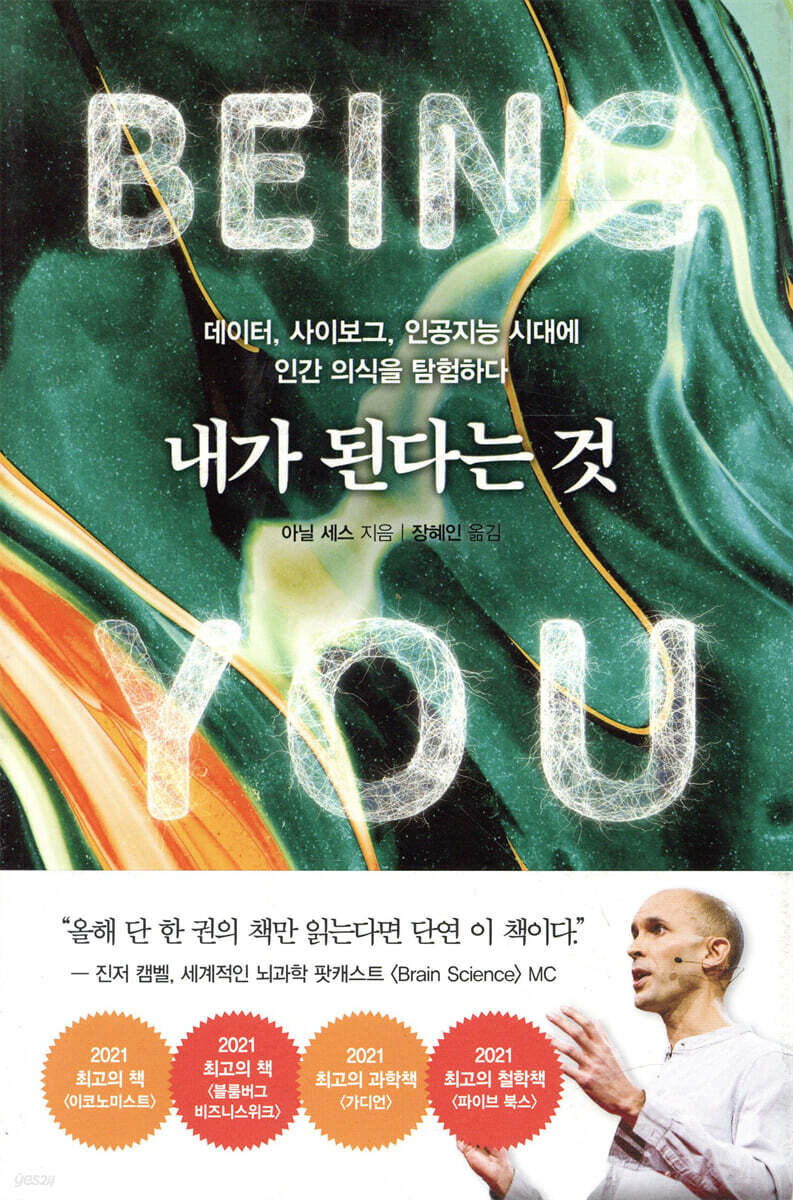
That I become
 |
Description
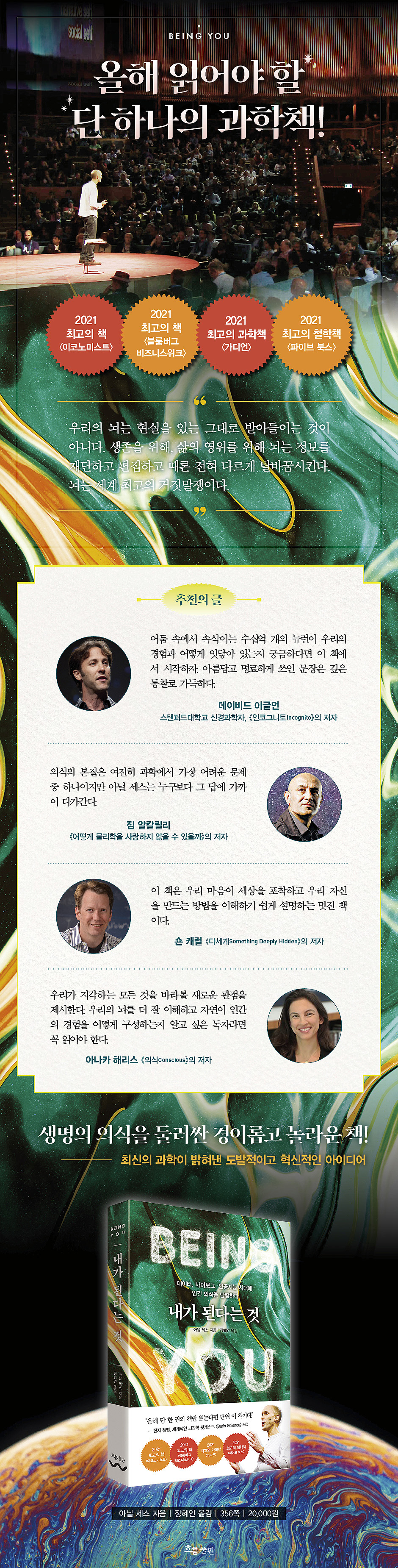
Book Introduction
{Best Books of 2021! (Bloomberg Businessweek)} {Best Science Book of 2021! (Financial Times)} The Best Science Books of 2021! (The Guardian) {The Best Philosophy Books of 2021! ([Five Books])} {Best Books of 2021! ([The Economist])} TED Talk 13 million views! On the topic of 'What is consciousness?' The most original and bold idea! The question, “What is consciousness?” is one of the core issues that neuroscience delves into today. Even today, with all the advancements in science, this topic remains a very abstract and mysterious area. Even consciousness is often considered a realm beyond science, beyond human understanding. "Becoming Me" is the latest work by world-renowned neuroscientist Anil Seth, who is praised for further expanding the horizons of consciousness science by approaching the subject of consciousness, which is considered mysterious and difficult, from a novel perspective. In 2017, his TED Talk on consciousness (https://www.ted.com/talks/anil_seth_your_brain_hallucinates_your_conscious_reality) generated such an enthusiastic response that it garnered over 13 million views, and this book can be seen as an expanded version of that popular TED Talk. One of the central messages that runs throughout this book is that our conscious experience of the external world and of ourselves is a brain-based prediction that occurs 'in', 'through', and 'because' of our living bodies. In other words, consciousness is not directly related to intelligence, which is a cognitive ability, but rather is more deeply related to the 'nature of being a living, breathing organism' (sensation). That is, the reason we can become conscious selves is because we are 'animal machines'. The essence of the self, or consciousness, lies not in the rational mind or the immaterial soul, but in the biological processes that support our sense of being alive. The experience or consciousness of 'being myself' is based on a living body and has a very material basis. Life is the root of consciousness. This book, "Becoming Me," contains not only novel perspectives on consciousness but also many interesting experiments being conducted in the field of consciousness science. If you are curious about the discourses taking place at the forefront of consciousness science, this is a must-read for general science students. |
- You can preview some of the book's contents.
Preview
index
Introduction
Part 1 Levels of Consciousness
Chapter 1: Real Problems
Chapter 2: Measurement of Consciousness
Chapter 3: Measurement of Consciousness, Pi
Part 2 Contents of the ritual
Chapter 4: Perceiving from the Inside Out
Chapter 5: The Wizard of Probability
Chapter 6: The Spectator's Share
Part 3 Self
Chapter 7 Delirium
Chapter 8 Self-Prediction
Chapter 9: Becoming an Animal Machine
Chapter 10: Fish in the Water
Chapter 11 Degrees of Freedom
Part 4 Other Things
Chapter 12 Beyond Humanity
Chapter 13: The Machine Mind
Conclusion
main
Part 1 Levels of Consciousness
Chapter 1: Real Problems
Chapter 2: Measurement of Consciousness
Chapter 3: Measurement of Consciousness, Pi
Part 2 Contents of the ritual
Chapter 4: Perceiving from the Inside Out
Chapter 5: The Wizard of Probability
Chapter 6: The Spectator's Share
Part 3 Self
Chapter 7 Delirium
Chapter 8 Self-Prediction
Chapter 9: Becoming an Animal Machine
Chapter 10: Fish in the Water
Chapter 11 Degrees of Freedom
Part 4 Other Things
Chapter 12 Beyond Humanity
Chapter 13: The Machine Mind
Conclusion
main
Detailed image
Into the book
Measuring a person's level of consciousness is different from determining whether someone is awake or asleep.
The level of consciousness is different from physiological wakefulness.
Although consciousness and arousal are usually highly correlated, consciousness (awareness) and arousal (being awake) can be distinguished in several ways and do not follow the same biological basis.
For example, when we dream, we are semantically asleep, but we have rich and varied conscious experiences.
There are also tragic states such as a vegetative state, where a person in a vegetative state still cycles between sleep and wakefulness but shows no behavioral signs of conscious awareness.
The lights come on sometimes in the house, but it's like no one is there.
---From Chapter 2, “Measurement of Consciousness”
Imagine what it would be like to be that brain above your head, sealed in your skull, trying to figure out what's out there.
There is no light, no sound, no nothing.
There is only complete darkness and silence.
As the brain tries to form perception, it is bombarded with a constant barrage of electrical signals that are only indirectly connected to the objects of the outside world.
These sensory inputs are not labeled ('I come from coffee', 'I come from a tree', etc.).
None of the sensory modalities, such as vision, hearing, or touch, tells us where a particular sensory input comes from.
---From Chapter 4, 'Perceiving from the Inside to the Outside'
Action is inextricably linked to perception.
Action and perception are closely linked and determine and regulate each other.
Every action alters incoming sensory data, changing perception, and every perception helps guide action.
Perception is useless without action.
We perceive the world around us to act effectively, achieve our goals, and increase our chances of long-term survival.
We do not perceive the world as it is, but in a way that is useful to us.
---From Chapter 5, “The Wizard of Probability”
The self is not an immutable being that looks out at the world through the window of the eyes and controls the body like a pilot controls an airplane.
The experience of being me or being you is a densely woven set of neurally encoded predictions focused on perception itself, or more precisely, on the survival of our bodies.
This is all we need to become ourselves.
(…) We do not perceive ourselves in order to know ourselves, but in order to control ourselves.
---From Chapter 8, “Self-Prediction”
From this perspective, the very nature of living things as being made of flesh and blood, that is, the very essence of an organism, has clearly nothing to do with the existence of mind, consciousness, or soul (if such things exist).
Animals are animal machines.
In Descartes' view, mind and life are clearly distinguished, like thinking substance and extended substance.
Descartes was able to placate many of the potential casualties that could arise from viewing the mind from this perspective by emphasizing the special nature of human beings.
But now a dangerous door has opened.
If animals are animal machines, and if humans, who are apparently made of the same flesh and blood, cartilage, and bone, are also a type of animal, then surely the faculties of mind and reason can be explained in mechanical and physiological terms?
---From Chapter 9, “Becoming an Animal Machine”
The claim that only humans have consciousness seems strange and stubborn today.
But how can we really say how far the scope of consciousness can extend, and how different the inner universes of different animals might be? First, it's important to note that we can't determine whether an animal is conscious based on any ability that indicates it is.
The absence of language cannot be seen as evidence of the absence of consciousness.
So-called 'higher-order' cognitive abilities, such as metacognition, which is the ability to reflect on thoughts and perceptions, are also not evidence of consciousness.
If animals have consciousness, their consciousness is different from human consciousness, and in some cases very different.
---From Chapter 12, 'Beyond Humanity'
Every time science pushes us away from the center of things, it gives us more in return.
The Copernican revolution gave us the universe.
Over the past 100 years, astronomical discoveries have expanded beyond the limits of human imagination.
Charles Darwin's theory of evolution by natural selection gave us family, a connection to all other species, and an understanding of the power of deep time and evolutionary design.
And now the science of consciousness, and its subset of animal-machine theory, is destroying the last bastion of human exceptionalism—the assumption that our conscious minds are special—while also showing that human exceptionalism is deeply embedded in the broader patterns of nature.
(…) In this way, encountering the mystery of perception is and will remain a deeply personal journey.
What good is the science of consciousness if it does not give us a new perspective on our individual mental lives and the inner lives of those around us?
The level of consciousness is different from physiological wakefulness.
Although consciousness and arousal are usually highly correlated, consciousness (awareness) and arousal (being awake) can be distinguished in several ways and do not follow the same biological basis.
For example, when we dream, we are semantically asleep, but we have rich and varied conscious experiences.
There are also tragic states such as a vegetative state, where a person in a vegetative state still cycles between sleep and wakefulness but shows no behavioral signs of conscious awareness.
The lights come on sometimes in the house, but it's like no one is there.
---From Chapter 2, “Measurement of Consciousness”
Imagine what it would be like to be that brain above your head, sealed in your skull, trying to figure out what's out there.
There is no light, no sound, no nothing.
There is only complete darkness and silence.
As the brain tries to form perception, it is bombarded with a constant barrage of electrical signals that are only indirectly connected to the objects of the outside world.
These sensory inputs are not labeled ('I come from coffee', 'I come from a tree', etc.).
None of the sensory modalities, such as vision, hearing, or touch, tells us where a particular sensory input comes from.
---From Chapter 4, 'Perceiving from the Inside to the Outside'
Action is inextricably linked to perception.
Action and perception are closely linked and determine and regulate each other.
Every action alters incoming sensory data, changing perception, and every perception helps guide action.
Perception is useless without action.
We perceive the world around us to act effectively, achieve our goals, and increase our chances of long-term survival.
We do not perceive the world as it is, but in a way that is useful to us.
---From Chapter 5, “The Wizard of Probability”
The self is not an immutable being that looks out at the world through the window of the eyes and controls the body like a pilot controls an airplane.
The experience of being me or being you is a densely woven set of neurally encoded predictions focused on perception itself, or more precisely, on the survival of our bodies.
This is all we need to become ourselves.
(…) We do not perceive ourselves in order to know ourselves, but in order to control ourselves.
---From Chapter 8, “Self-Prediction”
From this perspective, the very nature of living things as being made of flesh and blood, that is, the very essence of an organism, has clearly nothing to do with the existence of mind, consciousness, or soul (if such things exist).
Animals are animal machines.
In Descartes' view, mind and life are clearly distinguished, like thinking substance and extended substance.
Descartes was able to placate many of the potential casualties that could arise from viewing the mind from this perspective by emphasizing the special nature of human beings.
But now a dangerous door has opened.
If animals are animal machines, and if humans, who are apparently made of the same flesh and blood, cartilage, and bone, are also a type of animal, then surely the faculties of mind and reason can be explained in mechanical and physiological terms?
---From Chapter 9, “Becoming an Animal Machine”
The claim that only humans have consciousness seems strange and stubborn today.
But how can we really say how far the scope of consciousness can extend, and how different the inner universes of different animals might be? First, it's important to note that we can't determine whether an animal is conscious based on any ability that indicates it is.
The absence of language cannot be seen as evidence of the absence of consciousness.
So-called 'higher-order' cognitive abilities, such as metacognition, which is the ability to reflect on thoughts and perceptions, are also not evidence of consciousness.
If animals have consciousness, their consciousness is different from human consciousness, and in some cases very different.
---From Chapter 12, 'Beyond Humanity'
Every time science pushes us away from the center of things, it gives us more in return.
The Copernican revolution gave us the universe.
Over the past 100 years, astronomical discoveries have expanded beyond the limits of human imagination.
Charles Darwin's theory of evolution by natural selection gave us family, a connection to all other species, and an understanding of the power of deep time and evolutionary design.
And now the science of consciousness, and its subset of animal-machine theory, is destroying the last bastion of human exceptionalism—the assumption that our conscious minds are special—while also showing that human exceptionalism is deeply embedded in the broader patterns of nature.
(…) In this way, encountering the mystery of perception is and will remain a deeply personal journey.
What good is the science of consciousness if it does not give us a new perspective on our individual mental lives and the inner lives of those around us?
---From the "Concluding Remarks"
Publisher's Review
The Guardian, Financial Times, The Economist, etc.
The best book on 'consciousness', praised by leading journals around the world!
What allows me to be myself? There are many answers depending on one's perspective, but the most common one is probably consciousness.
We experience the world and ourselves only when we are conscious, that is, when we are awake and aware of ourselves or things.
In short, conscious experience is our entire existence.
Without conscious experience, neither the world nor the self exists.
The question, “What is consciousness?” is one of the most central questions being addressed in neuroscience today.
However, even today, with all the advancement in science, the topic of consciousness remains a very abstract and mysterious area.
Even consciousness is considered a realm beyond science, beyond the comprehension of human perception.
This book, "Becoming Me," is the new work of world-renowned neuroscientist Anil Seth, who is praised for further expanding the horizons of consciousness science by approaching the topic of consciousness, which is considered incomprehensible and difficult, from a novel perspective.
His 2017 TED Talk on consciousness was a sensation, garnering over 13 million views, and Becoming Me is an expanded version of that sensational TED Talk.
The TED organizers who organized his talk at the time even praised Anil Seth as "the only person who can truly lead us to understand one of humanity's most profound mysteries."
"Becoming Me" was repeatedly named one of the best books of the year by leading media outlets around the world, including The Guardian, The Financial Times, The Economist, and Bloomberg Businessweek, in the year it was published (2021) thanks to its excellent and lucid explanation of consciousness.
Consciousness research today is following a similar trajectory to life research of the past.
Long ago, mankind considered life to be a mysterious thing that could not be explained scientifically.
Some people even thought that life was a realm governed by a divine being.
However, thanks to centuries of research by biologists, we now understand the properties of living systems and can elucidate and explain the mechanisms of life using the theories of physics and chemistry.
The same goes for consciousness.
The author predicts that if we begin to unravel consciousness by examining what happens within our brains and bodies, humanity will be able to find answers to the seemingly intractable problem of consciousness.
This book deals with the neuroscience of consciousness.
We explore how the inner universe of subjective experience is related to the biological and physical processes unfolding in the brain and body, and how this process can be used to explain the inner universe.
The topic of the neuroscience of consciousness has fascinated me throughout my research career, and now a glimmer of hope is beginning to emerge.
This faint light has already dramatically changed the way we think about the world and our conscious experience of living in it.
The way we think about consciousness affects every aspect of our lives.
The science of consciousness explains why there is something that tells us who we are, what it is to be me, what it is to be you, and what it is to be something.
This book attempts to explain the properties of consciousness in terms of brain and body mechanisms, thereby gradually revealing the profound metaphysical reasons for the existence of consciousness and the mystery of its mode of existence.
(- From 'Introductory Remarks')
The most practical yet bold look at consciousness!
“Our perception is actually a ‘controlled hallucination’
“It is the brain’s ‘best guess’ about the outside world or the inside of the body.”
《Becoming Me》 is composed of four parts.
Part 1, “Levels of Consciousness,” describes existing approaches to scientifically studying consciousness.
Here we examine the history of the question of how conscious someone or something can be and attempts to measure consciousness.
There are many approaches to explaining the relationship between consciousness (mind) and matter, including materialism, idealism, dualism, panpsychism, and mysticism. Anil Seth adopts the physicalism (idealism) perspective to approach the problem of consciousness.
According to the author, physicalism is the most honest and clear approach to explaining the science of consciousness, which can easily drift into abstract discourse, in a practical and productive way.
In this extension, the author sets the goal of consciousness science as explaining, predicting, and controlling the phenomenological properties of conscious experience.
Simply put, it is about finding out why certain conscious experiences occur in terms of the physical processes that occur in our brain and body.
Part 2, “The Content of Consciousness,” deals with what we are conscious of and when we are conscious.
For example, the visual information, sounds, smells, emotions, feelings, thoughts, and beliefs that make up our inner universe are included in the content of consciousness.
The content of consciousness refers to various perceptions that are brain-based interpretations of sensory signals that collectively constitute conscious experience.
External reality, independent of the mind, is filled with objects, people, and places with properties such as color, shape, and texture.
According to common wisdom, the senses serve as a kind of window that shows us the world.
That is, objects in the outside world and their characteristics are detected through the sense organs, the corresponding information is transmitted to the brain, and the brain reads this information through neural processes to form its own perception.
This perception guides us to decide what actions to take in the future and to act accordingly.
Up to this point, this is a widely accepted view on perception.
The very reason for this book's existence shines through in the following idea.
According to the author, what we perceive is not the nature of the object itself.
We do not experience the world as it is.
There is no light or sound inside the skull.
There is just constant electrical stimulation coming in.
To perceive what is outside, we must go through a process of inference using the given information.
Our brain combines various sensory signals and uses our predictions and prior knowledge of the outside world to come up with a 'best guess' as to what caused those electrical signals.
One of the central messages that runs throughout this book is that our conscious experience of the external world and of ourselves is a brain-based projection that occurs in, through, and because of our living bodies.
That is, the author's view is that the experiences we call consciousness are various forms of 'controlled hallucinations'.
Our cognitive functions rely far more on counter-intuitive cognitive predictions than on sensory signals coming into the brain from the outside world.
That is, we do not merely passively perceive the outside world, but actively create it.
The world we experience is created within us as much as it is received from the outside.
“It is through this that we can experience the world and ourselves
“It is experienced through a living body, and because there is a living body.”
Part 3, “Self,” focuses on the inner activity that occurs when consciousness arises, and deals with the diverse world of experiences that the conscious self evokes.
The conscious self is the unique experience of 'being me', which encompasses specific sensations felt in our bodies, first-person perspectives, unique memories or feelings, emotions, and the experience of free will.
Humans experience the self in various ways, such as the experience of owning a body (which can be understood as a kind of 'feeling alive'), the experience of a first-person perspective that perceives the world from a specific point of view (perspectival self), the experience of will to do something and the experience of being the cause of something (volitional self), the unique experiences of an individual that accumulate over time (narrative self), and the experience of how I see others who perceive me within a social network (social self).
These sensations can be disrupted by any number of triggers, which means that the experience of an integrated self is a fragile construct created by the brain.
According to the author, the concrete experience of self is also a controlled sensation created by the brain.
Part 4, "Other Things," explores the consciousness of other animals and the possibility of conscious machines, building on our understanding of human consciousness.
Here too, the author shatters our conventional wisdom about consciousness throughout the book.
For example, we tend to think that ‘consciousness = intelligence.’
However, according to the author, consciousness is not directly related to intelligence, which is a cognitive ability, but rather, consciousness is more deeply related to the 'nature of being a living, breathing organism.'
The traditional view, which dates back to Descartes in the 17th century and remains highly influential, holds that non-human animals lack a rational mind to guide their actions and therefore have no conscious self.
Animals are nothing more than 'animal machines', flesh-based automata that are incapable of contemplating their own existence.
The author challenges this idea.
According to him, we become conscious selves precisely because we are 'animal machines'.
The essence of self, or consciousness, lies not in the rational mind or the immaterial soul, but in the biological processes that support our sense of being alive.
The experience or consciousness of 'being myself', contrary to our stereotypes, is based on a living body and has a very material foundation.
Being alive, life is the root of consciousness.
From this perspective, the view that only humans have consciousness is a very wrong view that is extremely human exceptionalistic.
Human consciousness is only a very small part of the many consciousnesses that exist in nature.
In the same vein, no matter how advanced the level of robots and artificial intelligence becomes, it will not be easy for them to have the level of conscious experience and perception that humans have.
As we have seen, human experience and mental life arise from the essence of a biological organism that seeks to maintain itself.
At the end of the book, the author concludes his journey through the science of consciousness by leading us to realize a profound truth, something so obvious yet so sublime that we have forgotten.
The fact that we can experience a conscious self because we are 'animal machines with a body (animal machine theory)' is a realization that breaks down human exceptionalism, which holds that our consciousness is special and unique, while also showing that we are part of a larger nature.
As David Eagleman, one of the most renowned neuroscientists of our time, puts it, "If you're curious about how billions of neurons whispering in the dark connect to our experience, pick up this book."
Not only will you be able to access the latest experimental results from the forefront of consciousness science, you will also gain the philosophical insight that our inner universe (consciousness) is not something separate from nature, but rather a part of it.
The best book on 'consciousness', praised by leading journals around the world!
What allows me to be myself? There are many answers depending on one's perspective, but the most common one is probably consciousness.
We experience the world and ourselves only when we are conscious, that is, when we are awake and aware of ourselves or things.
In short, conscious experience is our entire existence.
Without conscious experience, neither the world nor the self exists.
The question, “What is consciousness?” is one of the most central questions being addressed in neuroscience today.
However, even today, with all the advancement in science, the topic of consciousness remains a very abstract and mysterious area.
Even consciousness is considered a realm beyond science, beyond the comprehension of human perception.
This book, "Becoming Me," is the new work of world-renowned neuroscientist Anil Seth, who is praised for further expanding the horizons of consciousness science by approaching the topic of consciousness, which is considered incomprehensible and difficult, from a novel perspective.
His 2017 TED Talk on consciousness was a sensation, garnering over 13 million views, and Becoming Me is an expanded version of that sensational TED Talk.
The TED organizers who organized his talk at the time even praised Anil Seth as "the only person who can truly lead us to understand one of humanity's most profound mysteries."
"Becoming Me" was repeatedly named one of the best books of the year by leading media outlets around the world, including The Guardian, The Financial Times, The Economist, and Bloomberg Businessweek, in the year it was published (2021) thanks to its excellent and lucid explanation of consciousness.
Consciousness research today is following a similar trajectory to life research of the past.
Long ago, mankind considered life to be a mysterious thing that could not be explained scientifically.
Some people even thought that life was a realm governed by a divine being.
However, thanks to centuries of research by biologists, we now understand the properties of living systems and can elucidate and explain the mechanisms of life using the theories of physics and chemistry.
The same goes for consciousness.
The author predicts that if we begin to unravel consciousness by examining what happens within our brains and bodies, humanity will be able to find answers to the seemingly intractable problem of consciousness.
This book deals with the neuroscience of consciousness.
We explore how the inner universe of subjective experience is related to the biological and physical processes unfolding in the brain and body, and how this process can be used to explain the inner universe.
The topic of the neuroscience of consciousness has fascinated me throughout my research career, and now a glimmer of hope is beginning to emerge.
This faint light has already dramatically changed the way we think about the world and our conscious experience of living in it.
The way we think about consciousness affects every aspect of our lives.
The science of consciousness explains why there is something that tells us who we are, what it is to be me, what it is to be you, and what it is to be something.
This book attempts to explain the properties of consciousness in terms of brain and body mechanisms, thereby gradually revealing the profound metaphysical reasons for the existence of consciousness and the mystery of its mode of existence.
(- From 'Introductory Remarks')
The most practical yet bold look at consciousness!
“Our perception is actually a ‘controlled hallucination’
“It is the brain’s ‘best guess’ about the outside world or the inside of the body.”
《Becoming Me》 is composed of four parts.
Part 1, “Levels of Consciousness,” describes existing approaches to scientifically studying consciousness.
Here we examine the history of the question of how conscious someone or something can be and attempts to measure consciousness.
There are many approaches to explaining the relationship between consciousness (mind) and matter, including materialism, idealism, dualism, panpsychism, and mysticism. Anil Seth adopts the physicalism (idealism) perspective to approach the problem of consciousness.
According to the author, physicalism is the most honest and clear approach to explaining the science of consciousness, which can easily drift into abstract discourse, in a practical and productive way.
In this extension, the author sets the goal of consciousness science as explaining, predicting, and controlling the phenomenological properties of conscious experience.
Simply put, it is about finding out why certain conscious experiences occur in terms of the physical processes that occur in our brain and body.
Part 2, “The Content of Consciousness,” deals with what we are conscious of and when we are conscious.
For example, the visual information, sounds, smells, emotions, feelings, thoughts, and beliefs that make up our inner universe are included in the content of consciousness.
The content of consciousness refers to various perceptions that are brain-based interpretations of sensory signals that collectively constitute conscious experience.
External reality, independent of the mind, is filled with objects, people, and places with properties such as color, shape, and texture.
According to common wisdom, the senses serve as a kind of window that shows us the world.
That is, objects in the outside world and their characteristics are detected through the sense organs, the corresponding information is transmitted to the brain, and the brain reads this information through neural processes to form its own perception.
This perception guides us to decide what actions to take in the future and to act accordingly.
Up to this point, this is a widely accepted view on perception.
The very reason for this book's existence shines through in the following idea.
According to the author, what we perceive is not the nature of the object itself.
We do not experience the world as it is.
There is no light or sound inside the skull.
There is just constant electrical stimulation coming in.
To perceive what is outside, we must go through a process of inference using the given information.
Our brain combines various sensory signals and uses our predictions and prior knowledge of the outside world to come up with a 'best guess' as to what caused those electrical signals.
One of the central messages that runs throughout this book is that our conscious experience of the external world and of ourselves is a brain-based projection that occurs in, through, and because of our living bodies.
That is, the author's view is that the experiences we call consciousness are various forms of 'controlled hallucinations'.
Our cognitive functions rely far more on counter-intuitive cognitive predictions than on sensory signals coming into the brain from the outside world.
That is, we do not merely passively perceive the outside world, but actively create it.
The world we experience is created within us as much as it is received from the outside.
“It is through this that we can experience the world and ourselves
“It is experienced through a living body, and because there is a living body.”
Part 3, “Self,” focuses on the inner activity that occurs when consciousness arises, and deals with the diverse world of experiences that the conscious self evokes.
The conscious self is the unique experience of 'being me', which encompasses specific sensations felt in our bodies, first-person perspectives, unique memories or feelings, emotions, and the experience of free will.
Humans experience the self in various ways, such as the experience of owning a body (which can be understood as a kind of 'feeling alive'), the experience of a first-person perspective that perceives the world from a specific point of view (perspectival self), the experience of will to do something and the experience of being the cause of something (volitional self), the unique experiences of an individual that accumulate over time (narrative self), and the experience of how I see others who perceive me within a social network (social self).
These sensations can be disrupted by any number of triggers, which means that the experience of an integrated self is a fragile construct created by the brain.
According to the author, the concrete experience of self is also a controlled sensation created by the brain.
Part 4, "Other Things," explores the consciousness of other animals and the possibility of conscious machines, building on our understanding of human consciousness.
Here too, the author shatters our conventional wisdom about consciousness throughout the book.
For example, we tend to think that ‘consciousness = intelligence.’
However, according to the author, consciousness is not directly related to intelligence, which is a cognitive ability, but rather, consciousness is more deeply related to the 'nature of being a living, breathing organism.'
The traditional view, which dates back to Descartes in the 17th century and remains highly influential, holds that non-human animals lack a rational mind to guide their actions and therefore have no conscious self.
Animals are nothing more than 'animal machines', flesh-based automata that are incapable of contemplating their own existence.
The author challenges this idea.
According to him, we become conscious selves precisely because we are 'animal machines'.
The essence of self, or consciousness, lies not in the rational mind or the immaterial soul, but in the biological processes that support our sense of being alive.
The experience or consciousness of 'being myself', contrary to our stereotypes, is based on a living body and has a very material foundation.
Being alive, life is the root of consciousness.
From this perspective, the view that only humans have consciousness is a very wrong view that is extremely human exceptionalistic.
Human consciousness is only a very small part of the many consciousnesses that exist in nature.
In the same vein, no matter how advanced the level of robots and artificial intelligence becomes, it will not be easy for them to have the level of conscious experience and perception that humans have.
As we have seen, human experience and mental life arise from the essence of a biological organism that seeks to maintain itself.
At the end of the book, the author concludes his journey through the science of consciousness by leading us to realize a profound truth, something so obvious yet so sublime that we have forgotten.
The fact that we can experience a conscious self because we are 'animal machines with a body (animal machine theory)' is a realization that breaks down human exceptionalism, which holds that our consciousness is special and unique, while also showing that we are part of a larger nature.
As David Eagleman, one of the most renowned neuroscientists of our time, puts it, "If you're curious about how billions of neurons whispering in the dark connect to our experience, pick up this book."
Not only will you be able to access the latest experimental results from the forefront of consciousness science, you will also gain the philosophical insight that our inner universe (consciousness) is not something separate from nature, but rather a part of it.
GOODS SPECIFICS
- Date of issue: June 30, 2022
- Page count, weight, size: 356 pages | 526g | 145*218*23mm
- ISBN13: 9788965965169
- ISBN10: 8965965160
You may also like
카테고리
korean


korean

![GQ KOREA Mark (Monthly): December [2025]](http://librairie.coreenne.fr/cdn/shop/files/8ef265dbbfbf186523ed75ba7319009d.jpg?v=1765340328&width=3840)


