

Things we know but don't know
 |
Description
Book Introduction
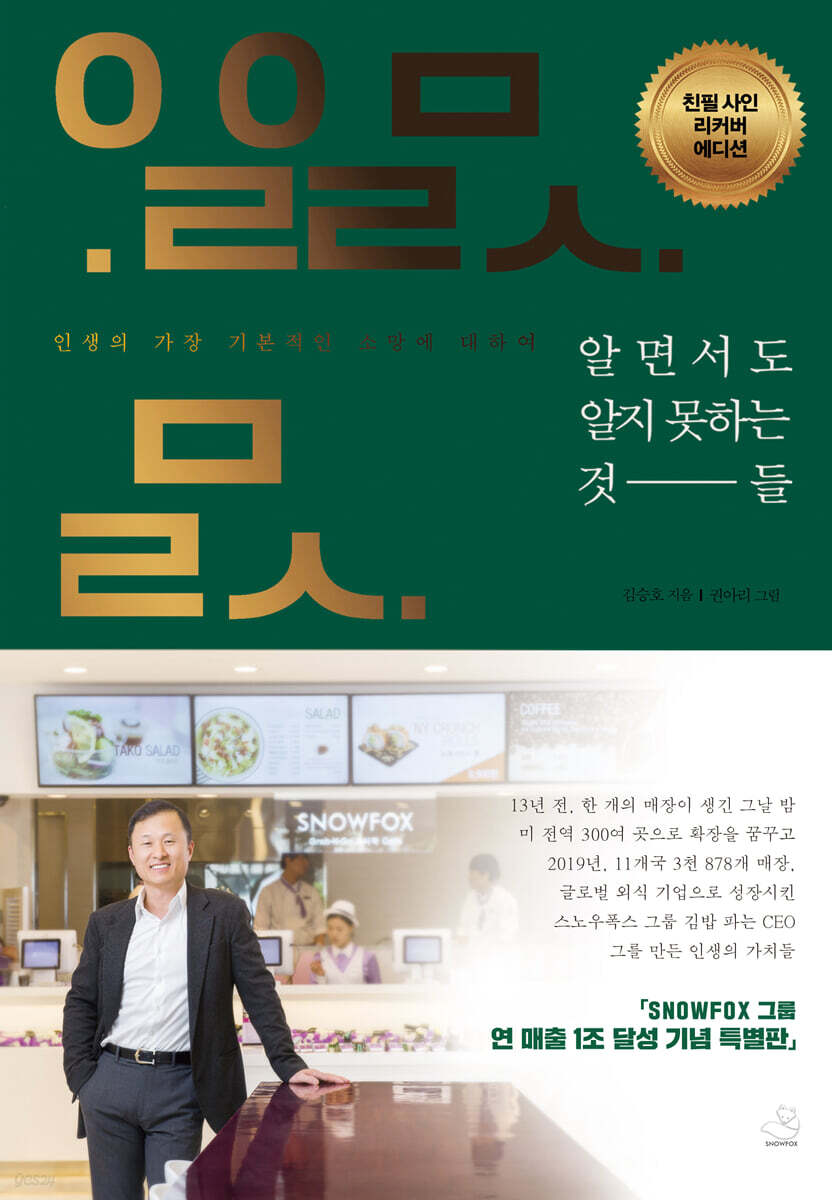
From poor immigrants to 8,308 employees, Annual sales of KRW 1 trillion in 2019, 3,878 stores in 11 countries Kim Seung-ho, the CEO of Kimbap, has become a super-rich man with personal assets of 600 billion won! Becoming the CEO of the world's largest lunchbox company Contains the wealth and philosophy of life that led him! Super-rich Kim Seung-ho, known for his works such as 'CEO Selling Kimbap', 'CEO Teaching CEOs', and 'Fair Trade Service Guide', has compiled the wealth and life wisdom he has learned and realized from his experiences of success and failure over the past 30 years into a single book. He immigrated to the United States with his family in 1987 and started a business with his father in a black neighborhood in Houston, Texas. However, as the eldest son of a poor immigrant family, the burden on the 23-year-old's shoulders was heavy. He tried various businesses, including a bedding store, a Korean grocery store, a local newspaper, and a computer assembly company, but failed in all of them. However, in 2019, he became the CEO of the world's number one lunchbox company. A small business started in 2005 has grown to 1,340 stores in the US, Europe, Australia, Korea, and other parts of the world, with annual sales reaching 350 billion won in just 10 years. This book, which contains lessons learned from diverse experiences of success and failure, as well as philosophies and thoughts on wealth, happiness, and life that have been pondered over for a long time, provides deep insight into the essence of work and life. His metaphors and directness about money, business, relationships, people, and society, such as 'Can't Money Buy Happiness?', 'To You Who Are Running a Fake Business', 'A New Person You've Met Is Like Freshly Baked Bread', 'Making a Compost Heap in Your Heart', and 'Just as You Have the Right to Success, You Have the Right to Failure', will become new proverbs for everyone. |
- You can preview some of the book's contents.
Preview
index
introduction
Chapter 1: The Path to Wealth
01 Can't money buy happiness?
02 How to increase your income tenfold
03 Measuring the Total Wealth You Will Have: Theory of the Numbers
04 Wealth is bestowed upon those who understand its properties.
05 Sweet Pain
06 My dream is to earn 10 billion won.
07 So what did you do? How long did you do it?
08 Risk Takers
Chapter 2 For those who want to start a business
01 The competitor has disappeared
02 My Service Creed as a CEO by Seungho Kim
03 To you who are running a fake business
04 Survive first, then do what you love.
05 When you entrust your money, shares, and trust to your spouse
06 How to view female colleagues
07 Why, How, What VS What, How, Why
08 Standing at the center of the controversy over bullying
Chapter 3: Living as a Beautiful Person and Remaining
01 A new person is like freshly baked bread
02 Ten Titles and One Mission
03 The Teacher's Dignity
04 On Solitude and Its Loneliness
05 Commonalities Between Fraud and Fake Teachers
06 Can Shy People Be Leaders?
07 You will fly to the highest place in the world
08 Do not submit to authority without reason.
Chapter 4: On a Life Together, a Little Loosely
01 Attitude towards life
02 In the end, we will remember the silence of our comrades.
03 Six Techniques for Living a Great Life
04 Creating a Compost Pile in Your Heart
05 Who are you with now?
06 The Power of Listening, That Great Ability
07 Uncomfortable aspects of Korean society
08 When you become bold in praise and criticism
09 Apologize for your mistakes and don't break anything.
10 Rudeness Disguised as Honesty
11 The Value of Good Deeds That Expect No Reward
Chapter 5: A Moment of Enlightenment at a Corner of Life
01 Humans resemble God, and ultimately humans are also gods.
02 Pungyeonsim
03 The poison that life gave me will one day become an antibiotic
04 Advice? Well
05 I became Kim Seung-ho even though I was never an extraordinary person.
06 Just as there is a right to success, there is also a right to failure.
07 To Eliminate or Control?
08 The Secret of Thought
09 If it's love after all
10 The Greatest Influence in the World: The Power of Goodness
11 Meet the best version of yourself
12 Living as the happiest person in the world
Chapter 6 Nature, following its pure laws
01 The world is never fair
02 When you pass a turning point in life
03 Moderation, knowing the right time
04 Nature, naturalness, just
05 Now that I'm over fifty years old
06 On time, in place, right then
07 Something went wrong with something that was going well until yesterday.
08 Now that I'm at an age where I don't have to like everyone,
09 Wuwei Yihua: You are already perfect
List of pictures
Chapter 1: The Path to Wealth
01 Can't money buy happiness?
02 How to increase your income tenfold
03 Measuring the Total Wealth You Will Have: Theory of the Numbers
04 Wealth is bestowed upon those who understand its properties.
05 Sweet Pain
06 My dream is to earn 10 billion won.
07 So what did you do? How long did you do it?
08 Risk Takers
Chapter 2 For those who want to start a business
01 The competitor has disappeared
02 My Service Creed as a CEO by Seungho Kim
03 To you who are running a fake business
04 Survive first, then do what you love.
05 When you entrust your money, shares, and trust to your spouse
06 How to view female colleagues
07 Why, How, What VS What, How, Why
08 Standing at the center of the controversy over bullying
Chapter 3: Living as a Beautiful Person and Remaining
01 A new person is like freshly baked bread
02 Ten Titles and One Mission
03 The Teacher's Dignity
04 On Solitude and Its Loneliness
05 Commonalities Between Fraud and Fake Teachers
06 Can Shy People Be Leaders?
07 You will fly to the highest place in the world
08 Do not submit to authority without reason.
Chapter 4: On a Life Together, a Little Loosely
01 Attitude towards life
02 In the end, we will remember the silence of our comrades.
03 Six Techniques for Living a Great Life
04 Creating a Compost Pile in Your Heart
05 Who are you with now?
06 The Power of Listening, That Great Ability
07 Uncomfortable aspects of Korean society
08 When you become bold in praise and criticism
09 Apologize for your mistakes and don't break anything.
10 Rudeness Disguised as Honesty
11 The Value of Good Deeds That Expect No Reward
Chapter 5: A Moment of Enlightenment at a Corner of Life
01 Humans resemble God, and ultimately humans are also gods.
02 Pungyeonsim
03 The poison that life gave me will one day become an antibiotic
04 Advice? Well
05 I became Kim Seung-ho even though I was never an extraordinary person.
06 Just as there is a right to success, there is also a right to failure.
07 To Eliminate or Control?
08 The Secret of Thought
09 If it's love after all
10 The Greatest Influence in the World: The Power of Goodness
11 Meet the best version of yourself
12 Living as the happiest person in the world
Chapter 6 Nature, following its pure laws
01 The world is never fair
02 When you pass a turning point in life
03 Moderation, knowing the right time
04 Nature, naturalness, just
05 Now that I'm over fifty years old
06 On time, in place, right then
07 Something went wrong with something that was going well until yesterday.
08 Now that I'm at an age where I don't have to like everyone,
09 Wuwei Yihua: You are already perfect
List of pictures
Detailed image
.jpg)
Into the book
I am a person who has experienced both failure and success.
Living in Korea and abroad, I have experienced completely different cultures and the extremes of poverty and wealth.
I've built and owned companies with one employee and thousands, and I've been through both good times and bad.
That's how I became one of the most successful people in the world.
Thanks to this, I was able to interact with many successful people in various fields and compare my own path to success with theirs.
And I found a lot of common ground and insight in it.
--- From the "Preface"
But just 12 years ago, I was just an immigrant, hauling apples in a Chevy box truck with no air conditioning, one arm outstretched in the 40-degree Texas sun.
Many self-made people I know are no different.
The difference is that we know how to do it effectively and successfully.
They are not simply people who have a desire to succeed, but rather people who have set specific goals and believe in themselves that they can achieve them, and who work tirelessly to achieve them.
--- From "Chapter 1: How to Increase Your Income Tenfold"
According to the company's analysis of the commercial district, the highest daily lunch box sales in the area was 1.5 million won.
It was a reasonable amount to lose.
Our sales goal to become self-sufficient was 2.5 million won, but our actual sales goal was 5 million won.
It was impossible to sell it for 5 million won when it was expected to be worth around 1.5 million won.
However, with the goal of satisfying even one customer who might come at any time, the store maintained 100% perfect display from the opening until just before closing.
When work was over, I disposed of all the products on the spot, more than the daily sales.
Most of the products were fresh, made just 30 minutes ago.
--- From "Chapter 2 Survive First, Then Do What You Love"
Actually, I think people with introverted personalities are more creative.
And I believe that people with that kind of disposition have the qualities of great leaders.
When an introvert becomes a leader and manages proactive subordinates, he or she knows how to accept and utilize their ideas.
On the other hand, extroverted managers tend to get excited about everything and take the lead in setting the tone, so they miss the opportunity to hear opinions from employees with different opinions.
Adam Grant of the Wharton School of the University of Pennsylvania has even published research showing that introverted leaders often produce better results than extroverts.
--- From "Chapter 3: Can Shy People Become Leaders?"
Unfortunately, too many people are ignorant and indifferent to politics and power.
People with power have the ability to make you do what they want.
Any objection or refusal can be punished by law and may even lead to moral bankruptcy.
It can also lead to financial ruin.
So we need to know who has the power to use this power.
We need to know how that power is operated and how it is inherited.
The result of this indifference and ignorance is that a very small number of people who understand power are happy.
And they only fight battles that they can win every time, changing the law according to their own purposes.
--- From "Chapter 4: In the end, we will remember the silence of our comrades"
Even after my business grew considerably, I continued to drive a used Ford F-150 pickup truck.
The employees drove BMWs that they were compensated for.
At the time, the pickup truck was embarrassing as the company was receiving criticism from those around it for being overly aggressive towards its employees.
But later, as his business prospered and he bought a large office building with cash, and no one around him could compare his wealth to, he began to brag about driving around in a battered truck.
I still drive a used truck sometimes.
You can buy a Porsche or an Aston Martin right now, so there's no reason to compete with anyone else.
--- From "Chapter 5: The Heart of Pungyeon"
In your 30s, running around is the place to be, and in your 40s, standing up and working is the place to be.
It is not right for a person in their 30s to sit like they are in their 50s or for a person in their 40s to lie down like they are in their 60s.
Conversely, it is not right for people in their 60s to run around like people in their 30s.
In your 20s and 30s, you should seek out teachers and seniors and work hard to find them. In your 40s, you should apply and practice what you have learned to build your own field.
Even though you're over forty, you still can't get started and are still wandering around, which means you're not in the right place at the right time.
Living in Korea and abroad, I have experienced completely different cultures and the extremes of poverty and wealth.
I've built and owned companies with one employee and thousands, and I've been through both good times and bad.
That's how I became one of the most successful people in the world.
Thanks to this, I was able to interact with many successful people in various fields and compare my own path to success with theirs.
And I found a lot of common ground and insight in it.
--- From the "Preface"
But just 12 years ago, I was just an immigrant, hauling apples in a Chevy box truck with no air conditioning, one arm outstretched in the 40-degree Texas sun.
Many self-made people I know are no different.
The difference is that we know how to do it effectively and successfully.
They are not simply people who have a desire to succeed, but rather people who have set specific goals and believe in themselves that they can achieve them, and who work tirelessly to achieve them.
--- From "Chapter 1: How to Increase Your Income Tenfold"
According to the company's analysis of the commercial district, the highest daily lunch box sales in the area was 1.5 million won.
It was a reasonable amount to lose.
Our sales goal to become self-sufficient was 2.5 million won, but our actual sales goal was 5 million won.
It was impossible to sell it for 5 million won when it was expected to be worth around 1.5 million won.
However, with the goal of satisfying even one customer who might come at any time, the store maintained 100% perfect display from the opening until just before closing.
When work was over, I disposed of all the products on the spot, more than the daily sales.
Most of the products were fresh, made just 30 minutes ago.
--- From "Chapter 2 Survive First, Then Do What You Love"
Actually, I think people with introverted personalities are more creative.
And I believe that people with that kind of disposition have the qualities of great leaders.
When an introvert becomes a leader and manages proactive subordinates, he or she knows how to accept and utilize their ideas.
On the other hand, extroverted managers tend to get excited about everything and take the lead in setting the tone, so they miss the opportunity to hear opinions from employees with different opinions.
Adam Grant of the Wharton School of the University of Pennsylvania has even published research showing that introverted leaders often produce better results than extroverts.
--- From "Chapter 3: Can Shy People Become Leaders?"
Unfortunately, too many people are ignorant and indifferent to politics and power.
People with power have the ability to make you do what they want.
Any objection or refusal can be punished by law and may even lead to moral bankruptcy.
It can also lead to financial ruin.
So we need to know who has the power to use this power.
We need to know how that power is operated and how it is inherited.
The result of this indifference and ignorance is that a very small number of people who understand power are happy.
And they only fight battles that they can win every time, changing the law according to their own purposes.
--- From "Chapter 4: In the end, we will remember the silence of our comrades"
Even after my business grew considerably, I continued to drive a used Ford F-150 pickup truck.
The employees drove BMWs that they were compensated for.
At the time, the pickup truck was embarrassing as the company was receiving criticism from those around it for being overly aggressive towards its employees.
But later, as his business prospered and he bought a large office building with cash, and no one around him could compare his wealth to, he began to brag about driving around in a battered truck.
I still drive a used truck sometimes.
You can buy a Porsche or an Aston Martin right now, so there's no reason to compete with anyone else.
--- From "Chapter 5: The Heart of Pungyeon"
In your 30s, running around is the place to be, and in your 40s, standing up and working is the place to be.
It is not right for a person in their 30s to sit like they are in their 50s or for a person in their 40s to lie down like they are in their 60s.
Conversely, it is not right for people in their 60s to run around like people in their 30s.
In your 20s and 30s, you should seek out teachers and seniors and work hard to find them. In your 40s, you should apply and practice what you have learned to build your own field.
Even though you're over forty, you still can't get started and are still wandering around, which means you're not in the right place at the right time.
---From "Chapter 6: On Time, in the Right Place, Right Then"
Publisher's Review
From how to become rich to life insights,
The ultimate guide to enriching your life
Have you made up your mind? What are your goals? What does success look like to you?
“Don’t worry about being slow, worry about stopping!”
It's rare for someone with a net worth of 400 billion won to talk about poverty and failure.
Most people who meet him ask him how to become rich and the secret to success in business.
The author answers this question as follows:
“Making money begins with making a decision and setting a goal.
People want to make a lot of money or be successful, but they don't have a specific plan.
“If you want to make money, you need to be clear about how much you want to make. If you want to be successful, you need to be clear about what that success looks like, including the type of job, income, and environment.” (p. 31)
Whenever the author gives lectures or interviews, he always emphasizes 'writing 100 times in 100 days.'
If you write down your specific goal 100 times a day for 100 days, your resolution will become stronger and you will be able to tell whether the goal is real or fake.
Among the numerous laws of success, the author prioritizes determination and goals, as explained by his extremely difficult past.
The Secret to Success: Learned from Seven Heartbreaking Business Failures
30 years ago, the author immigrated to the United States with his family without even graduating from college.
I had to do whatever it took to make a living, but I had no education, no possessions, and no one to help me.
I jumped into business without thinking and all the businesses I started over the past 20 years ended up failing.
If he had hesitated here, he would not have achieved the success he has now.
And just as poison can be used as medicine, I learned that failure can also have its uses.
“Every time you fail, the door to success opens.
“Because the reasons for failure are disappearing.” (p. 305)
The author decided to use his experiences of poverty and heartbreaking failure as medicine.
Then, the 8th opportunity to challenge came.
It was a business that made and sold kimbap in a corner of the supermarket food section.
When he opened his first store, he placed a map of America on his desk and marked 300 major cities.
I also changed my email password to '300 stores, weekly sales of one million dollars'.
Everyone laughed at him and said he was crazy, but he was sure.
By setting specific goals, we can now explore specific methods to achieve them.
After six years, he changed his password to '3,000 stores, annual sales of $1 billion.'
Because the goal was achieved.
If you think about it again and again, everything becomes a meaningful experience.
"Things You Know But Don't Know" is a dramatic success story of businessman Seungho Kim, one of the "10 Most Successful Koreans in America," and at the same time a "thought notebook" containing his insights into life in general.
The author believes so strongly in the power of thought that he calls himself a 'thinker.'
He thought and thought again, going back and forth between the extremes of success and failure, wealth and poverty.
Why did I fail and why did I succeed? What makes a respected leader? What does it mean to grow older? I reflected on money, business, family, happiness, death, happiness, and society, reflecting on all my experiences.
The thought made various experiences in life meaningful and gave me a new attitude toward life.
That is precisely why the author's message, though seemingly ordinary at first glance, contains extraordinary insight.
“Looking back, all the actions that led me to success were ordinary!”
Thought has allowed me to discover extraordinary wisdom in all ordinary things.
There is no one who does not know the importance of goals.
I also know that competition is necessary in business.
There is nothing special about the fact that there is learning from failure, or that the world is unfair.
But like nagging, all these stories, through the author's thoughts, sound like completely new guidelines for life.
For example, he says this about 'persistence':
“If an ordinary person has perseverance, he or she becomes extraordinary, and if an extraordinary person lacks perseverance, he or she becomes ordinary.
Persistence conquers all.
The world rewards those who know how to wait.
Opportunities always come back, but if you don't have persistence, you'll quit before you see them come back.
…If I were to ask what personal trait is most correlated with success in any field, I would naturally put perseverance first.” (pp. 74-75)
The author is a businessman with a busy schedule, but he visits Korea at least once or twice a month.
Because there are many people waiting for his lecture.
They come from a wide range of ages and social classes, including small business CEOs, aspiring startup CEOs, and college students and teenagers seeking to achieve their dreams.
The author speaks to these successful challengers.
Success comes when you embrace the ordinary as extraordinary.
Change your thinking!
"I wanted to leave my three sons a will that would require no further instruction."
The author became widely known in our society through Facebook and the media in 2015.
This is because he put up a poster titled ‘Fair Service Rights Guide’ in every Snowfox store he launched in Korea.
The content is that customers are not always kings, and if they are rude to employees, they will be kicked out.
This is something no company could have imagined.
The author believes that entrepreneurs can change the world through their businesses.
So, I took it upon myself to teach CEOs to develop well-intentioned businessmen.
His attitude is different not only in his mindset as an entrepreneur but also in all aspects of his life.
I have a consistent philosophy that extremely altruistic actions lead to extremely selfish outcomes, and that we should respect ourselves and not blindly submit to the authority of others.
Because people and people, and all things and all things are all connected, their influence returns like waves.
So, beyond respecting myself, I must also respect those around me.
The author put all his values into this one book.
The wisdom of work and life he imparts is clear and solid.
Believe in the power of thought, set specific goals, and never give up, your thoughts, words, and actions create your own destiny…
These are things that everyone knows but doesn't.
This is the secret to his success.
GOODS SPECIFICS
- Date of issue: January 10, 2017
- Page count, weight, size: 384 pages | 711g | 173*235*22mm
- ISBN13: 9791195963300
- ISBN10: 1195963300
You may also like
카테고리
korean


korean

![GQ KOREA Mark (Monthly): December [2025]](http://librairie.coreenne.fr/cdn/shop/files/8ef265dbbfbf186523ed75ba7319009d.jpg?v=1765340328&width=3840)


