

My heart was shaken, and I realized I was forty.
 |
Description
Book Introduction
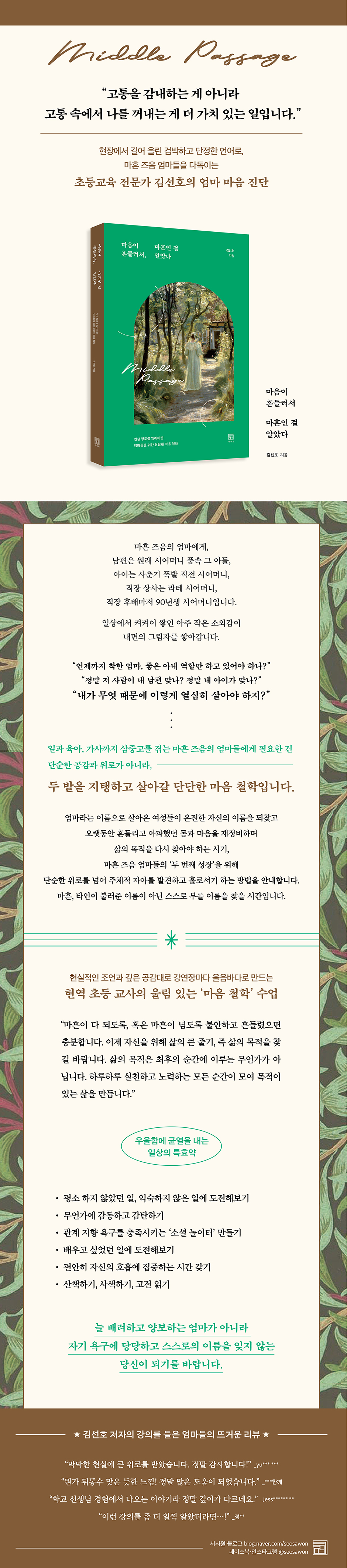
"Even moms need solitude sometimes." Elementary education expert Kim Seon-ho's assessment of Korean mothers' hearts With realistic advice and deep empathy Every lecture hall is filled with tears A resonant "philosophy of mind" class from a current elementary school teacher. “My physical strength is not what it used to be, and I feel pain here and there for no reason. When I suddenly feel sad about my daily life of being alone with my child, doing housework, It's not just your day It's something that happens to everyone around the age of forty. I want to tell you.” Author Kim Seon-ho, who has met countless children in educational settings over the past 15 years, discovered that children's psychological problems are closely connected to their mothers' inner selves. I decided that treating only the visible wounds without touching the child's fundamental psychology would only repeat the pattern of wounds, so I began to study the psychology of mothers. What mothers in their forties, who are going through the triple whammy of work, childcare, and housework, need is not simple empathy and comfort, but a strong mental philosophy that will allow them to stand on their own two feet and live. As the child enters elementary school and a few years pass, a mother's patience, willpower, and physical strength are almost completely exhausted. The reason why mothers feel that their children are increasingly less willing to listen to them after entering elementary school is because they no longer have the capacity to tolerate their children's tantrums. “The child opens the door to early adolescence, and the spouse keeps retreating into his own cave.” Then one day, I suddenly realize that I haven't achieved a single thing I had hoped for in my 40s. I have lived my life without any negligence, but I have not received any proper compensation or fulfillment. Above all, you realize that you cannot replace the time that has passed. In the midst of this sense of loss and depression, mothers in their forties rock like a ship that has lost its rudder. What should we do now? The author emphasizes that women who have lived under the name of "mother" must reclaim their true identities, reorganize their bodies and minds, which have long been shaken and aching, and rediscover their purpose in life. This book goes beyond simple comfort to guide mothers in their forties through their "second growth" by helping them discover their own independent selves and stand on their own two feet. Forty, it's time to find a name for yourself, not one given to you by others. |
- You can preview some of the book's contents.
Preview
index
prolog
The terrible loneliness has begun 08
Chapter 1.
Recognize
Forty: Unexpected Emotions
My body hurts 14
I haven't done anything by the time I'm forty. 22
Middle Passage 32
Sleeping in late 38
Divorce is not your fault 46
Chapter 2.
Introspection
It's time to find your path in life
54 Times I Need My Name
62 Times Your Relationship Needs Remodeling
Mother's Authority 70
Time to Cleanse Your Emotions 76
Time to Look at Shadows 84
90 between boredom and depression
98 Hours of Forgetting
Retrieving the projectile I threw 106
My mom has a lot of complexes 114
Playing with Your Inner Child 122
In Search of My Lost Mother 130
Chapter 3.
Face it
Forty, standing alone again
140 Not Assigning Meaning to Suffering
Self-Chosen Solitude 148
Creating Your Own Secret Place 156
Return to Me 164
There is no savior 170
Accepting Loss 178
Sending Off the Symbolic Guardian 186
Breaking Up with a Narcissist 194
Passion, How to Love Life 202
Actions toward a Purposeful Life 210
Chapter 4.
Forty Empathy Talk
Emergency Solutions for Moms
220 Wounds Mothers Receive from Their Children
230 Kids Who Want to Make Their Moms Angry
The Hostile Rebellious Child 239
How to Fight Well with Your Elementary School Child 249
259 Characteristics of Sixth Grade Children Every Forty-Year-Old Mom Should Know
Conflicts Between Parents Over Child Education 269
Concerns and Thoughts About an Only Child 280
Conflicts with other parents 290
The terrible loneliness has begun 08
Chapter 1.
Recognize
Forty: Unexpected Emotions
My body hurts 14
I haven't done anything by the time I'm forty. 22
Middle Passage 32
Sleeping in late 38
Divorce is not your fault 46
Chapter 2.
Introspection
It's time to find your path in life
54 Times I Need My Name
62 Times Your Relationship Needs Remodeling
Mother's Authority 70
Time to Cleanse Your Emotions 76
Time to Look at Shadows 84
90 between boredom and depression
98 Hours of Forgetting
Retrieving the projectile I threw 106
My mom has a lot of complexes 114
Playing with Your Inner Child 122
In Search of My Lost Mother 130
Chapter 3.
Face it
Forty, standing alone again
140 Not Assigning Meaning to Suffering
Self-Chosen Solitude 148
Creating Your Own Secret Place 156
Return to Me 164
There is no savior 170
Accepting Loss 178
Sending Off the Symbolic Guardian 186
Breaking Up with a Narcissist 194
Passion, How to Love Life 202
Actions toward a Purposeful Life 210
Chapter 4.
Forty Empathy Talk
Emergency Solutions for Moms
220 Wounds Mothers Receive from Their Children
230 Kids Who Want to Make Their Moms Angry
The Hostile Rebellious Child 239
How to Fight Well with Your Elementary School Child 249
259 Characteristics of Sixth Grade Children Every Forty-Year-Old Mom Should Know
Conflicts Between Parents Over Child Education 269
Concerns and Thoughts About an Only Child 280
Conflicts with other parents 290
Detailed image
Into the book
Around forty, suppressed emotions begin to surface.
The lock that locked the unconscious rattles, and as the rusty box opens, the weary inner self raises its head.
Your child is entering adolescence, and your partner is preparing to retreat into his or her own cave.
Each person looks at a different place.
When even the sympathy and comfort of others come across as empty, the best thing to do is to catch your breath and remain still.
Don't try to do anything, just sit there and watch yourself.
It takes courage to face your own pathetic self.
Although it is painful, I hope that you do not take this precious time lightly.
Now is the time to start standing on your own two feet.
It hurts a little, but it's just the time you needed.
--- p.9
By the time I was in my forties, I couldn't remember the last time I received a reward like this.
Unmet needs for rewards can pop up unexpectedly in unexpected places.
They may binge eat, stay up all night playing games, dream of forbidden relationships, or even resort to verbal or physical abuse against their children.
The psychology of compensation appears as a kind of 'revenge'.
Ironically, repeating retaliatory behavior in close relationships can actually lower your self-esteem.
Moreover, the gap between the 'me' I think I am and the 'me' in reality widens.
When the 'emptiness' from this gap becomes extreme, it leads to 'decompensation'.
--- p.24
I hope you don't remain a person who has to endure and cope between work and home.
The first step is to clearly understand where I stand and set boundaries.
Just stay away from anyone who tries to break down the boundaries you've created as a mother, and leave things outside those boundaries to them.
Then it becomes a little less difficult.
--- p.75
The mother is perplexed by her child's sudden change.
The more passionately a mother takes care of her child, the bigger and deeper the inner shadow becomes.
Working moms who struggle to juggle housework and work often feel overwhelmed by the weight of daily life when they return home from work and face a mountain of chores.
The feelings that I couldn't express in the gaze and tone of my husband's voice, which seemed to show little interest, suddenly burst into a torrent of tears in front of the coffee that my coworker casually handed me.
The very small feelings of alienation that pile up in our daily lives also thicken our inner shadows.
And then we are faced with the inevitable question:
“Why on earth, why do we have to live so hard?”
--- p.87
It's about changing just one very small part of the behavior you've been used to.
If you're addicted to the fun of drinking beer and watching Netflix every evening, try choosing a new beer instead of your usual favorite.
Of course, there is a high probability of failure.
It probably won't taste good.
At that moment, you may feel annoyed or regretful.
But the small ripples that that failure creates bring about change in the monotony of daily life.
The dynamic created by small changes shakes the stability of depression.
Sometimes irritation is a great remedy.
--- p.95
True independence begins when we recognize our lack and stop trying to fill that unfulfilled sense of loss, rather than trying to fill it with effort.
From then on, you become an adult who walks your own life.
Turning forty is a great time to stop trying to fill the void.
--- p.136
The tunnel around forty is deeper and darker than you think.
So, you should definitely have at least one small lantern to illuminate yourself.
At this time, what acts as a lantern is contemplation and meditation.
Listening to music that provides a moment of quiet can also help.
Even on the crowded subway, you can take a moment to reflect.
You can focus and immerse yourself in yourself while gazing at the scenery outside the window.
It is very helpful to develop the habit of quietly contemplating amidst the noise and bustle of people around you.
--- p.158
If you find yourself feeling strongly attached to someone around the age of forty, I encourage you to be skeptical.
Simply trying to distance yourself from someone with whom you have formed a strong attachment can help you grow closer to psychological independence.
Maybe it's something you've never thought about or imagined until you're in your forties.
But without even realizing it, we have been spending a lot of energy trying to narrow the distance between ourselves and our attachment relationships.
Because I knew it had to be that way, and I valued the unspoken agreement that we had to do everything together.
--- p.196
If it's difficult to keep a spatial distance, start by keeping a temporal distance.
If you can't be far away, try to minimize the time you spend together.
For example, one way is to come home as late as possible while learning something you've always wanted to learn.
Anything is fine.
I enrolled in an academy and studied hard until late at night.
You can go to the study room like a test taker and read books or study for a qualification.
But, it shouldn't be what the narcissists around you want.
I like to learn what I want with my own values and my own voice.
--- p.200
Now that I'm in my forties, I hope I don't find it difficult anymore.
Now that I'm in my forties, it's finally time to get started.
Anything is fine.
If you are admiring something, you are enjoying time loving yourself.
Are you ready to be amazed? I hope you don't delay the admiration of rediscovering your lost passion for the sake of your child.
The lock that locked the unconscious rattles, and as the rusty box opens, the weary inner self raises its head.
Your child is entering adolescence, and your partner is preparing to retreat into his or her own cave.
Each person looks at a different place.
When even the sympathy and comfort of others come across as empty, the best thing to do is to catch your breath and remain still.
Don't try to do anything, just sit there and watch yourself.
It takes courage to face your own pathetic self.
Although it is painful, I hope that you do not take this precious time lightly.
Now is the time to start standing on your own two feet.
It hurts a little, but it's just the time you needed.
--- p.9
By the time I was in my forties, I couldn't remember the last time I received a reward like this.
Unmet needs for rewards can pop up unexpectedly in unexpected places.
They may binge eat, stay up all night playing games, dream of forbidden relationships, or even resort to verbal or physical abuse against their children.
The psychology of compensation appears as a kind of 'revenge'.
Ironically, repeating retaliatory behavior in close relationships can actually lower your self-esteem.
Moreover, the gap between the 'me' I think I am and the 'me' in reality widens.
When the 'emptiness' from this gap becomes extreme, it leads to 'decompensation'.
--- p.24
I hope you don't remain a person who has to endure and cope between work and home.
The first step is to clearly understand where I stand and set boundaries.
Just stay away from anyone who tries to break down the boundaries you've created as a mother, and leave things outside those boundaries to them.
Then it becomes a little less difficult.
--- p.75
The mother is perplexed by her child's sudden change.
The more passionately a mother takes care of her child, the bigger and deeper the inner shadow becomes.
Working moms who struggle to juggle housework and work often feel overwhelmed by the weight of daily life when they return home from work and face a mountain of chores.
The feelings that I couldn't express in the gaze and tone of my husband's voice, which seemed to show little interest, suddenly burst into a torrent of tears in front of the coffee that my coworker casually handed me.
The very small feelings of alienation that pile up in our daily lives also thicken our inner shadows.
And then we are faced with the inevitable question:
“Why on earth, why do we have to live so hard?”
--- p.87
It's about changing just one very small part of the behavior you've been used to.
If you're addicted to the fun of drinking beer and watching Netflix every evening, try choosing a new beer instead of your usual favorite.
Of course, there is a high probability of failure.
It probably won't taste good.
At that moment, you may feel annoyed or regretful.
But the small ripples that that failure creates bring about change in the monotony of daily life.
The dynamic created by small changes shakes the stability of depression.
Sometimes irritation is a great remedy.
--- p.95
True independence begins when we recognize our lack and stop trying to fill that unfulfilled sense of loss, rather than trying to fill it with effort.
From then on, you become an adult who walks your own life.
Turning forty is a great time to stop trying to fill the void.
--- p.136
The tunnel around forty is deeper and darker than you think.
So, you should definitely have at least one small lantern to illuminate yourself.
At this time, what acts as a lantern is contemplation and meditation.
Listening to music that provides a moment of quiet can also help.
Even on the crowded subway, you can take a moment to reflect.
You can focus and immerse yourself in yourself while gazing at the scenery outside the window.
It is very helpful to develop the habit of quietly contemplating amidst the noise and bustle of people around you.
--- p.158
If you find yourself feeling strongly attached to someone around the age of forty, I encourage you to be skeptical.
Simply trying to distance yourself from someone with whom you have formed a strong attachment can help you grow closer to psychological independence.
Maybe it's something you've never thought about or imagined until you're in your forties.
But without even realizing it, we have been spending a lot of energy trying to narrow the distance between ourselves and our attachment relationships.
Because I knew it had to be that way, and I valued the unspoken agreement that we had to do everything together.
--- p.196
If it's difficult to keep a spatial distance, start by keeping a temporal distance.
If you can't be far away, try to minimize the time you spend together.
For example, one way is to come home as late as possible while learning something you've always wanted to learn.
Anything is fine.
I enrolled in an academy and studied hard until late at night.
You can go to the study room like a test taker and read books or study for a qualification.
But, it shouldn't be what the narcissists around you want.
I like to learn what I want with my own values and my own voice.
--- p.200
Now that I'm in my forties, I hope I don't find it difficult anymore.
Now that I'm in my forties, it's finally time to get started.
Anything is fine.
If you are admiring something, you are enjoying time loving yourself.
Are you ready to be amazed? I hope you don't delay the admiration of rediscovering your lost passion for the sake of your child.
--- p.208
Publisher's Review
To my mother in her forties
The shadow of the heart that comes unexpectedly
For elementary school mothers, there is more than just one mother-in-law.
“My husband is originally ‘the son in my mother-in-law’s arms,’ my child is ‘my mother-in-law on the verge of puberty,’ and my boss at work is ‘my mother-in-law who is late.’
Even my junior colleague at work is a 'mother-in-law born in 1990.' The small feelings of alienation that pile up in everyday life are building up an inner shadow.
As I try to understand and be considerate of others because they are my mother, wife, daughter, and daughter-in-law, I suddenly find myself facing the infinitely narrow space within me.
Because you put your own needs on the back burner while taking care of others.
In the mother's exhausted heart, there is an 'emptiness'.
The author suggests that mothers of elementary school-aged children entering early adolescence take time to reflect on their own life paths around the age of forty.
To do this, first recognize your inner turmoil and conflict (Chapter 1: Recognizing), and then give yourself a proper name (Chapter 2: Examining Yourself).
And it specifically explains how to properly establish your life purpose in your own name (Chapter 3 Facing It).
Now, it is time to face the shadow.
Until we recognize, diagnose, and confront it,
Psychology classes for moms
When you feel depressed for no apparent reason, suddenly feel angry, or suddenly feel sleepy or have trouble falling asleep, you should take a close look at the symptoms.
The reason loneliness becomes more intense for mothers as they reach the critical juncture of forty is because they are looking at their inner selves through the eyes of others.
I was so caught up in the expectations of those around me and the gaze of society that I couldn't even take care of my own body and mind.
I just pushed myself by saying things like, ‘Everyone lives like this,’ ‘Everyone says it’s hard,’ and ‘Let’s not be the only ones who act strangely.’
The inner self that has been suppressed for a long time becomes filled with ‘discomfort.’
Mothers who are unable to properly deal with this discomfort feel guilty and ashamed.
Then, she starts to scold her child for trivial things or complains to her husband.
This is because we 'project' the cause of our negative emotions onto the other person.
“If you want to recover the projectile you threw, you must first take care of yourself.
“Eat well, sleep well, soak in warm water, and take care of your inner self.”
When your body and mind are pushed beyond their limits, they become “like a stretched pen spring” and cannot return to their original position.
To maintain resilience, you need to look within yourself and give yourself the gift of 'solitude.'
You need to secure quiet time where you can be completely yourself without being disturbed by anyone.
As those quiet moments pile up, your own insights emerge like flashes of light.
The power of that insight allows us to discover and sustain our self.
Let's forget all those 'daily lists' of things to do, things to decide... and create some 'space' for ourselves.
Allow yourself to actively 'forget'.
“Creating the ‘self’ is not a process of proving oneself.
“It is a journey to shed the masks and names that have covered me and find the self that is buried deep down.”
The only way to stop a ship from rocking on the sea is to keep sailing.
Jump into things that excite you and excite you beyond measure.
Remodel the complex relationships that arise from marriage and raising children, and immerse yourself in contemplation and classic reading in your own 'hermitage.'
It's also a good idea to create your own social playground, like SNS, where your inner child can play to their heart's content, sharing writings and photos that express your inner self.
If there's something you've been wanting to learn for a long time, don't hesitate and just register.
And you learn as if you were buttoning the first button.
You never know what will happen next or what purpose it will give you in life.
An Emergency Prescription for Moms in Their Forties
Having a "no-loss fight" with a child who wants to upset their mother
“Mom, I don’t know anything.”
“Mom, I’m so frustrated.”
“What does Mom know how to do?”
A sweet child outside becomes a tyrant once he gets home.
He acts rudely towards his mother, talks back to her, and gets irritated easily over trivial matters.
Even if you scold the child, he or she is not afraid at all and instead feels threatened by the child.
The mother cares about the hurt she gives her child, but the child doesn't care at all.
Children unconsciously take out their anger on the person they feel safest with.
A mother who accepts and understands everything is the safest person for you.
The author advises that one should never engage in a 'fight without losing' with such a child.
“Children are more ‘innocent’ than you think.
In other words, it also means that it is that cruel.
“If Mom stays quiet, she thinks she can keep being rude.” Relationships that fight well are actually healthier relationships.
So it's important to fight properly.
To avoid an emotionally draining fight, you must remember the purpose and direction of the fight.
The first is to avoid becoming a tyrant child, and the second is to separate parents and children.
When fighting with a child, you must respond consistently using facial expressions, voice, and body language.
You have to deal with it without any reservations, like firmly saying “No!” and locking the gates of a high castle.
In addition, taking the initiative is important.
Children are the first movers and shakers.
They try to take the initiative by saying things like, “Mom, you don’t know how I feel.”
If the initiative is taken, the fight is as good as over.
Because my heart is shaken.
But there's no need to hesitate.
Even a mother cannot know everything about her child.
It's impossible.
There's never any need to be offended by a child asking for the impossible.
The reason this fight is so important is that the better parents fight with their children, the more likely the children will become adults who know how to face the world.
When a child does not have a guardian to fight for him, he remains just a spoiled child.
Parents who avoid conflict by saying, “Someday, the child will grow up and understand my feelings,” are like children who don’t know how to fight.
The moment you try to avoid a fight with your child, I hope you take a good look inside yourself.
“I think it would be better if the child would rather tell the parent openly, ‘I don’t want to do it.’
At least that kind of child is not a child who dreams of petty revenge and is happy.
I hope that children's curious energy is not wasted on dreams of revenge against their mothers.
“I hope my mother, who is in her forties, will not be in the position of having to take petty revenge.”
The shadow of the heart that comes unexpectedly
For elementary school mothers, there is more than just one mother-in-law.
“My husband is originally ‘the son in my mother-in-law’s arms,’ my child is ‘my mother-in-law on the verge of puberty,’ and my boss at work is ‘my mother-in-law who is late.’
Even my junior colleague at work is a 'mother-in-law born in 1990.' The small feelings of alienation that pile up in everyday life are building up an inner shadow.
As I try to understand and be considerate of others because they are my mother, wife, daughter, and daughter-in-law, I suddenly find myself facing the infinitely narrow space within me.
Because you put your own needs on the back burner while taking care of others.
In the mother's exhausted heart, there is an 'emptiness'.
The author suggests that mothers of elementary school-aged children entering early adolescence take time to reflect on their own life paths around the age of forty.
To do this, first recognize your inner turmoil and conflict (Chapter 1: Recognizing), and then give yourself a proper name (Chapter 2: Examining Yourself).
And it specifically explains how to properly establish your life purpose in your own name (Chapter 3 Facing It).
Now, it is time to face the shadow.
Until we recognize, diagnose, and confront it,
Psychology classes for moms
When you feel depressed for no apparent reason, suddenly feel angry, or suddenly feel sleepy or have trouble falling asleep, you should take a close look at the symptoms.
The reason loneliness becomes more intense for mothers as they reach the critical juncture of forty is because they are looking at their inner selves through the eyes of others.
I was so caught up in the expectations of those around me and the gaze of society that I couldn't even take care of my own body and mind.
I just pushed myself by saying things like, ‘Everyone lives like this,’ ‘Everyone says it’s hard,’ and ‘Let’s not be the only ones who act strangely.’
The inner self that has been suppressed for a long time becomes filled with ‘discomfort.’
Mothers who are unable to properly deal with this discomfort feel guilty and ashamed.
Then, she starts to scold her child for trivial things or complains to her husband.
This is because we 'project' the cause of our negative emotions onto the other person.
“If you want to recover the projectile you threw, you must first take care of yourself.
“Eat well, sleep well, soak in warm water, and take care of your inner self.”
When your body and mind are pushed beyond their limits, they become “like a stretched pen spring” and cannot return to their original position.
To maintain resilience, you need to look within yourself and give yourself the gift of 'solitude.'
You need to secure quiet time where you can be completely yourself without being disturbed by anyone.
As those quiet moments pile up, your own insights emerge like flashes of light.
The power of that insight allows us to discover and sustain our self.
Let's forget all those 'daily lists' of things to do, things to decide... and create some 'space' for ourselves.
Allow yourself to actively 'forget'.
“Creating the ‘self’ is not a process of proving oneself.
“It is a journey to shed the masks and names that have covered me and find the self that is buried deep down.”
The only way to stop a ship from rocking on the sea is to keep sailing.
Jump into things that excite you and excite you beyond measure.
Remodel the complex relationships that arise from marriage and raising children, and immerse yourself in contemplation and classic reading in your own 'hermitage.'
It's also a good idea to create your own social playground, like SNS, where your inner child can play to their heart's content, sharing writings and photos that express your inner self.
If there's something you've been wanting to learn for a long time, don't hesitate and just register.
And you learn as if you were buttoning the first button.
You never know what will happen next or what purpose it will give you in life.
An Emergency Prescription for Moms in Their Forties
Having a "no-loss fight" with a child who wants to upset their mother
“Mom, I don’t know anything.”
“Mom, I’m so frustrated.”
“What does Mom know how to do?”
A sweet child outside becomes a tyrant once he gets home.
He acts rudely towards his mother, talks back to her, and gets irritated easily over trivial matters.
Even if you scold the child, he or she is not afraid at all and instead feels threatened by the child.
The mother cares about the hurt she gives her child, but the child doesn't care at all.
Children unconsciously take out their anger on the person they feel safest with.
A mother who accepts and understands everything is the safest person for you.
The author advises that one should never engage in a 'fight without losing' with such a child.
“Children are more ‘innocent’ than you think.
In other words, it also means that it is that cruel.
“If Mom stays quiet, she thinks she can keep being rude.” Relationships that fight well are actually healthier relationships.
So it's important to fight properly.
To avoid an emotionally draining fight, you must remember the purpose and direction of the fight.
The first is to avoid becoming a tyrant child, and the second is to separate parents and children.
When fighting with a child, you must respond consistently using facial expressions, voice, and body language.
You have to deal with it without any reservations, like firmly saying “No!” and locking the gates of a high castle.
In addition, taking the initiative is important.
Children are the first movers and shakers.
They try to take the initiative by saying things like, “Mom, you don’t know how I feel.”
If the initiative is taken, the fight is as good as over.
Because my heart is shaken.
But there's no need to hesitate.
Even a mother cannot know everything about her child.
It's impossible.
There's never any need to be offended by a child asking for the impossible.
The reason this fight is so important is that the better parents fight with their children, the more likely the children will become adults who know how to face the world.
When a child does not have a guardian to fight for him, he remains just a spoiled child.
Parents who avoid conflict by saying, “Someday, the child will grow up and understand my feelings,” are like children who don’t know how to fight.
The moment you try to avoid a fight with your child, I hope you take a good look inside yourself.
“I think it would be better if the child would rather tell the parent openly, ‘I don’t want to do it.’
At least that kind of child is not a child who dreams of petty revenge and is happy.
I hope that children's curious energy is not wasted on dreams of revenge against their mothers.
“I hope my mother, who is in her forties, will not be in the position of having to take petty revenge.”
GOODS SPECIFICS
- Publication date: August 30, 2022
- Page count, weight, size: 304 pages | 410g | 135*210*16mm
- ISBN13: 9791168220911
- ISBN10: 1168220912
You may also like
카테고리
korean


korean

![ELLE 엘르 스페셜 에디션 A형 : 12월 [2025]](http://librairie.coreenne.fr/cdn/shop/files/b8e27a3de6c9538896439686c6b0e8fb.jpg?v=1766436872&width=3840)


