

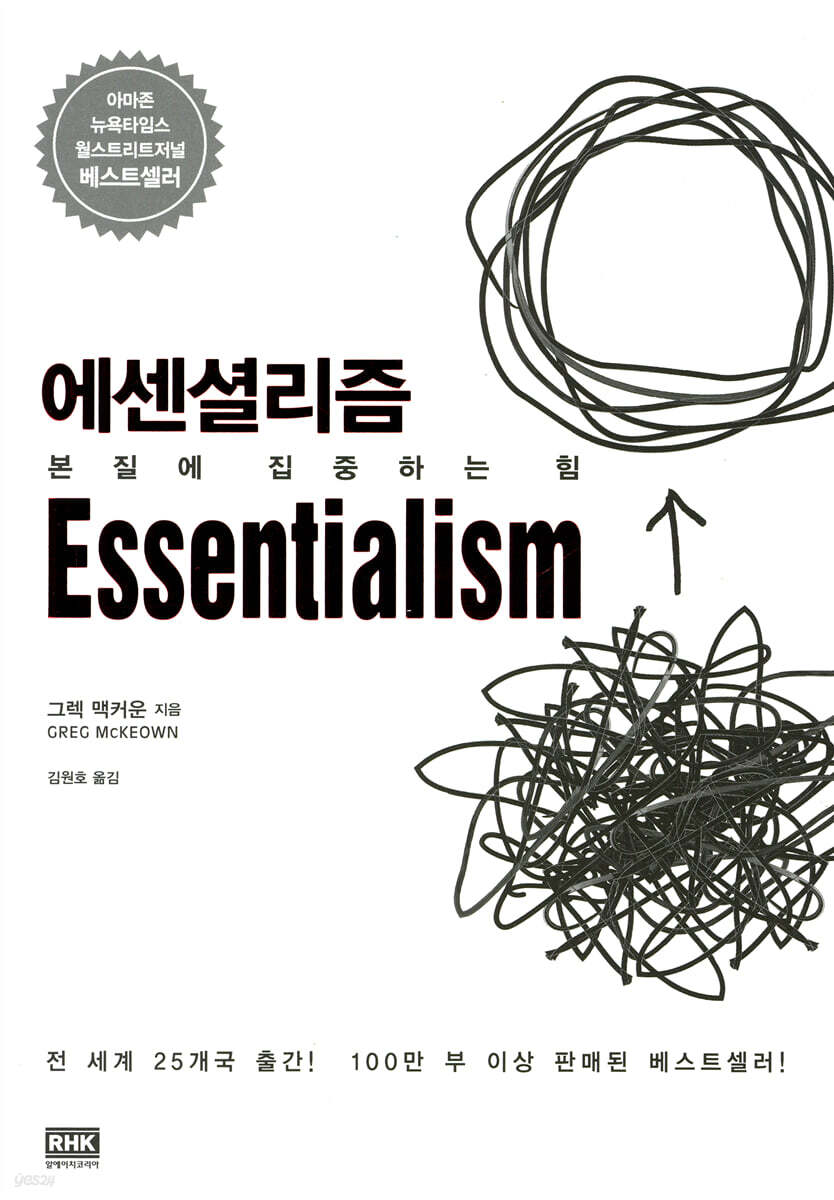
Essentialism
 |
Description
Book Introduction
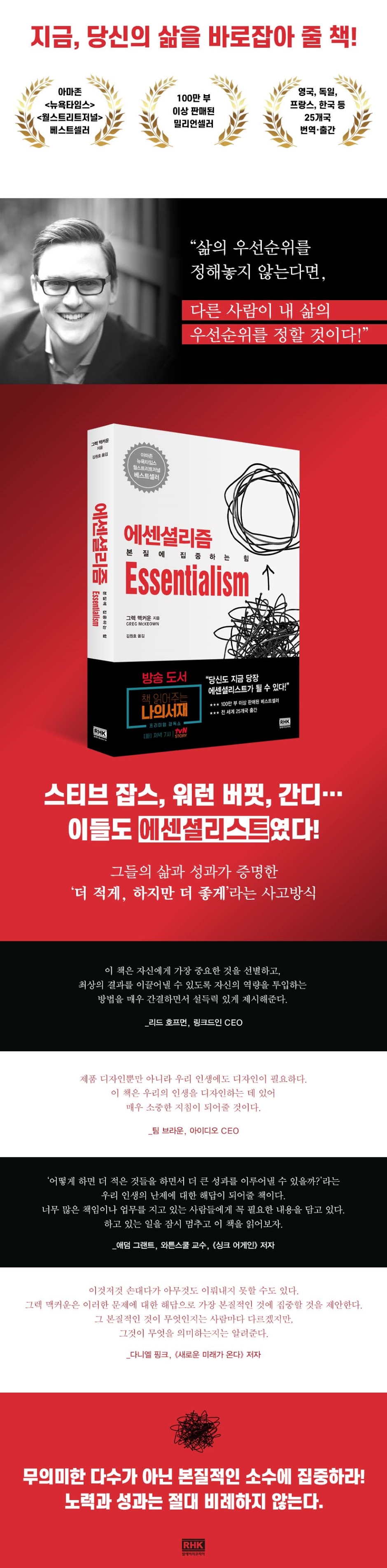
People who have achieved great success in their fields, such as Steve Jobs, Warren Buffett, and Gandhi, have one thing in common. They were 'essentialists' who practiced the 'less, but better' mindset in their work and lives. 『Essentialism』(original title: essentialism) raises the topic of 'essentialism', which pursues discerning minimization and focuses on the most essential goals. In an age like today's, where individuals are forced to make quick choices and where we are forced to fight the so-called war against speed, this book, as its title suggests, constantly poses more fundamental questions to us. “Are you investing your time and resources in the right, important things right now?” Author Greg McKeown, who received attention for his previous work, "Multipliers," which analyzed the characteristics of leaders who bring out the best in their organizations, freely moves between various fields of study, including management and psychology, to examine why such capable people make bad choices, select those that can lead to the greatest results, and present a systematic methodology for executing them while minimizing problems. Have you been spending too much time and energy on unproductive tasks today? Even when there's clearly more work to be done, have you been constantly taking on other tasks, ultimately failing to achieve the results you desire? If so, you need to become an "essentialist" right now. * Watch related videos Watch related videos |
- You can preview some of the book's contents.
Preview
index
Part 1: Essentialism
How do essentialists think?
Chapter 1: The Essentialist: A Person Who Selectively Does the Most Important Things
Chapter 2: Choose: The Incredible Power of Proactive Choice
Chapter 3: Distinguish: Only a Few Matter
Chapter 4: Balance: What Problems Can I Accept?
Evaluate Part 2
How can we distinguish essential primes?
Chapter 5: Create Space for Thought: The Amazing Gift of Leisure
Chapter 6: Look Deeper: Discover What Really Matters
Chapter 7: Play is Important: Awaken Your Inner Wisdom
Chapter 8: Get Enough Sleep: Protect Your Most Precious Asset
Chapter 9: Be Picky: Establish Firm Principles to Guide Your Judgments
Discard Part 3
Ways to Abandon the Nonessential Majority
Chapter 10: Be Clear: One Decision That Achieves a Thousand
Chapter 11: Take Courage: The Power of Refusal
Chapter 12: Stop What You Need to Stop: Win Bigger by Losing Now
Chapter 13: Become the Editor of Your Life: The Invisible Art
Chapter 14: Limiting the Boundaries: The Freedom That Comes
Running Part 4
Methods for pursuing essential minorities
Chapter 15: Build a Buffer: Considering Contingencies
Chapter 16: Eliminate Obstacles: Get More by Eliminating
Chapter 17: Moving Forward Little by Little: The Power of Small Victories
Chapter 18: Create Habits: Genius in Everyday Life
Chapter 19 Focus: What's Important Now?
Chapter 20: Becoming an Essentialist: Life as an Essentialist
Appendix: The Leadership of Essentialists Who Change the World
footnote
How do essentialists think?
Chapter 1: The Essentialist: A Person Who Selectively Does the Most Important Things
Chapter 2: Choose: The Incredible Power of Proactive Choice
Chapter 3: Distinguish: Only a Few Matter
Chapter 4: Balance: What Problems Can I Accept?
Evaluate Part 2
How can we distinguish essential primes?
Chapter 5: Create Space for Thought: The Amazing Gift of Leisure
Chapter 6: Look Deeper: Discover What Really Matters
Chapter 7: Play is Important: Awaken Your Inner Wisdom
Chapter 8: Get Enough Sleep: Protect Your Most Precious Asset
Chapter 9: Be Picky: Establish Firm Principles to Guide Your Judgments
Discard Part 3
Ways to Abandon the Nonessential Majority
Chapter 10: Be Clear: One Decision That Achieves a Thousand
Chapter 11: Take Courage: The Power of Refusal
Chapter 12: Stop What You Need to Stop: Win Bigger by Losing Now
Chapter 13: Become the Editor of Your Life: The Invisible Art
Chapter 14: Limiting the Boundaries: The Freedom That Comes
Running Part 4
Methods for pursuing essential minorities
Chapter 15: Build a Buffer: Considering Contingencies
Chapter 16: Eliminate Obstacles: Get More by Eliminating
Chapter 17: Moving Forward Little by Little: The Power of Small Victories
Chapter 18: Create Habits: Genius in Everyday Life
Chapter 19 Focus: What's Important Now?
Chapter 20: Becoming an Essentialist: Life as an Essentialist
Appendix: The Leadership of Essentialists Who Change the World
footnote
Detailed image
Into the book
How often have you accepted someone's request, only to find yourself resenting the hectic pace of the situation, wondering, "Why did I accept this?" How often have you simply accepted a request, fearing it might upset the other person or disrupt your relationship? Could it be that "Okay," is a hard-wired, automatic response to your thinking? _Page 15
Becoming an essentialist isn't just about saying no to more things, increasing the number of emails you delete from your inbox without reading them, or changing how you manage your time.
Being an essentialist means constantly asking yourself, “Am I investing my time and resources in the right things right now?”
Page 17
This book teaches you how to organize your life's closet.
Our life's closets should not be organized periodically, such as once a year, once a month, or once a week. Instead, we should organize them regularly, judging whether to accept or reject tasks as they arise.
And in this process, we must learn to select only the truly important things from among the countless things that seem okay.
We should use our limited time in life more efficiently by choosing and practicing fewer, better things, and in this way, achieve the maximum results we can.
Pages 34-35
Essentialists are keen observers and listeners.
They are well aware of the reality that they cannot take in all the information, and they know how to look beyond the surface.
It is about understanding the meaning between the lines.
Hermione from the Harry Potter novels perfectly illustrates the essentialist way (Hermione in the novels is clearly not an essentialist, but she does illustrate the essentialist way in the following lines):
“Actually, I’m very analytical.
“I just pass over irrelevant details, and I don’t clearly perceive things that others pass over.” _Page 100
Among the papers published in the Harvard Business Review, there is one titled “Sleep Deprivation: The Performance Killer” by Professor Charles Zeisler.
The paper concludes that sleep deprivation hinders high performance, and Professor Zeisler likens sleep deprivation to excessive alcohol consumption.
According to him, not sleeping for 24 hours (staying up all night) or only sleeping for four or five hours a day for a week produces a level of lethargy equivalent to a blood alcohol level of 0.1 percent.
Page 126
The more clearly the organization's members recognize the organization's goals, the higher the individual and overall organizational performance.
On the other hand, when the organization's goals and the roles of its members are not clearly stated, members experience confusion, stress, frustration, and ultimately failure.
A vice president of a certain company even said in a firm tone:
“Clarity equals success.”
This is why the principle of "less, but better" is so useful in building successful organizations and living meaningful lives.
Pages 312-313
Becoming an essentialist isn't just about saying no to more things, increasing the number of emails you delete from your inbox without reading them, or changing how you manage your time.
Being an essentialist means constantly asking yourself, “Am I investing my time and resources in the right things right now?”
Page 17
This book teaches you how to organize your life's closet.
Our life's closets should not be organized periodically, such as once a year, once a month, or once a week. Instead, we should organize them regularly, judging whether to accept or reject tasks as they arise.
And in this process, we must learn to select only the truly important things from among the countless things that seem okay.
We should use our limited time in life more efficiently by choosing and practicing fewer, better things, and in this way, achieve the maximum results we can.
Pages 34-35
Essentialists are keen observers and listeners.
They are well aware of the reality that they cannot take in all the information, and they know how to look beyond the surface.
It is about understanding the meaning between the lines.
Hermione from the Harry Potter novels perfectly illustrates the essentialist way (Hermione in the novels is clearly not an essentialist, but she does illustrate the essentialist way in the following lines):
“Actually, I’m very analytical.
“I just pass over irrelevant details, and I don’t clearly perceive things that others pass over.” _Page 100
Among the papers published in the Harvard Business Review, there is one titled “Sleep Deprivation: The Performance Killer” by Professor Charles Zeisler.
The paper concludes that sleep deprivation hinders high performance, and Professor Zeisler likens sleep deprivation to excessive alcohol consumption.
According to him, not sleeping for 24 hours (staying up all night) or only sleeping for four or five hours a day for a week produces a level of lethargy equivalent to a blood alcohol level of 0.1 percent.
Page 126
The more clearly the organization's members recognize the organization's goals, the higher the individual and overall organizational performance.
On the other hand, when the organization's goals and the roles of its members are not clearly stated, members experience confusion, stress, frustration, and ultimately failure.
A vice president of a certain company even said in a firm tone:
“Clarity equals success.”
This is why the principle of "less, but better" is so useful in building successful organizations and living meaningful lives.
Pages 312-313
--- From the text
Publisher's Review
Steve Jobs, Warren Buffett, Gandhi…
The common denominator among people who achieve great things: essentialism!
Have you ever washed and returned a rental car? Or perhaps you have clothes in your closet that haven't been worn for years? This is the so-called endowment effect.
People tend to place a higher value on things they own than they actually do, and a lower value on things they don't.
Clothes you don't wear pile up haphazardly and quickly make your closet a mess.
But this isn't just a story about the closet.
The same goes for our daily lives.
People who have achieved great success in their fields, such as Steve Jobs, Warren Buffett, and Gandhi, have one thing in common.
They were 'essentialists' who practiced the 'less, but better' mindset in their work and lives.
It seems like he was a master at organizing his life's closet.
『Essentialism』(original title: essentialism) raises the topic of 'essentialism', which pursues discerning minimization and focuses on the most essential goals.
In an age like today's, where individuals are forced to make quick choices and where we are forced to fight the so-called war against speed, this book, as its title suggests, constantly poses more fundamental questions to us.
“Are you investing your time and resources in the right, important things right now?”
Author Greg McKeown, who received attention for his previous work, "Multipliers," which analyzed the characteristics of leaders who bring out the best in their organizations, freely moves between various fields of study, including management and psychology, to examine why such capable people make bad choices, select those that can lead to the greatest results, and present a systematic methodology for executing them while minimizing problems.
Have you been spending too much time and energy on unproductive tasks today? Even when there's clearly more work to be done, have you been constantly taking on other tasks, ultimately failing to achieve the results you desire? If so, you need to become an "essentialist" right now.
Decision fatigue amidst too many choices
Why One Success Can Be a Catalyst for Subsequent Failures
This book is divided into four parts.
Part 1 introduces the essential mindset that those who want to become essentialists should have, and Parts 2-4 cover the three methodologies that essentialists use to approach work: evaluating what is essential and what is nonessential, effectively discarding what is nonessential, and executing this in a way that leads to the greatest results.
Becoming an essentialist isn't just about saying no to more things, increasing the number of emails you delete from your inbox without reading them, or changing how you manage your time.
So, in today's society, where desire and opportunity are at the forefront, how can we focus on what matters most and achieve greater results?
Peter Drucker once said that the most important phenomenon that future historians will notice is not new technologies or the Internet, but the unprecedented and rapid change in the human condition.
Because of this, we are faced with so many choices that we lose the ability to judge what is truly important to us.
Some psychologists apply the concept of "judgment fatigue" to this situation: the more judgments we have to make, the lower the quality of our judgments.
Another thing we must be more wary of is the idea that we can do anything.
Let's say you're lucky and have one success.
But most people too easily fall into what I call the "paradox of success."
Step 1: Achieve significant success by working hard with a strong will and goal to succeed.
Step 2: As you build a reputation as someone who can be "trusted" to do things, you'll be given more work, resources, and opportunities.
Step 3: You invest time and effort into getting more work done, but ultimately your time and effort are diverted.
Step 4: Lack of time prevents you from doing things that could make a significant contribution or lead to results.
In short, the initial success creates a situation that ultimately hinders success.
This is why initial success is relatively easy, but sustained success is difficult.
To avoid falling into this paradox of success, we must have a clear sense of purpose and continuously distinguish and discard non-essential things.
Filtering out the valuable from the noise of life
How can we achieve more while pursuing less?
Lincoln said, “If you give me six hours to chop down a tree, I will spend four sharpening the axe.”
Essentialists spend as much time as possible examining, listening to, discussing, questioning, and reflecting on the opportunities presented to them before undertaking any significant undertaking.
It is about providing sufficient time for thinking and preparation before taking action.
Non-essentialists, on the other hand, jump at any opportunity and try to reply to the email they just received.
But we should focus on the very few opportunities that can lead to maximum results, rather than on the vast number of good opportunities.
That's why this book says we should simply pass up good opportunities and set more demanding standards by asking the following three questions:
"What motivates me most?" "What am I best at?" "Does this align with the values that people around the world hold important?"
One way to avoid the endowment effect, which I mentioned earlier as a major obstacle to essentialism, is to avoid asking, "How much is this worth?" and instead ask, "If this wasn't mine, how much would I pay for it?"
This same method can be applied to the opportunities and tasks given to us.
Instead of asking, “How much would I regret if I missed this opportunity?” ask, “If I missed this opportunity, how much would I be willing to sacrifice to get it back?”
Similarly, for work, ask yourself, “If I weren’t involved in this project, how much effort would I put into it?”
If you don't get to the bottom of it, the problem will keep repeating itself.
Canadian police departments dramatically reduce youth recidivism rates
Focusing on your essential goals allows you to accomplish important tasks effortlessly.
A police department in Richmond, Canada, issued a commendation notice after a juvenile recidivism rate reached 65 percent.
This was possible because one employee, Ward Clapham, raised a fundamental question: while strict supervision might temporarily reduce crime rates, it would not eradicate the root causes.
Instead of focusing on catching juveniles who commit crimes, they identify juveniles who do good deeds (like throwing trash in the trash can properly or wearing a helmet while riding a motorcycle), issue them certificates of appreciation, and offer them free admission to the movie theater or free pizza if they submit these certificates.
As a result, the program was able to effectively divert youth from the streets to positive places and away from crime, and after 10 years of operating the praise notice program, the local youth recidivism rate, which was over 60 percent, dropped to 8 percent.
When countless young people received praise for doing good deeds, they were motivated to continue doing good deeds, and as this atmosphere spread throughout the city, the crime rate naturally decreased.
This system of praise and rewards can be used not only in cities, but also in the workplace and at home.
For example, the author actually gave children a token for every 30 minutes they spent on their smartphones at home, and at the end of the week, if there were any tokens left, he paid them 50 cents per token.
And they gave children an additional token for every 30 minutes of reading time, which reportedly reduced the amount of time they spent on television or smartphones by 90 percent.
In addition, the book introduces various cases of finding solutions by approaching the essence of a problem through 'essentialism', citing examples such as swimmer Michael Phelps, Rosa Parks, who ignited the modern civil rights movement, and American high school rugby teams.
Preventing Obstacles with Buffer Strategy
To avoid the "planning fallacy," you need to add 50 percent more time than initially estimated.
Even if you identify your essential goals and put them into practice, obstacles are bound to arise.
To this end, the author says that such obstacles must be prevented with a 'buffer device'.
Most people tend to estimate how long a task will take longer than it actually will.
This phenomenon is called the 'planning fallacy', which refers to the tendency for people to estimate the time it will take to do something as shorter than it actually will take.
There are several reasons why the estimated time required is shorter, but one of them is social pressure.
One study found that when anonymity was guaranteed, people were significantly less likely to commit the "planning fallacy," making them more accurate at predicting how long a task would take. This suggests that while we have a fairly accurate idea of how long a task will take, we often find it difficult to honestly admit to others that it's taking a long time.
Whatever the reason, we often end up later than we said we would.
Like arriving late to meetings, submitting reports late, and paying bills late.
The stress that these situations cause is enormous, but paying just a little attention to buffers can greatly reduce this stress.
The author suggests that as a way to reduce the stress and various problems caused by planning errors, “plan any task or project by adding 50 percent more time than initially estimated.”
Today we live in a very fast-moving and complex world.
It's as if countless cars, each driven by a different driver, are speeding at 160 kilometers per hour, leaving only a few meters between themselves and the car in front and next to them.
If even one driver makes a slightly rash move, numerous cars will collide with each other.
There is absolutely no room for error.
That's why living and working today is so hard and causes so much stress.
The book emphasizes that these buffers are essential for minimizing stress, maintaining a healthy mind, and working efficiently.
People who have too much work and responsibility
Are you currently investing your time and energy in the right, important things?
We live in a society today where people are reluctant to say 'no'.
They are afraid that the other person will be disappointed or that they will be alienated from the organization.
But the book says that to become an essentialist, you first need to stop trying to do everything, stop trying to accommodate everyone's requests, and learn to say "yes" slowly and "no" quickly.
The concept of "essentialism," which suggests that we achieve far greater results by focusing on the "essential few" rather than the meaningless many, is a crucial and valuable concept in today's complex times, applicable to any area of our work and life.
For essentialists, focus isn't just about pouring energy into something, it's about continually exploring its possibilities.
The reason I keep listening to the author's arguments is because he keeps touching on the essential meaning of the ordinary things we pass by.
This is a must-read for anyone who struggles with overwhelming workloads and the pressures they face, feeling overwhelmed by the need to do everything perfectly.
The common denominator among people who achieve great things: essentialism!
Have you ever washed and returned a rental car? Or perhaps you have clothes in your closet that haven't been worn for years? This is the so-called endowment effect.
People tend to place a higher value on things they own than they actually do, and a lower value on things they don't.
Clothes you don't wear pile up haphazardly and quickly make your closet a mess.
But this isn't just a story about the closet.
The same goes for our daily lives.
People who have achieved great success in their fields, such as Steve Jobs, Warren Buffett, and Gandhi, have one thing in common.
They were 'essentialists' who practiced the 'less, but better' mindset in their work and lives.
It seems like he was a master at organizing his life's closet.
『Essentialism』(original title: essentialism) raises the topic of 'essentialism', which pursues discerning minimization and focuses on the most essential goals.
In an age like today's, where individuals are forced to make quick choices and where we are forced to fight the so-called war against speed, this book, as its title suggests, constantly poses more fundamental questions to us.
“Are you investing your time and resources in the right, important things right now?”
Author Greg McKeown, who received attention for his previous work, "Multipliers," which analyzed the characteristics of leaders who bring out the best in their organizations, freely moves between various fields of study, including management and psychology, to examine why such capable people make bad choices, select those that can lead to the greatest results, and present a systematic methodology for executing them while minimizing problems.
Have you been spending too much time and energy on unproductive tasks today? Even when there's clearly more work to be done, have you been constantly taking on other tasks, ultimately failing to achieve the results you desire? If so, you need to become an "essentialist" right now.
Decision fatigue amidst too many choices
Why One Success Can Be a Catalyst for Subsequent Failures
This book is divided into four parts.
Part 1 introduces the essential mindset that those who want to become essentialists should have, and Parts 2-4 cover the three methodologies that essentialists use to approach work: evaluating what is essential and what is nonessential, effectively discarding what is nonessential, and executing this in a way that leads to the greatest results.
Becoming an essentialist isn't just about saying no to more things, increasing the number of emails you delete from your inbox without reading them, or changing how you manage your time.
So, in today's society, where desire and opportunity are at the forefront, how can we focus on what matters most and achieve greater results?
Peter Drucker once said that the most important phenomenon that future historians will notice is not new technologies or the Internet, but the unprecedented and rapid change in the human condition.
Because of this, we are faced with so many choices that we lose the ability to judge what is truly important to us.
Some psychologists apply the concept of "judgment fatigue" to this situation: the more judgments we have to make, the lower the quality of our judgments.
Another thing we must be more wary of is the idea that we can do anything.
Let's say you're lucky and have one success.
But most people too easily fall into what I call the "paradox of success."
Step 1: Achieve significant success by working hard with a strong will and goal to succeed.
Step 2: As you build a reputation as someone who can be "trusted" to do things, you'll be given more work, resources, and opportunities.
Step 3: You invest time and effort into getting more work done, but ultimately your time and effort are diverted.
Step 4: Lack of time prevents you from doing things that could make a significant contribution or lead to results.
In short, the initial success creates a situation that ultimately hinders success.
This is why initial success is relatively easy, but sustained success is difficult.
To avoid falling into this paradox of success, we must have a clear sense of purpose and continuously distinguish and discard non-essential things.
Filtering out the valuable from the noise of life
How can we achieve more while pursuing less?
Lincoln said, “If you give me six hours to chop down a tree, I will spend four sharpening the axe.”
Essentialists spend as much time as possible examining, listening to, discussing, questioning, and reflecting on the opportunities presented to them before undertaking any significant undertaking.
It is about providing sufficient time for thinking and preparation before taking action.
Non-essentialists, on the other hand, jump at any opportunity and try to reply to the email they just received.
But we should focus on the very few opportunities that can lead to maximum results, rather than on the vast number of good opportunities.
That's why this book says we should simply pass up good opportunities and set more demanding standards by asking the following three questions:
"What motivates me most?" "What am I best at?" "Does this align with the values that people around the world hold important?"
One way to avoid the endowment effect, which I mentioned earlier as a major obstacle to essentialism, is to avoid asking, "How much is this worth?" and instead ask, "If this wasn't mine, how much would I pay for it?"
This same method can be applied to the opportunities and tasks given to us.
Instead of asking, “How much would I regret if I missed this opportunity?” ask, “If I missed this opportunity, how much would I be willing to sacrifice to get it back?”
Similarly, for work, ask yourself, “If I weren’t involved in this project, how much effort would I put into it?”
If you don't get to the bottom of it, the problem will keep repeating itself.
Canadian police departments dramatically reduce youth recidivism rates
Focusing on your essential goals allows you to accomplish important tasks effortlessly.
A police department in Richmond, Canada, issued a commendation notice after a juvenile recidivism rate reached 65 percent.
This was possible because one employee, Ward Clapham, raised a fundamental question: while strict supervision might temporarily reduce crime rates, it would not eradicate the root causes.
Instead of focusing on catching juveniles who commit crimes, they identify juveniles who do good deeds (like throwing trash in the trash can properly or wearing a helmet while riding a motorcycle), issue them certificates of appreciation, and offer them free admission to the movie theater or free pizza if they submit these certificates.
As a result, the program was able to effectively divert youth from the streets to positive places and away from crime, and after 10 years of operating the praise notice program, the local youth recidivism rate, which was over 60 percent, dropped to 8 percent.
When countless young people received praise for doing good deeds, they were motivated to continue doing good deeds, and as this atmosphere spread throughout the city, the crime rate naturally decreased.
This system of praise and rewards can be used not only in cities, but also in the workplace and at home.
For example, the author actually gave children a token for every 30 minutes they spent on their smartphones at home, and at the end of the week, if there were any tokens left, he paid them 50 cents per token.
And they gave children an additional token for every 30 minutes of reading time, which reportedly reduced the amount of time they spent on television or smartphones by 90 percent.
In addition, the book introduces various cases of finding solutions by approaching the essence of a problem through 'essentialism', citing examples such as swimmer Michael Phelps, Rosa Parks, who ignited the modern civil rights movement, and American high school rugby teams.
Preventing Obstacles with Buffer Strategy
To avoid the "planning fallacy," you need to add 50 percent more time than initially estimated.
Even if you identify your essential goals and put them into practice, obstacles are bound to arise.
To this end, the author says that such obstacles must be prevented with a 'buffer device'.
Most people tend to estimate how long a task will take longer than it actually will.
This phenomenon is called the 'planning fallacy', which refers to the tendency for people to estimate the time it will take to do something as shorter than it actually will take.
There are several reasons why the estimated time required is shorter, but one of them is social pressure.
One study found that when anonymity was guaranteed, people were significantly less likely to commit the "planning fallacy," making them more accurate at predicting how long a task would take. This suggests that while we have a fairly accurate idea of how long a task will take, we often find it difficult to honestly admit to others that it's taking a long time.
Whatever the reason, we often end up later than we said we would.
Like arriving late to meetings, submitting reports late, and paying bills late.
The stress that these situations cause is enormous, but paying just a little attention to buffers can greatly reduce this stress.
The author suggests that as a way to reduce the stress and various problems caused by planning errors, “plan any task or project by adding 50 percent more time than initially estimated.”
Today we live in a very fast-moving and complex world.
It's as if countless cars, each driven by a different driver, are speeding at 160 kilometers per hour, leaving only a few meters between themselves and the car in front and next to them.
If even one driver makes a slightly rash move, numerous cars will collide with each other.
There is absolutely no room for error.
That's why living and working today is so hard and causes so much stress.
The book emphasizes that these buffers are essential for minimizing stress, maintaining a healthy mind, and working efficiently.
People who have too much work and responsibility
Are you currently investing your time and energy in the right, important things?
We live in a society today where people are reluctant to say 'no'.
They are afraid that the other person will be disappointed or that they will be alienated from the organization.
But the book says that to become an essentialist, you first need to stop trying to do everything, stop trying to accommodate everyone's requests, and learn to say "yes" slowly and "no" quickly.
The concept of "essentialism," which suggests that we achieve far greater results by focusing on the "essential few" rather than the meaningless many, is a crucial and valuable concept in today's complex times, applicable to any area of our work and life.
For essentialists, focus isn't just about pouring energy into something, it's about continually exploring its possibilities.
The reason I keep listening to the author's arguments is because he keeps touching on the essential meaning of the ordinary things we pass by.
This is a must-read for anyone who struggles with overwhelming workloads and the pressures they face, feeling overwhelmed by the need to do everything perfectly.
GOODS SPECIFICS
- Date of issue: September 19, 2014
- Page count, weight, size: 336 pages | 560g | 150*218*20mm
- ISBN13: 9788925553375
- ISBN10: 8925553376
You may also like
카테고리
korean


korean

![ELLE 엘르 스페셜 에디션 A형 : 12월 [2025]](http://librairie.coreenne.fr/cdn/shop/files/b8e27a3de6c9538896439686c6b0e8fb.jpg?v=1766436872&width=3840)


