

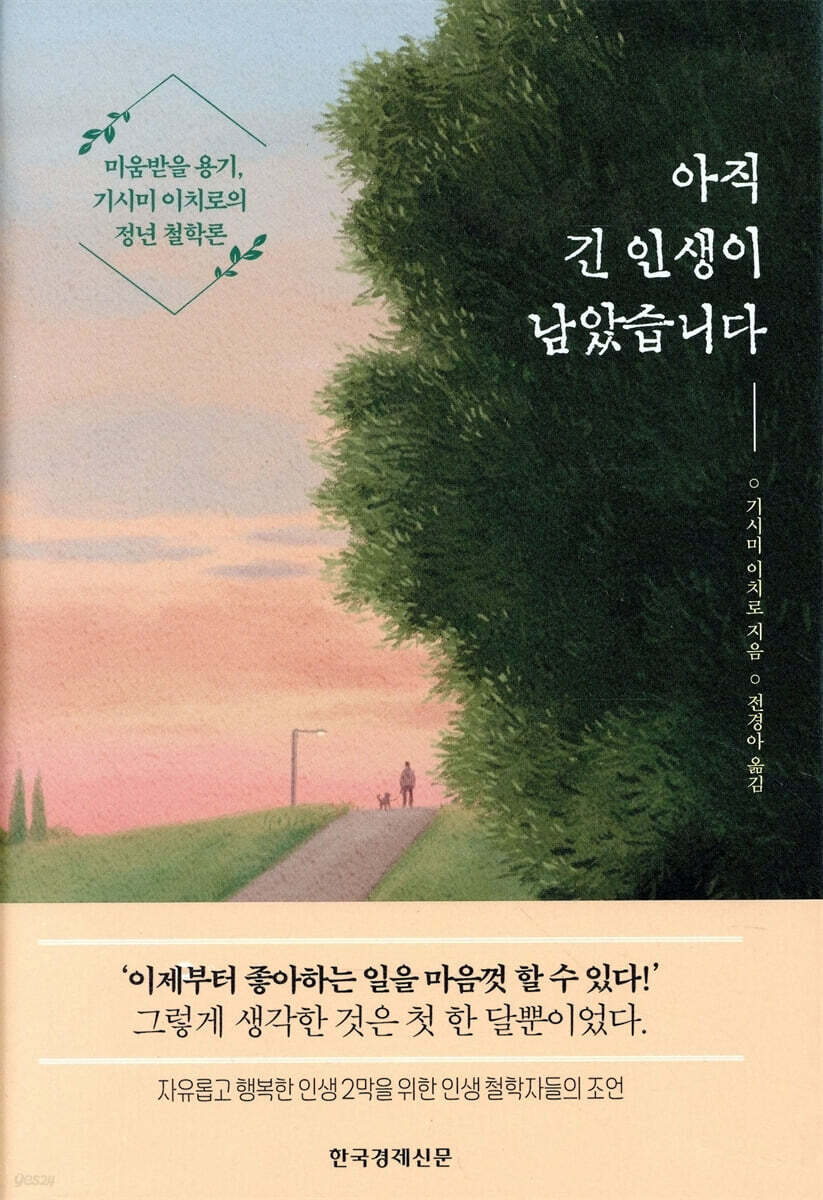
There's still a long life left
 |
Description
Book Introduction
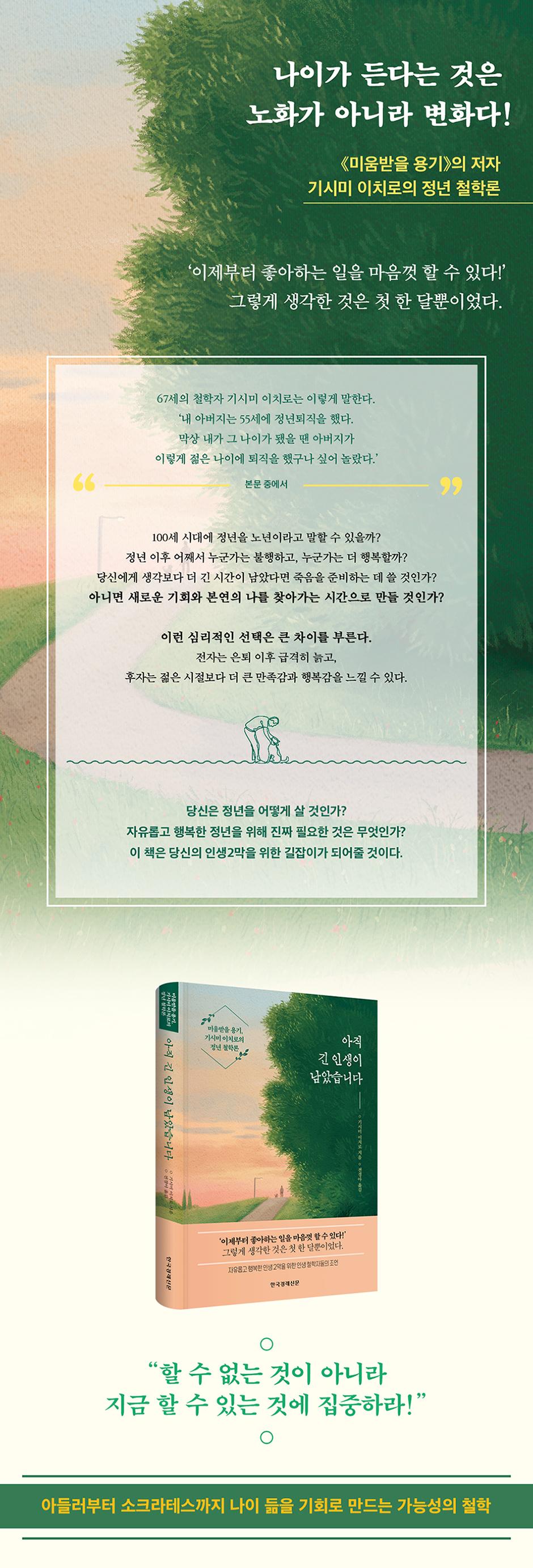
'From now on, I can do whatever I want!'
I only thought that way for the first month.
Ichiro Kishimi's Retirement Philosophy for a Freer and Happier Second Act of Life
In 2050, when people born in 1990 turn 60, the median age will be 60.
The distinction between middle age and old age also becomes meaningless.
Nevertheless, the perception of age remains stuck in the frame of '60 = retirement'.
But what if 60 is the median age? You might have at least a few decades left to live after retirement.
Despite the large gap between the perception of one's actual age and reality, some people spend their remaining years trapped in the frame of old age.
On the other hand, some people, despite being the same age, live more actively and freely after retirement than when they were younger.
Where does the difference come from?
This book begins with these questions and argues that life after retirement is not a life after the curtain falls, but is still the 'main story,' and suggests an attitude toward preparing for a new life after retirement.
Why retirement is so unsettling and how to prepare for it? This book poses questions through six themes: anxiety, attitude, work, relationships, happiness, and the future. It borrows the wisdom of various philosophers and seeks answers with the clear insight of Ichiro Kishimi, author of “The Courage to be Disliked.”
'Even if we leave the narrow world of the company, we belong to the world.' 'The value of a human being lies not in productivity, but in the very fact of being alive.' 'You don't have to do anything.
Stories like, 'If there's something you can do, think about it and do it,' are full of hope and possibility for a new life.
I only thought that way for the first month.
Ichiro Kishimi's Retirement Philosophy for a Freer and Happier Second Act of Life
In 2050, when people born in 1990 turn 60, the median age will be 60.
The distinction between middle age and old age also becomes meaningless.
Nevertheless, the perception of age remains stuck in the frame of '60 = retirement'.
But what if 60 is the median age? You might have at least a few decades left to live after retirement.
Despite the large gap between the perception of one's actual age and reality, some people spend their remaining years trapped in the frame of old age.
On the other hand, some people, despite being the same age, live more actively and freely after retirement than when they were younger.
Where does the difference come from?
This book begins with these questions and argues that life after retirement is not a life after the curtain falls, but is still the 'main story,' and suggests an attitude toward preparing for a new life after retirement.
Why retirement is so unsettling and how to prepare for it? This book poses questions through six themes: anxiety, attitude, work, relationships, happiness, and the future. It borrows the wisdom of various philosophers and seeks answers with the clear insight of Ichiro Kishimi, author of “The Courage to be Disliked.”
'Even if we leave the narrow world of the company, we belong to the world.' 'The value of a human being lies not in productivity, but in the very fact of being alive.' 'You don't have to do anything.
Stories like, 'If there's something you can do, think about it and do it,' are full of hope and possibility for a new life.
- You can preview some of the book's contents.
Preview
index
time
Preface_For the second act of a happy life
Chapter 1.
Why Retirement Is So Unstable
The problem isn't just money and health.
Why We Age Rapidly After Retirement
About aging
The source of worry: human relationships
Why are our relationships always so vertical?
Fear of being nothing special
Chapter 2.
What should I prepare for the second act of my life?
Retirement planning is for the present, not the future.
What is retirement age for office workers?
There are rewards to life beyond making money.
Side job or double job?
You don't necessarily have to do something
If you do the same thing at home as you do at work,
Other people's opinions have nothing to do with your worth.
Two containers
If you don't want to doubt your own worth
We must listen to the voice of the larger community.
Chapter 3.
Asking about the meaning of work
What is a job?
There's always someone to take your place.
What is something only I can do?
When you need a free spirit
Why Retirement Is Necessary
There are relationships that make things work out well.
If we don't have to compete
Why do humans work?
The essence of work is contribution.
Self-centered elites are only harmful to the world.
In a reality where contributions are exploited
It's okay if you don't achieve anything
Chapter 4.
For a new relationship
All joy comes from human relationships.
Foe or friend
A respected boss at work, but an outcast at home?
The easiest way to build an equal relationship
From self-centeredness to love
Are you lonely because you're alone?
Life goes on as long as you love.
Chapter 5.
To become a happy being
The life we live now is the only life
Everyone dreams of happiness
risky judgment
It's not regression, it's change
Living in the present
Chapter 6.
How will we live in the future?
Share the housework
Live realistically
Read books, even if it's just a little bit
Learn anything
Do something that makes you feel a sense of contribution.
Conclusion: Live today only for today.
References
Preface_For the second act of a happy life
Chapter 1.
Why Retirement Is So Unstable
The problem isn't just money and health.
Why We Age Rapidly After Retirement
About aging
The source of worry: human relationships
Why are our relationships always so vertical?
Fear of being nothing special
Chapter 2.
What should I prepare for the second act of my life?
Retirement planning is for the present, not the future.
What is retirement age for office workers?
There are rewards to life beyond making money.
Side job or double job?
You don't necessarily have to do something
If you do the same thing at home as you do at work,
Other people's opinions have nothing to do with your worth.
Two containers
If you don't want to doubt your own worth
We must listen to the voice of the larger community.
Chapter 3.
Asking about the meaning of work
What is a job?
There's always someone to take your place.
What is something only I can do?
When you need a free spirit
Why Retirement Is Necessary
There are relationships that make things work out well.
If we don't have to compete
Why do humans work?
The essence of work is contribution.
Self-centered elites are only harmful to the world.
In a reality where contributions are exploited
It's okay if you don't achieve anything
Chapter 4.
For a new relationship
All joy comes from human relationships.
Foe or friend
A respected boss at work, but an outcast at home?
The easiest way to build an equal relationship
From self-centeredness to love
Are you lonely because you're alone?
Life goes on as long as you love.
Chapter 5.
To become a happy being
The life we live now is the only life
Everyone dreams of happiness
risky judgment
It's not regression, it's change
Living in the present
Chapter 6.
How will we live in the future?
Share the housework
Live realistically
Read books, even if it's just a little bit
Learn anything
Do something that makes you feel a sense of contribution.
Conclusion: Live today only for today.
References
Detailed image
Into the book
Schools and workplaces aren't the only communities.
The Stoics believe that we are 'world citizens', belonging to the world and, by extension, the universe.
It was declared that there was.
So there is no one who does not belong somewhere.
--- p.6
The problem is the idea that old age is worthless compared to youth.
Rather than feeling discouraged and saying that life is on the decline because you can't do everything as well as you used to, you should carefully consider what you can and cannot do.
Even if it's a downhill slope, there's no need to view it negatively.
How comfortable it would be to no longer have to struggle uphill and to think that from now on you can descend slopes without pedaling.
However, if you think that the hardships of climbing uphill are the real reward of life, life after retirement may feel painful.
--- p.23
So what can we change? It's our perspective on interpersonal relationships and our own worth.
This is something you can do now to prepare for your retirement.
--- p.46
You have to accept that doing nothing is sometimes work.
That's how it works.
When working together, there are situations that don't bother you that much, but when you're alone, it's easy to feel pressured to not do anything for too long.
People who feel lazy if they don't do something must first break free from the idea that they must do something, and then they will lose the habit of viewing human value as productivity.
--- p.50
First of all, you don't have to do anything.
But let's think, 'If there's something I can do, then I can do it.'
--- p.59
The moment I entered the hospital where I had been staying from morning to night for three years, the space felt cramped.
I felt like I had gone out into the wide world.
--- p.98
Retirement means quitting what you've been doing, but it doesn't mean your life is over.
Rather, it is a great opportunity to start something you have never done before.
--- p.109
To break free from this self-centeredness, we must acknowledge that just as we do not live to satisfy other people's expectations, our families do not live to fulfill our desires and expectations.
At work, even if you did something that was hated, you might still have a place.
But if you do that at home, you will be of no use to anyone.
--- p.152
Just because I love someone doesn't mean they'll accept me.
Only through that experience do I realize that there are other people in this world who do not do as I wish.
--- p.153
Mickey's wife passed away early from illness.
He must have been lost in memories, thinking of his late wife.
The dead can no longer be seen, heard, or touched.
But when I think of a dead person, I feel like they are there just as they were when they were alive.
At that time, Mickey must have been sure that his wife would live forever.
--- p.161
But Aurelius preached that one can live a wonderful life if one is indifferent to whether one is good or evil.
He said it was a 'good life', but Socrates, who had a great influence on Aurelius, said it was 'living a good life'.
'Good' means 'happily'.
--- p.175
If you look back on the past and regret it, or look forward to the future and feel anxious, you cannot say that you are living in the present.
If we can live fully in the present, we will not fear the coming aging and death.
If you live each day doing what you can, you might suddenly realize that you have come further than you thought.
In short, you may be able to live a long time.
So, why not contribute to others in this world? It's great to leave something special behind, but even if you don't become that amazing, I hope someone will someday remember that I lived. I hope you live your life with that mindset, without feeling depressed or weighed down by your weight.
The Stoics believe that we are 'world citizens', belonging to the world and, by extension, the universe.
It was declared that there was.
So there is no one who does not belong somewhere.
--- p.6
The problem is the idea that old age is worthless compared to youth.
Rather than feeling discouraged and saying that life is on the decline because you can't do everything as well as you used to, you should carefully consider what you can and cannot do.
Even if it's a downhill slope, there's no need to view it negatively.
How comfortable it would be to no longer have to struggle uphill and to think that from now on you can descend slopes without pedaling.
However, if you think that the hardships of climbing uphill are the real reward of life, life after retirement may feel painful.
--- p.23
So what can we change? It's our perspective on interpersonal relationships and our own worth.
This is something you can do now to prepare for your retirement.
--- p.46
You have to accept that doing nothing is sometimes work.
That's how it works.
When working together, there are situations that don't bother you that much, but when you're alone, it's easy to feel pressured to not do anything for too long.
People who feel lazy if they don't do something must first break free from the idea that they must do something, and then they will lose the habit of viewing human value as productivity.
--- p.50
First of all, you don't have to do anything.
But let's think, 'If there's something I can do, then I can do it.'
--- p.59
The moment I entered the hospital where I had been staying from morning to night for three years, the space felt cramped.
I felt like I had gone out into the wide world.
--- p.98
Retirement means quitting what you've been doing, but it doesn't mean your life is over.
Rather, it is a great opportunity to start something you have never done before.
--- p.109
To break free from this self-centeredness, we must acknowledge that just as we do not live to satisfy other people's expectations, our families do not live to fulfill our desires and expectations.
At work, even if you did something that was hated, you might still have a place.
But if you do that at home, you will be of no use to anyone.
--- p.152
Just because I love someone doesn't mean they'll accept me.
Only through that experience do I realize that there are other people in this world who do not do as I wish.
--- p.153
Mickey's wife passed away early from illness.
He must have been lost in memories, thinking of his late wife.
The dead can no longer be seen, heard, or touched.
But when I think of a dead person, I feel like they are there just as they were when they were alive.
At that time, Mickey must have been sure that his wife would live forever.
--- p.161
But Aurelius preached that one can live a wonderful life if one is indifferent to whether one is good or evil.
He said it was a 'good life', but Socrates, who had a great influence on Aurelius, said it was 'living a good life'.
'Good' means 'happily'.
--- p.175
If you look back on the past and regret it, or look forward to the future and feel anxious, you cannot say that you are living in the present.
If we can live fully in the present, we will not fear the coming aging and death.
If you live each day doing what you can, you might suddenly realize that you have come further than you thought.
In short, you may be able to live a long time.
So, why not contribute to others in this world? It's great to leave something special behind, but even if you don't become that amazing, I hope someone will someday remember that I lived. I hope you live your life with that mindset, without feeling depressed or weighed down by your weight.
--- p.185
Publisher's Review
“Why are people afraid of turning 60?”
The philosophy of retirement from Ichiro Kishimi, author of "The Courage to be Disliked"
My relationships, my sense of belonging, my family, my meaning and happiness…
How to live a freer and happier life as your true self after retirement
It is said that in 2050, when people born in 1990 turn 60, the median age will be 60.
This means that the distinction between middle age and old age has become meaningless.
Nevertheless, the perception of age remains stuck in the frame of '60 = retirement'.
But what if 60 is the median age? You might have at least a few decades left to live after retirement.
Despite the large gap between the perception of one's actual age and reality, some people spend their remaining years trapped in the frame of old age.
On the other hand, some people, despite being the same age, live more actively and freely after retirement than when they were younger.
Where does the difference come from?
The author of this book, Ichiro Kishimi, says that the former is the result of accepting the frame that retirement means retirement, and the latter is the result of accepting the frame that retirement means change, and he talks about how to wisely prepare for and greet retirement, which every working person will experience at some point.
He also says that aging is not about aging but about change, and that if you are afraid of retirement, you should reflect on whether you have been choosing what is familiar rather than being courageous at the crossroads of choice.
Money and health aren't the only things you need after retirement.
Change always requires courage.
Even those who had no choice but to work to make a living in their youth can live happily after retirement doing what they love if they muster up the courage.
Even if you were awkward talking to your family before retirement, you can develop better relationships with them if you muster up the courage.
Even people who have lived their entire lives in the narrow world of work can, if they muster up the courage, venture out into a wider world.
To do that, ‘preparation for retirement’ is necessary.
Focus on what you can do now, not what you can't do!
From Adler to Socrates: A Philosophy of Possibility: Turning Aging into an Opportunity
The author says:
The value of a human being lies not in productivity, but in the very act of being alive.
If you're afraid of life after retirement, you might be someone who values productivity, suggesting that preparing for retirement isn't just about money and health.
On the other hand, if you are someone who can find meaning in work through a sense of contribution, and are accustomed to equal relationships with others, you will not have much to worry about even when retirement comes.
The past is already out of my hands and the future is not in my hands.
Regretting or worrying about the past doesn't mean that what's going to happen won't happen.
Instead of looking for things you can't do now, look for things you can do now.
Improving relationships with others, finding meaning in work, developing a love for reading, and living each day to the fullest without regrets are all things you can do now.
However, if there is anyone who thinks, “I have done things up until now,” then they should give up that kind of thinking from now on.
This is because after retirement, a completely new life unfolds as a member of society, as a member of a family, and as an individual, unlike any life one has lived up to now.
In this newness, it is entirely up to each individual to decide whether to cling to the past or discover new possibilities.
But such psychological decisions make a big difference.
The former ages rapidly after retirement, while the latter lives with greater satisfaction and happiness than in their youth, enjoying the fun of building a new life.
This book, which contains the experience of Ichiro Kishimi, a philosopher who has consulted on numerous cases for a long time, and the wisdom of various philosophers from Adler to Socrates, will serve as a guide for those seeking new possibilities.
How to prepare for retirement?
Reality-based advice based on numerous counseling experiences and Adlerian psychology
One day, a man came to Kishimi Ichiro's counseling office.
He complained that his wife tried to control him in every way after his retirement.
But the wife's position is also embarrassing.
When I go out, my husband follows me, and when I eat lunch alone, I have to consider my husband's eating habits.
This case, which sounds like the grumbling of the man next door, encapsulates many aspects of life after retirement.
A sense of belonging, the feeling that one has a place, is a fundamental human need.
But if I try to find my place at home the way I did at work, I can easily become an inconvenience to my family.
On the other hand, for people who have worked their entire lives but have participated in housework and childcare, their lives do not change dramatically after retirement; only their interpersonal relationships at work disappear.
In that respect, it is often men who have a hard time after retirement.
When the old world disappears and social status becomes meaningless, it feels like a psychological death sentence.
To avoid this, this book tells us to look at others as equals and find work that allows us to feel a sense of contribution.
It's not easy to suddenly change your lifestyle.
Regarding this, the author says, “Start participating in household chores now.
“If you don’t want to get tired when you get older,” he advises.
This book, which contains realistic and specific advice, asks the question, "How should we live in retirement?" through six themes: anxiety, preparation, the meaning of work, human relationships, happiness, and the future.
The philosophy of retirement from Ichiro Kishimi, author of "The Courage to be Disliked"
My relationships, my sense of belonging, my family, my meaning and happiness…
How to live a freer and happier life as your true self after retirement
It is said that in 2050, when people born in 1990 turn 60, the median age will be 60.
This means that the distinction between middle age and old age has become meaningless.
Nevertheless, the perception of age remains stuck in the frame of '60 = retirement'.
But what if 60 is the median age? You might have at least a few decades left to live after retirement.
Despite the large gap between the perception of one's actual age and reality, some people spend their remaining years trapped in the frame of old age.
On the other hand, some people, despite being the same age, live more actively and freely after retirement than when they were younger.
Where does the difference come from?
The author of this book, Ichiro Kishimi, says that the former is the result of accepting the frame that retirement means retirement, and the latter is the result of accepting the frame that retirement means change, and he talks about how to wisely prepare for and greet retirement, which every working person will experience at some point.
He also says that aging is not about aging but about change, and that if you are afraid of retirement, you should reflect on whether you have been choosing what is familiar rather than being courageous at the crossroads of choice.
Money and health aren't the only things you need after retirement.
Change always requires courage.
Even those who had no choice but to work to make a living in their youth can live happily after retirement doing what they love if they muster up the courage.
Even if you were awkward talking to your family before retirement, you can develop better relationships with them if you muster up the courage.
Even people who have lived their entire lives in the narrow world of work can, if they muster up the courage, venture out into a wider world.
To do that, ‘preparation for retirement’ is necessary.
Focus on what you can do now, not what you can't do!
From Adler to Socrates: A Philosophy of Possibility: Turning Aging into an Opportunity
The author says:
The value of a human being lies not in productivity, but in the very act of being alive.
If you're afraid of life after retirement, you might be someone who values productivity, suggesting that preparing for retirement isn't just about money and health.
On the other hand, if you are someone who can find meaning in work through a sense of contribution, and are accustomed to equal relationships with others, you will not have much to worry about even when retirement comes.
The past is already out of my hands and the future is not in my hands.
Regretting or worrying about the past doesn't mean that what's going to happen won't happen.
Instead of looking for things you can't do now, look for things you can do now.
Improving relationships with others, finding meaning in work, developing a love for reading, and living each day to the fullest without regrets are all things you can do now.
However, if there is anyone who thinks, “I have done things up until now,” then they should give up that kind of thinking from now on.
This is because after retirement, a completely new life unfolds as a member of society, as a member of a family, and as an individual, unlike any life one has lived up to now.
In this newness, it is entirely up to each individual to decide whether to cling to the past or discover new possibilities.
But such psychological decisions make a big difference.
The former ages rapidly after retirement, while the latter lives with greater satisfaction and happiness than in their youth, enjoying the fun of building a new life.
This book, which contains the experience of Ichiro Kishimi, a philosopher who has consulted on numerous cases for a long time, and the wisdom of various philosophers from Adler to Socrates, will serve as a guide for those seeking new possibilities.
How to prepare for retirement?
Reality-based advice based on numerous counseling experiences and Adlerian psychology
One day, a man came to Kishimi Ichiro's counseling office.
He complained that his wife tried to control him in every way after his retirement.
But the wife's position is also embarrassing.
When I go out, my husband follows me, and when I eat lunch alone, I have to consider my husband's eating habits.
This case, which sounds like the grumbling of the man next door, encapsulates many aspects of life after retirement.
A sense of belonging, the feeling that one has a place, is a fundamental human need.
But if I try to find my place at home the way I did at work, I can easily become an inconvenience to my family.
On the other hand, for people who have worked their entire lives but have participated in housework and childcare, their lives do not change dramatically after retirement; only their interpersonal relationships at work disappear.
In that respect, it is often men who have a hard time after retirement.
When the old world disappears and social status becomes meaningless, it feels like a psychological death sentence.
To avoid this, this book tells us to look at others as equals and find work that allows us to feel a sense of contribution.
It's not easy to suddenly change your lifestyle.
Regarding this, the author says, “Start participating in household chores now.
“If you don’t want to get tired when you get older,” he advises.
This book, which contains realistic and specific advice, asks the question, "How should we live in retirement?" through six themes: anxiety, preparation, the meaning of work, human relationships, happiness, and the future.
GOODS SPECIFICS
- Date of issue: August 1, 2022
- Format: Hardcover book binding method guide
- Page count, weight, size: 212 pages | 366g | 128*188*18mm
- ISBN13: 9788947548366
- ISBN10: 8947548367
You may also like
카테고리
korean


korean

![ELLE 엘르 스페셜 에디션 A형 : 12월 [2025]](http://librairie.coreenne.fr/cdn/shop/files/b8e27a3de6c9538896439686c6b0e8fb.jpg?v=1766436872&width=3840)


