

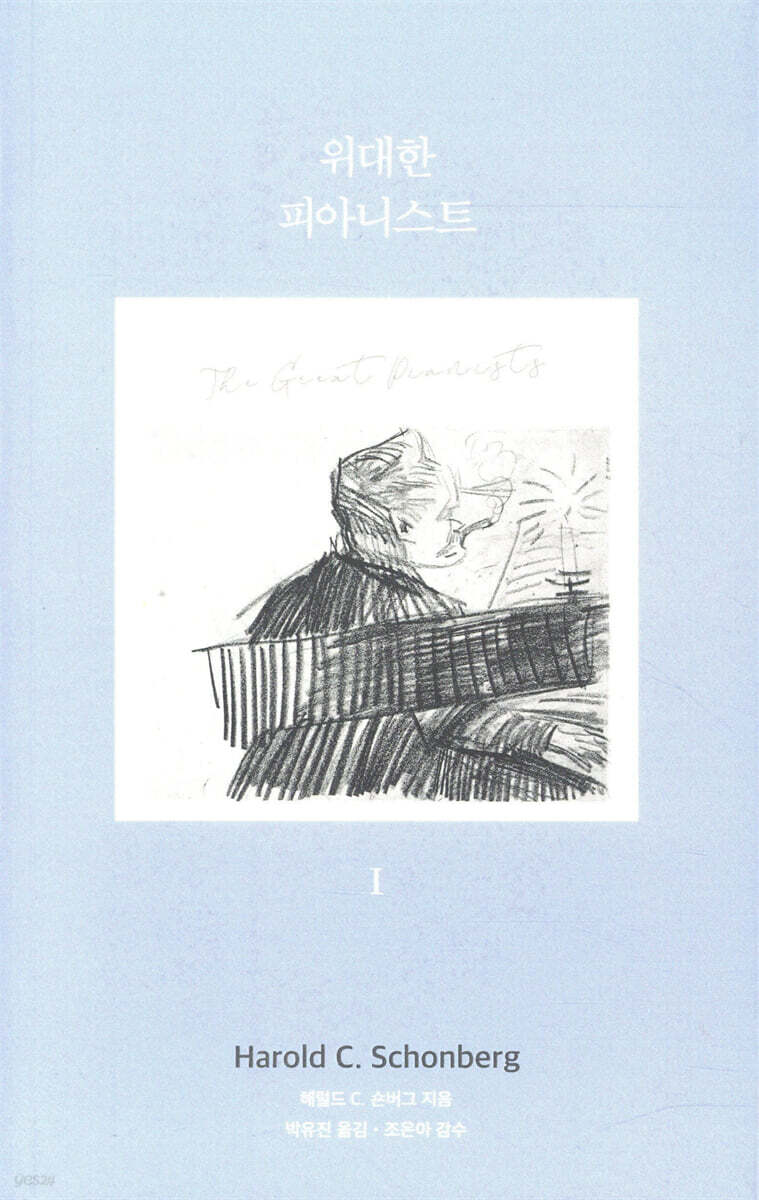
Great Pianist 1
 |
Description
Book Introduction
After reviewing numerous materials, we first revive the musician.
Then there's this old book that brought back the sound of the piano.
It is a daunting task to leave it in proper Korean.
Kim Ho-jeong│JoongAng Ilbo music reporter, JTBC [Classic Day] host
This book is like an encyclopedia of pianists, fascinatingly capturing the cultural history of piano performance over 250 years and anecdotes about the great masters on the keyboard.
It vividly captures the playing styles and technical characteristics of those considered the greatest pianists in history, and even vividly portrays their personal lives and personalities.
There has never been a book that covers the entire history of music so intently, focusing on the lives and music of pianists.
In that respect, unlike other books, the structure is unique in that it focuses on the activities of pianists rather than composers or their works. Instead of focusing on one person and introducing them separately, it introduces several pianists under one theme or in relation to other people, allowing for a more multi-layered look at the history of pianists, which is another interesting aspect of this book.
Harold Schonberg, author of "The Greatest Pianists," is considered one of the most influential music critics of the 20th century and the first music critic to win the Pulitzer Prize for criticism.
He repeatedly cross-checked sources to obtain reliable information while researching and researching materials, and this book also highlights his meticulous nature, extensive expertise, and keen perspective as a critic.
Schonberg's characteristically fast-paced writing style presents a vast amount of content in an easy and engaging way, satisfying the curiosity of not only pianists and musicians but also general readers.
- You can preview some of the book's contents.
Preview
index
introduction
Chapter 1: Early Days
Chapter 2: It must be smooth like oil.
Chapter 3 3rd, 6th, 8th
Chapter 4: Profile and Concert Tour
Chapter 5: Raise your hands high to the sky so that the strings break
Chapter 6 Transitional Period
Chapter 7 From Ireland to Bohemia
Chapter 8 Romanticism and its Rules
Chapter 9 Tuberculosis, Romanticism, and Poetry
Chapter 10: Thunder, Lightning, Hypnosis, and Sexual Attraction
Chapter 11: The Arpeggio Expert, Other Salon Players, and the American Expansion
Chapter 12: Other Salon Players and the Revolutionary Octave
Chapter 13: Two Emotional Pianists
Chapter 14 The First American Pianist
Chapter 15: Noble Virtuosos
Chapter 16: Tyrants and Intellectuals
Search
Recommendation - You'll hear it all when you read Schonberg
Detailed image

Into the book
Beginning in Beethoven's time, for the first time in history, pianists began to specialize in performing works by composers other than their own.
This was almost unheard of until the mid-18th century.
This is because, more than anything else, there weren't many professional pianists.
…the public was lucky when Mozart, Clementi, and Beethoven were pianists.
Other pianists came and went, playing their own trivial concertos and variations, waltzes, potpourri, war music, Janiczarenmusik, etc.
… However, the system of concerts for the public was not yet widespread.
This happens much later.
--- From "Early Days"
It was bound to happen someday.
In the last quarter of the eighteenth century, as the institution of public concerts became well established and pianists began to attract international attention, new problems arose.
How should a pianist sit when performing in front of an audience at a concert hall? With their backs to the stage? Facing each other? This presented a new and unprecedented challenge.
This is because Mozart and Clementi mostly performed in salons rather than concert halls.
The person who completely solved this problem was Jan Ladislav Dusek.
He was the first to sit with the audience on his right.
This achieved two goals.
He was able to show the audience his noble profile and the curves of the piano, and he was able to transmit the tone directly to the audience using the piano lid that he had set up as a soundboard.
--- From "Side Profile and Concert Tour"
As more and more people learned to play the piano, they wanted to hear pianists play, and they did.
Pianists appeared like mushrooms from all over Europe, and they all rushed to make Paris their base.
(It is surprising, however, that there were so few important French pianists at the time.) There were virtuosos like Liszt and Thalberg, pounding players like Leopold de Meyer, poets like Chopin, salon players like Hertz, eccentrics like Alkan, shy players like Heller and Henselt, extroverts like Ritolf and Rubinstein, academics like Clara Schumann and Hans von Bülow, and showmen like Dreisoch.
They worked hard, and the musicians' activities became standardized.
--- From "Romanticism and Its Rules"
When Liszt played the piano, women threw jewels onto the stage instead of bouquets of flowers.
They were screaming and shouting in a state of shock, and some even fainted.
Those who could still move rushed to the stage like madmen to see the features of this handsome gentleman.
The women fought over a pair of green gloves he had left behind on purpose.
Some women found cigarette butts left by Liszt and carried them to their chests until the day they died, while others took piano strings he had broken while playing as if they were precious relics.
These 'relics' (disjecta membra) were kept in frames and worshipped.
The list was not just a simple concert, but a noisy festival.
--- From "Thunder, Lightning, Hypnosis, and Sexual Attraction"
Publisher's Review
The colorful lives and musical history of pianists
The Korean edition of 『The Great Pianist』 will be published in two volumes.
Volume 1 vividly and meticulously tells the story of their playing styles and technical characteristics, such as Mozart's excellent legato that "flows like oil," Beethoven's tone that "surged like the sea," Clara Schumann's touch that "clearly resembles a pencil drawing," and Rubinstein's sensual playing that "erupts like a volcano," as well as personal anecdotes and personalities, such as the fierce competition between Mozart and Clementi, Liszt's charm in seducing women, and Gottschock's habit of biting his fingernails so obsessively that blood would drip down the keyboard.
It also reveals the dark side of those who were in the spotlight.
The scene where Beethoven, playing with an orchestra, couldn't do anything about the piano being out of tune and had to transpose it a semitone higher on the spot, and the anecdote about von Pachmann crouching high above the keyboard for fear of having his fingerings stolen by a fellow pianist sitting in the audience, provide interesting and rich information.
By analyzing the score, Schonberg can also infer the musician's physical characteristics and playing style.
Because the masters of the past composed music to be played directly, the instructions for fingering and expression written in the score reflect the physical condition of the performer.
It is very interesting to note that in the scores of Kalkbrenner and Hummel, the habit of playing with the fingers close to the keyboard is clearly revealed, while in the scores of Moscheles, an exaggerated gesture of raising the hands high is projected.
A vivid and entertaining story about the personalities, playing techniques, technical characteristics, and musical lineage of the musicians who contributed to the art of piano playing.
─ The New Yorker
This book is the most immersive of all books on the subject to date.
─ 『Boston Sunday Herald』
GOODS SPECIFICS
- Publication date: October 6, 2021
- Page count, weight, size: 444 pages | 522g | 134*210*21mm
- ISBN13: 9791190555746
- ISBN10: 1190555743
You may also like
카테고리
korean


korean


