

End of Time
 |
Description
Book Introduction
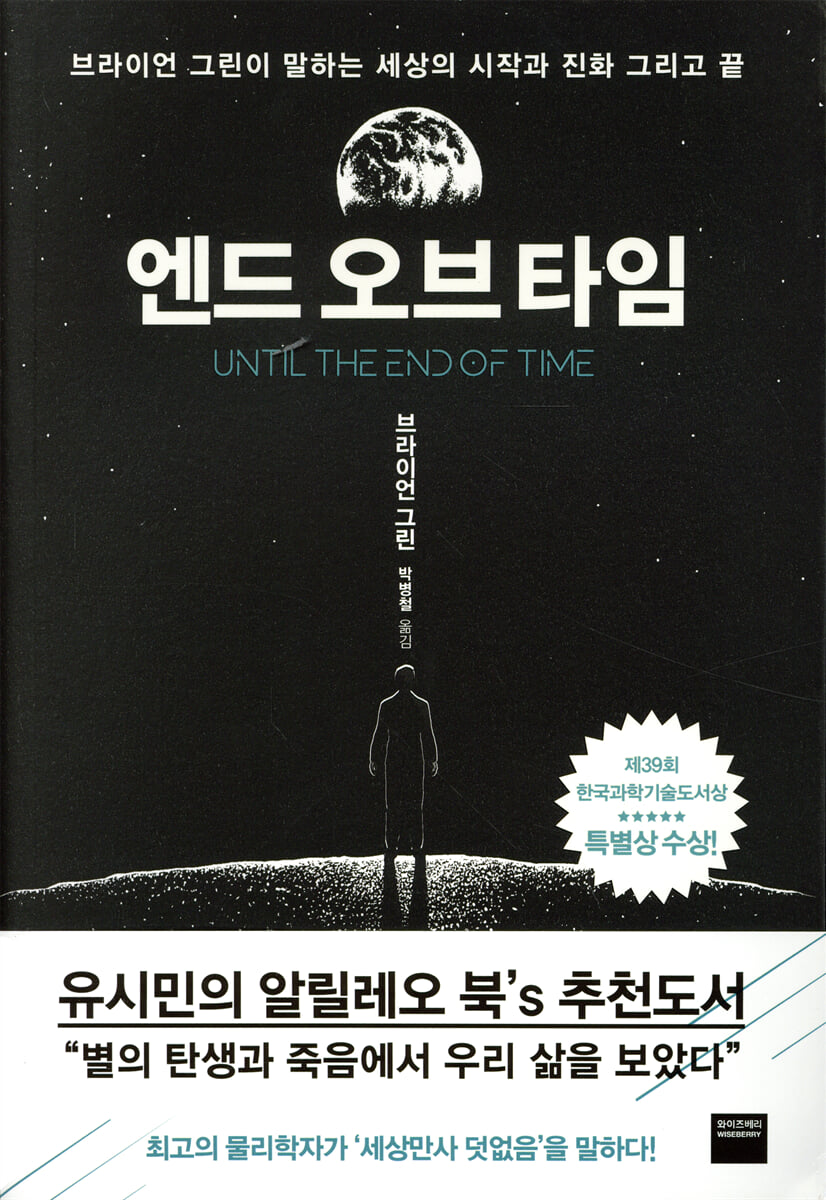
#1 in Amazon Science in the US in 2020! Physicist Kim Sang-wook: “It’s so cool, it’s almost awe-inspiring!” Consider how the universe, the solar system, the Earth, and life came into existence, Furthermore, it encompasses the evolution of consciousness, the meaning of human existence, and even the end of the universe. The greatest pop science masterpiece of our time, finally published in translation. Brian Greene, who has been called the greatest 'popular science evangelist' since Carl Sagan, writing masterpieces every few years, such as 'The Elegant Universe' and 'The Fabric of the Cosmos', has written a new book after 10 years. In the United States, it was published in 2020 under the title "Until The End of Time" and immediately became a huge hit, reaching number one in the Amazon science category. In the future, Wiseberry commissioned Dr. Park Byeong-cheol, a science translator and graduate of KAIST, to publish the Korean version of 『End of Time』 after a year of arduous translation work. "End of Time" contains the entire history of humanity's efforts to understand the universe. The space-time of the universe is unimaginably vast, yet it follows very elegant and simple mathematical laws. Greene guides us through the universe from its beginning to its end, based on these laws. How did life emerge from the chaos of the beginning, and how did humans, realizing their short lifespan, come to instill meaning in all their experiences? The author analyzes the human yearning for truth and eternity through countless stories, myths, religions, creative expression, and science. All things in the universe are destined to collapse and disappear one day, but the answer lies in the wondrous and profound experiences we experience and in the beauty we ourselves have created. |
- You can preview some of the book's contents.
Preview
index
Chapter 1.
The Allure of Eternity - Beginning, End, and Beyond
Chapter 2.
The Language of Time - Past, Future, and Change
Chapter 3.
Origin and Entropy - From Creation to Structure
Chapter 4.
Information and Life - From Structure to Life
Chapter 5.
Particles and Consciousness - From Life to Mind
Chapter 6.
Language and Story - From Mind to Imagination
Chapter 7.
Brain and Faith - From Imagination to Divinity
Chapter 8.
Instinct and Creativity - From the Divine to the Sublime
Chapter 9.
Continuity and Impermanence - From the Sublime to the Final Thought
Chapter 10.
The Twilight of Time: Quantum, Probability, and Eternity
Chapter 11.
The Nobility of Being - Mind, Matter, and Meaning
The Allure of Eternity - Beginning, End, and Beyond
Chapter 2.
The Language of Time - Past, Future, and Change
Chapter 3.
Origin and Entropy - From Creation to Structure
Chapter 4.
Information and Life - From Structure to Life
Chapter 5.
Particles and Consciousness - From Life to Mind
Chapter 6.
Language and Story - From Mind to Imagination
Chapter 7.
Brain and Faith - From Imagination to Divinity
Chapter 8.
Instinct and Creativity - From the Divine to the Sublime
Chapter 9.
Continuity and Impermanence - From the Sublime to the Final Thought
Chapter 10.
The Twilight of Time: Quantum, Probability, and Eternity
Chapter 11.
The Nobility of Being - Mind, Matter, and Meaning
Detailed image

Into the book
[Big Bang = lowest entropy state]
Following the second law of thermodynamics, we can conclude that today's state originated from yesterday's state, which had lower entropy than today.
If we continue to apply this logic, yesterday was the day before yesterday, the day before yesterday was the day before yesterday… and so on, until we eventually reach the origin of the universe, when entropy was at its lowest, that is, the Big Bang.
The entropy was unimaginably low around the time of the Big Bang, and because it has not yet reached maximum entropy, the future is unfolding differently from the past.
[The Dance of Entropy: Creating Order]
Let us call the process of decreasing entropy the “entropic two-step process.”
Entropy within a physical system may decrease, but the total amount of entropy always increases because the increase in entropy of the surrounding environment is greater than the decrease within it.
Otherwise, the second law would have been abandoned long ago.
In a universe that becomes more disordered over time, it was only thanks to the two-stage entropy process that orderly structures such as stars, planets, and humans could form.
The energy flowing in the physical world (the energy generated by burning coal is released through steam after doing work on the outside) can maintain order and even create order by releasing entropy to the outside.
Life, the mind, and almost everything the mind holds dear came into existence through this “dance of entropy.”
[Why quantum mechanics? … I don't know.]
Why does reality follow the laws of quantum mechanics? I don't know.
There is no one who can answer this question.
We simply believe that the theory is correct because the theoretical results calculated over the past century have been in perfect agreement with numerous experimental results.
However, the results of quantum mechanics are not as tangible as those of classical physics, because they are concentrated in a small area that is incomparable to our everyday experience.
If human senses were sophisticated enough to perceive the quantum realm, our intuition would be based on quantum phenomena, and quantum mechanics would become second nature to us.
Just as Newtonian physics is ingrained in us today (we can quickly catch a glass that falls from a table because we intuitively know the trajectory of an object calculated using classical mechanics), we will also react almost instinctively to quantum phenomena.
However, since we do not have this intuition, we can only understand quantum reality indirectly through mathematics and experiments.
The difficulty of scientifically explaining 'consciousness'
We still cannot explain the experience of consciousness in scientific terms.
It fails to elucidate the process by which consciousness intervenes in the extremely personal world of sight, hearing, and sensation.
Even if someone claims that “consciousness exists outside of traditional science,” there is no compelling evidence to refute it, and it is unlikely to be discovered anytime soon.
Anyone who has thought deeply about consciousness knows how difficult it is to scientifically dissect the nature of consciousness.
How can the movement of particles in the brain give rise to emotions and sensations?
How can a mindless, thoughtless, and emotionless swarm of particles perceive color and sound, love and hate, joy and sorrow? While particles possess certain properties, including mass and electric charge (there's also something called nuclear charge, which is similar to electric charge but fundamentally different), these quantities are completely unrelated to subjective experience.
But how can the movement of particles in the brain (which is all there is to the brain) give rise to emotions, sensations and feelings?
Can free will be explained by the laws of physics?
Our individuality, our values, and our self-esteem seem to be our own creations, but if all of this is the result of the uncompromising laws of physics, then free will has no place to stand.
We seem to be nothing more than toys tossed around by the cold laws of the universe.
So the key question is:
Is there no way for free will to survive the tyranny of thoughtless, emotionless particles? If even free will is a product of the laws of physics, then the uniquely human pride that says, "I create what I am," will be mercilessly crushed.
So many philosophers have been constantly struggling to find a way out, and some of them have even abandoned the reductionist view in favor of free will.
Although experimental data demonstrate that we have a deep understanding of the laws that govern individual particles (electrons, quarks, neutrinos, etc.), the trillions of trillions of trillions of particles that make up the human body and brain may (partially) deviate from the laws that apply to the microscopic world.
If so, phenomena forbidden in the microscopic world (especially free will) may appear in the macroscopic world.
[Humanity is experiencing a very rare and special time throughout the history of the universe]
We are transient beings, impermanent and infinite.
But the short time we exist is a very rare and special time in the history of the universe.
During this time, we gave value to all things through self-reflection and created metaphysical value.
While we long to leave behind a lasting legacy, we already know, having surveyed the cosmic timeline, that this is an unattainable goal.
But it is truly remarkable that tiny particles can come together to perceive reality, reflect on themselves, realize how short-lived they are, and with tireless passion create beauty, establish connections, and unravel the mysteries of the universe.
Following the second law of thermodynamics, we can conclude that today's state originated from yesterday's state, which had lower entropy than today.
If we continue to apply this logic, yesterday was the day before yesterday, the day before yesterday was the day before yesterday… and so on, until we eventually reach the origin of the universe, when entropy was at its lowest, that is, the Big Bang.
The entropy was unimaginably low around the time of the Big Bang, and because it has not yet reached maximum entropy, the future is unfolding differently from the past.
[The Dance of Entropy: Creating Order]
Let us call the process of decreasing entropy the “entropic two-step process.”
Entropy within a physical system may decrease, but the total amount of entropy always increases because the increase in entropy of the surrounding environment is greater than the decrease within it.
Otherwise, the second law would have been abandoned long ago.
In a universe that becomes more disordered over time, it was only thanks to the two-stage entropy process that orderly structures such as stars, planets, and humans could form.
The energy flowing in the physical world (the energy generated by burning coal is released through steam after doing work on the outside) can maintain order and even create order by releasing entropy to the outside.
Life, the mind, and almost everything the mind holds dear came into existence through this “dance of entropy.”
[Why quantum mechanics? … I don't know.]
Why does reality follow the laws of quantum mechanics? I don't know.
There is no one who can answer this question.
We simply believe that the theory is correct because the theoretical results calculated over the past century have been in perfect agreement with numerous experimental results.
However, the results of quantum mechanics are not as tangible as those of classical physics, because they are concentrated in a small area that is incomparable to our everyday experience.
If human senses were sophisticated enough to perceive the quantum realm, our intuition would be based on quantum phenomena, and quantum mechanics would become second nature to us.
Just as Newtonian physics is ingrained in us today (we can quickly catch a glass that falls from a table because we intuitively know the trajectory of an object calculated using classical mechanics), we will also react almost instinctively to quantum phenomena.
However, since we do not have this intuition, we can only understand quantum reality indirectly through mathematics and experiments.
The difficulty of scientifically explaining 'consciousness'
We still cannot explain the experience of consciousness in scientific terms.
It fails to elucidate the process by which consciousness intervenes in the extremely personal world of sight, hearing, and sensation.
Even if someone claims that “consciousness exists outside of traditional science,” there is no compelling evidence to refute it, and it is unlikely to be discovered anytime soon.
Anyone who has thought deeply about consciousness knows how difficult it is to scientifically dissect the nature of consciousness.
How can the movement of particles in the brain give rise to emotions and sensations?
How can a mindless, thoughtless, and emotionless swarm of particles perceive color and sound, love and hate, joy and sorrow? While particles possess certain properties, including mass and electric charge (there's also something called nuclear charge, which is similar to electric charge but fundamentally different), these quantities are completely unrelated to subjective experience.
But how can the movement of particles in the brain (which is all there is to the brain) give rise to emotions, sensations and feelings?
Can free will be explained by the laws of physics?
Our individuality, our values, and our self-esteem seem to be our own creations, but if all of this is the result of the uncompromising laws of physics, then free will has no place to stand.
We seem to be nothing more than toys tossed around by the cold laws of the universe.
So the key question is:
Is there no way for free will to survive the tyranny of thoughtless, emotionless particles? If even free will is a product of the laws of physics, then the uniquely human pride that says, "I create what I am," will be mercilessly crushed.
So many philosophers have been constantly struggling to find a way out, and some of them have even abandoned the reductionist view in favor of free will.
Although experimental data demonstrate that we have a deep understanding of the laws that govern individual particles (electrons, quarks, neutrinos, etc.), the trillions of trillions of trillions of particles that make up the human body and brain may (partially) deviate from the laws that apply to the microscopic world.
If so, phenomena forbidden in the microscopic world (especially free will) may appear in the macroscopic world.
[Humanity is experiencing a very rare and special time throughout the history of the universe]
We are transient beings, impermanent and infinite.
But the short time we exist is a very rare and special time in the history of the universe.
During this time, we gave value to all things through self-reflection and created metaphysical value.
While we long to leave behind a lasting legacy, we already know, having surveyed the cosmic timeline, that this is an unattainable goal.
But it is truly remarkable that tiny particles can come together to perceive reality, reflect on themselves, realize how short-lived they are, and with tireless passion create beauty, establish connections, and unravel the mysteries of the universe.
--- From the text
Publisher's Review
#1 in Amazon Science in the US in 2020!
Physicist Kim Sang-wook: “It’s so cool, it’s almost awe-inspiring!”
Consider how the universe, the solar system, the Earth, and life came into existence,
Furthermore, it encompasses the evolution of consciousness, the meaning of human existence, and even the end of the universe.
The greatest pop science masterpiece of our time, finally published in translation.
Brian Greene, who has been called the greatest 'popular science evangelist' since Carl Sagan, writing masterpieces every few years, such as 'The Elegant Universe' and 'The Fabric of the Cosmos', has written a new book after 10 years.
In the United States, it was published in 2020 under the title "Until The End of Time" and immediately became a huge hit, reaching number one in the Amazon science category.
In the future, Wiseberry commissioned Dr. Park Byeong-cheol, a science translator and graduate of KAIST, to publish the Korean version of 『End of Time』 after a year of arduous translation work.
The greatest physicist who led the development of string theory says, "Everything in the world is fleeting"!?
End of Time is a bit different from his previous books.
Compared to Brian Greene's past books, which explained specific physics theories as if lecturing to the public in his characteristically easy-to-understand sentences, this book is closer to a monologue.
As a physicist, I feel like I have been reflecting on my philosophical reflections for the past decade or so, beyond my research and exploration.
Of course, every sentence in the book was written based on scientific and logical thinking.
However, the difference is that the direction of the thought is not limited to a single scientific theory, but extends to various fields, including the universe, life, and the human mind.
He honestly reveals that many scientific mysteries that humanity has tried to explain remain unsolved, while also delving into the heart of the matter as best he can.
The author himself speaks about the direction of "End of Time"
In the future, we will travel back in time and examine the physical principles that created the orderly creation of stars, galaxies, life, and consciousness in a universe that was destined to collapse one day.
And we will also consider the claim that “just as human life is finite, so too are all life phenomena and spirits.”
In fact, at some stage, organized matter in any form cannot exist.
In this situation, we will also consider how beings capable of self-reflection can overcome reality.
As far as we know, humans are born from immutable laws, but they are destined to exist for a very short time compared to eternity and then disappear.
We are governed by laws that operate without a clear purpose, yet we constantly ask ourselves, “Where am I going now?”
Even though their fate is determined by laws whose very existence is unclear, they are still searching for meaning and purpose within them.
In this book, we will explore the path the universe has taken, from the moment time first began to flow, to the moment of its end (or something close to it), and the path it will take in the future.
And in this process, we will also learn how the “restless” human mind has responded to the impermanence of all things.
(_Excerpts from the introduction)
The Big Bang, the origins of stars and life, consciousness, religion, art, and the ultimate destiny of the universe… A peek into how this world was created and operates.
"End of Time" contains the entire history of humanity's efforts to understand the universe.
The space-time of the universe is unimaginably vast, yet it follows very elegant and simple mathematical laws.
Greene guides us through the universe from its beginning to its end, based on these laws.
How did life emerge from the chaos of the beginning, and how did humans, realizing their short lifespan, come to instill meaning in all their experiences? The author analyzes the human yearning for truth and eternity through countless stories, myths, religions, creative expression, and science.
All things in the universe are destined to collapse and disappear one day, but the answer lies in the wondrous and profound experiences we experience and in the beauty we ourselves have created.
Science was born in this cold universe
Can human 'consciousness' be explained?
By illuminating the interplay of entropy and evolution in a series of well-crafted stories—stories about particles, planets, creative consciousness, matter, and meaning—Bryan Greene offers a compelling glimpse into how we came to be, where we are now, and where we might be headed in the future.
Through this epic journey from the beginning to the end of the universe, readers will gain a deeper understanding of our unique existence, which, though it lives in a fleeting moment (compared to cosmic time), is incomparably special.
Ultimately, the purpose of this book is, in a word, 'a quest to find the meaning of a short human life in the vast space and time of the history of the universe.'
The author guides readers on a journey from the Big Bang to the final moments of the universe, exploring how these structures have persisted and how life and the mind were born. Through narrative, myth, religion, creative expression, and science, the author explores the process by which humans discover the meaning of their existence.
It also fosters a deep yearning for truth and eternity, enabling us to perceive and appreciate the fleeting yet exquisite moments unfolding within our own universe, from particles to planets, from consciousness to creativity, from matter to meaning.
Physicist Kim Sang-wook: “It’s so cool, it’s almost awe-inspiring!”
Consider how the universe, the solar system, the Earth, and life came into existence,
Furthermore, it encompasses the evolution of consciousness, the meaning of human existence, and even the end of the universe.
The greatest pop science masterpiece of our time, finally published in translation.
Brian Greene, who has been called the greatest 'popular science evangelist' since Carl Sagan, writing masterpieces every few years, such as 'The Elegant Universe' and 'The Fabric of the Cosmos', has written a new book after 10 years.
In the United States, it was published in 2020 under the title "Until The End of Time" and immediately became a huge hit, reaching number one in the Amazon science category.
In the future, Wiseberry commissioned Dr. Park Byeong-cheol, a science translator and graduate of KAIST, to publish the Korean version of 『End of Time』 after a year of arduous translation work.
The greatest physicist who led the development of string theory says, "Everything in the world is fleeting"!?
End of Time is a bit different from his previous books.
Compared to Brian Greene's past books, which explained specific physics theories as if lecturing to the public in his characteristically easy-to-understand sentences, this book is closer to a monologue.
As a physicist, I feel like I have been reflecting on my philosophical reflections for the past decade or so, beyond my research and exploration.
Of course, every sentence in the book was written based on scientific and logical thinking.
However, the difference is that the direction of the thought is not limited to a single scientific theory, but extends to various fields, including the universe, life, and the human mind.
He honestly reveals that many scientific mysteries that humanity has tried to explain remain unsolved, while also delving into the heart of the matter as best he can.
The author himself speaks about the direction of "End of Time"
In the future, we will travel back in time and examine the physical principles that created the orderly creation of stars, galaxies, life, and consciousness in a universe that was destined to collapse one day.
And we will also consider the claim that “just as human life is finite, so too are all life phenomena and spirits.”
In fact, at some stage, organized matter in any form cannot exist.
In this situation, we will also consider how beings capable of self-reflection can overcome reality.
As far as we know, humans are born from immutable laws, but they are destined to exist for a very short time compared to eternity and then disappear.
We are governed by laws that operate without a clear purpose, yet we constantly ask ourselves, “Where am I going now?”
Even though their fate is determined by laws whose very existence is unclear, they are still searching for meaning and purpose within them.
In this book, we will explore the path the universe has taken, from the moment time first began to flow, to the moment of its end (or something close to it), and the path it will take in the future.
And in this process, we will also learn how the “restless” human mind has responded to the impermanence of all things.
(_Excerpts from the introduction)
The Big Bang, the origins of stars and life, consciousness, religion, art, and the ultimate destiny of the universe… A peek into how this world was created and operates.
"End of Time" contains the entire history of humanity's efforts to understand the universe.
The space-time of the universe is unimaginably vast, yet it follows very elegant and simple mathematical laws.
Greene guides us through the universe from its beginning to its end, based on these laws.
How did life emerge from the chaos of the beginning, and how did humans, realizing their short lifespan, come to instill meaning in all their experiences? The author analyzes the human yearning for truth and eternity through countless stories, myths, religions, creative expression, and science.
All things in the universe are destined to collapse and disappear one day, but the answer lies in the wondrous and profound experiences we experience and in the beauty we ourselves have created.
Science was born in this cold universe
Can human 'consciousness' be explained?
By illuminating the interplay of entropy and evolution in a series of well-crafted stories—stories about particles, planets, creative consciousness, matter, and meaning—Bryan Greene offers a compelling glimpse into how we came to be, where we are now, and where we might be headed in the future.
Through this epic journey from the beginning to the end of the universe, readers will gain a deeper understanding of our unique existence, which, though it lives in a fleeting moment (compared to cosmic time), is incomparably special.
Ultimately, the purpose of this book is, in a word, 'a quest to find the meaning of a short human life in the vast space and time of the history of the universe.'
The author guides readers on a journey from the Big Bang to the final moments of the universe, exploring how these structures have persisted and how life and the mind were born. Through narrative, myth, religion, creative expression, and science, the author explores the process by which humans discover the meaning of their existence.
It also fosters a deep yearning for truth and eternity, enabling us to perceive and appreciate the fleeting yet exquisite moments unfolding within our own universe, from particles to planets, from consciousness to creativity, from matter to meaning.
GOODS SPECIFICS
- Publication date: February 15, 2021
- Page count, weight, size: 532 pages | 944g | 153*224*35mm
- ISBN13: 9791164137411
- ISBN10: 1164137417
You may also like
카테고리
korean


korean

![GQ KOREA Mark (Monthly): December [2025]](http://librairie.coreenne.fr/cdn/shop/files/8ef265dbbfbf186523ed75ba7319009d.jpg?v=1765340328&width=3840)


