

A cloud every day
 |
Description
Book Introduction
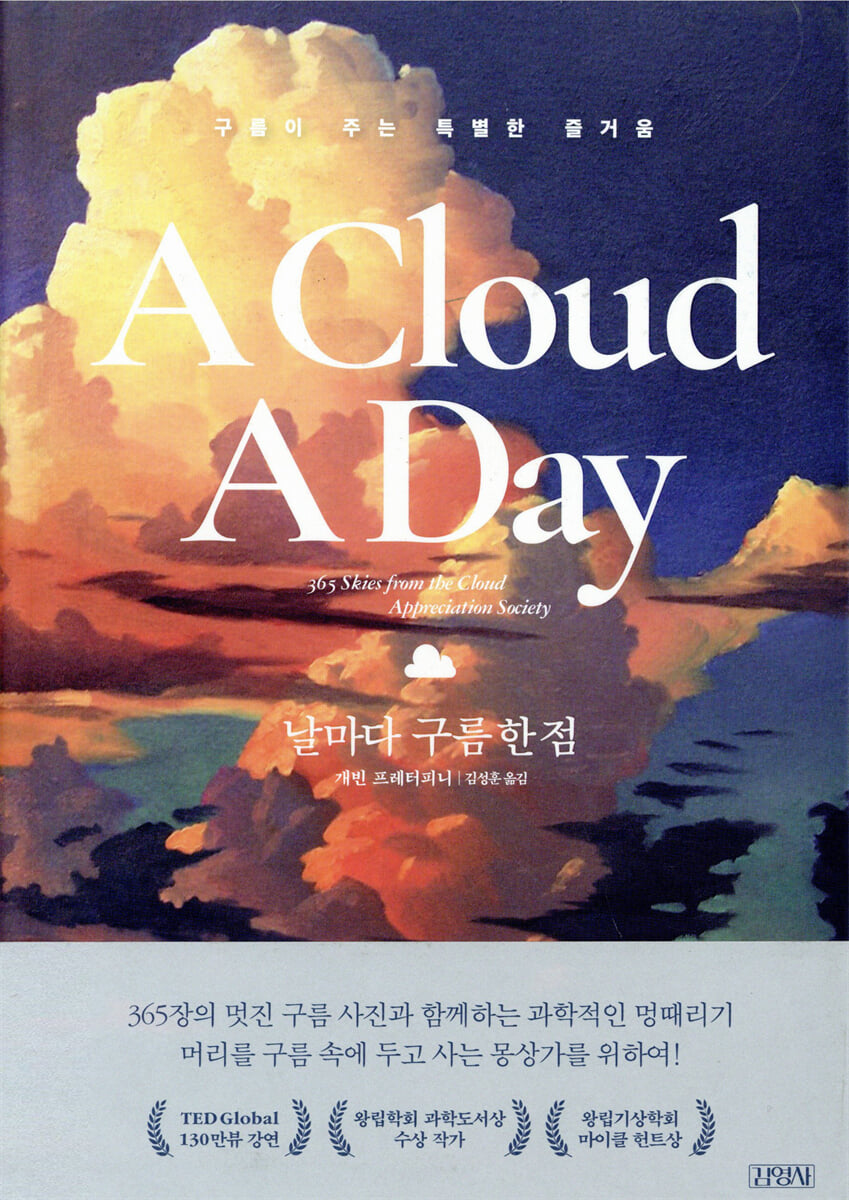
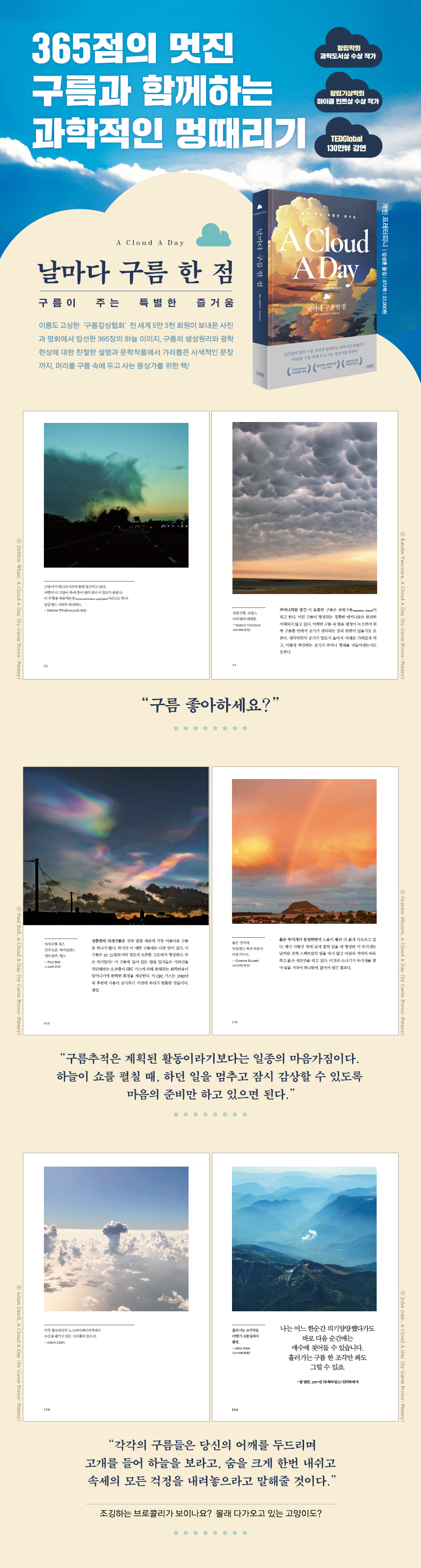
Do you like clouds? Scientifically mind-boggling with 365 stunning cloud photos - Winner of the Royal Society Scientific Book Award and the Royal Meteorological Society Michael Hunt Award - TEDGlobal lecture with 1.3 million views A collection of 365 carefully selected sky images from photos submitted by over 53,000 members of the Cloud Appreciation Association worldwide. Enjoy a purposeless pleasure with helpful explanations of cloud formation and optical phenomena, along with thoughtful passages selected from literary works! A book for dreamers who live with their heads in the clouds. “The 365 clouds in this book, whether photographed by astronauts aboard the International Space Station, painted by a Dutch Golden Age master, or captured in the backyard by a member of the Cloud Appreciation Society, are all signals meant to remind you of something. Each cloud will tap you on the shoulder, telling you to look up at the sky, take a deep breath, and let go of all your worldly worries. “The clouds are there to tell you to look around, to look up at the sky, and to appreciate this ever-changing sea of air in which we all live together.” |
- You can preview some of the book's contents.
Preview
index
preface
Clouds pictures
copyright
Search
Clouds pictures
copyright
Search
Detailed image
Into the book
We, the members of the Cloud Appreciation Society, believe it's only right to pay more attention to the sky.
If you can just spend a few moments each day with your head in the clouds and daydreaming, it's good for your mind, your body, and your soul.
The purpose of this book is to show why.
--- p.7
So, let us take the time to enjoy the passing clouds, as Samuel Taylor Coleridge said (see 214).
Then, as our culture of being tied to all kinds of devices takes hold, our brains enter an idle mode that is almost completely eradicated from our lives.
Cloud chasing is an activity that no one would blame you for doing without doing anything.
Rather, doing nothing allows your imagination to run free and keeps your mind at ease.
--- p.9
Cloud chasing is more of a state of mind than a planned activity.
When the sky puts on a show, all you have to do is prepare yourself mentally to stop what you're doing and take a moment to appreciate it.
--- p.11
Middle-level clouds, also known as altostratus clouds, are generally considered boring clouds because they are dull gray clouds with no special features.
But when the light hits it just right, every cloud has its own shining moment.
--- p.92
Cumulonimbus clouds, known as the 'king of clouds', can reach heights of up to 16 kilometers.
So, it is the tallest of all cloud types.
The expression 'cloud nine', which is used to mean a feeling of happiness as if one is about to fly, also comes from cumulonimbus clouds.
When the first edition of the International Cloud Atlas, a guide to identifying clouds, was published in 1896, cumulonimbus clouds were number 9 in the list of ten major classifications of cloud genera.
So being on cloud nine, or cloud 9, meant being on the highest cloud.
--- p.120
Fog can be thought of as the lowest hanging cloud.
Fog is formed when a featureless layer of clouds called stratus clouds sticks close to the ground.
A purist would argue that a certain level of altitude is necessary to qualify as a cloud, and therefore fog cannot be a true cloud.
We at the Cloud Viewing Association are not purists.
We acknowledge the fog as the only cloud that has come to visit us above the ground, and we are grateful for it.
Because fog reveals the beauty of a landscape by hiding it.
--- p.244
“We are the first generation to look at the clouds from the side.
What an amazing privilege! The first people looked up and dreamed.
Now we dream, looking at the sheep above and below.
“This will certainly change something.” Saul Bellow, Henderson the Rain King (1959)
If you can just spend a few moments each day with your head in the clouds and daydreaming, it's good for your mind, your body, and your soul.
The purpose of this book is to show why.
--- p.7
So, let us take the time to enjoy the passing clouds, as Samuel Taylor Coleridge said (see 214).
Then, as our culture of being tied to all kinds of devices takes hold, our brains enter an idle mode that is almost completely eradicated from our lives.
Cloud chasing is an activity that no one would blame you for doing without doing anything.
Rather, doing nothing allows your imagination to run free and keeps your mind at ease.
--- p.9
Cloud chasing is more of a state of mind than a planned activity.
When the sky puts on a show, all you have to do is prepare yourself mentally to stop what you're doing and take a moment to appreciate it.
--- p.11
Middle-level clouds, also known as altostratus clouds, are generally considered boring clouds because they are dull gray clouds with no special features.
But when the light hits it just right, every cloud has its own shining moment.
--- p.92
Cumulonimbus clouds, known as the 'king of clouds', can reach heights of up to 16 kilometers.
So, it is the tallest of all cloud types.
The expression 'cloud nine', which is used to mean a feeling of happiness as if one is about to fly, also comes from cumulonimbus clouds.
When the first edition of the International Cloud Atlas, a guide to identifying clouds, was published in 1896, cumulonimbus clouds were number 9 in the list of ten major classifications of cloud genera.
So being on cloud nine, or cloud 9, meant being on the highest cloud.
--- p.120
Fog can be thought of as the lowest hanging cloud.
Fog is formed when a featureless layer of clouds called stratus clouds sticks close to the ground.
A purist would argue that a certain level of altitude is necessary to qualify as a cloud, and therefore fog cannot be a true cloud.
We at the Cloud Viewing Association are not purists.
We acknowledge the fog as the only cloud that has come to visit us above the ground, and we are grateful for it.
Because fog reveals the beauty of a landscape by hiding it.
--- p.244
“We are the first generation to look at the clouds from the side.
What an amazing privilege! The first people looked up and dreamed.
Now we dream, looking at the sheep above and below.
“This will certainly change something.” Saul Bellow, Henderson the Rain King (1959)
--- p.304
Publisher's Review
Do you like clouds?
Scientifically mind-boggling with 365 stunning cloud photos
★ Royal Society Scientific Book Award, Royal Meteorological Society Michael Hunt Award-winning author
★ TEDGlobal lecture with 1.3 million views
“The 365 clouds in this book, whether photographed by astronauts aboard the International Space Station, painted by a Dutch Golden Age master, or captured in the backyard by a member of the Cloud Appreciation Society, are all signals meant to remind you of something.
Each cloud will tap you on the shoulder, telling you to look up at the sky, take a deep breath, and let go of all your worldly worries.
“The clouds are there to tell you to look around, to look up at the sky, and to appreciate this ever-changing sea of air in which we all live together.”
During the suffocating times of being confined to our homes due to COVID-19 and having to wear masks even when outdoors, it was the clouds that brought us comfort.
Thankfully, the skies of last summer and fall were incredibly beautiful, and there were plenty of photos of sunsets and clouds on the internet.
The western sky tinged with crimson, purple clouds, and the occasional lucky rainbow after the rain...
I don't know what to call it, but people were able to experience peace and emotion in the wonderful objects and scenery created by the sky.
"A Cloud Every Day" is a book filled with such wonderful and amazing cloud photos.
The Cloud Appreciation Society, with its noble name but unlikely origins, boasts over 53,000 members from 120 countries. This book features 365 interesting and rare photos submitted by members from all over the world, along with brief captions.
By looking at one cloud a day, you can build up your knowledge about clouds.
Gavin Pretterfinney and the Cloud Appreciation Society
When talking about the Cloud Viewing Society, the source of these amazing photographs, we cannot help but mention Gavin Pretterfinney, who wrote and compiled the book.
Fascinated by clouds since childhood, he spent his life fascinated by observing natural phenomena and understanding their principles.
After studying philosophy and psychology at Oxford University, he studied graphic design at Central Saint Martins School of Art and Design.
He was a visiting researcher at the University of Reading's Department of Meteorology and received the Royal Meteorological Society's Michael Hunt Award for his contributions to making meteorological phenomena accessible to the public.
In 2011, he won the prestigious Royal Society Scientific Book Award for his book, The Wave Observer's Guide.
His 2013 TED talk was viewed by over 1.3 million people.
In 2005, Gavin Pretterfinni founded the Cloud Appreciation Society in protest against the prevailing notion that clouds are ominous and bad, as seen in our language usage.
People who sympathized with the association's declaration, which begins with "We believe that clouds are being treated unfairly and that without clouds, our lives would be infinitely shabby," and "We vow to fight 'blue-skyism' whenever we encounter it," and then praises clouds and proclaims the benefits of looking at them, and ends with the exhortation, "Raise your head and marvel at their fleeting beauty, and never forget to live with your head in the clouds," have joined one by one, and are now sharing the cloud images they have discovered through a wonderful internet homepage and smartphone app.
Their activities have produced meaningful results even by secular standards.
He discovered a new type of cloud that was difficult to classify into existing types and proposed a cloud classification called 'asperitas', which was included in the 2017 edition of the 'International Cloud Atlas' published by the World Meteorological Organization.
It was the first time in 54 years that a new classification of clouds was recognized.
A variety of images, British humor, scientific explanations, and cool quotes.
The book contains images capturing a variety of clouds and colorful optical phenomena in the sky.
From the quintessential cumulus cloud, to the soothing cirrus clouds, to the thunderous cumulonimbus clouds, it showcases the ten main types of clouds, as well as lenticular clouds, often mistaken for UFOs, and rare species and varieties such as towering clouds, honeycomb clouds, scroll clouds, radiant clouds, and silky clouds.
Pictures showing a variety of 'cloud types' are included, including contrails called 'contrails', fog clouds that are clouds above the ground, luminous and mother-of-pearl clouds, clouds called 'horseshoe swirl clouds' because of their horseshoe-shaped appearance, and clouds with additional characteristics or considered accessory clouds such as arch clouds, breast clouds, wave clouds, tail clouds, hole clouds, wall clouds, cap clouds, and funnel clouds, along with concise, witty, and easy-to-understand explanations.
Perhaps what will catch the readers' eyes and delight their hearts the most are the 'clouds that resemble something'. The clouds in the book are shaped like all kinds of people, objects, and animals, including hearts, bubble gum, wigs, jogging broccoli, rocks, arrows, cats, pigs, elephants, smiling faces, Queen Nefertiti of Egypt, and Lightning Man.
Readers interested in optical effects will enjoy learning about what these amazing objects are and how they are created, whether they are common sights around us or only occasionally seen in nature documentaries or science books, from rainbows to shadow halos, fanlights, reflected rainbows, 22nd degree halos, horizontal halos, sun pillars, contact points, circumscribed halos, red sprites, and the northern lights.
You can also see how artists have explored clouds, from John Constable, famous for his landscapes featuring abundant clouds, to Chinese painter Miu Yin, Japanese artist Katsushika Hokusai, and from Turner, Van Gogh, and Henri Rousseau to Edward Hopper, Georgia O'Keeffe, Magritte, and installation artist Bernhard Smilde.
From Lao Tzu and Buddha to Zen Master Dogen, William Blake, John Ruskin, G.
K. Chesterton, Ralph Waldo Emerson, Lord Byron, Emily Dickinson, Saul Bellow, Rachel Carson, and Edward Wilson, all selected from the writings of writers past and present, invite readers to reflect.
How to live in the present, Cloud Chasing
We are so busy.
To make a living, to care for children, to share love, and sometimes to change the world.
I feel exhausted from reading and watching endless videos and images uploaded to my smartphone.
I can't even remember the last time I did nothing.
If you're tired of endless activity, the pursuit of meaning and purpose, look out the window and look up at the sky.
There, clouds will be waiting for us.
According to the author, cloudspotting is "a good excuse to do nothing."
Cloud chasing can give you peace of mind and save you money on psychiatric treatment.
If you meditate while looking at clouds that move at a fairly fast speed but appear to move very leisurely because they are far away, that in itself can be a mood-boosting and stress-reducing experience.
A really cool idea might come to mind.
You may gain a new sense of time and space.
Even if you don't reach the realization of what life is, you will at least be able to experience one of the joys of living.
When you feel depressed, look at the sky.
Let's start practicing '1 cloud a day' from today.
Scientifically mind-boggling with 365 stunning cloud photos
★ Royal Society Scientific Book Award, Royal Meteorological Society Michael Hunt Award-winning author
★ TEDGlobal lecture with 1.3 million views
“The 365 clouds in this book, whether photographed by astronauts aboard the International Space Station, painted by a Dutch Golden Age master, or captured in the backyard by a member of the Cloud Appreciation Society, are all signals meant to remind you of something.
Each cloud will tap you on the shoulder, telling you to look up at the sky, take a deep breath, and let go of all your worldly worries.
“The clouds are there to tell you to look around, to look up at the sky, and to appreciate this ever-changing sea of air in which we all live together.”
During the suffocating times of being confined to our homes due to COVID-19 and having to wear masks even when outdoors, it was the clouds that brought us comfort.
Thankfully, the skies of last summer and fall were incredibly beautiful, and there were plenty of photos of sunsets and clouds on the internet.
The western sky tinged with crimson, purple clouds, and the occasional lucky rainbow after the rain...
I don't know what to call it, but people were able to experience peace and emotion in the wonderful objects and scenery created by the sky.
"A Cloud Every Day" is a book filled with such wonderful and amazing cloud photos.
The Cloud Appreciation Society, with its noble name but unlikely origins, boasts over 53,000 members from 120 countries. This book features 365 interesting and rare photos submitted by members from all over the world, along with brief captions.
By looking at one cloud a day, you can build up your knowledge about clouds.
Gavin Pretterfinney and the Cloud Appreciation Society
When talking about the Cloud Viewing Society, the source of these amazing photographs, we cannot help but mention Gavin Pretterfinney, who wrote and compiled the book.
Fascinated by clouds since childhood, he spent his life fascinated by observing natural phenomena and understanding their principles.
After studying philosophy and psychology at Oxford University, he studied graphic design at Central Saint Martins School of Art and Design.
He was a visiting researcher at the University of Reading's Department of Meteorology and received the Royal Meteorological Society's Michael Hunt Award for his contributions to making meteorological phenomena accessible to the public.
In 2011, he won the prestigious Royal Society Scientific Book Award for his book, The Wave Observer's Guide.
His 2013 TED talk was viewed by over 1.3 million people.
In 2005, Gavin Pretterfinni founded the Cloud Appreciation Society in protest against the prevailing notion that clouds are ominous and bad, as seen in our language usage.
People who sympathized with the association's declaration, which begins with "We believe that clouds are being treated unfairly and that without clouds, our lives would be infinitely shabby," and "We vow to fight 'blue-skyism' whenever we encounter it," and then praises clouds and proclaims the benefits of looking at them, and ends with the exhortation, "Raise your head and marvel at their fleeting beauty, and never forget to live with your head in the clouds," have joined one by one, and are now sharing the cloud images they have discovered through a wonderful internet homepage and smartphone app.
Their activities have produced meaningful results even by secular standards.
He discovered a new type of cloud that was difficult to classify into existing types and proposed a cloud classification called 'asperitas', which was included in the 2017 edition of the 'International Cloud Atlas' published by the World Meteorological Organization.
It was the first time in 54 years that a new classification of clouds was recognized.
A variety of images, British humor, scientific explanations, and cool quotes.
The book contains images capturing a variety of clouds and colorful optical phenomena in the sky.
From the quintessential cumulus cloud, to the soothing cirrus clouds, to the thunderous cumulonimbus clouds, it showcases the ten main types of clouds, as well as lenticular clouds, often mistaken for UFOs, and rare species and varieties such as towering clouds, honeycomb clouds, scroll clouds, radiant clouds, and silky clouds.
Pictures showing a variety of 'cloud types' are included, including contrails called 'contrails', fog clouds that are clouds above the ground, luminous and mother-of-pearl clouds, clouds called 'horseshoe swirl clouds' because of their horseshoe-shaped appearance, and clouds with additional characteristics or considered accessory clouds such as arch clouds, breast clouds, wave clouds, tail clouds, hole clouds, wall clouds, cap clouds, and funnel clouds, along with concise, witty, and easy-to-understand explanations.
Perhaps what will catch the readers' eyes and delight their hearts the most are the 'clouds that resemble something'. The clouds in the book are shaped like all kinds of people, objects, and animals, including hearts, bubble gum, wigs, jogging broccoli, rocks, arrows, cats, pigs, elephants, smiling faces, Queen Nefertiti of Egypt, and Lightning Man.
Readers interested in optical effects will enjoy learning about what these amazing objects are and how they are created, whether they are common sights around us or only occasionally seen in nature documentaries or science books, from rainbows to shadow halos, fanlights, reflected rainbows, 22nd degree halos, horizontal halos, sun pillars, contact points, circumscribed halos, red sprites, and the northern lights.
You can also see how artists have explored clouds, from John Constable, famous for his landscapes featuring abundant clouds, to Chinese painter Miu Yin, Japanese artist Katsushika Hokusai, and from Turner, Van Gogh, and Henri Rousseau to Edward Hopper, Georgia O'Keeffe, Magritte, and installation artist Bernhard Smilde.
From Lao Tzu and Buddha to Zen Master Dogen, William Blake, John Ruskin, G.
K. Chesterton, Ralph Waldo Emerson, Lord Byron, Emily Dickinson, Saul Bellow, Rachel Carson, and Edward Wilson, all selected from the writings of writers past and present, invite readers to reflect.
How to live in the present, Cloud Chasing
We are so busy.
To make a living, to care for children, to share love, and sometimes to change the world.
I feel exhausted from reading and watching endless videos and images uploaded to my smartphone.
I can't even remember the last time I did nothing.
If you're tired of endless activity, the pursuit of meaning and purpose, look out the window and look up at the sky.
There, clouds will be waiting for us.
According to the author, cloudspotting is "a good excuse to do nothing."
Cloud chasing can give you peace of mind and save you money on psychiatric treatment.
If you meditate while looking at clouds that move at a fairly fast speed but appear to move very leisurely because they are far away, that in itself can be a mood-boosting and stress-reducing experience.
A really cool idea might come to mind.
You may gain a new sense of time and space.
Even if you don't reach the realization of what life is, you will at least be able to experience one of the joys of living.
When you feel depressed, look at the sky.
Let's start practicing '1 cloud a day' from today.
GOODS SPECIFICS
- Date of issue: January 8, 2021
- Format: Hardcover book binding method guide
- Page count, weight, size: 372 pages | 690g | 145*210*30mm
- ISBN13: 9788934991786
- ISBN10: 893499178X
You may also like
카테고리
korean


korean

![GQ KOREA Mark (Monthly): December [2025]](http://librairie.coreenne.fr/cdn/shop/files/8ef265dbbfbf186523ed75ba7319009d.jpg?v=1765340328&width=3840)


