

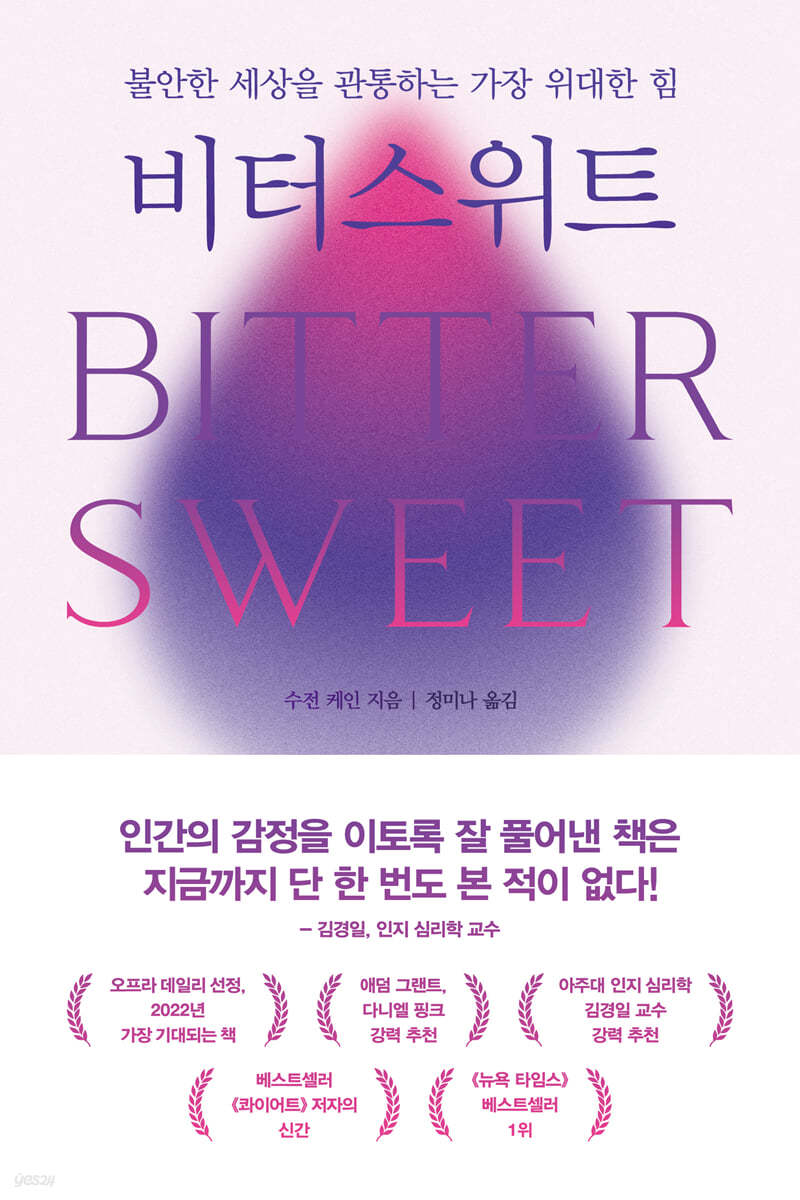
Bittersweet
 |
Description
Book Introduction
- A word from MD
-
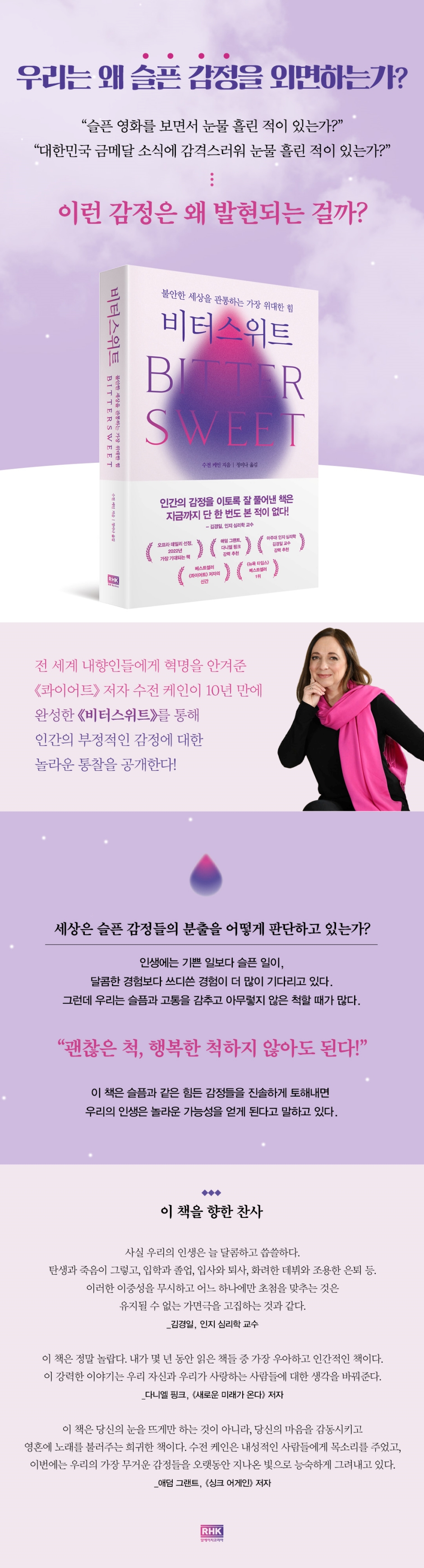
Life is inherently bitterIn a world where extroversion is praised, Susan Cain's new book, "Quiet," has drawn attention by shedding light on introversion.
We want our lives to be filled with happiness, joy, and romantic love, but reality isn't like that.
You can't avoid bitterness in life.
It reveals insights into the bittersweet emotions that make life bearable.
July 1, 2022. Humanities PD Son Min-gyu
A book that so well portrays human emotions
I've never seen it before!
* Oprah Daly's Most Anticipated Books of 2022
* #1 New York Times bestseller immediately after publication
* A new book from the author of the international bestseller 『Quiet』!
* Highly recommended by Adam Grant and Daniel Pink
* Highly recommended by Professor Kyung-il Kim of Cognitive Psychology at Ajou University
"Are you happy?" If someone asked you this question, how would you answer? Some people would confidently say, "Yes, I am happy!" while others would say, "No."
Some might say, somewhat cynically, “I’m unhappy!”
Is that all? "Sometimes I'm happy, and sometimes I'm unhappy," "Sometimes happiness and unhappiness come at the same time," "Sometimes I feel happy, and sometimes I feel unhappy," "I don't know." The happiness and unhappiness experienced by countless people manifest in a variety of ways.
So, you must have already felt a strange emotion that happiness and unhappiness cannot be divided into dichotomies.
What is this feeling that is difficult to express in words, but that everyone has felt at least once, and what meaning does it have in life?
Susan Cain, author of the sensational book "Quiet" among introverts, has come out with a book about human emotions that are both joyful and painful, sweet and bitter, after 10 years.
She named it "Bittersweet," meaning "bittersweet," and through various research data and autobiographical stories, she proves the power of bittersweet emotions to ultimately play a role in our lives and move us forward.
A study by a neuroscientist found that the same brain regions are activated when we help someone in need, win a prize, or eat a delicious meal.
Also, as we all know, people with depression tend to see the world from other people's perspectives and feel compassion, and people with high empathy tend to enjoy sad music more than others.
In other words, we can see that joy and sadness are inseparable emotions, like two sides of a coin.
It means that there is a continuum of bittersweet emotions, not joy and sadness separately.
Author Susan Cain explores the meaning of these conflicting emotions, particularly sadness, pain, and anxiety, for us living in the present, in a scientific yet literary tone.
I've never seen it before!
* Oprah Daly's Most Anticipated Books of 2022
* #1 New York Times bestseller immediately after publication
* A new book from the author of the international bestseller 『Quiet』!
* Highly recommended by Adam Grant and Daniel Pink
* Highly recommended by Professor Kyung-il Kim of Cognitive Psychology at Ajou University
"Are you happy?" If someone asked you this question, how would you answer? Some people would confidently say, "Yes, I am happy!" while others would say, "No."
Some might say, somewhat cynically, “I’m unhappy!”
Is that all? "Sometimes I'm happy, and sometimes I'm unhappy," "Sometimes happiness and unhappiness come at the same time," "Sometimes I feel happy, and sometimes I feel unhappy," "I don't know." The happiness and unhappiness experienced by countless people manifest in a variety of ways.
So, you must have already felt a strange emotion that happiness and unhappiness cannot be divided into dichotomies.
What is this feeling that is difficult to express in words, but that everyone has felt at least once, and what meaning does it have in life?
Susan Cain, author of the sensational book "Quiet" among introverts, has come out with a book about human emotions that are both joyful and painful, sweet and bitter, after 10 years.
She named it "Bittersweet," meaning "bittersweet," and through various research data and autobiographical stories, she proves the power of bittersweet emotions to ultimately play a role in our lives and move us forward.
A study by a neuroscientist found that the same brain regions are activated when we help someone in need, win a prize, or eat a delicious meal.
Also, as we all know, people with depression tend to see the world from other people's perspectives and feel compassion, and people with high empathy tend to enjoy sad music more than others.
In other words, we can see that joy and sadness are inseparable emotions, like two sides of a coin.
It means that there is a continuum of bittersweet emotions, not joy and sadness separately.
Author Susan Cain explores the meaning of these conflicting emotions, particularly sadness, pain, and anxiety, for us living in the present, in a scientific yet literary tone.
- You can preview some of the book's contents.
Preview
index
Review and Recommendation
Note
Opening remarks: The Cellist from Sarajevo
Introduction: The Power of Bittersweetness
PART 01 Sorrow and Longing
How can we transform suffering into creativity, transcendence, and love?
CHAPTER 01 What Use Is Sadness?
· The instinct for compassion that gave birth to the sadness of "Inside Out"
· Compassion that shaped Charles Darwin's worldview
· Transcendent, recognized as a bittersweet type
· Sadness is a wise being that also causes self-pity.
CHAPTER 02 Why do we long for perfect and unconditional love?
· Illusion of the lost half
· The sublime emotions contained in bittersweet music
· The power of longing that everyone feels but is difficult to explain
· In Sufiism, longing is both suffering and healing.
· Longing in "The Bridges of Madison County"
CHAPTER 03 How do sadness, longing, and transcendence relate to creativity?
· Sadness is the main emotion that stimulates creativity.
· The transcendence of Leonard Cohen's music
· Self-transcendence is the source of creativity.
· Make pain a sacrifice to creativity
CHAPTER 04 How to deal with the loss of love?
· The diary of a daughter who was emotionally murdered by her mother
· 3 Answers to Healing Your Heart When You Love But Want to Break Away
· How Oprah Winfrey Faces Hurt
· Become friends with loss
Love and loss go together like twins.
· In the end, love returns in a different form.
PART 02 Winners and Losers
How can we live and work with authenticity amidst the "tyranny of positivity"?
CHAPTER 05 How did a country built on painful wounds transform into a positive culture?
· American culture that denies sadness and longing
· A bitter American history that only recognizes the victors
A society where everything must be said to be very good
CHAPTER 06 How can we overcome the 'tyranny of positivity' in the workplace and society?
· The type of leader needed in a workplace where suffering is rampant
· Why it's necessary to feel sad at work
· Bittersweetness also affects performance.
· You are not a problematic person
PART 03 Death and Mourning
How should we live knowing that we will die someday?
CHAPTER 07 Should we pursue eternal life?
· What is the meaning of life without death?
Is eternal life possible in the Epic of Gilgamesh?
· Let us not deny the bittersweet nature of the human condition.
CHAPTER 08 Should we overcome the grief and impermanence of bereavement?
· The poet Isa's feelings about his fate to die
· Humans are born to wither
· Remember that you too are mortal.
· The attitude of those who have sent their children away first
· Don't pretend the sadness is gone.
CHAPTER 09 If suffering is inherited, how can it be transformed?
· People who live with sorrow
· Suffering can last for generations
· How to heal past wounds in the present
· Let's help people who are suffering similarly.
· Let us free ourselves from the pain of the past.
Conclusion: The Road Home
Acknowledgements
main
Note
Opening remarks: The Cellist from Sarajevo
Introduction: The Power of Bittersweetness
PART 01 Sorrow and Longing
How can we transform suffering into creativity, transcendence, and love?
CHAPTER 01 What Use Is Sadness?
· The instinct for compassion that gave birth to the sadness of "Inside Out"
· Compassion that shaped Charles Darwin's worldview
· Transcendent, recognized as a bittersweet type
· Sadness is a wise being that also causes self-pity.
CHAPTER 02 Why do we long for perfect and unconditional love?
· Illusion of the lost half
· The sublime emotions contained in bittersweet music
· The power of longing that everyone feels but is difficult to explain
· In Sufiism, longing is both suffering and healing.
· Longing in "The Bridges of Madison County"
CHAPTER 03 How do sadness, longing, and transcendence relate to creativity?
· Sadness is the main emotion that stimulates creativity.
· The transcendence of Leonard Cohen's music
· Self-transcendence is the source of creativity.
· Make pain a sacrifice to creativity
CHAPTER 04 How to deal with the loss of love?
· The diary of a daughter who was emotionally murdered by her mother
· 3 Answers to Healing Your Heart When You Love But Want to Break Away
· How Oprah Winfrey Faces Hurt
· Become friends with loss
Love and loss go together like twins.
· In the end, love returns in a different form.
PART 02 Winners and Losers
How can we live and work with authenticity amidst the "tyranny of positivity"?
CHAPTER 05 How did a country built on painful wounds transform into a positive culture?
· American culture that denies sadness and longing
· A bitter American history that only recognizes the victors
A society where everything must be said to be very good
CHAPTER 06 How can we overcome the 'tyranny of positivity' in the workplace and society?
· The type of leader needed in a workplace where suffering is rampant
· Why it's necessary to feel sad at work
· Bittersweetness also affects performance.
· You are not a problematic person
PART 03 Death and Mourning
How should we live knowing that we will die someday?
CHAPTER 07 Should we pursue eternal life?
· What is the meaning of life without death?
Is eternal life possible in the Epic of Gilgamesh?
· Let us not deny the bittersweet nature of the human condition.
CHAPTER 08 Should we overcome the grief and impermanence of bereavement?
· The poet Isa's feelings about his fate to die
· Humans are born to wither
· Remember that you too are mortal.
· The attitude of those who have sent their children away first
· Don't pretend the sadness is gone.
CHAPTER 09 If suffering is inherited, how can it be transformed?
· People who live with sorrow
· Suffering can last for generations
· How to heal past wounds in the present
· Let's help people who are suffering similarly.
· Let us free ourselves from the pain of the past.
Conclusion: The Road Home
Acknowledgements
main
Detailed image
Into the book
Two thousand years ago, Aristotle wondered why so many great poets, philosophers, artists, and politicians had melancholic personalities.2 Aristotle's question was based on the ancient theory of the four humors.
The human body is made up of four humors, each with a different temperament: melancholic (sad), sanguine (happy), choleric (aggressive), and phlegmatic (calm).
And it was believed that personality was determined by the specific gravity of these bodily fluids.
Hippocrates, the famous Greek physician, believed that the ideal person was one in which these four bodily fluids were in harmonious balance.3 However, most of us tend to lean in one direction or another.
In this book, I will focus on the melancholic side of this, and discuss what I call "bittersweetness."4 I will talk about the tendency to fall into feelings of longing, yearning, and sadness, the awareness of the impermanence of life, and the joy of being curious about and insightful about the beauty of the world.
--- p.23
The Doctor was worried that the executives would perceive Sadness as too gloomy and dark a character.
I was worried about how people would perceive the unattractive, squat, and gloomy image the animators had drawn.
It was worth pointing out why such a character was chosen as the lead role in the movie, and why anyone would sympathize with such a female character.
Then, I got an unexpected ally.
It was Dacher Keltner, a veteran psychology professor at the University of California, Berkeley.
The Doctor asked Keltner to teach him and his colleagues about the science of emotions, and this led to a close bond between the two.
At the time, Keltner's daughter was going through the pains of puberty like the doctor's daughter, so the two shared their unusual concerns and developed a close friendship.
Keltner explained to the Doctor and his team the roles of the main emotions, explaining that Fear keeps us safe, and Anger protects us from being taken advantage of.
So what is Sadness's role?
Keltner explained that sadness stimulates compassion and strengthens relationships between people, and that it also makes people realize how precious Pixar's film crew, a group of creative people, are to them.
--- p.49
The lecture also reminded us that we don't have a missing half.
“It’s a bit of a dark story, but there is no partner who understands everything about us and who communicates well with us in all aspects, big and small.
You have to accept that fact.
Ultimately, all we can aim for is the ratio of compatibility.
Let us return to Plato and together we shall completely kill his ecstatic but insane and love-destructive innocence.
“There is no soul mate.”
--- p.82
So far I've talked about how I loved and lost my mother, but I'm not telling this story because it's special.
Your story of love and loss, its bittersweet twists and turns, is special.
I know, painfully, that that story may be far more traumatic than mine (though I hope it's less so).
And yet, I know why I decided to tell my story, whether you consider it a small loss compared to the suffering of the world, or a great loss because (as we have seen with Darwin and the Dalai Lama) a mother is a symbol of love.
That you too have experienced the loss of love, or will experience such loss in the future.
And it took me decades to even understand, let alone heal (most of) the things I just talked about.
Perhaps the lessons I learned from that exaggeration can be useful to you too.
--- p.164~165
In their final meeting, Kafka gives the girl a doll along with a letter.
Knowing full well that the doll was different from the one the girl had lost, she wrote in the letter:
“I changed a bit while traveling.”
The girl cherishes the gift for the rest of her life.
And then one day, decades later, he finds another letter stuffed into the crack of the doll that he had overlooked.
“Everything you love is destined to be lost someday.
But in the end, love comes back in a different form.”
--- p.187
Today's society distinguishes between winners and losers more clearly than ever before.
As journalist Neal Gabler wrote in Salon in 2017, “America has a deepening divide between those who are recognized as winners (and who declare themselves winners) and those who are perceived by the winners as losers.
The losers were relegated to cultural pariah status, becoming the American equivalent of India's untouchables.
(Omitted) To be respected, including self-respect, you must be a winner.”
--- p.209
It's no coincidence that the phrase "perfection without effort" originated at America's elite universities, where young winners strive to maintain their edge.
This also comes at a time when rates of anxiety, depression, and suicide on campus are rising.
This is because this phenomenon is more about winning than perfection.
It's a question of trying to be a winner, so to speak, trying to fly high and avoid the bitter side of life, and not being a loser.
Even though "effortless perfection" is a popular slogan in many of our colleges and universities, its origins lie in the very cultural pressures we've been subjected to since the dawn of the American republic.
Add to this the new reality of growing inequality and social conflict, and the pressure to feel like a winner in a society that produces relatively few winners is intensifying.
--- p.219
As has long been known among researchers, the power of a leader is perceived differently depending on the emotions he or she displays.
In general, leaders who react with anger in difficult situations are perceived as more powerful than those who react with sadness.
In fact, when we looked at the bittersweet types of cases, we found that while creative people were readily apparent, business leaders were few and far between.
My guess is that this isn't because there aren't many melancholic managers, but because they don't reveal themselves to others as such.
But business professors Juan Madera and D.
Brent SmithD.
A 2009 study by Brent Smith found that sadness sometimes leads to better outcomes for leaders than anger (such as stronger relationships with followers and increased perceptions of effectiveness).
The human body is made up of four humors, each with a different temperament: melancholic (sad), sanguine (happy), choleric (aggressive), and phlegmatic (calm).
And it was believed that personality was determined by the specific gravity of these bodily fluids.
Hippocrates, the famous Greek physician, believed that the ideal person was one in which these four bodily fluids were in harmonious balance.3 However, most of us tend to lean in one direction or another.
In this book, I will focus on the melancholic side of this, and discuss what I call "bittersweetness."4 I will talk about the tendency to fall into feelings of longing, yearning, and sadness, the awareness of the impermanence of life, and the joy of being curious about and insightful about the beauty of the world.
--- p.23
The Doctor was worried that the executives would perceive Sadness as too gloomy and dark a character.
I was worried about how people would perceive the unattractive, squat, and gloomy image the animators had drawn.
It was worth pointing out why such a character was chosen as the lead role in the movie, and why anyone would sympathize with such a female character.
Then, I got an unexpected ally.
It was Dacher Keltner, a veteran psychology professor at the University of California, Berkeley.
The Doctor asked Keltner to teach him and his colleagues about the science of emotions, and this led to a close bond between the two.
At the time, Keltner's daughter was going through the pains of puberty like the doctor's daughter, so the two shared their unusual concerns and developed a close friendship.
Keltner explained to the Doctor and his team the roles of the main emotions, explaining that Fear keeps us safe, and Anger protects us from being taken advantage of.
So what is Sadness's role?
Keltner explained that sadness stimulates compassion and strengthens relationships between people, and that it also makes people realize how precious Pixar's film crew, a group of creative people, are to them.
--- p.49
The lecture also reminded us that we don't have a missing half.
“It’s a bit of a dark story, but there is no partner who understands everything about us and who communicates well with us in all aspects, big and small.
You have to accept that fact.
Ultimately, all we can aim for is the ratio of compatibility.
Let us return to Plato and together we shall completely kill his ecstatic but insane and love-destructive innocence.
“There is no soul mate.”
--- p.82
So far I've talked about how I loved and lost my mother, but I'm not telling this story because it's special.
Your story of love and loss, its bittersweet twists and turns, is special.
I know, painfully, that that story may be far more traumatic than mine (though I hope it's less so).
And yet, I know why I decided to tell my story, whether you consider it a small loss compared to the suffering of the world, or a great loss because (as we have seen with Darwin and the Dalai Lama) a mother is a symbol of love.
That you too have experienced the loss of love, or will experience such loss in the future.
And it took me decades to even understand, let alone heal (most of) the things I just talked about.
Perhaps the lessons I learned from that exaggeration can be useful to you too.
--- p.164~165
In their final meeting, Kafka gives the girl a doll along with a letter.
Knowing full well that the doll was different from the one the girl had lost, she wrote in the letter:
“I changed a bit while traveling.”
The girl cherishes the gift for the rest of her life.
And then one day, decades later, he finds another letter stuffed into the crack of the doll that he had overlooked.
“Everything you love is destined to be lost someday.
But in the end, love comes back in a different form.”
--- p.187
Today's society distinguishes between winners and losers more clearly than ever before.
As journalist Neal Gabler wrote in Salon in 2017, “America has a deepening divide between those who are recognized as winners (and who declare themselves winners) and those who are perceived by the winners as losers.
The losers were relegated to cultural pariah status, becoming the American equivalent of India's untouchables.
(Omitted) To be respected, including self-respect, you must be a winner.”
--- p.209
It's no coincidence that the phrase "perfection without effort" originated at America's elite universities, where young winners strive to maintain their edge.
This also comes at a time when rates of anxiety, depression, and suicide on campus are rising.
This is because this phenomenon is more about winning than perfection.
It's a question of trying to be a winner, so to speak, trying to fly high and avoid the bitter side of life, and not being a loser.
Even though "effortless perfection" is a popular slogan in many of our colleges and universities, its origins lie in the very cultural pressures we've been subjected to since the dawn of the American republic.
Add to this the new reality of growing inequality and social conflict, and the pressure to feel like a winner in a society that produces relatively few winners is intensifying.
--- p.219
As has long been known among researchers, the power of a leader is perceived differently depending on the emotions he or she displays.
In general, leaders who react with anger in difficult situations are perceived as more powerful than those who react with sadness.
In fact, when we looked at the bittersweet types of cases, we found that while creative people were readily apparent, business leaders were few and far between.
My guess is that this isn't because there aren't many melancholic managers, but because they don't reveal themselves to others as such.
But business professors Juan Madera and D.
Brent SmithD.
A 2009 study by Brent Smith found that sadness sometimes leads to better outcomes for leaders than anger (such as stronger relationships with followers and increased perceptions of effectiveness).
--- p.226
Publisher's Review
“It’s okay to cry if you’re sad!”
Emotions that are being rebuked in an optimistic world
You may remember the movie "Inside Out."
This is an animation that depicts the unpredictable emotions of an 11-year-old girl named Layla.
This is a film created by director Pete Docter, who has a daughter in her teens, based on his own.
After much deliberation over several emotions for the lead role, the Doctor decided to cast Sim-i as the central character of the film, along with Gip-i.
It is said that the fact that Sosim is an interesting character had some influence on the decision.
He said that he considered sadness, but he didn't think it would be attractive.
So, when the film's production entered its third year, the script was already complete, the animation was in some production, and a preview screening schedule for the pre-production footage had been set, but the director was troubled.
As the story progresses, Joy had to learn a very big lesson, but Sosim had nothing to teach her.
The director, who was so sad and despairing, realized the earnest love in the midst of sadness and changed the main character from timid to sad.
The film was a huge success, winning the Academy Award for Best Animated Feature and becoming Pixar's highest-grossing original film of all time.
We live with a variety of emotions: joy, sadness, fear, irritation, anger, etc.
Moreover, these emotions help us empathize with others.
But secretly, we also emphasize only joy.
Even in the actual movie, Joy hates Sadness.
I just want the main character, Layla, to be happy.
But our emotions should all be in harmony, but we often try to fit ourselves into societal standards.
Rather than honestly expressing our feelings in situations or with people around us, we often pretend to be okay when we are upset or to like something when we don't like it.
However, this book, "Bittersweet," emphasizes that we should express our sadness and not pretend that the sadness is gone.
The world cannot survive on joy alone.
In fact, he says there are more sad things than happy things.
When you truly let go of that sadness, the true joy and love that were hidden will be discovered.
“A surprising discovery about bittersweetness”
Negative emotions that stimulate creativity
There is an interesting research case.
An economist named Carol Jan Borowecki used language analysis software to study 1,400 letters written by Mozart, Liszt, and Beethoven throughout their lives.
He tracked whether the letters of three people mentioned positive emotions like happiness or negative emotions like sadness, and examined whether there was a relationship between the amount and nature of music composed during the period in which these emotions were mentioned.
As a result, the three artists' negative emotions were found to be related to their own creative output.
Additionally, scholars who study minor-key music have found that among the negative emotions expressed through music, only sadness is able to lift our mood.
Several other studies have also found that feeling sad generally makes attention sharper.
Feeling sad not only increases concentration and attention to detail, but also improves memory and corrects cognitive biases.
But let's look at the world.
When a friend gets angry or irritated, you comfort them by saying, “It’s okay, just bear with it.”
If you burst into tears because you're sad, they'll urge you, "Why are you crying over something like that? It's nothing serious, so don't cry."
When you say you are afraid or scared, they say, “You have to endure it, you have to overcome it.”
Such behavior ultimately becomes detrimental to living a healthy and creative life.
In a society plagued by positivity, where everything must be fine, everything must be good, everything must be okay, is sadness truly an emotion to be condemned and abandoned? This book re-evaluates emotions like sadness, pain, loss, separation, and anxiety, which have been so neglected, ignored, and even distorted.
Just as Susan Cain's book "Quiet" helped introverts discover new strength, this book "Bittersweet" should also be of interest to those who are more sensitive and delicate than others to melancholy, bittersweet emotions, or sad feelings.
This book tells exactly these types of people, “You are not the one with the problem.”
And we help them discover their creativity and provide solutions that turn their pain into joy.
Emotions that are being rebuked in an optimistic world
You may remember the movie "Inside Out."
This is an animation that depicts the unpredictable emotions of an 11-year-old girl named Layla.
This is a film created by director Pete Docter, who has a daughter in her teens, based on his own.
After much deliberation over several emotions for the lead role, the Doctor decided to cast Sim-i as the central character of the film, along with Gip-i.
It is said that the fact that Sosim is an interesting character had some influence on the decision.
He said that he considered sadness, but he didn't think it would be attractive.
So, when the film's production entered its third year, the script was already complete, the animation was in some production, and a preview screening schedule for the pre-production footage had been set, but the director was troubled.
As the story progresses, Joy had to learn a very big lesson, but Sosim had nothing to teach her.
The director, who was so sad and despairing, realized the earnest love in the midst of sadness and changed the main character from timid to sad.
The film was a huge success, winning the Academy Award for Best Animated Feature and becoming Pixar's highest-grossing original film of all time.
We live with a variety of emotions: joy, sadness, fear, irritation, anger, etc.
Moreover, these emotions help us empathize with others.
But secretly, we also emphasize only joy.
Even in the actual movie, Joy hates Sadness.
I just want the main character, Layla, to be happy.
But our emotions should all be in harmony, but we often try to fit ourselves into societal standards.
Rather than honestly expressing our feelings in situations or with people around us, we often pretend to be okay when we are upset or to like something when we don't like it.
However, this book, "Bittersweet," emphasizes that we should express our sadness and not pretend that the sadness is gone.
The world cannot survive on joy alone.
In fact, he says there are more sad things than happy things.
When you truly let go of that sadness, the true joy and love that were hidden will be discovered.
“A surprising discovery about bittersweetness”
Negative emotions that stimulate creativity
There is an interesting research case.
An economist named Carol Jan Borowecki used language analysis software to study 1,400 letters written by Mozart, Liszt, and Beethoven throughout their lives.
He tracked whether the letters of three people mentioned positive emotions like happiness or negative emotions like sadness, and examined whether there was a relationship between the amount and nature of music composed during the period in which these emotions were mentioned.
As a result, the three artists' negative emotions were found to be related to their own creative output.
Additionally, scholars who study minor-key music have found that among the negative emotions expressed through music, only sadness is able to lift our mood.
Several other studies have also found that feeling sad generally makes attention sharper.
Feeling sad not only increases concentration and attention to detail, but also improves memory and corrects cognitive biases.
But let's look at the world.
When a friend gets angry or irritated, you comfort them by saying, “It’s okay, just bear with it.”
If you burst into tears because you're sad, they'll urge you, "Why are you crying over something like that? It's nothing serious, so don't cry."
When you say you are afraid or scared, they say, “You have to endure it, you have to overcome it.”
Such behavior ultimately becomes detrimental to living a healthy and creative life.
In a society plagued by positivity, where everything must be fine, everything must be good, everything must be okay, is sadness truly an emotion to be condemned and abandoned? This book re-evaluates emotions like sadness, pain, loss, separation, and anxiety, which have been so neglected, ignored, and even distorted.
Just as Susan Cain's book "Quiet" helped introverts discover new strength, this book "Bittersweet" should also be of interest to those who are more sensitive and delicate than others to melancholy, bittersweet emotions, or sad feelings.
This book tells exactly these types of people, “You are not the one with the problem.”
And we help them discover their creativity and provide solutions that turn their pain into joy.
GOODS SPECIFICS
- Publication date: June 24, 2022
- Page count, weight, size: 408 pages | 616g | 140*210*30mm
- ISBN13: 9788925577982
- ISBN10: 8925577984
You may also like
카테고리
korean


korean

![ELLE 엘르 스페셜 에디션 A형 : 12월 [2025]](http://librairie.coreenne.fr/cdn/shop/files/b8e27a3de6c9538896439686c6b0e8fb.jpg?v=1766436872&width=3840)


