

THE FIRST CELL
 |
Description
Book Introduction
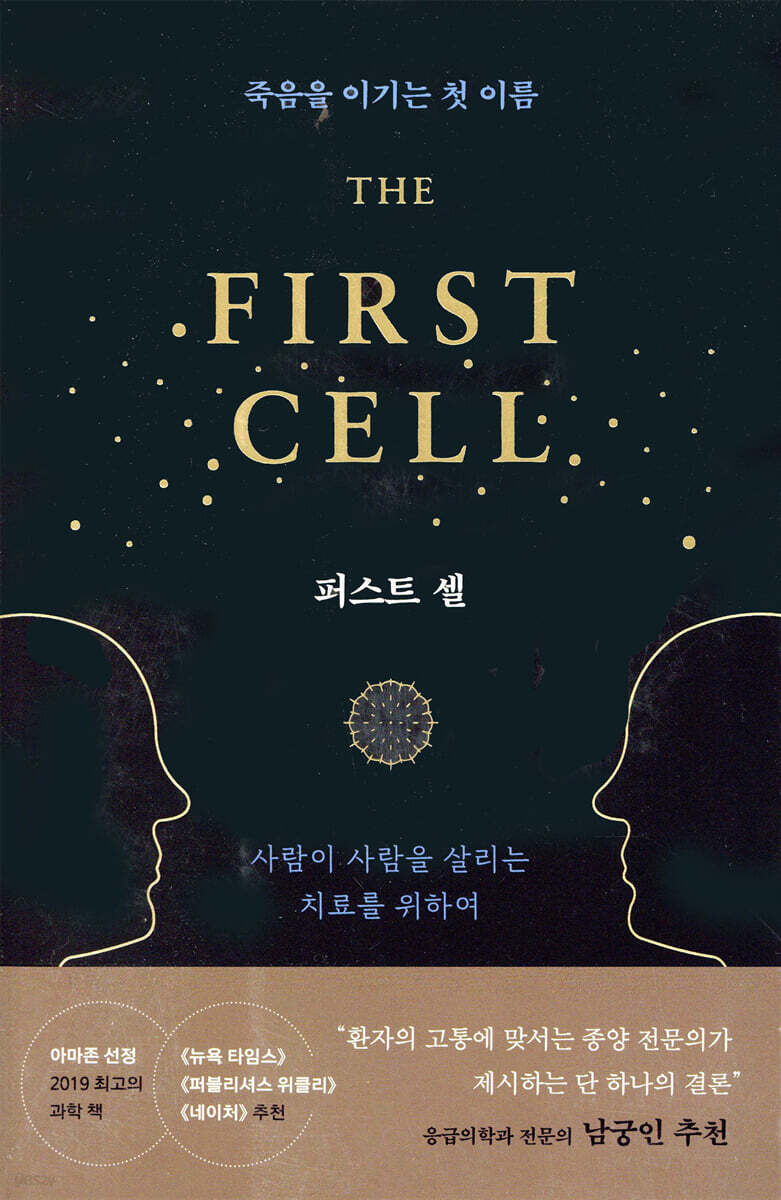
A book by Azra Raza, a world-renowned oncologist who has dedicated her life to treating cancer patients and researching cancer. It talks about the changes in cancer research and treatment that save patients. Named a "Best Science Book of 2019" by Amazon and Smithsonian, recommended by The New York Times, Publisher's Weekly, and Nature, and recommended by Pulitzer Prize-winning author and physician Siddhartha Mukherjee. In the Korean version, Namgung In, an emergency medicine specialist and writer, supervised the book and wrote the recommendation. Azra Raja's message is simple. “We need to find the first cancer cell, not the last.” Currently, the medical community treats cancer by finding the last cancer cell when it has spread and killing it. Ultimately, this creates a situation where the patient's entire body suffers in order to kill cancer cells, a situation called 'treatment killing the patient.' In this situation, patients waver, unable to give up hope on the new drugs that are appearing here and there, and ultimately end up dying in extreme pain, unable to choose between life and death. The authors argue for a paradigm shift in treatment by identifying and eradicating the first cancer cells, or first cells, before they can develop into malignant cells. The idea is to shift the focus of all cancer research, cancer treatment, and cancer prevention toward finding the first cancer cell to form. Dr. Raja asks: “Why is science silent on the suffering of patients?” This book tells the story of patients who had to leave in pain and of her husband who passed away from cancer. Readers feel the human agony of doctors facing the suffering of their patients, and before they know it, they are deeply moved. This book illuminates the current state of cancer research, while also being a heartbreaking account of the struggles of doctors and patients within it. The author's writing skills, which are also deeply versed in literature, shine throughout. |
- You can preview some of the book's contents.
Preview
index
A Letter of Recommendation - Sentencing Life to Others Countless Times (Namgung In)
Prologue - Cancer and the Suffering of Cancer
Introductory remarks - from last to first
1.
Omar
This is the nobility of life.
2.
fur
Sand piles and rocks
3.
Lady N.
loaded gun
4.
Kitty C.
Where is the wound that does not heal slowly?
5. JC
Experiencing nature's wonders makes you more attuned to it.
6.
Andrew
Was honesty a choice?
7.
Harvey
Death stares at him.
He also shoots back
Oh, and after that - language to sadness
Epilogue - Dawn Has Already Come
Prologue - Cancer and the Suffering of Cancer
Introductory remarks - from last to first
1.
Omar
This is the nobility of life.
2.
fur
Sand piles and rocks
3.
Lady N.
loaded gun
4.
Kitty C.
Where is the wound that does not heal slowly?
5. JC
Experiencing nature's wonders makes you more attuned to it.
6.
Andrew
Was honesty a choice?
7.
Harvey
Death stares at him.
He also shoots back
Oh, and after that - language to sadness
Epilogue - Dawn Has Already Come
Detailed image

Into the book
I wouldn't have been able to write this book when I was thirty.
I'm not saying this because I made some great discovery or wrote some research paper after I turned thirty.
During this time, I have met thousands of cancer patients and witnessed the deaths of many of them.
The disease I deal with is usually fatal.
So, even words of comfort sound contrived, and personal achievements in academia seem out of place.
The working environment doesn't seem to have changed much.
On the other hand, my thoughts have changed.
--- p.21
Treating cancer as a single disease is like treating the continent of Africa as a single country.
Even if cancer occurs in the same patient, cancers that occur in different locations or at different times are not the same disease.
This vicious and self-centered disease learns to grow rapidly, becoming stronger, smarter, and more dangerous each time it divides.
A perfect example of molecular intelligence.
They are able to perceive their surroundings and move to maximize their chances of survival.
--- p.28
Cancer learns to divide more vigorously over time.
They invade new spaces, mutate to turn relevant genes on and off, try to better adapt to their environment, and make the most of the cooperation between the seed (the cancer cell) and the soil (the microenvironment in which the cancer takes root).
We witness the transformation of cancer firsthand.
When treatment causes a tumor in one area to disappear, fresh lesions with a new genotype arise in other areas.
A newly selected genotype because the treatment used on the patient did not work.
Like a mini Frankenstein, cancer haunts the body's machinery like a ghost, bent on destroying its creator.
--- p.28
Cancer is a profound tragedy on an intimate personal level, devastating the lives of patients and their families, taking a financial and social toll, and leaving psychological trauma.
Do we truly understand these facts? Above all, are we treating cancer patients in the best possible way? Shouldn't some of the harsh measures we currently use be reconsidered? If we constantly have to ask ourselves whether it's the cancer or the treatment that's killing the patient, are our solutions even good? Which is worse? Someone aptly pointed out.
Using chemotherapy, immunotherapy, and stem cell transplants to treat cancer is like swinging a baseball bat at a dog to get rid of its fleas.
So how can this be considered the best treatment?
--- p.32
Oncologists treated Omar with experimental drugs and chemoradiation, believing they offered at least a chance of a response.
Whatever the chances are.
But the problem is not simple.
The medication he received ultimately did not help.
The advice he received was also problematic.
The advice we gave him may not have been realistic or honest.
Perhaps it would have been better to encourage him to enjoy life for however long he has left.
Instead of enduring the stomach-churning, red bumps on my neck and the disgusting, tasteless liquid I drink every time I have a round of chemotherapy.
--- p.57
In this book, I wanted to write, from the beginning, about the intimate aspects of cancer that people who have experienced the pain of cancer keep hidden like secrets.
This is because I strongly believed that empathy would be the driving force when our society and science seek to achieve fundamental transformations like quantum leaps, rather than unbearably slow progress.
Only the profound suffering of a cancer patient can ignite the passion needed to achieve dramatic change in a short period of time.
The field of oncology is a stubborn, foolish mess, and only empathy can break it.
The future lies not in chasing the last cancer cell, but in preventing cancer by identifying ultra-early markers that signal the first cancer cell.
I've been telling this story since 1984, and I'll keep telling it until someone listens.
I'm not saying this because I made some great discovery or wrote some research paper after I turned thirty.
During this time, I have met thousands of cancer patients and witnessed the deaths of many of them.
The disease I deal with is usually fatal.
So, even words of comfort sound contrived, and personal achievements in academia seem out of place.
The working environment doesn't seem to have changed much.
On the other hand, my thoughts have changed.
--- p.21
Treating cancer as a single disease is like treating the continent of Africa as a single country.
Even if cancer occurs in the same patient, cancers that occur in different locations or at different times are not the same disease.
This vicious and self-centered disease learns to grow rapidly, becoming stronger, smarter, and more dangerous each time it divides.
A perfect example of molecular intelligence.
They are able to perceive their surroundings and move to maximize their chances of survival.
--- p.28
Cancer learns to divide more vigorously over time.
They invade new spaces, mutate to turn relevant genes on and off, try to better adapt to their environment, and make the most of the cooperation between the seed (the cancer cell) and the soil (the microenvironment in which the cancer takes root).
We witness the transformation of cancer firsthand.
When treatment causes a tumor in one area to disappear, fresh lesions with a new genotype arise in other areas.
A newly selected genotype because the treatment used on the patient did not work.
Like a mini Frankenstein, cancer haunts the body's machinery like a ghost, bent on destroying its creator.
--- p.28
Cancer is a profound tragedy on an intimate personal level, devastating the lives of patients and their families, taking a financial and social toll, and leaving psychological trauma.
Do we truly understand these facts? Above all, are we treating cancer patients in the best possible way? Shouldn't some of the harsh measures we currently use be reconsidered? If we constantly have to ask ourselves whether it's the cancer or the treatment that's killing the patient, are our solutions even good? Which is worse? Someone aptly pointed out.
Using chemotherapy, immunotherapy, and stem cell transplants to treat cancer is like swinging a baseball bat at a dog to get rid of its fleas.
So how can this be considered the best treatment?
--- p.32
Oncologists treated Omar with experimental drugs and chemoradiation, believing they offered at least a chance of a response.
Whatever the chances are.
But the problem is not simple.
The medication he received ultimately did not help.
The advice he received was also problematic.
The advice we gave him may not have been realistic or honest.
Perhaps it would have been better to encourage him to enjoy life for however long he has left.
Instead of enduring the stomach-churning, red bumps on my neck and the disgusting, tasteless liquid I drink every time I have a round of chemotherapy.
--- p.57
In this book, I wanted to write, from the beginning, about the intimate aspects of cancer that people who have experienced the pain of cancer keep hidden like secrets.
This is because I strongly believed that empathy would be the driving force when our society and science seek to achieve fundamental transformations like quantum leaps, rather than unbearably slow progress.
Only the profound suffering of a cancer patient can ignite the passion needed to achieve dramatic change in a short period of time.
The field of oncology is a stubborn, foolish mess, and only empathy can break it.
The future lies not in chasing the last cancer cell, but in preventing cancer by identifying ultra-early markers that signal the first cancer cell.
I've been telling this story since 1984, and I'll keep telling it until someone listens.
--- p.387
Publisher's Review
What is the first cell?
The first cell the author is talking about is the cell before cancer occurs.
If we can find those cells and prevent cancer from starting, we can be free from cancer.
The current medical community is only looking for the last cell.
Dr. Azra, an oncologist and oncologist, says the current treatment approach, which focuses on killing the last cancer cells, must be completely overhauled, as cancer cells grow unpredictably and spread uncontrollably.
What he advocates is a scientific and concrete method that goes beyond early detection and prevention.
Finding the 'first cell' means finding and eradicating the cell at its infancy stage before it grows into a malignant cell.
Given the high cost of current treatments that seek out the last cell, Dr. Raja says, simply shifting that money, manpower, and energy to finding the first cell could offer new hope for cancer research.
If you just change direction from the end to the beginning, everything will change.
Just as turning the ship's direction changes the direction of the waves and the target point.
Ultimately, the author says, the purpose of all treatment is to 'alleviate human suffering', and that is the doctor's job.
The greatest cost of finding the last cell is the suffering of the patients and the helplessness of the doctors who witness their suffering.
He has been consistently advocating for a change in the way cancer research is conducted in the scientific and medical communities.
And this book is the definitive edition of the scientific, medical, and humanistic claims he has been making for nearly 30 years since he was 28.
Current cancer research is fundamentally flawed; we need to shift from animal research to human research.
The author says that not only is the direction of cancer research wrong, but the target of cancer research is also wrong.
What the author particularly criticizes are cancer studies based on animal studies.
The authors are adamant that research on animals cannot provide a direct translation to human treatments.
Once cancer cells arise, their proliferation patterns change completely depending on each individual's DNA characteristics.
The rate of proliferation is unpredictable, taking from 3 months for some to 14 years for others.
In fact, it is no exaggeration to say that in the 50 years of cancer research, there have been very few cases in which animal research has shown results when applied to humans.
Although numerous animal studies have reported successes, few have actually been effective when applied to humans.
The human variable is unpredictable.
The idea that animal models can be applied as is is nothing but reductionist arrogance.
Animal studies cannot explain the evolution of cancer cells in the human body.
That is why the author argues that we should stop animal research and focus on 'human research'.
Dr. Raja realized the need for 'human research' in 1984 when he was 28 years old, and has been collecting and studying the DNA of his patients, and has now created a tissue bank with nearly 60,000 samples.
His patients agreed with his thinking, and he continues to insist on this, if only for the sake of the devotion of those he has sent away.
A doctor's human confession of seeing a patient's suffering
What makes this book special, despite being a scientific book, is that the author's claims are supported by the pain of each and every patient he had to say goodbye to.
Each chapter title in this book is the name of a patient the author has sent away.
Among those names is the author's husband, who was also a doctor.
Each chapter unfolds the story of a patient who suffered from cancer until the very end.
The author, while heartbroken by the suffering, also expresses awe as he looks upon the human being who bravely fights against the pain before the end.
This book reaches a literary level in the author's lament over the current state of cancer research while observing the patients' final moments, their confessions that no one has revealed, and their suffering.
This book, with its unique spectrum of scientific arguments expressed through the patient's suffering and ending with literary language, will resonate with readers interested in science, those who have lost someone close to them to cancer, and those who long to read the intimate confessions of doctors.
The stories of the patients' families, those left behind, words for sorrow.
Cancer has a tremendous impact not only on the patient's life, but also on the life of their family.
The book also features stories from patients' families.
Cancer patients and their families face a constant stream of choices from the moment they are diagnosed with cancer.
Which treatment to choose, whether to undergo more surgery, or whether to forgo treatment.
The author asks the patient's family what choices they would make if they could go back to the beginning.
They hope that the patient made a choice that was not even slightly painful.
A wife whose husband died of cancer says the trip she took secretly was the best decision she could have made - 'if I had told the doctor, he would have been against it'.
Conversely, he says that the choice he would not have made again was to undergo seven surgeries right up until his death.
His pain always got worse after the surgery, and his wife regrets that she wished her husband had passed away with less pain.
Some families say they regret not being able to put their loved one's final moments in order because they fought the illness without any thought to death.
They say we should have talked more about death and dying with families, and that we should have shared sooner why patients choose certain treatments.
Because the topic of cancer is closely linked to death, this book is not only a story about cancer research, but also a story about humans facing death.
The author is moved by the human condition in the face of death and deeply empathizes with the stories of the families of the patients who remain.
As a family member of a cancer patient who lost her husband, the stories he heard from patients soon became his own story.
A book that shows that empathy is as important to cancer patients as prescription medication.
It elicits empathy and understanding that cannot be achieved through purely scientific explanation.
- [Publisher's Weekly]
A book that tells the stories of patients and their families in a literary yet scientific way.
We can't help but listen to her story.
It opens new horizons in cancer research that could help overcome today's suffering.
- [Kirkus]
The first cell the author is talking about is the cell before cancer occurs.
If we can find those cells and prevent cancer from starting, we can be free from cancer.
The current medical community is only looking for the last cell.
Dr. Azra, an oncologist and oncologist, says the current treatment approach, which focuses on killing the last cancer cells, must be completely overhauled, as cancer cells grow unpredictably and spread uncontrollably.
What he advocates is a scientific and concrete method that goes beyond early detection and prevention.
Finding the 'first cell' means finding and eradicating the cell at its infancy stage before it grows into a malignant cell.
Given the high cost of current treatments that seek out the last cell, Dr. Raja says, simply shifting that money, manpower, and energy to finding the first cell could offer new hope for cancer research.
If you just change direction from the end to the beginning, everything will change.
Just as turning the ship's direction changes the direction of the waves and the target point.
Ultimately, the author says, the purpose of all treatment is to 'alleviate human suffering', and that is the doctor's job.
The greatest cost of finding the last cell is the suffering of the patients and the helplessness of the doctors who witness their suffering.
He has been consistently advocating for a change in the way cancer research is conducted in the scientific and medical communities.
And this book is the definitive edition of the scientific, medical, and humanistic claims he has been making for nearly 30 years since he was 28.
Current cancer research is fundamentally flawed; we need to shift from animal research to human research.
The author says that not only is the direction of cancer research wrong, but the target of cancer research is also wrong.
What the author particularly criticizes are cancer studies based on animal studies.
The authors are adamant that research on animals cannot provide a direct translation to human treatments.
Once cancer cells arise, their proliferation patterns change completely depending on each individual's DNA characteristics.
The rate of proliferation is unpredictable, taking from 3 months for some to 14 years for others.
In fact, it is no exaggeration to say that in the 50 years of cancer research, there have been very few cases in which animal research has shown results when applied to humans.
Although numerous animal studies have reported successes, few have actually been effective when applied to humans.
The human variable is unpredictable.
The idea that animal models can be applied as is is nothing but reductionist arrogance.
Animal studies cannot explain the evolution of cancer cells in the human body.
That is why the author argues that we should stop animal research and focus on 'human research'.
Dr. Raja realized the need for 'human research' in 1984 when he was 28 years old, and has been collecting and studying the DNA of his patients, and has now created a tissue bank with nearly 60,000 samples.
His patients agreed with his thinking, and he continues to insist on this, if only for the sake of the devotion of those he has sent away.
A doctor's human confession of seeing a patient's suffering
What makes this book special, despite being a scientific book, is that the author's claims are supported by the pain of each and every patient he had to say goodbye to.
Each chapter title in this book is the name of a patient the author has sent away.
Among those names is the author's husband, who was also a doctor.
Each chapter unfolds the story of a patient who suffered from cancer until the very end.
The author, while heartbroken by the suffering, also expresses awe as he looks upon the human being who bravely fights against the pain before the end.
This book reaches a literary level in the author's lament over the current state of cancer research while observing the patients' final moments, their confessions that no one has revealed, and their suffering.
This book, with its unique spectrum of scientific arguments expressed through the patient's suffering and ending with literary language, will resonate with readers interested in science, those who have lost someone close to them to cancer, and those who long to read the intimate confessions of doctors.
The stories of the patients' families, those left behind, words for sorrow.
Cancer has a tremendous impact not only on the patient's life, but also on the life of their family.
The book also features stories from patients' families.
Cancer patients and their families face a constant stream of choices from the moment they are diagnosed with cancer.
Which treatment to choose, whether to undergo more surgery, or whether to forgo treatment.
The author asks the patient's family what choices they would make if they could go back to the beginning.
They hope that the patient made a choice that was not even slightly painful.
A wife whose husband died of cancer says the trip she took secretly was the best decision she could have made - 'if I had told the doctor, he would have been against it'.
Conversely, he says that the choice he would not have made again was to undergo seven surgeries right up until his death.
His pain always got worse after the surgery, and his wife regrets that she wished her husband had passed away with less pain.
Some families say they regret not being able to put their loved one's final moments in order because they fought the illness without any thought to death.
They say we should have talked more about death and dying with families, and that we should have shared sooner why patients choose certain treatments.
Because the topic of cancer is closely linked to death, this book is not only a story about cancer research, but also a story about humans facing death.
The author is moved by the human condition in the face of death and deeply empathizes with the stories of the families of the patients who remain.
As a family member of a cancer patient who lost her husband, the stories he heard from patients soon became his own story.
A book that shows that empathy is as important to cancer patients as prescription medication.
It elicits empathy and understanding that cannot be achieved through purely scientific explanation.
- [Publisher's Weekly]
A book that tells the stories of patients and their families in a literary yet scientific way.
We can't help but listen to her story.
It opens new horizons in cancer research that could help overcome today's suffering.
- [Kirkus]
GOODS SPECIFICS
- Publication date: November 5, 2020
- Format: Paperback book binding method guide
- Page count, weight, size: 432 pages | 606g | 145*220*30mm
- ISBN13: 9791155813157
- ISBN10: 1155813154
You may also like
카테고리
korean


korean

![GQ KOREA Mark (Monthly): December [2025]](http://librairie.coreenne.fr/cdn/shop/files/8ef265dbbfbf186523ed75ba7319009d.jpg?v=1765340328&width=3840)


