

Emotion vocabulary
 |
Description
Book Introduction
- A word from MD
-
Knowing the vocabulary reveals the emotionsUnderstanding my emotions is essential for peace of mind and harmonious relationships.
If you struggle to accept and express your emotions, it may be due to a lack of vocabulary.
This book introduces a variety of vocabulary needed to understand ambiguous emotions and helps you use words appropriately for the situation.
May 31, 2022. Humanities PD Son Min-gyu
In a wide variety of situations, people use vague expressions like “I’m stressed” or “I’m annoyed.”
Then, I think about various stress relief methods.
But the real feelings that lie beneath these expressions vary from person to person and from situation to situation.
When you say “stress,” you might mean you’re angry, but you might also mean you’re anxious, scared, or bored.
You may say, “I’m annoyed,” but you may actually be feeling a sense of self-pity, hostility, guilt, exhaustion, or frustration.
Whether it's problem solving or emotional regulation, knowing your true feelings comes first.
Author Yoo Seon-gyeong, who brought to light the importance of 'vocabulary' for adults in a new light in 'Adult Vocabulary', says in 'Emotional Vocabulary' that numerous problems in psychology, communication, and relationships can be solved simply by correctly recognizing the emotions I am feeling and expressing them with the right vocabulary.
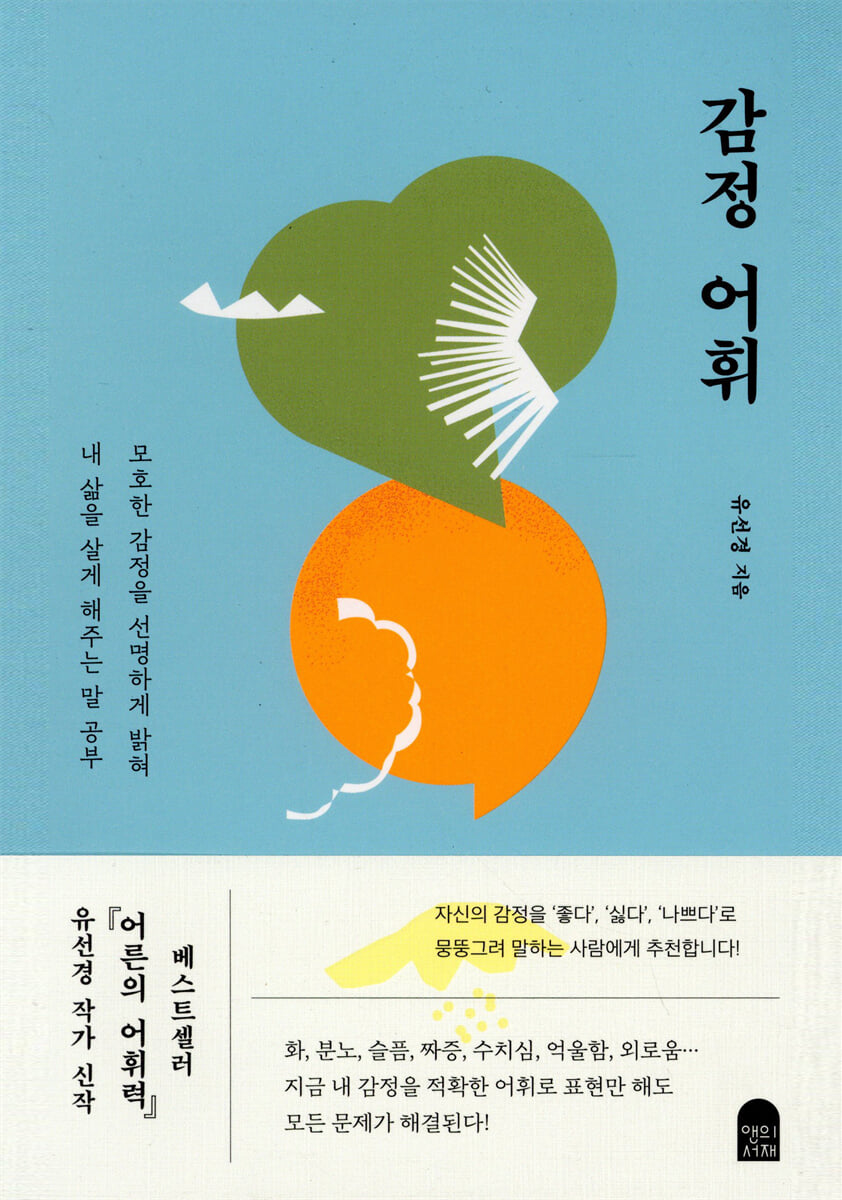
"Emotional Vocabulary" is a book about distinguishing emotions and assigning appropriate vocabulary to them as a way to find a compass in life.
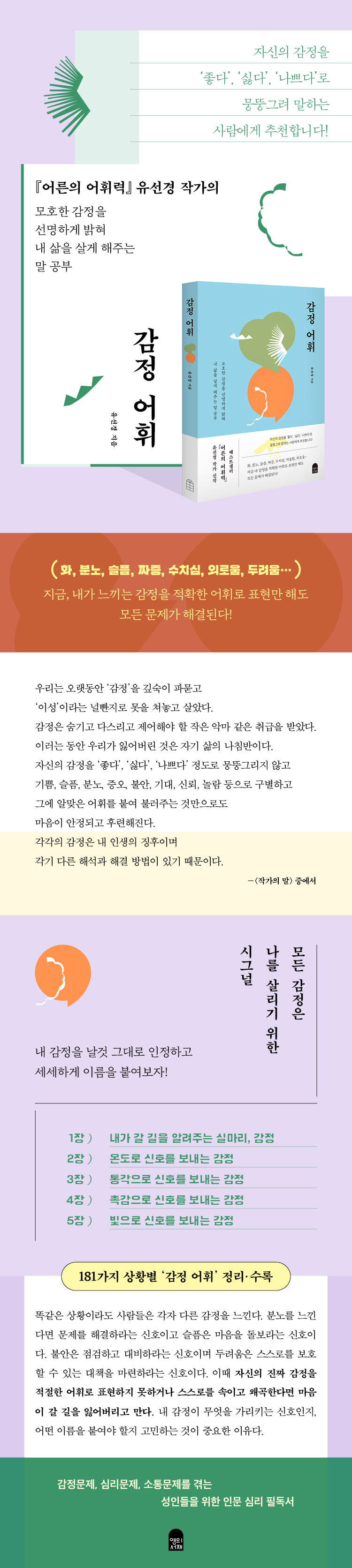
It consists of five chapters. Chapter 1 provides an overview of emotions, while chapters 2 through 5 examine emotions using the senses of temperature, pain, touch, and light.
And at the end of each chapter, emotional vocabulary is categorized and organized according to each emotion.
Let's express the feelings I'm feeling right now with appropriate vocabulary!
Then, I think about various stress relief methods.
But the real feelings that lie beneath these expressions vary from person to person and from situation to situation.
When you say “stress,” you might mean you’re angry, but you might also mean you’re anxious, scared, or bored.
You may say, “I’m annoyed,” but you may actually be feeling a sense of self-pity, hostility, guilt, exhaustion, or frustration.
Whether it's problem solving or emotional regulation, knowing your true feelings comes first.
Author Yoo Seon-gyeong, who brought to light the importance of 'vocabulary' for adults in a new light in 'Adult Vocabulary', says in 'Emotional Vocabulary' that numerous problems in psychology, communication, and relationships can be solved simply by correctly recognizing the emotions I am feeling and expressing them with the right vocabulary.
"Emotional Vocabulary" is a book about distinguishing emotions and assigning appropriate vocabulary to them as a way to find a compass in life.
It consists of five chapters. Chapter 1 provides an overview of emotions, while chapters 2 through 5 examine emotions using the senses of temperature, pain, touch, and light.
And at the end of each chapter, emotional vocabulary is categorized and organized according to each emotion.
Let's express the feelings I'm feeling right now with appropriate vocabulary!
- You can preview some of the book's contents.
Preview
index
Author's Note: Adding vocabulary that fits my emotions
Chapter 1.
Emotions, the clues that show me the way to go
Emotions wait for a response
1.
Everything starts with my feelings.
2.
Pretend it's not like that, pretend it's like that, pretend it's nothing
3.
Let's name my feelings in detail.
4.
Emotions are the mind's response to stimuli.
5.
The process of developing my individuality, subjectivity, and uniqueness
2.
Emotions that signal with temperature
From 'hot' to 'cold' and everything in between
1.
All emotions are signals to keep me alive
2.
Am I living as myself?
3.
About lukewarm feelings
4.
The problem isn't getting tied up, it's not being able to untie it.
5.
Emotions that freeze a person's heart
[Temperature-related emotional vocabulary] Let's express the emotions I'm feeling right now with appropriate vocabulary!
3.
Emotions that signal pain
From 'sick' to 'tingling' and everything in between
1.
The pain of being sick vs. the difficulty of being anxious
2.
Listen to my emotions as they respond to pain.
3.
Why You Fail to Regulate Your Emotions
4.
Living a good life means experiencing all emotions.
5.
A feeling, a pain, that is difficult to tie into one thing
6.
The message that worry gives us
7.
Distinguish between anxiety and fear and face reality.
8.
If there were no precious things, would there be no joy, no sorrow, no fear?
9.
Even if you experience the same thing, you can remember it with different emotions.
10.
How to Cope with Grief
11.
Tears, a liquid hug
[Emotional Vocabulary for Appreciation] Let's express the emotions I'm feeling right now with appropriate vocabulary!
4.
Emotions that signal through touch
From 'smooth' to 'rough' and everything in between
1.
Be brave and bold in the direction your emotions point you.
2.
My emotional utopia
3.
Gentleness increases the resilience of the mind.
4.
The Reality of the Emotion Hidden in the Word 'Stress'
5.
Anger passes, but hatred never goes away.
6.
What happens when you lack sensitivity to insults
7.
Everyone has that one "Ugh!" moment.
8.
Shifting your perspective broadens your thinking.
9.
In moments of despair, let me persevere and bless myself.
[Tactile Emotion Vocabulary] Let's express the emotions I'm feeling right now with appropriate vocabulary!
5.
Emotions that signal with light
From 'bright' to 'dark' and everything in between
1.
Elements that bring joy to life
2.
Bright sunshine isn't the only answer to growing up.
3.
About the emotions of 'envy' and 'jealousy'
4.
Envy is a dual emotion of anger and sadness.
5.
Why You're Not Confident
6.
You have to shake it even if it's on purpose
7.
The signal that loneliness points to me
8.
We still need ??
Chapter 1.
Emotions, the clues that show me the way to go
Emotions wait for a response
1.
Everything starts with my feelings.
2.
Pretend it's not like that, pretend it's like that, pretend it's nothing
3.
Let's name my feelings in detail.
4.
Emotions are the mind's response to stimuli.
5.
The process of developing my individuality, subjectivity, and uniqueness
2.
Emotions that signal with temperature
From 'hot' to 'cold' and everything in between
1.
All emotions are signals to keep me alive
2.
Am I living as myself?
3.
About lukewarm feelings
4.
The problem isn't getting tied up, it's not being able to untie it.
5.
Emotions that freeze a person's heart
[Temperature-related emotional vocabulary] Let's express the emotions I'm feeling right now with appropriate vocabulary!
3.
Emotions that signal pain
From 'sick' to 'tingling' and everything in between
1.
The pain of being sick vs. the difficulty of being anxious
2.
Listen to my emotions as they respond to pain.
3.
Why You Fail to Regulate Your Emotions
4.
Living a good life means experiencing all emotions.
5.
A feeling, a pain, that is difficult to tie into one thing
6.
The message that worry gives us
7.
Distinguish between anxiety and fear and face reality.
8.
If there were no precious things, would there be no joy, no sorrow, no fear?
9.
Even if you experience the same thing, you can remember it with different emotions.
10.
How to Cope with Grief
11.
Tears, a liquid hug
[Emotional Vocabulary for Appreciation] Let's express the emotions I'm feeling right now with appropriate vocabulary!
4.
Emotions that signal through touch
From 'smooth' to 'rough' and everything in between
1.
Be brave and bold in the direction your emotions point you.
2.
My emotional utopia
3.
Gentleness increases the resilience of the mind.
4.
The Reality of the Emotion Hidden in the Word 'Stress'
5.
Anger passes, but hatred never goes away.
6.
What happens when you lack sensitivity to insults
7.
Everyone has that one "Ugh!" moment.
8.
Shifting your perspective broadens your thinking.
9.
In moments of despair, let me persevere and bless myself.
[Tactile Emotion Vocabulary] Let's express the emotions I'm feeling right now with appropriate vocabulary!
5.
Emotions that signal with light
From 'bright' to 'dark' and everything in between
1.
Elements that bring joy to life
2.
Bright sunshine isn't the only answer to growing up.
3.
About the emotions of 'envy' and 'jealousy'
4.
Envy is a dual emotion of anger and sadness.
5.
Why You're Not Confident
6.
You have to shake it even if it's on purpose
7.
The signal that loneliness points to me
8.
We still need ??
Detailed image
Into the book
If there is one thing I am certain of, it is that “humans are ultimately all about emotions.”
However, emotions are just signals or symbols at the moment and need to be deciphered.
I tend to think of 'happiness' as more of an 'attitude' than an emotion, and I believe that learning to express emotions appropriately can be a great help in developing an attitude of happiness.
If we recognize and correctly express the emotions we feel—joy, sadness, anger, hatred, anxiety, anticipation, trust, surprise, etc.—in any given situation and how they flow, we can predict the waves of life and, incredibly, ride them with ease and enjoy them.
--- p.7
As we transition to a bigger, harder shell, we get hurt less, but we also get less joy.
It's like a pie with various emotions pressed flat, so you can't feel each layer of it.
All I can say is that I feel good or bad, and I can only express it in words as either "awesome" or "annoying." I don't receive the right signals about the state of my body and mind, what I need, and how I should relate to myself, others, and the world.
Emotions take the wrong path.
--- p.21~22
Let's focus solely on our own inner sensations, on how we feel, rather than on how others feel.
It may feel awkward and clumsy at first, but if you make it a habit, it will put you at the center of your life.
The vague feeling that lingers like a ghost between heaven and earth, between people, and even between me will gradually disappear, and my emotions, feelings, and memories will become clearer.
It is a process of acquiring my own individuality, subjectivity, and uniqueness that is unique in the world.
--- p.32
I don't particularly like what I'm doing now, but I don't hate it either.
The person I'm seeing now isn't exactly comfortable, but it's not uncomfortable either.
They try to package it as 'peace' by saying that it is not bad or evil.
But as I said before, peace is a warm, cozy, righteous, and comforting feeling of joy.
If it's not right or cozy, let's stop insisting on peace.
In reality, it is a lukewarm state with no fun or style, and is a sign of boredom or lethargy.
--- p.55
Feeling bored is a signal that you are ready to hate whatever is boring you.
In the emotion of hate, the weakest intensity is 'boredom', the middle intensity is 'disgust', and the strong intensity is hatred.
Before you get tired of people, work, or life, you have to find some fun in it before you end up hating or resenting it.
I need to keep devices that entertain me in every corner.
--- p.56
If suffering is a feeling that is too great to accept or endure, then difficulty is a feeling of being overwhelmed by difficulties or trials.
It doesn't matter which vocabulary is correct in a given situation.
In the same situation, some people will feel pain, while others will feel difficulty.
But the suffering of those who feel pain and the difficulties of those who feel ticklishness are as vast as the gap between discouragement and hope.
--- p.83~84
Controlling emotions does not mean holding them back, suppressing them, or getting rid of them, nor does it mean expressing them well.
Regulating emotions means being able to put 'thought' between external or internal stimuli and my response.
Rather than immediately accepting something if it feels good or comfortable and avoiding it if it feels bad or difficult, it is about accurately recognizing the true nature of the emotion you are experiencing, analyzing the cause that triggered the emotion, and then naming and expressing it in as much detail and accuracy as possible.
By the time you get to this point, you may have already finished regulating your emotions in your mind.
All that remains is to choose how I will react to this feeling.
--- p.96
'All or nothing', this phrase often applied to love seems to apply to emotions as well.
Just as the body and mind are not separate, so too are the various emotions. When negative emotions are put to sleep, positive emotions also fall asleep.
If you numb pain, you numb peace, and if you suppress suffering or difficulty, you suppress joy or pleasure.
--- p.100
Living a good life isn't about selecting only positive emotions, but experiencing all emotions and responding to them more maturely than before.
All emotions come and go like the tide.
Also, it leaves and then comes back again.
--- p.101
When pain hits me, I may still feel pain, but I may be confused about what the feeling is signaling, what to name it, and how to react.
As I mentioned earlier, there are so many different types of pain, and the reactions they evoke in our hearts, that is, the emotions they evoke, are also different.
It is difficult to recognize, understand, and control emotions with just the word 'it hurts'.
The confusion that arises at times like this is also a sign that I do not know my own mind through emotions and that I lack the information necessary to understand it.
In other words, knowledge about emotions is required.
Simply understanding and properly naming your uncontrollable emotions can help you find peace.
Because it shows the way to how to deal with and react.
The ultimate goal that this path leads to is for everyone to feel a sense of presence, happiness, and growth as they wish.
--- p.105~106
Even if the sensation felt by the body and mind is the same, the energy and direction are different for each, so each requires a different response.
If you think that all pain is sadness and try to deal with anger, disgust, fear, hope, trust, and even frustration with comforting words like “It will be okay,” it is not right.
However, it is not as easy as you think to accurately distinguish emotions.
Especially sadness, anger, and fear.
Our minds often disguise anger or fear as sadness, and vice versa, and often we don't even notice it because it's so habitual.
--- p.107
Rather than taking a defensive stance of not being stressed, it is necessary to manage stress so that it does not become chronic stress.
Because it is impossible to live without any stress.
First of all, we must recognize that stress is not a word that accurately describes the emotion.
We often describe negative emotional states as "stress" or "irritation," but those two words can be used to squash or lump together emotions, leaving neither the speaker nor the listener aware of exactly what they are referring to.
So, first of all, what are ‘real stress’ and ‘real annoyance’?
However, emotions are just signals or symbols at the moment and need to be deciphered.
I tend to think of 'happiness' as more of an 'attitude' than an emotion, and I believe that learning to express emotions appropriately can be a great help in developing an attitude of happiness.
If we recognize and correctly express the emotions we feel—joy, sadness, anger, hatred, anxiety, anticipation, trust, surprise, etc.—in any given situation and how they flow, we can predict the waves of life and, incredibly, ride them with ease and enjoy them.
--- p.7
As we transition to a bigger, harder shell, we get hurt less, but we also get less joy.
It's like a pie with various emotions pressed flat, so you can't feel each layer of it.
All I can say is that I feel good or bad, and I can only express it in words as either "awesome" or "annoying." I don't receive the right signals about the state of my body and mind, what I need, and how I should relate to myself, others, and the world.
Emotions take the wrong path.
--- p.21~22
Let's focus solely on our own inner sensations, on how we feel, rather than on how others feel.
It may feel awkward and clumsy at first, but if you make it a habit, it will put you at the center of your life.
The vague feeling that lingers like a ghost between heaven and earth, between people, and even between me will gradually disappear, and my emotions, feelings, and memories will become clearer.
It is a process of acquiring my own individuality, subjectivity, and uniqueness that is unique in the world.
--- p.32
I don't particularly like what I'm doing now, but I don't hate it either.
The person I'm seeing now isn't exactly comfortable, but it's not uncomfortable either.
They try to package it as 'peace' by saying that it is not bad or evil.
But as I said before, peace is a warm, cozy, righteous, and comforting feeling of joy.
If it's not right or cozy, let's stop insisting on peace.
In reality, it is a lukewarm state with no fun or style, and is a sign of boredom or lethargy.
--- p.55
Feeling bored is a signal that you are ready to hate whatever is boring you.
In the emotion of hate, the weakest intensity is 'boredom', the middle intensity is 'disgust', and the strong intensity is hatred.
Before you get tired of people, work, or life, you have to find some fun in it before you end up hating or resenting it.
I need to keep devices that entertain me in every corner.
--- p.56
If suffering is a feeling that is too great to accept or endure, then difficulty is a feeling of being overwhelmed by difficulties or trials.
It doesn't matter which vocabulary is correct in a given situation.
In the same situation, some people will feel pain, while others will feel difficulty.
But the suffering of those who feel pain and the difficulties of those who feel ticklishness are as vast as the gap between discouragement and hope.
--- p.83~84
Controlling emotions does not mean holding them back, suppressing them, or getting rid of them, nor does it mean expressing them well.
Regulating emotions means being able to put 'thought' between external or internal stimuli and my response.
Rather than immediately accepting something if it feels good or comfortable and avoiding it if it feels bad or difficult, it is about accurately recognizing the true nature of the emotion you are experiencing, analyzing the cause that triggered the emotion, and then naming and expressing it in as much detail and accuracy as possible.
By the time you get to this point, you may have already finished regulating your emotions in your mind.
All that remains is to choose how I will react to this feeling.
--- p.96
'All or nothing', this phrase often applied to love seems to apply to emotions as well.
Just as the body and mind are not separate, so too are the various emotions. When negative emotions are put to sleep, positive emotions also fall asleep.
If you numb pain, you numb peace, and if you suppress suffering or difficulty, you suppress joy or pleasure.
--- p.100
Living a good life isn't about selecting only positive emotions, but experiencing all emotions and responding to them more maturely than before.
All emotions come and go like the tide.
Also, it leaves and then comes back again.
--- p.101
When pain hits me, I may still feel pain, but I may be confused about what the feeling is signaling, what to name it, and how to react.
As I mentioned earlier, there are so many different types of pain, and the reactions they evoke in our hearts, that is, the emotions they evoke, are also different.
It is difficult to recognize, understand, and control emotions with just the word 'it hurts'.
The confusion that arises at times like this is also a sign that I do not know my own mind through emotions and that I lack the information necessary to understand it.
In other words, knowledge about emotions is required.
Simply understanding and properly naming your uncontrollable emotions can help you find peace.
Because it shows the way to how to deal with and react.
The ultimate goal that this path leads to is for everyone to feel a sense of presence, happiness, and growth as they wish.
--- p.105~106
Even if the sensation felt by the body and mind is the same, the energy and direction are different for each, so each requires a different response.
If you think that all pain is sadness and try to deal with anger, disgust, fear, hope, trust, and even frustration with comforting words like “It will be okay,” it is not right.
However, it is not as easy as you think to accurately distinguish emotions.
Especially sadness, anger, and fear.
Our minds often disguise anger or fear as sadness, and vice versa, and often we don't even notice it because it's so habitual.
--- p.107
Rather than taking a defensive stance of not being stressed, it is necessary to manage stress so that it does not become chronic stress.
Because it is impossible to live without any stress.
First of all, we must recognize that stress is not a word that accurately describes the emotion.
We often describe negative emotional states as "stress" or "irritation," but those two words can be used to squash or lump together emotions, leaving neither the speaker nor the listener aware of exactly what they are referring to.
So, first of all, what are ‘real stress’ and ‘real annoyance’?
--- p.176~177
Publisher's Review
『Adult Vocabulary』 A new work by author Yoo Seon-gyeong!
"Emotional Vocabulary": A study of words that clarify ambiguous emotions and help you live your life.
“Anger, rage, sadness, irritation, shame, loneliness, fear…
“If I could just express my feelings in the right words right now, all my problems would be solved!”
Recommended for people who lump together their feelings into words like 'good', 'bad', 'annoying', etc.!
◇ 181 situation-specific 'emotional vocabulary' organized and included ◇
“For a long time, we have buried our ‘emotions’ deep inside and lived with nails driven in using the plank called ‘reason.’
I was even brainwashed into thinking that it was useless and should be thrown away.
Emotions were treated like little devils that had to be hidden, governed, and controlled.
What we have lost in this process is the compass of our own lives.
Rather than lumping your emotions together as “good,” “bad,” or “bad,” just distinguish between them—joy, sadness, anger, hatred, anxiety, anticipation, trust, surprise—and use appropriate vocabulary to describe them. This will help you feel more at ease and at peace.
Furthermore, it becomes a compass and shows you the way forward.
Because each emotion is a sign of my life and each has a different interpretation and solution.
― From the author’s note
In a wide variety of situations, people use vague expressions like “I’m stressed” or “I’m annoyed.”
Then, I think about various stress relief methods.
But the real feelings that lie beneath these expressions vary from person to person and from situation to situation.
When you say “stress,” you might mean you’re angry, but you might also mean you’re anxious, scared, or bored.
You may say, “I’m annoyed,” but you may actually be feeling a sense of self-pity, hostility, guilt, exhaustion, or frustration.
Whether it's problem solving or emotional regulation, knowing what your true feelings are comes first.
Author Yoo Seon-gyeong, who brought to light the importance of 'vocabulary' for adults in a new light in 'Adult Vocabulary', says in 'Emotional Vocabulary' that numerous problems in psychology, communication, and relationships can be solved simply by correctly recognizing the emotions I am feeling and expressing them with the right vocabulary.
It is said that the vocabulary that expresses sadness accounts for the largest portion of Korean emotional vocabulary.
The most frequently used word to express sadness is 'hurt'.
However, it is difficult to lump all of the painful, bitter, and numb types of pain, namely death, separation, sacrifice, poverty, abandonment, robbing, discrimination, alienation, isolation, blame, neglect, humiliation, shame, sorrow, loneliness, loss, helplessness, betrayal, resentment, pressure, worry, anxiety, hatred, resignation, despair, fear, pessimism, and futility, into a single emotion called sadness.
So, knowledge about emotions is necessary.
As I said before, there are so many different types of pain, and the reactions they evoke in our hearts, that is, the emotions, are also different.
It is difficult to recognize, understand, and control emotions with just the word 'it hurts'.
In the same situation, some people feel angry and others feel sad.
Feeling angry is a signal to address the problem, and feeling sad is a signal to take care of your heart.
Anxiety is a signal to check and prepare, and fear is a signal to take measures to protect yourself.
If you fail to express your true feelings with appropriate vocabulary at this time or if you deceive and distort yourself, not only will you experience great and small pain, but your heart will also lose its way.
What would happen if you couldn't tell the difference between 'itchy' and 'ticklish' and scratched someone who was ticklish or tickled someone who was itchy?
That's why it's important to think about what your emotions are signaling and what to label them.
Author Yoo Seon-gyeong emphasizes that, because "emotions are the clues that show me the way to go," we must acknowledge our emotions as they are and give them names in detail in order to live our lives properly.
"Emotional Vocabulary" is a book about distinguishing emotions and assigning appropriate vocabulary to them as a way to find a compass in life.
It consists of five chapters. Chapter 1 provides an overview of emotions, while chapters 2 through 5 examine emotions using the senses of temperature, pain, touch, and light.
And at the end of each chapter, emotional vocabulary is categorized and organized according to each emotion.
Let's express the feelings I'm feeling right now with appropriate vocabulary!
This book is a must-read for those who lump together their emotions into terms like "good," "bad," or "bad." It is also recommended for readers who have difficulty controlling their emotions or are struggling with psychological or communication issues.
Additionally, it will be of great help to readers who are interested in writing, as it introduces over 1,000 different emotional vocabulary words.
All emotions are signals to save me!
Let's acknowledge our raw emotions and give them an appropriate name.
There is no good or evil in emotions.
There is no right or wrong and it is not subject to judgment.
There is absolutely no need to feel shame or guilt about feeling certain emotions.
However, people usually perceive emotions as something to be controlled and believe that they should not be expressed to others if possible.
Pain in the heart does not come from emotions, but from hiding, suppressing, and denying the emotions we feel.
Author Yoo Seon-gyeong says that all human emotions, whether positive or negative, are very important because they are signals that help us survive, and that the way the other person inside us looks at us is not necessarily harmful just because it is negative.
Simply knowing what you're feeling and expressing it clearly can help alleviate intense feelings.
If you acknowledge your emotions as they are and express them in words, you can separate them and look at them objectively.
Emotions are temporary and most of the time they subside over time, so you can come up with a realistic response when you do.
Let's read the signals our emotions are sending us correctly, without missing or ignoring them, to see if our hearts are in need of recognition, love, achievement, or comfort.
Knowing when and how you feel and how your emotions change can serve as a compass that can help you predict the flow of your life.
I can also figure out what I ultimately want and how I should relate to others and the world.
The author advises that if we fail to properly read and examine the signals our emotions send, others will end up seeing us the way we see ourselves.
『Emotional Vocabulary』 introduces various emotional vocabulary that can be used for each emotion to help readers accurately distinguish and express the emotions they are feeling at the moment.
"Emotional Vocabulary": A study of words that clarify ambiguous emotions and help you live your life.
“Anger, rage, sadness, irritation, shame, loneliness, fear…
“If I could just express my feelings in the right words right now, all my problems would be solved!”
Recommended for people who lump together their feelings into words like 'good', 'bad', 'annoying', etc.!
◇ 181 situation-specific 'emotional vocabulary' organized and included ◇
“For a long time, we have buried our ‘emotions’ deep inside and lived with nails driven in using the plank called ‘reason.’
I was even brainwashed into thinking that it was useless and should be thrown away.
Emotions were treated like little devils that had to be hidden, governed, and controlled.
What we have lost in this process is the compass of our own lives.
Rather than lumping your emotions together as “good,” “bad,” or “bad,” just distinguish between them—joy, sadness, anger, hatred, anxiety, anticipation, trust, surprise—and use appropriate vocabulary to describe them. This will help you feel more at ease and at peace.
Furthermore, it becomes a compass and shows you the way forward.
Because each emotion is a sign of my life and each has a different interpretation and solution.
― From the author’s note
In a wide variety of situations, people use vague expressions like “I’m stressed” or “I’m annoyed.”
Then, I think about various stress relief methods.
But the real feelings that lie beneath these expressions vary from person to person and from situation to situation.
When you say “stress,” you might mean you’re angry, but you might also mean you’re anxious, scared, or bored.
You may say, “I’m annoyed,” but you may actually be feeling a sense of self-pity, hostility, guilt, exhaustion, or frustration.
Whether it's problem solving or emotional regulation, knowing what your true feelings are comes first.
Author Yoo Seon-gyeong, who brought to light the importance of 'vocabulary' for adults in a new light in 'Adult Vocabulary', says in 'Emotional Vocabulary' that numerous problems in psychology, communication, and relationships can be solved simply by correctly recognizing the emotions I am feeling and expressing them with the right vocabulary.
It is said that the vocabulary that expresses sadness accounts for the largest portion of Korean emotional vocabulary.
The most frequently used word to express sadness is 'hurt'.
However, it is difficult to lump all of the painful, bitter, and numb types of pain, namely death, separation, sacrifice, poverty, abandonment, robbing, discrimination, alienation, isolation, blame, neglect, humiliation, shame, sorrow, loneliness, loss, helplessness, betrayal, resentment, pressure, worry, anxiety, hatred, resignation, despair, fear, pessimism, and futility, into a single emotion called sadness.
So, knowledge about emotions is necessary.
As I said before, there are so many different types of pain, and the reactions they evoke in our hearts, that is, the emotions, are also different.
It is difficult to recognize, understand, and control emotions with just the word 'it hurts'.
In the same situation, some people feel angry and others feel sad.
Feeling angry is a signal to address the problem, and feeling sad is a signal to take care of your heart.
Anxiety is a signal to check and prepare, and fear is a signal to take measures to protect yourself.
If you fail to express your true feelings with appropriate vocabulary at this time or if you deceive and distort yourself, not only will you experience great and small pain, but your heart will also lose its way.
What would happen if you couldn't tell the difference between 'itchy' and 'ticklish' and scratched someone who was ticklish or tickled someone who was itchy?
That's why it's important to think about what your emotions are signaling and what to label them.
Author Yoo Seon-gyeong emphasizes that, because "emotions are the clues that show me the way to go," we must acknowledge our emotions as they are and give them names in detail in order to live our lives properly.
"Emotional Vocabulary" is a book about distinguishing emotions and assigning appropriate vocabulary to them as a way to find a compass in life.
It consists of five chapters. Chapter 1 provides an overview of emotions, while chapters 2 through 5 examine emotions using the senses of temperature, pain, touch, and light.
And at the end of each chapter, emotional vocabulary is categorized and organized according to each emotion.
Let's express the feelings I'm feeling right now with appropriate vocabulary!
This book is a must-read for those who lump together their emotions into terms like "good," "bad," or "bad." It is also recommended for readers who have difficulty controlling their emotions or are struggling with psychological or communication issues.
Additionally, it will be of great help to readers who are interested in writing, as it introduces over 1,000 different emotional vocabulary words.
All emotions are signals to save me!
Let's acknowledge our raw emotions and give them an appropriate name.
There is no good or evil in emotions.
There is no right or wrong and it is not subject to judgment.
There is absolutely no need to feel shame or guilt about feeling certain emotions.
However, people usually perceive emotions as something to be controlled and believe that they should not be expressed to others if possible.
Pain in the heart does not come from emotions, but from hiding, suppressing, and denying the emotions we feel.
Author Yoo Seon-gyeong says that all human emotions, whether positive or negative, are very important because they are signals that help us survive, and that the way the other person inside us looks at us is not necessarily harmful just because it is negative.
Simply knowing what you're feeling and expressing it clearly can help alleviate intense feelings.
If you acknowledge your emotions as they are and express them in words, you can separate them and look at them objectively.
Emotions are temporary and most of the time they subside over time, so you can come up with a realistic response when you do.
Let's read the signals our emotions are sending us correctly, without missing or ignoring them, to see if our hearts are in need of recognition, love, achievement, or comfort.
Knowing when and how you feel and how your emotions change can serve as a compass that can help you predict the flow of your life.
I can also figure out what I ultimately want and how I should relate to others and the world.
The author advises that if we fail to properly read and examine the signals our emotions send, others will end up seeing us the way we see ourselves.
『Emotional Vocabulary』 introduces various emotional vocabulary that can be used for each emotion to help readers accurately distinguish and express the emotions they are feeling at the moment.
GOODS SPECIFICS
- Publication date: June 10, 2022
- Page count, weight, size: 280 pages | 350g | 140*200*20mm
- ISBN13: 9791190710411
- ISBN10: 1190710412
You may also like
카테고리
korean


korean

![ELLE 엘르 스페셜 에디션 A형 : 12월 [2025]](http://librairie.coreenne.fr/cdn/shop/files/b8e27a3de6c9538896439686c6b0e8fb.jpg?v=1766436872&width=3840)


