

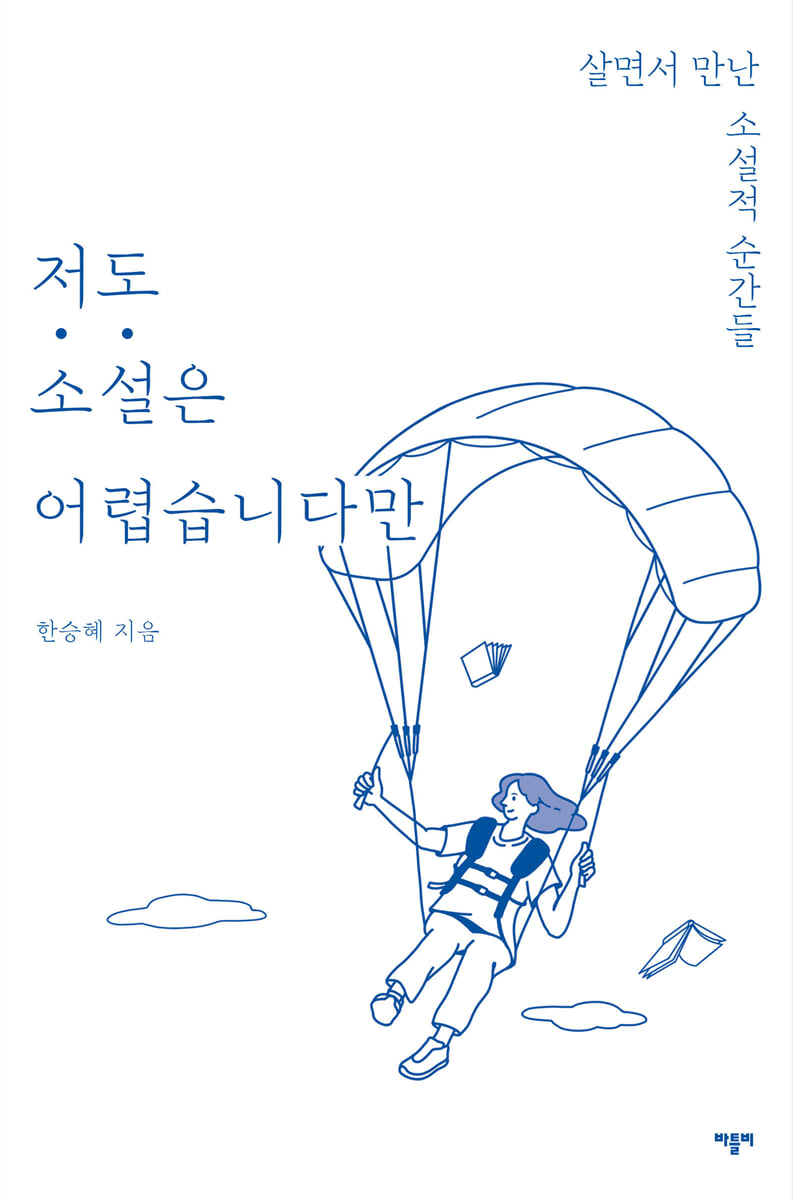
I also find novels difficult.
 |
Description
Book Introduction
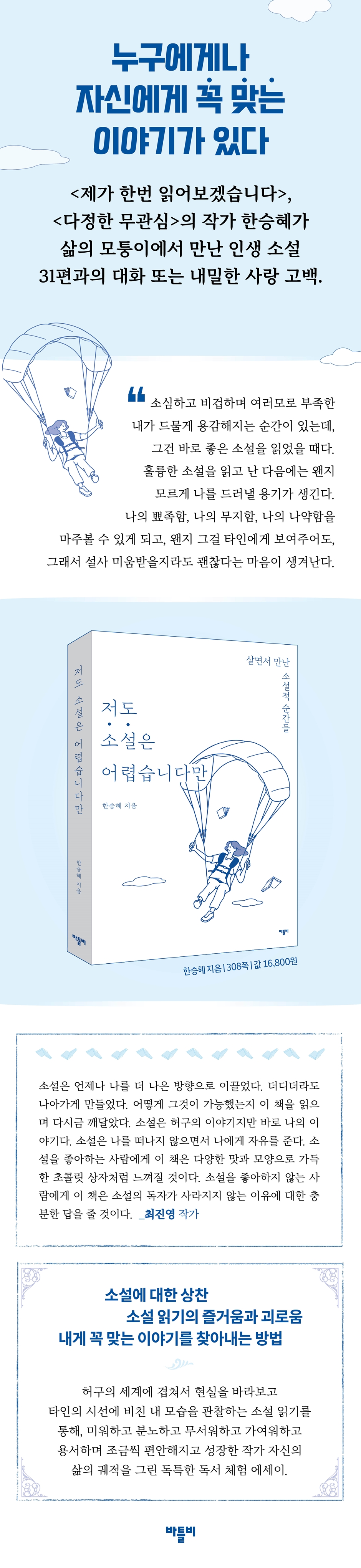
A conversation with Han Seung-hye, author of "I'll Read It Once" and "Affectionate Indifference," about 29 novels she encountered in the corners of life, or a confession of her intimate love for novels.
This book is a unique reading experience essay that borrows the format of a book review collection to express the joys and sorrows of reading novels and to depict the author's life trajectory, which, though slow, gradually grew through novels.
Just as finding a soulmate that fits you well requires a lot of trial and error, the same goes for novels.
To find the right novel for you, you need to learn how to explore it and find enjoyment in it.
The author shares his own experiences and guides readers into the world of novels, small stories that are yet perfect for each individual, stories that must be encountered at least once in life.
This book is a unique reading experience essay that borrows the format of a book review collection to express the joys and sorrows of reading novels and to depict the author's life trajectory, which, though slow, gradually grew through novels.
Just as finding a soulmate that fits you well requires a lot of trial and error, the same goes for novels.
To find the right novel for you, you need to learn how to explore it and find enjoyment in it.
The author shares his own experiences and guides readers into the world of novels, small stories that are yet perfect for each individual, stories that must be encountered at least once in life.
- You can preview some of the book's contents.
Preview
index
Prologue: Novels are difficult for me too...005
[Part 1] Between Discomfort and Injustice: The Face of Everyday Life
Between Discomfort and Injustice*『The Perpetrators』...021
The Privilege of Ignorance*〈Eumbok〉 ...030
People Without a Homeland*『Pachinko』...039
Moebius's Daily Life*『The Woman in the Sand』...048
How to Get Used to Despair*『A Gentleman in Moscow』...058
To all the daughters of the world*『Dear, dear』...067
[Part 2] We Are So Lonely: The Shadow of Desire
We are so lonely*〈Sender〉...079
The Unstoppable* "Paper Moon" ...090
In Search of the Master of Desire*『The Staggering Woman』...99
The Ethics of Truth* "Don't Let Me Go" ...108
Was That Really Love?*『Lovers』...117
[Part 3] To Live as Me: The Pains of Growing Up
That was our best*『The Best Life』...129
Time Spent Under the Spotlight*〈She Spent a Lot of Time Under the Spotlight〉 ...140
Wandering Hearts*〈Tracing Time〉...152
Things Left Behind*〈Theory of Light and Matter〉...162
I like you more than you do*『My Bird to You』...170
To live as myself* "The dream of becoming me" ...179
[Part 4] What Kind of Person Are You: The Secret of Humanity
What Kind of Person Are You?*『Your Life』...191
Do you know someone like this? *『Eileen』...199
Sometimes innocence wins*『White Dog』...208
To avoid becoming evil*『Hide』...218
Repeating regrets and mistakes*『The Veil of Life』...227
In Search of the Perfect Man*『Oryx and Crake』, 『The Year of the Flood』, 『Mad Adam』...235
[Part 5] The Heart I Want to Protect: The Logic of Love
No Regrets*『The Last Day of the Year, or How You Remember the World』 ...247
Even if it's just a fleeting flash* "Night Watch" ...256
Can the heart be 'replaced'? *『Clara and the Sun』...265
Knowing everything*『The Normandy Kite』...275
It was always just that*『Yeonnyeonsese』...285
A Heart I Want to Protect*『Road』...294
Author's Note...304
Books listed here...305
[Part 1] Between Discomfort and Injustice: The Face of Everyday Life
Between Discomfort and Injustice*『The Perpetrators』...021
The Privilege of Ignorance*〈Eumbok〉 ...030
People Without a Homeland*『Pachinko』...039
Moebius's Daily Life*『The Woman in the Sand』...048
How to Get Used to Despair*『A Gentleman in Moscow』...058
To all the daughters of the world*『Dear, dear』...067
[Part 2] We Are So Lonely: The Shadow of Desire
We are so lonely*〈Sender〉...079
The Unstoppable* "Paper Moon" ...090
In Search of the Master of Desire*『The Staggering Woman』...99
The Ethics of Truth* "Don't Let Me Go" ...108
Was That Really Love?*『Lovers』...117
[Part 3] To Live as Me: The Pains of Growing Up
That was our best*『The Best Life』...129
Time Spent Under the Spotlight*〈She Spent a Lot of Time Under the Spotlight〉 ...140
Wandering Hearts*〈Tracing Time〉...152
Things Left Behind*〈Theory of Light and Matter〉...162
I like you more than you do*『My Bird to You』...170
To live as myself* "The dream of becoming me" ...179
[Part 4] What Kind of Person Are You: The Secret of Humanity
What Kind of Person Are You?*『Your Life』...191
Do you know someone like this? *『Eileen』...199
Sometimes innocence wins*『White Dog』...208
To avoid becoming evil*『Hide』...218
Repeating regrets and mistakes*『The Veil of Life』...227
In Search of the Perfect Man*『Oryx and Crake』, 『The Year of the Flood』, 『Mad Adam』...235
[Part 5] The Heart I Want to Protect: The Logic of Love
No Regrets*『The Last Day of the Year, or How You Remember the World』 ...247
Even if it's just a fleeting flash* "Night Watch" ...256
Can the heart be 'replaced'? *『Clara and the Sun』...265
Knowing everything*『The Normandy Kite』...275
It was always just that*『Yeonnyeonsese』...285
A Heart I Want to Protect*『Road』...294
Author's Note...304
Books listed here...305
Detailed image
Into the book
The dawn air was cold and the darkness all around was frightening, but the thought that I couldn't bear the noise any longer paralyzed my fear.
Then, when it was finally the turn of the house right above ours, a faint sound of a musical instrument was heard through the front door, accompanied by a slight vibration.
At the same time, a smile naturally appeared on my lips, and a strange excitement and joy came over me.
Got you, you punk!
That was when.
Suddenly, the metal front door that was right next to my ear felt surprisingly cold, and I felt unfamiliar with myself.
(Omitted) After returning home that night, I tried to sleep while suppressing my fear.
It wasn't a fear of noise, but a fear of myself possibly changing strangely because of the noise.
--- p.25~26
I felt it then.
They don't know.
You don't know anything.
You really don't know.
We live in a completely different world.
(Omitted) At that time, I felt jealousy before I felt anger toward those who did not believe my story and criticized what I wrote.
About the fact that I have never experienced anything like that in my entire life.
They don't know.
I was jealous of the thought that I would never know or want to know the feeling of being scared by the sound of footsteps following me on the street at night, or being unable to put my phone down until I got out of a taxi with dark tint, or being suspicious when a stranger speaks to me, or the hair-raising sensation of a stranger touching me on the subway or bus.
I felt so jealous that I couldn't stand it.
--- p.32~33
How to get used to wearing a mask at all times, paying attention to personal hygiene, avoiding crowded places as much as possible, staying home as much as possible, living in constant anxiety about what the future holds, and feeling despair every time we see the vulnerable people in society collapsing amidst the pandemic.
Washing your hands frequently is a good thing, masks now feel almost like a part of your clothing, and even though 'a life where you have to avoid people' is difficult now, there may come a day when you can somehow adapt to it.
But I had no idea what to do about the latter two.
How can one become accustomed to despair and anxiety?
But as I learned from Count Rostov while reading A Gentleman in Moscow, the first thing to do is to do what you can.
--- p.64~65
And it is precisely because of this point that I believe that for women struggling with heterosexuality and emotional connection with men, this novel might be a useful guide, rather than a flimsy dating guide or a "how-to" book that promises to teach them how to win a man's heart.
This is because a character appears who seeks to satisfy his need for recognition from others rather than focusing on his own inner self, and ends up broken, abandoned, and broken, but still unable to let go of his attachment.
It's a novel that makes you aware of reality, so to speak.
--- p.106
Because nothing will change even if I go back home.
Because you can't make money, no one recognizes you, and you don't even get a sense of 'usefulness' that you're useful.
Come to think of it, the main character of the movie “Park Hwa-young”, Park Hwa-young, also repeated the words as if reciting a spell while being constantly exploited by those around her.
“What would you have done without me?” he said.
Even though I knew I was being used, I wanted to be useful.
In this way, the re-opened "Lover" read to me as a story about how vulnerable a girl's sexuality is rather than a love story.
A girl has so few avenues to find her own sense of utility that sometimes she mistakes her desire for utility or power for love.
--- p.124~125
Yet, whenever I look at my children, I can't help but feel anxious and uneasy.
Children in lower elementary school and preschool, respectively, have not yet been fully exposed to the world of violence, but they will inevitably face such a world as they grow older.
A world I know all too well, having already experienced it.
And then I imagine.
What can I do to help my children if they become victims or perpetrators of such violence?
Then suddenly a creepy thought crosses my mind.
If that time really comes, will I be able to help my children? Or even realize that they're in that situation?
--- p.138
Nevertheless, I think my experience with J changed me a little bit.
Once you have that experience, you change in some way.
As a result, I have received the same unconditional love as I did from J, though it is rare, on a few occasions since then.
Meeting such a being is an incredibly precious experience in life.
Even though most people act in pursuit of their own interests, and even though they smile on the outside but internally evaluate and judge others, and even though this is an inevitable human characteristic, it is important to realize that there are people who do not act in this way.
Meeting that one being.
The one person who loves me unwaveringly no matter what the situation.
--- p.177~178
In the novel, Tae-hee, now an adult, vows, “I will cry again, but I will never cry for the same reason.”
But perhaps in the not-too-distant future, my future self will cry again, and unlike Tae-hee's determination in the novel, there is a high probability that my future self will be crying for the same reasons as my present self.
Nevertheless, after reading this novel, I promise myself that even if I forget this fact in the future, I will not regret it for a moment or blame my past self.
Because my future self will be a different person from my past self and my present self, yet the same person, and someone I still dream of becoming.
Anyway, since I can't help but be myself no matter what, I will find the courage to live as myself tomorrow as I am today.
--- p.187
Reading the novel at this point is truly sad.
Reality always surpasses fiction.
As you read a novel, you encounter many points of contact with reality, and in the process, you come to understand reality, and you experience forgiveness and acceptance of many things. However, you also feel a solid wall that you cannot overcome, and you experience the painful realization of your limitations as a human being.
Just like now after reading "Eileen".
Of course, this too has its own meaning in that it forces me to face my own hypocrisy and true nature.
--- p.207
I haven't lived very long, and perhaps that's why I doubt human goodness, but I still hold onto the hope that there's still a last bit of 'humanity' in humans.
That is why, whenever I am overcome with disillusionment and disgust, I try not to lose my love for humanity.
Some people might think I'm naive and foolish.
But even if retraining a dog that has been mistrained is a waste of time, and even if the process involves hurt, betrayal, and suffering, I believe it is at least in the best interest of all of us.
That is the only way we believe things will 'not get any worse'.
--- p.217
In that sense, the humanity that humans possess is like water.
Its appearance changes depending on the vessel it is placed in, and it is easy to become contaminated but difficult to purify.
Of course, there are always noble people who maintain their dignity even in difficult and hard times.
I also believe that there exists a last bastion of humanity that evil cannot destroy.
However, apart from believing in the goodness of human beings, it is very important to know how evil humans can become.
That's why reading novels and stories seems important.
To understand humans, to see how evil they can become, and so to avoid becoming evil.
--- p.226
But now I think I have a vague idea.
About the heart that is willing to risk everything for a certain love.
Even if it means going through all the pain you've experienced so far again, there are times in this world when you have no choice but to do so.
Just as I, having given birth to and raised two children, can no longer return to the person I was before giving birth to and raising children, or as if I cannot choose not to have children knowing all this.
There are cases like that in this world.
--- p.254
Can we love something as a 'substitute' for something else? No, that's impossible.
We can always love something new.
But nothing can 'replace' anything else.
When you receive love from someone, a 'heart' is created around that love, and it is that heart that makes the object unique.
In that case, even machines cannot replace other machines.
--- p.274
Maybe that's what true love is.
Loving even though you know everything.
It's easy to love when you don't really know.
Because I only see good things.
(Omitted) It cannot be truly called love to only look at the good things that are outwardly apparent and harbor good feelings while ignoring the flaws.
Isn't true love not losing your loving heart despite everything?
Loving even though you know everything.
If God exists, his feelings toward humans would not be much different from this.
--- p.283~284
Sometimes I don't know why I'm living.
It's not that I'm experiencing any great misfortune, but it's just that there are moments when I don't know why all living things in the world, including humans, were born and why they exist.
Countless things are born without meaning, exist without meaning, and then die without meaning. Some lives would have been more comfortable and happier if they had never been born.
If you keep seeing things like that, you will start to think that life itself is fleeting and meaningless.
Still, when I encounter moments like this, I feel fortunate to be alive.
I think that I have lived and will continue to live for moments like these.
Then, when it was finally the turn of the house right above ours, a faint sound of a musical instrument was heard through the front door, accompanied by a slight vibration.
At the same time, a smile naturally appeared on my lips, and a strange excitement and joy came over me.
Got you, you punk!
That was when.
Suddenly, the metal front door that was right next to my ear felt surprisingly cold, and I felt unfamiliar with myself.
(Omitted) After returning home that night, I tried to sleep while suppressing my fear.
It wasn't a fear of noise, but a fear of myself possibly changing strangely because of the noise.
--- p.25~26
I felt it then.
They don't know.
You don't know anything.
You really don't know.
We live in a completely different world.
(Omitted) At that time, I felt jealousy before I felt anger toward those who did not believe my story and criticized what I wrote.
About the fact that I have never experienced anything like that in my entire life.
They don't know.
I was jealous of the thought that I would never know or want to know the feeling of being scared by the sound of footsteps following me on the street at night, or being unable to put my phone down until I got out of a taxi with dark tint, or being suspicious when a stranger speaks to me, or the hair-raising sensation of a stranger touching me on the subway or bus.
I felt so jealous that I couldn't stand it.
--- p.32~33
How to get used to wearing a mask at all times, paying attention to personal hygiene, avoiding crowded places as much as possible, staying home as much as possible, living in constant anxiety about what the future holds, and feeling despair every time we see the vulnerable people in society collapsing amidst the pandemic.
Washing your hands frequently is a good thing, masks now feel almost like a part of your clothing, and even though 'a life where you have to avoid people' is difficult now, there may come a day when you can somehow adapt to it.
But I had no idea what to do about the latter two.
How can one become accustomed to despair and anxiety?
But as I learned from Count Rostov while reading A Gentleman in Moscow, the first thing to do is to do what you can.
--- p.64~65
And it is precisely because of this point that I believe that for women struggling with heterosexuality and emotional connection with men, this novel might be a useful guide, rather than a flimsy dating guide or a "how-to" book that promises to teach them how to win a man's heart.
This is because a character appears who seeks to satisfy his need for recognition from others rather than focusing on his own inner self, and ends up broken, abandoned, and broken, but still unable to let go of his attachment.
It's a novel that makes you aware of reality, so to speak.
--- p.106
Because nothing will change even if I go back home.
Because you can't make money, no one recognizes you, and you don't even get a sense of 'usefulness' that you're useful.
Come to think of it, the main character of the movie “Park Hwa-young”, Park Hwa-young, also repeated the words as if reciting a spell while being constantly exploited by those around her.
“What would you have done without me?” he said.
Even though I knew I was being used, I wanted to be useful.
In this way, the re-opened "Lover" read to me as a story about how vulnerable a girl's sexuality is rather than a love story.
A girl has so few avenues to find her own sense of utility that sometimes she mistakes her desire for utility or power for love.
--- p.124~125
Yet, whenever I look at my children, I can't help but feel anxious and uneasy.
Children in lower elementary school and preschool, respectively, have not yet been fully exposed to the world of violence, but they will inevitably face such a world as they grow older.
A world I know all too well, having already experienced it.
And then I imagine.
What can I do to help my children if they become victims or perpetrators of such violence?
Then suddenly a creepy thought crosses my mind.
If that time really comes, will I be able to help my children? Or even realize that they're in that situation?
--- p.138
Nevertheless, I think my experience with J changed me a little bit.
Once you have that experience, you change in some way.
As a result, I have received the same unconditional love as I did from J, though it is rare, on a few occasions since then.
Meeting such a being is an incredibly precious experience in life.
Even though most people act in pursuit of their own interests, and even though they smile on the outside but internally evaluate and judge others, and even though this is an inevitable human characteristic, it is important to realize that there are people who do not act in this way.
Meeting that one being.
The one person who loves me unwaveringly no matter what the situation.
--- p.177~178
In the novel, Tae-hee, now an adult, vows, “I will cry again, but I will never cry for the same reason.”
But perhaps in the not-too-distant future, my future self will cry again, and unlike Tae-hee's determination in the novel, there is a high probability that my future self will be crying for the same reasons as my present self.
Nevertheless, after reading this novel, I promise myself that even if I forget this fact in the future, I will not regret it for a moment or blame my past self.
Because my future self will be a different person from my past self and my present self, yet the same person, and someone I still dream of becoming.
Anyway, since I can't help but be myself no matter what, I will find the courage to live as myself tomorrow as I am today.
--- p.187
Reading the novel at this point is truly sad.
Reality always surpasses fiction.
As you read a novel, you encounter many points of contact with reality, and in the process, you come to understand reality, and you experience forgiveness and acceptance of many things. However, you also feel a solid wall that you cannot overcome, and you experience the painful realization of your limitations as a human being.
Just like now after reading "Eileen".
Of course, this too has its own meaning in that it forces me to face my own hypocrisy and true nature.
--- p.207
I haven't lived very long, and perhaps that's why I doubt human goodness, but I still hold onto the hope that there's still a last bit of 'humanity' in humans.
That is why, whenever I am overcome with disillusionment and disgust, I try not to lose my love for humanity.
Some people might think I'm naive and foolish.
But even if retraining a dog that has been mistrained is a waste of time, and even if the process involves hurt, betrayal, and suffering, I believe it is at least in the best interest of all of us.
That is the only way we believe things will 'not get any worse'.
--- p.217
In that sense, the humanity that humans possess is like water.
Its appearance changes depending on the vessel it is placed in, and it is easy to become contaminated but difficult to purify.
Of course, there are always noble people who maintain their dignity even in difficult and hard times.
I also believe that there exists a last bastion of humanity that evil cannot destroy.
However, apart from believing in the goodness of human beings, it is very important to know how evil humans can become.
That's why reading novels and stories seems important.
To understand humans, to see how evil they can become, and so to avoid becoming evil.
--- p.226
But now I think I have a vague idea.
About the heart that is willing to risk everything for a certain love.
Even if it means going through all the pain you've experienced so far again, there are times in this world when you have no choice but to do so.
Just as I, having given birth to and raised two children, can no longer return to the person I was before giving birth to and raising children, or as if I cannot choose not to have children knowing all this.
There are cases like that in this world.
--- p.254
Can we love something as a 'substitute' for something else? No, that's impossible.
We can always love something new.
But nothing can 'replace' anything else.
When you receive love from someone, a 'heart' is created around that love, and it is that heart that makes the object unique.
In that case, even machines cannot replace other machines.
--- p.274
Maybe that's what true love is.
Loving even though you know everything.
It's easy to love when you don't really know.
Because I only see good things.
(Omitted) It cannot be truly called love to only look at the good things that are outwardly apparent and harbor good feelings while ignoring the flaws.
Isn't true love not losing your loving heart despite everything?
Loving even though you know everything.
If God exists, his feelings toward humans would not be much different from this.
--- p.283~284
Sometimes I don't know why I'm living.
It's not that I'm experiencing any great misfortune, but it's just that there are moments when I don't know why all living things in the world, including humans, were born and why they exist.
Countless things are born without meaning, exist without meaning, and then die without meaning. Some lives would have been more comfortable and happier if they had never been born.
If you keep seeing things like that, you will start to think that life itself is fleeting and meaningless.
Still, when I encounter moments like this, I feel fortunate to be alive.
I think that I have lived and will continue to live for moments like these.
--- p.303
Publisher's Review
A sincere and courageous book reviewer
How to Read a Novel of Life
A new book has been published by author Seunghye Han, a voracious reader and book addict who reads over 200 books a year, and a diligent book critic who cannot help but savor and ruminate on the joy and emotion it brings when she discovers a good book and share it with those who have yet to read it.
“Novels Are Difficult for Me Too” is the author’s third book, following “I’ll Read It Once” and “Affectionate Indifference.”
Author Han Seung-hye has gained the attention of many readers with her first book, "I'll Read It Once," in which she bravely and sharply attempted to critically interpret best-selling books that no one had seriously critiqued for their ingredients and content, and became known as an "honest, brave, and unique" book reviewer.
This latest book also appears to be a collection of book reviews, as it carefully examines 31 novels that have inspired and inspired the author's emotions in the twists and turns of life, divided into five themes: daily life, desire, growth, people, and love.
However, what the author focuses on in this book is not critiques of individual novels.
Rather, it painstakingly captures the author's own experiences of bumping into things, breaking things, and stamping his feet while reading the novel.
In other words, this book is also a story of the author's own growth and transformation as he read the novel as a reader before writing a review, experiencing pain, reflection, encouragement, and affirmation along with the work.
Therefore, instead of 'recommending' novels that anyone would find interesting in this book, I will write frankly about the process of discovering, realizing, and feeling while reading novels.
The idea is that it gives us a glimpse into the influence a novel can have on an individual.
Therefore, the writings included here are not so much 'book reviews' of individual books as they are records of how my life and the works in question overlap, and what impact reading them has had on me.
It's a story about a book, but on the other hand, it could also be said to be the trajectory of the time I've lived.
(Page 14)
While recommending dozens of excellent works would be useful, the author chose instead to tell us how a novel enters a person's mind, sprouts, and grows green leaves, and how, when the shade of the tree of the mind grows thick, we can find solace and rest under it.
Everyone has a story that's just right for them.
The author is a 'novel evangelist' who teaches people the joy of reading novels and actively recommends and encourages novels.
However, this does not mean that the author always loved novels and read them diligently.
During my college years, the author spent some time ignoring novels, believing them to be boring, a waste of time, and impractical.
Then one day, I happened to pick up Park Wan-seo's "City Famine" in the school library, and I found myself so captivated that I sat there glued to my seat and read the entire book until it got dark.
Because I discovered that the book was perfect for me, my complete story.
That day, I felt a sensation that was almost thrilling.
The protagonist, who didn't bother to hide his materialistic desires and his hatred for the world, who thought he knew everything about the world, who laughed at and made fun of others, and who ended up getting hurt and driven to the edge of a cliff, was secretly reflecting aspects of myself that I was aware of without realizing it, but didn't want to acknowledge.
Moreover, my family had been quite wealthy at the time, but as I was born and raised, our family's fortunes began to decline, which was similar to the situation of the protagonist in the novel.
(Page 10)
When you encounter a story that fits you perfectly, then the novel transcends the level of a fictional story.
The novel soon becomes your life, and conversely, you come to see things you thought you were the only one experiencing through the window of the novel with an objective perspective.
This is why the subtitle of this book is not 'Wonderful Novels I've Encountered in Life' but 'Novel Moments I've Encountered in Life'.
As readers read the novelistic moments encountered by the author, they gradually find themselves drawn into the world of novels, small stories, but stories that are perfect for them and that everyone must encounter at least once in their lives.
For example, while reading Kang Hwa-gil's short story "Drinking", the author is reminded of the images of people who are comfortably 'ignorant'.
Unlike myself, who, as a woman living in South Korea, was always on edge, wary of the potential sexual discrimination and violence that could strike at any moment, many men are completely unaware of such situations.
The author's feelings toward such ignorant people were more jealousy or envy than anger.
They don't know.
I was jealous of the thought that I would never know or want to know the feeling of being scared by the sound of footsteps following me on the street at night, or being unable to put my phone down until I got out of a taxi with dark tint, or being suspicious when a stranger speaks to me, or the hair-raising sensation of a stranger touching me on the subway or bus.
I felt so jealous that I couldn't stand it.
(Page 33)
Those who do not experience inconveniences may be ignorant, indifferent, and also at peace because they do not fully understand the situation.
Ignorance is another form of privilege.
The author is angry at the ignorance of the privileged, but at the same time, he realizes his own contradictions.
This is precisely why I felt a great deal of empathy while reading “Eumbok” and also felt a sense of eeriness.
Through this novel, I realized my own contradictions.
A part of me that I didn't even know I had that wanted me and those I love to be as ignorant as possible.
While I shout that being ignorant to many is a privilege, I actually hope that those close to me will remain ignorant, that they will not be exposed to the bitterness of the world and will continue to be ignorant, and that they will be happy by doing so. That is my petty heart.
(Page 38)
The author was confused by the way the Koreans in Japan he met while participating in a language exchange program during his college years alternately displayed feelings of superiority toward Korea and inferiority toward Japan. After reading Lee Min-jin's "Pachinko," he came to understand why they had to live in contradiction and boundaries.
Reading Amor Towles' A Gentleman in Moscow reminds me of a conversation I had with my young daughter, who was sobbing because she couldn't go to daycare due to the COVID-19 pandemic.
I tried to console my daughter by telling her that she needed to get used to the coronavirus situation, but I felt like I was being hit in the head by her question, “How do you get used to it?”
In this novel about Count Rostov, who comes from a noble family but is suddenly labeled a target for liquidation during the revolution and sentenced to life imprisonment, the author realizes that there is no way to become accustomed to anxiety and despair, and that the advice he gave his daughter to "get used to it" was misguided.
But in such a case, the only option we can choose is to return to what we can do at that moment.
Doing what you can do, trying not to lose love and laughter.
In doing so, even if you never get used to despair and anxiety, you may be able to gain the courage and hope to face them.
Just like Count Rostov in A Gentleman in Moscow.
(Page 66)
In this way, the author discovers himself in the novel that connects with his life and learns how to understand others.
The author, who progressed slowly but steadily while reading the novel, ends the book with the following praise for the novel.
Ultimately, this book is also a confession of author Han Seung-hye's intimate love for novels.
There are rare moments when I, a timid, cowardly, and in many ways inadequate person, become brave, and that is when I read a good novel.
After reading a great novel, I somehow find the courage to reveal myself.
I am able to face my sharpness, my ignorance, my weakness, and somehow I feel like it's okay to show it to others, even if I get hated for it.
I want to talk a little more about myself, who was only concerned with hiding and concealing things.
For a little while, I want to become a better person.
I want to love even if it means enduring the pain.
(Page 304)
How to Find the Story That's Right for You
But how can I discern which of the countless novels is truly my perfect fit? Just as finding a soulmate requires meeting and experiencing many people, the same holds true for novels.
To find the right novel for you, you need to read and experience many novels, develop your eye for selecting novels, and discover your own tastes.
There are no shortcuts in life or in reading, right?
Of course, that doesn't mean you need to start reading five cartloads of novels from now on.
The 31 novels covered in “Novels Are Difficult for Me Too” are very diverse in terms of authors, topics, and story development methods.
If you dismiss novels as trivial stories, or if you're a reader whose passion for literature has long since waned, finding and reading the works included here can be a good starting point.
There is a strong possibility that some of these works will open my eyes to my tastes.
By reading another life story told by the author alongside the novel, readers can compare the similarities and differences between their impressions of the same work and their own, which will further increase their interest.
I hope that readers will also encounter a story that is just right for them.
How to Read a Novel of Life
A new book has been published by author Seunghye Han, a voracious reader and book addict who reads over 200 books a year, and a diligent book critic who cannot help but savor and ruminate on the joy and emotion it brings when she discovers a good book and share it with those who have yet to read it.
“Novels Are Difficult for Me Too” is the author’s third book, following “I’ll Read It Once” and “Affectionate Indifference.”
Author Han Seung-hye has gained the attention of many readers with her first book, "I'll Read It Once," in which she bravely and sharply attempted to critically interpret best-selling books that no one had seriously critiqued for their ingredients and content, and became known as an "honest, brave, and unique" book reviewer.
This latest book also appears to be a collection of book reviews, as it carefully examines 31 novels that have inspired and inspired the author's emotions in the twists and turns of life, divided into five themes: daily life, desire, growth, people, and love.
However, what the author focuses on in this book is not critiques of individual novels.
Rather, it painstakingly captures the author's own experiences of bumping into things, breaking things, and stamping his feet while reading the novel.
In other words, this book is also a story of the author's own growth and transformation as he read the novel as a reader before writing a review, experiencing pain, reflection, encouragement, and affirmation along with the work.
Therefore, instead of 'recommending' novels that anyone would find interesting in this book, I will write frankly about the process of discovering, realizing, and feeling while reading novels.
The idea is that it gives us a glimpse into the influence a novel can have on an individual.
Therefore, the writings included here are not so much 'book reviews' of individual books as they are records of how my life and the works in question overlap, and what impact reading them has had on me.
It's a story about a book, but on the other hand, it could also be said to be the trajectory of the time I've lived.
(Page 14)
While recommending dozens of excellent works would be useful, the author chose instead to tell us how a novel enters a person's mind, sprouts, and grows green leaves, and how, when the shade of the tree of the mind grows thick, we can find solace and rest under it.
Everyone has a story that's just right for them.
The author is a 'novel evangelist' who teaches people the joy of reading novels and actively recommends and encourages novels.
However, this does not mean that the author always loved novels and read them diligently.
During my college years, the author spent some time ignoring novels, believing them to be boring, a waste of time, and impractical.
Then one day, I happened to pick up Park Wan-seo's "City Famine" in the school library, and I found myself so captivated that I sat there glued to my seat and read the entire book until it got dark.
Because I discovered that the book was perfect for me, my complete story.
That day, I felt a sensation that was almost thrilling.
The protagonist, who didn't bother to hide his materialistic desires and his hatred for the world, who thought he knew everything about the world, who laughed at and made fun of others, and who ended up getting hurt and driven to the edge of a cliff, was secretly reflecting aspects of myself that I was aware of without realizing it, but didn't want to acknowledge.
Moreover, my family had been quite wealthy at the time, but as I was born and raised, our family's fortunes began to decline, which was similar to the situation of the protagonist in the novel.
(Page 10)
When you encounter a story that fits you perfectly, then the novel transcends the level of a fictional story.
The novel soon becomes your life, and conversely, you come to see things you thought you were the only one experiencing through the window of the novel with an objective perspective.
This is why the subtitle of this book is not 'Wonderful Novels I've Encountered in Life' but 'Novel Moments I've Encountered in Life'.
As readers read the novelistic moments encountered by the author, they gradually find themselves drawn into the world of novels, small stories, but stories that are perfect for them and that everyone must encounter at least once in their lives.
For example, while reading Kang Hwa-gil's short story "Drinking", the author is reminded of the images of people who are comfortably 'ignorant'.
Unlike myself, who, as a woman living in South Korea, was always on edge, wary of the potential sexual discrimination and violence that could strike at any moment, many men are completely unaware of such situations.
The author's feelings toward such ignorant people were more jealousy or envy than anger.
They don't know.
I was jealous of the thought that I would never know or want to know the feeling of being scared by the sound of footsteps following me on the street at night, or being unable to put my phone down until I got out of a taxi with dark tint, or being suspicious when a stranger speaks to me, or the hair-raising sensation of a stranger touching me on the subway or bus.
I felt so jealous that I couldn't stand it.
(Page 33)
Those who do not experience inconveniences may be ignorant, indifferent, and also at peace because they do not fully understand the situation.
Ignorance is another form of privilege.
The author is angry at the ignorance of the privileged, but at the same time, he realizes his own contradictions.
This is precisely why I felt a great deal of empathy while reading “Eumbok” and also felt a sense of eeriness.
Through this novel, I realized my own contradictions.
A part of me that I didn't even know I had that wanted me and those I love to be as ignorant as possible.
While I shout that being ignorant to many is a privilege, I actually hope that those close to me will remain ignorant, that they will not be exposed to the bitterness of the world and will continue to be ignorant, and that they will be happy by doing so. That is my petty heart.
(Page 38)
The author was confused by the way the Koreans in Japan he met while participating in a language exchange program during his college years alternately displayed feelings of superiority toward Korea and inferiority toward Japan. After reading Lee Min-jin's "Pachinko," he came to understand why they had to live in contradiction and boundaries.
Reading Amor Towles' A Gentleman in Moscow reminds me of a conversation I had with my young daughter, who was sobbing because she couldn't go to daycare due to the COVID-19 pandemic.
I tried to console my daughter by telling her that she needed to get used to the coronavirus situation, but I felt like I was being hit in the head by her question, “How do you get used to it?”
In this novel about Count Rostov, who comes from a noble family but is suddenly labeled a target for liquidation during the revolution and sentenced to life imprisonment, the author realizes that there is no way to become accustomed to anxiety and despair, and that the advice he gave his daughter to "get used to it" was misguided.
But in such a case, the only option we can choose is to return to what we can do at that moment.
Doing what you can do, trying not to lose love and laughter.
In doing so, even if you never get used to despair and anxiety, you may be able to gain the courage and hope to face them.
Just like Count Rostov in A Gentleman in Moscow.
(Page 66)
In this way, the author discovers himself in the novel that connects with his life and learns how to understand others.
The author, who progressed slowly but steadily while reading the novel, ends the book with the following praise for the novel.
Ultimately, this book is also a confession of author Han Seung-hye's intimate love for novels.
There are rare moments when I, a timid, cowardly, and in many ways inadequate person, become brave, and that is when I read a good novel.
After reading a great novel, I somehow find the courage to reveal myself.
I am able to face my sharpness, my ignorance, my weakness, and somehow I feel like it's okay to show it to others, even if I get hated for it.
I want to talk a little more about myself, who was only concerned with hiding and concealing things.
For a little while, I want to become a better person.
I want to love even if it means enduring the pain.
(Page 304)
How to Find the Story That's Right for You
But how can I discern which of the countless novels is truly my perfect fit? Just as finding a soulmate requires meeting and experiencing many people, the same holds true for novels.
To find the right novel for you, you need to read and experience many novels, develop your eye for selecting novels, and discover your own tastes.
There are no shortcuts in life or in reading, right?
Of course, that doesn't mean you need to start reading five cartloads of novels from now on.
The 31 novels covered in “Novels Are Difficult for Me Too” are very diverse in terms of authors, topics, and story development methods.
If you dismiss novels as trivial stories, or if you're a reader whose passion for literature has long since waned, finding and reading the works included here can be a good starting point.
There is a strong possibility that some of these works will open my eyes to my tastes.
By reading another life story told by the author alongside the novel, readers can compare the similarities and differences between their impressions of the same work and their own, which will further increase their interest.
I hope that readers will also encounter a story that is just right for them.
GOODS SPECIFICS
- Date of issue: May 3, 2022
- Page count, weight, size: 308 pages | 436g | 135*205*18mm
- ISBN13: 9791191959055
- ISBN10: 1191959058
You may also like
카테고리
korean


korean

![GQ KOREA Mark (Monthly): December [2025]](http://librairie.coreenne.fr/cdn/shop/files/8ef265dbbfbf186523ed75ba7319009d.jpg?v=1765340328&width=3840)


