

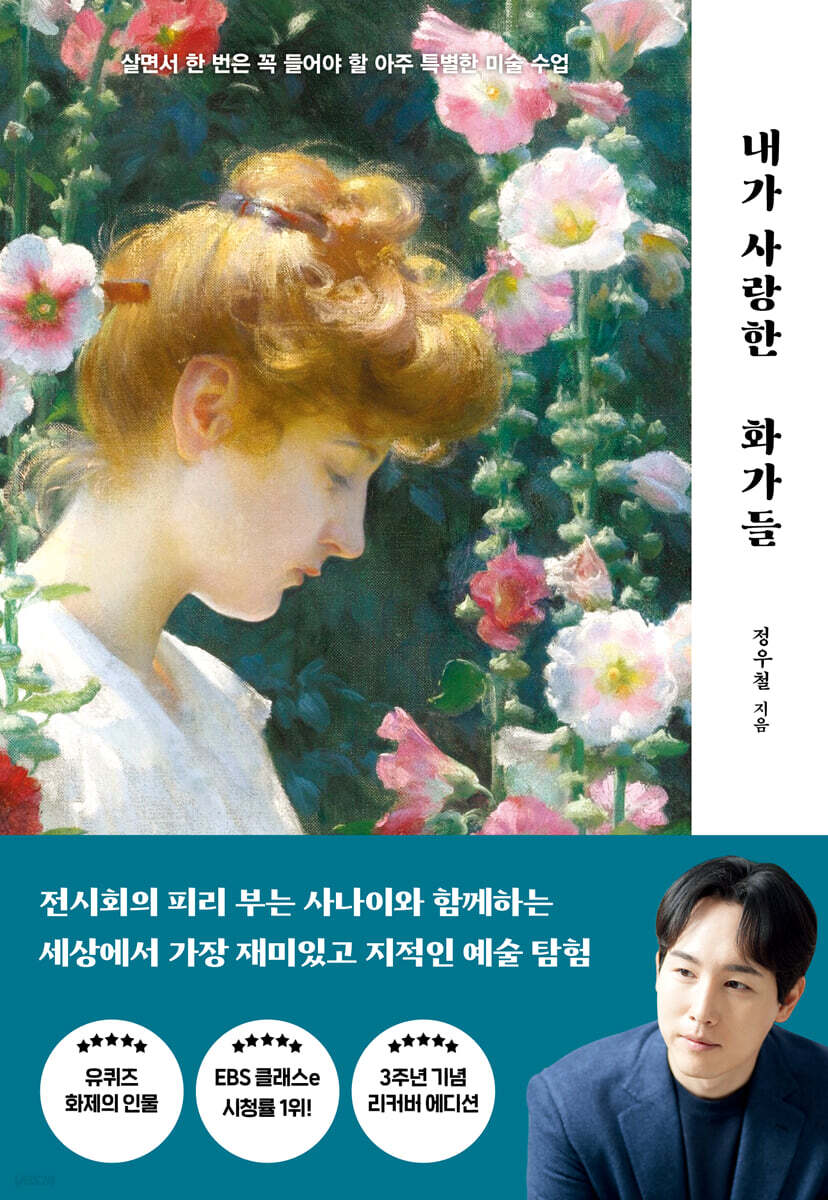
Painters I Love: Recover Edition
 |
Description
Book Introduction
- A word from MD
-
EBS Class e docent Jeong Woo-cheol's first bookHe studied the lives of artists with the hope of becoming a docent, and his life was completely changed. He introduces the lives and representative works of eleven artists he especially loves.
If you follow the explanation slowly, you will become immersed in the lives of artists.
Art PD Kim Tae-hee
With the Pied Piper at the exhibition
The world's most entertaining and intelligent art exploration
***You Quiz on the Block Hot Topic***
***EBS Class e viewership ratings #1***
***3rd Anniversary Recover Edition***
With the Pied Piper at the exhibition
The world's most entertaining and intelligent art exploration
The idol of the docent world, the "pied piper" of the exhibition hall, the person who helps museum visitors fall in love with paintings without even realizing it, and the person who leads the popularization of art by achieving the highest viewership ratings on EBS Class e, hosted by Korea's top intellectuals.
Docent Woo-cheol Jeong, who is currently the most talked about artist in the Korean art world, has published his first book.
The title is “Painters I Loved.”
“I started studying painting with the intention of becoming a docent, but it completely changed my life.” So, among the many painters, I personally selected eleven painters that I especially love and introduced their lives and representative works in an easy and fun way.
The author grew up watching his mother, who was an artist, paint and hold solo exhibitions, so he became familiar with art from an early age.
After graduating from college, I worked an ordinary job, but after thinking about what would truly make me happy, I quit my job without thinking twice. Then, recalling my childhood days when I enjoyed looking at paintings, I decided to become a docent.
While studying art and working part-time at an exhibition hall, he conducted exhibition docent tours on several occasions before being assigned to docent tours for the Bernard Buffet Exhibition. After months of thorough preparations, including going all the way to Japan to obtain the catalog, the exhibition was a huge success, and he became known as a docent.
The most notable feature of docent Jeong Woo-cheol's exhibition commentary is his flowing storytelling.
Previous exhibition commentaries typically focused on analyzing the artwork.
Commentaries that focus on providing information such as how the painting was painted or what movement the artist belonged to are helpful for acquiring related knowledge, but often give the impression that "art is difficult" to viewers who are not familiar with art or are unfamiliar with exhibitions.
However, docent Jeong Woo-cheol focuses on introducing the life of a painter from birth to death like a movie, explaining why he made this choice and created this painting, what influence this work had on the painter's life, and how the painter's life unfolded afterwards.
The reason the audience sheds tears and is moved while listening to his commentary is not because they have great knowledge of art, but because they are moved to see that the person who created the incredible painting hanging before their eyes is a human being who suffered and agonized throughout his life before being a great artist of a different level from them.
Docent Jeong Woo-cheol's commentary accurately explains why we constantly yearn for art that is not necessary for survival.
“While studying the lives of painters who are revered as great artists, geniuses, and masters, I found that their common thread was ‘nevertheless.’
Even when life brought them hardships, they moved forward in spite of it all.
Thanks to that, I was able to rise to the ranks of a master.
The more I studied their pain and how they overcame it, the more I felt empathy and comfort.
Meanwhile, the painters' paintings had entered my mind.” _6p
If you want to live a happy life rather than just appearing to be well-off in the eyes of others, but are struggling to muster the courage, why not listen to the stories of painters told by docent Jeong Woo-cheol this spring?
You will be able to receive a lot of comfort and encouragement from artists who lived their lives honestly, even if they were clumsy and lacking.
- You can preview some of the book's contents.
Preview
index
Prologue 4
Chapter 1: Love, the Painters Who Pursued Only This One Thing
Marc Chagall, who longed for unchanging love in his finite life 12
Chagall's Childhood 15 | The Promise Not to Be Shabby in the Face of Love 19 | After Emerging from Grief 29
■ Henri Matisse, revolutionary of color and founder of Fauvism 39
A Childhood Full of Joyful Imagination 41 | A Box of Paints, a Fateful Encounter 43 | What I Wanted to Say with Free Color 47
Simpler and more intense, more Matisse-like 52 | With scissors instead of a broken brush 57
Amedeo Modigliani, the bohemian artist who was on fire at every moment 63
Abandoning Dignity and Settling in Montmartre 66 | The Opportunity of Encountering Picasso 69 | Facing a Love That Not Even Death Could Stop 77
Alphonse Mucha, the hero of Prague who painted for his people 89
A Boy Born to Become an Artist 91 | A Fortune That Came in the Hardest of Times 95 | Beautifully, Dazzlingly 99 | Awakening to Art for the Nation 107
Chapter 2: Self-Respect: Painters Who Endured All Trials to Live as Themselves
■ Frida Kahlo's face of will drawn with pain 116
Misfortunes That Came Too Soon 121 | Living as a Genius' Wife 125 | A Life of Happiness Just by Being Alive 142
■ Gustav Klimt, the painter of contradictions who simultaneously preserved the past and the present 145
An Artistic Sense Unlike Any Other 147 | A Bold Challenge to a New Art 151 | The Birth of the Golden "Kiss" 156 | Taking a Path No One Can Imitate 164
■ Toulouse-Lautrec, the little giant of Paris who loved the nights at the Moulin Rouge 168
A Leg That Stopped Growing, and My Father's Disregard 170 | I Won't Draw Like Others 174 | With a Will to Not Glorify Reality 176 | The Daily Lives of the Lower Class Become Art 181 | With a Desire to Run 185
■ Käthe Kollwitz, who recorded reality and struggles from her own perspective, 190
Capturing the Lives of Suffering Neighbors in Artwork 192 | Beauty Isn't the Only Art 196 | Becoming a Fighter in the Face of the Tragedy of War 199 | A Lifelong Struggle Against the Nazis 202 | For the Unprotected 206
Chapter 3: Betrayal: Painters Unshaken by the World's Coldness
Paul Gauguin, who dedicated his life to finding the original color 212
Selling Stocks on Weekdays, Painting on Weekends 214 | Willingly Taking on the Challenge of Being an Artist After Unemployment 220 | Searching for Primary Colors Like a Battle 223 | Between a Great Artist and an Arrogant Monster 226 | The Art World's Innovator Who Eventually Became a Legend 235
Bernard Buffet, who loved even the bare face of Paris, stained with death 245
The Discovery of a Genius Painter More Dramatic Than Drama 247 | I Painted Only to Live 250 | The Age of Buffet Begins 253 | Rising to the Art World Phenomenon 256 | The Fate of Annabel 259 | The Bullying That Was All the More Extreme Because She Was So Perfect 263 | Couldn't Live Without Painting 268
■ Egon Schiele, the tragic genius narcissist who saw through human nature 274
A genius's talent revealed at age seven 276 | Choosing the Vienna Secession over the Academy 279 | The emergence of ugly and hideous nudes 282 | The stigma of being a problematic artist 287 | The world was cruel to him until the end 295
Detailed image

Into the book
In this book, I have included the stories of eleven painters whom I particularly love.
Of course, if you were to introduce one person's life in detail, one book would not be enough.
I hope you will find it more approachable and fun, so I have condensed it a lot and written it focusing on the most representative events.
I hope this book, which introduces painters I particularly love, will serve as a tool to help you become more familiar with painting.
If there is an artist among these who particularly touches your heart, I hope that his or her life will bring you some comfort in your difficult days.
As an author, it would be an immense joy to be able to encounter a painting by that artist in an art gallery, engage in a conversation with it, and enjoy it in your own way.
--- p.6
From the moment he began painting until the very last work he completed, Chagall's paintings were imbued with love.
The dark corners of life
Even as he passed through you, he expressed the colorful emotions that love gives with his brush.
It was love that brought joy to our lives, it was love that brought pain, it was love that helped us get back on our feet when we were discouraged by unexpected circumstances.
Maybe that's why, when I look at Chagall's paintings, I think of what he said.
“If life is to end someday, we must paint it with the colors of love and hope.”
--- p.38
Still Life with Books is the first work in which Matisse, who had taken on the challenge of changing his life completely, felt satisfied with himself.
The characteristic of Matisse we know is his somewhat crude, almost invisible works, right? This work is a still life, painted as he sees it. Like any artist, Matisse also started from painting "what he sees."
At first, he draws as is, but gradually he creates his own characteristics by incorporating elements that he sees, feels, and experiences, and over time, those elements become the artist's own personality.
It is the process of moving from so-called reproduction to expression.
Isn't this why each artist's style varies based on their experiences in life? Therefore, I believe that understanding the artist's life and then viewing their paintings allows for a richer, more profound appreciation.
When you understand and empathize with the artist's life and values, you will connect not only with the painting in front of you, but also with the artist beyond the painting.
--- p.44~45
He felt the most fulfilling joy when working, to the point where he once said, “Work heals everything.” He finally put down his brush and passed away in 1954 at the age of 85.
It is said that the day before he passed away, Matisse, who was lying in bed, had Lydia, who had nursed him for a long time, bring him a pen and paper, and then drew her likeness.
How can one not love an artist like Matisse, who poured his heart and soul into painting for the person who stayed by his side until the very end?
--- p.62
How did Muha end up becoming a painter? It was because of voice change.
At this time, my voice was damaged and I could no longer sing in the choir.
It disappeared.
After turning to art, Mucha began to draw portraits of villagers and earned pocket money, leading a fairly comfortable life. Then, by chance, he draws a portrait of an upper-class count.
The count, who liked the portrait painted by Mucha, made a suggestion.
“I think it will be successful if I give you just a little support.
“I will support you, so go to Paris.”
In this way, he entered Paris, which was the center of art at the time.
At this time, Muha was twenty-seven years old.
Most famous painters were born when they were young.
It was rather late compared to when it first came to prominence.
If you think about Muha's success, 'Even though he started late, he must have done well because he's a genius,' you are completely mistaken.
Genius wasn't the first factor in his success.
In fact, Mucha failed the exam to enter the Prague Academy of Fine Arts.
'I don't deny that you have talent.
but
It's surprising to hear the response, "That level of talent isn't enough." The biggest factor in Muha's success, without a doubt, was his sincerity.
He was really drawing with sincerity and was ready to seize the opportunity when it came.
--- p.94
If you don't know Mucha's entire life, but only his time in Paris, you might remember him simply as a successful commercial writer.
summer solstice
Man Mu-ha was an artist who loved both commercial art and pure art.
Through commercial art, even poor people can enjoy the beauty of art on the streets.
It enabled them to do so, and through pure art, they expressed the suppressed national pride and gave hope to many of their citizens.
Perhaps this is why, even a century after Muha became a star, we still use the term "master" when referring to him.
If you happen to come across a painting by Muha after reading this, why not think of Muha, who always held a brush with a heart that loved his people and humanity, rather than just drawing pretty and flashy pictures?
--- p.113
Of course, Frida must have felt pessimistic about her life at times.
Why do things that are just given to others, like living day to day and loving?
I lamented, "Why am I not allowed to meet someone and have children?"
But if he had given up on life in such despair, the great painter we know would not have existed.
In her diary she wrote, “I spent a year
I suffered from it and had spinal surgery seven times.
I often fall into despair.
What do you think of the phrase "Desperation beyond words, yet I want to live"? I was really touched by the last sentence.
Sometimes I see people casually saying things like, “I want to die,” or “I’ll just die,” as if it were a joke, but I don’t know.
While studying Frida, I couldn't say anything like that, even as a joke.
--- p.140
If Klimt had continued to follow trends, would he have been able to rise to the ranks of masters? He might have remained just another painter.
I'm afraid.
In these days when we are so easily swept away by trends and lose our individuality, Klimt's life may be showing us another path to success.
Are you honest about your life? Do you have something unique about yourself that reveals your true self? In every corner of society,
When you suddenly feel tired of living wearing many masks, I would like to recommend that you look at Klimt's paintings.
--- p.167
Publisher's Review
“Gathering a cloud-like audience through hot word of mouth
The best star docent
“You are invited to a very special art class.”
With inequality deepening and the future becoming increasingly uncertain, focusing solely on financial investment and making money seems like a wise approach.
But if you want to maintain your individuality even in a chaotic reality, if you want to enjoy small hobbies, if you want to live with peace of mind and a positive attitude, you can stop for a moment and take a look at the painter introduced by docent Jeong Woo-cheol.
Among the eleven painters introduced by docent Jeong Woo-cheol, there are familiar artists such as Marc Chagall, Henri Matisse, and Frida Kahlo, but there are also painters that are not easily encountered in Korea, such as Bernard Buffet, Paul Gauguin, and Käthe Kollwitz.
In particular, since there are few books by Bernard Buffet published in Korea, I recommend encountering him through “Painters I Loved.”
What criteria did docent Jeong Woo-cheol use to select these eleven artists? They are figures who offer us courage and comfort, even today, in this era of low growth.
Artists who, like us, faced trials with their entire bodies in the face of a reality that shakes them several times a day, and who, instead of giving in helplessly, tried to overcome them willingly, are the artists that Docent Jeong Woo-cheol especially loved.
So, as you read the book, you realize that the artists who passionately protected their lives and values were not people with special genes.
It would be better to have some knowledge of art, but even without that knowledge, there is no problem crying and laughing in front of a painting, which is another fun aspect of art appreciation presented by docent Jeong Woo-cheol.
Through this book, docent Jeong Woo-cheol conveys the conviction that although life is not easy for anyone, if we believe in ourselves and do our best, we too can live as the protagonists of our own lives, just like great artists.
As you follow the lives of artists under the author's kind and affectionate guidance, you will find yourself becoming more solid before you know it.
“Art is not a noble hobby for noble people.
Something we all need to see, enjoy and love
“It is a beautiful duty in life.”
This is truly an era of 'showing', where you take a photo to prove you're seeing a painting before you go to an art gallery.
Although many people consider their hobbies as important as their work, it is true that art appreciation is still considered a somewhat special and luxurious hobby.
I think I need to know art history, and when I go to an art museum, I need to dress up and act differently than usual.
Since it's a famous piece, I go to see it, but if I think, 'Is it really that great?', I feel embarrassed and wonder if there's something wrong with my taste.
Even if I wanted to get closer and take a closer look, I'd have to take a quick photo and leave for fear of disturbing other visitors.
Isn't this what art appreciation and exhibition outings that we are familiar with look like?
《The Painters I Love》 stands out from other art books in that it addresses these questions and concerns.
When talking about immortal love, why are Chagall's works always mentioned, why Matisse is never left out when talking about 20th century art, why Gauguin devoted his life to traveling the world in search of a single color? Listening to docent Woo-cheol Jeong's kind explanations, you will naturally understand why artists are sometimes driven by madness and obsession, why they are so obsessed with their lovers, why some sacrifice their pride to receive the patronage of nobles, and why others fight against the regime to the end and abandon their families and hometowns.
After knowing this background, the painting you appreciate will inevitably come across differently than before.
Frida Kahlo, who did not want to remain just the wife of a famous painter; Paul Gauguin, who had a stronger desire than anyone else to succeed as a painter; Egon Schiele, who steadfastly observed the deepest desires of humanity despite criticism and ridicule from critics; Marc Chagall, who could never put down his brush for the sake of his loved ones…
The lives of those who are admired by the whole world were by no means rosy, nor could they be said to be beautiful and happy.
Rather, it is very similar to the daily lives of ordinary people like us.
Artists who believed in themselves and drew and drew with the hope that one day they would be recognized, happy, and smiling, they are not just stars in the sky or anyone else.
Among the eleven painters introduced by docent Jeong Woo-cheol, it will not be difficult to find several who capture my heart and who resemble me.
“I hope that you too can experience the life-changing experience that I had while studying the lives of artists.
“I hope that the eleven painters who changed my life will bring great inspiration to yours as well.” _Docent Woo-cheol Jeong
GOODS SPECIFICS
- Date of issue: November 6, 2024
- Page count, weight, size: 304 pages | 502g | 145*210*19mm
- ISBN13: 9791158512132
- ISBN10: 1158512139
You may also like
카테고리
korean


korean


