

I could be wrong
 |
Description
Book Introduction
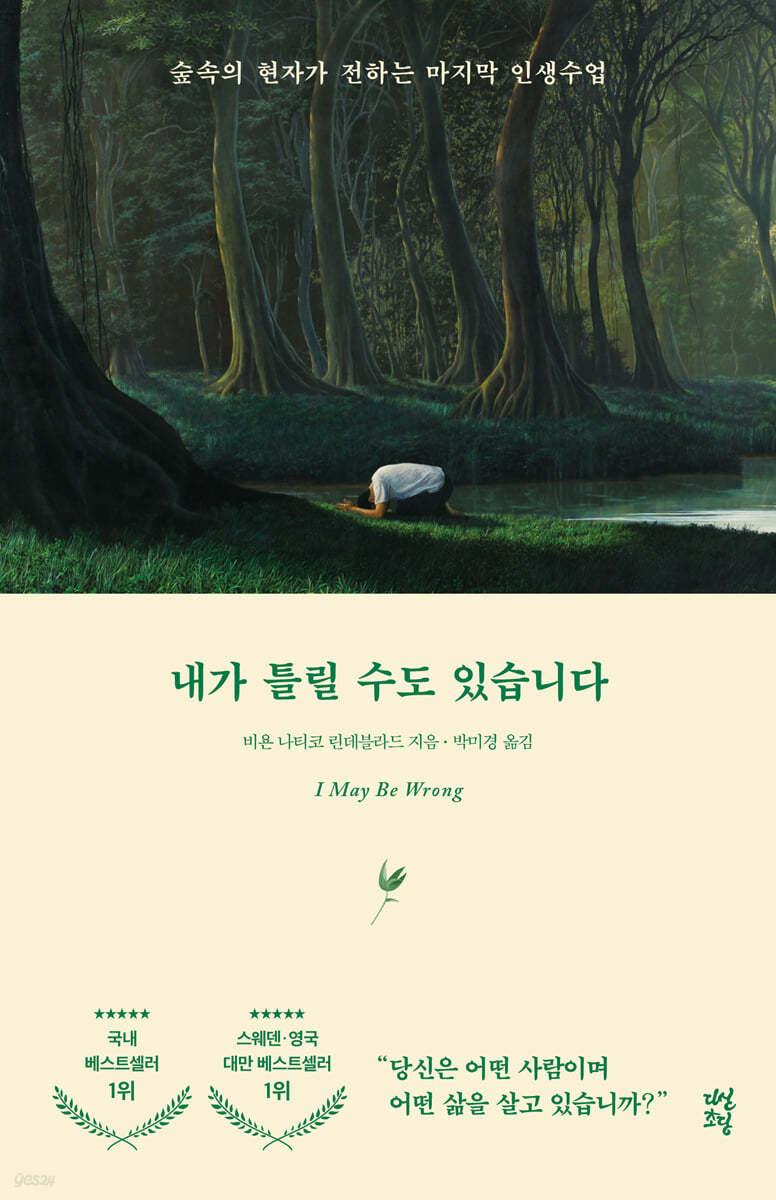
From the Dalai Lama to Faker, the life and wisdom of a kind monk loved by the world. Limited Edition of "I Could Be Wrong" by Thomas Sanchez Released “Read it in one sitting, you will be filled with joy!” In January 2022, one person passed away. Leaving behind the words, 'I leave without hesitation or fear.' A huge wave of mourning swept through Sweden. Bjorn Natiko Lindeblad. He brought peace and tranquility to countless Swedes from their anxiety, and even after being diagnosed with Lou Gehrig's disease, he continued to impart cheerful and warm wisdom. The book "I Could Be Wrong" contains the journey, enlightenment, and final moments of the author who, despite achieving dazzling social success, abandoned everything and went into the forest to practice for 17 years. It has been loved by readers of all ages and backgrounds, including Faker, professional baseball players, and Professor Choi Jae-cheon, and has maintained its position as a bestseller in Korea. For readers who want to renew and preserve the emotion and enlightenment of "I Could Be Wrong" in 2024, the Thomas Sanchez Edition has been published. Many readers have said that just looking at the works of painter Tomás Sanchez, who was highly praised by Nobel Prize winner for literature, brings them peace. This edition, which includes twice as much of his work, has been significantly enlarged, replaced with high-quality paper, and produced with a fabric binding, aiming to create a book that begins to heal when opened. |
- You can preview some of the book's contents.
Preview
index
Prologue_ The One Thing Most Precious
notice
An uncomfortable life even when you stay still
The leash of the past
The Brothers Karamazov
Step into the temple for the first time
I don't believe every thought that comes to mind.
Mom, I want to become a forest monk.
Natiko, the one who grows in wisdom
intelligence of the moment
A community of geeks
Training without choice
The Wisdom of Winnie the Pooh
magic spell
Nine failures
The person who is bothering me
The awkward hermit's happiness
Closed fist, open palm
I have nothing to do, so I'm begging
There is room for a miracle to happen
One thing is certain
Something awakens
There's so much to lose
The shame of a former monk
The Secret Inside the Ring
Everything starts with you
Enter through the open door
The meaning of life is to find and share your gifts.
To the place where faith is shown
You don't have to be afraid
The sight of death coming
Everything will be taken away
What you want to see more of in the world
A farewell that knows when to leave
A very annoying word
That's how it was originally
On the way home
Epilogue_ Without fear or hesitation
notice
An uncomfortable life even when you stay still
The leash of the past
The Brothers Karamazov
Step into the temple for the first time
I don't believe every thought that comes to mind.
Mom, I want to become a forest monk.
Natiko, the one who grows in wisdom
intelligence of the moment
A community of geeks
Training without choice
The Wisdom of Winnie the Pooh
magic spell
Nine failures
The person who is bothering me
The awkward hermit's happiness
Closed fist, open palm
I have nothing to do, so I'm begging
There is room for a miracle to happen
One thing is certain
Something awakens
There's so much to lose
The shame of a former monk
The Secret Inside the Ring
Everything starts with you
Enter through the open door
The meaning of life is to find and share your gifts.
To the place where faith is shown
You don't have to be afraid
The sight of death coming
Everything will be taken away
What you want to see more of in the world
A farewell that knows when to leave
A very annoying word
That's how it was originally
On the way home
Epilogue_ Without fear or hesitation
Detailed image
.jpg)
Into the book
I hope this book will help you live your life more smoothly and authentically.
Some of the wisdom contained in this book has been pivotal in my life.
This has been especially true in the past few years, when I accepted the day of my death earlier than expected.
This is where it all ends.
No, maybe it's a place to start.
--- p.11, from “Prologue”
We all have the ability to let go of our thoughts.
It just takes a little practice.
If we ignore or even lose sight of that potential, our lives will be governed by the behaviors and perspectives that have been deeply ingrained in us.
All decisions become habitual.
It's like being dragged around on a leash in the past.
Ultimately, we end up going around and around the same track.
That kind of life is not free.
There is no dignity or decency in it.
--- p.36, from “The Leash Called the Past”
Within each of us, we have our own, quietly refined compass.
But that wisdom, unlike the noisy ego, is subtle and cannot be heard unless you pay attention.
Because the questions and demands of the ego are several times louder and completely drown out the voice of wisdom.
When we fail to do so, our attention will be drawn to the loudest noises, wherever and whenever they occur.
If that happens, life will become a soap opera.
We are drawn to conflict, and we react most sensitively and focus on anxiety and unhappiness.
You will always be struggling with reality.
--- p.85-86, from “Intellect of the Moment”
There was a monk from Oklahoma who hated me for four years.
Every day, without hiding anything or resting, I would somehow express my displeasure.
Looking back, I think life is truly paradoxical.
I've always lived my life worrying too much about what other people think of me.
That's why I worked so hard when I was young.
Maybe I needed someone who hated me that much.
I was so afraid that someone would hate me, but after being hated for so long without knowing why, it was only then that I realized how pointless it was to try to please everyone.
--- p.95, from “Community of Freaks”
Humans have a natural tendency to live in a way that makes them happier.
And 'I could be wrong.
It's rare for us to find a way to be truly happy, as we become accustomed to the idea that 'I don't know everything'.
--- p.134, from “Magic Spells”
Everyone likes to blame others.
Many of us have this thought.
“If only my parents had been different… If only my coworkers hadn’t been so mean… If only politicians had done their job properly…”
We cannot change the human nature of constantly falling into such shackles.
It is a fundamental property of our self.
It's perfectly natural.
When life gets tough and we're under psychological pressure, it's much easier to point fingers at others, and we don't have to think of it as our own problem.
But there are questions you must ask yourself at some point, even if they are unpleasant and uncomfortable.
'What can I do right here, right now, to ease my own suffering in this current situation?'
--- p.151-152, from “The Person Who Torments Me”
Actually, I was very embarrassed.
I have dedicated half of my life to understanding and developing myself more deeply as a human being.
If so, you should have returned with the light of timeless wisdom in your heart.
But in reality, it seemed like he had become the most unfortunate and failed person in Sweden.
In my head, only voices predicting a gloomy future echoed.
'Everything is going to get worse.' I couldn't resist or fight that voice.
It would be like wearing a helmet made of newspaper and swinging a wooden stick at a fire-breathing dragon.
That anxiety was the harshest and greatest spiritual teacher I have ever known.
--- p.212-213, from “The Shame of a Former Monk”
Of all the relationships we form from birth to death, only one truly lasts a lifetime.
It is the relationship we have with ourselves.
What if that relationship were built on compassion and kindness, where minor mistakes could be forgiven and even brushed aside? What if we could look at ourselves with a kind and gentle gaze, laughing at our own shortcomings? And what if we could care for our children and those we love with that same heart, without reservation? If only that could happen, the world would surely become a better place.
The noble spirit within us will overflow.
--- p.228-229, from “Everything Starts with You”
What I learned as a monk helped me in many ways.
Anyway, I've been practicing for 17 years not to worry about the future and not to believe every thought that comes to mind.
Thanks to that technique, I was able to overcome the despair that sometimes came over me.
I also wasn't able to obsess over what it would be like to be confined to a wheelchair or to be unable to speak or swallow anything.
Instead, I could sense a different feeling sprouting inside me.
It was a strong will to truly live until the day I die.
--- p., from “The Approach of Death”
Life is easier and freer for those who know the direction their inner moral compass points.
I see evidence of that often.
This universe is not a careless place where things flow haphazardly.
Quite the opposite.
Existence resonates.
The universe responds to the intentions behind our words and actions.
What we put out comes back to us.
The world does not exist in its own form.
The world exists in our image.
So, if there is something we want to see in it, we must become that kind of being.
--- p.278, from “What You Want to See More of in the World”
What happens when we stop taking life for granted? What happens when we understand, not just intellectually but with our whole being, that we can't stay with our loved ones forever? We can no longer live believing that enough is enough.
We don't know when that day will be, but we will inevitably say goodbye to everyone who means something to us.
That is the only certainty, everything else is speculation and possibility.
When that truth becomes part of our being, we realize that there is only one way to reach others and to life itself.
That means you have to approach them with affection and kindness.
--- p.291-292, from “A Very Annoying Word”
When the day comes that I breathe my last, please don't tell me to fight, no matter when that day comes.
Rather, I hope you can help me somehow to let it all go.
Please stay by my side and tell me everything will be okay.
Help us remember all the things we have to be grateful for.
When the time comes, show me your open palms so I can remember what kind of ending I always wanted.
Some of the wisdom contained in this book has been pivotal in my life.
This has been especially true in the past few years, when I accepted the day of my death earlier than expected.
This is where it all ends.
No, maybe it's a place to start.
--- p.11, from “Prologue”
We all have the ability to let go of our thoughts.
It just takes a little practice.
If we ignore or even lose sight of that potential, our lives will be governed by the behaviors and perspectives that have been deeply ingrained in us.
All decisions become habitual.
It's like being dragged around on a leash in the past.
Ultimately, we end up going around and around the same track.
That kind of life is not free.
There is no dignity or decency in it.
--- p.36, from “The Leash Called the Past”
Within each of us, we have our own, quietly refined compass.
But that wisdom, unlike the noisy ego, is subtle and cannot be heard unless you pay attention.
Because the questions and demands of the ego are several times louder and completely drown out the voice of wisdom.
When we fail to do so, our attention will be drawn to the loudest noises, wherever and whenever they occur.
If that happens, life will become a soap opera.
We are drawn to conflict, and we react most sensitively and focus on anxiety and unhappiness.
You will always be struggling with reality.
--- p.85-86, from “Intellect of the Moment”
There was a monk from Oklahoma who hated me for four years.
Every day, without hiding anything or resting, I would somehow express my displeasure.
Looking back, I think life is truly paradoxical.
I've always lived my life worrying too much about what other people think of me.
That's why I worked so hard when I was young.
Maybe I needed someone who hated me that much.
I was so afraid that someone would hate me, but after being hated for so long without knowing why, it was only then that I realized how pointless it was to try to please everyone.
--- p.95, from “Community of Freaks”
Humans have a natural tendency to live in a way that makes them happier.
And 'I could be wrong.
It's rare for us to find a way to be truly happy, as we become accustomed to the idea that 'I don't know everything'.
--- p.134, from “Magic Spells”
Everyone likes to blame others.
Many of us have this thought.
“If only my parents had been different… If only my coworkers hadn’t been so mean… If only politicians had done their job properly…”
We cannot change the human nature of constantly falling into such shackles.
It is a fundamental property of our self.
It's perfectly natural.
When life gets tough and we're under psychological pressure, it's much easier to point fingers at others, and we don't have to think of it as our own problem.
But there are questions you must ask yourself at some point, even if they are unpleasant and uncomfortable.
'What can I do right here, right now, to ease my own suffering in this current situation?'
--- p.151-152, from “The Person Who Torments Me”
Actually, I was very embarrassed.
I have dedicated half of my life to understanding and developing myself more deeply as a human being.
If so, you should have returned with the light of timeless wisdom in your heart.
But in reality, it seemed like he had become the most unfortunate and failed person in Sweden.
In my head, only voices predicting a gloomy future echoed.
'Everything is going to get worse.' I couldn't resist or fight that voice.
It would be like wearing a helmet made of newspaper and swinging a wooden stick at a fire-breathing dragon.
That anxiety was the harshest and greatest spiritual teacher I have ever known.
--- p.212-213, from “The Shame of a Former Monk”
Of all the relationships we form from birth to death, only one truly lasts a lifetime.
It is the relationship we have with ourselves.
What if that relationship were built on compassion and kindness, where minor mistakes could be forgiven and even brushed aside? What if we could look at ourselves with a kind and gentle gaze, laughing at our own shortcomings? And what if we could care for our children and those we love with that same heart, without reservation? If only that could happen, the world would surely become a better place.
The noble spirit within us will overflow.
--- p.228-229, from “Everything Starts with You”
What I learned as a monk helped me in many ways.
Anyway, I've been practicing for 17 years not to worry about the future and not to believe every thought that comes to mind.
Thanks to that technique, I was able to overcome the despair that sometimes came over me.
I also wasn't able to obsess over what it would be like to be confined to a wheelchair or to be unable to speak or swallow anything.
Instead, I could sense a different feeling sprouting inside me.
It was a strong will to truly live until the day I die.
--- p., from “The Approach of Death”
Life is easier and freer for those who know the direction their inner moral compass points.
I see evidence of that often.
This universe is not a careless place where things flow haphazardly.
Quite the opposite.
Existence resonates.
The universe responds to the intentions behind our words and actions.
What we put out comes back to us.
The world does not exist in its own form.
The world exists in our image.
So, if there is something we want to see in it, we must become that kind of being.
--- p.278, from “What You Want to See More of in the World”
What happens when we stop taking life for granted? What happens when we understand, not just intellectually but with our whole being, that we can't stay with our loved ones forever? We can no longer live believing that enough is enough.
We don't know when that day will be, but we will inevitably say goodbye to everyone who means something to us.
That is the only certainty, everything else is speculation and possibility.
When that truth becomes part of our being, we realize that there is only one way to reach others and to life itself.
That means you have to approach them with affection and kindness.
--- p.291-292, from “A Very Annoying Word”
When the day comes that I breathe my last, please don't tell me to fight, no matter when that day comes.
Rather, I hope you can help me somehow to let it all go.
Please stay by my side and tell me everything will be okay.
Help us remember all the things we have to be grateful for.
When the time comes, show me your open palms so I can remember what kind of ending I always wanted.
--- p.308, from “On the Way Home”
Publisher's Review
★From Faker to the Dalai Lama, warm teachings that have captivated people around the world.
Discover a limited edition art book that begins healing the moment you open it.
★ No. 1 domestic comprehensive bestseller ★
★ #1 Bestseller in Sweden, the UK, and Taiwan ★
★ Exported to 33 countries worldwide ★
“If I had to read one book in my life, this would be it” (UK Amazon reader)
“I underlined every page of this book.
Warm wisdom gave me the courage to let go of the anxieties I had stubbornly held onto and to feel free and light.
“This is a book I open whenever I need comfort and courage.” (ADLIBRIS reader, Sweden)
“A book I read on the subway and couldn’t hold back my tears, so I had to move to another car.” (Yes24 szs*****)
“By far the best book I’ve read this year.
This one book changed my life completely.
“I always keep it by my side and read it.” (Yes24 ari*****)
“I read it with my eyes the first time, underlined it the second time, and copied it the third time.” (Yes24 whi*****)
“It was a book I absorbed naturally, as if I was breathing.” (Yes24 joy*****)
"A treasure trove of books that simultaneously offers clear answers to the many questions we've all carried with us, along with the comforting thought that things are okay as they are." (Kyobo ju*****)
“I was moved to tears while reading it, and I think it will stay with me for a long time.” (Kyobo hy********)
“I ordered one more copy as a gift.” (Kyobo fe********)
“Personally, I think it is the best textbook on life, death, and humanity.” (Aladdin am******)
“I feel so grateful to have come across this book at this time.” (Aladdin Ming**)
- Among the praises from domestic and international readers
“No one can escape his magic.”
_Gabriel García Márquez (Nobel Prize in Literature winner)
The Tomás Sánchez Edition with South America's greatest living painters
“I Could Be Wrong”, which ranked first on the domestic bestseller list.
Among the explosive reactions from readers, there were endless mentions of the illustrations on the cover and inside pages.
"Just looking at it brought me peace." "I stopped and stared at each painting for a long time." "I felt myself becoming more deeply immersed in Natico's story." Who created this work that captivated readers so much? It was Tomás Sánchez, the greatest living South American painter, whose work was praised by Nobel Prize winner Gabriel Márquez and once owned by Fidel Castro.
His work, which depicts tiny humans becoming one with the vast natural landscape, conveys the warm insight contained in "I Could Be Wrong" at a glance.
This edition of Thomas Sanchez has been prepared with the hope that readers will not miss out on the power of such art.
The works were doubled in size and the format was significantly enlarged to ensure that the power of the illustrations can be felt from the moment they are opened.
In addition, it was produced with specifications comparable to art books, such as using high-quality MFC paper to ensure that the artwork fully reflects the saturation without being visible or blurred, and binding it with a full-length, curved cover so that you can enjoy the artwork without distortion.
The cover also adopted the triple-fold method, which requires three manual steps, and was finished with a warm and elegant feel using fabric that is rarely used in books due to its cost.
I hope that you will feel the comfort and wisdom for existence that this book offers more intuitively through the harmony between the works of Tomás Sánchez, who captured the inner landscapes he encountered while practicing meditation for 50 years, and the stories of Björn Natiko Lindeblad.
“As you read this book, I will be dead.”
A beautiful ending to a life that began in Sweden and shook the world.
On January 14, 2022, the death of a person was announced.
Then a huge wave of mourning swept across Sweden.
Bjorn Natiko Lindeblad, aged 60.
His final years, which ended in an untimely death, were painful and dazzling.
He was a teacher who had comforted and led many to peace even before that. He was diagnosed with Lou Gehrig's disease in 2018, but he was not overcome by fear.
Rather, I lived more immersed in every moment than ever before, giving and receiving the deepest kindness and love.
He showed us that peace can always be found even when dark thoughts come, and he chose euthanasia, leaving behind the words, "I leave without hesitation or fear."
But there was a time when his mind was also constantly in a state of agitation.
At one time, he was a 27-year-old young man who was appointed as the youngest executive in the history of a large corporation after only 3 years of employment.
He had a house on the beach, a car and a chauffeur from work, and he was a dazzling success story like something out of a web novel, but in reality, he wasn't happy at all.
Rather, I was constantly anxious.
When he finally acknowledged that fact, his life began to shake to its core.
The book, "I Could Be Wrong," which contains the simple yet profound truths of life that he finally reached after a winding 30-year journey, was published in 2020 and immediately rose to the top of the bestseller list, drawing enthusiasm from 300,000 Swedish readers.
In this book, which has been showered with praise such as “a book to keep by your bedside for the rest of your life” and “a book to underline on every page,” he speaks of the wisdom of the heart, but never takes the posture of someone who has transcended from a high place.
Rather, it makes us laugh and cry by revealing moments that made us feel deep shame and frustration, or moments that were ridiculous and foolish.
He accepts darkness as a part of being human.
But even so, we can clearly say that we can relieve our own suffering now.
Through this book, he hopes to leave us with the wisdom that allowed him to focus on the moment and enjoy the present joy rather than fear the future, even as he faced a life-altering illness and the loss of all his loved ones.
In a very affectionate and sincere voice.
'You may be right, but sometimes it might help to think of it this way.'
“What you have gained from practicing in the forest for 17 years
“What is the most important teaching?”
17 years.
I didn't want to give a hasty and vague answer to the question of what I gained from that long and arduous training.
I wanted to tell you exactly what I saw.
I paused for a moment and looked deep inside myself.
Then, not long after, the answer came to me spontaneously.
“After 17 years of dedicated practice in the pursuit of enlightenment, I have come to realize that I no longer believe every thought that comes into my head.
“That’s the superpower I’ve acquired.” (Page 8)
The author quit his job, gave away all his possessions, and took refuge in a forest temple in the Thai jungle, where strict precepts are followed.
He began his 17-year life of training under the Buddhist name 'Natico', which means 'one whose wisdom grows'.
He wanted to somehow silence the constant anxiety and doubts in his mind and live as his true self.
But what he actually gained was the realization that he couldn't get rid of that sound, and that what he had believed to be 'himself' until then was nothing more than a combination of various random and impulsive thoughts.
But at the same time, I learned something.
Instead of believing all those thoughts, we can distance ourselves from them and listen to the voice of wisdom that originally resided within us.
We learn in silence.
So that when the storm comes, you remember
"I Could Be Wrong" doesn't say that everyone should live their lives pursuing the truth of life.
It's not like you have to practice in the forest for 17 years to gain wisdom.
However, if we accept every single stimulus given to us by today's society at every moment, we will inevitably suffer from all kinds of deprivation, anxiety, and emptiness.
If you live a life of discomfort even when you are still, if you habitually dwell on unhappiness and anxiety and torment yourself, we want to help you break free from that pattern and live a more peaceful and free life.
In life, we will face storms at some point.
It comes again and again.
If you believe all your thoughts at this time, you will fall into a bottomless abyss.
If you learn to let go of your thoughts during more peaceful times, you will have a slender but strong lifeline when fear and pain finally find you.
Summary of interviews with the original publisher and media interviews
Q.
How did you feel when you quit your job?
It was a relief.
Because I no longer had to pretend to be interested in financial management or corporate administration.
I felt like my energy was rising.
Because it was the first time I made a decision without worrying about other people's opinions.
Since I had no plans, I felt curious and free.
Of course, I was also worried whether this was okay.
Q.
How did your family react when you told them you wanted to become a monk in Thailand?
Thank you for your support and encouragement.
He wasn't that surprised and trusted me to figure it out.
It was only after so many years had passed that I finally realized how difficult it must have been for a mother to raise a child so far away for so long.
It took me three years to actually convert to Buddhism after giving up my career, so my parents and siblings had already seen me gradually change, meditating daily and observing the Five Precepts.
Q.
What's your most memorable memory from your time as a monk? What was the best part?
The brightest souls I have ever met were my fellow monks.
I laughed more when I was a monk than ever before.
We laughed at each other, but we also laughed a lot at our own foolishness.
It was truly a luxury to live surrounded by wise and warm-hearted people.
We have learned much more from observing the people around us than from the scriptures.
After six years as a monk, I once traveled 500 kilometers alone, without money or a map, wearing only thin plastic sandals.
After completing a year of training at a hermitage in the mountains, I was on my way back to the next temple.
Nothing was to be asked before being given anything but water.
That would be the biggest adventure I've ever been on.
Q.
So, what was the most difficult thing about being a monk?
I was so bad at meditation that I thought I might be the worst meditator of the century.
Whenever I sat with my eyes closed, I would constantly have other thoughts and I couldn't help but feel sleepy.
I used to be a caffeine addict, but due to my precepts, I couldn't drink coffee whenever I wanted. And since I had to wake up at 3 a.m. to meditate, I would often fall forward while meditating.
It took me almost seven years to meditate and not fall asleep.
The next most difficult thing was probably people.
Later on, I received a lot of comfort from my fellow monks and came to cherish them, but at first it wasn't like that.
As I began my monastic life, I was looking forward to finally being alone.
But when I actually lived there, I always had to live in a community with the most eccentric people I've ever met.
Among them was a German who made a living stealing stereos from Mercedes-Benzes in his youth, and an anarchist Dane who played in a punk band.
There were also people recovering from drug addiction.
But one of the greatest charms of his life and the core of his practice was that he needed no qualifications or standards to become a monk.
To get along with all kinds of people, I had to be kinder and more tolerant and learn to accept others as they are.
Q.
What is a mendicant monk? Isn't it difficult?
In the sect I belonged to, monks were not required to work to gather food, but were required to roam the streets and eat only what others handed out in bowls.
This is called almsgiving and you can only eat one meal a day.
In Thailand, where the majority of the population is Buddhist, it wasn't difficult because if you went out to the village at dawn, there were usually many villagers waiting with food to share.
But it was different when I started my life as a monk in a British temple.
On the first day I started begging, a truck stopped and shouted:
“Are you begging because you have nothing better to do?” In the span of one plane ride, you went from being a gift to the gods to a parasite of society.
Some days we starved, and other days we were given tomatoes and bread.
The essence of almsgiving is to frustrate desire.
Because you can't choose what to eat or when to eat it.
Q.
Has having Lou Gehrig's disease affected your faith?
Thirty years of training myself to be present and not just believe my thoughts has helped me more than ever since my diagnosis.
Living as a monk, I constantly meditated on death, and that also helped me prepare for what would happen in the future.
I am more grateful than ever in my life for that time of practice.
At the same time, the experience of my body slowly breaking down is the most painful thing in my life.
Q.
Have your relationships with friends or family changed since your diagnosis?
I express my gratitude to them much more often than before.
I cry more than before.
I cry in front of others without feeling embarrassed anymore.
However, I avoid wasting my emotions unnecessarily, and I've become much less critical of things or reacting impulsively to things.
It's easier to see the beauty in others.
At the same time, I need more time to spend alone.
Because my ability to interact with people has diminished.
Q.
What is your attitude towards time?
Time is shaped by thoughts.
If you don't think, only the present exists.
So the more I focus on living in the present, the less time matters.
Now I spend most of my waking hours sitting in a chair.
Life is coming to me more and more, I am not chasing life.
The past is but a memory, and the future is more uncertain than ever.
This moment is where I live.
Never has it been more important than now to not think about what comes next.
There is nothing more precious than the practice I did as a monk to prepare for such times.
Q.
What is most precious to you right now?
It's about being a precious friend to my close friends and family, meditation, and myself.
It is important to not believe my thoughts and to prepare for death, both practically and spiritually.
It's a joy to see my books reaching readers all over the world, and it's also a joy to look back on the life I've lived so far.
If I were to summarize my most honest feelings, it would be, “I’ve been happy to be able to participate in this world so far.”
Q.
You've said that people finally learn in life when things don't go their way. Why is that?
As long as our lives are going well, there is no reason to worry about our past habits, living conditions, or reactions.
It's only when something doesn't go as planned that we ask that question.
“How can I make this time a little less painful?” That’s when true empathy for yourself begins.
If reading teaches us anything, it's that everyone always thinks they're right.
That's why it's refreshing and unprejudiced to hear a former forest monk speak candidly about the deep inner doubts and fears he's experienced.
This book provides more comfort and wisdom than reading a bunch of psychology books.
The author accepts the misfortune that comes his way just as he did when he was lucky.
It is a remarkably wise and humble book.
-Daily Mail
This is a book where profundity and affection coexist in equal depth.
As I was reading, folding and underlining the parts I wanted to go back to, I ended up folding and underlining every page.
-The Telegraph
There are books that have become a part of my life.
This book is just that kind of book.
It helps me let go of the little things, accept the things I can't control, and open my heart.
A happier and more peaceful life becomes possible.
_Woman & Home (British monthly magazine)
Natiko's words are full of wisdom, insight, beauty, and vulnerability, yet they are also unbearably painful.
…His story, which reveals his heart without fear of vulnerability, offers us much-needed wisdom right now, and it burrows into us no matter how hard we try to block it out.
_『Aftonbladet』(Swedish daily newspaper)
Discover a limited edition art book that begins healing the moment you open it.
★ No. 1 domestic comprehensive bestseller ★
★ #1 Bestseller in Sweden, the UK, and Taiwan ★
★ Exported to 33 countries worldwide ★
“If I had to read one book in my life, this would be it” (UK Amazon reader)
“I underlined every page of this book.
Warm wisdom gave me the courage to let go of the anxieties I had stubbornly held onto and to feel free and light.
“This is a book I open whenever I need comfort and courage.” (ADLIBRIS reader, Sweden)
“A book I read on the subway and couldn’t hold back my tears, so I had to move to another car.” (Yes24 szs*****)
“By far the best book I’ve read this year.
This one book changed my life completely.
“I always keep it by my side and read it.” (Yes24 ari*****)
“I read it with my eyes the first time, underlined it the second time, and copied it the third time.” (Yes24 whi*****)
“It was a book I absorbed naturally, as if I was breathing.” (Yes24 joy*****)
"A treasure trove of books that simultaneously offers clear answers to the many questions we've all carried with us, along with the comforting thought that things are okay as they are." (Kyobo ju*****)
“I was moved to tears while reading it, and I think it will stay with me for a long time.” (Kyobo hy********)
“I ordered one more copy as a gift.” (Kyobo fe********)
“Personally, I think it is the best textbook on life, death, and humanity.” (Aladdin am******)
“I feel so grateful to have come across this book at this time.” (Aladdin Ming**)
- Among the praises from domestic and international readers
“No one can escape his magic.”
_Gabriel García Márquez (Nobel Prize in Literature winner)
The Tomás Sánchez Edition with South America's greatest living painters
“I Could Be Wrong”, which ranked first on the domestic bestseller list.
Among the explosive reactions from readers, there were endless mentions of the illustrations on the cover and inside pages.
"Just looking at it brought me peace." "I stopped and stared at each painting for a long time." "I felt myself becoming more deeply immersed in Natico's story." Who created this work that captivated readers so much? It was Tomás Sánchez, the greatest living South American painter, whose work was praised by Nobel Prize winner Gabriel Márquez and once owned by Fidel Castro.
His work, which depicts tiny humans becoming one with the vast natural landscape, conveys the warm insight contained in "I Could Be Wrong" at a glance.
This edition of Thomas Sanchez has been prepared with the hope that readers will not miss out on the power of such art.
The works were doubled in size and the format was significantly enlarged to ensure that the power of the illustrations can be felt from the moment they are opened.
In addition, it was produced with specifications comparable to art books, such as using high-quality MFC paper to ensure that the artwork fully reflects the saturation without being visible or blurred, and binding it with a full-length, curved cover so that you can enjoy the artwork without distortion.
The cover also adopted the triple-fold method, which requires three manual steps, and was finished with a warm and elegant feel using fabric that is rarely used in books due to its cost.
I hope that you will feel the comfort and wisdom for existence that this book offers more intuitively through the harmony between the works of Tomás Sánchez, who captured the inner landscapes he encountered while practicing meditation for 50 years, and the stories of Björn Natiko Lindeblad.
“As you read this book, I will be dead.”
A beautiful ending to a life that began in Sweden and shook the world.
On January 14, 2022, the death of a person was announced.
Then a huge wave of mourning swept across Sweden.
Bjorn Natiko Lindeblad, aged 60.
His final years, which ended in an untimely death, were painful and dazzling.
He was a teacher who had comforted and led many to peace even before that. He was diagnosed with Lou Gehrig's disease in 2018, but he was not overcome by fear.
Rather, I lived more immersed in every moment than ever before, giving and receiving the deepest kindness and love.
He showed us that peace can always be found even when dark thoughts come, and he chose euthanasia, leaving behind the words, "I leave without hesitation or fear."
But there was a time when his mind was also constantly in a state of agitation.
At one time, he was a 27-year-old young man who was appointed as the youngest executive in the history of a large corporation after only 3 years of employment.
He had a house on the beach, a car and a chauffeur from work, and he was a dazzling success story like something out of a web novel, but in reality, he wasn't happy at all.
Rather, I was constantly anxious.
When he finally acknowledged that fact, his life began to shake to its core.
The book, "I Could Be Wrong," which contains the simple yet profound truths of life that he finally reached after a winding 30-year journey, was published in 2020 and immediately rose to the top of the bestseller list, drawing enthusiasm from 300,000 Swedish readers.
In this book, which has been showered with praise such as “a book to keep by your bedside for the rest of your life” and “a book to underline on every page,” he speaks of the wisdom of the heart, but never takes the posture of someone who has transcended from a high place.
Rather, it makes us laugh and cry by revealing moments that made us feel deep shame and frustration, or moments that were ridiculous and foolish.
He accepts darkness as a part of being human.
But even so, we can clearly say that we can relieve our own suffering now.
Through this book, he hopes to leave us with the wisdom that allowed him to focus on the moment and enjoy the present joy rather than fear the future, even as he faced a life-altering illness and the loss of all his loved ones.
In a very affectionate and sincere voice.
'You may be right, but sometimes it might help to think of it this way.'
“What you have gained from practicing in the forest for 17 years
“What is the most important teaching?”
17 years.
I didn't want to give a hasty and vague answer to the question of what I gained from that long and arduous training.
I wanted to tell you exactly what I saw.
I paused for a moment and looked deep inside myself.
Then, not long after, the answer came to me spontaneously.
“After 17 years of dedicated practice in the pursuit of enlightenment, I have come to realize that I no longer believe every thought that comes into my head.
“That’s the superpower I’ve acquired.” (Page 8)
The author quit his job, gave away all his possessions, and took refuge in a forest temple in the Thai jungle, where strict precepts are followed.
He began his 17-year life of training under the Buddhist name 'Natico', which means 'one whose wisdom grows'.
He wanted to somehow silence the constant anxiety and doubts in his mind and live as his true self.
But what he actually gained was the realization that he couldn't get rid of that sound, and that what he had believed to be 'himself' until then was nothing more than a combination of various random and impulsive thoughts.
But at the same time, I learned something.
Instead of believing all those thoughts, we can distance ourselves from them and listen to the voice of wisdom that originally resided within us.
We learn in silence.
So that when the storm comes, you remember
"I Could Be Wrong" doesn't say that everyone should live their lives pursuing the truth of life.
It's not like you have to practice in the forest for 17 years to gain wisdom.
However, if we accept every single stimulus given to us by today's society at every moment, we will inevitably suffer from all kinds of deprivation, anxiety, and emptiness.
If you live a life of discomfort even when you are still, if you habitually dwell on unhappiness and anxiety and torment yourself, we want to help you break free from that pattern and live a more peaceful and free life.
In life, we will face storms at some point.
It comes again and again.
If you believe all your thoughts at this time, you will fall into a bottomless abyss.
If you learn to let go of your thoughts during more peaceful times, you will have a slender but strong lifeline when fear and pain finally find you.
Summary of interviews with the original publisher and media interviews
Q.
How did you feel when you quit your job?
It was a relief.
Because I no longer had to pretend to be interested in financial management or corporate administration.
I felt like my energy was rising.
Because it was the first time I made a decision without worrying about other people's opinions.
Since I had no plans, I felt curious and free.
Of course, I was also worried whether this was okay.
Q.
How did your family react when you told them you wanted to become a monk in Thailand?
Thank you for your support and encouragement.
He wasn't that surprised and trusted me to figure it out.
It was only after so many years had passed that I finally realized how difficult it must have been for a mother to raise a child so far away for so long.
It took me three years to actually convert to Buddhism after giving up my career, so my parents and siblings had already seen me gradually change, meditating daily and observing the Five Precepts.
Q.
What's your most memorable memory from your time as a monk? What was the best part?
The brightest souls I have ever met were my fellow monks.
I laughed more when I was a monk than ever before.
We laughed at each other, but we also laughed a lot at our own foolishness.
It was truly a luxury to live surrounded by wise and warm-hearted people.
We have learned much more from observing the people around us than from the scriptures.
After six years as a monk, I once traveled 500 kilometers alone, without money or a map, wearing only thin plastic sandals.
After completing a year of training at a hermitage in the mountains, I was on my way back to the next temple.
Nothing was to be asked before being given anything but water.
That would be the biggest adventure I've ever been on.
Q.
So, what was the most difficult thing about being a monk?
I was so bad at meditation that I thought I might be the worst meditator of the century.
Whenever I sat with my eyes closed, I would constantly have other thoughts and I couldn't help but feel sleepy.
I used to be a caffeine addict, but due to my precepts, I couldn't drink coffee whenever I wanted. And since I had to wake up at 3 a.m. to meditate, I would often fall forward while meditating.
It took me almost seven years to meditate and not fall asleep.
The next most difficult thing was probably people.
Later on, I received a lot of comfort from my fellow monks and came to cherish them, but at first it wasn't like that.
As I began my monastic life, I was looking forward to finally being alone.
But when I actually lived there, I always had to live in a community with the most eccentric people I've ever met.
Among them was a German who made a living stealing stereos from Mercedes-Benzes in his youth, and an anarchist Dane who played in a punk band.
There were also people recovering from drug addiction.
But one of the greatest charms of his life and the core of his practice was that he needed no qualifications or standards to become a monk.
To get along with all kinds of people, I had to be kinder and more tolerant and learn to accept others as they are.
Q.
What is a mendicant monk? Isn't it difficult?
In the sect I belonged to, monks were not required to work to gather food, but were required to roam the streets and eat only what others handed out in bowls.
This is called almsgiving and you can only eat one meal a day.
In Thailand, where the majority of the population is Buddhist, it wasn't difficult because if you went out to the village at dawn, there were usually many villagers waiting with food to share.
But it was different when I started my life as a monk in a British temple.
On the first day I started begging, a truck stopped and shouted:
“Are you begging because you have nothing better to do?” In the span of one plane ride, you went from being a gift to the gods to a parasite of society.
Some days we starved, and other days we were given tomatoes and bread.
The essence of almsgiving is to frustrate desire.
Because you can't choose what to eat or when to eat it.
Q.
Has having Lou Gehrig's disease affected your faith?
Thirty years of training myself to be present and not just believe my thoughts has helped me more than ever since my diagnosis.
Living as a monk, I constantly meditated on death, and that also helped me prepare for what would happen in the future.
I am more grateful than ever in my life for that time of practice.
At the same time, the experience of my body slowly breaking down is the most painful thing in my life.
Q.
Have your relationships with friends or family changed since your diagnosis?
I express my gratitude to them much more often than before.
I cry more than before.
I cry in front of others without feeling embarrassed anymore.
However, I avoid wasting my emotions unnecessarily, and I've become much less critical of things or reacting impulsively to things.
It's easier to see the beauty in others.
At the same time, I need more time to spend alone.
Because my ability to interact with people has diminished.
Q.
What is your attitude towards time?
Time is shaped by thoughts.
If you don't think, only the present exists.
So the more I focus on living in the present, the less time matters.
Now I spend most of my waking hours sitting in a chair.
Life is coming to me more and more, I am not chasing life.
The past is but a memory, and the future is more uncertain than ever.
This moment is where I live.
Never has it been more important than now to not think about what comes next.
There is nothing more precious than the practice I did as a monk to prepare for such times.
Q.
What is most precious to you right now?
It's about being a precious friend to my close friends and family, meditation, and myself.
It is important to not believe my thoughts and to prepare for death, both practically and spiritually.
It's a joy to see my books reaching readers all over the world, and it's also a joy to look back on the life I've lived so far.
If I were to summarize my most honest feelings, it would be, “I’ve been happy to be able to participate in this world so far.”
Q.
You've said that people finally learn in life when things don't go their way. Why is that?
As long as our lives are going well, there is no reason to worry about our past habits, living conditions, or reactions.
It's only when something doesn't go as planned that we ask that question.
“How can I make this time a little less painful?” That’s when true empathy for yourself begins.
If reading teaches us anything, it's that everyone always thinks they're right.
That's why it's refreshing and unprejudiced to hear a former forest monk speak candidly about the deep inner doubts and fears he's experienced.
This book provides more comfort and wisdom than reading a bunch of psychology books.
The author accepts the misfortune that comes his way just as he did when he was lucky.
It is a remarkably wise and humble book.
-Daily Mail
This is a book where profundity and affection coexist in equal depth.
As I was reading, folding and underlining the parts I wanted to go back to, I ended up folding and underlining every page.
-The Telegraph
There are books that have become a part of my life.
This book is just that kind of book.
It helps me let go of the little things, accept the things I can't control, and open my heart.
A happier and more peaceful life becomes possible.
_Woman & Home (British monthly magazine)
Natiko's words are full of wisdom, insight, beauty, and vulnerability, yet they are also unbearably painful.
…His story, which reveals his heart without fear of vulnerability, offers us much-needed wisdom right now, and it burrows into us no matter how hard we try to block it out.
_『Aftonbladet』(Swedish daily newspaper)
GOODS SPECIFICS
- Date of issue: January 8, 2024
- Page count, weight, size: 320 pages | 822g | 132*200*25mm
- ISBN13: 9791130689890
- ISBN10: 1130689891
You may also like
카테고리
korean


korean

![ELLE 엘르 스페셜 에디션 A형 : 12월 [2025]](http://librairie.coreenne.fr/cdn/shop/files/b8e27a3de6c9538896439686c6b0e8fb.jpg?v=1766436872&width=3840)


