

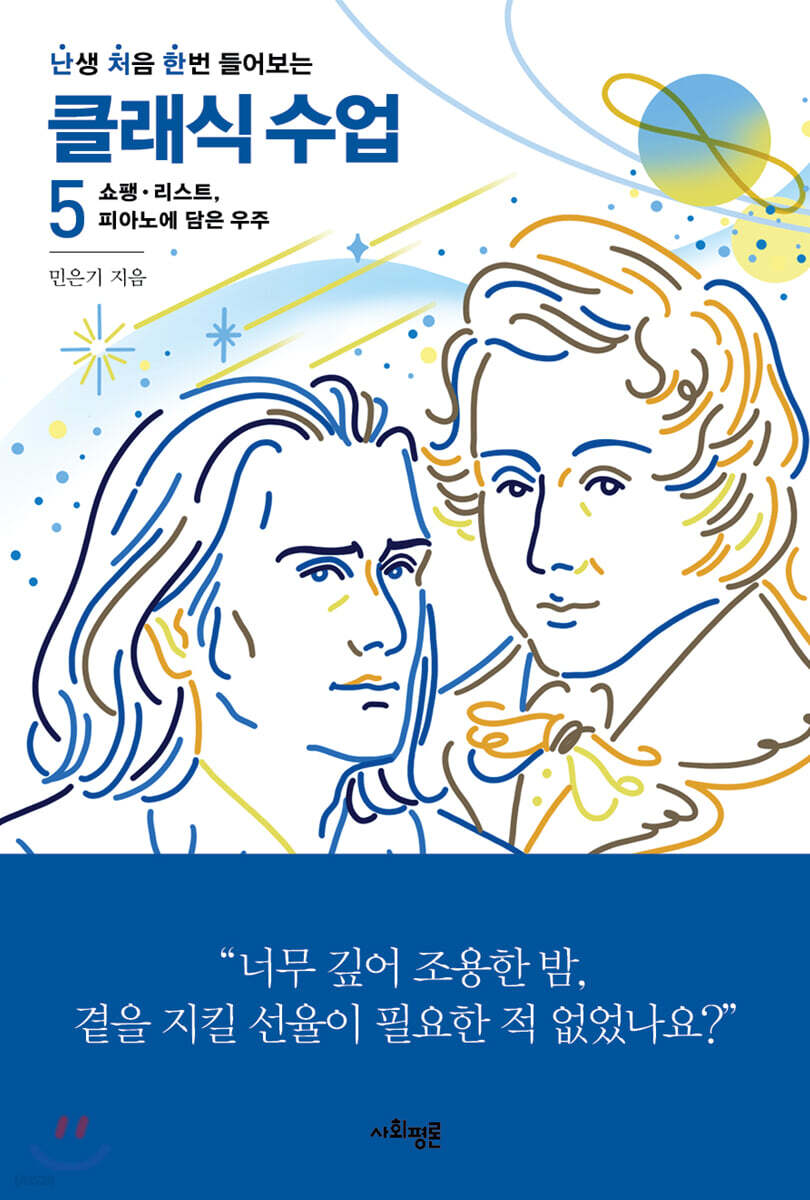
Embarrassing Classical Lesson 5
 |
Description
Book Introduction
“Classical music is not difficult at all when paired with the difficult.” "The First Classical Music Lesson in My Life" is an easy and fun introduction to classical music for those who have found classical music 'difficult'. In particular, the five volumes published this time contain the lives and works of Chopin and Liszt, two of the most renowned pianists in music history. As you appreciate the works of Chopin and Liszt and delve into the ins and outs of the piano, piano music will no longer sound the same. The author intersected the lives of two people, focusing on their commonality of playing the piano, and completed it into a single book. Chopin and Liszt had many similarities, but they also had many differences. Chopin, who was weak and conservative, and Liszt, who was powerful and progressive, presented completely different styles of music. Volume 5 traces the growth process of two musicians, starting with the invention of the piano and explaining the elements of piano music one by one. From the author's unique perspective, he explains not only the piano but also everything about Chopin and Liszt, including numerous songs that fully capture the love story of two people and the philosophy contained in the piano studies of Chopin and Liszt. The author begins the book with a cultural-historical analysis of why the piano was so beloved during the era in which the two composers were active, and then tells the story of how the young Chopin and Liszt lived amidst the revolutions of 19th-century Paris. As you read the book, you will learn not only about classical music, but also about the great historical trends from the 18th century to the 20th century when these artists were born and active. Professor Min Eun-ki, the first female professor of composition at Seoul National University and currently serving as Dean of the College of Music, is a diligent scholar who has never strayed from the real world while being a true researcher. He is a first-generation Korean musicologist, but he is also a social intellectual who has always met people outside of the university through numerous public lectures and writings. Perhaps no other scholar has worked as hard as Professor Min Eun-ki to introduce the world of classical music to the vast majority of Koreans, despite his keen understanding that it may be unfamiliar. Why classical music, anyway? According to the author, it's because classical music is a shared cultural heritage of humanity, a legacy we all share. It's a shame to live without it. The author begins Volume 1 by explaining why the classics are so important. “Classical music is a type of music that moves you more deeply the more you listen to it. You can listen to it for a long time without getting tired of it. As is often the case with other things that bear the name of classic.” If we are beings who have to listen to something to survive, then classic music, which is not influenced by trends, is probably the music genre that we can listen to for the longest time. |
- You can preview some of the book's contents.
Preview
index
Ⅰ The Eighty-Eight-Key Orchestra - The Birth and Development of the Piano
01 A new era begins
02 Pianists' Pianist
Ⅱ Chopin of Poland, Liszt of Hungary - Growth and Education
01 'Little Mozart' landed in Warsaw
02 The poor prodigy blessed by a comet
Ⅲ The Age of Revolution, Turbulent Paris - Social Change and Artists
01 A time for leap forward
02 In the chaotic metropolis
Ⅳ Love's Notes on the Staff - Musical Achievement
01 The year he went on pilgrimage
02 Music written in the Garden of Eden
03 The Greatest Star Leaves the Stage
V. The Stars Set and Become Constellations - The End and Influence of Two Masters
01 Funeral March for Chopin
02 Music knocks on the door of the future
03 Wearing monastic attire, go to God's side
04 Forever remembered on the keyboard
Detailed image

Into the book
The piano was connected not only to one's cultural and artistic literacy, but also to access to advanced civilization, wealth, and social status, and having a piano at home was a powerful way to show off one's culture and wealth.
But it wasn't just our country that was like that.
The situation was similar in Europe and the United States.
--- p.6, from “Opening Volume 5”
As you listen to the piano music in this lecture, your thoughts will change.
Because you will be able to feel a very rich sound.
Throughout history, countless musicians have loved the instrument known as the piano and have developed various ways to bring out its potential.
That love began with Mozart, passed through Beethoven, and reached its peak with our protagonists, Chopin and Liszt.
Since the advent of the piano, most composers have placed the piano at the top of their list of musical instruments.
--- p.24, from “A New Era Begins”
If you were to ask every pianist in the world to name their two favorite piano musicians, I'm sure these names would come up most often.
Chopin and Liszt, musicians who lived 200 years ago, are still greatly loved by people.
Although these two had a similar passion for the piano, their playing styles and lives were completely different.
--- p.43, from “The Pianist of Pianists”
Musicians practice endlessly to become better at playing their instruments.
Among them, playing the piano is closely related to motor skills.
In particular, you need to carefully consider your physical condition.
The most important thing is your fingers.
We'll look at it in more detail soon, but since each of the five fingers has a different personality, you need to utilize the strengths of each finger while also compensating for their weaknesses.
It is equally difficult to touch the keyboard as you think.
So, isn't a musician who can manipulate his fingers so freely truly amazing?
--- p.124, from “Poem for Leaping”
An exercise is also called an etude.
Etude is a French word meaning 'study'.
Of course, there were many etudes for piano before Chopin composed them.
But after the publication of 'Chopin Etude', the meaning of etude changed.
Is it because it was a great etude?
Yes, that's right.
The work is so excellent that it would not be out of place even if performed in a concert, and it is packed into the practice piece.
I practiced various techniques until I was comfortable with them, while also adding poetic expressions.
The once boring genre of etudes was elevated to art thanks to Chopin.
In other words, for Chopin, the idea of 'practice' became the inspiration for his creation.
Under Chopin's influence, many later musicians composed many musically excellent etudes.
--- p.139~140, from “Poem for a Leap”
What's more significant is that this was a time when musicians from all over Europe were gathering in Paris.
The fact that Liszt never returned to Vienna also suggests that the capital of music had shifted from Vienna to Paris since the early 19th century.
Even if you look at it not necessarily from the perspective of art but from the perspective of urban planning and architecture, Paris was at its peak at the time.
There was even a saying that “the 19th century made Paris beautiful and damaged Vienna.”
--- p.188, from “In the Chaotic City”
Liszt was a genius as a performer.
The influence he had on other pianists was also really great.
It is said that even professional pianists at the time played Chopin's compositions according to Liszt's interpretation.
The object of pianist admiration, the pianist's pianist.
--- p.220, from “In the Chaotic City”
I mentioned earlier that it's not easy to move each finger independently, right? When playing the piano, both hands usually share the same role.
I play the melody with one hand and the accompaniment with the other.
But to play Liszt's etudes, each finger must do its own part.
--- p.267, from “The Year He Went on Pilgrimage”
This means that the initial inspiration itself was that excellent.
It will go back to the original manuscript, and seeing that he revised it endlessly, we can see that Chopin was a perfectionist.
This is also clearly evident in the fact that he limited the scope of the genre he deals with early on.
I focused on what I was good at.
Instead of just following the rules of the established genre, we transformed it in an original way.
--- p.295, from “Music Written in the Garden of Eden”
The list also meticulously designed a stage of unprecedented form to meet the audience's expectations.
A small stage rose like an island in the middle of the concert hall, and two pianos were placed facing each other.
When playing, he would constantly move to a piano that sounded better for each song.
--- p.317, from “The Greatest Star Leaves the Stage”
Caroline said of Liszt's music during this period, "Liszt threw a spear into the land of the future, and later composers Schoenberg and Bartók picked it up."
Schoenberg and Bartok were the leaders of modernism in music in the early 20th century.
Liszt and Schoenberg, who later became famous for atonal music, all challenged the existing traditional tonality.
--- p.403, from “Wearing the Monk’s Robe and Going to God’s Side”
In this way, the two great pianists, Chopin and Liszt, left behind music that shines brighter than anything else.
So, finally, I would like to tell you the story of the juniors who polished that legacy.
Thanks to them, the melodies they created still linger with us.
--- p.413, from “Forever Remembered on the Keyboard”
Publisher's Review
★ Learn music through books! The "Embarrassing Series" raises the quality of knowledge and lowers the barrier to learning.
★ A truly comprehensive introduction to classical music for those who find classical music challenging but are comfortable with the piano! Ever wondered why the piano is called a "small orchestra?" Everything you need to know about the piano is contained in Volume 5, featuring Chopin and Liszt!
★ Insert a QR code into the text. With just the book and your smartphone, you can enjoy a personalized classical music lecture anywhere! No need to search for music separately!
Mozart, Beethoven, Bach, Handel, Chopin and Liszt
"The Embarrassing Classical Music Class" is a series that was first released in late 2018 after extensive preparation by Professor Min Eun-ki and Social Criticism Publishing, who shared the same concern that there was no easy-to-pick-up introductory classical music book.
As it took a long time, the series was meticulously planned.
From the most basic of basics, Do-Re-Mi-Fa-So-La-Si, to the symphony, the flower of instrumental music, and from the first song of mankind to today's popular pop songs, it guides you step by step through time and space and genres to the best path to the world of classical music.
In addition to music links, you can access classical music, which was once considered difficult, through sheet music, portraits, and landscape photos.
The reason why the Mozart volume 1, Beethoven volume 2, Bach volume 3, and Handel volume 4 were all praised as “an easy-to-read classical music textbook,” “a friendly introduction to classical music that explains it step by step so that even those who have had no connection to music since elementary school can understand it,” and “a book that balances musical works and background knowledge” was that it was able to quickly establish itself as a “bible” for beginners to classical music.
Volume 5 is noteworthy for its attempts to differentiate itself from other books in the "Awkward Classics Class" series.
If the existing series was structured to follow one musician, Volume 5 features two musicians as the main characters.
Additionally, while the text up to Volume 4 mainly explained classical music in general, Volume 5 focuses on one instrument, the piano.
The next six volumes will cover Verdi and Wagner.
The stories contained in the lives and music of these two musicians, who were men of the times, will be a great opportunity to learn about the times and the artistic genre of opera.
You can listen to music and take lectures anytime, anywhere with just a smartphone.
While 『The Story of Studying Art for the First Time in My Life』, which opened the door to the 'Embarrassing Series' with unprecedented success as a domestically planned art textbook, allowed readers to comfortably read the illustrations without turning the pages, 『Embarrassing Classical Music Class』 connected to music using QR codes, saving readers the trouble of having to search for the music.
The advantages were maintained in other areas as well.
It is structured in a conversational format where the professor lectures and the reader responds, making it readable as if receiving one-on-one tutoring. The book is enriched with illustrator Kang Han's sensual illustrations and photographs that add a sense of realism, making it even more enjoyable to read.
It can be said that the composition was designed with the generation in mind who is more familiar with spoken language than written language and with images than with print.
In particular, the fifth volume of 『Embarrassing Classical Music Lessons』, which is being published this time, introduces over 260 visual materials and 70 pieces of music, far exceeding the previous number, allowing you to enjoy the world of piano music in a more colorful way.
The universe called the piano, and the stars within it called Chopin and Liszt
The protagonists of Volume 5 of "Awkward Classical Music Lessons" are Chopin and Liszt, who are always included in the concert repertoires of famous pianists such as Seong-Jin Cho and Yeol-Eum Son.
Chopin is still so loved that he is still at the forefront of people's favorite classical musicians.
Liszt was also an outstanding pianist who lived in the same era as Chopin and a composer whose presence cannot be left out of music history.
Chopin's 'Nocturnes' and 'Etudes', which comfort many with their soft melodies, are so widely known that they are used as proper nouns.
On the other hand, Liszt's pieces such as 'La Campanella' and 'Hungarian Rhapsody' are extremely difficult pieces in a style that is the complete opposite of Chopin's works, and are familiar to us as pieces that many pianists perform without fail.
It is a little known fact that Chopin and Liszt were friends who were only one year apart in age.
There are many things in common between the two.
They were artists representing Poland and Hungary, which were persecuted by the European powers of the time, and both had a great passion for the piano.
Moreover, it is noteworthy that he was an artist who was active in 19th century Paris and breathed in the very air of revolution.
The story of two young men who wrote their works in the midst of the French Revolution vividly conveys the spirit of the times.
Their friendship promises drama unlike anything seen in the previous "Awkward Classics Class" series.
19th-century Paris was home to not only Chopin and Liszt, but also historically significant figures such as Victor Hugo, George Sand, and Delacroix.
The music of these two people, who stood among countless artists sharing their passion and raising their voices, is engraved with a cross-section of the fierce times.
In Volume 5, you will discover more dramatic anecdotes than ever before in the music of Chopin and Liszt.
The author, who studied piano for a long time as a child, says with special affection that the sound of the piano contains the universe.
And it provides a scientific and rational analysis of the piano, as well as a step-by-step explanation of the imagination needed to appreciate piano music.
While analyzing where our passion for the piano, which everyone has experienced or witnessed, began, he kindly adds an explanation of what makes the performances of famous pianists different.
This course covers a wide range of topics, from an analysis of the piano's internal structure to its lineage as a modern pianist, and will provide readers with a thorough understanding of the piano.
GOODS SPECIFICS
- Publication date: December 15, 2020
- Page count, weight, size: 440 pages | 680g | 152*225*25mm
- ISBN13: 9791162731383
- ISBN10: 1162731389
You may also like
카테고리
korean


korean


