

Everyday Sense Research Institute
 |
Description
Book Introduction
The science of the senses, from the director of the Oxford Integrated Senses Institute!
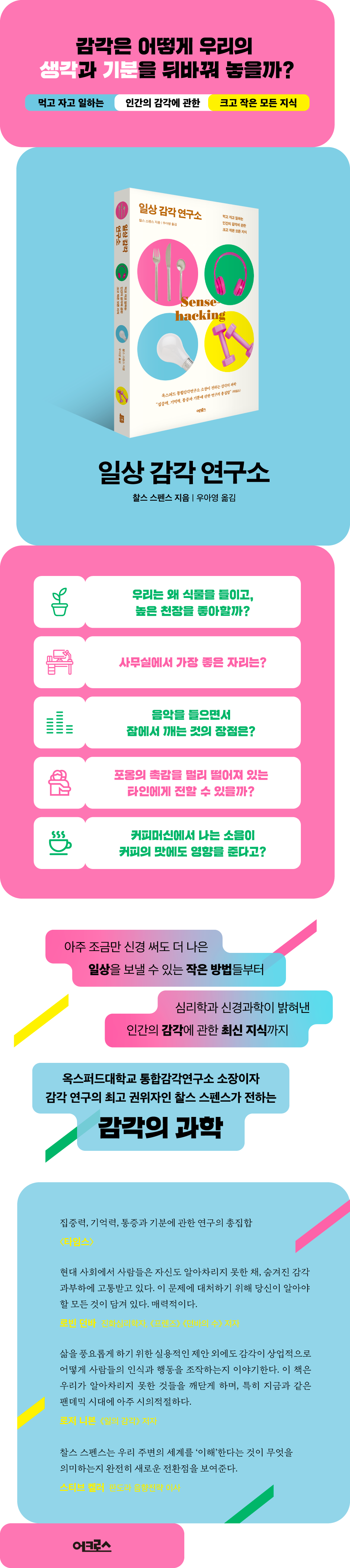
How do our senses change our thoughts and feelings?
We greatly underestimate the power of our senses.
No, have you ever thought about your senses? They are the organs through which humans first receive all information.
That's why our thoughts and feelings change so amazingly depending on how we use our senses.
Charles Spence, a world authority on sensory research, is the director of the Integrated Senses Laboratory at Oxford University and an experimental psychologist who has been studying how people perceive the world around them for over 20 years.
In this book, he confidently asserts that by applying the scientific knowledge gained through sensory science to daily life, even just a few small changes can lead to a healthier and happier life.
Just as the senses span everything we perceive, Charles Spence's research subjects also boast a vast spectrum.
He has conducted various collaborative studies on human senses with global companies such as Johnson & Johnson, Unilever, and Dulux, and even won the Ig Nobel Prize for his paper on the topic, "We tend to believe that snacks that make a pleasant sound when chewed are more delicious."
This eccentric scientist, with a wide range of curiosity, introduces not only academically valuable research, but also topics that had to be abandoned for some reason or are still uncharted territory, with affection and humor.
As we follow his guide through the new world of senses, we will come to understand the power of senses in all the experiences that surround us in our daily lives, and how we can harness that power.
How do our senses change our thoughts and feelings?
We greatly underestimate the power of our senses.
No, have you ever thought about your senses? They are the organs through which humans first receive all information.
That's why our thoughts and feelings change so amazingly depending on how we use our senses.
Charles Spence, a world authority on sensory research, is the director of the Integrated Senses Laboratory at Oxford University and an experimental psychologist who has been studying how people perceive the world around them for over 20 years.
In this book, he confidently asserts that by applying the scientific knowledge gained through sensory science to daily life, even just a few small changes can lead to a healthier and happier life.
Just as the senses span everything we perceive, Charles Spence's research subjects also boast a vast spectrum.
He has conducted various collaborative studies on human senses with global companies such as Johnson & Johnson, Unilever, and Dulux, and even won the Ig Nobel Prize for his paper on the topic, "We tend to believe that snacks that make a pleasant sound when chewed are more delicious."
This eccentric scientist, with a wide range of curiosity, introduces not only academically valuable research, but also topics that had to be abandoned for some reason or are still uncharted territory, with affection and humor.
As we follow his guide through the new world of senses, we will come to understand the power of senses in all the experiences that surround us in our daily lives, and how we can harness that power.
- You can preview some of the book's contents.
Preview
index
1 Everyday Senses - Everything is conveyed through the senses.
Multisensory Interiors│Why We Feel Anxious About Spiders and Snakes, But Love Smiling Faces│Sensory Interactions│Sensory Integration│The Science of Sense Hacking
2nd House - Conditions for Feeling Comfortable
Why do we bring in plants and love high ceilings? │ 'Sensory Living' │ The Duality of White Walls │ The Color of Emotions │ Why We Love Homes as Warm as Africa │ Blocking Out Food Smells │ Can We Suppress Our Appetite? │ The Mere Presence of a Tablecloth │ Do We Want a Truly Quiet Kitchen? │ Home Alone │ Soaking in Hot Water
3 Gardens - An Invitation to Another World
Nature's Effects│Rooms with a View│Ranking the Benefits of Nature│Natural Rhythms and Body Rhythms│Santandercito, My Garden Retreat│Experience Nature with All Your Senses
4 Bedrooms - Are Your Efforts to Sleep Well Effective?
The less you sleep, the shorter your lifespan│While you are half-asleep│The trap of light│The different aspects of morning and evening│A good night's sleep│Thinking while sleeping for one night│Good night!│A flower pot next to the bed│Are you a night owl or a lark?│The first night effect│Sleep deprivation│The scent of sleep│Dream sense hacking│Wake up, it's time to smell the bacon!│Sleep inertia│The best sleep│Are we really more sleep-deprived than ever?
5 Commuting - It's a very dangerous thing when you know it
What's real and what's fake? │Vroom, vroom, how important is the sound of an engine? │Can you tell quality from sound? │"Make it feel good in your hand." │What does techno music have to do with traffic accidents? │Technology is too distracting! How to keep drivers focused. │"You don't have to reply now." │Drowsy driving. │Driving with nature's benefits. │Dangerous solutions. │Car sickness is painful. There's a long way to go.
6 Jobs - Surviving in a Sick Building
Sensory imbalance in the office│Who wants lean design?│A discussion on sick buildings│Is air conditioning sexist?│Who doesn't get tired at work?│Increasing creativity with sensory hacking│Open office│First, choose a desk by the window│Green office│“What's wrong with artificial trees?”│Have you put all the beauty of nature in your office computer?│Why Google offers free meals
7 Shopping Scams You Know You're Falling for
The scent that stops customers in their tracks│Smell the colors│What kind of music should I play?│Subliminal, the temptation that delves into the subconscious│Atmosphere│The smell of a teenager's soul│Keep your head cool│"Touch it"│Contact contamination│Does multisensory marketing actually achieve hyper-valuable sales increases?│Time to brighten the lights and turn down the music?│A taste of the future│Multisensory online shopping│The future of online marketing│Shopping until you turn into kimchi
8 Healthcare - The Age of Loss of Contact
Why are hospitals starting to resemble luxury hotels? │ Healthy Taste │ Healthy Looks │ Healthy Listening │ Music Therapy │ The Healing Touch │ Aromatherapy │ Multisensory Medicine
9 Exercise and Sports - The Scent of Victory, the Taste of Success
Is it better to exercise outdoors or indoors? │Running while watching TV │Mood music, moving to the beat │Why do tennis players roar? │Listen to the crowd │The scent of victory, the taste of success │The power of clothing │The red of victory │Exercise with your senses
10 Dates - Attracted by the Circumstances, Not the People
Excitement│'The Appearance of Love'│The Fragrance of Women│The Rings Effect│A Glamorous Red│Kill Heels│Swipe Right if You Like It! Online Dating Tips│Are Oysters Really the Food of Love?│The Voice of Lust│The Reversal of Body Odor│I Love You with All My Senses
11 The Future of the Senses: Sense Hacking, Sensism, and Multisensory
Sensory Deprivation│Are You Suffering from Sensory Overload?│Primal Pleasure│Welcome to the Explosive World of Sensory Marketing!│Sensism: A Mindful Approach to the Senses│Is Your Sensory Balance Alright?│Social Isolation in the Pandemic Era│Sense Hacking: The Future of Senses
Simple Sense Hacking Method
Americas
References
Multisensory Interiors│Why We Feel Anxious About Spiders and Snakes, But Love Smiling Faces│Sensory Interactions│Sensory Integration│The Science of Sense Hacking
2nd House - Conditions for Feeling Comfortable
Why do we bring in plants and love high ceilings? │ 'Sensory Living' │ The Duality of White Walls │ The Color of Emotions │ Why We Love Homes as Warm as Africa │ Blocking Out Food Smells │ Can We Suppress Our Appetite? │ The Mere Presence of a Tablecloth │ Do We Want a Truly Quiet Kitchen? │ Home Alone │ Soaking in Hot Water
3 Gardens - An Invitation to Another World
Nature's Effects│Rooms with a View│Ranking the Benefits of Nature│Natural Rhythms and Body Rhythms│Santandercito, My Garden Retreat│Experience Nature with All Your Senses
4 Bedrooms - Are Your Efforts to Sleep Well Effective?
The less you sleep, the shorter your lifespan│While you are half-asleep│The trap of light│The different aspects of morning and evening│A good night's sleep│Thinking while sleeping for one night│Good night!│A flower pot next to the bed│Are you a night owl or a lark?│The first night effect│Sleep deprivation│The scent of sleep│Dream sense hacking│Wake up, it's time to smell the bacon!│Sleep inertia│The best sleep│Are we really more sleep-deprived than ever?
5 Commuting - It's a very dangerous thing when you know it
What's real and what's fake? │Vroom, vroom, how important is the sound of an engine? │Can you tell quality from sound? │"Make it feel good in your hand." │What does techno music have to do with traffic accidents? │Technology is too distracting! How to keep drivers focused. │"You don't have to reply now." │Drowsy driving. │Driving with nature's benefits. │Dangerous solutions. │Car sickness is painful. There's a long way to go.
6 Jobs - Surviving in a Sick Building
Sensory imbalance in the office│Who wants lean design?│A discussion on sick buildings│Is air conditioning sexist?│Who doesn't get tired at work?│Increasing creativity with sensory hacking│Open office│First, choose a desk by the window│Green office│“What's wrong with artificial trees?”│Have you put all the beauty of nature in your office computer?│Why Google offers free meals
7 Shopping Scams You Know You're Falling for
The scent that stops customers in their tracks│Smell the colors│What kind of music should I play?│Subliminal, the temptation that delves into the subconscious│Atmosphere│The smell of a teenager's soul│Keep your head cool│"Touch it"│Contact contamination│Does multisensory marketing actually achieve hyper-valuable sales increases?│Time to brighten the lights and turn down the music?│A taste of the future│Multisensory online shopping│The future of online marketing│Shopping until you turn into kimchi
8 Healthcare - The Age of Loss of Contact
Why are hospitals starting to resemble luxury hotels? │ Healthy Taste │ Healthy Looks │ Healthy Listening │ Music Therapy │ The Healing Touch │ Aromatherapy │ Multisensory Medicine
9 Exercise and Sports - The Scent of Victory, the Taste of Success
Is it better to exercise outdoors or indoors? │Running while watching TV │Mood music, moving to the beat │Why do tennis players roar? │Listen to the crowd │The scent of victory, the taste of success │The power of clothing │The red of victory │Exercise with your senses
10 Dates - Attracted by the Circumstances, Not the People
Excitement│'The Appearance of Love'│The Fragrance of Women│The Rings Effect│A Glamorous Red│Kill Heels│Swipe Right if You Like It! Online Dating Tips│Are Oysters Really the Food of Love?│The Voice of Lust│The Reversal of Body Odor│I Love You with All My Senses
11 The Future of the Senses: Sense Hacking, Sensism, and Multisensory
Sensory Deprivation│Are You Suffering from Sensory Overload?│Primal Pleasure│Welcome to the Explosive World of Sensory Marketing!│Sensism: A Mindful Approach to the Senses│Is Your Sensory Balance Alright?│Social Isolation in the Pandemic Era│Sense Hacking: The Future of Senses
Simple Sense Hacking Method
Americas
References
Detailed image
Into the book
So what exactly is sense hacking? It can be defined as using the power of the senses and sensory stimulation to enhance social, cognitive, and emotional well-being.
Only by understanding the unique capabilities of each sense and the predictable ways they interact to drive emotions and behaviors can you most effectively "hack" your own sensory experiences.
In this way, you can start from yourself and improve the quality of life of your loved ones.
---From “Everyday Senses - Everything is Transmitted Through the Senses”
How interactive are our senses? The answer to this question is crucial, as it determines how we experience the world around us and how we perceive that experience.
According to science, our senses are much more connected than we think.
What this means is that you can actually change what you hear by simply replacing what you see, and you can even manipulate sounds to make them feel different.
---From “Everyday Senses - Everything is Transmitted Through the Senses”
Whether we realize it or not, sound plays a functional role in our product experiences.
Engineers and designers often struggle to create quieter models by eliminating the noise of washing machines, blenders, and vacuum cleaners.
Because it feels like the product isn't working properly.
(…) In the high-end kitchen appliance market, it is also important to ensure that the refrigerator door makes a proper sound when closing.
In fact, the design of the refrigerator door is very similar to the design of the car door.
In both cases, the key is to provide an appropriately safe sound and feel.
---From "Conditions for Feeling Comfortable at Home"
Brief exposure to nature helps animals recover more quickly from laboratory stress.
A standard way to induce stress in the lab is to give someone a very difficult task and tell them that others can do it easily.
Another way is to watch a stressful movie.
Heart rate and skin conductance, physiological indicators of stress, return to normal levels more quickly in nature than in artificial environments.
The beneficial effects of nature work throughout life.
In other words, most of us living in modern industrialized societies are likely suffering from what is called a 'nature deficiency'.
---From "Garden - Invitation to Another World"
As the profound benefits of regular, deep sleep for our social, emotional, and physical well-being become increasingly evident, the old culture of waking up early and sleeping less is finally beginning to fade.
Therefore, it will become increasingly important to find the best ways to maximize sleep efficiency and spend more time sleeping.
My guess is that in the future, sleep sense hacking will be combined with cognitive behavioral therapy strategies.
Soon, we will be able to leverage cutting-edge mobile technology to provide multisensory interventions across various sleep stages.
---From "Bedroom - Are Efforts to Sleep Well Effective?"
A car is the second most expensive single purchase we will make in our lifetime, after a house.
Naturally, automakers are adept at using sensor hacking.
The appearance, sound, smell, and even the feel are all carefully crafted to convey just the right impression.
However, commuting may also face significant changes due to changes in public transportation usage caused by COVID-19, electric and hybrid vehicles, semi-autonomous vehicles, and the upcoming emergence of driverless cars.
Who knows, flying cars might be here soon.
But let's be honest: while the technical challenges of realizing these ideas are quickly being solved, there's a fundamental psychological barrier to engaging in the unnatural activity of driving.
Our brains never evolved to drive, which is probably why so many people get carsick.
---From "Commuting - A Very Dangerous Thing When You Know It"
What we really need is a work environment that allows us to stay alert after lunch, while also allowing us to relax as we wrap up the day and prepare to leave.
This temporally varying need for environmental stimulation may partly explain why fixed environmental characteristics are not very helpful in managing people's well-being and productivity in the workplace.
---From "Workplace - Surviving in a Sick Building"
In terms of tactile sensation, the most obvious factor affecting mood is probably ambient temperature.
You might be surprised to know this, but high-end clothing stores deliberately keep their store temperatures low.
A reporter recorded the internal temperatures of several clothing stores in New York and found that temperature and price range were inversely proportional.
In other words, luxury brands tend to set their temperatures lower than mass-market chains.
---From "Shopping - Tricks You Fall for Even Though You Know It"
Now, looking specifically at the treadmill exercise situation, the results again show that performance improves when listening to loud, fast music.
For rhythmic activities like running, it's best to listen to music that synchronizes with your movements.
According to research by Fritz and his colleagues, 'control over music' is key.
In other words, people will exercise better if they believe that their actions create the rhythm of the music they are listening to.
---From "Exercise and Sports - The Scent of Victory, the Taste of Success"
Many of the latest insights into sense hacking are already being used to help us sleep better without drugs, eat less without starving, look more attractive without plastic surgery, drive more safely, and exercise with maximum enjoyment without feeling bored or disillusioned.
All this and much more can be achieved simply by paying attention to the calming influences our senses convey.
Only by understanding the unique capabilities of each sense and the predictable ways they interact to drive emotions and behaviors can you most effectively "hack" your own sensory experiences.
In this way, you can start from yourself and improve the quality of life of your loved ones.
---From “Everyday Senses - Everything is Transmitted Through the Senses”
How interactive are our senses? The answer to this question is crucial, as it determines how we experience the world around us and how we perceive that experience.
According to science, our senses are much more connected than we think.
What this means is that you can actually change what you hear by simply replacing what you see, and you can even manipulate sounds to make them feel different.
---From “Everyday Senses - Everything is Transmitted Through the Senses”
Whether we realize it or not, sound plays a functional role in our product experiences.
Engineers and designers often struggle to create quieter models by eliminating the noise of washing machines, blenders, and vacuum cleaners.
Because it feels like the product isn't working properly.
(…) In the high-end kitchen appliance market, it is also important to ensure that the refrigerator door makes a proper sound when closing.
In fact, the design of the refrigerator door is very similar to the design of the car door.
In both cases, the key is to provide an appropriately safe sound and feel.
---From "Conditions for Feeling Comfortable at Home"
Brief exposure to nature helps animals recover more quickly from laboratory stress.
A standard way to induce stress in the lab is to give someone a very difficult task and tell them that others can do it easily.
Another way is to watch a stressful movie.
Heart rate and skin conductance, physiological indicators of stress, return to normal levels more quickly in nature than in artificial environments.
The beneficial effects of nature work throughout life.
In other words, most of us living in modern industrialized societies are likely suffering from what is called a 'nature deficiency'.
---From "Garden - Invitation to Another World"
As the profound benefits of regular, deep sleep for our social, emotional, and physical well-being become increasingly evident, the old culture of waking up early and sleeping less is finally beginning to fade.
Therefore, it will become increasingly important to find the best ways to maximize sleep efficiency and spend more time sleeping.
My guess is that in the future, sleep sense hacking will be combined with cognitive behavioral therapy strategies.
Soon, we will be able to leverage cutting-edge mobile technology to provide multisensory interventions across various sleep stages.
---From "Bedroom - Are Efforts to Sleep Well Effective?"
A car is the second most expensive single purchase we will make in our lifetime, after a house.
Naturally, automakers are adept at using sensor hacking.
The appearance, sound, smell, and even the feel are all carefully crafted to convey just the right impression.
However, commuting may also face significant changes due to changes in public transportation usage caused by COVID-19, electric and hybrid vehicles, semi-autonomous vehicles, and the upcoming emergence of driverless cars.
Who knows, flying cars might be here soon.
But let's be honest: while the technical challenges of realizing these ideas are quickly being solved, there's a fundamental psychological barrier to engaging in the unnatural activity of driving.
Our brains never evolved to drive, which is probably why so many people get carsick.
---From "Commuting - A Very Dangerous Thing When You Know It"
What we really need is a work environment that allows us to stay alert after lunch, while also allowing us to relax as we wrap up the day and prepare to leave.
This temporally varying need for environmental stimulation may partly explain why fixed environmental characteristics are not very helpful in managing people's well-being and productivity in the workplace.
---From "Workplace - Surviving in a Sick Building"
In terms of tactile sensation, the most obvious factor affecting mood is probably ambient temperature.
You might be surprised to know this, but high-end clothing stores deliberately keep their store temperatures low.
A reporter recorded the internal temperatures of several clothing stores in New York and found that temperature and price range were inversely proportional.
In other words, luxury brands tend to set their temperatures lower than mass-market chains.
---From "Shopping - Tricks You Fall for Even Though You Know It"
Now, looking specifically at the treadmill exercise situation, the results again show that performance improves when listening to loud, fast music.
For rhythmic activities like running, it's best to listen to music that synchronizes with your movements.
According to research by Fritz and his colleagues, 'control over music' is key.
In other words, people will exercise better if they believe that their actions create the rhythm of the music they are listening to.
---From "Exercise and Sports - The Scent of Victory, the Taste of Success"
Many of the latest insights into sense hacking are already being used to help us sleep better without drugs, eat less without starving, look more attractive without plastic surgery, drive more safely, and exercise with maximum enjoyment without feeling bored or disillusioned.
All this and much more can be achieved simply by paying attention to the calming influences our senses convey.
---From "The Future of Senses: Sense Hacking, Sensism, and Multisensory"
Publisher's Review
The science of the senses, from the director of the Oxford Integrated Senses Institute!
How do our senses change our thoughts and feelings?
We greatly underestimate the power of our senses.
No, have you ever thought about your senses? They are the organs through which humans first receive all information.
That's why our thoughts and feelings change so amazingly depending on how we use our senses.
Charles Spence, a world authority on sensory research, is the director of the Integrated Senses Laboratory at Oxford University and an experimental psychologist who has been studying how people perceive the world around them for over 20 years.
In this book, he confidently asserts that by applying the scientific knowledge gained through sensory science to daily life, even just a few small changes can lead to a healthier and happier life.
Just as the senses span everything we perceive, Charles Spence's research subjects also boast a vast spectrum.
He has conducted various collaborative studies on human senses with global companies such as Johnson & Johnson, Unilever, and Dulux, and even won the Ig Nobel Prize for his paper on the topic, "We tend to believe that snacks that make a pleasant sound when chewed are more delicious."
This eccentric scientist, with a wide range of curiosity, introduces not only academically valuable research, but also topics that had to be abandoned for some reason or are still uncharted territory, with affection and humor.
As we follow his guide through the new world of senses, we will come to understand the power of senses in all the experiences that surround us in our daily lives, and how we can harness that power.
A "sensory instruction manual" that moves from the bed to the office, gym, and shopping center.
Even the smallest change can change your daily life for the better.
The 『Everyday Sense Research Institute』 is centered around the everyday environments in which people live ordinary lives.
Beginning with the front door, we'll explore how to make your home more comfortable and livable, exploring the living room, kitchen, and bathroom; how to benefit from nature through a garden; and how to promote a good night's sleep through the bedroom environment.
It also provides tips on how to drive safely during your commute to and from work, and how to create an office environment that promotes productivity.
Finally, we cover our leisure activities: shopping, dating, sports, and healthcare.
You'll discover proven, effective methods that help you exercise harder and recover faster from illness or injury.
The book is full of practical advice, but it also contains ingenious and entertaining research and questions that members of society would do well to think about together.
If you're having trouble falling asleep in an unfamiliar place because of the noise, and you only have one earplug, which one should you put in? The right one.
Initially, the right brain sleeps while the left brain remains alert. This is because sensations felt on one side of the body or sounds heard through one ear are processed in the opposite hemisphere of the brain.
If women and men feel the cold differently in the office, how should we adjust the temperature to suit their needs? There may not be a satisfactory middle ground when it comes to office temperature.
However, it is better to raise the temperature.
This is because it has been experimentally proven that increasing the temperature increases women's performance to a greater extent than decreasing men's performance.
Why do tennis players scream so loudly on the court?
How to make better judgments than relying on one sense
Our responses to the stimuli that surround us are ultimately a product of evolution.
We evolved to prefer smiles over frowns in other people.
The analog clocks in advertisements almost always point to 10:10 because when the clock points to 10:10, it looks like a person is smiling.
This has nothing to do with the quality of the watch, but experimental evidence shows that people clearly prefer watches that show 10:10.
These evolutionary triggers subtly, and sometimes overtly, encourage customers to open their wallets.
Perhaps after reading this book, you will feel betrayed by how many companies already exploit people's senses for marketing purposes.
To effectively utilize human senses in various aspects of life and industry, we must first understand that senses do not operate independently but are always interacting.
We consider each of our senses, which we call the 'five senses', to be a separate system.
But our senses are much more and more closely connected than we think.
For example, the noise from a coffee machine can affect the bitterness of the coffee as much as the type of beans used.
The story is that it is possible to manipulate sound to make people perceive different tastes.
This interaction of the senses is called 'multisensory'.
When we feel something, we perceive not one sensation, but multiple sensations.
Understanding how multiple senses work (sensory integration) can help you make more reliable judgments than relying on a single sense.
A prime example is the reason why players yell during a tennis match.
A player's roar may simply be a physical reaction, but it may also be a strategy to prevent the opposing player from hearing the sound of the ball being hit.
In an experiment at the University of Jena in Germany, participants predicted a ball's landing location differently from the actual location based on the loudness of the sound made when the racket hit the ball.
Although they could clearly see the ball hitting the racket, they predicted that the ball would fly farther if they heard a louder sound than the actual sound.
In this way, when a tennis player screams during a game, it is difficult for the opponent to properly judge where the ball will land.
Is it possible to convey the tactile sensation of a hug to someone far away?
From social isolation in the pandemic era to the future of our senses as revealed by cutting-edge science.
As social distancing continues due to the COVID-19 virus, the sense humans are neglecting the most is touch.
The skin is a huge sensory organ that occupies the largest surface area of the body.
Physical contact between people can even relieve physical pain.
If we could send a caress or hug to a loved one far away via the Internet, could it alleviate some of the social isolation so many people experience?
Surprisingly, clothing that can transmit tactile stimulation to others has been around for a long time.
The problem, however, is that these digitally mediated contacts do not have the same effect as real-life, in-person contact.
It could be a temperature issue, or it could be a chemical sensory signal such as a pheromone.
Ultimately, the act of hugging, which is simply 'moving', is not enough.
This is why we need to understand multisensory phenomena.
Because our experience of touching others is not simply through touch.
Meanwhile, the future of the senses is even more promising.
We may now be aware of not only our 'five senses' but also new, even more bizarre, sensations such as magnetic fields, seismic sensations, and more.
Catalan cyborg activist Moon Rivas can feel seismic activity through an implant in his arm.
London-based Cyborgnest sells a device called North Sense, which sends vibrations to the chest of a person wearing it whenever they face north of the Earth's magnetic field.
What utility does the experience of perceiving the North provide us? And how does it change the human senses that perceive it? Currently, we don't know.
But someday, a truly new sensation may be born.
The inevitable fate of modern man: an era of sensory overload and sensory imbalance.
Nature, accessible to all, could be the answer.
City dwellers living in modern society suffer from sensory overload due to excessive noise and information.
Just look at the various alarms that go off on the mobile devices we use.
For this reason, a method called "dopamine fasting" became popular in Silicon Valley, which involved cutting off all forms of social contact for a short period of time.
But let's think about it.
Most of the overstimulation we suffer from relies on hearing and sight.
The experience of suffering from too many smells or tastes may be unfamiliar.
The authors argue that the real issue is not simply overstimulation, but rather striking a balance between the senses.
The right balance of sensory stimulation is essential for health, productivity, and well-being.
One solution to this can be found in nature.
This is because the stimulation that nature gives us is multisensory in itself.
Although the author structured this book around the 'spaces' in which humans live and the 'situations' in which they spend their leisure time, he repeatedly explains the benefits of 'nature' throughout several chapters of the book.
For thousands of years, people have intuitively known that spending time in nature is beneficial to us.
Humans who are exposed to nature even briefly recover from stress more quickly.
Numerous studies confirm that people feel more positive about themselves and the world when they are in nature.
The author cites Edward Wilson's 'biophilia hypothesis' and Stephen Kaplan's 'attention restoration theory' as the basis for this claim.
Even though we're so aware of the benefits nature offers, why don't we venture outside more often? It's because our emotional predictability is limited.
You can't predict exactly how much better you'll feel.
Simply ‘knowing’ is not enough.
To fully benefit from it, you need 'experience'.
The same goes for the utility of the senses.
Rather than simply understanding the power of the senses, we need to apply it more actively in real life.
First, let's go outside more often to experience nature and restore balance to our senses.
It will definitely be worth it.
How do our senses change our thoughts and feelings?
We greatly underestimate the power of our senses.
No, have you ever thought about your senses? They are the organs through which humans first receive all information.
That's why our thoughts and feelings change so amazingly depending on how we use our senses.
Charles Spence, a world authority on sensory research, is the director of the Integrated Senses Laboratory at Oxford University and an experimental psychologist who has been studying how people perceive the world around them for over 20 years.
In this book, he confidently asserts that by applying the scientific knowledge gained through sensory science to daily life, even just a few small changes can lead to a healthier and happier life.
Just as the senses span everything we perceive, Charles Spence's research subjects also boast a vast spectrum.
He has conducted various collaborative studies on human senses with global companies such as Johnson & Johnson, Unilever, and Dulux, and even won the Ig Nobel Prize for his paper on the topic, "We tend to believe that snacks that make a pleasant sound when chewed are more delicious."
This eccentric scientist, with a wide range of curiosity, introduces not only academically valuable research, but also topics that had to be abandoned for some reason or are still uncharted territory, with affection and humor.
As we follow his guide through the new world of senses, we will come to understand the power of senses in all the experiences that surround us in our daily lives, and how we can harness that power.
A "sensory instruction manual" that moves from the bed to the office, gym, and shopping center.
Even the smallest change can change your daily life for the better.
The 『Everyday Sense Research Institute』 is centered around the everyday environments in which people live ordinary lives.
Beginning with the front door, we'll explore how to make your home more comfortable and livable, exploring the living room, kitchen, and bathroom; how to benefit from nature through a garden; and how to promote a good night's sleep through the bedroom environment.
It also provides tips on how to drive safely during your commute to and from work, and how to create an office environment that promotes productivity.
Finally, we cover our leisure activities: shopping, dating, sports, and healthcare.
You'll discover proven, effective methods that help you exercise harder and recover faster from illness or injury.
The book is full of practical advice, but it also contains ingenious and entertaining research and questions that members of society would do well to think about together.
If you're having trouble falling asleep in an unfamiliar place because of the noise, and you only have one earplug, which one should you put in? The right one.
Initially, the right brain sleeps while the left brain remains alert. This is because sensations felt on one side of the body or sounds heard through one ear are processed in the opposite hemisphere of the brain.
If women and men feel the cold differently in the office, how should we adjust the temperature to suit their needs? There may not be a satisfactory middle ground when it comes to office temperature.
However, it is better to raise the temperature.
This is because it has been experimentally proven that increasing the temperature increases women's performance to a greater extent than decreasing men's performance.
Why do tennis players scream so loudly on the court?
How to make better judgments than relying on one sense
Our responses to the stimuli that surround us are ultimately a product of evolution.
We evolved to prefer smiles over frowns in other people.
The analog clocks in advertisements almost always point to 10:10 because when the clock points to 10:10, it looks like a person is smiling.
This has nothing to do with the quality of the watch, but experimental evidence shows that people clearly prefer watches that show 10:10.
These evolutionary triggers subtly, and sometimes overtly, encourage customers to open their wallets.
Perhaps after reading this book, you will feel betrayed by how many companies already exploit people's senses for marketing purposes.
To effectively utilize human senses in various aspects of life and industry, we must first understand that senses do not operate independently but are always interacting.
We consider each of our senses, which we call the 'five senses', to be a separate system.
But our senses are much more and more closely connected than we think.
For example, the noise from a coffee machine can affect the bitterness of the coffee as much as the type of beans used.
The story is that it is possible to manipulate sound to make people perceive different tastes.
This interaction of the senses is called 'multisensory'.
When we feel something, we perceive not one sensation, but multiple sensations.
Understanding how multiple senses work (sensory integration) can help you make more reliable judgments than relying on a single sense.
A prime example is the reason why players yell during a tennis match.
A player's roar may simply be a physical reaction, but it may also be a strategy to prevent the opposing player from hearing the sound of the ball being hit.
In an experiment at the University of Jena in Germany, participants predicted a ball's landing location differently from the actual location based on the loudness of the sound made when the racket hit the ball.
Although they could clearly see the ball hitting the racket, they predicted that the ball would fly farther if they heard a louder sound than the actual sound.
In this way, when a tennis player screams during a game, it is difficult for the opponent to properly judge where the ball will land.
Is it possible to convey the tactile sensation of a hug to someone far away?
From social isolation in the pandemic era to the future of our senses as revealed by cutting-edge science.
As social distancing continues due to the COVID-19 virus, the sense humans are neglecting the most is touch.
The skin is a huge sensory organ that occupies the largest surface area of the body.
Physical contact between people can even relieve physical pain.
If we could send a caress or hug to a loved one far away via the Internet, could it alleviate some of the social isolation so many people experience?
Surprisingly, clothing that can transmit tactile stimulation to others has been around for a long time.
The problem, however, is that these digitally mediated contacts do not have the same effect as real-life, in-person contact.
It could be a temperature issue, or it could be a chemical sensory signal such as a pheromone.
Ultimately, the act of hugging, which is simply 'moving', is not enough.
This is why we need to understand multisensory phenomena.
Because our experience of touching others is not simply through touch.
Meanwhile, the future of the senses is even more promising.
We may now be aware of not only our 'five senses' but also new, even more bizarre, sensations such as magnetic fields, seismic sensations, and more.
Catalan cyborg activist Moon Rivas can feel seismic activity through an implant in his arm.
London-based Cyborgnest sells a device called North Sense, which sends vibrations to the chest of a person wearing it whenever they face north of the Earth's magnetic field.
What utility does the experience of perceiving the North provide us? And how does it change the human senses that perceive it? Currently, we don't know.
But someday, a truly new sensation may be born.
The inevitable fate of modern man: an era of sensory overload and sensory imbalance.
Nature, accessible to all, could be the answer.
City dwellers living in modern society suffer from sensory overload due to excessive noise and information.
Just look at the various alarms that go off on the mobile devices we use.
For this reason, a method called "dopamine fasting" became popular in Silicon Valley, which involved cutting off all forms of social contact for a short period of time.
But let's think about it.
Most of the overstimulation we suffer from relies on hearing and sight.
The experience of suffering from too many smells or tastes may be unfamiliar.
The authors argue that the real issue is not simply overstimulation, but rather striking a balance between the senses.
The right balance of sensory stimulation is essential for health, productivity, and well-being.
One solution to this can be found in nature.
This is because the stimulation that nature gives us is multisensory in itself.
Although the author structured this book around the 'spaces' in which humans live and the 'situations' in which they spend their leisure time, he repeatedly explains the benefits of 'nature' throughout several chapters of the book.
For thousands of years, people have intuitively known that spending time in nature is beneficial to us.
Humans who are exposed to nature even briefly recover from stress more quickly.
Numerous studies confirm that people feel more positive about themselves and the world when they are in nature.
The author cites Edward Wilson's 'biophilia hypothesis' and Stephen Kaplan's 'attention restoration theory' as the basis for this claim.
Even though we're so aware of the benefits nature offers, why don't we venture outside more often? It's because our emotional predictability is limited.
You can't predict exactly how much better you'll feel.
Simply ‘knowing’ is not enough.
To fully benefit from it, you need 'experience'.
The same goes for the utility of the senses.
Rather than simply understanding the power of the senses, we need to apply it more actively in real life.
First, let's go outside more often to experience nature and restore balance to our senses.
It will definitely be worth it.
GOODS SPECIFICS
- Date of issue: January 12, 2022
- Page count, weight, size: 420 pages | 524g | 140*210*30mm
- ISBN13: 9791167740274
- ISBN10: 1167740270
You may also like
카테고리
korean


korean

![ELLE 엘르 스페셜 에디션 A형 : 12월 [2025]](http://librairie.coreenne.fr/cdn/shop/files/b8e27a3de6c9538896439686c6b0e8fb.jpg?v=1766436872&width=3840)


