

Making a Steinway
 |
Description
Book Introduction
Everything about Steinway pianos, closely covered by a New York Times reporter for 11 months.
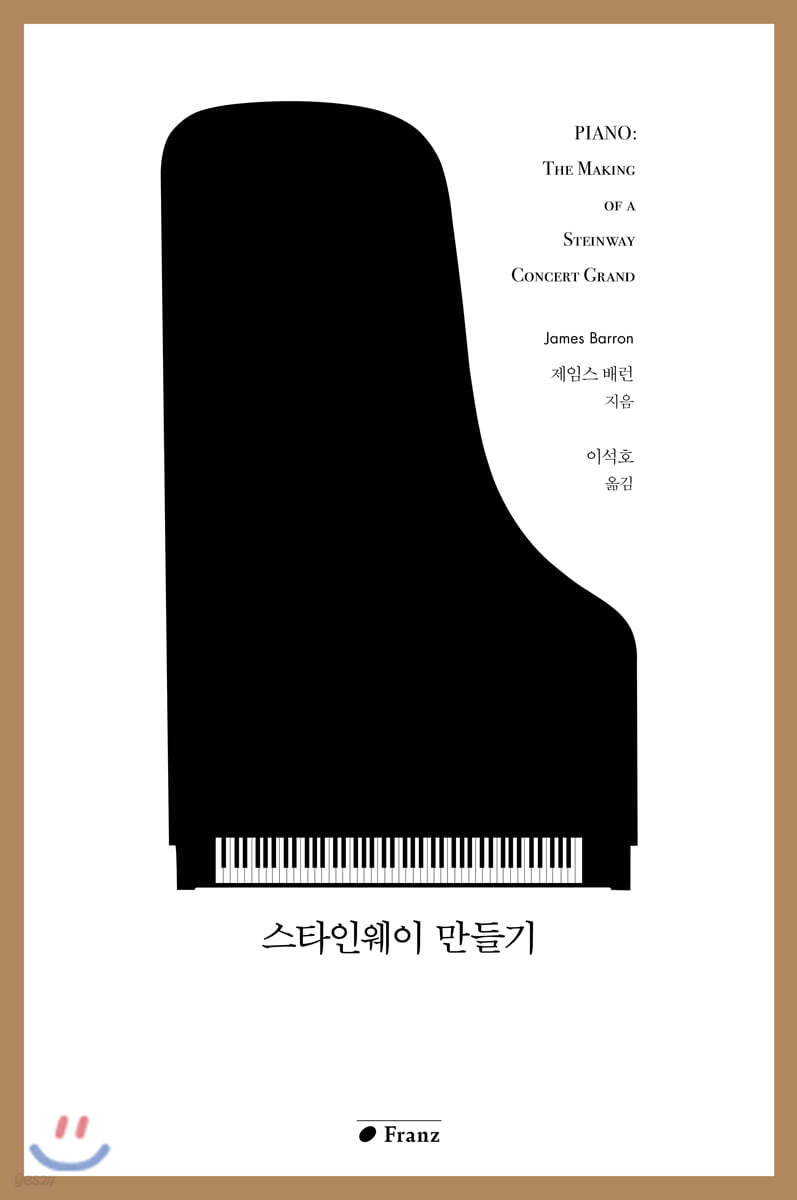
The Steinway, a companion to a star-studded lineup of pianists and a renowned masterpiece, is crafted by whom and how? This book is written by New York Times reporter James Barron, who observed the Steinway piano's production process from the closest possible perspective for 11 months.
The author fascinatingly explains the process by which a raw piece of wood is transformed into a complete Steinway piano.
The piano known as 'K0862' is a piano produced at the Steinway factory that combines time-honored manufacturing methods with modern industrial efficiency.
The author follows the men and women who work at the factory—some of whom have worked at Steinway since their fathers and grandfathers, while others are first-generation immigrants who have just settled in America—and observes how, in their hands, a lump of wood and iron is transformed into a concert grand.
They are all continuing a tradition that began 150 years ago by the German immigrants who founded Steinway & Sons.
Over the past 150 years, the Steinway family has become a household name in the music world and, at one point, was active in New York's political and business circles.
Barron also traces the decades of innovation and chance that gave rise to the concert grand's design, the fierce competition and shifting musical landscapes that surrounded the piano industry, and reveals how pianos develop their own unique personalities before they even hit the market.
Will the K0862, finally released into the world, truly be an instrument that lives up to the legend of Steinway?
- You can preview some of the book's contents.
Preview
index
Jeonju - By their hands, here
Chapter 1: A Familiar Curve
Chapter 2: The Old Mechanic
Chapter 3: Anti-Manufacturing
Chapter 4, Part 81
Chapter 5 Descendants
Chapter 6 Belly
Chapter 7: Yesterday's Company
Chapter 8: Creating Sound
Chapter 9: A New Personality
Chapter 10: Finding the Screw
Chapter 11 Temporary Status
Chapter 12 Debut
Huzhou - Independence
References
Acknowledgements
Translator's Note
Search
Diagram - Steinway Concert Grand
Into the book
All Steinway pianos are made by the same workers, with the same materials, and in the same way.
Yet, each Steinway piano becomes a being with its own individual personality.
Although they may all look the same or similar, they each have their own differences that cannot be easily expressed in words.
--- p.18
Before it can step outside the factory walls and encounter the world of the concert stage, catching the eye of demanding concert planners, satisfying cantankerous performers, earning the acclaim of rigorous critics, and passing through the hands of perfectionist tuners, the K0862 must first undergo a long journey.
This book records that story.
--- p.22
“There are processes that cannot be automated.
“If we turn even those things into machines, we will end up taking the soul out of Steinway.” --- p.35
To borrow the words of a New York Times reporter, Steinway's early pianos were the work of "an old mechanic and (...) his three sons."
The essential elements of a modern piano like the K0862 were already contained within the lid of the original Steinway's tiny "rectangle"—a square instrument designed for Victorian drawing rooms—and subsequent refinements and improvements were passed down steadily from generation to generation.
--- p.57
Descriptions of the work are passed down through various languages.
German, Italian, and Spanish precede English, and Serbian has also been heard a lot recently.
Because Steinway's workforce changes along with the city of New York.
--- p.116
Standing on Verasamy's machine, towering over a space filled with haphazardly placed workbenches and shabby shelves, you have a panoramic view of the factory's oldest workshop.
But the passengers aboard Verasamy's machine actually come from much higher up, as they are the world's largest spruce trees.
These are trees that have survived in the forest for 200 or even 500 years.
--- p.141
The second half of the 19th century saw several important turning points in the development of the modern concert grand.
K0862's ancestor is also one of them.
A New York Times reporter who visited the 19th-century World's Fair played a piano that was a distant ancestor of the K0862 and commented that it had a "surprisingly smooth touch."
The judges at the fair were also fascinated by this instrument and awarded it a gold medal.
This was the first time that the company called Steinway & Sons became known.
--- p.182
Henry stepped down as chairman in 1980, when he was sixty-five, but in a sense, he never left the company until the moment of his death.
Throughout the 1980s and 1990s, and well into the 21st century, he served as a Steinway ambassador, bringing back memories of a time when America was obsessed with pianos and when piano manufacturing was a huge industry.
Henry also personally signed his pianos for customers who weren't satisfied with just the distinct gold-leafed Steinway logo on the keys.
Like Leonard Bernstein, who signed his Bösendorfer piano, he too, with a felt-tip pen, inscribed 'Henry Z.
He scribbled 'Steinway'.
--- p.265
A piano that satisfies Vladimir Horowitz may not suffice for Artur Rubinstein.
Alfred Brendel might be dissatisfied with an action that satisfied Martha Argerich.
--- p.273
Finally, K0862 lets out its first cry.
Sukai randomly presses the notes below middle C, about six or eight keys, with his left palm and fingers.
Out-of-tune notes are mixed together in a jumble of overtones.
It's like the sound of an old piano that has been left in a church basement for a long time without ever seeing a tuner.
--- p.294
Like countless workers before him, Campbell takes out a notebook and writes down the serial number of K0862.
“I’m writing this down just in case someone scolds me, saying, ‘There’s something wrong with this piano.’
“At least you should know whether I did the work or not,” he adds.
“I haven’t heard anyone criticize me like that yet.” --- p.326
He strokes K0862, his voice still filled with a sense of wonder.
“How many people would imagine a piano when they see a tree?” --- p.339
It has nothing to do with how the piano sounds or how it works, but for someone like Boot, who has worked in the factory for over 40 years, it is a task of great significance: attaching a round medal commemorating Steinway's 150th anniversary to the case of a piano nearing completion.
He opens his mouth as he drills a hole to attach the medal to K0862.
“150 years...” But soon, his throat feels choked up and he cannot continue speaking.
--- p.345
The concert opens with a short, angry piece of music, full of dark chords and sharp melodies that do not match the blue sky or green grass outside the concert hall.
So, 982 kilometers from the Steinway basement, the CD-60 makes its debut.
--- p.381
Publisher's Review
From a 500-year-old tree to a concert grand stage,
A vivid 11-month journey by New York Times reporter James Barron.
This book is a detailed account of the vivid journey of James Barron, a reporter for the New York Times and amateur pianist, based on his personal love for the piano and journalistic curiosity.
It is like watching a well-made documentary, with valuable and fascinating information that allows you to look into the piano-making process from beginning to end, and details the history of Steinway and the evolution of the piano.
Heinrich Engelhard Steinbeck, a young German born in 1797 who dreamed of becoming a furniture maker, built his first piano in his kitchen and immigrated to the United States in 1850.
The family changed their surname to the English name 'Steinway' and the whole family started a full-fledged piano manufacturing business.
Within 10 years of settling in New York, the number of musical instruments produced and the scale of sales had grown to the point where they were able to build the 'largest and best factory', while CF, which had hated the United States,
Theodore Steinway returned to his homeland in 1884 and established Steinway & Sons in Hamburg.
Steinway & Sons, which won a gold medal at the 1867 Paris World's Fair and was recognized for its exceptional technology, expanded its business and gained an unrivaled reputation along with the booming piano industry.
Although it experienced ups and downs and ups and downs with the changing times and was eventually sold to CBS in 1972, the production process and traditions that continued over that long period are still ongoing.
Unlike most manufacturers, Steinway has been passed down through generations, relying on the inherited memories of its workers.
It is a system where you take over the work of a predecessor who has done the same job for 20 to 30 years and work for 20 to 30 years.
Descriptions of the work are passed down through various languages.
German, Italian, and Spanish precede English, and Serbian has also been heard a lot recently.
Because Steinway's workforce changes along with the city of New York.
Although Steinway has undergone a modernization process over the past few decades, there are still many processes that cannot be automated.
“If we were to turn those things into machines, we would be taking the soul out of Steinway,” says the producer.
If you look into the production process, the line between custom-made and custom-made feels vague.
Even the finest wood often falls short of Steinway's standards when cut, so at least half of it is discarded during the manufacturing process. For some parts, the margin of error is meticulously managed to the point of plus or minus 0.07 millimeters.
As a result, it takes nearly a year to go through a 24-step manufacturing process to become a grand piano.
The author's investigative instinct does not stop at the point where the production of K0862 ends.
It is an interesting story that reveals where this piano will debut, what pianists think of it, and even what kind of piano K0862 will become in two years.
GOODS SPECIFICS
- Date of issue: May 29, 2020
- Page count, weight, size: 436 pages | 139*209*30mm
- ISBN13: 9791195949991
- ISBN10: 1195949995
You may also like
카테고리
korean


korean


