

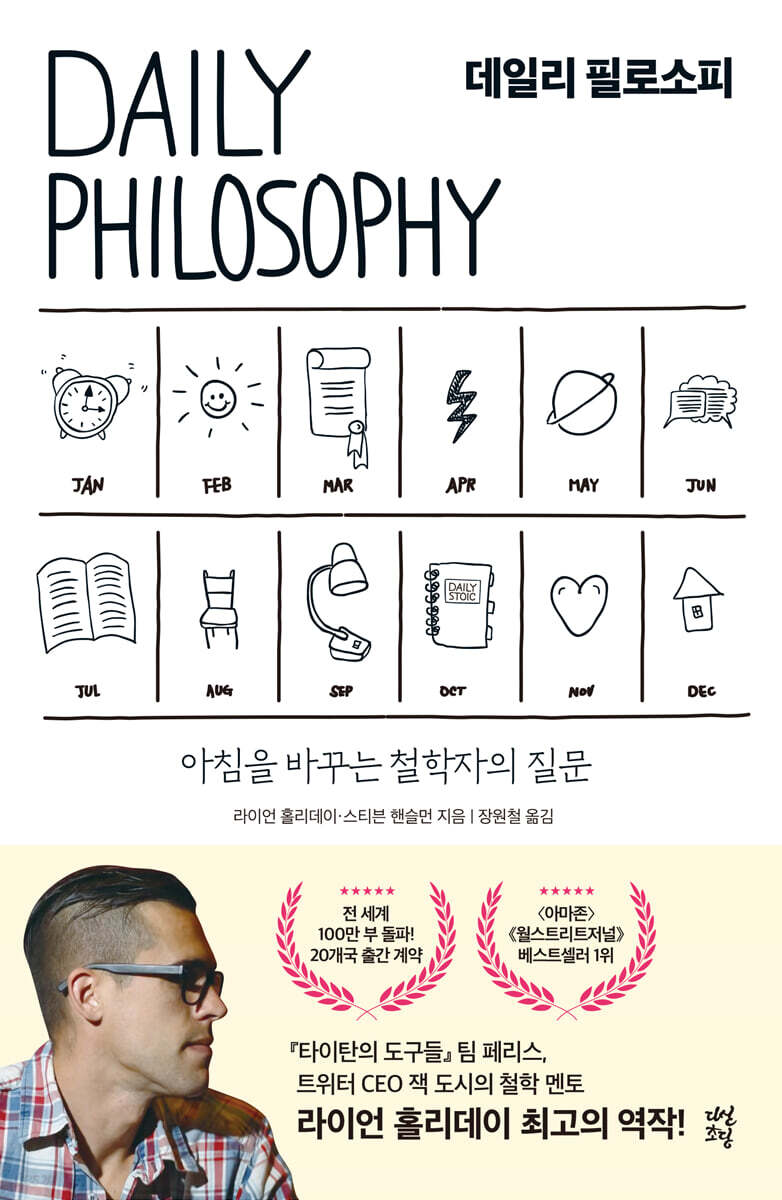
Daily Philosophy
 |
Description
Book Introduction
*Over 1 million copies sold worldwide!* *#1 Amazon and Wall Street Journal bestseller*
*Writer Tim Ferriss, Twitter CEO Jack Dorsey, and other 'Silicon Valley's Philosophy Mentors'*
“Every morning, I read a sentence of philosophy.
“It’s the simplest way to change your day!”
『Tools of Titans』 Tim Ferriss, Twitter CEO Jack Dorsey's philosophical mentor Ryan Holiday's best work.
Ryan Holiday, whose books combining philosophy and self-development, such as "The Enemy Ego" and "Stoic Lessons," have been greatly loved by readers, and Stephen Hanselman, who received a master's degree in philosophy from Harvard University, invite us into the world of the most useful philosophy that will change your day.
This book, which has already sold over 1 million copies in 28 countries around the world and has firmly established itself as an Amazon and Wall Street Journal bestseller, is structured so that readers can read one page a day of vivid messages from philosophers representing Stoic philosophy, including Emperor Marcus Aurelius, ancient thinker Seneca, and philosopher Epictetus, who was born a slave.
Their timeless aphorisms still resonate powerfully with us today, complemented by Ryan Holiday's signature clear and approachable commentary, allowing anyone to apply their wisdom to their own lives.
The reason you should apply this philosophy directly to your daily life is simple.
Because it shows us the way to a better life.
"What is the purpose of life, and how should we live?" We ask ourselves this question whenever we face a difficult situation in life, but finding a definitive answer isn't easy.
Two thousand years ago, Stoic philosophers found answers to the questions we face throughout life's journey in the everyday lives we live.
So this philosophy is surprisingly modern and practical.
To borrow Seneca's words, “philosophy must be able to provide answers.”
This book was written for the sole purpose of helping you find answers to the problems you face.
*Writer Tim Ferriss, Twitter CEO Jack Dorsey, and other 'Silicon Valley's Philosophy Mentors'*
“Every morning, I read a sentence of philosophy.
“It’s the simplest way to change your day!”
『Tools of Titans』 Tim Ferriss, Twitter CEO Jack Dorsey's philosophical mentor Ryan Holiday's best work.
Ryan Holiday, whose books combining philosophy and self-development, such as "The Enemy Ego" and "Stoic Lessons," have been greatly loved by readers, and Stephen Hanselman, who received a master's degree in philosophy from Harvard University, invite us into the world of the most useful philosophy that will change your day.
This book, which has already sold over 1 million copies in 28 countries around the world and has firmly established itself as an Amazon and Wall Street Journal bestseller, is structured so that readers can read one page a day of vivid messages from philosophers representing Stoic philosophy, including Emperor Marcus Aurelius, ancient thinker Seneca, and philosopher Epictetus, who was born a slave.
Their timeless aphorisms still resonate powerfully with us today, complemented by Ryan Holiday's signature clear and approachable commentary, allowing anyone to apply their wisdom to their own lives.
The reason you should apply this philosophy directly to your daily life is simple.
Because it shows us the way to a better life.
"What is the purpose of life, and how should we live?" We ask ourselves this question whenever we face a difficult situation in life, but finding a definitive answer isn't easy.
Two thousand years ago, Stoic philosophers found answers to the questions we face throughout life's journey in the everyday lives we live.
So this philosophy is surprisingly modern and practical.
To borrow Seneca's words, “philosophy must be able to provide answers.”
This book was written for the sole purpose of helping you find answers to the problems you face.
- You can preview some of the book's contents.
Preview
index
Prologue - For a life that moves forward one step at a time every day
Part 1: How to Start Your Morning Like a Philosopher
What will you practice today in January?
When do I feel passionate in February?
What is the purpose that guides my life in March?
Part 2: Building Strong Relationships While Protecting Myself
How to deal with an insulting situation in April?
May Why Should We Be Kind to Others?
How can I protect myself in the battlefield of life in June?
Part 3: Words that give courage to a weary and anxious heart
Where does peace of mind and body come from in July?
Am I living as the master of my own heart in August?
Why should we do the right thing in September?
Part 4: Every evening, questions that make my day meaningful
Did you faithfully accomplish the things you planned for October?
November What does it mean to truly love yourself?
Did you have a satisfying day in December?
Part 1: How to Start Your Morning Like a Philosopher
What will you practice today in January?
When do I feel passionate in February?
What is the purpose that guides my life in March?
Part 2: Building Strong Relationships While Protecting Myself
How to deal with an insulting situation in April?
May Why Should We Be Kind to Others?
How can I protect myself in the battlefield of life in June?
Part 3: Words that give courage to a weary and anxious heart
Where does peace of mind and body come from in July?
Am I living as the master of my own heart in August?
Why should we do the right thing in September?
Part 4: Every evening, questions that make my day meaningful
Did you faithfully accomplish the things you planned for October?
November What does it mean to truly love yourself?
Did you have a satisfying day in December?
Detailed image

Into the book
Those who follow Stoic philosophy give bold advice.
Let us first humbly accept that our lives are random, uncertain, and unpredictable.
Paradoxically, on that foundation, we can focus only on what we can accomplish in this short life, on what we truly want to do.
---From "Prologue: For a Life That Takes One Step A Day"
Reinhold Niebuhr prayed:
“Oh my god.
“Give me the serenity to accept the things I cannot change, the courage to change the things I can, and the wisdom to know the difference.” The pain of childhood abuse cannot be changed.
You can't undo a decision you've already made, and no matter how much you regret it, you can't change the past.
The only thing we can change is the future.
That is the power of this very moment.
As Epictetus said, you should control only what you can control.
---From "January 1st, Are You Fighting a Winning Battle Every Day?"
Philosophy tells us to pay more attention to ourselves and to strive not to become pawns on a chessboard.
Viktor Frankl, a psychologist and survivor of the Auschwitz concentration camp, said, “Man is driven by impulses, but pulled back by values.”
When you think about true value, you can avoid becoming a puppet.
Only constant attention and awareness can enable us to become masters of our own lives.
---From "January 14th, How to Become the Master of Your Life"
Epictetus said, “It is impossible to teach someone who thinks he already knows.”
As long as we believe ourselves to be perfect and universally respected, we cannot cultivate any virtues or earn the respect of others.
In that sense, false pride and self-deception are the enemies of virtue.
Therefore, we must be hostile to the pride that rushes forward to deceive us.
---From "March 14, Pride is My Enemy"
Socrates said.
“No one commits a mistake intentionally.” If we look back at ourselves, we can immediately understand this saying.
We can't remember them all, but how many wrongdoings have we committed without malice or intention? Forgive others as you forgive your own.
They have potential just as we have potential.
Remember this and be generous to yourself and others.
---From "May 1st, Be Generous to Yourself and Others"
Those who have overcome difficult times often recall those times with glorious scars.
In addition, bad luck helps us in another way.
As Seneca said, through experience and overcoming, we come to understand our own abilities much better and discover our inner strengths.
Moreover, harsh trials give us the strength to overcome similar adversities that may come in the near future.
Don't complain that things are not easy when you are going through a difficult time.
Let us be grateful for adversity, as Nietzsche said, “What does not kill me makes me stronger.”
---From "The Usefulness of Adversity" on September 4th
“No one can step into the same river twice.” Just as a river flows without stopping, people also change.
Life keeps changing.
Getting angry about things changing is a false assumption that they will last forever.
We have no power to hold on to wealth, power, status, fame, or even love.
Everything changes.
Let it flow.
---From "Let It Flow" on November 15th
Money is like a bag with a hole in the bottom. No matter how much you fill it, it never gets full.
Success is like a mountain peak that has no end; no matter how much you climb, you can never reach the top.
Love is like a flower that blooms for a season and then falls. Even if it blooms and falls again, you can't stop it from falling.
Money, success, and love are like fog that disappears just when we think we have them.
The only thing we can have forever is in our hearts.
Only the moral values that I find beautiful will fill my heart and not leave it until the day I die.
---From "What will fill your heart on December 8th"
Money is like a bag with a hole in the bottom. No matter how much you fill it, it never gets full.
Success is like a mountain peak that has no end; no matter how much you climb, you can never reach the top.
Love is like a flower that blooms for a season and then falls. Even if it blooms and falls again, you can't stop it from falling.
Money, success, and love are like fog that disappears just when we think we have them.
The only thing we can have forever is in our hearts.
Only the moral values that I find beautiful will fill my heart and not leave it until the day I die.
---From "What will fill your heart on December 8th"
What we ultimately need to do is take action.
So go ahead.
The answer is not written in any book in the world.
There is only choice, decision, and action.
And that's something I have to do, not someone else.
We don't know how much time we have left.
You never know what tomorrow might bring.
If you have a wish, you should put it into action, not just pray to God.
Let us first humbly accept that our lives are random, uncertain, and unpredictable.
Paradoxically, on that foundation, we can focus only on what we can accomplish in this short life, on what we truly want to do.
---From "Prologue: For a Life That Takes One Step A Day"
Reinhold Niebuhr prayed:
“Oh my god.
“Give me the serenity to accept the things I cannot change, the courage to change the things I can, and the wisdom to know the difference.” The pain of childhood abuse cannot be changed.
You can't undo a decision you've already made, and no matter how much you regret it, you can't change the past.
The only thing we can change is the future.
That is the power of this very moment.
As Epictetus said, you should control only what you can control.
---From "January 1st, Are You Fighting a Winning Battle Every Day?"
Philosophy tells us to pay more attention to ourselves and to strive not to become pawns on a chessboard.
Viktor Frankl, a psychologist and survivor of the Auschwitz concentration camp, said, “Man is driven by impulses, but pulled back by values.”
When you think about true value, you can avoid becoming a puppet.
Only constant attention and awareness can enable us to become masters of our own lives.
---From "January 14th, How to Become the Master of Your Life"
Epictetus said, “It is impossible to teach someone who thinks he already knows.”
As long as we believe ourselves to be perfect and universally respected, we cannot cultivate any virtues or earn the respect of others.
In that sense, false pride and self-deception are the enemies of virtue.
Therefore, we must be hostile to the pride that rushes forward to deceive us.
---From "March 14, Pride is My Enemy"
Socrates said.
“No one commits a mistake intentionally.” If we look back at ourselves, we can immediately understand this saying.
We can't remember them all, but how many wrongdoings have we committed without malice or intention? Forgive others as you forgive your own.
They have potential just as we have potential.
Remember this and be generous to yourself and others.
---From "May 1st, Be Generous to Yourself and Others"
Those who have overcome difficult times often recall those times with glorious scars.
In addition, bad luck helps us in another way.
As Seneca said, through experience and overcoming, we come to understand our own abilities much better and discover our inner strengths.
Moreover, harsh trials give us the strength to overcome similar adversities that may come in the near future.
Don't complain that things are not easy when you are going through a difficult time.
Let us be grateful for adversity, as Nietzsche said, “What does not kill me makes me stronger.”
---From "The Usefulness of Adversity" on September 4th
“No one can step into the same river twice.” Just as a river flows without stopping, people also change.
Life keeps changing.
Getting angry about things changing is a false assumption that they will last forever.
We have no power to hold on to wealth, power, status, fame, or even love.
Everything changes.
Let it flow.
---From "Let It Flow" on November 15th
Money is like a bag with a hole in the bottom. No matter how much you fill it, it never gets full.
Success is like a mountain peak that has no end; no matter how much you climb, you can never reach the top.
Love is like a flower that blooms for a season and then falls. Even if it blooms and falls again, you can't stop it from falling.
Money, success, and love are like fog that disappears just when we think we have them.
The only thing we can have forever is in our hearts.
Only the moral values that I find beautiful will fill my heart and not leave it until the day I die.
---From "What will fill your heart on December 8th"
Money is like a bag with a hole in the bottom. No matter how much you fill it, it never gets full.
Success is like a mountain peak that has no end; no matter how much you climb, you can never reach the top.
Love is like a flower that blooms for a season and then falls. Even if it blooms and falls again, you can't stop it from falling.
Money, success, and love are like fog that disappears just when we think we have them.
The only thing we can have forever is in our hearts.
Only the moral values that I find beautiful will fill my heart and not leave it until the day I die.
---From "What will fill your heart on December 8th"
What we ultimately need to do is take action.
So go ahead.
The answer is not written in any book in the world.
There is only choice, decision, and action.
And that's something I have to do, not someone else.
We don't know how much time we have left.
You never know what tomorrow might bring.
If you have a wish, you should put it into action, not just pray to God.
---From "Start Now, December 31st"
Publisher's Review
“Do you have any life-changing questions in your day?”
A Philosopher's Questions for a Life That Takes a Step Each Day
· Why am I not satisfied with my appearance?
· How can we escape from anxiety, fear, and worry?
· Is it possible to live without comparing ourselves to others?
· What can I do now to find true happiness?
We all live our lives with all our hearts.
But no matter how hard you live, no one is completely free from pain and suffering.
Rather, the agony never ceases.
We struggle with overwork every day, we feel the crushing weight of parenthood, we struggle with strained relationships, we lose sleep over worries about our old age, and we regret the days of our youth that were wasted.
However, we must train our minds not to be shaken by any difficulties, and live our lives accepting the challenges of life that have been given to us.
Here are philosophers who have dedicated their lives to asking the most fundamental questions of life and finding answers to them.
Marcus Aurelius, who was an emperor but always guarded against pride; Epictetus, who lived a life richer in spirit than anyone else despite the adversity of being a slave; Seneca, who walked between life and death under a tyrant, wrote every night in hopes of living a better life.
These are all Stoic philosophers.
And this philosophy continues to this day, having a profound influence on prominent leaders and thinkers, including the "Oracle of Omaha" Warren Buffett, Twitter CEO Jack Dorsey, and bestselling author and venture capitalist Tim Ferriss.
To us who seek the answer to life, Aurelius tells us this:
“The skills needed for life are more like wrestling than dancing.
To live gracefully, we need to be prepared to withstand unexpected surprise attacks and the ability to stand firm.” In the questions raised while exploring real life and the philosophers’ answers to them, we can discover wisdom for a happy life, such as how to stop hesitating and start, how to protect myself and build strong relationships with others, and how to add courage to a tired and anxious mind.
By applying this philosophy of daily practice of patience, resilience, and wise action, anyone can find the right direction in their life.
From Aurelius, Epictetus, and Seneca
Life wisdom from Nietzsche, Shakespeare, and Warren Buffett
Stoic philosophy, unusually, was not transmitted as a rigid and difficult philosophical text, but rather in the form of diaries, letters, and essays.
The Diaries of Aurelius, the Letters of Seneca, and the Essays of Epictetus were the most popular works in Rome at the time.
What kind of great insight and wisdom are contained in these works that have enabled them to be loved by so many people and survive for so long?
Stoicism is a philosophy founded by Zeno in the early 3rd century BC.
Zeno, a merchant, had a shocking experience one day when his ship was wrecked and he lost a huge amount of wealth in an instant.
He laid the ideological foundations of Stoic philosophy while engrossed in finding ways to deal with sudden misfortunes.
As can be seen from the background of its birth, this philosophy was not focused on abstract and idealistic values, but on finding practical answers useful in everyday life.
And we still face questions like these throughout our journey through life.
If you want to calm down and truly communicate with someone who has wronged you, rather than lashing out and feeling regretful, listen to Seneca's story.
“Nothing makes us more foolish than anger.
Anger does not retreat even when it fails.
“When the object of one’s anger disappears, the teeth of anger soon turn against oneself.”
For those who are in deep despair over the loss of something precious, Epictetus offers this advice:
“Whenever I feel the pain of loss, I think of it as a glass that could break at any moment.
Just as even a victorious general cannot escape death, there is nothing in this world that we can continue to possess.
“It is only given to you for a short time, and you cannot have it forever.”
Stoic philosophy teaches us to focus on what we can control and change.
It is our heart, and it is this very moment.
The past is already gone and the future is not yet here, so I cannot control it, but the present, when I am doing something, means that I can decide.
In this way, Stoic philosophy serves as a compass that tells us how to live whenever we lose our way on the journey of life.
“Let go of what you can’t control and focus on the present moment!”
Make my life the best starting today
How to practice philosophy in 10 minutes a day!
To convey the practical wisdom of Stoic philosophy in the simplest and clearest way possible, the author selected aphorisms that can be read one sentence a day and provided interpretations to help readers apply the maxims to their daily lives.
Ryan Holiday, a popular author whose books have been translated into 28 languages and garnered critical acclaim from readers, has been co-authored with Stephen Hanselman, who holds a master's degree in philosophy from Harvard University, adding depth to the philosophical interpretation.
The Stoic philosophers were called the heralds of the morning and the priests of the night.
They prepared for life early, and spent the evenings in deep thought.
Daily Philosophy was inspired by their practices.
The book is divided into 366 days, meaning one reflection per day.
We must first find the purpose and direction of life through time of reflection.
Only then can I know what I want to do, what I can and cannot change, and when trials come, I can move forward instead of giving in to disappointment or regret.
As Seneca observed, “We are not given a short life.
We just made it that way.” To find the reason and purpose of life and the answer to how to live, all it takes is 10 minutes a day.
If we each find our own clear direction in life, we can, as Aurelius said, “live each day as if it were our last.”
Through this book, readers will not simply hear and understand Stoic philosophy, but will gain the courage to re-establish their sense of purpose and pioneer a new path in life.
A Philosopher's Questions for a Life That Takes a Step Each Day
· Why am I not satisfied with my appearance?
· How can we escape from anxiety, fear, and worry?
· Is it possible to live without comparing ourselves to others?
· What can I do now to find true happiness?
We all live our lives with all our hearts.
But no matter how hard you live, no one is completely free from pain and suffering.
Rather, the agony never ceases.
We struggle with overwork every day, we feel the crushing weight of parenthood, we struggle with strained relationships, we lose sleep over worries about our old age, and we regret the days of our youth that were wasted.
However, we must train our minds not to be shaken by any difficulties, and live our lives accepting the challenges of life that have been given to us.
Here are philosophers who have dedicated their lives to asking the most fundamental questions of life and finding answers to them.
Marcus Aurelius, who was an emperor but always guarded against pride; Epictetus, who lived a life richer in spirit than anyone else despite the adversity of being a slave; Seneca, who walked between life and death under a tyrant, wrote every night in hopes of living a better life.
These are all Stoic philosophers.
And this philosophy continues to this day, having a profound influence on prominent leaders and thinkers, including the "Oracle of Omaha" Warren Buffett, Twitter CEO Jack Dorsey, and bestselling author and venture capitalist Tim Ferriss.
To us who seek the answer to life, Aurelius tells us this:
“The skills needed for life are more like wrestling than dancing.
To live gracefully, we need to be prepared to withstand unexpected surprise attacks and the ability to stand firm.” In the questions raised while exploring real life and the philosophers’ answers to them, we can discover wisdom for a happy life, such as how to stop hesitating and start, how to protect myself and build strong relationships with others, and how to add courage to a tired and anxious mind.
By applying this philosophy of daily practice of patience, resilience, and wise action, anyone can find the right direction in their life.
From Aurelius, Epictetus, and Seneca
Life wisdom from Nietzsche, Shakespeare, and Warren Buffett
Stoic philosophy, unusually, was not transmitted as a rigid and difficult philosophical text, but rather in the form of diaries, letters, and essays.
The Diaries of Aurelius, the Letters of Seneca, and the Essays of Epictetus were the most popular works in Rome at the time.
What kind of great insight and wisdom are contained in these works that have enabled them to be loved by so many people and survive for so long?
Stoicism is a philosophy founded by Zeno in the early 3rd century BC.
Zeno, a merchant, had a shocking experience one day when his ship was wrecked and he lost a huge amount of wealth in an instant.
He laid the ideological foundations of Stoic philosophy while engrossed in finding ways to deal with sudden misfortunes.
As can be seen from the background of its birth, this philosophy was not focused on abstract and idealistic values, but on finding practical answers useful in everyday life.
And we still face questions like these throughout our journey through life.
If you want to calm down and truly communicate with someone who has wronged you, rather than lashing out and feeling regretful, listen to Seneca's story.
“Nothing makes us more foolish than anger.
Anger does not retreat even when it fails.
“When the object of one’s anger disappears, the teeth of anger soon turn against oneself.”
For those who are in deep despair over the loss of something precious, Epictetus offers this advice:
“Whenever I feel the pain of loss, I think of it as a glass that could break at any moment.
Just as even a victorious general cannot escape death, there is nothing in this world that we can continue to possess.
“It is only given to you for a short time, and you cannot have it forever.”
Stoic philosophy teaches us to focus on what we can control and change.
It is our heart, and it is this very moment.
The past is already gone and the future is not yet here, so I cannot control it, but the present, when I am doing something, means that I can decide.
In this way, Stoic philosophy serves as a compass that tells us how to live whenever we lose our way on the journey of life.
“Let go of what you can’t control and focus on the present moment!”
Make my life the best starting today
How to practice philosophy in 10 minutes a day!
To convey the practical wisdom of Stoic philosophy in the simplest and clearest way possible, the author selected aphorisms that can be read one sentence a day and provided interpretations to help readers apply the maxims to their daily lives.
Ryan Holiday, a popular author whose books have been translated into 28 languages and garnered critical acclaim from readers, has been co-authored with Stephen Hanselman, who holds a master's degree in philosophy from Harvard University, adding depth to the philosophical interpretation.
The Stoic philosophers were called the heralds of the morning and the priests of the night.
They prepared for life early, and spent the evenings in deep thought.
Daily Philosophy was inspired by their practices.
The book is divided into 366 days, meaning one reflection per day.
We must first find the purpose and direction of life through time of reflection.
Only then can I know what I want to do, what I can and cannot change, and when trials come, I can move forward instead of giving in to disappointment or regret.
As Seneca observed, “We are not given a short life.
We just made it that way.” To find the reason and purpose of life and the answer to how to live, all it takes is 10 minutes a day.
If we each find our own clear direction in life, we can, as Aurelius said, “live each day as if it were our last.”
Through this book, readers will not simply hear and understand Stoic philosophy, but will gain the courage to re-establish their sense of purpose and pioneer a new path in life.
GOODS SPECIFICS
- Publication date: December 24, 2021
- Page count, weight, size: 400 pages | 548g | 132*203*30mm
- ISBN13: 9791130679365
- ISBN10: 1130679365
You may also like
카테고리
korean


korean

![ELLE 엘르 스페셜 에디션 A형 : 12월 [2025]](http://librairie.coreenne.fr/cdn/shop/files/b8e27a3de6c9538896439686c6b0e8fb.jpg?v=1766436872&width=3840)


