

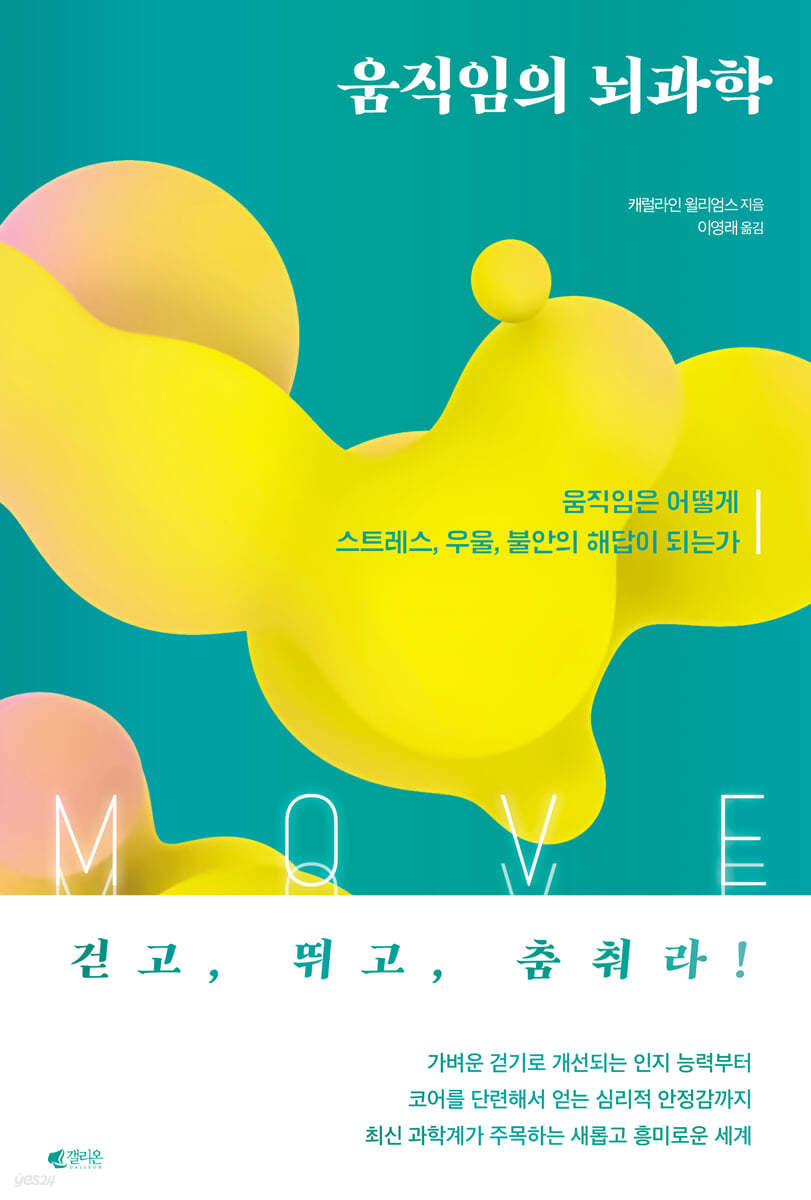
The Neuroscience of Movement
 |
Description
Book Introduction
From cognitive abilities improved by light walking, Even the psychological stability gained from training the core A new and exciting world that is attracting the attention of the scientific community! Why do jumbled ideas become a few sentences after a walk? Why does yoga help me distance myself from the worries that have been plaguing my mind all day? Why does swaying to music in the kitchen make me feel so good? Scientists from fields ranging from neuroscience to evolutionary biology have begun to study how physical movement influences the mind. What they are discovering is so new and exciting that it could change the landscape of science and is crucial for our health and well-being. In "The Neuroscience of Movement," Caroline Williams, science journalist for New Scientist, explores the latest research exploring how movement affects our minds. I interviewed scientists in this field, as well as people who have actually proven the connection between body and mind. The author's meticulous research and compelling language demonstrate why we need to move our bodies, leading readers to a more fulfilling and healthy life. |
- You can preview some of the book's contents.
Preview
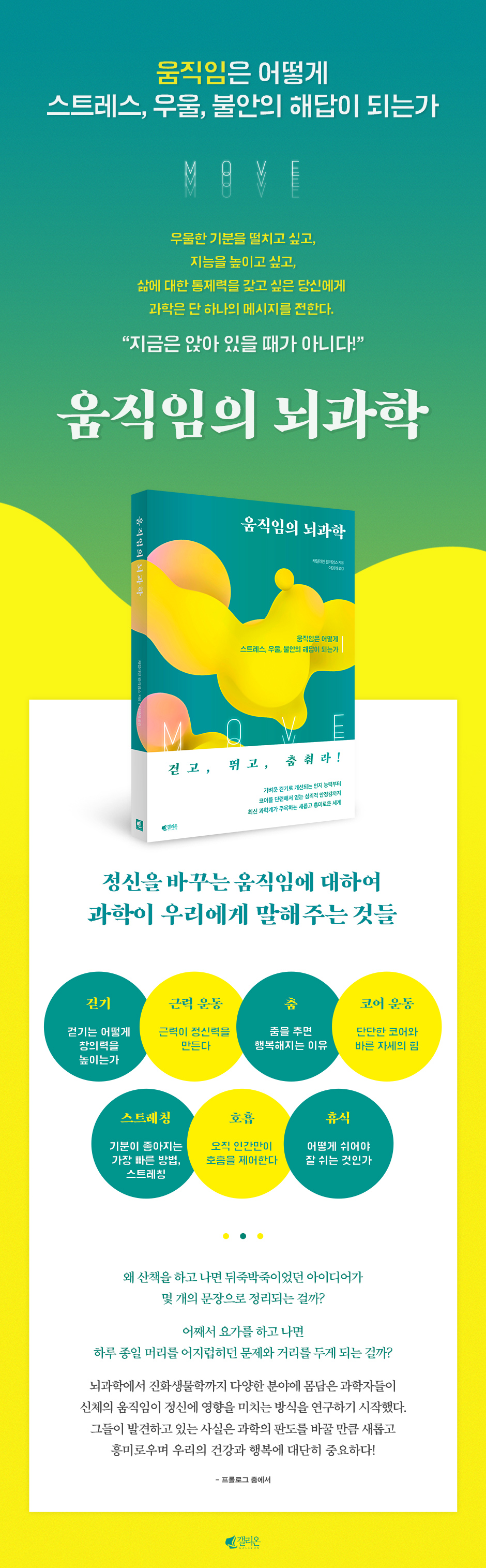
index
1.
We evolved to move
2.
How Walking Boosts Creativity
3.
Strength creates mental strength
4.
Why Dancing Makes Us Happy
5.
The power of a solid core
6.
The quickest way to feel better: stretching
7.
Only humans control their breathing
8.
The Art of Relaxation
9.
Add more movement to your daily life
We evolved to move
2.
How Walking Boosts Creativity
3.
Strength creates mental strength
4.
Why Dancing Makes Us Happy
5.
The power of a solid core
6.
The quickest way to feel better: stretching
7.
Only humans control their breathing
8.
The Art of Relaxation
9.
Add more movement to your daily life
Detailed image
Into the book
The sea squirt gives us a glimpse into a point in biological evolution.
A time when we were experimenting with whether or not we could increase the chances of survival through the harsh survival process of living things through the nervous system.
It costs a lot to keep the nervous system running.
Our brain accounts for only 2 percent of our body weight.
However, the brain uses 20 percent of the body's total energy.
In this situation, the monk gives this answer.
“The only time it’s worth investing in your brain is when you’re moving!” After that, your brain isn’t really needed.
In an environment where movement is no longer necessary, thinking is just a waste.
As a result, the entire brain and nervous system become recyclable waste.
--- p.20
It is entirely possible to improve your physical and mental function by using movement as a form of self-care.
It doesn't matter whether you believe your ego lives in your head and looks out through your eyes, or whether you believe it's distributed throughout your body, including your brain, or whether you believe there's no such thing as a ego at all.
The truth is that brain, body, and mind are part of one wonderful system.
And they work better in every way when they move.
--- p.37
Not everyone will agree that unconscious thinking is better than direct thinking.
Some people don't even believe in the existence of unconscious thought.
The problem with unconscious thinking is that the person doing it is often unaware of its effects, making it difficult to measure.
But whatever the cause, a brief decrease in prefrontal cortex activity can provide a brief respite from depressive rumination.
There is also strong evidence that prioritizing unrealistic thinking over conventional solutions fosters creativity.
--- p.62
Beats activate brain-body pathways.
In a way that you can't learn without moving to the beat.
The beat does this through synchronized electrical activity waves within brain regions involved in sound and movement.
As a result, brain waves in the two areas begin to connect.
As if shaking to two extra beats.
This phenomenon makes it easier to share information throughout the brain.
Because the synchronized rhythm stands out clearly even in the background noise of electrical information.
It's similar to how the cheers of soccer fans stand out even in the midst of the commotion of a crowded stadium.
The ability of a beat to cut through the noise of our nerves is central to the impulse to dance to music.
This ability allows us to move to the beat with little conscious effort.
--- p.107
If the stress goes away in a few days, there's no problem.
The problem is that in modern life, that's often not the case.
In cases of repetitive, long-term stress, such as caring for a patient or child or a difficult job, the body remains in a state of mild inflammation that does not fully resolve.
Modern life is full of inflammatory features.
Loneliness and social exclusion, like a sedentary lifestyle, have been shown to increase markers of inflammation in the blood.
5 Obesity makes the problem worse.
This is because inflammatory cytokines (signaling molecules that initiate and sustain inflammatory responses) are stored in body fat.
The more fat there is, the more severe, rapid, and long-lasting the inflammatory response is likely to be.
As if that weren't enough, inflammation increases with age and plays a major role in age-related diseases, from heart disease to dementia and cancer.
It also accelerates aging.
--- p.168
Meanwhile, humans sigh to express emotions such as anger, sadness, and relief.
Psychological studies suggest that emotional sighing is a form of communication, but it also acts as a reset button for the respiratory system.
Sighing brings us back to normal after a series of shallow or irregular breaths associated with stress.
3 Making a conscious decision to control your breathing is the easiest way to intentionally control your breathing for the sake of your mind.
A strategically timed deep sigh serves as a mental pause.
This can make it easier to leave stress behind and focus on something else.
A time when we were experimenting with whether or not we could increase the chances of survival through the harsh survival process of living things through the nervous system.
It costs a lot to keep the nervous system running.
Our brain accounts for only 2 percent of our body weight.
However, the brain uses 20 percent of the body's total energy.
In this situation, the monk gives this answer.
“The only time it’s worth investing in your brain is when you’re moving!” After that, your brain isn’t really needed.
In an environment where movement is no longer necessary, thinking is just a waste.
As a result, the entire brain and nervous system become recyclable waste.
--- p.20
It is entirely possible to improve your physical and mental function by using movement as a form of self-care.
It doesn't matter whether you believe your ego lives in your head and looks out through your eyes, or whether you believe it's distributed throughout your body, including your brain, or whether you believe there's no such thing as a ego at all.
The truth is that brain, body, and mind are part of one wonderful system.
And they work better in every way when they move.
--- p.37
Not everyone will agree that unconscious thinking is better than direct thinking.
Some people don't even believe in the existence of unconscious thought.
The problem with unconscious thinking is that the person doing it is often unaware of its effects, making it difficult to measure.
But whatever the cause, a brief decrease in prefrontal cortex activity can provide a brief respite from depressive rumination.
There is also strong evidence that prioritizing unrealistic thinking over conventional solutions fosters creativity.
--- p.62
Beats activate brain-body pathways.
In a way that you can't learn without moving to the beat.
The beat does this through synchronized electrical activity waves within brain regions involved in sound and movement.
As a result, brain waves in the two areas begin to connect.
As if shaking to two extra beats.
This phenomenon makes it easier to share information throughout the brain.
Because the synchronized rhythm stands out clearly even in the background noise of electrical information.
It's similar to how the cheers of soccer fans stand out even in the midst of the commotion of a crowded stadium.
The ability of a beat to cut through the noise of our nerves is central to the impulse to dance to music.
This ability allows us to move to the beat with little conscious effort.
--- p.107
If the stress goes away in a few days, there's no problem.
The problem is that in modern life, that's often not the case.
In cases of repetitive, long-term stress, such as caring for a patient or child or a difficult job, the body remains in a state of mild inflammation that does not fully resolve.
Modern life is full of inflammatory features.
Loneliness and social exclusion, like a sedentary lifestyle, have been shown to increase markers of inflammation in the blood.
5 Obesity makes the problem worse.
This is because inflammatory cytokines (signaling molecules that initiate and sustain inflammatory responses) are stored in body fat.
The more fat there is, the more severe, rapid, and long-lasting the inflammatory response is likely to be.
As if that weren't enough, inflammation increases with age and plays a major role in age-related diseases, from heart disease to dementia and cancer.
It also accelerates aging.
--- p.168
Meanwhile, humans sigh to express emotions such as anger, sadness, and relief.
Psychological studies suggest that emotional sighing is a form of communication, but it also acts as a reset button for the respiratory system.
Sighing brings us back to normal after a series of shallow or irregular breaths associated with stress.
3 Making a conscious decision to control your breathing is the easiest way to intentionally control your breathing for the sake of your mind.
A strategically timed deep sigh serves as a mental pause.
This can make it easier to leave stress behind and focus on something else.
--- p.189
Publisher's Review
An era where many things can be solved without moving.
Tell us why we need to move
Did you know that we move about 30 percent less than people in the 1960s? Adults spend 70 percent of their lives sitting or lying down.
Children spend 50 percent of their free time sitting.
That's not including the time spent hunched over at a school desk.
What about older people? They barely move their muscles 80 percent of the time they're awake.
This fact may not be particularly surprising.
Because it's not news to us living in the present that most people aren't moving enough.
There is a good reason why humans choose to live like sloths.
First, it's comfortable.
Second, humans have spent the last 100 years inventing technologies to help us stay still.
Unlike almost every other creature on Earth, humans have become so motionless that they barely need to move to find food, entertainment, or even a mate.
We live in an age where such things can be easily handled by just sitting down and wiggling your thumbs.
While humans are proud of their ability to replace many of their behaviors with technology, the reality is that a lifestyle that prioritizes comfort leads to lower IQ, increased antisocial behavior, and mental illness.
Several studies suggest that people who spend a lot of time sitting have lower self-esteem and prosocial behavior, and that sedentary time is linked to emotions like anxiety and depression.
Additionally, sitting still for long periods of time reduces concentration, memory, planning skills, and limits creative thinking.
A recent study of Finnish students found a striking link between sitting time and lower performance on math and English tests.
Also, this lifestyle makes us older than our age.
Studies show that middle-aged people who spend two to three hours a day sitting in their car or in front of the TV lose mental acuity much faster than those who are more active.
Extensive research results and latest case studies,
Crossing the boundaries of brain science, anthropology, and biology
A fascinating guide to movement
Caroline Williams, a science journalist for New Scientist who has always shared new and interesting science with the public, was also not an active person.
I was more of a person who sat quietly, reading, thinking, and writing about research on the nature of the human mind.
Then, after experiencing several instances of heightening concentration and changing his mood while walking or dancing, he began to delve into the scientific basis for the connection between mind and body.
When he decided to write a book on this topic, many scientists were already questioning the conventional wisdom that separated body and mind.
The realization began to spread that thoughts do not originate in the head and that thoughts are not the only path to emotions.
Now, scientists across a wide range of fields, from neuroscience to cell biology to evolutionary biology, are studying how body movement influences the mind and the physiological mechanisms that explain why.
The findings they are discovering have the potential to revolutionize science and, given modern lifestyles, have a profound impact on our health and well-being.
The authors argue that movement is important for our mental, cognitive, and emotional health, and cite research showing that certain types of physical movement can help reduce the troubling "inflammation" that contributes to chronic pain in depression.
Research also shows that moving your body can block stress pathways between the brain and body, reducing anxiety and boosting confidence.
Movement can also directly affect our mental state by changing the way electrical information flows in our brain.
The body is no longer a lump carrying the brain, but rather an extension of the brain and an equal partner.
How Walking Boosts Creativity
From Charles Darwin to Friedrich Nietzsche
The Scientific Reason Why Geniuses Think While Walking
If you're someone who diligently lifts weights at the gym every day, the advice to move might sound boring.
However, the author does not recommend the kind of exercise we associate with high-intensity exercise, which involves taking short breaks from sitting still all day.
It doesn't matter what time of day you do your high-intensity exercise.
While it's true that your mood and focus improve immediately after exercise, an hour of strength training during your lunch break won't make a difference.
Brain imaging studies show a correlation between the thickness of brain regions associated with memory and the amount of time a person spends sitting.
The important thing is that the effects of sitting still for four hours before and after lunch don't go away.
The author says that light movements that are done naturally as a habit in daily life are more effective than high-intensity exercise that is done all at once.
"The Neuroscience of Movement" suggests simple movements such as walking, running, dancing, and stretching based on various research results and the latest cases.
This book says that getting up from your chair and moving your body right now is much more helpful for your mental health than investing money and time in a gym.
So how does walking enhance our creativity? According to the author, our bodies are designed to resist the downward pull of gravity, and moving our bodies while bearing weight on our bones stimulates the secretion of osteocalcin.
Osteocalcin improves memory, overall cognitive ability, and reduces anxiety.
Additionally, the pressure applied to the soles of the feet helps blood flow more efficiently throughout the body, energizing the brain.
The overall goal of this book is to use the latest science to introduce the emerging dial of "motion" and explain how it works.
The author interviewed scientists who study the physiological, neural, and hormonal connections between body and mind, as well as those who have clearly demonstrated the close connection between body and mind.
A psychologist who overcame dyslexia through dancing, a marathon runner who sheds the weight of his mind through running, a stuntman who performs somersaults for mental strength and resilience…
"The Neuroscience of Movement" is a scientific book that supports valid theories in a field that lacked scientific evidence, and a self-help book that motivates readers to get up and move right away.
Whether you want to increase your intelligence, shake off depression, or gain control over your life, science has a clear message.
“Now is not the time to sit still!”
Tell us why we need to move
Did you know that we move about 30 percent less than people in the 1960s? Adults spend 70 percent of their lives sitting or lying down.
Children spend 50 percent of their free time sitting.
That's not including the time spent hunched over at a school desk.
What about older people? They barely move their muscles 80 percent of the time they're awake.
This fact may not be particularly surprising.
Because it's not news to us living in the present that most people aren't moving enough.
There is a good reason why humans choose to live like sloths.
First, it's comfortable.
Second, humans have spent the last 100 years inventing technologies to help us stay still.
Unlike almost every other creature on Earth, humans have become so motionless that they barely need to move to find food, entertainment, or even a mate.
We live in an age where such things can be easily handled by just sitting down and wiggling your thumbs.
While humans are proud of their ability to replace many of their behaviors with technology, the reality is that a lifestyle that prioritizes comfort leads to lower IQ, increased antisocial behavior, and mental illness.
Several studies suggest that people who spend a lot of time sitting have lower self-esteem and prosocial behavior, and that sedentary time is linked to emotions like anxiety and depression.
Additionally, sitting still for long periods of time reduces concentration, memory, planning skills, and limits creative thinking.
A recent study of Finnish students found a striking link between sitting time and lower performance on math and English tests.
Also, this lifestyle makes us older than our age.
Studies show that middle-aged people who spend two to three hours a day sitting in their car or in front of the TV lose mental acuity much faster than those who are more active.
Extensive research results and latest case studies,
Crossing the boundaries of brain science, anthropology, and biology
A fascinating guide to movement
Caroline Williams, a science journalist for New Scientist who has always shared new and interesting science with the public, was also not an active person.
I was more of a person who sat quietly, reading, thinking, and writing about research on the nature of the human mind.
Then, after experiencing several instances of heightening concentration and changing his mood while walking or dancing, he began to delve into the scientific basis for the connection between mind and body.
When he decided to write a book on this topic, many scientists were already questioning the conventional wisdom that separated body and mind.
The realization began to spread that thoughts do not originate in the head and that thoughts are not the only path to emotions.
Now, scientists across a wide range of fields, from neuroscience to cell biology to evolutionary biology, are studying how body movement influences the mind and the physiological mechanisms that explain why.
The findings they are discovering have the potential to revolutionize science and, given modern lifestyles, have a profound impact on our health and well-being.
The authors argue that movement is important for our mental, cognitive, and emotional health, and cite research showing that certain types of physical movement can help reduce the troubling "inflammation" that contributes to chronic pain in depression.
Research also shows that moving your body can block stress pathways between the brain and body, reducing anxiety and boosting confidence.
Movement can also directly affect our mental state by changing the way electrical information flows in our brain.
The body is no longer a lump carrying the brain, but rather an extension of the brain and an equal partner.
How Walking Boosts Creativity
From Charles Darwin to Friedrich Nietzsche
The Scientific Reason Why Geniuses Think While Walking
If you're someone who diligently lifts weights at the gym every day, the advice to move might sound boring.
However, the author does not recommend the kind of exercise we associate with high-intensity exercise, which involves taking short breaks from sitting still all day.
It doesn't matter what time of day you do your high-intensity exercise.
While it's true that your mood and focus improve immediately after exercise, an hour of strength training during your lunch break won't make a difference.
Brain imaging studies show a correlation between the thickness of brain regions associated with memory and the amount of time a person spends sitting.
The important thing is that the effects of sitting still for four hours before and after lunch don't go away.
The author says that light movements that are done naturally as a habit in daily life are more effective than high-intensity exercise that is done all at once.
"The Neuroscience of Movement" suggests simple movements such as walking, running, dancing, and stretching based on various research results and the latest cases.
This book says that getting up from your chair and moving your body right now is much more helpful for your mental health than investing money and time in a gym.
So how does walking enhance our creativity? According to the author, our bodies are designed to resist the downward pull of gravity, and moving our bodies while bearing weight on our bones stimulates the secretion of osteocalcin.
Osteocalcin improves memory, overall cognitive ability, and reduces anxiety.
Additionally, the pressure applied to the soles of the feet helps blood flow more efficiently throughout the body, energizing the brain.
The overall goal of this book is to use the latest science to introduce the emerging dial of "motion" and explain how it works.
The author interviewed scientists who study the physiological, neural, and hormonal connections between body and mind, as well as those who have clearly demonstrated the close connection between body and mind.
A psychologist who overcame dyslexia through dancing, a marathon runner who sheds the weight of his mind through running, a stuntman who performs somersaults for mental strength and resilience…
"The Neuroscience of Movement" is a scientific book that supports valid theories in a field that lacked scientific evidence, and a self-help book that motivates readers to get up and move right away.
Whether you want to increase your intelligence, shake off depression, or gain control over your life, science has a clear message.
“Now is not the time to sit still!”
GOODS SPECIFICS
- Publication date: December 5, 2021
- Page count, weight, size: 256 pages | 412g | 142*210*20mm
- ISBN13: 9788901254531
- ISBN10: 8901254530
You may also like
카테고리
korean


korean

![ELLE 엘르 스페셜 에디션 A형 : 12월 [2025]](http://librairie.coreenne.fr/cdn/shop/files/b8e27a3de6c9538896439686c6b0e8fb.jpg?v=1766436872&width=3840)


