

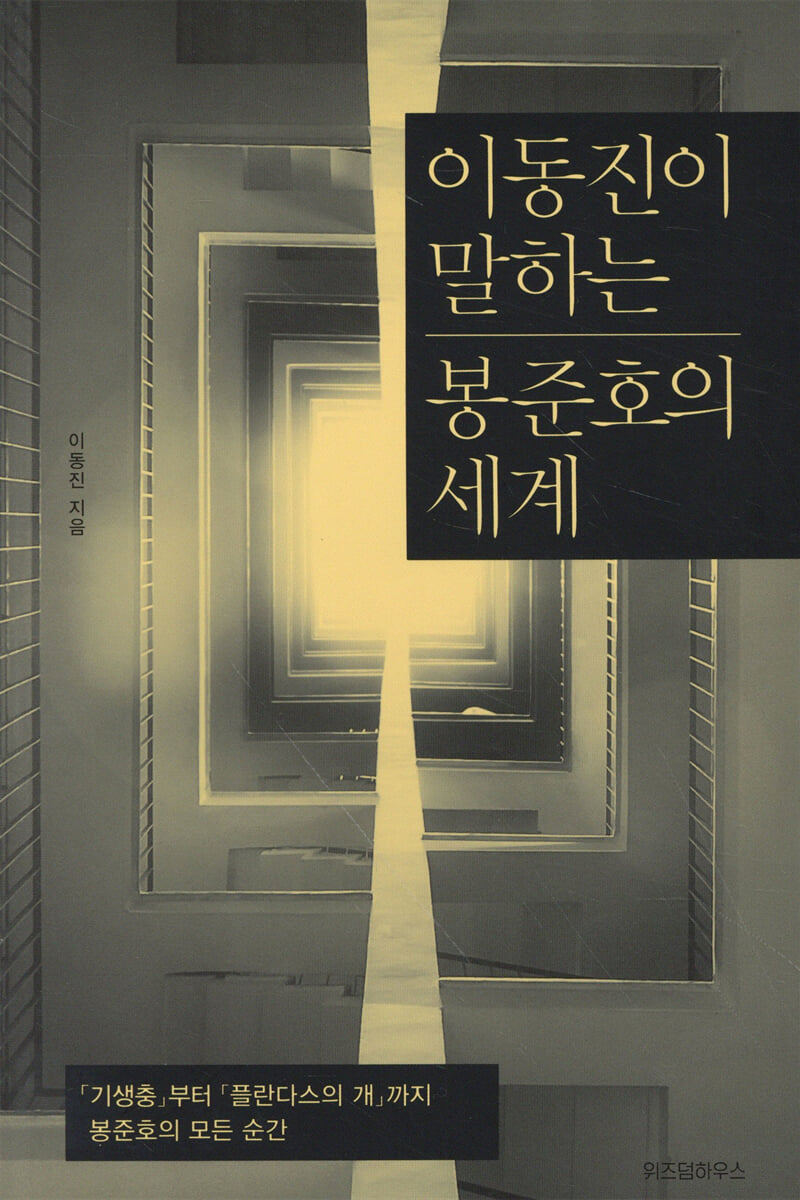
Lee Dong-jin talks about Bong Joon-ho's world
 |
Description
Book Introduction
Explored by Korea's best film critic, Lee Dong-jin
From "Parasite" to "Barking Dogs Never Bite," Bong Joon-ho's Works
A book in which Lee Dong-jin, Korea's top film critic, examines the world of director Bong Joon-ho, who has written a new chapter in the history of Korean and global cinema.
This is the only book that richly discusses seven of director Bong Joon-ho's feature films, from "Parasite" to "Barking Dogs Never Bite," from various perspectives, allowing us to see how director Bong Joon-ho's current state is "not a sudden stroke of exceptional luck, but the fruit that has ripened while continuously overcoming limitations."
- You can preview some of the book's contents.
Preview
index
Chapter 1 Parasites
The structure of the fight is more important than the outcome of the fight_ Parasite
Parasite 189 Scenes, Scene-by-Scene Commentary
Parasite Interview_ Lee Dong-jin x Bong Joon-ho
Chapter 2 Okja
Hope is not a torch, but a spark_ Okja
Okja Interview_ Lee Dong-jin x Bong Joon-ho
Chapter 3: Snowpiercer
Hot Class Struggle and Cold Sociobiology_ Snowpiercer
"Snowpiercer" 1st Interview_ Lee Dong-jin × Bong Joon-ho × Benjamin Legrand × Jean-Marc Rochette
"Snowpiercer" 2nd Interview_ Lee Dong-jin × Bong Joon-ho × Benjamin Legrand × Jean-Marc Rochette
Chapter 4 Mother
When the one who asked for memory wishes for oblivion_ Mother
Chapter 5 Monsters
A place to feed the weaker_ Monster
Chapter 6: Memories of Murder
The place his last gaze landed on was_ Memories of Murder
Chapter 7 The Dog of Flanders
He can't climb the mountain_ The Dog of Flanders
Chapter 8: Lee Dong-jin x Bong Joon-ho Boomerang Interview
"Mother," "The Host," "Memories of Murder," and "Barking Dogs Never Bite"
Into the book
The tremendous external success of “Parasite” was possible because of its outstanding internal achievements.
And the huge success of 2020 was the resonance created by the small, solid start in 2000, swimming across the river of time.
It was not a sudden stroke of exceptional luck, but the fruit of overcoming constant limitations one after another.
In between, there was "Memories of Murder," "Mother," and "The Host."
There was “Snowpiercer” and “Okja,” and there was also “Barking Dogs Never Bite.”
While everyone may have different preferences for their favorite films, none of the seven were mediocre.
His world, brilliantly illuminated with humor, irony, and pathos, captivated us.
Over the past 20 years, it has been a great blessing for me to have the opportunity to write about or meet with Director Bong Joon-ho and talk to him whenever his films were released.
---From the author's note
#6-7 Ki-woo explains the plan: Regarding the fake certificate that Ki-jung made, Ki-woo argues that it is not a forgery since he only took out the documents in advance and will be going to Yonsei University next year anyway.
This is a logic that seeks to guarantee the legitimacy of current actions by entitlement to future ones.
Ki-taek is impressed by his son's plan.
But a series of plans, including applying for a job and going to college, eventually fall apart.
The reason the plan didn't work was because Gi-woo and his family were not granted a future.
Knowing that, Geun-sae, who belonged to the same class, did not even make plans to leave that underground space.
---From "Parasite 189 Scenes, Scene-by-Scene Commentary"
#82∼93, 82∼93-1 Chung-sook boils Jjapaguri: In the midst of a fierce fight, the fight is suddenly stopped when Yeon-gyo calls.
(It is very similar to the scene in "Snowpiercer" where they fight fiercely with axes and clubs, but the fight stops when they reach the Catherine Bridge.) Unlike Moon-gwang, who rings the doorbell and asks for permission, Yeon-gyo, the real owner who doesn't even need permission, returns.
The absurd tragedy of the coexistence of three families reaches its peak when two families return one after another to the mansion that was supposed to be occupied solely by the Ki-taek family.
---From "Parasite 189 Scenes, Scene-by-Scene Commentary"
Lee Dong-jin: This time, I'd like to ask you about Indians.
There are many parts related to Indians in the movie, so I'd like to hear the director's basic thoughts on this.
Bong Joon-ho: I can't point out and talk about both Indians and Sansu Kyungseok as "A is B."
There are probably many aspects to it.
Especially since Indians, Cub Scouts, and Morse code are all connected.
In some ways, the various moments of class, hierarchy, and society shown in this film are, as you said, sharp and poignant, but this is an innocent world that could only exist in a stuffed museum.
It's the world in Wes Anderson's "Moonrise Kingdom."
Lee Dong-jin: Actually, the music reminded me of "Moonrise Kingdom."
Bong Joon-ho: It's like a completely innocent world like "Moonrise Kingdom."
It's a world that Yeon-gyo seems to be suitable for explaining.
Actually, Yeon-gyo is not a stupid or dull person at all.
He's just so innocent and pure that he trusts people too easily.
So that's why all this trouble came about.
Allowing everything to infiltrate.
The things Dasong talks about, like Indians, Cub Scouts, and Morse code, overlap with Ki-woo's, and within this sharp and realistic reality, there is a slightly strange and distant world.
I think it became a device that naturally played its role in the movie, as it led to a vague communication between the rich and the poor in Morse code at the end.
---From "Parasite" Interview_ Lee Dong-jin x Bong Joon-ho"
Wilford is both a pessimist and a realist.
He believes in the principle of balance not because it is the highest good, but because it is a necessary evil.
“Because we (humanity) are prisoners trapped inside this cursed lump of metal train anyway, and balance is essential in the closed ecosystem of the train.”
No, wait a minute.
So what if this world isn't a closed ecosystem?
Unless the train is your whole world.
It is right there that the third contrasting figure emerges.
The two are Curtis and Namgoong Min-soo (Song Kang-ho).
The two meet for the first time, strike a deal over Kronol, and then continue to advance in the same direction.
However, in contrast to Wilford and Gilliam, who at first glance appeared to be on opposite sides but in fact cooperated with the same intention, Curtis and Namgung Minsu, who appeared to be acting together toward the same point, had completely different goals.
Curtis was looking at the front compartment, but Namgung Minsu was thinking of the side door.
So, what is contrasted between the two is the direction.
---From "Hot Class Struggle and Cold Sociobiology_ Snowpiercer"
Originally, Kang-du was a person who slept without any warning.
In the introduction, a boy named Se-ju tries to steal something from the store while Kang-du is sleeping, but gives up, but he continues to sleep without even knowing about it.
However, Hee-bong's comical line, "Wake up, wake up, while you're at it!", which was used to scold him, eventually becomes Kang-du's attitude.
He doesn't wake up easily, but once he does, he stays awake.
This character, who first appears drooling and sleeping in a store, loses his own child and ends up at the end of the film, not sleeping even in the middle of the night, but staring out the window, protecting someone else's child, and then waking him up to feed him.
That child, Seju, was someone who had no way of interfering with his sleep at the very beginning.
---From "A Place to Feed the Weak_ Monster"
The prologue of "Memories of Murder" ends with Du-man's face looking at his own face.
And the epilogue ends with Du-man's face looking out of the film.
So once again, in "Memories of Murder," inside and outside are not clearly divided.
Evil exists not only within the story of the film, but also outside of it.
And even if you stare at the movie with your eyes wide open, you cannot clearly see the evil in reality.
The movie doesn't have that kind of insight.
There is simply an artistic longing to bring the true nature of evil to the forefront of the film through the faces of actors staring at the camera outside the story.
---From "The place his last gaze landed on_ Memories of Murder"
Publisher's Review
“Despite the dazzling success story of “Parasite,”
I can assure you that Bong Joon-ho's peak has not yet arrived.
I still believe that.”
Director Bong Joon-ho, who won the Palme d'Or at the 72nd Cannes Film Festival for "Parasite," then swept four categories at the 92nd Academy Awards: Best Picture, Best Director, Best Original Screenplay, and Best International Feature Film.
The world is going wild over "Parasite," the first non-English film to win the Academy Award for Best Picture and the Palme d'Or in 64 years.
"The World of Bong Joon-ho as Told by Lee Dong-jin" is a book in which Korea's top film critic Lee Dong-jin examines the world of director Bong Joon-ho's work, which has written a new chapter in the history of Korean and global cinema. It is no exaggeration to say that it contains "everything about director Bong Joon-ho."
As critic Lee Dong-jin said, “Parasite’s tremendous external success was possible because of its outstanding internal achievements.
And the huge success of 2020 was the resonance that the small and solid start in 2000 swam across the river of time and brought about.” “The World of Bong Joon-ho as Told by Lee Dong-jin” is the only book that richly discusses seven of director Bong Joon-ho’s feature films from “Parasite” to “Barking Dogs Never Bite” from various perspectives, allowing us to see how director Bong Joon-ho’s current state is “not a sudden stroke of exceptional luck, but the fruit that has ripened while continuously overcoming limitations one after another.”
Explored by Korea's best film critic, Lee Dong-jin
From "Parasite" to "Barking Dogs Never Bite," Bong Joon-ho's Works
『The World of Bong Joon-ho as Told by Lee Dong-jin』 consists of eight chapters.
Chapter 1 includes a detailed scene-by-scene analysis of the 189 scenes of "Parasite," a conversation between critic Lee Dong-jin and director Bong Joon-ho, and a review of "Parasite" from "The Movie Starts Twice," truly encompassing the world of "Parasite."
In particular, "Parasite 189 Scenes, Scene-by-Scene Commentary" is a long, detailed, and colorful analysis of "Parasite," to the point that critic Lee Dong-jin confessed that it was "close to being overused."
Chapter 2 includes a review of "Okja" from "The Movie Starts Twice" and a discussion between critic Lee Dong-jin and director Bong Joon-ho about "Okja," providing a glimpse into interesting and diverse stories about "Okja."
Chapter 3 includes a newly written critique of "Snowpiercer" and two interviews with critic Dong-jin Lee, director Bong Joon-ho, and original authors Benjamin Legrand and Jean-Marc Rochette, conducted in 2008 during the planning stage and again in 2013 right after the film's release, revealing the behind-the-scenes story of "Snowpiercer" from its planning to its completion, never before seen.
Chapters 4-7 contain plaintexts of “Mother,” “The Monster,” “Memories of Murder,” and “The Dog of Flanders.”
All five reviews, including "Snowpiercer," are newly written, offering deep and engaging insights into director Bong Joon-ho's beginnings in 2020 and the feast of powerful masterpieces.
Additionally, Chapter 8 includes interviews with “Mother,” “The Host,” “Memories of Murder,” and “Barking Dogs Never Bite” from “Lee Dong-jin’s Boomerang Interview: The Secret of That Movie,” providing a special experience that allows readers to look into Director Bong Joon-ho’s human charm and artistic world together.
GOODS SPECIFICS
- Date of issue: March 20, 2020
- Page count, weight, size: 432 pages | 666g | 140*210*30mm
- ISBN13: 9791190630702
- ISBN10: 1190630702
You may also like
카테고리
korean


korean


