

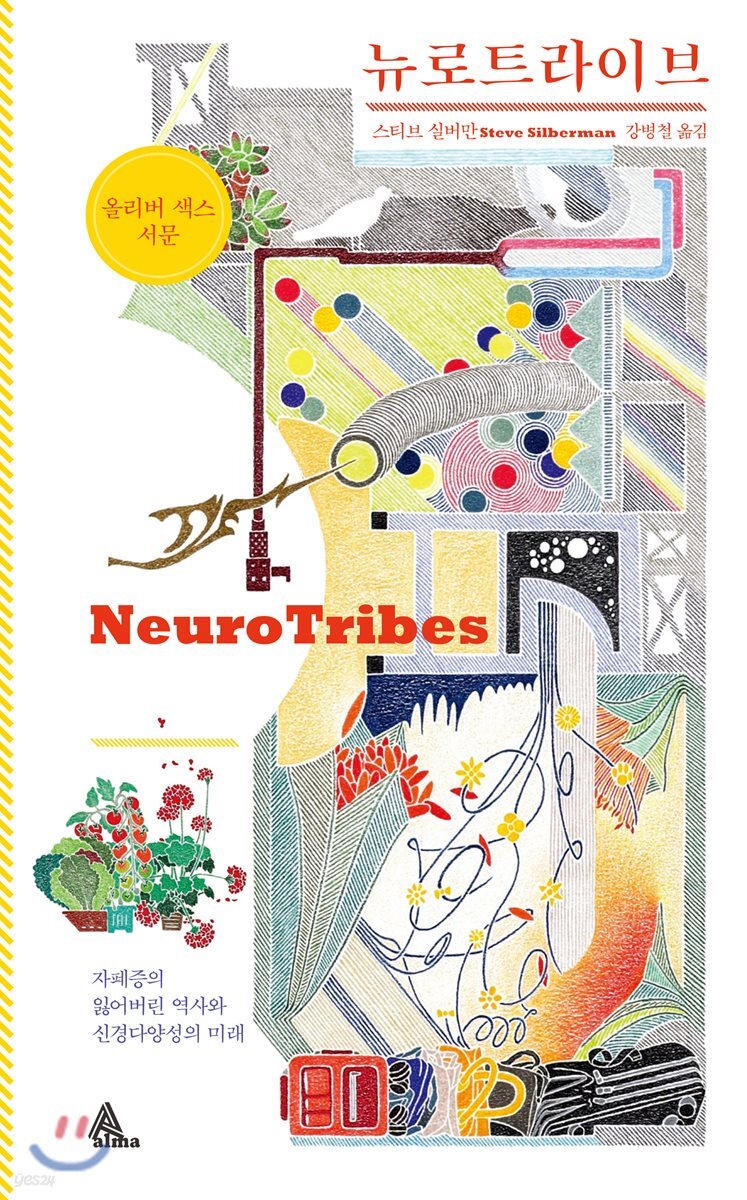
Neurotribe
 |
Description
Book Introduction
2015 Samuel Johnson Nonfiction Award Winner
“A beautiful, human, and important book!” The New York Times
“The definitive book on the past of autism.” The Economist
“It’s breathtaking.
“It touches the heart more than any other book.” Boston Globe
“Everyone should read this book.
Everyone says, "Forbes
Neurotribes, the first science book to win the Samuel Johnson Award for Nonfiction, restores the lost history of autism, fundamentally overturns societal stereotypes about autism, and explores the concept of neurodiversity, which will open up new possibilities for our future.
Paramount Pictures decided to make the book into a movie.
What is autism? Is it a lifelong disability, or a specific form of genius manifested through naturally occurring cognitive differences? Autism encompasses both types, as well as a broader spectrum.
And our future depends on how well we understand autism.
This book scientifically and movingly argues that when we accurately understand, accept, and develop the complexities and diversity of the human genome—neurological differences like autism, dyslexia, and ADHD—we can move toward a healthier, safer, and happier future.
“Neurotribes” depicts the entire history of autism with a rare level of empathy and sensitivity, both broadly and deeply.
Reading this book will completely change your thinking about autism.
Anyone interested in autism and how the brain works should have this book on their bookshelf alongside works by Temple Grandin and Clara Claiborne Park.” — From the foreword by Oliver Sacks
“A beautiful, human, and important book!” The New York Times
“The definitive book on the past of autism.” The Economist
“It’s breathtaking.
“It touches the heart more than any other book.” Boston Globe
“Everyone should read this book.
Everyone says, "Forbes
Neurotribes, the first science book to win the Samuel Johnson Award for Nonfiction, restores the lost history of autism, fundamentally overturns societal stereotypes about autism, and explores the concept of neurodiversity, which will open up new possibilities for our future.
Paramount Pictures decided to make the book into a movie.
What is autism? Is it a lifelong disability, or a specific form of genius manifested through naturally occurring cognitive differences? Autism encompasses both types, as well as a broader spectrum.
And our future depends on how well we understand autism.
This book scientifically and movingly argues that when we accurately understand, accept, and develop the complexities and diversity of the human genome—neurological differences like autism, dyslexia, and ADHD—we can move toward a healthier, safer, and happier future.
“Neurotribes” depicts the entire history of autism with a rare level of empathy and sensitivity, both broadly and deeply.
Reading this book will completely change your thinking about autism.
Anyone interested in autism and how the brain works should have this book on their bookshelf alongside works by Temple Grandin and Clara Claiborne Park.” — From the foreword by Oliver Sacks
- You can preview some of the book's contents.
Preview
index
Foreword by Oliver Sacks
Prologue_Behind the Geek Syndrome
1.
The Wizard of Clapham Common
2.
The Boy Who Loves Green Straws
3.
What does Sister Victorine know?
4.
Fascinating and bizarre features
5.
The Invention of Harmful Parenting
6.
Prince of Wireless Communications
7.
Fighting monsters
8.
The lines drawn by nature always spread out to the surroundings.
9.
Rain Man effect
10.
Pandora's Box
11.
How vast is the space called autism?
12.
Building the Enterprise: Designing a Neurodiverse World
Epilogue_Mayor Kensington
Reviews
Translator's Note
annotation
Search
Prologue_Behind the Geek Syndrome
1.
The Wizard of Clapham Common
2.
The Boy Who Loves Green Straws
3.
What does Sister Victorine know?
4.
Fascinating and bizarre features
5.
The Invention of Harmful Parenting
6.
Prince of Wireless Communications
7.
Fighting monsters
8.
The lines drawn by nature always spread out to the surroundings.
9.
Rain Man effect
10.
Pandora's Box
11.
How vast is the space called autism?
12.
Building the Enterprise: Designing a Neurodiverse World
Epilogue_Mayor Kensington
Reviews
Translator's Note
annotation
Search
Detailed image
.jpg)
Into the book
A few months later, I started working on a profile of Judy Estrin, one of Silicon Valley's most highly regarded female technologists and entrepreneurs.
After graduating from Stanford University in the 1970s, she developed the TCP/IP protocol, the backbone of the Internet, together with Vint Cerf.
Since then, he has continued to run successfully, launching several startups in the male-dominated IT field.
While researching Judy's personal story, I contacted her sister-in-law, Manin Kligfeld, and asked if I could go to her home for an interview.
“Of course.
But please know that we have a daughter with autism.”
It felt like a strange coincidence.
Two Silicon Valley families with significant tech success have children with rare neurological disorders? The next day, I met a friend at a cafe near my house and we discussed this fascinating coincidence.
Then a young woman with short, dark hair who was sitting at the next table suddenly interjected.
"I'm a special education teacher, and you know what's happening right now? There's an autism epidemic in Silicon Valley.
“Something terrible is happening to our children.” I suddenly felt goosebumps.
Is that true?
---From the "Prologue"
Parents struggling to raise a child newly diagnosed with autism suddenly find themselves thrown into a minefield of conflicting information about the safety of routine vaccinations and the potential developmental impact of heavy metals like mercury (found in trace amounts in vaccine preservatives like thimerosal).
Rumors of a massive conspiracy between big pharmaceutical companies and corrupt government officials to cover up widespread vaccine side effects around the world were spreading like wildfire on the internet.
As vaccination rates begin to decline worldwide, fears are growing that epidemic diseases like whooping cough, which kills tens of thousands of children each year, could return.
The official explanation for the dramatic increase in autism was that diagnostic criteria had been gradually expanded over time.
So why were the diagnostic criteria so inappropriately narrow in the first place? How did a mysterious, rare disease, previously thought to be genetic, suddenly become ubiquitous?
---From the "Prologue"
In my search for an answer to this question for this book, I decided to start from the very beginning—even earlier than the 1940s, when Kanner and Asperger are thought to have independently discovered autism.
As we began to take nothing for granted, it dawned on us that the standard chronology of autism history—the so-called creation myth itself—was fundamentally flawed, making it difficult to identify people with autism in earlier eras.
Without correcting this inaccurate timeline, it will be difficult to make informed decisions about which research and societal consensus will best serve people with autism and their families.
One of the most promising developments since the publication of 'Geek Syndrome' is the emergence of the concept of neurodiversity.
I believe that conditions like autism, dyslexia, and attention-deficit hyperactivity disorder (ADHD) should not be viewed simply as a collection of abilities and dysfunctions, but rather as naturally occurring cognitive mutations that possess unique strengths and have contributed to the advancement of human technology and culture.
While it is widely believed that the model of autism as a spectrum and the concept of neurodiversity are products of a postmodern worldview, these concepts are actually quite old, having been first proposed by Hans Asperger in a public lecture in 1938.
---From the "Prologue"
Even today, few people, except a small group of cognitive psychologists, realize that the adoption of the model of autism spectrum disorder in psychiatry in the 1980s was a decisive defeat for the man who first defined the condition.
For decades, Kanner maintained that his syndrome was by definition a single disorder, limited to children, and extremely rare.
If he had seen influential economist Tyler Cowen tout the virtues of having an innate “autistic cognitive style,” or Hollywood star Daryl Hannah confessing in middle age that he was actually autistic, or Fields Medal-winning mathematician Richard Borchers discussing his autistic tendencies in interviews with the press, he would have found these actions irresponsible, if not downright crazy.
Even comedian Jerry Seinfeld joined in, appearing on "Nightly News" and telling host Brian Williams:
“If you look at it very broadly, I think I fall into that category.
Because basic social relationships are so difficult.
That doesn't mean you can't do anything.
“It’s just that they think differently than other people.” For Kanner, autism wasn’t simply about having a unique cognitive style or a different way of thinking.
It was a tragic childhood mental illness caused by inadequate parenting, comparable to schizophrenia.
It wasn't something to be proud of at all.
---「1.
From "The Wizard of Clapham Common"
One thing was clear.
The new treatment was making Leo miserable.
Before, he always seemed to look forward to the time when he would eat with his family with anticipation, but now he sat down at the table reluctantly with a gloomy expression.
He even threw the food in front of him on the floor.
However, there were also aspects of the diet that facilitated the acquisition of expressive language.
I started pestering my mom for foods I didn't even know the names of, like yogurt and watermelon.
Previously, Leo had always been a surprisingly energetic boy, despite the countless realistic difficulties he faced in his daily life.
But now, every time I swallowed a pill every hour, every time Mom fretted over a poop in my diaper, every night when I got my vitamin B-12 shot, I was filled with rebellion.
The child looked as exhausted as his parents.
When I returned to Los Altos with the intention of going on a pilgrimage, the doctor, as expected, brought up chelation therapy again.
This time Craig objected.
“Wait a minute, doctor, are you recommending chelation therapy because your mercury toxicity levels are low?” The doctor said yes.
“You recommended chelation therapy even when my mercury toxicity levels were high, right?” The doctor nodded.
“So, is there any case where chelation therapy should not be performed?” the doctor finally spoke.
“No.” Craig and Shannon said, “Thank you very much,” and left the examination room without looking back.
And I never went to Los Altos again.
---「2.
From "The Boy Who Loves Green Straws"
Over a decade, Asperger and his colleagues treated more than 200 children who, like Gottfried, exhibited a striking combination of social immaturity, precocious abilities, and an excessive preoccupation with rules, regulations, and schedules.
We have also observed numerous teenagers and adults who exhibit similar characteristics.
The most severely affected children were admitted to mental hospitals with the stigma of mental retardation.
There were also children who, despite their genius, were kicked out of school because their teachers deemed their excessive rule-breaking and inability to follow directions as willful rebellion.
Even the most gifted children were unable to learn basic life skills like dressing, washing, and behaving politely at the table.
They were also clumsy and awkward at exercise, making them a target of ridicule in a culture where vigorous exercise was seen as a sign of mental health.
Asperger was struck by the fact that many of these children were remarkably beautiful, with mature and chiseled features.
But his expression was heavy and serious, as if he had aged prematurely, consumed by endless worry.
I was especially agitated when there were unexpected changes in the environment or when things went in an unexpected direction.
(Asperger wrote about one child:
“If anything went a little bit different from what they expected or were used to, they would get very angry, confused, and launch into a long-winded rant.”) They tended to act according to a very strict discipline, as if they could avoid chaos by following the rules in everything.
(…) They seemed to be a mixture of various contradictions.
He was precocious and childish at the same time, delicate and old-fashioned, formal on the point of being unpolished, lonely and cold to others, sensitive to the musical elements of language but insensitive to the rhythm of human interaction.
Asperger wrote, “They were a very interesting type of child, one you could never miss.” He became convinced that they were suffering from a unique syndrome that was “by no means rare” but had somehow escaped recognition by previous generations of therapists.
---「3.
From "What Does Sister Victorine Know?"
Kaner was struck by how strikingly handsome these difficult, easily angered, and uncompromising children were.
He was fascinated by their "shockingly intelligent facial features," as if their faces were not just windows into the soul but the intricate wiring of the brain itself.
His belief that they possess great cognitive potential has been an indescribable comfort to parents who have spent years seeking rational explanations for their children's behavior from pediatricians, psychiatrists, neurologists, and other specialists, only to find no results.
Some of his parents were psychiatrists and wanted to hear Kaner's opinion no matter what.
It was because he didn't want to believe that his own child was mentally retarded.
Historically, such diagnoses have been associated with workers, immigrants, and people of color.
Kanner was not fooled into thinking that what he had observed in these cases was a uniquely modern phenomenon, as anti-vaccinators later argued, pointing to the development of mercury-containing antifungals and vaccine preservatives, such as merthiolate, in the 1920s and 1930s.
---「4.
Among the “fascinating and bizarre features”
Kaner's conditional surrender to his powerful colleagues was as harsh to his parents as it was swift.
By the time Time magazine published an article in April 1948 titled “Frozen Children: The Childhood Schizophrenia Patients,” it was clear he wasn’t going to insist that his syndrome was present from birth.
While speaking to colleagues at a conference in Manhattan, Kanner lashed out at the patients' parents.
They were cold-hearted perfectionists who were so busy rushing to the lab or the opening of the next exhibition that they didn't even have time to properly hug their children.
He explained that his parents did not do it out of bad intentions.
However, the idea that 'robot service like overly diligent gas station employees' is responsible parenting was prevalent.
He added that the reason these children turn their backs on others is because they have been "raised neatly in a refrigerator with no sex-depriving function" and have come to find solace in being alone.
---「5.
From "The Invention of Harmful Parenting"
With his keen observation, Sax realized that the patients were not incapable of communication, but rather constantly communicating, especially among themselves.
Although they did not use words, they expressed themselves through gestures and other nonverbal forms.
He contributed an essay to the hospital journal called “Culture and Community in the Mentally Ill” to encourage his colleagues to pay more attention to the more subtle interactions that were constantly happening around them.
However, he was eventually banned from working in the ward after protesting against the so-called 'therapeutic punishment' that was prevalent among the staff.
“Finally, I couldn’t stand it any longer, so I brought up the issue at our regular Wednesday meeting and said I thought it was morally shameful.
“I personally did not want to get involved in that, and I emphasized that I would be happy to find other ways to connect with patients.” The faces of those sitting around the table all darkened.
A few days later, the administrator banned him from working on the ward.
---「7.
From "Fighting Monsters"
Morrow first realized what a phenomenon his work had caused when he read a letter from a mother after the film's release.
She described taking her son shopping as a grueling ordeal.
She was always sitting down and making a fuss, and other mothers often criticized her for spoiling her children.
But recently, when a woman in a supermarket glared at her as if she was going to eat her, she asked,
“Have you seen [Rain Man]?”
“Oh, yes.
“That movie was really good.”
“Well, my son Johnny is similar to Raymond Babbitt.”
The other person's face softened.
“Oh, Johnny, you have autism too? I didn’t know that.”
Phyllis Terry Gold, co-founder of NSAC, told Hoffman that her own mother didn't even tell her friends about her grandson's existence until she saw the film.
One parent wrote in a letter that on the way home from a movie, his normally reserved son proudly declared:
“I have autism!” Through a film about one autistic person, countless people have been given a new understanding of their existence by their families, neighbors, teachers, doctors, and themselves.
---「8.
From the "Rain Man Effect"
“It’s a matter of diagnosis,” Rona said firmly.
When she expanded Kanner's narrow definition to include children and adults with milder disabilities, she already predicted that the prevalence of autism would increase.
The controversy arose precisely because it was about making it possible for more people to be diagnosed with autism, so that their families would not have to go through what they did in the 1960s without any help.
“These people have always existed,” Judith thought.
“We weren’t surprised when people said it was a pandemic.
If you set the standards too broadly, the number of patients will inevitably increase.
We talked about it countless times, but people didn't even give a damn.”
---「9.
From "Pandora's Box"
The theme of the meeting, inspired by the release of the film "Rain Man" five months earlier, was "Functionally Highly Autistic People," and the special speaker who took the stage was well-qualified to speak at such a gathering.
Finally she began to speak.
“I am a 44-year-old woman with autism who has had a successful career internationally in livestock equipment design.
“I completed my Ph.D. in Animal Science at the University of Illinois at Urbana-Champaign and am currently an Assistant Professor in the Animal Science Department at Colorado State University.” Her name was Temple Grandin.
It was a time when the name was not widely known outside of those associated with autism.
(…) First, Grandin points out that the idea that children who don't speak are intentionally ignoring those around them is a huge misconception.
“When adults spoke directly to me, I could understand everything they said.
But I couldn't say what I wanted to say.
My mom and teachers wondered why I was screaming.
But screaming was the only way to communicate,” she said, and she found that existing methods for capturing the sensory sensitivities that are central to the autistic experience were inadequate.
Although hearing tests she had as a child showed no hearing problems, she described certain sounds as being unbearable, as if she had "a hearing aid in her ear turned up to the max volume."
She explained that the reason she often acted strangely in church as a child was because she felt the awkward petticoats, skirts, and stockings she was forced to wear every Sunday were very itchy.
---「11.
From "How wide is the space called autism"
It took five years for my daughter to look at me.
The moment my child looked at me in April 1977 was truly a miracle.
It was bedtime, so I was reading her a storybook that I read every night.
“And Beth fell asleep knowing that her mommy and daddy loved her,” I continued.
“Oh, Beth, how I wish you would just tell me once that you love me!” Suddenly the child opened her eyes.
He looked straight into my eyes and said this.
“I love you, Mom.” I have never experienced anything so surprising, so joyful, so miraculous in my life.
I realized it for the first time.
'There's someone out there.' Unless you live with or are constantly in contact with someone with autism, you probably don't know exactly what I mean.
I never, not once, take it for granted when a child looks at me.
And now my daughter looks at me very often.
I never take it for granted when my daughter washes her hands on her own.
It took me six years to teach that.
Now I think washing my hands is the most amazing and wonderful thing in the world. What I'm saying is, I've learned to find immense joy in the smallest things.
---「11.
From "How wide is the space called autism"
One way to understand neurodiversity is to look at it not in terms of diagnoses like dyslexia or ADHD, but in terms of the human operating system.
Our brains are incredibly adaptable and are very good at maximizing our chances of success despite the many frustrating limitations.
Just because you don't use the Windows operating system doesn't mean your computer is broken.
Just because the human operating system is not a commonly used operating system doesn't mean that all of its features are buggy.
By autistic standards, a 'normal' brain is easily distracted, compulsively social, and has a poor attention to minute details and things that must always be done in a consistent manner.
So autistic people perceive the neurotypical world as wildly unpredictable, chaotic, filled with constant noise, and people who don't respect their personal space.
After graduating from Stanford University in the 1970s, she developed the TCP/IP protocol, the backbone of the Internet, together with Vint Cerf.
Since then, he has continued to run successfully, launching several startups in the male-dominated IT field.
While researching Judy's personal story, I contacted her sister-in-law, Manin Kligfeld, and asked if I could go to her home for an interview.
“Of course.
But please know that we have a daughter with autism.”
It felt like a strange coincidence.
Two Silicon Valley families with significant tech success have children with rare neurological disorders? The next day, I met a friend at a cafe near my house and we discussed this fascinating coincidence.
Then a young woman with short, dark hair who was sitting at the next table suddenly interjected.
"I'm a special education teacher, and you know what's happening right now? There's an autism epidemic in Silicon Valley.
“Something terrible is happening to our children.” I suddenly felt goosebumps.
Is that true?
---From the "Prologue"
Parents struggling to raise a child newly diagnosed with autism suddenly find themselves thrown into a minefield of conflicting information about the safety of routine vaccinations and the potential developmental impact of heavy metals like mercury (found in trace amounts in vaccine preservatives like thimerosal).
Rumors of a massive conspiracy between big pharmaceutical companies and corrupt government officials to cover up widespread vaccine side effects around the world were spreading like wildfire on the internet.
As vaccination rates begin to decline worldwide, fears are growing that epidemic diseases like whooping cough, which kills tens of thousands of children each year, could return.
The official explanation for the dramatic increase in autism was that diagnostic criteria had been gradually expanded over time.
So why were the diagnostic criteria so inappropriately narrow in the first place? How did a mysterious, rare disease, previously thought to be genetic, suddenly become ubiquitous?
---From the "Prologue"
In my search for an answer to this question for this book, I decided to start from the very beginning—even earlier than the 1940s, when Kanner and Asperger are thought to have independently discovered autism.
As we began to take nothing for granted, it dawned on us that the standard chronology of autism history—the so-called creation myth itself—was fundamentally flawed, making it difficult to identify people with autism in earlier eras.
Without correcting this inaccurate timeline, it will be difficult to make informed decisions about which research and societal consensus will best serve people with autism and their families.
One of the most promising developments since the publication of 'Geek Syndrome' is the emergence of the concept of neurodiversity.
I believe that conditions like autism, dyslexia, and attention-deficit hyperactivity disorder (ADHD) should not be viewed simply as a collection of abilities and dysfunctions, but rather as naturally occurring cognitive mutations that possess unique strengths and have contributed to the advancement of human technology and culture.
While it is widely believed that the model of autism as a spectrum and the concept of neurodiversity are products of a postmodern worldview, these concepts are actually quite old, having been first proposed by Hans Asperger in a public lecture in 1938.
---From the "Prologue"
Even today, few people, except a small group of cognitive psychologists, realize that the adoption of the model of autism spectrum disorder in psychiatry in the 1980s was a decisive defeat for the man who first defined the condition.
For decades, Kanner maintained that his syndrome was by definition a single disorder, limited to children, and extremely rare.
If he had seen influential economist Tyler Cowen tout the virtues of having an innate “autistic cognitive style,” or Hollywood star Daryl Hannah confessing in middle age that he was actually autistic, or Fields Medal-winning mathematician Richard Borchers discussing his autistic tendencies in interviews with the press, he would have found these actions irresponsible, if not downright crazy.
Even comedian Jerry Seinfeld joined in, appearing on "Nightly News" and telling host Brian Williams:
“If you look at it very broadly, I think I fall into that category.
Because basic social relationships are so difficult.
That doesn't mean you can't do anything.
“It’s just that they think differently than other people.” For Kanner, autism wasn’t simply about having a unique cognitive style or a different way of thinking.
It was a tragic childhood mental illness caused by inadequate parenting, comparable to schizophrenia.
It wasn't something to be proud of at all.
---「1.
From "The Wizard of Clapham Common"
One thing was clear.
The new treatment was making Leo miserable.
Before, he always seemed to look forward to the time when he would eat with his family with anticipation, but now he sat down at the table reluctantly with a gloomy expression.
He even threw the food in front of him on the floor.
However, there were also aspects of the diet that facilitated the acquisition of expressive language.
I started pestering my mom for foods I didn't even know the names of, like yogurt and watermelon.
Previously, Leo had always been a surprisingly energetic boy, despite the countless realistic difficulties he faced in his daily life.
But now, every time I swallowed a pill every hour, every time Mom fretted over a poop in my diaper, every night when I got my vitamin B-12 shot, I was filled with rebellion.
The child looked as exhausted as his parents.
When I returned to Los Altos with the intention of going on a pilgrimage, the doctor, as expected, brought up chelation therapy again.
This time Craig objected.
“Wait a minute, doctor, are you recommending chelation therapy because your mercury toxicity levels are low?” The doctor said yes.
“You recommended chelation therapy even when my mercury toxicity levels were high, right?” The doctor nodded.
“So, is there any case where chelation therapy should not be performed?” the doctor finally spoke.
“No.” Craig and Shannon said, “Thank you very much,” and left the examination room without looking back.
And I never went to Los Altos again.
---「2.
From "The Boy Who Loves Green Straws"
Over a decade, Asperger and his colleagues treated more than 200 children who, like Gottfried, exhibited a striking combination of social immaturity, precocious abilities, and an excessive preoccupation with rules, regulations, and schedules.
We have also observed numerous teenagers and adults who exhibit similar characteristics.
The most severely affected children were admitted to mental hospitals with the stigma of mental retardation.
There were also children who, despite their genius, were kicked out of school because their teachers deemed their excessive rule-breaking and inability to follow directions as willful rebellion.
Even the most gifted children were unable to learn basic life skills like dressing, washing, and behaving politely at the table.
They were also clumsy and awkward at exercise, making them a target of ridicule in a culture where vigorous exercise was seen as a sign of mental health.
Asperger was struck by the fact that many of these children were remarkably beautiful, with mature and chiseled features.
But his expression was heavy and serious, as if he had aged prematurely, consumed by endless worry.
I was especially agitated when there were unexpected changes in the environment or when things went in an unexpected direction.
(Asperger wrote about one child:
“If anything went a little bit different from what they expected or were used to, they would get very angry, confused, and launch into a long-winded rant.”) They tended to act according to a very strict discipline, as if they could avoid chaos by following the rules in everything.
(…) They seemed to be a mixture of various contradictions.
He was precocious and childish at the same time, delicate and old-fashioned, formal on the point of being unpolished, lonely and cold to others, sensitive to the musical elements of language but insensitive to the rhythm of human interaction.
Asperger wrote, “They were a very interesting type of child, one you could never miss.” He became convinced that they were suffering from a unique syndrome that was “by no means rare” but had somehow escaped recognition by previous generations of therapists.
---「3.
From "What Does Sister Victorine Know?"
Kaner was struck by how strikingly handsome these difficult, easily angered, and uncompromising children were.
He was fascinated by their "shockingly intelligent facial features," as if their faces were not just windows into the soul but the intricate wiring of the brain itself.
His belief that they possess great cognitive potential has been an indescribable comfort to parents who have spent years seeking rational explanations for their children's behavior from pediatricians, psychiatrists, neurologists, and other specialists, only to find no results.
Some of his parents were psychiatrists and wanted to hear Kaner's opinion no matter what.
It was because he didn't want to believe that his own child was mentally retarded.
Historically, such diagnoses have been associated with workers, immigrants, and people of color.
Kanner was not fooled into thinking that what he had observed in these cases was a uniquely modern phenomenon, as anti-vaccinators later argued, pointing to the development of mercury-containing antifungals and vaccine preservatives, such as merthiolate, in the 1920s and 1930s.
---「4.
Among the “fascinating and bizarre features”
Kaner's conditional surrender to his powerful colleagues was as harsh to his parents as it was swift.
By the time Time magazine published an article in April 1948 titled “Frozen Children: The Childhood Schizophrenia Patients,” it was clear he wasn’t going to insist that his syndrome was present from birth.
While speaking to colleagues at a conference in Manhattan, Kanner lashed out at the patients' parents.
They were cold-hearted perfectionists who were so busy rushing to the lab or the opening of the next exhibition that they didn't even have time to properly hug their children.
He explained that his parents did not do it out of bad intentions.
However, the idea that 'robot service like overly diligent gas station employees' is responsible parenting was prevalent.
He added that the reason these children turn their backs on others is because they have been "raised neatly in a refrigerator with no sex-depriving function" and have come to find solace in being alone.
---「5.
From "The Invention of Harmful Parenting"
With his keen observation, Sax realized that the patients were not incapable of communication, but rather constantly communicating, especially among themselves.
Although they did not use words, they expressed themselves through gestures and other nonverbal forms.
He contributed an essay to the hospital journal called “Culture and Community in the Mentally Ill” to encourage his colleagues to pay more attention to the more subtle interactions that were constantly happening around them.
However, he was eventually banned from working in the ward after protesting against the so-called 'therapeutic punishment' that was prevalent among the staff.
“Finally, I couldn’t stand it any longer, so I brought up the issue at our regular Wednesday meeting and said I thought it was morally shameful.
“I personally did not want to get involved in that, and I emphasized that I would be happy to find other ways to connect with patients.” The faces of those sitting around the table all darkened.
A few days later, the administrator banned him from working on the ward.
---「7.
From "Fighting Monsters"
Morrow first realized what a phenomenon his work had caused when he read a letter from a mother after the film's release.
She described taking her son shopping as a grueling ordeal.
She was always sitting down and making a fuss, and other mothers often criticized her for spoiling her children.
But recently, when a woman in a supermarket glared at her as if she was going to eat her, she asked,
“Have you seen [Rain Man]?”
“Oh, yes.
“That movie was really good.”
“Well, my son Johnny is similar to Raymond Babbitt.”
The other person's face softened.
“Oh, Johnny, you have autism too? I didn’t know that.”
Phyllis Terry Gold, co-founder of NSAC, told Hoffman that her own mother didn't even tell her friends about her grandson's existence until she saw the film.
One parent wrote in a letter that on the way home from a movie, his normally reserved son proudly declared:
“I have autism!” Through a film about one autistic person, countless people have been given a new understanding of their existence by their families, neighbors, teachers, doctors, and themselves.
---「8.
From the "Rain Man Effect"
“It’s a matter of diagnosis,” Rona said firmly.
When she expanded Kanner's narrow definition to include children and adults with milder disabilities, she already predicted that the prevalence of autism would increase.
The controversy arose precisely because it was about making it possible for more people to be diagnosed with autism, so that their families would not have to go through what they did in the 1960s without any help.
“These people have always existed,” Judith thought.
“We weren’t surprised when people said it was a pandemic.
If you set the standards too broadly, the number of patients will inevitably increase.
We talked about it countless times, but people didn't even give a damn.”
---「9.
From "Pandora's Box"
The theme of the meeting, inspired by the release of the film "Rain Man" five months earlier, was "Functionally Highly Autistic People," and the special speaker who took the stage was well-qualified to speak at such a gathering.
Finally she began to speak.
“I am a 44-year-old woman with autism who has had a successful career internationally in livestock equipment design.
“I completed my Ph.D. in Animal Science at the University of Illinois at Urbana-Champaign and am currently an Assistant Professor in the Animal Science Department at Colorado State University.” Her name was Temple Grandin.
It was a time when the name was not widely known outside of those associated with autism.
(…) First, Grandin points out that the idea that children who don't speak are intentionally ignoring those around them is a huge misconception.
“When adults spoke directly to me, I could understand everything they said.
But I couldn't say what I wanted to say.
My mom and teachers wondered why I was screaming.
But screaming was the only way to communicate,” she said, and she found that existing methods for capturing the sensory sensitivities that are central to the autistic experience were inadequate.
Although hearing tests she had as a child showed no hearing problems, she described certain sounds as being unbearable, as if she had "a hearing aid in her ear turned up to the max volume."
She explained that the reason she often acted strangely in church as a child was because she felt the awkward petticoats, skirts, and stockings she was forced to wear every Sunday were very itchy.
---「11.
From "How wide is the space called autism"
It took five years for my daughter to look at me.
The moment my child looked at me in April 1977 was truly a miracle.
It was bedtime, so I was reading her a storybook that I read every night.
“And Beth fell asleep knowing that her mommy and daddy loved her,” I continued.
“Oh, Beth, how I wish you would just tell me once that you love me!” Suddenly the child opened her eyes.
He looked straight into my eyes and said this.
“I love you, Mom.” I have never experienced anything so surprising, so joyful, so miraculous in my life.
I realized it for the first time.
'There's someone out there.' Unless you live with or are constantly in contact with someone with autism, you probably don't know exactly what I mean.
I never, not once, take it for granted when a child looks at me.
And now my daughter looks at me very often.
I never take it for granted when my daughter washes her hands on her own.
It took me six years to teach that.
Now I think washing my hands is the most amazing and wonderful thing in the world. What I'm saying is, I've learned to find immense joy in the smallest things.
---「11.
From "How wide is the space called autism"
One way to understand neurodiversity is to look at it not in terms of diagnoses like dyslexia or ADHD, but in terms of the human operating system.
Our brains are incredibly adaptable and are very good at maximizing our chances of success despite the many frustrating limitations.
Just because you don't use the Windows operating system doesn't mean your computer is broken.
Just because the human operating system is not a commonly used operating system doesn't mean that all of its features are buggy.
By autistic standards, a 'normal' brain is easily distracted, compulsively social, and has a poor attention to minute details and things that must always be done in a consistent manner.
So autistic people perceive the neurotypical world as wildly unpredictable, chaotic, filled with constant noise, and people who don't respect their personal space.
---「12.
From "Building the Enterprise: Designing a Neurodiverse World"
From "Building the Enterprise: Designing a Neurodiverse World"
Publisher's Review
In Search of the Lost History of Autism
Steve Silverman, a journalist who has written for outlets such as [Wired], discovered that a high number of successful computer engineers in Silicon Valley had children with autism and Asperger's syndrome.
What began as a curiosity-driven investigation led to a massive body of research and data review, including direct visits to doctors, therapists, researchers, autistic individuals, and their families, ultimately revealing the forgotten history and full picture of autism.
In 1943, American child psychiatrist Leo Kanner discovered this mysterious disorder and named it autism while treating 11 children who seemed to live in their own world and ignore those around them.
However, Kanner not only believed that autism was a very rare disease with little chance of improvement, but also claimed that autism was caused by poor parenting methods, thereby sowing the seeds of much suffering.
Because of this, the condition of autism was defined in a negative light for a long time.
Long before Kanner discovered autism, the Vienna Children's Hospital in Germany had been focusing on children who had sophisticated language skills or were gifted in science and mathematics but who were often ostracized because they were unable to form meaningful social relationships with others. They encouraged these children to develop their talents and recommend the most suitable careers to lead fulfilling lives.
Pediatrician Hans Asperger called these children "little professors" and named their condition autism.
It was named independently of Kanner, a year after Kanner named autism.
Unlike Kanner, Asperger noted the positive aspects of autism.
In other words, it was believed that autistic people exist on a very diverse spectrum, and that if they were educated in an inclusive way, their lives and abilities could be improved and they could contribute to society.
Unfortunately, however, Asperger's theory was not known to the world for a long time because the Nazis were driven by madness, started a war, and were defeated.
What Causes Autism, and Is It Curable?
The person who helped to relegate the theory that autism stems from toxic parenting to the dustbin of history was Bernard Rimland, a loving father and psychologist with an autistic son.
He couldn't accept that his son would have to live his whole life with the shackles of autism.
Although he was not an autism expert, he studied on his own and wrote a book called “Infant Autism.”
This book put autism back on the right track of science by revealing that the cause of autism is not a "refrigerator mother" (a mother as cold as a refrigerator), but a "congenital perception disorder."
But when Rimland's unwavering determination to cure his child reached its limits, he advocated for massive doses of vitamins, mysterious drugs that claimed to calm the nerves, and unfounded treatments that claimed to eliminate toxins.
This phenomenon continues to repeat itself even today.
Pediatrician Kang Byeong-cheol, who translated this book into Korean, wrote the following:
“Those blinded by money cannot miss this opportunity.
Now, parents who are determined to cure their children's autism are putting all their effort into testing their children for heavy metals, allergies, and yeast, and taking nutritional supplements, vitamins, and detoxification therapies that have no effect.
Spending tens or even hundreds of millions of won per month adds to the discomfort and anxiety of an already sensitive child, so it is like asking for a triple whammy.
When misfortune strikes anyone, they try to find the cause.
It is a behavior that combines the emotional response of finding a scapegoat on which to project unbearable despair and the rational response of seeking justice, uncovering the source of misfortune, and protecting the group.
While the rise of civic movements and increased environmental awareness are certainly positive, when faced with the complex problem of autism, people often choose the easy answer.
They concluded that corporate greed and environmental toxins were the cause.
With Rimland, a widely respected figure in the autism field, joining the fold, the easy answer became the right answer.
Even when British fraudster Andrew Wakefield carried out the notorious fraud of claiming that vaccines were the cause of autism, Rimland actively supported the idea, contributing to the decline in vaccination rates and the resurgence of infectious diseases.” _ From the translator’s note
The movie [Rain Man] and the amazing abilities of people with autism
The 1988 film [Rain Man] was a decisive moment that brought a new awareness of autism to the public.
Autism is characterized by difficulties forming social relationships, intolerance of change, difficulty recognizing nuances or context in communication, and a tendency to repeat certain behaviors or focus intensely on special interests.
While this could be considered a disability or illness, [Rain Man] highlights the special abilities of people with autism.
It showed the world that some people with autism have remarkable memories, computational skills, language skills, artistic talents, and imagination.
Neurotribes is full of stories about people with autism who have these special talents and abilities.
The stories of Henry Cavendish, who laid the foundations of modern science; Nobel Prize-winning theoretical physicist Paul Dirac; Nikola Tesla, an inventor on par with Edison; Hugo Gernsback, who created the science fiction genre; and John McCarthy, who made a decisive contribution to the development of artificial intelligence and network computing, unfold in a fascinating way.
Among them, the confession of Temple Grandin, a world-renowned industrial designer, university professor, and autistic person herself, resonates particularly deeply.
She shares her own experience with autism, dramatically broadening our understanding of autistic people.
The reason these autistic individuals were able to overcome countless social prejudices and adversities and succeed in their fields is because of the role of their parents and teachers who supported and cared for them to develop their special talents.
The future of a neurodiverse society unfolding together with people with autism.
This book proposes to accept autism through the concept of neurodiversity.
Rather than viewing conditions like autism, dyslexia, and attention-deficit hyperactivity disorder (ADHD) as mere collections of deficits and dysfunctions, we should view them as naturally occurring cognitive mutations that possess unique strengths and have contributed to the advancement of human technology and culture.
This book compellingly argues that by broadly embracing and applying the concept of neurodiversity to our society, we can move toward a healthier, safer, and happier future.
And above all, people with autism are now beginning to speak up and actively show solidarity.
The Internet has become the optimal space for communication and solidarity for those who find it difficult to form direct social relationships.
Jim Sinclair, an autistic person and author, says:
“We need you.
We need your help and understanding.
Yes, autism is tragic.
But it's not because of who we are, it's because of what happens to us.
…if you absolutely have to, be sad.
It's okay to grieve over lost dreams.
But don't be sad for us.
We are alive.
We are reality.
We are waiting for you.” _ From page 575 of the text
Now it's our turn to respond to them.
Steve Silverman, a journalist who has written for outlets such as [Wired], discovered that a high number of successful computer engineers in Silicon Valley had children with autism and Asperger's syndrome.
What began as a curiosity-driven investigation led to a massive body of research and data review, including direct visits to doctors, therapists, researchers, autistic individuals, and their families, ultimately revealing the forgotten history and full picture of autism.
In 1943, American child psychiatrist Leo Kanner discovered this mysterious disorder and named it autism while treating 11 children who seemed to live in their own world and ignore those around them.
However, Kanner not only believed that autism was a very rare disease with little chance of improvement, but also claimed that autism was caused by poor parenting methods, thereby sowing the seeds of much suffering.
Because of this, the condition of autism was defined in a negative light for a long time.
Long before Kanner discovered autism, the Vienna Children's Hospital in Germany had been focusing on children who had sophisticated language skills or were gifted in science and mathematics but who were often ostracized because they were unable to form meaningful social relationships with others. They encouraged these children to develop their talents and recommend the most suitable careers to lead fulfilling lives.
Pediatrician Hans Asperger called these children "little professors" and named their condition autism.
It was named independently of Kanner, a year after Kanner named autism.
Unlike Kanner, Asperger noted the positive aspects of autism.
In other words, it was believed that autistic people exist on a very diverse spectrum, and that if they were educated in an inclusive way, their lives and abilities could be improved and they could contribute to society.
Unfortunately, however, Asperger's theory was not known to the world for a long time because the Nazis were driven by madness, started a war, and were defeated.
What Causes Autism, and Is It Curable?
The person who helped to relegate the theory that autism stems from toxic parenting to the dustbin of history was Bernard Rimland, a loving father and psychologist with an autistic son.
He couldn't accept that his son would have to live his whole life with the shackles of autism.
Although he was not an autism expert, he studied on his own and wrote a book called “Infant Autism.”
This book put autism back on the right track of science by revealing that the cause of autism is not a "refrigerator mother" (a mother as cold as a refrigerator), but a "congenital perception disorder."
But when Rimland's unwavering determination to cure his child reached its limits, he advocated for massive doses of vitamins, mysterious drugs that claimed to calm the nerves, and unfounded treatments that claimed to eliminate toxins.
This phenomenon continues to repeat itself even today.
Pediatrician Kang Byeong-cheol, who translated this book into Korean, wrote the following:
“Those blinded by money cannot miss this opportunity.
Now, parents who are determined to cure their children's autism are putting all their effort into testing their children for heavy metals, allergies, and yeast, and taking nutritional supplements, vitamins, and detoxification therapies that have no effect.
Spending tens or even hundreds of millions of won per month adds to the discomfort and anxiety of an already sensitive child, so it is like asking for a triple whammy.
When misfortune strikes anyone, they try to find the cause.
It is a behavior that combines the emotional response of finding a scapegoat on which to project unbearable despair and the rational response of seeking justice, uncovering the source of misfortune, and protecting the group.
While the rise of civic movements and increased environmental awareness are certainly positive, when faced with the complex problem of autism, people often choose the easy answer.
They concluded that corporate greed and environmental toxins were the cause.
With Rimland, a widely respected figure in the autism field, joining the fold, the easy answer became the right answer.
Even when British fraudster Andrew Wakefield carried out the notorious fraud of claiming that vaccines were the cause of autism, Rimland actively supported the idea, contributing to the decline in vaccination rates and the resurgence of infectious diseases.” _ From the translator’s note
The movie [Rain Man] and the amazing abilities of people with autism
The 1988 film [Rain Man] was a decisive moment that brought a new awareness of autism to the public.
Autism is characterized by difficulties forming social relationships, intolerance of change, difficulty recognizing nuances or context in communication, and a tendency to repeat certain behaviors or focus intensely on special interests.
While this could be considered a disability or illness, [Rain Man] highlights the special abilities of people with autism.
It showed the world that some people with autism have remarkable memories, computational skills, language skills, artistic talents, and imagination.
Neurotribes is full of stories about people with autism who have these special talents and abilities.
The stories of Henry Cavendish, who laid the foundations of modern science; Nobel Prize-winning theoretical physicist Paul Dirac; Nikola Tesla, an inventor on par with Edison; Hugo Gernsback, who created the science fiction genre; and John McCarthy, who made a decisive contribution to the development of artificial intelligence and network computing, unfold in a fascinating way.
Among them, the confession of Temple Grandin, a world-renowned industrial designer, university professor, and autistic person herself, resonates particularly deeply.
She shares her own experience with autism, dramatically broadening our understanding of autistic people.
The reason these autistic individuals were able to overcome countless social prejudices and adversities and succeed in their fields is because of the role of their parents and teachers who supported and cared for them to develop their special talents.
The future of a neurodiverse society unfolding together with people with autism.
This book proposes to accept autism through the concept of neurodiversity.
Rather than viewing conditions like autism, dyslexia, and attention-deficit hyperactivity disorder (ADHD) as mere collections of deficits and dysfunctions, we should view them as naturally occurring cognitive mutations that possess unique strengths and have contributed to the advancement of human technology and culture.
This book compellingly argues that by broadly embracing and applying the concept of neurodiversity to our society, we can move toward a healthier, safer, and happier future.
And above all, people with autism are now beginning to speak up and actively show solidarity.
The Internet has become the optimal space for communication and solidarity for those who find it difficult to form direct social relationships.
Jim Sinclair, an autistic person and author, says:
“We need you.
We need your help and understanding.
Yes, autism is tragic.
But it's not because of who we are, it's because of what happens to us.
…if you absolutely have to, be sad.
It's okay to grieve over lost dreams.
But don't be sad for us.
We are alive.
We are reality.
We are waiting for you.” _ From page 575 of the text
Now it's our turn to respond to them.
GOODS SPECIFICS
- Date of issue: September 14, 2018
- Page count, weight, size: 700 pages | 928g | 140*225*35mm
- ISBN13: 9791159922244
- ISBN10: 1159922241
You may also like
카테고리
korean


korean

![ELLE 엘르 스페셜 에디션 A형 : 12월 [2025]](http://librairie.coreenne.fr/cdn/shop/files/b8e27a3de6c9538896439686c6b0e8fb.jpg?v=1766436872&width=3840)


