

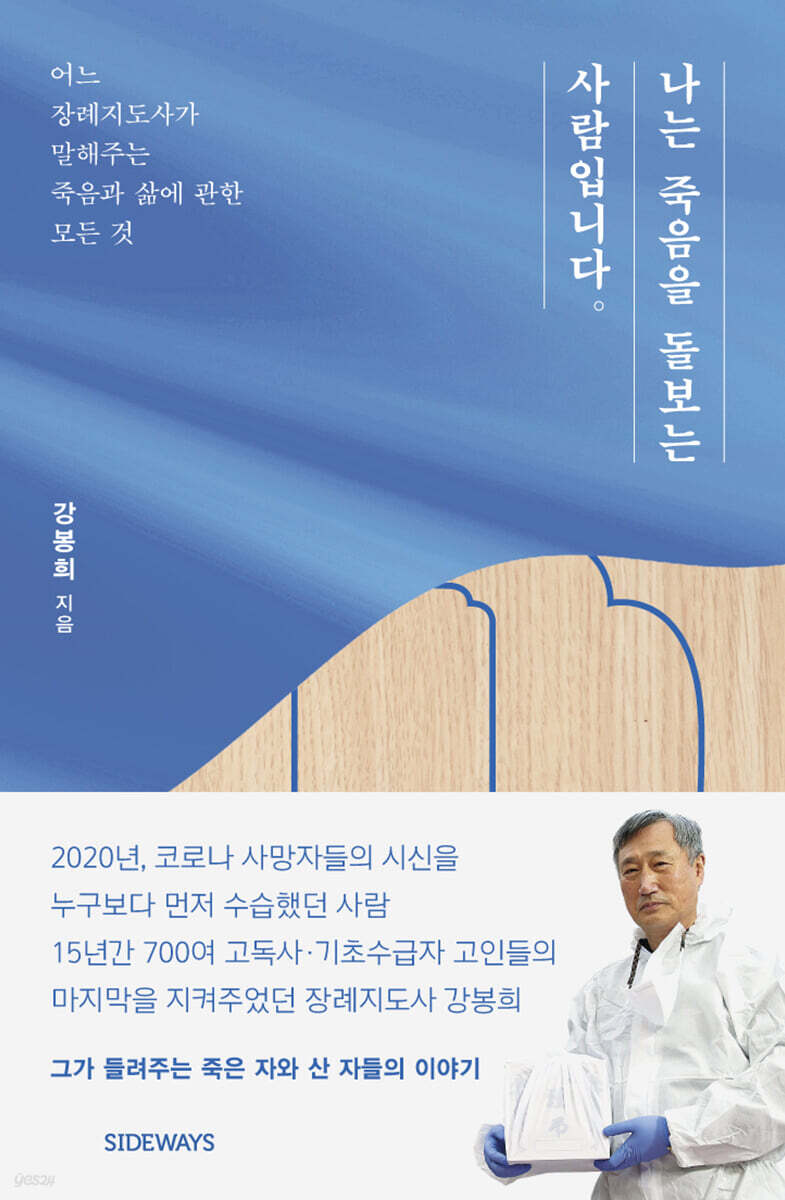
I am a caregiver of death
 |
Description
Book Introduction
- A word from MD
-
The minimum courtesy to face deathSince 2004, funeral director Kang Bong-hee has conducted funerals for over 700 people who died alone and those receiving basic livelihood security.
Why did he volunteer for this job without compensation? What is Korean society's attitude toward death? What is the minimum courtesy we should have in the face of such a tragic death? This book contains profound thoughts on life and death.
October 12, 2021. Humanities PD Son Min-gyu
In 2020, the bodies of those who died from Corona
The person who trained before anyone else
Over the past 15 years, over 700 people have died alone or received basic livelihood security benefits.
Kang Bong-hee, the funeral director who watched over the final moments
The stories of the dead and the living he tells
This book is the record of a funeral director who spent nearly 20 years by the side of the deceased and accompanied them through their final moments.
In her mid-40s, author Kang Bong-hee, who barely returned from the brink of death after being diagnosed with cancer, decided to devote herself to caring for the dead.
Since 2004, he has been handling the funerals of over 700 people who died alone and those receiving basic livelihood security benefits without any compensation.
In 2020, when everyone was too afraid of infection to touch the bodies of COVID-19 victims, he was the first to rush to the hospital to collect the bodies.
Even today, the author collects the bodies of those who died alone, and goes back and forth between funeral homes, crematoriums, and columbariums to commemorate their sorrowful souls.
"I am a person who cares for death" is a long and arduous trajectory of reflection on the meaning of death and funerals, life, and humanity, told by a person who has witnessed the final moments of the dead for a long time.
The person who trained before anyone else
Over the past 15 years, over 700 people have died alone or received basic livelihood security benefits.
Kang Bong-hee, the funeral director who watched over the final moments
The stories of the dead and the living he tells
This book is the record of a funeral director who spent nearly 20 years by the side of the deceased and accompanied them through their final moments.
In her mid-40s, author Kang Bong-hee, who barely returned from the brink of death after being diagnosed with cancer, decided to devote herself to caring for the dead.
Since 2004, he has been handling the funerals of over 700 people who died alone and those receiving basic livelihood security benefits without any compensation.
In 2020, when everyone was too afraid of infection to touch the bodies of COVID-19 victims, he was the first to rush to the hospital to collect the bodies.
Even today, the author collects the bodies of those who died alone, and goes back and forth between funeral homes, crematoriums, and columbariums to commemorate their sorrowful souls.
"I am a person who cares for death" is a long and arduous trajectory of reflection on the meaning of death and funerals, life, and humanity, told by a person who has witnessed the final moments of the dead for a long time.
- You can preview some of the book's contents.
Preview
index
introduction
Part 1: Is Your Death Well?
1 I work for the dead, not the living.
2 After visiting the gates of the afterlife about 20 years ago
3. Concerning the care of the dead body
4 The corpse speaks after it has died.
5. Receive the last breath of the coronavirus victims. 1.
6. 2. Receive the last breaths of the coronavirus victims.
7 There is no one on this earth who has no ties. 1
8 There is no one on this earth who has no ties. 2
9 If a person is an animal that cannot live alone
10 Life and death are connected by a single line.
11 To tie death with a string
12 What will you wear when you die?
13 We all die with the face of a baby.
14 What happens if you ride in a limousine after you die?
15 A funeral is a game for the living.
Part 2: Thoughts at Death's Side
16 On the day I first washed the dead body
17 To young people who dream of becoming funeral directors
18 Funeral: Never Be Swayed by a Company
19 Bloodlines are a scary thing
20 The beginning of consideration lies in 'frequently'
21 On Legacy and Inheritance
22 Even if the family forgets them, we
23 The civil servant I can't forget
24 Death has no borders
25 Baby Boomers Were the Worst People
26 What is a sacrifice?
Don't forget that 27 Myeongdang is '1 minute by taxi or Uber'
28 Respect for humanity comes before tradition and formality.
29 An era where adults have disappeared, an era where education has disappeared
30 My Death I Wish
Part 1: Is Your Death Well?
1 I work for the dead, not the living.
2 After visiting the gates of the afterlife about 20 years ago
3. Concerning the care of the dead body
4 The corpse speaks after it has died.
5. Receive the last breath of the coronavirus victims. 1.
6. 2. Receive the last breaths of the coronavirus victims.
7 There is no one on this earth who has no ties. 1
8 There is no one on this earth who has no ties. 2
9 If a person is an animal that cannot live alone
10 Life and death are connected by a single line.
11 To tie death with a string
12 What will you wear when you die?
13 We all die with the face of a baby.
14 What happens if you ride in a limousine after you die?
15 A funeral is a game for the living.
Part 2: Thoughts at Death's Side
16 On the day I first washed the dead body
17 To young people who dream of becoming funeral directors
18 Funeral: Never Be Swayed by a Company
19 Bloodlines are a scary thing
20 The beginning of consideration lies in 'frequently'
21 On Legacy and Inheritance
22 Even if the family forgets them, we
23 The civil servant I can't forget
24 Death has no borders
25 Baby Boomers Were the Worst People
26 What is a sacrifice?
Don't forget that 27 Myeongdang is '1 minute by taxi or Uber'
28 Respect for humanity comes before tradition and formality.
29 An era where adults have disappeared, an era where education has disappeared
30 My Death I Wish
Into the book
This book contains everything I felt and thought while working for the deceased.
Where on this earth can there be a death that is not sad, but most of the people I have seen through to the end have lived lonelier and more difficult lives than others.
As I was taking them in, I told them that they were going to a much more comfortable place than here, and that they should not worry about anything there and not hate anyone.
---From the "Preface"
I know very well that, like many people around me who have passed away, I too will one day become a dead body.
If someone asks me for help, I just go and help them.
I just do it because I like it.
Bring someone's body, clean it, dress it in a shroud, place it in a coffin, put it in a car, and go to cremate it.
The cremated remains are placed in a columbarium.
That's all you need to do.
That's just my job.
---From "I work for the dead, not the living"
Caring for the dead body is a solemn and blessed task.
I often think that it is the foundation of civilization that makes humans human.
There is nothing more rewarding than the final meeting of the bereaved family members who shared their love with the body I have carefully prepared.
---From “On Caring for the Dead Body”
Whether or not someone witnesses his end, his dead body bears witness to the life he has lived and the death he has endured.
We say that the corpse speaks after it has died.
And sometimes, the words of a person are most accurate after he or she has passed away, not while he or she is alive.
Even if no one listens to it… .
I hear it.
I guess that's my part.
---From "The corpse speaks after it is dead"
Even as the suffering caused by the COVID-19 virus continues around the world, the spring of 2020 in Daegu felt like an unprecedented time and unprecedented days.
In my sixty-eight years of life, it was the first time I had seen such a sight of death, such a scene of death.
And it made me rethink the very roots of how humans deal with death, and the meaning of humans and funerals.
It made me reaffirm my resolve that people shouldn't die like that.
---From "Recovering the Last of the Corona Deaths 2"
I wish people living next to me would pay attention while they are still alive.
No matter how he lived.
What matters is not what happened to him in the past.
Even if he is cut off from his family, that doesn't mean it's okay for him to be cut off from us.
It is not the family's duty to leave him alone, it is our duty.
---From "There is no one on this earth without a connection 2"
The saying that humans are animals that cannot live alone is synonymous with the saying that humans should not die alone.
I don't want to live in a world where corpses are buried, and I don't want to die in such a world.
---From "If Man Were an Animal That Could Not Live Alone"
We must get rid of this culture of thinking of death as separate from life.
Someday, my parents and I will have to go there.
It is a birth and death that our ancestors used to cut off, but it can be done from now on.
I'm sure that if they go together, everyone will be better off.
---From “Life and death are connected by a single line”
And as long as the living don't forget the meaning of dressing the dead in their favorite clothes, there will be no problem.
Even if it's not expensive, or new, if I dress up in clothes that people have carefully prepared for me, it doesn't matter what I wear in this world.
What is precious is the sincere heart of the mountain people who tried to take care of him until the end.
---From "What Will I Wear to Die"
It is your freedom to make the inside of the coffin like a flower garden.
But even if you place a single chrysanthemum flower you prepared on the body, the feeling is the same.
If you want, you can put coins and rice in the mouth like in the old days, or you can decorate the coffin with flowers or something pretty with paper as a gift.
However, it is much more valuable to do something good for the deceased while they are still alive, even if it is simple.
The limousine the body rides in after death has nothing to do with the deceased.
---From "What happens if you ride in a limousine after you die"
The wish for someone's happiness transcends this world and the next.
A funeral is merely an expression of that feeling.
It doesn't matter whether I made arms for the living or the dead.
Because we are all living and dying at the same time.
---From "Because a funeral is a game for the living"
Funerals are an inevitable part of our lives.
So get ready.
Prepare your mind, prepare your body.
Remember, it is a matter of upholding the will of the deceased.
The deceased would have wished for us to be happy and at ease wherever and whenever.
That's enough.
What else matters?
---From "Funerals, Never Be Swayed by Companies"
Just because you're family doesn't mean you have to give everything to them.
More important than giving material things is giving the possibility of faith.
It's so important to have faith in someone who can see me from my perspective, someone who can see me for who I am, even if I show them all my ugly past and scars.
Bloodline is the minimum bulwark that can provide that trust.
---From "Bloodline is a scary thing"
It is enough for my parents and connections to serve as a backrest that I can lean on when I am having a hard time.
Lean back comfortably at any time.
It is the warmest network of relationships that humans can provide.
But if you lean on it and don't want to take your back off, you'll end up ruining everything by applying force and rubbing it.
It is truly unfortunate that disputes and greedy fights arise over inheritance and legacy.
I have nothing, so I regret that I will not be able to treat this society to a big meal someday.
---From “On Legacy and Inheritance”
So, they started making money and starting families, and around the mid to late 1980s, when the men of that generation were in their mid-30s to 40s, they all started doing bad things.
Abandoning the family, cheating, and wandering around… .
So, can they ever return home? Even if they do, who in their family will be happy? So, there are countless cases of people dying alone, unable to move.
---From "The Baby Boomer Generation Was the Worst People"
So, what is a sacrifice?
A sacrifice is an expression of gratitude for one's life and the relationships around one, and a pledge to live long and happily with them.
Any sacrifice other than this is nothing but meaningless formality.
I know that much.
If I share friendship and consideration with my living blood relatives, our ancestors will look upon us with joy, even if we do not have to go on an excursion to this world.
---From "What is a Sacrifice"
There is no such thing as a good geomantic spot.
Anywhere where the sun is warm and the wind is calm is the best place.
A place where the deceased can remain in your heart, a place where you can visit often.
That place suffices as a good location.
The era of the Azure Dragon on the Left and the White Tiger on the Right has long since passed.
---“Don’t forget that the best spot is ‘1 minute by taxi or Uber’”
Just because death is similar to sleep doesn't mean we can't sleep.
We can sleep comfortably because we think that if we fall asleep at night, we will wake up in the morning.
We usually fall asleep talking to our spouse or children at the bedside, knowing that we'll wake up in the morning to see them again.
We don't die so we can meet those precious people.
If I die, I will never see you again.
So, there is no choice but to spend more enjoyable and happy times with them while they are still alive.
Where on this earth can there be a death that is not sad, but most of the people I have seen through to the end have lived lonelier and more difficult lives than others.
As I was taking them in, I told them that they were going to a much more comfortable place than here, and that they should not worry about anything there and not hate anyone.
---From the "Preface"
I know very well that, like many people around me who have passed away, I too will one day become a dead body.
If someone asks me for help, I just go and help them.
I just do it because I like it.
Bring someone's body, clean it, dress it in a shroud, place it in a coffin, put it in a car, and go to cremate it.
The cremated remains are placed in a columbarium.
That's all you need to do.
That's just my job.
---From "I work for the dead, not the living"
Caring for the dead body is a solemn and blessed task.
I often think that it is the foundation of civilization that makes humans human.
There is nothing more rewarding than the final meeting of the bereaved family members who shared their love with the body I have carefully prepared.
---From “On Caring for the Dead Body”
Whether or not someone witnesses his end, his dead body bears witness to the life he has lived and the death he has endured.
We say that the corpse speaks after it has died.
And sometimes, the words of a person are most accurate after he or she has passed away, not while he or she is alive.
Even if no one listens to it… .
I hear it.
I guess that's my part.
---From "The corpse speaks after it is dead"
Even as the suffering caused by the COVID-19 virus continues around the world, the spring of 2020 in Daegu felt like an unprecedented time and unprecedented days.
In my sixty-eight years of life, it was the first time I had seen such a sight of death, such a scene of death.
And it made me rethink the very roots of how humans deal with death, and the meaning of humans and funerals.
It made me reaffirm my resolve that people shouldn't die like that.
---From "Recovering the Last of the Corona Deaths 2"
I wish people living next to me would pay attention while they are still alive.
No matter how he lived.
What matters is not what happened to him in the past.
Even if he is cut off from his family, that doesn't mean it's okay for him to be cut off from us.
It is not the family's duty to leave him alone, it is our duty.
---From "There is no one on this earth without a connection 2"
The saying that humans are animals that cannot live alone is synonymous with the saying that humans should not die alone.
I don't want to live in a world where corpses are buried, and I don't want to die in such a world.
---From "If Man Were an Animal That Could Not Live Alone"
We must get rid of this culture of thinking of death as separate from life.
Someday, my parents and I will have to go there.
It is a birth and death that our ancestors used to cut off, but it can be done from now on.
I'm sure that if they go together, everyone will be better off.
---From “Life and death are connected by a single line”
And as long as the living don't forget the meaning of dressing the dead in their favorite clothes, there will be no problem.
Even if it's not expensive, or new, if I dress up in clothes that people have carefully prepared for me, it doesn't matter what I wear in this world.
What is precious is the sincere heart of the mountain people who tried to take care of him until the end.
---From "What Will I Wear to Die"
It is your freedom to make the inside of the coffin like a flower garden.
But even if you place a single chrysanthemum flower you prepared on the body, the feeling is the same.
If you want, you can put coins and rice in the mouth like in the old days, or you can decorate the coffin with flowers or something pretty with paper as a gift.
However, it is much more valuable to do something good for the deceased while they are still alive, even if it is simple.
The limousine the body rides in after death has nothing to do with the deceased.
---From "What happens if you ride in a limousine after you die"
The wish for someone's happiness transcends this world and the next.
A funeral is merely an expression of that feeling.
It doesn't matter whether I made arms for the living or the dead.
Because we are all living and dying at the same time.
---From "Because a funeral is a game for the living"
Funerals are an inevitable part of our lives.
So get ready.
Prepare your mind, prepare your body.
Remember, it is a matter of upholding the will of the deceased.
The deceased would have wished for us to be happy and at ease wherever and whenever.
That's enough.
What else matters?
---From "Funerals, Never Be Swayed by Companies"
Just because you're family doesn't mean you have to give everything to them.
More important than giving material things is giving the possibility of faith.
It's so important to have faith in someone who can see me from my perspective, someone who can see me for who I am, even if I show them all my ugly past and scars.
Bloodline is the minimum bulwark that can provide that trust.
---From "Bloodline is a scary thing"
It is enough for my parents and connections to serve as a backrest that I can lean on when I am having a hard time.
Lean back comfortably at any time.
It is the warmest network of relationships that humans can provide.
But if you lean on it and don't want to take your back off, you'll end up ruining everything by applying force and rubbing it.
It is truly unfortunate that disputes and greedy fights arise over inheritance and legacy.
I have nothing, so I regret that I will not be able to treat this society to a big meal someday.
---From “On Legacy and Inheritance”
So, they started making money and starting families, and around the mid to late 1980s, when the men of that generation were in their mid-30s to 40s, they all started doing bad things.
Abandoning the family, cheating, and wandering around… .
So, can they ever return home? Even if they do, who in their family will be happy? So, there are countless cases of people dying alone, unable to move.
---From "The Baby Boomer Generation Was the Worst People"
So, what is a sacrifice?
A sacrifice is an expression of gratitude for one's life and the relationships around one, and a pledge to live long and happily with them.
Any sacrifice other than this is nothing but meaningless formality.
I know that much.
If I share friendship and consideration with my living blood relatives, our ancestors will look upon us with joy, even if we do not have to go on an excursion to this world.
---From "What is a Sacrifice"
There is no such thing as a good geomantic spot.
Anywhere where the sun is warm and the wind is calm is the best place.
A place where the deceased can remain in your heart, a place where you can visit often.
That place suffices as a good location.
The era of the Azure Dragon on the Left and the White Tiger on the Right has long since passed.
---“Don’t forget that the best spot is ‘1 minute by taxi or Uber’”
Just because death is similar to sleep doesn't mean we can't sleep.
We can sleep comfortably because we think that if we fall asleep at night, we will wake up in the morning.
We usually fall asleep talking to our spouse or children at the bedside, knowing that we'll wake up in the morning to see them again.
We don't die so we can meet those precious people.
If I die, I will never see you again.
So, there is no choice but to spend more enjoyable and happy times with them while they are still alive.
---From "The Death I Wish for"
Publisher's Review
The last witness of death, uncared for by anyone,
The meaning of death and funerals that he tells us
“I work for the dead, not the living.”
When no one was willing to collect the bodies of COVID-19 victims, there was one person who rushed to the hospital before anyone else and stayed by their side.
There is a person who, without being asked to do so, took the lead and conducted the funerals of over 700 people who died alone and were basic livelihood security recipients.
In this world, there is a person who, with the hope that not a single person will die alone and miserable, lived a difficult life and died, and watched over the last moments of those who died, and witnessed their deaths.
His name is Kang Bong-hee, and his occupation is a funeral director.
A person who does the job that was called 'salting' in the past.
He cleans the body of the deceased, dresses the neatly arranged body in a shroud, and prepares it for burial by tying it in a shroud.
We also oversee the entire funeral, working with the bereaved family from the funeral home and funeral hall to the cremation and burial site.
Even after a person has passed away, there is still work to be done for the deceased before he returns to the earth.
Kang Bong-hee, the author of “I am a person who cares for death,” does not receive money or anything for this work.
He just does it because he likes it.
With the help of my juniors who also graduated from the funeral guidance department of Daegu Catholic University's Lifelong Education Center, I have continued this work without any material compensation.
Thanks to that, he was able to witness the final moments of those who died alone without any relatives, and those whose families were reluctant to hold funerals due to lack of money.
Even if someone has nothing and doesn't receive much attention from those around them, I hope they won't become a burden to society after they die, and I hope to provide them with the basics when they pass away.
After visiting the gates of the afterlife about 20 years ago,
Decided to work as a funeral director
More than 17 years have passed since he started doing this.
"I am a person who cares for death" contains everything that author Kang Bong-hee, who has such a unique background, felt and thought while working for the dead.
What thoughts does he have about the living and the dead, living a life where encountering corpses is a natural part of his life, both in the morgue and at the scene? What stories does he hope to tell us as he touches the corpses? What does he envision as a humane life and a humane death?
The reason why the author of the book, Bonghee Kang, started working as a funeral director is not ordinary.
He was diagnosed with bladder cancer in 1996 in his mid-forties and was given three months to live in the hospital.
After several years of painful struggles with illness and relapse, the author decides that if he walks out of the hospital alive, he will live a truly human life.
I will live without worrying about money, without fighting with others, and only doing what I like.
What caught the author's eye at that time was the funeral hall visible beyond the hospital room window.
Looking at the scene in front of the funeral home where corpses come and go every day, he decides that he must serve the dead.
It is human nature to want no one to touch the body of a dead person.
But someone is out there doing that.
It is the thing that most people in the world hate, but it is something that someone must do, and it is the most necessary and dignified thing in this world.
After recovering from cancer, he becomes a funeral director.
Kang Bong-hee confesses that it felt like the only thing she could do for someone after barely surviving a terminal illness for several years.
His message about dying alone, and
Reflecting on Human Death in the Tragedy of Corona
The thing that he was most concerned about and worried about was the corpses of people who died alone and without any relatives.
There is no one on this earth who does not have relatives, but it is a sad reality that the number of deaths caused by relatives or neighbors ignoring and neglecting someone is rapidly increasing.
It is reported that in 2021 alone, the number of people who died from loneliness will exceed 3,000.
The number of lonely deaths he is collecting is also increasing, and so over the past few years, many media outlets and broadcasters have asked him for his opinions on the issue of lonely deaths.
But he raises his voice to our society, telling us not to make a fuss about someone dying alone.
They criticize the fact that the body was discovered months after death, and they say they shouldn't even point a camera at it.
Making a big fuss in society about a person who was forgotten and ignored while alive dying alone is no different from looking at life and death as separate entities.
We could not forget him while he was alive, and we could take care of him so he would not die alone.
His message is that rather than writing articles or reciting theories after something happens, take action first. If you think there are people like that around you, contact them often or visit them.
He also drew public attention when he was among the first to recover the bodies of those who died from the COVID-19 virus in 2020.
In February 2020, when the coronavirus was spreading in Daegu and no funeral home was willing to touch the bodies of COVID-19 victims for fear of infection, he rushed to the hospital at the earnest request of the Daegu City Hall.
He confesses that it was the first time in his sixty-eight years of life that he had experienced such a tragedy, as he encountered a scene of death where the family could not even see the body for the last time, let alone a three-day funeral.
And he reveals that the experience made him rethink the fundamentals of how humans deal with death, the meaning of humans and funerals, and the determination that people should not die that way.
Life and death are never separate.
Warm reflections brought up near death
This book, "I am a Death Caretaker," describes in detail and meticulously not only the issue of lonely deaths and the handling of COVID-19 corpses, but also the entire process of death and funerals, along with reflections on them.
The author's process of purifying the corpse on the morgue and releasing the rigor mortis, stories about the traces the deceased left on their bodies, stories about the shrouds worn by the deceased, what he thought while moving the body of the deceased from the funeral home to the crematorium, that we all die with the face and expression of a baby, finding the bereaved family of the deceased, listening to their stories, and resolving the sorrow or resentment toward the deceased, etc...
Above all, he takes a critical look at our culture, which separates life and death.
The history of our ancestors who looked down on death was by no means short.
In the past, Baekjeong performed funerals, and the profession of dealing with death was the lowest occupation in our society.
It is in the same vein that the tombs of the dead were placed on the top of a mountain in a distant village and the bodies were wrapped tightly to prevent ghosts from reaching the living.
This is because everyone thought of death as something bad, something to be avoided, almost like a taboo.
But now things have to change.
Just as in Japan, where crematoriums and columbariums are located in the heart of downtown, and in the United States, where cemeteries are built in the heart of major cities, we too must increasingly eliminate this culture of thinking of death as separate from life.
It is a birth and death that our ancestors cut off, but we can start putting it on now.
The author warmly unfolds his thoughts on death and life, confident that everyone will be better off if the two go together.
Stories for young funeral directors, ways to never be swayed by funeral parlors, and about auspicious sites, about family, about bereaved families and inheritance, about bloodlines, about ancestral rites and community, about death without borders, and about the role of adults that has disappeared from our society…
The various short stories he has collected over nearly 20 years at the side of death permeate the entire manuscript of “I am a person who cares for death.”
Even though a funeral is ultimately a play for the living,
If there is any courtesy we should show to the dead,
The author describes himself as a person who cares about death.
Caring for the dead body is a solemn and blessed task.
It is the foundation of civilization that makes humans human, and the author says that there is nothing more rewarding than the last meeting of the bereaved family members who shared their love with the body that he has carefully prepared.
Funeral directors are in the business of presiding over a person's death, and by being respectful to both the living and the dead, they can truly provide deep comfort to the bereaved as they bid farewell to their loved ones.
But even if it is a death with no one by one's side, Kang Bong-hee believes that it is the right thing to do in this world for someone to be the last witness to that painful life.
Everything that happens at a funeral is the will of the living.
A funeral is ultimately a sad celebration of the living, and is like a dirge sung by everyone.
A dead person knows nothing from the moment he dies.
However, the author says that it would be right to view it as a duty of society and our own duty, rather than a matter of the living, to provide at least a minimal level of human care to those who have not received any care while alive and until the moment of death.
The last thing I want to do is protect a lonely person from loneliness after a lonely death.
The author says there were times when he felt a little pride in that work.
Even if we have no money or possessions, even if someone dies without anyone's condolences, even if a funeral is ultimately just a consolation for the living, there may be some courtesy we should show the dead.
The author believes that it exists.
Because a funeral director is someone who works to protect that very thing.
The meaning of death and funerals that he tells us
“I work for the dead, not the living.”
When no one was willing to collect the bodies of COVID-19 victims, there was one person who rushed to the hospital before anyone else and stayed by their side.
There is a person who, without being asked to do so, took the lead and conducted the funerals of over 700 people who died alone and were basic livelihood security recipients.
In this world, there is a person who, with the hope that not a single person will die alone and miserable, lived a difficult life and died, and watched over the last moments of those who died, and witnessed their deaths.
His name is Kang Bong-hee, and his occupation is a funeral director.
A person who does the job that was called 'salting' in the past.
He cleans the body of the deceased, dresses the neatly arranged body in a shroud, and prepares it for burial by tying it in a shroud.
We also oversee the entire funeral, working with the bereaved family from the funeral home and funeral hall to the cremation and burial site.
Even after a person has passed away, there is still work to be done for the deceased before he returns to the earth.
Kang Bong-hee, the author of “I am a person who cares for death,” does not receive money or anything for this work.
He just does it because he likes it.
With the help of my juniors who also graduated from the funeral guidance department of Daegu Catholic University's Lifelong Education Center, I have continued this work without any material compensation.
Thanks to that, he was able to witness the final moments of those who died alone without any relatives, and those whose families were reluctant to hold funerals due to lack of money.
Even if someone has nothing and doesn't receive much attention from those around them, I hope they won't become a burden to society after they die, and I hope to provide them with the basics when they pass away.
After visiting the gates of the afterlife about 20 years ago,
Decided to work as a funeral director
More than 17 years have passed since he started doing this.
"I am a person who cares for death" contains everything that author Kang Bong-hee, who has such a unique background, felt and thought while working for the dead.
What thoughts does he have about the living and the dead, living a life where encountering corpses is a natural part of his life, both in the morgue and at the scene? What stories does he hope to tell us as he touches the corpses? What does he envision as a humane life and a humane death?
The reason why the author of the book, Bonghee Kang, started working as a funeral director is not ordinary.
He was diagnosed with bladder cancer in 1996 in his mid-forties and was given three months to live in the hospital.
After several years of painful struggles with illness and relapse, the author decides that if he walks out of the hospital alive, he will live a truly human life.
I will live without worrying about money, without fighting with others, and only doing what I like.
What caught the author's eye at that time was the funeral hall visible beyond the hospital room window.
Looking at the scene in front of the funeral home where corpses come and go every day, he decides that he must serve the dead.
It is human nature to want no one to touch the body of a dead person.
But someone is out there doing that.
It is the thing that most people in the world hate, but it is something that someone must do, and it is the most necessary and dignified thing in this world.
After recovering from cancer, he becomes a funeral director.
Kang Bong-hee confesses that it felt like the only thing she could do for someone after barely surviving a terminal illness for several years.
His message about dying alone, and
Reflecting on Human Death in the Tragedy of Corona
The thing that he was most concerned about and worried about was the corpses of people who died alone and without any relatives.
There is no one on this earth who does not have relatives, but it is a sad reality that the number of deaths caused by relatives or neighbors ignoring and neglecting someone is rapidly increasing.
It is reported that in 2021 alone, the number of people who died from loneliness will exceed 3,000.
The number of lonely deaths he is collecting is also increasing, and so over the past few years, many media outlets and broadcasters have asked him for his opinions on the issue of lonely deaths.
But he raises his voice to our society, telling us not to make a fuss about someone dying alone.
They criticize the fact that the body was discovered months after death, and they say they shouldn't even point a camera at it.
Making a big fuss in society about a person who was forgotten and ignored while alive dying alone is no different from looking at life and death as separate entities.
We could not forget him while he was alive, and we could take care of him so he would not die alone.
His message is that rather than writing articles or reciting theories after something happens, take action first. If you think there are people like that around you, contact them often or visit them.
He also drew public attention when he was among the first to recover the bodies of those who died from the COVID-19 virus in 2020.
In February 2020, when the coronavirus was spreading in Daegu and no funeral home was willing to touch the bodies of COVID-19 victims for fear of infection, he rushed to the hospital at the earnest request of the Daegu City Hall.
He confesses that it was the first time in his sixty-eight years of life that he had experienced such a tragedy, as he encountered a scene of death where the family could not even see the body for the last time, let alone a three-day funeral.
And he reveals that the experience made him rethink the fundamentals of how humans deal with death, the meaning of humans and funerals, and the determination that people should not die that way.
Life and death are never separate.
Warm reflections brought up near death
This book, "I am a Death Caretaker," describes in detail and meticulously not only the issue of lonely deaths and the handling of COVID-19 corpses, but also the entire process of death and funerals, along with reflections on them.
The author's process of purifying the corpse on the morgue and releasing the rigor mortis, stories about the traces the deceased left on their bodies, stories about the shrouds worn by the deceased, what he thought while moving the body of the deceased from the funeral home to the crematorium, that we all die with the face and expression of a baby, finding the bereaved family of the deceased, listening to their stories, and resolving the sorrow or resentment toward the deceased, etc...
Above all, he takes a critical look at our culture, which separates life and death.
The history of our ancestors who looked down on death was by no means short.
In the past, Baekjeong performed funerals, and the profession of dealing with death was the lowest occupation in our society.
It is in the same vein that the tombs of the dead were placed on the top of a mountain in a distant village and the bodies were wrapped tightly to prevent ghosts from reaching the living.
This is because everyone thought of death as something bad, something to be avoided, almost like a taboo.
But now things have to change.
Just as in Japan, where crematoriums and columbariums are located in the heart of downtown, and in the United States, where cemeteries are built in the heart of major cities, we too must increasingly eliminate this culture of thinking of death as separate from life.
It is a birth and death that our ancestors cut off, but we can start putting it on now.
The author warmly unfolds his thoughts on death and life, confident that everyone will be better off if the two go together.
Stories for young funeral directors, ways to never be swayed by funeral parlors, and about auspicious sites, about family, about bereaved families and inheritance, about bloodlines, about ancestral rites and community, about death without borders, and about the role of adults that has disappeared from our society…
The various short stories he has collected over nearly 20 years at the side of death permeate the entire manuscript of “I am a person who cares for death.”
Even though a funeral is ultimately a play for the living,
If there is any courtesy we should show to the dead,
The author describes himself as a person who cares about death.
Caring for the dead body is a solemn and blessed task.
It is the foundation of civilization that makes humans human, and the author says that there is nothing more rewarding than the last meeting of the bereaved family members who shared their love with the body that he has carefully prepared.
Funeral directors are in the business of presiding over a person's death, and by being respectful to both the living and the dead, they can truly provide deep comfort to the bereaved as they bid farewell to their loved ones.
But even if it is a death with no one by one's side, Kang Bong-hee believes that it is the right thing to do in this world for someone to be the last witness to that painful life.
Everything that happens at a funeral is the will of the living.
A funeral is ultimately a sad celebration of the living, and is like a dirge sung by everyone.
A dead person knows nothing from the moment he dies.
However, the author says that it would be right to view it as a duty of society and our own duty, rather than a matter of the living, to provide at least a minimal level of human care to those who have not received any care while alive and until the moment of death.
The last thing I want to do is protect a lonely person from loneliness after a lonely death.
The author says there were times when he felt a little pride in that work.
Even if we have no money or possessions, even if someone dies without anyone's condolences, even if a funeral is ultimately just a consolation for the living, there may be some courtesy we should show the dead.
The author believes that it exists.
Because a funeral director is someone who works to protect that very thing.
GOODS SPECIFICS
- Publication date: October 7, 2021
- Page count, weight, size: 220 pages | 234g | 128*188*20mm
- ISBN13: 9791191998009
- ISBN10: 1191998002
You may also like
카테고리
korean


korean

![ELLE 엘르 스페셜 에디션 A형 : 12월 [2025]](http://librairie.coreenne.fr/cdn/shop/files/b8e27a3de6c9538896439686c6b0e8fb.jpg?v=1766436872&width=3840)


