

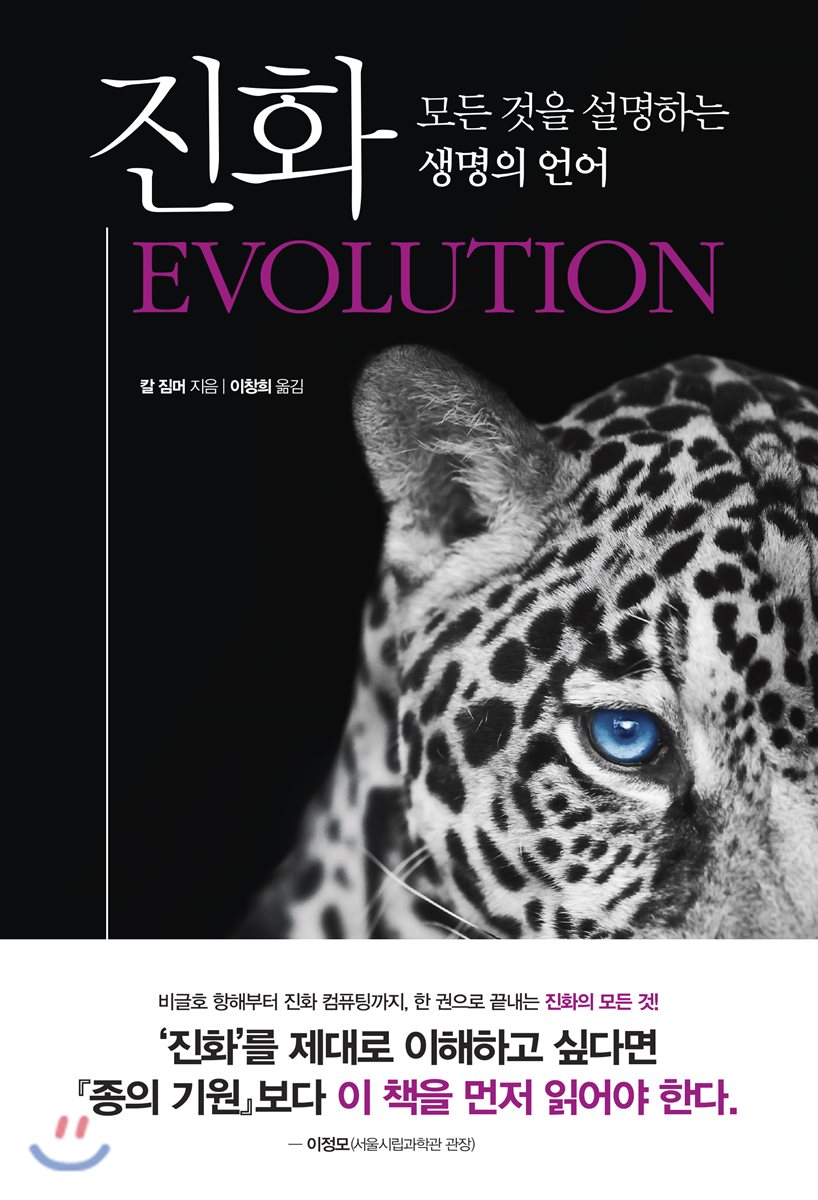
evolution
 |
Description
Book Introduction
The big idea that explains everything,
The ultimate science textbook covering everything about evolution.
"Evolution: The Language of Life That Explains Everything" focuses on the idea of "evolution," which, along with Copernicus' cosmology in the 16th century and Newton's physics in the 17th century, changed the course of history and broadened humanity's intellectual horizons.
Author Carl Zimmer does not get bogged down in specific topics or issues, but instead comprehensively covers the history of evolution, its core concepts and principles, and related issues in one volume.
This book is a superb educational resource that comprehensively explores why the idea of "evolution" is so important and powerful, and how it offers limitless explanatory power for the wondrous phenomena of nature and humanity.
The ultimate science textbook covering everything about evolution.
"Evolution: The Language of Life That Explains Everything" focuses on the idea of "evolution," which, along with Copernicus' cosmology in the 16th century and Newton's physics in the 17th century, changed the course of history and broadened humanity's intellectual horizons.
Author Carl Zimmer does not get bogged down in specific topics or issues, but instead comprehensively covers the history of evolution, its core concepts and principles, and related issues in one volume.
This book is a superb educational resource that comprehensively explores why the idea of "evolution" is so important and powerful, and how it offers limitless explanatory power for the wondrous phenomena of nature and humanity.
- You can preview some of the book's contents.
Preview
index
Preface by Stephen Jay Gould, 7
Enteringㆍ18
Part 1: A Long-Awaited Victory
Chapter 1: Darwin and the Beagleㆍ38
Chapter 2: Like a Confession to Murder: The Origin of the Origin of Speciesㆍ71
Chapter 3: In Search of the Distant Past: Dating the History of Lifeㆍ111
Chapter 4: A Look Inside Change: Genes, Natural Selection, and Evolutionㆍ131
Part 2: Creation and Destruction
Chapter 5: In Search of the Roots of the Tree of Life: From the Dawn of Life to the Age of Microbesㆍ170
Chapter 6: The Accidental Toolbox: Opportunities and Constraints in Animal Evolutionㆍ190
Chapter 7: Extinction: How Organisms Disappear and Reappearㆍ228
Part 3: The Dance of Evolution
Chapter 8: Coevolution: Weaving the Web of Lifeㆍ294
Chapter 9: Doctor Darwin: Disease in the Age of Evolutionary Medicineㆍ326
Chapter 10: The Logic of Affection: The Evolution of Sexualityㆍ350
Part 4: The Position of Humanity in Evolution and the Position of Evolution in Humanity
Chapter 11: The Chatty Monkey: The Social Roots of Human Evolutionㆍ394
Chapter 12 Life 50,000 Years Ago: The Dawn of Modern Manㆍ446
Chapter 13: On Godㆍ471
Acknowledgmentsㆍ519
Translator's Noteㆍ523
Referencesㆍ530
Enteringㆍ18
Part 1: A Long-Awaited Victory
Chapter 1: Darwin and the Beagleㆍ38
Chapter 2: Like a Confession to Murder: The Origin of the Origin of Speciesㆍ71
Chapter 3: In Search of the Distant Past: Dating the History of Lifeㆍ111
Chapter 4: A Look Inside Change: Genes, Natural Selection, and Evolutionㆍ131
Part 2: Creation and Destruction
Chapter 5: In Search of the Roots of the Tree of Life: From the Dawn of Life to the Age of Microbesㆍ170
Chapter 6: The Accidental Toolbox: Opportunities and Constraints in Animal Evolutionㆍ190
Chapter 7: Extinction: How Organisms Disappear and Reappearㆍ228
Part 3: The Dance of Evolution
Chapter 8: Coevolution: Weaving the Web of Lifeㆍ294
Chapter 9: Doctor Darwin: Disease in the Age of Evolutionary Medicineㆍ326
Chapter 10: The Logic of Affection: The Evolution of Sexualityㆍ350
Part 4: The Position of Humanity in Evolution and the Position of Evolution in Humanity
Chapter 11: The Chatty Monkey: The Social Roots of Human Evolutionㆍ394
Chapter 12 Life 50,000 Years Ago: The Dawn of Modern Manㆍ446
Chapter 13: On Godㆍ471
Acknowledgmentsㆍ519
Translator's Noteㆍ523
Referencesㆍ530
Detailed image

Into the book
There have been many scientific discoveries that have shaken humanity, which lived comfortably in certainty, but none have shaken it as deeply as Darwin's theory of evolution.
The only things that can challenge this are the discoveries of Copernicus and Galileo.
They removed the Earth from the center of the universe and relegated it to the status of a peripheral planet orbiting the sun.
But while their discoveries only changed our concept of where we live, Darwin's theory revolutionized our view of the meaning and nature of human beings.
--- p.11
The true irony of The Origin of Species is that it was not until the 20th century that its true value was truly recognized.
Only then could paleontologists and geologists compile a chronology of the Earth.
Only then did biologists begin to identify the molecules behind heredity and natural selection.
Only then did scientists truly begin to understand the power of evolution in shaping everything on Earth, from cold viruses to the human brain.
--- p.110
It's easy to pretend that humans are the ultimate victors of evolution, that they have taken over the Earth through their own efforts, using their superior intelligence.
But whatever success we have achieved, what we enjoy today is a balance achieved through the co-evolution of humans, plants, animals, fungi, protozoa, bacteria, and other things that have co-evolved with us.
Humans are the most coevolved species that has ever existed, and we rely more on the web of life than any other species.
--- p.325
The history of life is linked to these significant moments.
That point is like the poles stuck in the downhill course of Alpine skiing.
Any theory of the evolution of life must follow the course of Paul's cycle.
Rocks in southwest Greenland show that life existed on Earth as early as 3.85 billion years ago.
Rocks in South Africa's Karoo Desert show that nearly all species went extinct 250 million years ago.
The Chauvet Cave paintings reveal events as epochal as these in the history of life.
At this point, our ancestors leaped into the world of art, symbols, complex tools, and culture—the things that set us apart from other animals and made us human.
The only things that can challenge this are the discoveries of Copernicus and Galileo.
They removed the Earth from the center of the universe and relegated it to the status of a peripheral planet orbiting the sun.
But while their discoveries only changed our concept of where we live, Darwin's theory revolutionized our view of the meaning and nature of human beings.
--- p.11
The true irony of The Origin of Species is that it was not until the 20th century that its true value was truly recognized.
Only then could paleontologists and geologists compile a chronology of the Earth.
Only then did biologists begin to identify the molecules behind heredity and natural selection.
Only then did scientists truly begin to understand the power of evolution in shaping everything on Earth, from cold viruses to the human brain.
--- p.110
It's easy to pretend that humans are the ultimate victors of evolution, that they have taken over the Earth through their own efforts, using their superior intelligence.
But whatever success we have achieved, what we enjoy today is a balance achieved through the co-evolution of humans, plants, animals, fungi, protozoa, bacteria, and other things that have co-evolved with us.
Humans are the most coevolved species that has ever existed, and we rely more on the web of life than any other species.
--- p.325
The history of life is linked to these significant moments.
That point is like the poles stuck in the downhill course of Alpine skiing.
Any theory of the evolution of life must follow the course of Paul's cycle.
Rocks in southwest Greenland show that life existed on Earth as early as 3.85 billion years ago.
Rocks in South Africa's Karoo Desert show that nearly all species went extinct 250 million years ago.
The Chauvet Cave paintings reveal events as epochal as these in the history of life.
At this point, our ancestors leaped into the world of art, symbols, complex tools, and culture—the things that set us apart from other animals and made us human.
--- p.448
Publisher's Review
The most complete "evolution" book, encompassing concepts, theories, history, and issues.
Few scientific terms are as commonly used in everyday life as ‘evolution.’
It is often mentioned as a metaphor for positive change, such as progress and improvement.
It is also often used as a prefix for recently popular convergence fields of study, such as 'evolutionary' economics, 'evolutionary' psychology, 'evolutionary' medicine, and 'evolutionary' computing.
Along with the creation science debate, the word 'evolution' appears frequently in the news.
But in reality, ‘evolution’ as a science is incredibly unfamiliar.
Evolution theory occupies a small portion of the curriculum, making it difficult to access unless you are a specialist.
Even if you open a biology textbook or a classic like "The Origin of Species" out of personal curiosity, you are likely to be frustrated by the high difficulty level.
Most evolution-related textbooks on the market focus on specific topics or issues, leaving it up to the reader to systematically organize the knowledge acquired sporadically.
"Evolution: The Language of Life That Explains Everything" is a comprehensive science textbook that covers everything about evolution, from the history of evolution theory to its core concepts and principles, rich research cases, and various episodes centered on people. It serves as an excellent bridge between popular and specialized books.
Written by Carl Zimmer, a well-known science writer in Korea for his works such as 『Parasite Empire』 and 『Virus Planet』, and with the advice of world-renowned scientists such as Stephen Jay Gould, Jane Goodall, Steven Pinker, and Robin Dunbar, this book is equipped with a solid plot, rich storytelling, and specific and rigorous scientific knowledge.
Named a "Best Science Book" by Discover and New Scientist, Evolution has been recognized for its excellence. Revised in 2006 to reflect Carl Zimmer's introduction and new research, it will serve as an excellent introduction for anyone seeking to understand evolution as a science.
Evolution: Standing tall with a new frame for viewing the world
After returning from the Beagle voyage in 1836, Darwin began to draw a family tree of branching species based on the geological, paleontological, and ecological evidence he had collected.
And Darwin's "Origin of Species," which he shyly published in 1859 "as if confessing to murder," caused such a stir that all 1,250 copies of the first edition sold out on the first day.
His theory of natural selection both fascinated and angered people with its superior explanatory power that surpassed religious worldviews.
But today's theory of evolution is not limited to Darwin's mechanism of natural selection.
This book provides a fascinating account of how Darwin's ideas successfully overcame the problems of the age of the Earth and the inheritance of traits, and were reborn as a "modern synthesis."
In the process, readers can meet various people who laid the foundation for modern evolutionary research, including Thomas Huxley, “Darwin’s bulldog,” who led the way in spreading Darwin’s theory of evolution and did not hesitate to debate, William Thomson, who caused Darwin to have a mental breakdown over the age of the Earth, Gregor Mendel, who discovered the laws of heredity, Theodosius Dobzhansky, who explained the diversity of species genetically, George Simpson, who successfully supported Darwin’s claims with fossil research, and the Grants, who stayed on the island for 44 years and witnessed the evolution of Galapagos finches.
Evolutionary insights that elegantly explain the diversity of life and the wonders of nature.
When and how did life begin? What is a species, and how do new species arise? What role has mass extinction played in the history of life? People have sought answers to these questions in the will and purpose of some supreme being.
William Paley, a representative British priest, argued that just as one naturally thinks of the maker of a watch that has fallen on the street, living things that are much more sophisticated than a watch are naturally the creations of God.
But evolution has amply demonstrated that it can explain the diversity of life and the wonders of nature without the control of a transcendent being like God.
In particular, with the emergence of the concepts of coevolution and sexual selection in addition to natural selection, the insight into evolution deepened.
Coevolution has broken down the pyramid with humans at the top and redrawn the picture of the ecosystem as a web of closely interacting relationships.
Sexual selection has brilliantly solved nature's mysteries, from the peacock's flamboyant plumage and the rooster's large red crest to infanticide and altruism, all driven by the desire to spread one's genes.
In addition, the core concepts and main principles of evolution are introduced in an easy-to-understand manner in this book with various examples.
The power of evolution that solved the mystery of human origins and liberated human existence from metaphysical teleology.
Human origins are one of the most exciting areas of evolutionary science.
Fortunately, our ancestors left behind many traces, including not only bone fossils but also clothing, tools, and art.
The most popular hypothesis today is that modern humans (Homo sapiens) first appeared in Africa 200,000 years ago and, with their superior mental abilities, won the competition with Neanderthals and Homo erectus, coming to dominate the world.
Evolutionary thinking also offers new perspectives on the origins of language, mind, and society.
However, some religions do not accept evolution even today, believing that it denies the existence of God and the special status of humans.
At the end of the book, the author discusses in detail the debate between evolution and creationism in the United States.
Since our country is also not free from the evolution-creationism debate, this book provides us with many insights.
In just the past few years, there has been controversy over the almost opening of a creation science class at a prominent university in the country and the appointment of a candidate with a history of activities in the Creation Science Society as the minister of a government ministry with the authority to manage the research and development (R&D) budget.
Recently, a foreign news article that distorted the results of paleoanthropological research was translated verbatim and spread under the headline, “The theory of evolution has lost its basis,” causing quite a stir.
In this context, this book provides an intellectual foundation for deeply considering the desirable relationship between science and religion today.
Few scientific terms are as commonly used in everyday life as ‘evolution.’
It is often mentioned as a metaphor for positive change, such as progress and improvement.
It is also often used as a prefix for recently popular convergence fields of study, such as 'evolutionary' economics, 'evolutionary' psychology, 'evolutionary' medicine, and 'evolutionary' computing.
Along with the creation science debate, the word 'evolution' appears frequently in the news.
But in reality, ‘evolution’ as a science is incredibly unfamiliar.
Evolution theory occupies a small portion of the curriculum, making it difficult to access unless you are a specialist.
Even if you open a biology textbook or a classic like "The Origin of Species" out of personal curiosity, you are likely to be frustrated by the high difficulty level.
Most evolution-related textbooks on the market focus on specific topics or issues, leaving it up to the reader to systematically organize the knowledge acquired sporadically.
"Evolution: The Language of Life That Explains Everything" is a comprehensive science textbook that covers everything about evolution, from the history of evolution theory to its core concepts and principles, rich research cases, and various episodes centered on people. It serves as an excellent bridge between popular and specialized books.
Written by Carl Zimmer, a well-known science writer in Korea for his works such as 『Parasite Empire』 and 『Virus Planet』, and with the advice of world-renowned scientists such as Stephen Jay Gould, Jane Goodall, Steven Pinker, and Robin Dunbar, this book is equipped with a solid plot, rich storytelling, and specific and rigorous scientific knowledge.
Named a "Best Science Book" by Discover and New Scientist, Evolution has been recognized for its excellence. Revised in 2006 to reflect Carl Zimmer's introduction and new research, it will serve as an excellent introduction for anyone seeking to understand evolution as a science.
Evolution: Standing tall with a new frame for viewing the world
After returning from the Beagle voyage in 1836, Darwin began to draw a family tree of branching species based on the geological, paleontological, and ecological evidence he had collected.
And Darwin's "Origin of Species," which he shyly published in 1859 "as if confessing to murder," caused such a stir that all 1,250 copies of the first edition sold out on the first day.
His theory of natural selection both fascinated and angered people with its superior explanatory power that surpassed religious worldviews.
But today's theory of evolution is not limited to Darwin's mechanism of natural selection.
This book provides a fascinating account of how Darwin's ideas successfully overcame the problems of the age of the Earth and the inheritance of traits, and were reborn as a "modern synthesis."
In the process, readers can meet various people who laid the foundation for modern evolutionary research, including Thomas Huxley, “Darwin’s bulldog,” who led the way in spreading Darwin’s theory of evolution and did not hesitate to debate, William Thomson, who caused Darwin to have a mental breakdown over the age of the Earth, Gregor Mendel, who discovered the laws of heredity, Theodosius Dobzhansky, who explained the diversity of species genetically, George Simpson, who successfully supported Darwin’s claims with fossil research, and the Grants, who stayed on the island for 44 years and witnessed the evolution of Galapagos finches.
Evolutionary insights that elegantly explain the diversity of life and the wonders of nature.
When and how did life begin? What is a species, and how do new species arise? What role has mass extinction played in the history of life? People have sought answers to these questions in the will and purpose of some supreme being.
William Paley, a representative British priest, argued that just as one naturally thinks of the maker of a watch that has fallen on the street, living things that are much more sophisticated than a watch are naturally the creations of God.
But evolution has amply demonstrated that it can explain the diversity of life and the wonders of nature without the control of a transcendent being like God.
In particular, with the emergence of the concepts of coevolution and sexual selection in addition to natural selection, the insight into evolution deepened.
Coevolution has broken down the pyramid with humans at the top and redrawn the picture of the ecosystem as a web of closely interacting relationships.
Sexual selection has brilliantly solved nature's mysteries, from the peacock's flamboyant plumage and the rooster's large red crest to infanticide and altruism, all driven by the desire to spread one's genes.
In addition, the core concepts and main principles of evolution are introduced in an easy-to-understand manner in this book with various examples.
The power of evolution that solved the mystery of human origins and liberated human existence from metaphysical teleology.
Human origins are one of the most exciting areas of evolutionary science.
Fortunately, our ancestors left behind many traces, including not only bone fossils but also clothing, tools, and art.
The most popular hypothesis today is that modern humans (Homo sapiens) first appeared in Africa 200,000 years ago and, with their superior mental abilities, won the competition with Neanderthals and Homo erectus, coming to dominate the world.
Evolutionary thinking also offers new perspectives on the origins of language, mind, and society.
However, some religions do not accept evolution even today, believing that it denies the existence of God and the special status of humans.
At the end of the book, the author discusses in detail the debate between evolution and creationism in the United States.
Since our country is also not free from the evolution-creationism debate, this book provides us with many insights.
In just the past few years, there has been controversy over the almost opening of a creation science class at a prominent university in the country and the appointment of a candidate with a history of activities in the Creation Science Society as the minister of a government ministry with the authority to manage the research and development (R&D) budget.
Recently, a foreign news article that distorted the results of paleoanthropological research was translated verbatim and spread under the headline, “The theory of evolution has lost its basis,” causing quite a stir.
In this context, this book provides an intellectual foundation for deeply considering the desirable relationship between science and religion today.
GOODS SPECIFICS
- Date of publication: September 14, 2018
- Format: Hardcover book binding method guide
- Page count, weight, size: 552 pages | 828g | 152*225*35mm
- ISBN13: 9788901226484
- ISBN10: 8901226480
You may also like
카테고리
korean


korean

![ELLE 엘르 스페셜 에디션 A형 : 12월 [2025]](http://librairie.coreenne.fr/cdn/shop/files/b8e27a3de6c9538896439686c6b0e8fb.jpg?v=1766436872&width=3840)


