

Cosmic Connection
 |
Description
Book Introduction
Scientists who resemble the universe
Carl Sagan's Dream and Vision,
A scientific classic that condenses his science and insights.
2018 may go down in history as a year of leap forward in human space exploration and development.
First, on February 6, the Falcon Heavy, a massive rocket developed by Elon Musk's SpaceX, was successfully launched.
Technology has been developed to send more weight into space more cheaply.
Also, NASA launched the Transiting Exoplanet Survey Satellite (TESS) on April 18, the Mars Geophysical Exploration Lander InSight on May 5, and the Parker Solar Probe, humanity's first solar probe, on August 12.
Not only the United States, but also Europe, China, and Japan are pursuing plans to explore the moon, asteroids, and Mars.
Mars is the biggest focus of space exploration and development, emerging from decades of stagnation since the end of the Cold War.
The Falcon Heavy launch prepares for a crewed Mars mission in 2024, and InSight and other Mars landers will search for definitive evidence of life on Mars.
The era of Mars exploration has begun.
The 'Martian boom' is being revived after 100 years since the 1910s, when science fiction novels set on Mars, such as 'A Princess of Mars' by Edgar Rice Burroughs, the novelist who created Tarzan, became bestsellers and Percival Lowell's 'Martian Canal Hypothesis' was featured in the headlines.
In the form of science, not 'science fiction'.
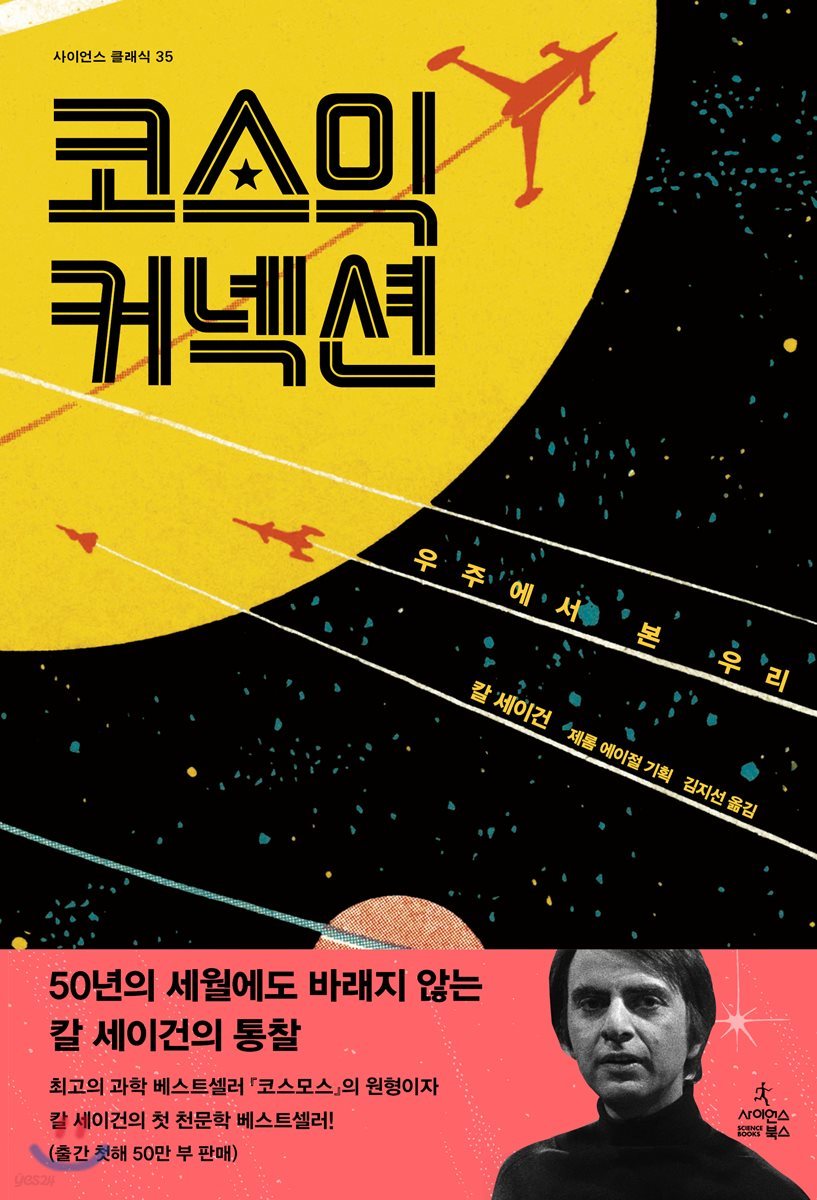
『Carl Sagan's Cosmic Connection: A Extraterrestrial Perspective』, recently published by Science Books, is a book by Carl Edward Sagan (November 9, 1934 - December 20, 1996), a scientist who truly loved Mars.
First published in 1973, this book sold 500,000 copies in its first year, establishing Carl Sagan as a best-selling author. It is his first popular science book, and is the prototype for Cosmos, which has reigned as the best popular science content since the latter half of the 20th century through publication and television documentaries.
Carl Sagan's Dream and Vision,
A scientific classic that condenses his science and insights.
2018 may go down in history as a year of leap forward in human space exploration and development.
First, on February 6, the Falcon Heavy, a massive rocket developed by Elon Musk's SpaceX, was successfully launched.
Technology has been developed to send more weight into space more cheaply.
Also, NASA launched the Transiting Exoplanet Survey Satellite (TESS) on April 18, the Mars Geophysical Exploration Lander InSight on May 5, and the Parker Solar Probe, humanity's first solar probe, on August 12.
Not only the United States, but also Europe, China, and Japan are pursuing plans to explore the moon, asteroids, and Mars.
Mars is the biggest focus of space exploration and development, emerging from decades of stagnation since the end of the Cold War.
The Falcon Heavy launch prepares for a crewed Mars mission in 2024, and InSight and other Mars landers will search for definitive evidence of life on Mars.
The era of Mars exploration has begun.
The 'Martian boom' is being revived after 100 years since the 1910s, when science fiction novels set on Mars, such as 'A Princess of Mars' by Edgar Rice Burroughs, the novelist who created Tarzan, became bestsellers and Percival Lowell's 'Martian Canal Hypothesis' was featured in the headlines.
In the form of science, not 'science fiction'.
『Carl Sagan's Cosmic Connection: A Extraterrestrial Perspective』, recently published by Science Books, is a book by Carl Edward Sagan (November 9, 1934 - December 20, 1996), a scientist who truly loved Mars.
First published in 1973, this book sold 500,000 copies in its first year, establishing Carl Sagan as a best-selling author. It is his first popular science book, and is the prototype for Cosmos, which has reigned as the best popular science content since the latter half of the 20th century through publication and television documentaries.
- You can preview some of the book's contents.
Preview
index
Preface 1 A Monument to the Great Man Who Changed Our View of the Universe (Freeman Dyson) … 7
Preface 2: Carl Sagan (Ann Druyan), the scientist who redefined sacredness… 13
Starting the book… 29
Part 1 In Space
Chapter 1: Transitional Animals… 41
Chapter 2: The Unicorn of Cetus… 51
Chapter 3: Message from Earth… 63
Chapter 4: A Message to Earth… 71
Chapter 5: The Utopian Experiment… 87
Chapter 6: Chauvinism … 95
Chapter 7: Space Exploration as a Human Adventure 1: Scientific Interests … 109
Chapter 8: Space Exploration as a Human Adventure 2: Public Interest… 121
Chapter 9: Space Exploration as a Human Adventure 3: Historical Interest … 133
Part 2 In the Solar System
Chapter 10: Teaching First Graders … 143
Chapter 11: "The Ancient and Legendary Gods" … 149
Chapter 12 Venus Mystery Novel… 155
Chapter 13: Venus is Hell… 165
Chapter 14: Science and 'Information' … 175
Chapter 15: The Two Months of Barsoom… 183
Chapter 16: Mountains of Mars 1: Observations from Earth… 203
Chapter 17: Mountains of Mars 2: Observations from Space… 213
Chapter 18: The Canals of Mars… 223
Chapter 19: Lost Photos of Mars… 233
Chapter 20: The Ice Age and the Cauldron… 241
Chapter 21: The Beginning and End of the Earth… 247
Chapter 22: Terraforming… 253
Chapter 23: Exploration and Exploration of the Solar System… 263
Part 3 Beyond the Solar System
Chapter 24: The Dolphin is My Friend… 279
Chapter 25: The Making of Kubrick's "2001" … 299
Chapter 26: Cosmic Connections … 305
Chapter 27: Alien Life, Now Is the Time! … 313
Chapter 28: Have Aliens Ever Visited Earth? … 325
Chapter 29: Extraterrestrial Intelligence Search Strategies… 337
Chapter 30: If Success Comes... 345
Chapter 31: Communication Cables, Books, and Conch Shells… 355
Chapter 32: Night Train to the Stars… 363
Chapter 33: Astronomical Engineering… 367
Chapter 34: The Twenty Questions Game to Find Space Civilizations… 373
Chapter 35: Galactic Cultural Exchange… 381
Chapter 36: A Path to Another Time… 387
Chapter 37: The Star People 1: Myths … 395
Chapter 38: The Star People 2: The Future… 405
Chapter 39: Star People 3: The Cosmic Cheshire Cat… 415
About this book (David Morrison) … 423
Search … 461
Preface 2: Carl Sagan (Ann Druyan), the scientist who redefined sacredness… 13
Starting the book… 29
Part 1 In Space
Chapter 1: Transitional Animals… 41
Chapter 2: The Unicorn of Cetus… 51
Chapter 3: Message from Earth… 63
Chapter 4: A Message to Earth… 71
Chapter 5: The Utopian Experiment… 87
Chapter 6: Chauvinism … 95
Chapter 7: Space Exploration as a Human Adventure 1: Scientific Interests … 109
Chapter 8: Space Exploration as a Human Adventure 2: Public Interest… 121
Chapter 9: Space Exploration as a Human Adventure 3: Historical Interest … 133
Part 2 In the Solar System
Chapter 10: Teaching First Graders … 143
Chapter 11: "The Ancient and Legendary Gods" … 149
Chapter 12 Venus Mystery Novel… 155
Chapter 13: Venus is Hell… 165
Chapter 14: Science and 'Information' … 175
Chapter 15: The Two Months of Barsoom… 183
Chapter 16: Mountains of Mars 1: Observations from Earth… 203
Chapter 17: Mountains of Mars 2: Observations from Space… 213
Chapter 18: The Canals of Mars… 223
Chapter 19: Lost Photos of Mars… 233
Chapter 20: The Ice Age and the Cauldron… 241
Chapter 21: The Beginning and End of the Earth… 247
Chapter 22: Terraforming… 253
Chapter 23: Exploration and Exploration of the Solar System… 263
Part 3 Beyond the Solar System
Chapter 24: The Dolphin is My Friend… 279
Chapter 25: The Making of Kubrick's "2001" … 299
Chapter 26: Cosmic Connections … 305
Chapter 27: Alien Life, Now Is the Time! … 313
Chapter 28: Have Aliens Ever Visited Earth? … 325
Chapter 29: Extraterrestrial Intelligence Search Strategies… 337
Chapter 30: If Success Comes... 345
Chapter 31: Communication Cables, Books, and Conch Shells… 355
Chapter 32: Night Train to the Stars… 363
Chapter 33: Astronomical Engineering… 367
Chapter 34: The Twenty Questions Game to Find Space Civilizations… 373
Chapter 35: Galactic Cultural Exchange… 381
Chapter 36: A Path to Another Time… 387
Chapter 37: The Star People 1: Myths … 395
Chapter 38: The Star People 2: The Future… 405
Chapter 39: Star People 3: The Cosmic Cheshire Cat… 415
About this book (David Morrison) … 423
Search … 461
Publisher's Review
Carl Sagan's insights remain undiminished after 50 years.
The prototype of the best science bestseller, Cosmos
Carl Sagan's first astronomy bestseller!
This book exemplifies the exemplary format of a science textbook.
It perfectly incorporates the elements of a good science book: it introduces the new worldview that modern astronomy and space exploration would bring, or the insights about humans and the Earth, mixed with the (then) cutting-edge scientific achievements of the Pioneer and Mariner programs, in which Carl Sagan himself participated in the early 1970s, and uses this as a basis for public persuasion of the need for public, social, and public support for the (then) futuristic research of the search for extraterrestrial life or intelligence.
Marshall McLuhan, Isaac Asimov, R.
Jerome B. Azell, author and publisher, has written or produced over 50 books, collaborating with bestselling authors such as Buckminster Fuller and Stanley Kubrick.
This book, planned and produced by Agel, is also the book that brought Carl Sagan out of the ivory tower of academia and into the publishing market for general readers.
Before the publication of "Cosmic Connection," Carl Sagan was a theoretical astronomer who had published only research papers in the field of astrobiology, which he was pioneering, translations of works by (former) Soviet scholars, and collections of papers documenting UFO-related controversies.
However, this book, published at the suggestion of Azel, who planned and produced Marshall McLuhan's "Media is Massage," which shocked readers at the time with its modern editorial design and message and is now considered a classic of modern media theory, sold 500,000 copies in its first year alone, surpassing all sales of popular science books up to that time, and turning Carl Sagan into a big-name author in the publishing world who signed a publishing contract for a sum in the million dollar range.
The renowned science fiction writer Isaac Asimov wrote to Sagan that after reading The Cosmic Connection, he “loved every word of it.”
Carl Sagan highly praised the “honest” writing of scientists.
Throughout this book, you can see the themes and formats that became the prototype for 『Cosmos』, which was published seven years later.
Fans of Carl Sagan will find this book, translated into Korean for the first time, particularly fascinating, as it explores the evolution of his "cosmic" thinking and the writing style that Isaac Asimov described as "like hearing Sagan's voice directly."
Since its first publication in 1973, Cosmic Connection has been published in various editions, including extended hardcover and paperback, around the world.
This book, published by Science Books, Inc., is based on the edition published by Cambridge University Press in 2000 during Jerome Azel's later years.
For the 2000 edition, Jerome Azel included essays by legendary theoretical physicist Freeman Dyson, Carl Sagan's widow Ann Druyan, and Sagan's first PhD student David Morrison, to shed light on the circumstances surrounding the book's publication and why Sagan's message remains relevant after 50 years.
In particular, David Morrison provides an overview of the achievements in astronomy and space exploration over the 30 years since the first publication of this book.
In addition, it is fun to see all of the illustrations that Carl Sagan carefully selected when writing this book, as well as the illustrations from the first edition by John Romberg, a pioneer in space illustration who participated as an art director in various science content production projects of Carl Sagan and was in charge of the illustrations in the first edition.
Carl Sagan's writing philosophy and sensibility, which emphasized the organic fusion of images and text, can be seen throughout the book.
Last but not least, Carl Sagan's message remains undiminished even after nearly 50 years.
Throughout this book, Carl Sagan emphasizes that the era he and we live in is very unique.
“For some generations, the planets they saw in their youth were points of light so far away they could not even imagine.
And the moon was a symbol of what could not be obtained.
When they reached middle age, they saw their contemporaries walking on the moon.
Perhaps when we grow old, we will see wanderers wandering the sandy surface of Mars, and the rugged surface of Phobos watching their footsteps.
In the 10 million years of human history, only one generation has ever experienced such a change.
That generation is us.”
Carl Sagan recommends that this “Cosmos Generation,” who shared an era of change in cosmology that would not have occurred even if they had been born 50 years earlier or 50 years later, reflect on their perspectives on humans, society, planet Earth, and the universe from a “cosmic perspective.”
Sagan's core message is that if we reflect from a cosmic perspective, we will be able to say goodbye to "chauvinism," which has been called nationalism, tribalism, statism, and elitism since time immemorial.
This book also allows us to confirm the starting point and core ideas of academic fields founded or pioneered by Carl Sagan, such as solar system planetary science, exoplanet exploration, astrobiology, and the search for extraterrestrial intelligence (SETI), which are major trends in modern astronomy.
Some of Carl Sagan's predictions, outlooks, and prophecies came true, while others were discarded.
Science advances by building on countless discarded predictions.
In fact, Carl Sagan, who was a true believer in life on Mars, passed away without ever seeing a single piece of evidence of life on Mars.
In introducing the exploration plans for Venus and Mars that were underway around the time of the publication of this book, Carl Sagan candidly shows how his hypothesis about extraterrestrial life was shattered in the face of experimentation.
And while calmly acknowledging that fact, we encourage new research by establishing new hypotheses and theories to find possibilities that have not yet completely disappeared.
This book tells the story of a scientist who never abandoned his childhood belief in the existence of extraterrestrial life, but who never allowed that belief to taint his science.
Winner of the John Campbell Memorial Award for the best science book!
First domestic translation!
This book is divided into 3 parts and 39 chapters.
Part 1, "From Space," introduces Carl Sagan's cosmic perspective.
It tells us how “transitional animals” we are, “living on a tiny lump of rock and metal orbiting one of the 250 billion stars that make up our galaxy in a universe of billions of galaxies.”
It also introduces the impact on society of the Pioneer 10 gold plaque, the first extraterrestrial message to record the location of the Earth and the existence of humans living on Earth, and explains how the constellations in the sky seen from Earth would look from Tau Ceti using the first computerized space map developed at the time. It also analyzes the scientific, humanistic, and historical implications of space exploration.
Part 2, “In the Solar System,” introduces the various achievements in solar planetary science achieved through space exploration at the time.
Anecdotes from the early golden age of planetary science, when it was just being discovered that Venus's atmosphere was composed of sulfuric acid, when television cameras were being used to film the Martian moons Phobos and Deimos and visually analyze them, and when it was discovered that Percival Lowell's Martian canals were actually canyons larger than the American continent, are vividly introduced through the eyes and voices of participants and eyewitnesses.
As a theoretical astronomer, Sagan also illustrates how science works by showing in detail how various hypotheses about planets in the solar system, such as Venus and Mars, were rejected and confirmed by actual experiments conducted by space probes.
Of course, some of these theories that are being discarded or proven are Sagan's own, which allows us to see Carl Sagan's true nature as a scientist.
Part 3, “Beyond the Solar System,” explores topics such as extraterrestrial intelligence, extraterrestrial civilizations, and humanity as a “star people.”
Here we see one of Carl Sagan's key theories: that if extraterrestrial intelligence exists and has developed a technological civilization, it will somehow be able to communicate with humanity, and that such communication will advance human civilization to a new level.
It also systematically organizes various controversies surrounding extraterrestrial intelligence, and clearly confirms Carl Sagan's position on these controversies.
And the trilogy "The Star People" (chapters 37-39), which concludes this third part, beautifully outlines the outlines of modern astrophysics and cosmology, which have become modern creation myths.
It is also a place where you can see the prototype of Sagan's ideas that are grandly displayed in 『Cosmos』.
2018 is also the year of the 'Great Mars Conjunction', when the distance between Mars and Earth will be about 57 million kilometers, the closest in 15 years.
In 2018, when the distance between Mars and Earth, which is usually 100 million kilometers and sometimes over 500 million kilometers away, was the closest, humanity declared the start of Mars exploration.
At the root of this massive exploration was the science and thought of Carl Sagan.
Carl Sagan concludes Chapter 38, discussing the life and death of stars:
“Stars create the cradle of planetary life as they are born, and as they live, they provide the energy upon which life depends.
And even as they die, they create materials and tools for other life to continue to develop elsewhere in the galaxy.
If there are intelligent beings on the planets of dying stars who cannot escape their fate, they may find some solace in the thought that while the death of their star may bring extinction for them, it will also serve as a catalyst for the continued biological progress of star peoples on millions of other worlds.”
The late Carl Sagan, like dying stars, became the “fertilizer” for new scientific advances.
In this classic science book, "Cosmic Connection," which encapsulates the dreams and vision of Carl Sagan, a scientist who resembles the universe, as well as his science and insights, you will be able to see what kind of foundation he left behind.
We might be what Carl Sagan dreamed we would one day become.
A being that is conscious, wise, empathetic, passionately curious, eternally skeptical, unyielding to manipulation and threats from the powerful, and unbound by the walls that imprison and divide us.
A being who marvels at the beauty of the ever-widening horizon of identification, who welcomes its expansion, who is no longer hindered by the old primate hierarchy and instead takes pride in our ability to care for one another, and who realizes how insignificant and insignificant we are within the fabric of nature and space and time.
Long-term thinkers, sensitive to a heightened and profound sense of the divine, who embrace the wonder inherent in this reality and find a profound sense of security, recognizing our responsibility as a link between past and future generations, and who are not at odds with our own self-realization.
As the sword was, a fully alive, fully connected, solid citizen of this planet and universe.
-Ann Druyan (Chairperson of the Carl Sagan Foundation, Carl Sagan's last wife)
This book is a record of failed short-term visions and surviving long-term visions.
It contains a dream a young man had at a specific moment in history.
This book is a monument to a great man who, despite his frustrations and disappointments, ultimately changed the way we see our planet and our view of the universe.
-Freeman Dyson (Professor Emeritus, Institute for Advanced Study, Princeton)
Today, a new science that combines biology, astronomy, and planetary science is called astrobiology.
Once again, we are starting down the path Sagan advocated.
The search for the nature of life on Earth and what life might be like elsewhere in the solar system has begun again.
And this road will continue beyond that.
-David Morrison (astronomer, Ames Research Center)
Carl Sagan is truly an unrivaled master at communicating the breadth and beauty of science to the public.
-Sam Harris (author of The End of Religion)
I just finished reading "Cosmic Connection" and I love every word of it.
You are a good writer.
Because I write in an honest style.
When I read your writing, it was like hearing your voice.
There is one thing that bothers me about this book.
Because this book clearly shows that you are smarter than me.
I don't like that.
-Isaac Asimov (novelist, in a letter to Sagan)
The prototype of the best science bestseller, Cosmos
Carl Sagan's first astronomy bestseller!
This book exemplifies the exemplary format of a science textbook.
It perfectly incorporates the elements of a good science book: it introduces the new worldview that modern astronomy and space exploration would bring, or the insights about humans and the Earth, mixed with the (then) cutting-edge scientific achievements of the Pioneer and Mariner programs, in which Carl Sagan himself participated in the early 1970s, and uses this as a basis for public persuasion of the need for public, social, and public support for the (then) futuristic research of the search for extraterrestrial life or intelligence.
Marshall McLuhan, Isaac Asimov, R.
Jerome B. Azell, author and publisher, has written or produced over 50 books, collaborating with bestselling authors such as Buckminster Fuller and Stanley Kubrick.
This book, planned and produced by Agel, is also the book that brought Carl Sagan out of the ivory tower of academia and into the publishing market for general readers.
Before the publication of "Cosmic Connection," Carl Sagan was a theoretical astronomer who had published only research papers in the field of astrobiology, which he was pioneering, translations of works by (former) Soviet scholars, and collections of papers documenting UFO-related controversies.
However, this book, published at the suggestion of Azel, who planned and produced Marshall McLuhan's "Media is Massage," which shocked readers at the time with its modern editorial design and message and is now considered a classic of modern media theory, sold 500,000 copies in its first year alone, surpassing all sales of popular science books up to that time, and turning Carl Sagan into a big-name author in the publishing world who signed a publishing contract for a sum in the million dollar range.
The renowned science fiction writer Isaac Asimov wrote to Sagan that after reading The Cosmic Connection, he “loved every word of it.”
Carl Sagan highly praised the “honest” writing of scientists.
Throughout this book, you can see the themes and formats that became the prototype for 『Cosmos』, which was published seven years later.
Fans of Carl Sagan will find this book, translated into Korean for the first time, particularly fascinating, as it explores the evolution of his "cosmic" thinking and the writing style that Isaac Asimov described as "like hearing Sagan's voice directly."
Since its first publication in 1973, Cosmic Connection has been published in various editions, including extended hardcover and paperback, around the world.
This book, published by Science Books, Inc., is based on the edition published by Cambridge University Press in 2000 during Jerome Azel's later years.
For the 2000 edition, Jerome Azel included essays by legendary theoretical physicist Freeman Dyson, Carl Sagan's widow Ann Druyan, and Sagan's first PhD student David Morrison, to shed light on the circumstances surrounding the book's publication and why Sagan's message remains relevant after 50 years.
In particular, David Morrison provides an overview of the achievements in astronomy and space exploration over the 30 years since the first publication of this book.
In addition, it is fun to see all of the illustrations that Carl Sagan carefully selected when writing this book, as well as the illustrations from the first edition by John Romberg, a pioneer in space illustration who participated as an art director in various science content production projects of Carl Sagan and was in charge of the illustrations in the first edition.
Carl Sagan's writing philosophy and sensibility, which emphasized the organic fusion of images and text, can be seen throughout the book.
Last but not least, Carl Sagan's message remains undiminished even after nearly 50 years.
Throughout this book, Carl Sagan emphasizes that the era he and we live in is very unique.
“For some generations, the planets they saw in their youth were points of light so far away they could not even imagine.
And the moon was a symbol of what could not be obtained.
When they reached middle age, they saw their contemporaries walking on the moon.
Perhaps when we grow old, we will see wanderers wandering the sandy surface of Mars, and the rugged surface of Phobos watching their footsteps.
In the 10 million years of human history, only one generation has ever experienced such a change.
That generation is us.”
Carl Sagan recommends that this “Cosmos Generation,” who shared an era of change in cosmology that would not have occurred even if they had been born 50 years earlier or 50 years later, reflect on their perspectives on humans, society, planet Earth, and the universe from a “cosmic perspective.”
Sagan's core message is that if we reflect from a cosmic perspective, we will be able to say goodbye to "chauvinism," which has been called nationalism, tribalism, statism, and elitism since time immemorial.
This book also allows us to confirm the starting point and core ideas of academic fields founded or pioneered by Carl Sagan, such as solar system planetary science, exoplanet exploration, astrobiology, and the search for extraterrestrial intelligence (SETI), which are major trends in modern astronomy.
Some of Carl Sagan's predictions, outlooks, and prophecies came true, while others were discarded.
Science advances by building on countless discarded predictions.
In fact, Carl Sagan, who was a true believer in life on Mars, passed away without ever seeing a single piece of evidence of life on Mars.
In introducing the exploration plans for Venus and Mars that were underway around the time of the publication of this book, Carl Sagan candidly shows how his hypothesis about extraterrestrial life was shattered in the face of experimentation.
And while calmly acknowledging that fact, we encourage new research by establishing new hypotheses and theories to find possibilities that have not yet completely disappeared.
This book tells the story of a scientist who never abandoned his childhood belief in the existence of extraterrestrial life, but who never allowed that belief to taint his science.
Winner of the John Campbell Memorial Award for the best science book!
First domestic translation!
This book is divided into 3 parts and 39 chapters.
Part 1, "From Space," introduces Carl Sagan's cosmic perspective.
It tells us how “transitional animals” we are, “living on a tiny lump of rock and metal orbiting one of the 250 billion stars that make up our galaxy in a universe of billions of galaxies.”
It also introduces the impact on society of the Pioneer 10 gold plaque, the first extraterrestrial message to record the location of the Earth and the existence of humans living on Earth, and explains how the constellations in the sky seen from Earth would look from Tau Ceti using the first computerized space map developed at the time. It also analyzes the scientific, humanistic, and historical implications of space exploration.
Part 2, “In the Solar System,” introduces the various achievements in solar planetary science achieved through space exploration at the time.
Anecdotes from the early golden age of planetary science, when it was just being discovered that Venus's atmosphere was composed of sulfuric acid, when television cameras were being used to film the Martian moons Phobos and Deimos and visually analyze them, and when it was discovered that Percival Lowell's Martian canals were actually canyons larger than the American continent, are vividly introduced through the eyes and voices of participants and eyewitnesses.
As a theoretical astronomer, Sagan also illustrates how science works by showing in detail how various hypotheses about planets in the solar system, such as Venus and Mars, were rejected and confirmed by actual experiments conducted by space probes.
Of course, some of these theories that are being discarded or proven are Sagan's own, which allows us to see Carl Sagan's true nature as a scientist.
Part 3, “Beyond the Solar System,” explores topics such as extraterrestrial intelligence, extraterrestrial civilizations, and humanity as a “star people.”
Here we see one of Carl Sagan's key theories: that if extraterrestrial intelligence exists and has developed a technological civilization, it will somehow be able to communicate with humanity, and that such communication will advance human civilization to a new level.
It also systematically organizes various controversies surrounding extraterrestrial intelligence, and clearly confirms Carl Sagan's position on these controversies.
And the trilogy "The Star People" (chapters 37-39), which concludes this third part, beautifully outlines the outlines of modern astrophysics and cosmology, which have become modern creation myths.
It is also a place where you can see the prototype of Sagan's ideas that are grandly displayed in 『Cosmos』.
2018 is also the year of the 'Great Mars Conjunction', when the distance between Mars and Earth will be about 57 million kilometers, the closest in 15 years.
In 2018, when the distance between Mars and Earth, which is usually 100 million kilometers and sometimes over 500 million kilometers away, was the closest, humanity declared the start of Mars exploration.
At the root of this massive exploration was the science and thought of Carl Sagan.
Carl Sagan concludes Chapter 38, discussing the life and death of stars:
“Stars create the cradle of planetary life as they are born, and as they live, they provide the energy upon which life depends.
And even as they die, they create materials and tools for other life to continue to develop elsewhere in the galaxy.
If there are intelligent beings on the planets of dying stars who cannot escape their fate, they may find some solace in the thought that while the death of their star may bring extinction for them, it will also serve as a catalyst for the continued biological progress of star peoples on millions of other worlds.”
The late Carl Sagan, like dying stars, became the “fertilizer” for new scientific advances.
In this classic science book, "Cosmic Connection," which encapsulates the dreams and vision of Carl Sagan, a scientist who resembles the universe, as well as his science and insights, you will be able to see what kind of foundation he left behind.
We might be what Carl Sagan dreamed we would one day become.
A being that is conscious, wise, empathetic, passionately curious, eternally skeptical, unyielding to manipulation and threats from the powerful, and unbound by the walls that imprison and divide us.
A being who marvels at the beauty of the ever-widening horizon of identification, who welcomes its expansion, who is no longer hindered by the old primate hierarchy and instead takes pride in our ability to care for one another, and who realizes how insignificant and insignificant we are within the fabric of nature and space and time.
Long-term thinkers, sensitive to a heightened and profound sense of the divine, who embrace the wonder inherent in this reality and find a profound sense of security, recognizing our responsibility as a link between past and future generations, and who are not at odds with our own self-realization.
As the sword was, a fully alive, fully connected, solid citizen of this planet and universe.
-Ann Druyan (Chairperson of the Carl Sagan Foundation, Carl Sagan's last wife)
This book is a record of failed short-term visions and surviving long-term visions.
It contains a dream a young man had at a specific moment in history.
This book is a monument to a great man who, despite his frustrations and disappointments, ultimately changed the way we see our planet and our view of the universe.
-Freeman Dyson (Professor Emeritus, Institute for Advanced Study, Princeton)
Today, a new science that combines biology, astronomy, and planetary science is called astrobiology.
Once again, we are starting down the path Sagan advocated.
The search for the nature of life on Earth and what life might be like elsewhere in the solar system has begun again.
And this road will continue beyond that.
-David Morrison (astronomer, Ames Research Center)
Carl Sagan is truly an unrivaled master at communicating the breadth and beauty of science to the public.
-Sam Harris (author of The End of Religion)
I just finished reading "Cosmic Connection" and I love every word of it.
You are a good writer.
Because I write in an honest style.
When I read your writing, it was like hearing your voice.
There is one thing that bothers me about this book.
Because this book clearly shows that you are smarter than me.
I don't like that.
-Isaac Asimov (novelist, in a letter to Sagan)
GOODS SPECIFICS
- Date of issue: August 31, 2018
- Format: Hardcover book binding method guide
- Page count, weight, size: 468 pages | 828g | 152*224*30mm
- ISBN13: 9791189198091
- ISBN10: 1189198096
You may also like
카테고리
korean


korean

![ELLE 엘르 스페셜 에디션 A형 : 12월 [2025]](http://librairie.coreenne.fr/cdn/shop/files/b8e27a3de6c9538896439686c6b0e8fb.jpg?v=1766436872&width=3840)


