

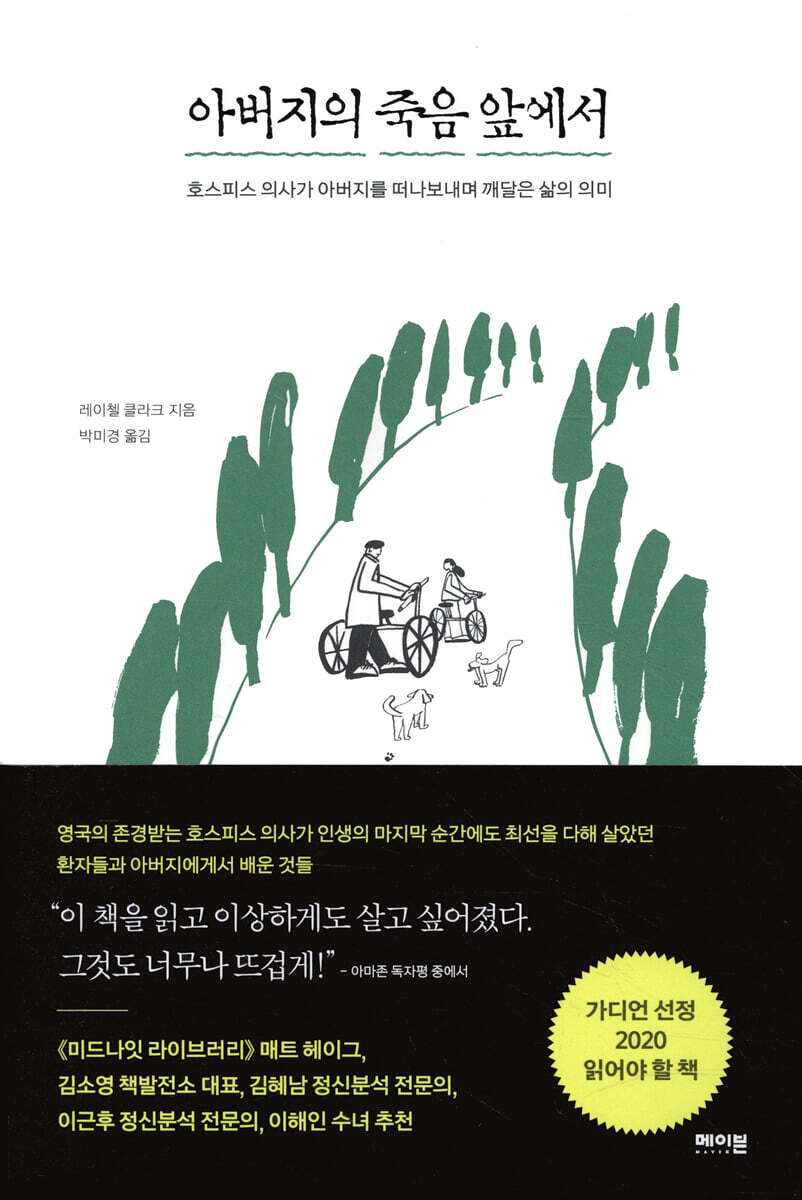
In front of my father's death
 |
Description
Book Introduction
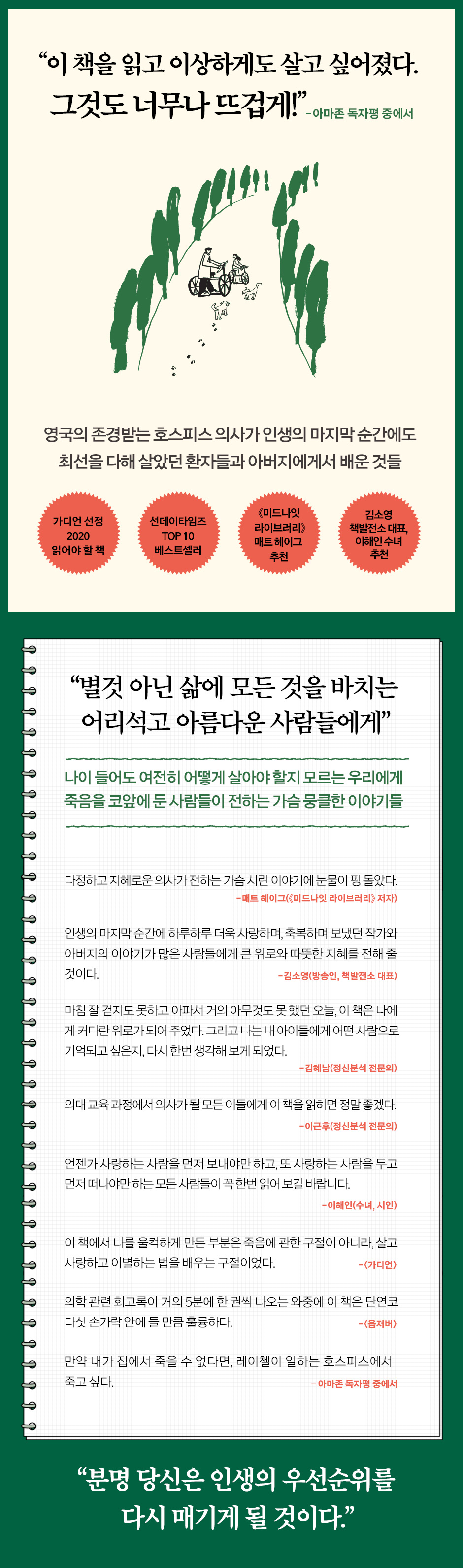
“After reading this book, strangely enough, I wanted to live. And it was so hot!” What a respected British hospice doctor learned from his patients and his father, who lived their best lives even in their final moments. A must-read book of 2020 by The Guardian and a Sunday Times Top 10 bestseller! Recommended by Matt Haig, CEO of Book Power Plant Kim So-young, and Sister Lee Hae-in, author of "Midnight Library" A hospice doctor who prided himself on having learned everything there was to know about living from terminally ill patients finally realized the meaning of life after seeing off his father. People often think that working in hospice is difficult and depressing. But the author answers the exact opposite. Hospices are full of people who are doing their best to live until their last moments. The good qualities of human nature, such as courage, compassion, and love, exist in their most refined form. Michael, who is more worried about his wife suffering from dementia being left alone than about his own aching heart; Dorothy, who says, “Even if I die tomorrow, I’ll play bridge today!” and continues with her daily life until the end; Simon, who struggles to survive until his grandson’s sixth birthday; Arthur, who reveals a secret he has kept for 80 years at the last moment and dies in his most authentic self… Rather, we learn an attitude toward life without regrets from foolish and beautiful people who give everything to a life that is nothing special. Moreover, it movingly conveys the realization that the meaning of love, realized through experiencing the death of one's father firsthand, is the courage to love and dedicate oneself despite the pain of separation, which is our destiny as humans. The Observer praised this book, which is full of heartwarming stories for those of us who still don't know how to live as we age, saying, "In a world where medical memoirs are published at the rate of one every five minutes, this one is definitely one of the top five." The Guardian commented, "The parts of this book that made me cry weren't the passages about death, but the passages about learning how to live, love and say goodbye." It was a Sunday Times Top 10 bestseller, a finalist for the 2020 Costa Biography Award, which evaluates both popularity and literary merit, and was selected as one of the Guardian's must-read books of 2020. |
- You can preview some of the book's contents.
Preview
index
Recommendation
prolog
PART 1 Dying in a Hospital: Stories for a Humane Death
1.
What my father knew but I didn't
-The last moments of two young soldiers
-A very different story about life
-Natural life and death encountered at the neighborhood clinic
It would be no exaggeration to say that I am alive by accident.
2.
What a trivial life
-He died and I lived, just by one second.
-Living in a crazy world where anything can happen at any time
When did the attitude of avoiding death begin?
-Again, on the path to becoming a doctor
3.
What We Lose While Trying to Avoid Death
-When you need affection the most in life
-What ordinary people gradually lose as they become medical students
-The cold and indifferent way in which death is dealt with in hospitals
Questions for a Humane Death
4.
How a life-threatening illness can change your life
What my close encounter with cancer left me with
-What kind of care is needed for a sick person?
-Between life and death, the moment when precious things reveal themselves
-If you have to send someone you love first
5.
There is no such thing as a dramatic revival.
-People who cannot die comfortably even after living their entire lives
-The one truth doctors are reluctant to tell
-The reason our hearts stop is because it's time for us to leave.
-What I realized after killing my first patient
6.
What kind of ending will you prepare?
-What the emergency room and life have in common
-When life starts to deviate from averages and statistics
-People who bet everything on a 1 percent chance
-What kind of ending will you prepare?
PART 2: Facing My Father's Death: Stories for a Life Without Regrets
7.
What kind of story will my life be remembered as?
-“What’s the point of living like this?”
-If you listen to the words of a person facing death
-The reason he revealed the secret he had kept for 80 years at the last moment
-What kind of story will my life be remembered as?
8.
About a day a dying person lives
Why hospice is full of joy
- Even in dark moments, joy exists.
-What makes you waste your precious time?
-Let go of baseless fears and create concrete hopes.
9.
Even if I die tomorrow, I'll play bridge today!
-When you feel like you've reached a dead end
-Life doesn't always go as planned.
-Even if I die tomorrow, I'll play bridge today!
-Don't rashly decide that it's the end while you're alive.
10.
On Wise Giving Up and Good Choices
-About the desperate desire to grab even a straw
The man who only followed the doctor's instructions made his final choice.
-Fuck, when I die, I want to die the way I want to die.
-What attitude will you choose?
11.
To the foolish and beautiful people who give everything to a trivial life
-Life, love, and sadness are all just a moment in the end
-The moment I felt his pain was like mine
-A sadness that only a loved one can understand
-To the beautiful people who do not give up on love
12.
What my father's last journey left behind
-The comfort that only nature can provide
There comes a time when it doesn't matter whether you've lived a good life or a bad one.
-The reason my father went on his last journey
- Things only change when you accept your fate
13.
The force that ultimately keeps us alive
How to Make an Ordinary Life Great
-Things that remain after death
-The miracle that happens when small and weak people take care of each other
14.
Before My Father's Death: Stories He Left Behind
15.
A life for the things that truly matter
Looking back on my yesterday, which I habitually spent carelessly
To live today more deeply and passionately
I will go forward to the end with love and courage in my heart.
Acknowledgements
prolog
PART 1 Dying in a Hospital: Stories for a Humane Death
1.
What my father knew but I didn't
-The last moments of two young soldiers
-A very different story about life
-Natural life and death encountered at the neighborhood clinic
It would be no exaggeration to say that I am alive by accident.
2.
What a trivial life
-He died and I lived, just by one second.
-Living in a crazy world where anything can happen at any time
When did the attitude of avoiding death begin?
-Again, on the path to becoming a doctor
3.
What We Lose While Trying to Avoid Death
-When you need affection the most in life
-What ordinary people gradually lose as they become medical students
-The cold and indifferent way in which death is dealt with in hospitals
Questions for a Humane Death
4.
How a life-threatening illness can change your life
What my close encounter with cancer left me with
-What kind of care is needed for a sick person?
-Between life and death, the moment when precious things reveal themselves
-If you have to send someone you love first
5.
There is no such thing as a dramatic revival.
-People who cannot die comfortably even after living their entire lives
-The one truth doctors are reluctant to tell
-The reason our hearts stop is because it's time for us to leave.
-What I realized after killing my first patient
6.
What kind of ending will you prepare?
-What the emergency room and life have in common
-When life starts to deviate from averages and statistics
-People who bet everything on a 1 percent chance
-What kind of ending will you prepare?
PART 2: Facing My Father's Death: Stories for a Life Without Regrets
7.
What kind of story will my life be remembered as?
-“What’s the point of living like this?”
-If you listen to the words of a person facing death
-The reason he revealed the secret he had kept for 80 years at the last moment
-What kind of story will my life be remembered as?
8.
About a day a dying person lives
Why hospice is full of joy
- Even in dark moments, joy exists.
-What makes you waste your precious time?
-Let go of baseless fears and create concrete hopes.
9.
Even if I die tomorrow, I'll play bridge today!
-When you feel like you've reached a dead end
-Life doesn't always go as planned.
-Even if I die tomorrow, I'll play bridge today!
-Don't rashly decide that it's the end while you're alive.
10.
On Wise Giving Up and Good Choices
-About the desperate desire to grab even a straw
The man who only followed the doctor's instructions made his final choice.
-Fuck, when I die, I want to die the way I want to die.
-What attitude will you choose?
11.
To the foolish and beautiful people who give everything to a trivial life
-Life, love, and sadness are all just a moment in the end
-The moment I felt his pain was like mine
-A sadness that only a loved one can understand
-To the beautiful people who do not give up on love
12.
What my father's last journey left behind
-The comfort that only nature can provide
There comes a time when it doesn't matter whether you've lived a good life or a bad one.
-The reason my father went on his last journey
- Things only change when you accept your fate
13.
The force that ultimately keeps us alive
How to Make an Ordinary Life Great
-Things that remain after death
-The miracle that happens when small and weak people take care of each other
14.
Before My Father's Death: Stories He Left Behind
15.
A life for the things that truly matter
Looking back on my yesterday, which I habitually spent carelessly
To live today more deeply and passionately
I will go forward to the end with love and courage in my heart.
Acknowledgements
Detailed image
Into the book
If you are not disabled or sick at the age of eighty,
If you want to stay healthy, still enjoy walking and eating delicious food,
If you can sleep well without taking medication,
If you still feel moved by flowers, birds, mountains and the sea,
You are a very lucky person
We must kneel down and give thanks to God every morning and evening.
Even though I'm younger, I'm mentally exhausted
If you live each day like a machine,
It would be a good idea to go to your boss and say this:
Of course, in a small voice.
“Damn it! I’m not your pawn!”
If I could fall in love again and again,
If you can forgive your parents for the sin of bringing you into this world,
Even if you don't achieve great success, if you live each day satisfied,
If you can not only forget the past, but also forgive it,
If only I could stop becoming more and more spiteful, venomous, and cynical,
You are definitely living a wonderful life.
---From "On Wise Giving Up and Good Choices"
“Okay, I will do that.
Maybe I can last until our little one's birthday.
Thank you, Rachel.
“I’m serious.”
I almost lost my composure for a moment because of the emotions that suddenly came up, but I suppressed them.
I couldn't show it in front of him, so I went home and reflected on my feelings.
A dying man witnessed his own end.
I've seen it all in the worst possible way: suffocation.
But at the moment of final judgment, when the last flame went out, the ones he looked upon with all his might were the ones he loved.
How can one exert such strength while trembling in the face of death?
That night I cried alone.
It wasn't because of the pain of loss.
It was because of human nature.
I have always been impressed by the indomitable will of humans, even when they tremble in fear.
People often ask me if hospice work is very difficult and depressing.
I answer the exact opposite.
Hospice care is where the good qualities of human nature, such as courage, compassion, and love, exist in their most refined form.
I often see people come out on top when faced with the worst of situations.
I am surrounded by people who have reached the pinnacle of their abilities.
---From "Even if I die tomorrow, I'll play bridge today!"
“I’m not crying for the reasons you imagine,” Arthur began.
“There is something you don’t know.
“There are things that no one in the world knows.”
A man's story of love and patience begins as far as his damaged lungs will allow.
Arthur and I both couldn't breathe properly.
One person held his breath, and the other gasped for breath.
“Rachel, I’ve been living a lie my whole life.
“Ever since I became an adult,” Arthur whispered.
“But there’s something you need to know.
I'm from the 50s.
When I was young, the very existence of someone like me was a crime.
“I couldn’t choose whether to lie to myself or to accept that I was… a mutant.”
I couldn't even move.
Because at that moment, I knew that I was receiving something truly precious and profound.
It was such a sacred secret that I felt like a priest rather than a doctor.
A man opens his heart to someone he believes will not avoid or condemn him at the moment of his death.
Arthur had been homosexual for decades.
He has maintained a secret and shameful relationship with the South all his life.
Arthur was unable to reveal his true self throughout his life, burdened by social prejudice and personal obligations, and he was deeply saddened by this.
“I couldn’t be there for my partner Jonathan when he died.
It wasn't me, but his children who stayed by his side.
Even if Jonathan were still alive, he wouldn't be able to stay by my side right now.
“We were like this, a relationship that could never be revealed.”
Without realizing it, I grabbed Arthur's hand.
We live in various ways as we unravel the threads of life.
In the process, they hope to connect with someone and desperately want to be recognized for who they truly are.
Arthur told me his story as he faced death.
I was his witness.
Now I know his true self, his truth.
“Thank you, Arthur,” I repeated.
“Thank you so much for telling me the story you’ve been trying so hard to keep hidden.”
---From "What kind of story will my life be remembered as?"
"Julie, do you want to say goodbye to Ron? I mean, do you want to lie down next to your husband?"
The sobbing suddenly stopped.
Julie stared at me and stuttered.
“Is that… okay? Is that… possible?”
I wasn't sure if that was possible.
Ron was taking up most of the cushioned bed.
Although I was worried that I might make him uncomfortable, I worked with the nurses to move his weakened body to the side.
It was something that took time and skill.
After a while, a space was created for Julie to lie down.
Julie carefully crawled into her husband's arms, took his hand, and stroked his forehead.
And I felt his faint breath against my cheek as he whispered the words “I love you” like a spell.
I bit my lip and swallowed my tears.
For the precious last moments of this loving couple, we dimmed the lights and quietly left the hospital room.
(…)
I don't know if what I did that day was right or appropriate.
I don't even know if you can call that medicine.
A nurse quickly helped Julie up as she cried.
We offered them hot tea, hugs, and a shoulder to lean on.
No amount of comfort seemed to ease Julie's sense of loss.
But a few weeks later, Julie came to visit us with a gift basket.
Julie said she couldn't believe how much strength and comfort the hospice staff showed her when she was so devastated and heartbroken.
---From "On the Day a Dying Person Lives"
“Take it all out,” Henry demanded of me.
“I didn’t know what I was signing.
“Get these damn things out of here, quick.”
“If you take the tube out, your kidneys won’t be able to function properly.” I didn’t beat around the bush.
“Then you will die before long.
It may be impossible to turn things around.
“Are you sure you understand that?”
Henry replied in anger.
“Look, I was already dead when I was first diagnosed.
No one gave me a chance to think about what would happen next.
I never dreamed I would end up like this.
“The four months I spent in the hospital were absolute hell.”
Although the risks and benefits of all kinds of surgeries were explained on the surface, Henry never really understood them.
The doctors forgot to ask the most important question.
How much can you endure to save your life? How can you even accept survival? Henry felt he had been subjected to a pointless ordeal over the past few months, forced into painful and degrading surgeries by medical professionals who mistakenly believed they knew what was best for the patient.
---From "On Wise Giving Up and Good Choices"
As poet Mary Oliver said, life is truly rough and precious.
My father had nothing left to lose in his one, rough, precious life.
So I readily decided to spend what little time I had left in the rugged wilderness of the Torridon Mountains.
My father stood at the foot of the mountain and conquered the peaks in his mind.
I savored each sandstone mountainside and trembled at the sound of the white-tailed eagle's flight.
It wasn't just any ordinary eagle.
He was the last eagle for his father.
It was our last hike, and our last lobster dish, marinated in garlic butter.
The lush heath and granite, the red deer and the quartz were all gone.
That's why it was more touching and more precious.
My father savored every moment with joy, without wallowing in self-pity.
---From "Things Left Behind by Father's Last Journey"
It's already been six months since my father passed away.
When I returned to work after the funeral, I was a different doctor.
Now I know the taste and weight of sadness.
As I entered the hospital room, I saw the sad faces of the families clinging to the precious lives of their loved ones who would soon have to leave.
I now know deeply that grief, like love, is something we cannot do anything about, and that the only way to avoid the pain of grief is ultimately not to love.
I learned, especially through conversations with my father, that a terminal diagnosis changes everything, but also changes nothing.
Before his diagnosis, the seventy-four-year-old father knew he would die someday, but he didn't know exactly when.
Even after being diagnosed, my father knew he would die someday, but he didn't know exactly when that day would be.
The things my father had loved all his life were still there.
The only thing that changed was the realization that I had to savor the remaining days more deeply and passionately.
My father once told me this.
“You could waste the rest of your days wondering, ‘Why me? Why me?’
But if you think about it, I, no, we have been dying from the moment we were born.
But until you cross the threshold of death, you are still alive.
So I'm just going to live my life quietly.”
There can still be some surprisingly sweet moments before we cross the threshold of death.
Even though we are no longer fully healed, we can still love, be happy, and be together.
You can laugh, cry, admire, and comfort.
You can enjoy everything in life in a more concentrated state.
Just as in my father's final days, I have dedicated myself to ensuring that death coexists with life for my patients who choose to spend their final days in hospice.
If you want to stay healthy, still enjoy walking and eating delicious food,
If you can sleep well without taking medication,
If you still feel moved by flowers, birds, mountains and the sea,
You are a very lucky person
We must kneel down and give thanks to God every morning and evening.
Even though I'm younger, I'm mentally exhausted
If you live each day like a machine,
It would be a good idea to go to your boss and say this:
Of course, in a small voice.
“Damn it! I’m not your pawn!”
If I could fall in love again and again,
If you can forgive your parents for the sin of bringing you into this world,
Even if you don't achieve great success, if you live each day satisfied,
If you can not only forget the past, but also forgive it,
If only I could stop becoming more and more spiteful, venomous, and cynical,
You are definitely living a wonderful life.
---From "On Wise Giving Up and Good Choices"
“Okay, I will do that.
Maybe I can last until our little one's birthday.
Thank you, Rachel.
“I’m serious.”
I almost lost my composure for a moment because of the emotions that suddenly came up, but I suppressed them.
I couldn't show it in front of him, so I went home and reflected on my feelings.
A dying man witnessed his own end.
I've seen it all in the worst possible way: suffocation.
But at the moment of final judgment, when the last flame went out, the ones he looked upon with all his might were the ones he loved.
How can one exert such strength while trembling in the face of death?
That night I cried alone.
It wasn't because of the pain of loss.
It was because of human nature.
I have always been impressed by the indomitable will of humans, even when they tremble in fear.
People often ask me if hospice work is very difficult and depressing.
I answer the exact opposite.
Hospice care is where the good qualities of human nature, such as courage, compassion, and love, exist in their most refined form.
I often see people come out on top when faced with the worst of situations.
I am surrounded by people who have reached the pinnacle of their abilities.
---From "Even if I die tomorrow, I'll play bridge today!"
“I’m not crying for the reasons you imagine,” Arthur began.
“There is something you don’t know.
“There are things that no one in the world knows.”
A man's story of love and patience begins as far as his damaged lungs will allow.
Arthur and I both couldn't breathe properly.
One person held his breath, and the other gasped for breath.
“Rachel, I’ve been living a lie my whole life.
“Ever since I became an adult,” Arthur whispered.
“But there’s something you need to know.
I'm from the 50s.
When I was young, the very existence of someone like me was a crime.
“I couldn’t choose whether to lie to myself or to accept that I was… a mutant.”
I couldn't even move.
Because at that moment, I knew that I was receiving something truly precious and profound.
It was such a sacred secret that I felt like a priest rather than a doctor.
A man opens his heart to someone he believes will not avoid or condemn him at the moment of his death.
Arthur had been homosexual for decades.
He has maintained a secret and shameful relationship with the South all his life.
Arthur was unable to reveal his true self throughout his life, burdened by social prejudice and personal obligations, and he was deeply saddened by this.
“I couldn’t be there for my partner Jonathan when he died.
It wasn't me, but his children who stayed by his side.
Even if Jonathan were still alive, he wouldn't be able to stay by my side right now.
“We were like this, a relationship that could never be revealed.”
Without realizing it, I grabbed Arthur's hand.
We live in various ways as we unravel the threads of life.
In the process, they hope to connect with someone and desperately want to be recognized for who they truly are.
Arthur told me his story as he faced death.
I was his witness.
Now I know his true self, his truth.
“Thank you, Arthur,” I repeated.
“Thank you so much for telling me the story you’ve been trying so hard to keep hidden.”
---From "What kind of story will my life be remembered as?"
"Julie, do you want to say goodbye to Ron? I mean, do you want to lie down next to your husband?"
The sobbing suddenly stopped.
Julie stared at me and stuttered.
“Is that… okay? Is that… possible?”
I wasn't sure if that was possible.
Ron was taking up most of the cushioned bed.
Although I was worried that I might make him uncomfortable, I worked with the nurses to move his weakened body to the side.
It was something that took time and skill.
After a while, a space was created for Julie to lie down.
Julie carefully crawled into her husband's arms, took his hand, and stroked his forehead.
And I felt his faint breath against my cheek as he whispered the words “I love you” like a spell.
I bit my lip and swallowed my tears.
For the precious last moments of this loving couple, we dimmed the lights and quietly left the hospital room.
(…)
I don't know if what I did that day was right or appropriate.
I don't even know if you can call that medicine.
A nurse quickly helped Julie up as she cried.
We offered them hot tea, hugs, and a shoulder to lean on.
No amount of comfort seemed to ease Julie's sense of loss.
But a few weeks later, Julie came to visit us with a gift basket.
Julie said she couldn't believe how much strength and comfort the hospice staff showed her when she was so devastated and heartbroken.
---From "On the Day a Dying Person Lives"
“Take it all out,” Henry demanded of me.
“I didn’t know what I was signing.
“Get these damn things out of here, quick.”
“If you take the tube out, your kidneys won’t be able to function properly.” I didn’t beat around the bush.
“Then you will die before long.
It may be impossible to turn things around.
“Are you sure you understand that?”
Henry replied in anger.
“Look, I was already dead when I was first diagnosed.
No one gave me a chance to think about what would happen next.
I never dreamed I would end up like this.
“The four months I spent in the hospital were absolute hell.”
Although the risks and benefits of all kinds of surgeries were explained on the surface, Henry never really understood them.
The doctors forgot to ask the most important question.
How much can you endure to save your life? How can you even accept survival? Henry felt he had been subjected to a pointless ordeal over the past few months, forced into painful and degrading surgeries by medical professionals who mistakenly believed they knew what was best for the patient.
---From "On Wise Giving Up and Good Choices"
As poet Mary Oliver said, life is truly rough and precious.
My father had nothing left to lose in his one, rough, precious life.
So I readily decided to spend what little time I had left in the rugged wilderness of the Torridon Mountains.
My father stood at the foot of the mountain and conquered the peaks in his mind.
I savored each sandstone mountainside and trembled at the sound of the white-tailed eagle's flight.
It wasn't just any ordinary eagle.
He was the last eagle for his father.
It was our last hike, and our last lobster dish, marinated in garlic butter.
The lush heath and granite, the red deer and the quartz were all gone.
That's why it was more touching and more precious.
My father savored every moment with joy, without wallowing in self-pity.
---From "Things Left Behind by Father's Last Journey"
It's already been six months since my father passed away.
When I returned to work after the funeral, I was a different doctor.
Now I know the taste and weight of sadness.
As I entered the hospital room, I saw the sad faces of the families clinging to the precious lives of their loved ones who would soon have to leave.
I now know deeply that grief, like love, is something we cannot do anything about, and that the only way to avoid the pain of grief is ultimately not to love.
I learned, especially through conversations with my father, that a terminal diagnosis changes everything, but also changes nothing.
Before his diagnosis, the seventy-four-year-old father knew he would die someday, but he didn't know exactly when.
Even after being diagnosed, my father knew he would die someday, but he didn't know exactly when that day would be.
The things my father had loved all his life were still there.
The only thing that changed was the realization that I had to savor the remaining days more deeply and passionately.
My father once told me this.
“You could waste the rest of your days wondering, ‘Why me? Why me?’
But if you think about it, I, no, we have been dying from the moment we were born.
But until you cross the threshold of death, you are still alive.
So I'm just going to live my life quietly.”
There can still be some surprisingly sweet moments before we cross the threshold of death.
Even though we are no longer fully healed, we can still love, be happy, and be together.
You can laugh, cry, admire, and comfort.
You can enjoy everything in life in a more concentrated state.
Just as in my father's final days, I have dedicated myself to ensuring that death coexists with life for my patients who choose to spend their final days in hospice.
---From "Living for the Truly Precious Things"
Publisher's Review
“To the foolish and beautiful people who give everything to a life that is nothing special.”
-For us who still don't know how to live even as we grow older
Heartwarming Stories from People on the Verge of Death
No building is more surrounded by fear and taboo than a hospice.
People often think of hospice wards as cliffs where life's story ends abruptly, and that coming here means experiencing nothing but plummeting to death.
So people ask the author, a hospice specialist:
“How do you endure something like that?”
But hospices are full of people who know they will die, but who are doing their best to live the rest of their lives.
Because terminally ill patients are well aware that time is limited, they do the things they've always wanted to do, reach out to loved ones, and savor the moments they have left.
The good qualities of human nature exist in their most refined form: kindness and smiles, dignity and joy, kindness and courtesy, love and compassion.
So the author says:
Ironically, the place that helped me grow as a doctor and as a human being was the hospice, which most people avoid and fear.
Only when patients enter hospice do they realize that life exists even on the path to death.
One day, Simon, a 60-year-old patient with thyroid cancer, was brought to the hospice by ambulance because the tumor was compressing his airway and making it difficult for him to breathe.
There is nothing more painful than having your prayers blocked.
All the spiritual powers of man crumble helplessly before the desperate longing for air.
Simon also arrived here convinced that he would die soon.
The author details to a terrified Simon what his life will be like in the weeks ahead.
Contrary to expectations, the painful symptoms are mostly manageable with medication, you gradually lose energy and end up taking long naps, and you have to save your energy for really important things.
Simon, after first assessing the form, manner, and time of death, said:
“Maybe I can last until our little one’s birthday.
Thank you, Rachel.
“I’m serious.”
Simon had a grandson whom he wanted to be a father figure for after his son-in-law left the family, and that was the most important thing in his life.
In the end, he gathered all his remaining time and energy and quietly ended his life two days later, without fear or regret, after throwing his grandson his last birthday party.
Even in the day that a dying person lives, there are surprisingly sweet moments.
As long as we are alive, we can still laugh, admire, love, rejoice, and enjoy all that life has to offer in a more concentrated way.
So patients live their lives as best they can until the very last moment.
That's why we learn everything we need to know to survive from them.
How to Make Ordinary Life Great
-The meaning of life and the value of love that I finally realized after losing my father.
In a crowded emergency room on a Friday night, Michael, an octogenarian, sat curled up with his arms wrapped around his chest.
He fidgeted and muttered, his voice trailing off as he released his arm.
“Oh, I should have come earlier….
“That’s the problem.”
To his surprise, what he was carefully cradling in both hands was a pacemaker (a device implanted in the chest to prevent sudden cardiac arrest in people with heart disease).
A few weeks ago, after a simple procedure to replace the pacemaker battery, the inflammation left behind had ruptured and the pacemaker had protruded from the scar, exposing her ribs.
As a doctor, I couldn't understand how someone with a heart-related problem could be neglected like this.
But there was something more important to Michael than his heart.
It was my wife who had been with me for 60 years.
Michael has been Mary's caregiver since she was diagnosed with dementia three years ago.
He fed, clothed, washed, and comforted his wife all by himself.
If he gets hospitalized, who will take care of Mary?
Even as he lay in the emergency room, his heart ached more for Mary than for his own heart, who must have been trembling in fear without even knowing what was happening.
As Michael did, even as death looms and the patient and caregivers struggle to see and protect their loved ones.
As I've witnessed countless times in the hospice of Death Star, in the moments leading up to the end, nothing matters but love.
Physical pain, such as pain, delirium, nausea, and fever, can be relieved with medication.
However, the pain of leaving behind things we have cherished throughout our lives and the pain of being cut off from the world we have loved so passionately can only be healed through relationships with others.
Love is at the core of human life.
Therefore, those who choose love cannot avoid the pain of loss.
Grief is the pain of eternal separation from a loved one, the price of love, and it can never be alleviated.
The author confesses that he realized this fact through his father's death.
My father, who worked his entire life as a community health specialist in rural Wiltshire, was a role model for me both as a doctor and as a person.
When my father was diagnosed with terminal cancer, all the expertise and judgment he had accumulated in the field of palliative care disappeared.
He had always prided himself on knowing better than anyone else in the world how to face death with steadfast determination, but when his father died, he found himself struggling in the depths of despair.
Only then did I notice the sad faces of the families clinging to the precious lives of their loved ones who would soon have to leave.
I have come to understand that grief, like love, is something we cannot do anything about, and that the only way to avoid the pain of grief is ultimately not to love.
-What my father's last journey left behind
On the other hand, my father, who was the one who died, did not cower or cover his face in pain even while being conquered by cancer cells.
Instead, he raised his head and looked up at the sky.
My father had nothing left to lose in his one and only precious life.
So I set off on my last journey into the rugged mountains.
The flight of a white-tailed eagle, lobster marinated in garlic butter, red deer and quartz… All of these were especially moving and precious to my father because they were his last.
My father savored every moment with joy, without wallowing in self-pity.
Before he died, my father said this.
“You could waste the rest of your days wondering, ‘Why me? Why me?’
But if you think about it, I, no, we have been dying from the moment we were born.
But until you cross the threshold of death, you are still alive.
So I'm just going to live my life quietly.”
Death is an unknown path that no one has ever traveled.
Not only the patient but also those watching cannot help but feel fear.
But if a person facing death accepts his or her impending fate with dignity, if he or she decides to enjoy all the pleasures of life to the fullest rather than fear death, the resonance of such an attitude is considerable.
And even more so if that person is your beloved father.
The author confesses that by watching his father accept death and savor the remaining days more deeply and passionately, he was able to become a slightly better doctor and human being.
Stories for a life without regrets and a humane death
-From journalist to hospice specialist,
A doctor's intense struggles and warm practices to see beyond illness to humanity.
This book tells the story of a journalist who made current affairs documentaries on various topics, including the Monica Lewinsky scandal, Al Qaeda, and the Congolese civil war, and then turned into a hospice specialist.
Journalism is exciting and powerful because every time a program airs, a story reaches millions of people.
But in the process, persuading, guiding, and manipulating people was commonplace.
They say the ends justify the means, but at some point it felt like it was eating away at my soul.
After much thought, the author decided to become a doctor who saves people directly, and entered medical school at a late age.
However, an inhumane atmosphere was also prevalent in the medical field.
Of course, the author was fascinated by the role of medicine in saving lives and the lives of doctors who dedicate themselves day and night to this cause.
He even volunteered to work in the emergency room, a job that others would avoid because it was too burdensome.
But, in the midst of being obsessed with the goal of saving lives, the lives of patients in the hospital disappeared.
There were organs that needed to be repaired instead of people, and the patients' lives were reduced to shame and disease.
Doctors, exhausted from their hard work, were indifferent to the confusion and suffering of their patients, and patients who were incurable were easily thrown away.
Having witnessed countless deaths so ugly and cruel that they could not be ignored in hospitals, the author realized that the process of death is as important as curing the disease, and decided to specialize in palliative care.
The author says:
Dying and living are not binary opposites, and the two can coexist.
A hospital should be a place where a wife can lie beside her dying husband and offer him warmth, a place where the doors are wide open to a teenager who brings pizza to watch a movie with his beloved father before he leaves, a place where pets are welcome.
As I read the author's story of how she has done everything she could to help her patients end their lives the way they wanted, I realized she was the epitome of the doctor we all longed to meet.
So, one Amazon reader left this review:
“If I can’t die at home, I want to die in the hospice where Rachel works.”
-For us who still don't know how to live even as we grow older
Heartwarming Stories from People on the Verge of Death
No building is more surrounded by fear and taboo than a hospice.
People often think of hospice wards as cliffs where life's story ends abruptly, and that coming here means experiencing nothing but plummeting to death.
So people ask the author, a hospice specialist:
“How do you endure something like that?”
But hospices are full of people who know they will die, but who are doing their best to live the rest of their lives.
Because terminally ill patients are well aware that time is limited, they do the things they've always wanted to do, reach out to loved ones, and savor the moments they have left.
The good qualities of human nature exist in their most refined form: kindness and smiles, dignity and joy, kindness and courtesy, love and compassion.
So the author says:
Ironically, the place that helped me grow as a doctor and as a human being was the hospice, which most people avoid and fear.
Only when patients enter hospice do they realize that life exists even on the path to death.
One day, Simon, a 60-year-old patient with thyroid cancer, was brought to the hospice by ambulance because the tumor was compressing his airway and making it difficult for him to breathe.
There is nothing more painful than having your prayers blocked.
All the spiritual powers of man crumble helplessly before the desperate longing for air.
Simon also arrived here convinced that he would die soon.
The author details to a terrified Simon what his life will be like in the weeks ahead.
Contrary to expectations, the painful symptoms are mostly manageable with medication, you gradually lose energy and end up taking long naps, and you have to save your energy for really important things.
Simon, after first assessing the form, manner, and time of death, said:
“Maybe I can last until our little one’s birthday.
Thank you, Rachel.
“I’m serious.”
Simon had a grandson whom he wanted to be a father figure for after his son-in-law left the family, and that was the most important thing in his life.
In the end, he gathered all his remaining time and energy and quietly ended his life two days later, without fear or regret, after throwing his grandson his last birthday party.
Even in the day that a dying person lives, there are surprisingly sweet moments.
As long as we are alive, we can still laugh, admire, love, rejoice, and enjoy all that life has to offer in a more concentrated way.
So patients live their lives as best they can until the very last moment.
That's why we learn everything we need to know to survive from them.
How to Make Ordinary Life Great
-The meaning of life and the value of love that I finally realized after losing my father.
In a crowded emergency room on a Friday night, Michael, an octogenarian, sat curled up with his arms wrapped around his chest.
He fidgeted and muttered, his voice trailing off as he released his arm.
“Oh, I should have come earlier….
“That’s the problem.”
To his surprise, what he was carefully cradling in both hands was a pacemaker (a device implanted in the chest to prevent sudden cardiac arrest in people with heart disease).
A few weeks ago, after a simple procedure to replace the pacemaker battery, the inflammation left behind had ruptured and the pacemaker had protruded from the scar, exposing her ribs.
As a doctor, I couldn't understand how someone with a heart-related problem could be neglected like this.
But there was something more important to Michael than his heart.
It was my wife who had been with me for 60 years.
Michael has been Mary's caregiver since she was diagnosed with dementia three years ago.
He fed, clothed, washed, and comforted his wife all by himself.
If he gets hospitalized, who will take care of Mary?
Even as he lay in the emergency room, his heart ached more for Mary than for his own heart, who must have been trembling in fear without even knowing what was happening.
As Michael did, even as death looms and the patient and caregivers struggle to see and protect their loved ones.
As I've witnessed countless times in the hospice of Death Star, in the moments leading up to the end, nothing matters but love.
Physical pain, such as pain, delirium, nausea, and fever, can be relieved with medication.
However, the pain of leaving behind things we have cherished throughout our lives and the pain of being cut off from the world we have loved so passionately can only be healed through relationships with others.
Love is at the core of human life.
Therefore, those who choose love cannot avoid the pain of loss.
Grief is the pain of eternal separation from a loved one, the price of love, and it can never be alleviated.
The author confesses that he realized this fact through his father's death.
My father, who worked his entire life as a community health specialist in rural Wiltshire, was a role model for me both as a doctor and as a person.
When my father was diagnosed with terminal cancer, all the expertise and judgment he had accumulated in the field of palliative care disappeared.
He had always prided himself on knowing better than anyone else in the world how to face death with steadfast determination, but when his father died, he found himself struggling in the depths of despair.
Only then did I notice the sad faces of the families clinging to the precious lives of their loved ones who would soon have to leave.
I have come to understand that grief, like love, is something we cannot do anything about, and that the only way to avoid the pain of grief is ultimately not to love.
-What my father's last journey left behind
On the other hand, my father, who was the one who died, did not cower or cover his face in pain even while being conquered by cancer cells.
Instead, he raised his head and looked up at the sky.
My father had nothing left to lose in his one and only precious life.
So I set off on my last journey into the rugged mountains.
The flight of a white-tailed eagle, lobster marinated in garlic butter, red deer and quartz… All of these were especially moving and precious to my father because they were his last.
My father savored every moment with joy, without wallowing in self-pity.
Before he died, my father said this.
“You could waste the rest of your days wondering, ‘Why me? Why me?’
But if you think about it, I, no, we have been dying from the moment we were born.
But until you cross the threshold of death, you are still alive.
So I'm just going to live my life quietly.”
Death is an unknown path that no one has ever traveled.
Not only the patient but also those watching cannot help but feel fear.
But if a person facing death accepts his or her impending fate with dignity, if he or she decides to enjoy all the pleasures of life to the fullest rather than fear death, the resonance of such an attitude is considerable.
And even more so if that person is your beloved father.
The author confesses that by watching his father accept death and savor the remaining days more deeply and passionately, he was able to become a slightly better doctor and human being.
Stories for a life without regrets and a humane death
-From journalist to hospice specialist,
A doctor's intense struggles and warm practices to see beyond illness to humanity.
This book tells the story of a journalist who made current affairs documentaries on various topics, including the Monica Lewinsky scandal, Al Qaeda, and the Congolese civil war, and then turned into a hospice specialist.
Journalism is exciting and powerful because every time a program airs, a story reaches millions of people.
But in the process, persuading, guiding, and manipulating people was commonplace.
They say the ends justify the means, but at some point it felt like it was eating away at my soul.
After much thought, the author decided to become a doctor who saves people directly, and entered medical school at a late age.
However, an inhumane atmosphere was also prevalent in the medical field.
Of course, the author was fascinated by the role of medicine in saving lives and the lives of doctors who dedicate themselves day and night to this cause.
He even volunteered to work in the emergency room, a job that others would avoid because it was too burdensome.
But, in the midst of being obsessed with the goal of saving lives, the lives of patients in the hospital disappeared.
There were organs that needed to be repaired instead of people, and the patients' lives were reduced to shame and disease.
Doctors, exhausted from their hard work, were indifferent to the confusion and suffering of their patients, and patients who were incurable were easily thrown away.
Having witnessed countless deaths so ugly and cruel that they could not be ignored in hospitals, the author realized that the process of death is as important as curing the disease, and decided to specialize in palliative care.
The author says:
Dying and living are not binary opposites, and the two can coexist.
A hospital should be a place where a wife can lie beside her dying husband and offer him warmth, a place where the doors are wide open to a teenager who brings pizza to watch a movie with his beloved father before he leaves, a place where pets are welcome.
As I read the author's story of how she has done everything she could to help her patients end their lives the way they wanted, I realized she was the epitome of the doctor we all longed to meet.
So, one Amazon reader left this review:
“If I can’t die at home, I want to die in the hospice where Rachel works.”
GOODS SPECIFICS
- Publication date: October 4, 2021
- Page count, weight, size: 376 pages | 540g | 145*217*30mm
- ISBN13: 9791190538381
- ISBN10: 1190538385
You may also like
카테고리
korean


korean

![ELLE 엘르 스페셜 에디션 A형 : 12월 [2025]](http://librairie.coreenne.fr/cdn/shop/files/b8e27a3de6c9538896439686c6b0e8fb.jpg?v=1766436872&width=3840)


