

When Math is Needed
 |
Description
Book Introduction
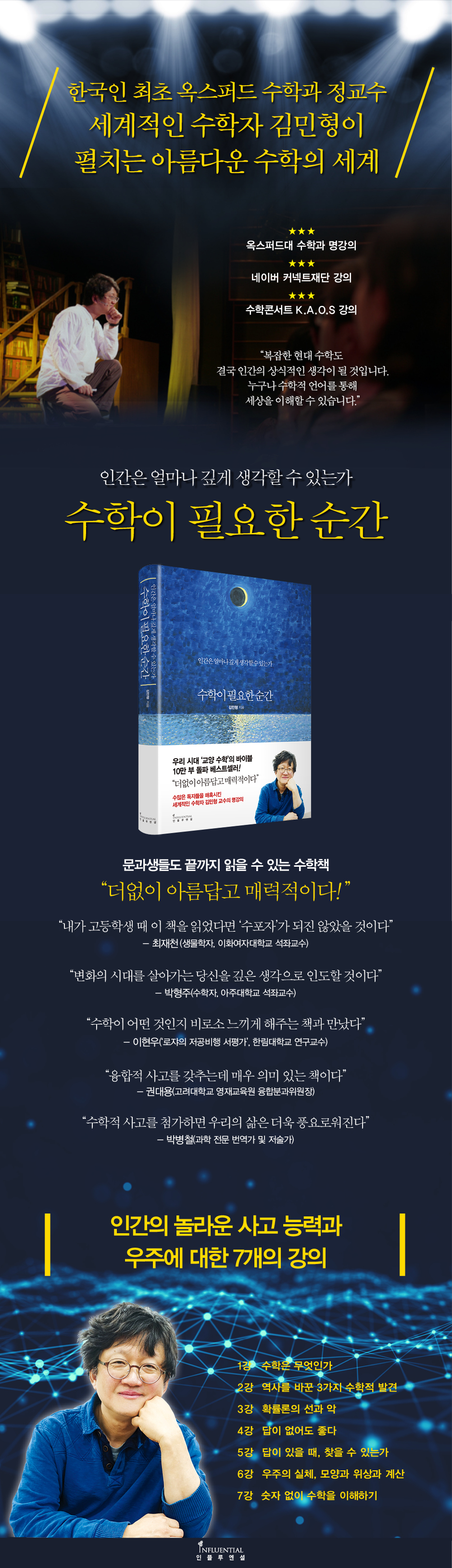
“Ultimately, all of life has to be thought of mathematically.” Human thinking ability and exploration of the universe 7 lectures on modern mathematics _A beautiful lecture by world-renowned mathematician Professor Kim Min-hyung of Oxford University The Naver Connect Foundation and Chaos Foundation now publish the lectures that swept the nation. The calculations we use so familiarly, the probabilities we talk about every day, and the coordinates we draw so easily were once complex theories that even experts could not understand. Fermat, Newton, Einstein, and even modern mathematical theories that we are not familiar with now will one day become common sense that we naturally recall. After all, humans are beings that think ‘mathematically.’ Professor Kim Min-hyung, the first Korean to be a full professor at Oxford University and a world-renowned mathematician. He explained human thinking ability and exploration of the universe through a total of seven lectures. "When Math is Needed" is a remarkable work by a leading modern mathematician, explaining the complex and difficult world of mathematics in a language that anyone can understand. Through this book, we come to realize that even human understanding of the universe and ethical judgment are based on mathematical thinking. You will be captivated by the thrilling and captivating joy that comes from thinking more deeply. |
- You can preview some of the book's contents.
Preview
index
Recommendation
Author's Note
To begin with
Mathematics influences human intuition.
Although probability theory only began in the 17th century, people today have no trouble reading and understanding '37% chance of rain'.
If there is a difference in the imagination of humans today, it is probably due to a difference in mathematical understanding.
Lesson 1: What is Mathematics?
Galileo said:
“In order to understand the universe, we must learn and become familiar with the language in which the universe is written, and that language is mathematical language.” Mathematics is not a specific type of logic or thinking, but rather the common sense that helps us understand our daily lives and the universe.
2nd lecture: Three mathematical discoveries that changed history
Looking at great discoveries like Fermat and Descartes' coordinate systems and Einstein's theory of relativity, we can see why mathematical thinking is necessary.
It's about asking precise questions about what we don't know now and figuring out what questions we want to ask in the future.
The Good and Evil of Probability Theory, Part 3
Ten people were killed in Hyde Park.
Is this a serious matter, or not? It's unacceptable that even one person should die, but what if ten people were killed in the process of preventing a terrorist attack that could have killed tens of thousands? Even in these ethical judgments, mathematical probability comes into play.
It's okay if there's no answer to the quarterfinals
What's the best way to elect representatives? Looking at the numerous election methods, we see that each can produce drastically different results.
So, are these methods all wrong? Rather than giving up on them because they're imperfect, it's mathematically important to understand them within their limited context.
When you have the answer to Lesson 5, can you find it?
You know the 19th-century marriage culture? Men and women went through stages like proposal, engagement, breakup, and marriage to find a partner.
If 100 men and 100 women pair up, is there a stable answer? 'Love is complicated, but there's always an answer.' How on earth does mathematics prove that there is an answer?
Lecture 6: The Reality of the Universe: Shape, Phase, and Calculation
Let's say the universe is curved.
Although we can express this in words, it is difficult to know it accurately.
Without the concept of inner geometry, it would be impossible to claim that the universe is curved.
How can we imagine the unimaginable?
In conclusion
Mathematics is not about finding the right answer, but rather the process by which humans find the answer.
We try to get the answer right, not wrong.
But if you don't want to be wrong, it's hard to discover the errors in any question or the limitations of any method.
Special Lecture: Understanding Math Without Numbers
When we think of math, numbers are the first thing that comes to mind.
Strictly speaking, numbers and numerals are different.
Numbers are one of the elements that make up the number system.
We can do calculations without using numbers at all.
In publishing this book
Author's Note
To begin with
Mathematics influences human intuition.
Although probability theory only began in the 17th century, people today have no trouble reading and understanding '37% chance of rain'.
If there is a difference in the imagination of humans today, it is probably due to a difference in mathematical understanding.
Lesson 1: What is Mathematics?
Galileo said:
“In order to understand the universe, we must learn and become familiar with the language in which the universe is written, and that language is mathematical language.” Mathematics is not a specific type of logic or thinking, but rather the common sense that helps us understand our daily lives and the universe.
2nd lecture: Three mathematical discoveries that changed history
Looking at great discoveries like Fermat and Descartes' coordinate systems and Einstein's theory of relativity, we can see why mathematical thinking is necessary.
It's about asking precise questions about what we don't know now and figuring out what questions we want to ask in the future.
The Good and Evil of Probability Theory, Part 3
Ten people were killed in Hyde Park.
Is this a serious matter, or not? It's unacceptable that even one person should die, but what if ten people were killed in the process of preventing a terrorist attack that could have killed tens of thousands? Even in these ethical judgments, mathematical probability comes into play.
It's okay if there's no answer to the quarterfinals
What's the best way to elect representatives? Looking at the numerous election methods, we see that each can produce drastically different results.
So, are these methods all wrong? Rather than giving up on them because they're imperfect, it's mathematically important to understand them within their limited context.
When you have the answer to Lesson 5, can you find it?
You know the 19th-century marriage culture? Men and women went through stages like proposal, engagement, breakup, and marriage to find a partner.
If 100 men and 100 women pair up, is there a stable answer? 'Love is complicated, but there's always an answer.' How on earth does mathematics prove that there is an answer?
Lecture 6: The Reality of the Universe: Shape, Phase, and Calculation
Let's say the universe is curved.
Although we can express this in words, it is difficult to know it accurately.
Without the concept of inner geometry, it would be impossible to claim that the universe is curved.
How can we imagine the unimaginable?
In conclusion
Mathematics is not about finding the right answer, but rather the process by which humans find the answer.
We try to get the answer right, not wrong.
But if you don't want to be wrong, it's hard to discover the errors in any question or the limitations of any method.
Special Lecture: Understanding Math Without Numbers
When we think of math, numbers are the first thing that comes to mind.
Strictly speaking, numbers and numerals are different.
Numbers are one of the elements that make up the number system.
We can do calculations without using numbers at all.
In publishing this book
Detailed image
Into the book
Even the problems that seem somewhat difficult to us now will one day become common sense.
If there is any difference in the intelligence and imagination of humans today, it is probably due to differences in mathematical understanding.
Conversely, the process by which new ideas become common sense will also be possible based on mathematical understanding.
---From "Starting"
Among the students who came to my university to major in mathematics, there are a lot of students who think that mathematical proofs are some kind of special idea.
But the proof doesn't require any special skills, it's just a matter of explaining it clearly.
It's no different from what we usually say, 'clearly'.
---From "What is Mathematics in Lesson 1"
We ask many questions as we live.
But often when we ask questions, it's not clear what kind of answer we want.
For example, when finding x, the answer may be satisfactory or unsatisfactory.
But in fact, as in Newton's case, there are many cases where it is not clear which answer we accept as satisfactory.
Therefore, in the process of developing a scientific theory, it is also important to create a ‘framework for an appropriate answer’.
---From "Three Mathematical Discoveries That Changed the History of the Second Class"
Are you a good person or a bad person? What criteria should guide such judgments? Is someone who helps those in need a good person? Or is someone who doesn't break the law a good person? I sometimes ask my students these questions.
For example, last year, a total of 10 people were murdered in London's Hyde Park.
Is this a big deal or not?
---From "The Good and Evil of the Three-Lead Probability Theory"
There are a lot of wrong proofs and wrong theorems in the history of mathematics.
But, in fact, those numerous failures often help us understand the phenomenon more.
Because it forces us to examine the constraints we face. "Arrow's impossibility theorem" also establishes limitations, but it doesn't end there; it serves as a guide for future researchers.
---From "It's okay if there is no answer to the quarterfinals"
The point of this question is not only that it can be found, but that it can be found 'efficiently'.
A significant number of mathematical problems involve three issues at once.
The first is whether there is a sun or not, the second is whether it can be found, and the third is whether it can be found efficiently.
Is there a concept of efficiency that can be given objective meaning, rather than just perceived as efficient by some and inefficient by others? The definition of efficiency and the related theories are actively being studied in mathematics and computational science.
---From "Can you find the answer when there is a 5-point answer?"
According to general relativity, feeling gravity is itself a process of feeling the curvature of spacetime.
It is because space-time is warped.
The important thing here is the basic idea.
If space is warped, if the universe is warped, and we feel gravity, then what does it mean for the universe to be warped? While we can express this coherently in words, it's actually difficult to grasp intuitively.
Why is it so difficult to understand what it means for the universe to be warped? Could it be because we're inside it?
Because we cannot look into the universe from outside the universe.
That is why it is impossible to claim that the universe is curved without the concept of internal geometry.
---From "Lecture 6: The Reality, Shape, Phase, and Calculation of the Universe"
I believe that when we try to ask good questions first rather than trying to quickly find the right answer in everyday problems, that is mathematical thinking.
Perhaps we could even boldly say that only through mathematical thinking can we ask good questions and verify that the answers we find are meaningful.
If there is any difference in the intelligence and imagination of humans today, it is probably due to differences in mathematical understanding.
Conversely, the process by which new ideas become common sense will also be possible based on mathematical understanding.
---From "Starting"
Among the students who came to my university to major in mathematics, there are a lot of students who think that mathematical proofs are some kind of special idea.
But the proof doesn't require any special skills, it's just a matter of explaining it clearly.
It's no different from what we usually say, 'clearly'.
---From "What is Mathematics in Lesson 1"
We ask many questions as we live.
But often when we ask questions, it's not clear what kind of answer we want.
For example, when finding x, the answer may be satisfactory or unsatisfactory.
But in fact, as in Newton's case, there are many cases where it is not clear which answer we accept as satisfactory.
Therefore, in the process of developing a scientific theory, it is also important to create a ‘framework for an appropriate answer’.
---From "Three Mathematical Discoveries That Changed the History of the Second Class"
Are you a good person or a bad person? What criteria should guide such judgments? Is someone who helps those in need a good person? Or is someone who doesn't break the law a good person? I sometimes ask my students these questions.
For example, last year, a total of 10 people were murdered in London's Hyde Park.
Is this a big deal or not?
---From "The Good and Evil of the Three-Lead Probability Theory"
There are a lot of wrong proofs and wrong theorems in the history of mathematics.
But, in fact, those numerous failures often help us understand the phenomenon more.
Because it forces us to examine the constraints we face. "Arrow's impossibility theorem" also establishes limitations, but it doesn't end there; it serves as a guide for future researchers.
---From "It's okay if there is no answer to the quarterfinals"
The point of this question is not only that it can be found, but that it can be found 'efficiently'.
A significant number of mathematical problems involve three issues at once.
The first is whether there is a sun or not, the second is whether it can be found, and the third is whether it can be found efficiently.
Is there a concept of efficiency that can be given objective meaning, rather than just perceived as efficient by some and inefficient by others? The definition of efficiency and the related theories are actively being studied in mathematics and computational science.
---From "Can you find the answer when there is a 5-point answer?"
According to general relativity, feeling gravity is itself a process of feeling the curvature of spacetime.
It is because space-time is warped.
The important thing here is the basic idea.
If space is warped, if the universe is warped, and we feel gravity, then what does it mean for the universe to be warped? While we can express this coherently in words, it's actually difficult to grasp intuitively.
Why is it so difficult to understand what it means for the universe to be warped? Could it be because we're inside it?
Because we cannot look into the universe from outside the universe.
That is why it is impossible to claim that the universe is curved without the concept of internal geometry.
---From "Lecture 6: The Reality, Shape, Phase, and Calculation of the Universe"
I believe that when we try to ask good questions first rather than trying to quickly find the right answer in everyday problems, that is mathematical thinking.
Perhaps we could even boldly say that only through mathematical thinking can we ask good questions and verify that the answers we find are meaningful.
---From "In Closing"
Publisher's Review
The beautiful world of mathematics, as told by world-renowned mathematician Professor Kim Min-hyung.
_7 Lectures on the Amazing Power of Human Thinking and Mathematics
Probability theory, invented in the 17th century, was once a complex mathematical theory that even experts could not understand, but now anyone can read and understand '37% chance of rain'.
The intuition that arose while observing the world was refined into a theory, which gradually became widely used and became common sense for many people.
Professor Kim Min-hyung, a world-renowned mathematician, says that as this process repeats and accumulates over centuries, human cognitive abilities are constantly expanding, and this trend will accelerate further.
Even the most complex modern mathematical theories will soon become common sense that everyone can naturally recall.
Professor Kim Min-hyung's new book, "When Math is Needed," contains seven insightful lectures on the vast world of mathematics, which has expanded human thinking abilities.
From fundamental mathematical principles to understanding information and the universe, to sociocultural topics like ethical judgment and encounters with reason, you will encounter the essence of mathematical thinking that underpins our understanding of every moment in the world.
This book, which compiles lectures delivered over a year, including the contents of various public lectures he gave, contains a deep exploration and message about mathematical thinking that is essential in this era.
As you follow this book, which is structured as questions and answers, as if you were sitting in a lecture hall, and gradually increase the temperature of your thoughts, you will soon find yourself completely immersed in the charm of mathematics.
Even modern mathematical concepts that cross the boundaries between physics and mathematics, such as Gale Shapley's theory, which won the Nobel Prize in Economics, Arrow's impossibility theorem, Euler's number, and inner geometry, are written in common-sense language, so anyone can read through them.
How deeply can humans think?
From everyday life to exploring the universe, "Moments When Math Is Needed"
For those who are afraid of math, math is always something to be afraid of.
But even people who are bad at math are already thinking mathematically.
Mathematical thinking is the most fundamental and fundamental ability humans have to understand the world. "When Math is Needed" is a book that helps us discover the mathematical thinking within ourselves.
According to this book, mathematics is a process of asking precise questions about what we don't know and creating the conceptual tools necessary to answer them.
Just as Fermat's 17th-century question, "How does light travel?", evolved over centuries into Newton's laws of motion and Einstein's theory of relativity, so too have mathematical questions continued to explore the world for centuries. (Chapter 2, "Three Mathematical Discoveries That Changed History")
From ethical judgments we consider to be matters of the humanities to the infinite realms of the universe, there is no moment when mathematics is not necessary for human understanding of the world.
For example, the trolley problem, known in the realm of philosophy as “Who would you save from a broken car?” is currently being used as a game at MIT to create programs for self-driving cars.
The 'ethical judgments' that subjects make in dangerous situations are being made into probability data, that is, mathematical problems (Lecture 4, 'Good and Evil in Probability Theory').
This goes beyond the issue of whether science and technology are used ethically, suggesting that in the future, human ethics itself may become a matter of probability.
A fundamental understanding of space-time and the universe is also not possible without mathematics.
The fundamental assumption of physics, that gravity arises from the warping of the universe, cannot be explained without the mathematical concept of "internal geometry," and the latest research in physics, such as quantum field theory and string theory, is no different from the process of discovering the mathematical structure that exists in the universe. (Lecture 6, The Real Shape, Phase, and Computation of the Universe) In this way, the major discoveries and proofs made by modern mathematics allow us to transcend our existing worldview and common sense and imagine the impossible about nature and the universe.
Develop your thinking muscles
The power of mathematics to make you think more deeply without giving up
Even if it's not necessarily math, if the process of thinking about a problem is even slightly burdensome or you encounter a wrong answer, people tend to give up or skip it.
But in the history of mathematics, more often than not, important moments occurred when the answer was wrong or missing.
The fourth lecture, "It's Okay If There's No Answer," begins with the question, "What is democracy?"
There are dozens of ways to elect representatives, but none of them are perfect.
However, despite the countless socio-cultural considerations and realistic dilemmas, understanding the problem within limited conditions and creating an appropriate framework for the answer can actually help us get closer to the essence of the problem.
The power of mathematics lies here.
It is about making us think more deeply and rationally without giving up, even when we are getting closer to the answer or when there is no answer.
These mathematical methodologies are naturally applied not only in natural science and engineering, but also in sociology, economics, humanities, and art.
For example, the Gale-Shapley theory, which won the 2012 Nobel Prize in Economics and is introduced in Chapter 5 of this book, “Can You Find the Answer When You Have It?”, was originally a paper published by two mathematicians in a mathematics education journal to explain “what mathematical thinking is.”
This theory, which begins with the question: can all 100 men and women find stable partners? It makes us realize that mathematical thinking isn't something far-fetched, but rather, like the human mind, it's a process that clarifies even seemingly intractable questions.
If, while reading this book, you suddenly look up and the world around you looks a little different, it may be a sign that you are getting closer to mathematical thinking.
In an age where math is essential, even liberal arts students, corporate executives, and ballerinas are captivated by the intellectual pleasure.
In this era of advanced information science, where big data and machine learning have become commonplace, the ability to logically process vast amounts of information and solve problems has become increasingly important, and mathematical thinking is gaining recognition as an essential skill for individuals and businesses.
Among these, Professor Kim Min-hyung is a leading figure in popularizing mathematics, and he gives lectures on mathematics to a wide range of audiences whenever he visits Korea.
The audience that filled Professor Kim Min-hyung's lecture halls, including the sold-out Math Concert KAOS and the Naver Connect Foundation, ranged from elementary school math prodigies to office workers, corporate executives, and even middle school ballet majors.
They are all amazed by the fact that they can naturally 'understand' complex mathematics rather than 'study' it, and they are completely captivated by the charm of mathematics.
It seems like he explains things more slowly and in simpler terms, but it's his teaching style that makes you think more deeply until the end.
This book was created based on the contents of various mathematics lectures given by Professor Kim Min-hyung in Korea, including the famous lectures given by the Oxford Department of Mathematics.
It is full of detailed conversations about mathematics, asking and answering questions, as if you were at a lecture.
He loves Shakespeare and Chopin, and has extensive knowledge across academic fields such as physics, brain science, and humanities. He says he “enjoys thinking about mathematics more than doing mathematics.”
He has poured his lifelong exploration of the vast world of mathematics into this book.
I hope that readers of this book will experience the joy of viewing the world mathematically, the pure intellectual pleasure of interpreting the world with a deep and broad perspective.
_7 Lectures on the Amazing Power of Human Thinking and Mathematics
Probability theory, invented in the 17th century, was once a complex mathematical theory that even experts could not understand, but now anyone can read and understand '37% chance of rain'.
The intuition that arose while observing the world was refined into a theory, which gradually became widely used and became common sense for many people.
Professor Kim Min-hyung, a world-renowned mathematician, says that as this process repeats and accumulates over centuries, human cognitive abilities are constantly expanding, and this trend will accelerate further.
Even the most complex modern mathematical theories will soon become common sense that everyone can naturally recall.
Professor Kim Min-hyung's new book, "When Math is Needed," contains seven insightful lectures on the vast world of mathematics, which has expanded human thinking abilities.
From fundamental mathematical principles to understanding information and the universe, to sociocultural topics like ethical judgment and encounters with reason, you will encounter the essence of mathematical thinking that underpins our understanding of every moment in the world.
This book, which compiles lectures delivered over a year, including the contents of various public lectures he gave, contains a deep exploration and message about mathematical thinking that is essential in this era.
As you follow this book, which is structured as questions and answers, as if you were sitting in a lecture hall, and gradually increase the temperature of your thoughts, you will soon find yourself completely immersed in the charm of mathematics.
Even modern mathematical concepts that cross the boundaries between physics and mathematics, such as Gale Shapley's theory, which won the Nobel Prize in Economics, Arrow's impossibility theorem, Euler's number, and inner geometry, are written in common-sense language, so anyone can read through them.
How deeply can humans think?
From everyday life to exploring the universe, "Moments When Math Is Needed"
For those who are afraid of math, math is always something to be afraid of.
But even people who are bad at math are already thinking mathematically.
Mathematical thinking is the most fundamental and fundamental ability humans have to understand the world. "When Math is Needed" is a book that helps us discover the mathematical thinking within ourselves.
According to this book, mathematics is a process of asking precise questions about what we don't know and creating the conceptual tools necessary to answer them.
Just as Fermat's 17th-century question, "How does light travel?", evolved over centuries into Newton's laws of motion and Einstein's theory of relativity, so too have mathematical questions continued to explore the world for centuries. (Chapter 2, "Three Mathematical Discoveries That Changed History")
From ethical judgments we consider to be matters of the humanities to the infinite realms of the universe, there is no moment when mathematics is not necessary for human understanding of the world.
For example, the trolley problem, known in the realm of philosophy as “Who would you save from a broken car?” is currently being used as a game at MIT to create programs for self-driving cars.
The 'ethical judgments' that subjects make in dangerous situations are being made into probability data, that is, mathematical problems (Lecture 4, 'Good and Evil in Probability Theory').
This goes beyond the issue of whether science and technology are used ethically, suggesting that in the future, human ethics itself may become a matter of probability.
A fundamental understanding of space-time and the universe is also not possible without mathematics.
The fundamental assumption of physics, that gravity arises from the warping of the universe, cannot be explained without the mathematical concept of "internal geometry," and the latest research in physics, such as quantum field theory and string theory, is no different from the process of discovering the mathematical structure that exists in the universe. (Lecture 6, The Real Shape, Phase, and Computation of the Universe) In this way, the major discoveries and proofs made by modern mathematics allow us to transcend our existing worldview and common sense and imagine the impossible about nature and the universe.
Develop your thinking muscles
The power of mathematics to make you think more deeply without giving up
Even if it's not necessarily math, if the process of thinking about a problem is even slightly burdensome or you encounter a wrong answer, people tend to give up or skip it.
But in the history of mathematics, more often than not, important moments occurred when the answer was wrong or missing.
The fourth lecture, "It's Okay If There's No Answer," begins with the question, "What is democracy?"
There are dozens of ways to elect representatives, but none of them are perfect.
However, despite the countless socio-cultural considerations and realistic dilemmas, understanding the problem within limited conditions and creating an appropriate framework for the answer can actually help us get closer to the essence of the problem.
The power of mathematics lies here.
It is about making us think more deeply and rationally without giving up, even when we are getting closer to the answer or when there is no answer.
These mathematical methodologies are naturally applied not only in natural science and engineering, but also in sociology, economics, humanities, and art.
For example, the Gale-Shapley theory, which won the 2012 Nobel Prize in Economics and is introduced in Chapter 5 of this book, “Can You Find the Answer When You Have It?”, was originally a paper published by two mathematicians in a mathematics education journal to explain “what mathematical thinking is.”
This theory, which begins with the question: can all 100 men and women find stable partners? It makes us realize that mathematical thinking isn't something far-fetched, but rather, like the human mind, it's a process that clarifies even seemingly intractable questions.
If, while reading this book, you suddenly look up and the world around you looks a little different, it may be a sign that you are getting closer to mathematical thinking.
In an age where math is essential, even liberal arts students, corporate executives, and ballerinas are captivated by the intellectual pleasure.
In this era of advanced information science, where big data and machine learning have become commonplace, the ability to logically process vast amounts of information and solve problems has become increasingly important, and mathematical thinking is gaining recognition as an essential skill for individuals and businesses.
Among these, Professor Kim Min-hyung is a leading figure in popularizing mathematics, and he gives lectures on mathematics to a wide range of audiences whenever he visits Korea.
The audience that filled Professor Kim Min-hyung's lecture halls, including the sold-out Math Concert KAOS and the Naver Connect Foundation, ranged from elementary school math prodigies to office workers, corporate executives, and even middle school ballet majors.
They are all amazed by the fact that they can naturally 'understand' complex mathematics rather than 'study' it, and they are completely captivated by the charm of mathematics.
It seems like he explains things more slowly and in simpler terms, but it's his teaching style that makes you think more deeply until the end.
This book was created based on the contents of various mathematics lectures given by Professor Kim Min-hyung in Korea, including the famous lectures given by the Oxford Department of Mathematics.
It is full of detailed conversations about mathematics, asking and answering questions, as if you were at a lecture.
He loves Shakespeare and Chopin, and has extensive knowledge across academic fields such as physics, brain science, and humanities. He says he “enjoys thinking about mathematics more than doing mathematics.”
He has poured his lifelong exploration of the vast world of mathematics into this book.
I hope that readers of this book will experience the joy of viewing the world mathematically, the pure intellectual pleasure of interpreting the world with a deep and broad perspective.
GOODS SPECIFICS
- Date of issue: August 3, 2018
- Format: Hardcover book binding method guide
- Page count, weight, size: 328 pages | 424g | 125*190*30mm
- ISBN13: 9791186560785
- ISBN10: 1186560789
You may also like
카테고리
korean


korean

![ELLE 엘르 스페셜 에디션 A형 : 12월 [2025]](http://librairie.coreenne.fr/cdn/shop/files/b8e27a3de6c9538896439686c6b0e8fb.jpg?v=1766436872&width=3840)


