

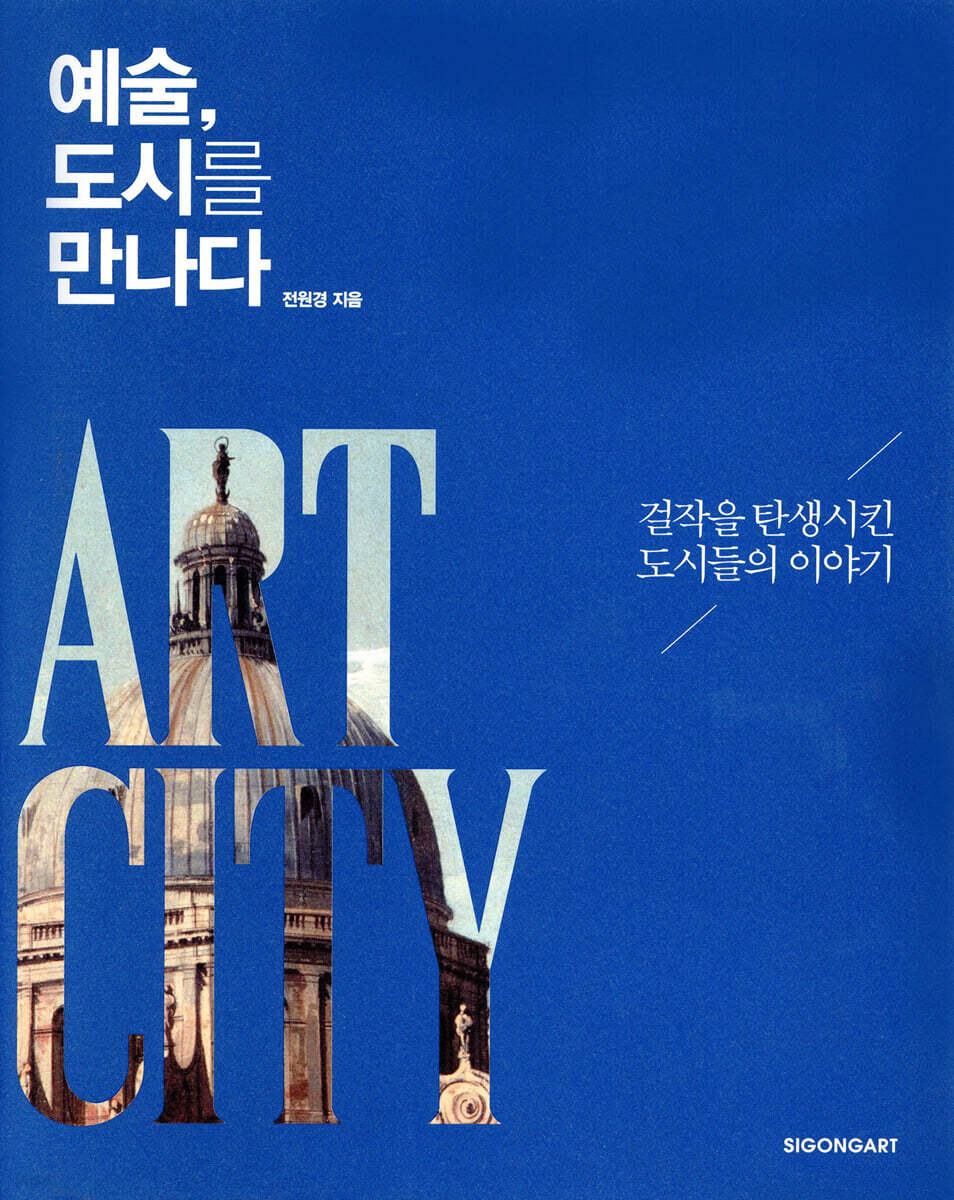
Art Meets the City
 |
Description
Book Introduction
How did a city create a masterpiece? Jeon Won-kyung, author of 『Art, Making History』, which has been praised for its profound perspective encompassing art and history, now explores the relationship between art and space. Artists create their world of work by connecting with the region where they were born and raised. Many works of art are born from the broad influences of the artist's surroundings, and more broadly, the city and country in which he lived. Without the intense sunsets of Norway, Munch's The Scream would not have been possible, and the dense forests of Germany were given form through the sounds of brooks and forest wanderings in many of Schubert's lieder. For this reason, exploring the connections between human geographic characteristics, works of art, and artists is as meaningful as pursuing the connections between art and history, and this is the main content of "Art Meets the City." A gift-like part of this book is the music the author recommends at the end of each chapter. These songs are all representative of the cities in the book, so you can fully experience the lingering emotions of the unfamiliar city through your eyes and ears. The 'Art Trilogy', which explores the hidden aspects of works of art through a broad humanistic perspective, will continue with the theme of art and humanity, following the themes of art and history and art and city. |
- You can preview some of the book's contents.
Preview
index
Entering
01 Grand Tour: The Nobles' School Trip
02 London: A Street Where Intellect and Literature Breathe
03 Scotland: Sad Legends Left Behind in the Mountains and Lakes
04 Normandy: Full of sunshine, wind, and raindrops
05 Paris 1: Paris in 1840
06 Paris 2: Cafes in Paris
07 Provence: Cypress and Lavender Scent
08 Weimar and Leipzig: Cities that conceived the German spirit
09 Berlin and Hamburg: A New Artist's Paradise
10 The Rhine and Bavaria: Home to Castles and Legends
11 Amsterdam and Brussels: Artists in Between
12 Bin 1: The Glory of the Habsburg Empire
13 Bin 2: Yesterday's World
14 Bohemia: Eternal Nostalgia
15 Madrid and Barcelona: When Illusion Becomes Reality
16 Andalusia: Between Islam and Africa
17 Tuscany: Home of Wine and Art
18 Venice: Innovative Art on the Sea of Trade
19 Rome and Naples: Orange and Lemon Scents
20 Scandinavia: Gloomy and cool skies
21 Moscow and St. Petersburg: Masterpieces that Blossomed in Vast Lands
22 New York: City of Desire
References
Detailed image

Into the book
As the saying goes, 'good wine doesn't travel.'
Whether it's beer, whiskey, or wine, to savor its true flavor, you have to go to the place where the alcohol was produced.
This applies not only to alcohol, but also to great works of art.
True masterpieces don't travel.
This does not mean that the Louvre will never take the Mona Lisa abroad, and the Uffizi Gallery will never take Spring and The Birth of Venus abroad, so we have no choice but to go there to see these works.
Just as with wine, the presence of a great work of art, where it is created and performed, allows us to intuitively and more deeply understand that work.
---From "Entering"
During the Georgian era (1714–1837), when William Hogarth was active, London emerged as a center of world trade.
As stock prices fluctuated, instant tycoons and bankrupts emerged, and the Jews who had dominated Amsterdam's trade moved to London.
From the early 1700s until the end of World War II in 1945, London reigned as the world's greatest city for over 200 years.
William Hogarth (1697-1764), a painter and philosopher, candidly and ruthlessly portrays the bustling atmosphere of London, a metropolis that led the European economy and was rife with energy, materialism, immorality, and greed.
---From "London: A Street Where Intellect and Literature Breathe"
The wave of Romanticism that was popular in Germany also reached France.
"Liberty Leading the People," painted by Eugene Delacroix (1798-1863), a leading figure of French Romanticism, vividly shows how German Romanticism was interpreted in France.
The goddess leading the people in the painting does not look like a mythical goddess, but like an ordinary Parisian girl.
She wore a triangular hat, which was worn by citizens during the French Revolution, and carried the tricolor flag, which was banned by the Bourbon dynasty.
The people's appearance is truly diverse.
The young man in the top hat is wearing the uniform of the École Polytechnique in Paris, while the young man next to him is obviously dressed as a city worker.
The sight of Notre Dame in the distance lets us know that this battle took place in Paris.
Victor Hugo is said to have been inspired by this painting for the barricade scene in Les Misérables.
Delacroix himself initially titled the painting 'Barricade'.
---From "Paris 1: Paris in 1840"
Rubens reigned as the most popular painter in Europe for more than 20 years, from 1620 to 1640.
The absolute monarchies that took hold in each European country before and after the Peace of Westphalia also gave wings to Rubens' activities.
The courts of England, Flanders, Spain, France, and Italy (Mantua) wanted him.
This is why we can find Rubens' paintings in every art museum in Europe today.
Although he was skilled in sacred painting, Rubens' true value lay in his recreation of Greek mythology, overflowing with dynamism, sensuality, and elegance.
Rubens lived a wealthy life as a painter and diplomat until his later years, and his works left a long trail that even influenced Delacroix and Renoir.
---From "Amsterdam and Brussels: Artists in Between"
Publisher's Review
Revisit the popular lectures from the Seoul Arts Center as a book!
This book was completed by organizing the lectures given at the Arts Center Humanities Academy every Saturday and including over 300 illustrations.
As this is a lecture that brings together numerous students every week, it is filled with fascinating stories about art and space that catch the eye.
The story of “Art Meets the City” begins in Europe, passes through Russia, and ends in New York, USA.
There may be many books that unpack art by space rather than chronologically, but it is difficult to find one that lays out the entirety of Western art on a single map.
The author's broad perspective, spanning art, music, and literature, shines through.
For Paul Cézanne, who painted and repainted a single rock mountain for over 20 years; for Van Gogh, who left behind immortal masterpieces captivated by the dry summer wind and vivid green cypress trees of Arles; and for Monet, who spent his life exploring the sea of Le Havre, France, and the pond of Giverny, space was a source of fascination and a universe.
If "Art, Making History" was a communication between art and the times, then "Art Meets the City" can be said to be a communication between art and space.
From London, the starting point of the 'Grand Tour', to New York, the symbol of modern art.
The concept of travel has existed since ancient Rome.
Travel was not difficult for the Romans thanks to the roads they built throughout the vast Roman Empire.
The advent of the Crusades in 1096 brought with it a proliferation of long-distance adventures and pilgrimages, but these were more like life-threatening journeys than the journeys we now think of.
The true beginning of a 'journey' to experience a different culture in an unfamiliar place can be said to be the 'Grand Tour' that emerged in the mid-1600s when Europe was emerging from a long period of religious conflict.
The Grand Tour, which was mainly conducted by the children of British and German-speaking nobles, was a trip across the sea and overland to Rome to learn about the advanced culture there, and it became an opportunity for Italian works of art to spread to the island nation of Britain.
Paris, a 'Mecca of art' no less than Rome, emerged around the 1830s when young European artists began visiting Paris.
In the 1840s, Paris, which was experiencing political turmoil following the French Revolution, began to flourish in an atmosphere of yearning for innovative art, with art, music, and literature all flourishing.
Eugène Delacroix's "Liberty Leading the People," which reminds us of the French Revolution, influenced Victor Hugo's "Les Misérables," and Chopin was very popular in Paris, where Romanticism was in full bloom.
If we go to Italy, the center of Western art, we find Michelangelo and Leonardo da Vinci working in Florence, where the Renaissance flourished, and Titian and Vivaldi making their names in Venice, which maintained its independence through active trade.
Needless to say, Rome was an arena of art where the masters of the time showed off their skills.
The journey, which begins in London, passes through France, Germany, the Netherlands, Belgium, Austria, the Czech Republic, Spain, Italy, Northern Europe and Russia, and ends in New York, the symbol of modern art.
It's like unfolding a large map of the world and taking in Western art and culture at a glance.
The stories of artists who created their worlds in the same space, although active in different eras, vividly unfold across art, music, and literature.
At the same time, it is a book that satisfies both the arts and humanities by allowing one to observe the process through which a city develops its culture.
Travel the world with masterpieces
In "Art Meets the City," you will naturally embark on an artistic journey as you follow the story of how a city gave birth to a masterpiece and, conversely, the influence art exerted on the city.
Readers of this book will think of Brunelleschi, who built the Santa Maria del Fiore Cathedral in Florence, when they visit it, and they will think of Toulouse-Lautrec and Edith Piaf when they see the Moulin Rouge in Montmartre, Paris.
This book chose 'space' as another keyword for understanding works of art, and at the same time, 'art' as a means of viewing a city.
We can gain a deeper understanding of great works of art by being present where they are created and performed.
GOODS SPECIFICS
- Date of publication: October 8, 2019
- Page count, weight, size: 556 pages | 1,172g | 165*210*35mm
- ISBN13: 9788952739148
- ISBN10: 8952739140
You may also like
카테고리
korean


korean


