

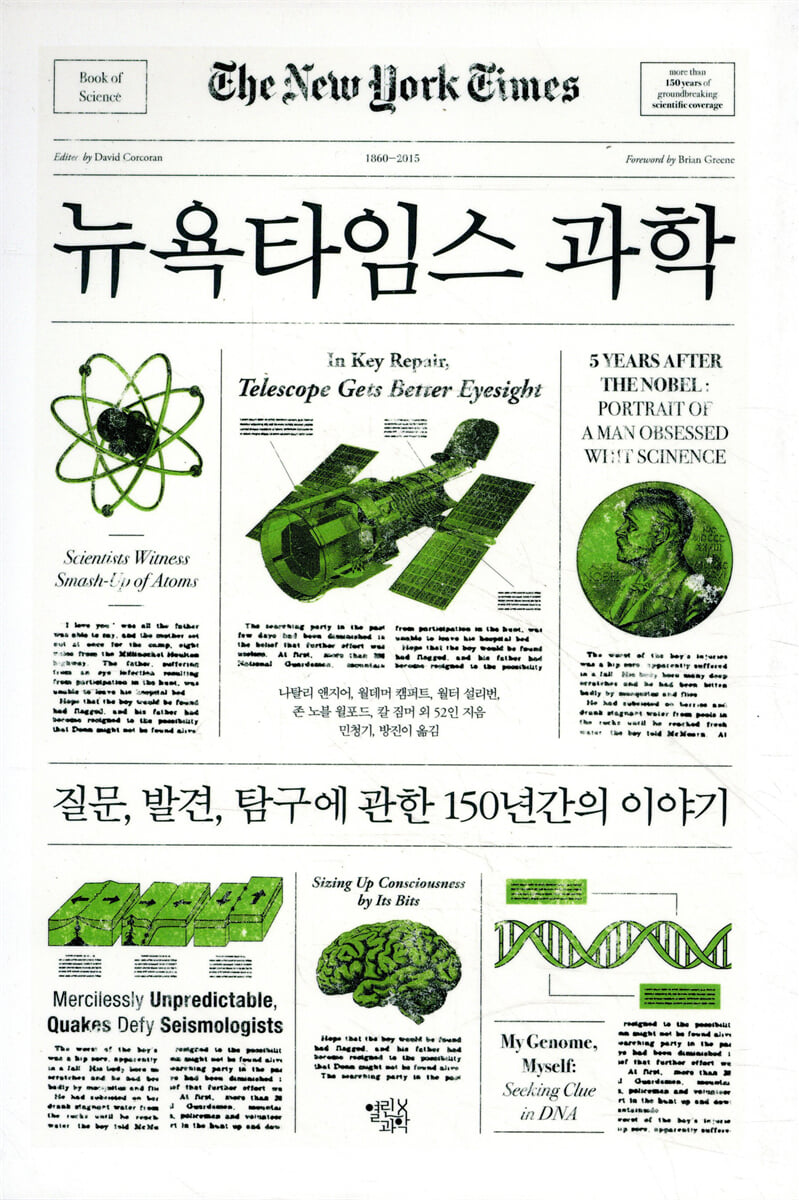
New York Times Science
 |
Description
Book Introduction
[New York Times] Selected from the Archives
Best Science Articles
The New York Times has been at the forefront of science news reporting for more than 100 years.
As early as the 1970s, there were ten science and medical reporters, the largest of any American newspaper, and their authority was recognized.
In 1978, he created [Science Times], the first science-focused section in the American media, and was passionate about creating a connection between science and the public.
This book covers the history of modern and contemporary science, meticulously documented by the New York Times, which has devoted more effort to science reporting than any other media outlet.
David Corcoran, who served as editor-in-chief of [Science Times] for 13 years, has carefully selected 125 articles containing discoveries, explorations, questions, as well as challenges and frustrations that caught the attention of the scientific community from 1860 to 2015.
The articles, categorized under 13 keywords (Archaeology, Astronomy, Biology, Earth Science, Environment, Exploration, Life on Earth, Mathematics, Medicine, Neuroscience, Science and Scientists, Physics, and Science and Technology), stimulate intellectual curiosity and imagination, while also being filled with surprising insights.
Not only are there articles on major events in the history of modern and contemporary science, such as a long, literary yet sharp review of Darwin's 『Origin of Species』 (1860), the discovery of the roentgen ray and the photographers' commentary on it (1896), an impressive interview in which Einstein explains his theory (1919), the development of Salvarsan (1910), and the use of penicillin (1944), but there are also articles on the rise and progress of global warming and the search for solutions based on the research of geologists and climate experts (1934-1997), the vivid competition between the United States and the Soviet Union over space exploration during the Cold War (1961-1962), chimpanzees using computers to communicate with humans (1974), early observations of galaxies (1998), the problem of gray matter, which is the neuron responsible for most of the brain's thinking ability, and gender (2005), sexual orientation imprinted in genes (2007), the great unknown mathematician Emmy Noether (2012), and sociological studies on the relationship between HIV and race. There are many articles that confirm the development and advancement of modern science, such as Gosal (2013), Large-scale anticancer drug clinical trials and the resulting crossover of joy and sorrow (2015).
By reading informative and broad-ranging scientific articles spanning 150 years of physical time, you will naturally gain answers to the questions of what science is and why it is an important discipline.
This book, which is a special history of science created by the New York Times' unique science journalism, which is passionate about creating connections between science and the public, will be of great help in dispelling the misconception that science is a difficult discipline.
I highly recommend this book to readers looking for an easy introduction to science.
Best Science Articles
The New York Times has been at the forefront of science news reporting for more than 100 years.
As early as the 1970s, there were ten science and medical reporters, the largest of any American newspaper, and their authority was recognized.
In 1978, he created [Science Times], the first science-focused section in the American media, and was passionate about creating a connection between science and the public.
This book covers the history of modern and contemporary science, meticulously documented by the New York Times, which has devoted more effort to science reporting than any other media outlet.
David Corcoran, who served as editor-in-chief of [Science Times] for 13 years, has carefully selected 125 articles containing discoveries, explorations, questions, as well as challenges and frustrations that caught the attention of the scientific community from 1860 to 2015.
The articles, categorized under 13 keywords (Archaeology, Astronomy, Biology, Earth Science, Environment, Exploration, Life on Earth, Mathematics, Medicine, Neuroscience, Science and Scientists, Physics, and Science and Technology), stimulate intellectual curiosity and imagination, while also being filled with surprising insights.
Not only are there articles on major events in the history of modern and contemporary science, such as a long, literary yet sharp review of Darwin's 『Origin of Species』 (1860), the discovery of the roentgen ray and the photographers' commentary on it (1896), an impressive interview in which Einstein explains his theory (1919), the development of Salvarsan (1910), and the use of penicillin (1944), but there are also articles on the rise and progress of global warming and the search for solutions based on the research of geologists and climate experts (1934-1997), the vivid competition between the United States and the Soviet Union over space exploration during the Cold War (1961-1962), chimpanzees using computers to communicate with humans (1974), early observations of galaxies (1998), the problem of gray matter, which is the neuron responsible for most of the brain's thinking ability, and gender (2005), sexual orientation imprinted in genes (2007), the great unknown mathematician Emmy Noether (2012), and sociological studies on the relationship between HIV and race. There are many articles that confirm the development and advancement of modern science, such as Gosal (2013), Large-scale anticancer drug clinical trials and the resulting crossover of joy and sorrow (2015).
By reading informative and broad-ranging scientific articles spanning 150 years of physical time, you will naturally gain answers to the questions of what science is and why it is an important discipline.
This book, which is a special history of science created by the New York Times' unique science journalism, which is passionate about creating connections between science and the public, will be of great help in dispelling the misconception that science is a difficult discipline.
I highly recommend this book to readers looking for an easy introduction to science.
- You can preview some of the book's contents.
Preview
index
Recommendation... David Green 006
Foreword … … David Corcoran 011
Chapter 01 Archaeology: Rediscovering Civilization
King Tutankhamun's inner tomb revealed after 3,400 years... 024
Archaeologists Open Door to Antiquity … … R.
L. Dupuis 035
A scientist accidentally discovers a method for dating artifacts… … 045
Jamestown Fort, the "birthplace" of America, built in 1607, discovered... John Noble Wilford 049
Remains found in underground parking lot identified as Richard III… …John F.
Burns 055
Chapter 02 Astronomy: The Study of Time and the Stars
Father Lemaître claims a star was suddenly born… Waldemar Campert 062
Astronomers peer back in time to glimpse the birth of galaxies... John Noble Wilford 069
What happened before the Big Bang? ... ... Dennis Overbye 079
Martian satellites… … 083
A New Solar Theory… … 085
Canals on Mars Revealed to Be 'Optical Illusions'… … 088
Viking robot lands on Mars, sending photos of rocky plains… John Noble Wilford 093
Pluto isn't just a planet in New York... Kenneth Chang 103
The Curiosity rover searches for clues on Mars… Kenneth Chang 109
Harvard astronomers calculate that the universe has grown 1,000 times in size… … 116
What will humanity see with its new 5-meter-long eyes? … … James H.
Jeans 118
If the theory is correct, most of the mass of the universe is still 'unknown'... ...William J.
Broad 129
Hubble's performance improves... John Noble Wilford 137
Astronomers delight in rare supernova explosion… … Malcolm W.
Brown 143
The End of the World... Dennis Overbye 148
Tracking a 'suitable' distant planet... Dennis Overbye 160
Chapter 03 Biology: The Mechanism of Life
Life is born in a scientist's test tube... ...William L.
Lawrence 172
Clues to Genetic Chemistry… … 178
Fifty years later, Rosalind Franklin's X-ray photographs spark controversy... Dennis Grady 182
British scientists successfully clone the first adult mammal… … Gina Kolata 187
The sexual behavior of two individuals is imprinted on their genes… Nicholas Wade 195
My Genome, and Myself: Searching for Clues in DNA… Amy Harmon 204
The New Reproductive Technology Controversy… Sabrina Tabernase 211
Chapter 04 Earth Science: Plates, Polar Regions, and Oceans
Testing continental drift in icy Greenland… Kurt Wegener 218
US satellite discovers radiation barrier… …John W.
Finney 226
Mountain formation is revealed to be linked to the sea… Walter Sullivan 231
San Francisco earthquake records stored in Washington... ... 237
Mount St. Helens eruption: Scientists finally pinpoint the cause… Walter Sullivan 240
The daunting task of flood control in New Orleans... John Nordheimer 248
Seismologists frustrated by completely unpredictable earthquakes… Sandra Blakeslee 255
Building a Bridge That Shakes During an Earthquake… Henry Fountain 261
The Aftermath of Hurricane Sandy: The Costs of Helping Coastal Communities… Cornelia Dean 268
Chapter 05 Environment: A Challenge to Life
The life of a tree spanning 1,300 years… … 276
Toxins Surround Us: A Review of Rachel Carson's Silent Spring ... ... Laurus and Marjorie Milne 285
Experiments reveal that aerosols can pose a threat to Earth… Walter Sullivan 292
The West in Danger… … 298
A terrifying wild world lies beneath every fallen leaf… James Gorman 302
The Growing Trash Island in the Ocean… Lindsay Hosho 310
The Arctic is melting ice... Waldemar Campert 000
A warming Arctic, melting glaciers, rising sea levels… Gladwin Hill 317
The climate is actually changing… Leonard Engel 319
Global warming may be due to increased concentrations of carbon dioxide in the atmosphere… Waldemar Campert 328
Kyoto Agreement to Reduce Greenhouse Gases… …William K.
Stevens 332
Chapter 06 Exploration: New Worlds Here and Out There
The explorer who found the source of the Nile River… … 338
Peary reaches the North Pole after eight attempts over 23 years… … 342
Dr. Cook answers questions from the New York Times about his Arctic expedition… … 348
The Arctic Swindler and His Followers… John Tierney 356
Amundsen describes his Antarctic expedition… … 362
Descending into Davy Jones's Box... William Beebe 369
Journey to the Deep: Darkness, Gold, and Godzilla… …William J.
Broad 382
Soviet Union launches satellite into space... William J.
Jordan 395
The US satellite is “operating normally” … … John W.
Finney 400
A Russian observes the Earth from his spaceship window as he circles it… Osgood Carruthers 407
Lieutenant Colonel Glenn successfully circles the Earth three times… Richard Witkin 414
Man Walks on the Moon... John Noble Wilford 427
Waiting to revise the poem commemorating the moon landing… … A.
M. Rosenthal 441
Journey to the Moon… Archibald MacLeish 445
Space Shuttle Columbia's maiden flight into orbit... John Noble Wilford 448
Space Shuttle Challenger explosion… …William J.
Broad 456
Chapter 07 Life on Earth: Biology, Paleontology, and Zoology
Charles Darwin's 『On the Origin of Species by Means of Natural Selection, or the Preservation of Favoured Species in the Struggle for Life』
Book review of "About" … … 468
Are humans merely advanced apes? … … 482
Reproducing the Birth of a New Species for the First Time… Carol Gye-sook Yoon 486
Inheriting the Gene of Buzzing… Maureen Dowd 494
The Dance of Evolution, or How Art Began… Natalie Angier 498
The most important mystery about the origins of life appears to have been solved… Nicholas Wade 503
Fossil excavations testify to the relationship between apes and humans… … 507
Two theories about mass extinctions emerge… Walter Sullivan 510
A New Theory About Dinosaurs: Multiple Meteor Impacts Drive Dinosaurs to Extinction… …William J.
Broad 516
A giant prehistoric dinosaur is resurrected, if only in name… James Gorman 523
A chimpanzee learned to read, write, and "converse" with humans with the help of a computer... ...Boyce Rensberger 527
Staying with your partner for life? Not birds or bees… Natalie Angier 539
Slow is beautiful… Natalie Angier 551
Chapter 08 Mathematics: From Reality to Infinity
Redefining Chaos with Modern Calculus… … 562
Map Guessing Puzzle: Color in the Solved Areas… Tom Ferrell 565
Aren't truth and beauty enough? ... ... James Gleick 567
Finally, "Eureka!"—An Age-Old Math Mystery Solved… … Gina Kolata 574
Decoding the Spy's Code... George Johnson 582
The Great Unknown Mathematician… Natalie Angier 587
The Life of Pi and Other Infinities… Natalie Angier 593
Don't expect logic from math... ...Manil Math 599
Chapter 09 Medicine: Pathogenesis and Breakthroughs
Development of germ theory… …606
Ehrlich's Treatment: A Medical Miracle… …610
A fungus fights to save human life… Daniel Schwartz 614
Oral contraceptives in clinical trials… …Robert K.
Plume 623
Brady's Recovery: Doctors Explain Dramatic Lucky Streaks … …Lawrence K.
Altman 626
A rare cancer found in only 41 homosexuals… …Lawrence K.
Altman 634
A new type of anti-cholesterol drug with proven efficacy has been approved… … Jane E.
Brody 638
Poor Black and Hispanic men who became the face of HIV… …Donald G.
McNeil Jr. 644
The Placenta, the Mysterious Tree of Neonatal Life… Dennis Grady 653
How to test many drugs on many cancers in a short period of time… Gina Kolata 661
Chapter 10 Neuroscience: Secrets of the Brain
H, who lost his memory and is remembered forever.
M. Died … … Benedict Carey 668
Measuring consciousness piece by piece… Carl Zimmer 675
Unraveling the Brain's Secrets Hidden in a Tiny Roundworm... Nicholas Wade 684
A sense of knowing where you are… James Gorman 694
Chapter 11: On Science and Scientists: People, Processes, and Appearances
Dr. Goddard's Rocket Launch Project: Trustworthy? … … 704
[Notice] Correction of an editorial error dated January 13, 1920… … 707
Five Years After the Nobel Prize: A Portrait of a Scientifically Madman … … Harold M.
Schmeck Jr. 708
A World of Scientific Discovery: A Memoir of an Eternal Student Exploring the Universe of Science… … Malcolm W.
Brown 716
Adding Color to Science with Mountain Metaphors… George Johnson 722
The Birth of Science Times: An Unexpected Event, But Not a Coincidence… John Noble Wilford 731
Gray Matter and Gender: Science's Gray Areas... Natalie Angier, Kenneth Chang 735
Scientists' Positions on the Compatibility of God and Science... Cornelia Dean 743
A surge in retractions calls for reform in the scientific community… Carl Zimmer 752
Chapter 12 Physics: Understanding the Unimaginable
Scientists Observe Atomic Collisions… Alva Johnston 762
A neutron is a combination of two particles… Ferdinand Kuhn Jr. 767
Atomic bomb based on Einstein's theory... William L.
Lawrence 771
The light of the sky is all curved… … 777
Einstein explains his own theory… …781
Slowing down the speed of light as much as a car on a weekend outing… … Malcolm W.
Brown 787
Billions of Reasons to Be Excited: Finding the Higgs Boson... Dennis Overbye 792
Chapter 13 Science and Technology: Inventions and Revolutions
Professor Alexander Graham Bell speaks on the telephone during the "Sound and Electricity" lecture.
Demonstration… … 802
Discovery of the Roentgen ray… … 804
Home television is becoming more and more of a reality… … Orin E.
Dunlap Jr. 812
Army radar successfully tests lunar communications… Jack Gould 826
The field of electronics is excited by the tiny pipe... 833
Light amplifier laser… … 836
Engineering work is poised to accelerate thanks to electrical computers that can churn out answers… …T.
R. Kennedy Jr. 838
The "Chip" That Revolutionized Electronics... Charles Lytham 845
A free and simple computer link... John Markoff 857
Self-Driving Google Cars… John Markoff 864
Editor and Author Biographies … … 870
Acknowledgments… … 881
Search … … 882
Foreword … … David Corcoran 011
Chapter 01 Archaeology: Rediscovering Civilization
King Tutankhamun's inner tomb revealed after 3,400 years... 024
Archaeologists Open Door to Antiquity … … R.
L. Dupuis 035
A scientist accidentally discovers a method for dating artifacts… … 045
Jamestown Fort, the "birthplace" of America, built in 1607, discovered... John Noble Wilford 049
Remains found in underground parking lot identified as Richard III… …John F.
Burns 055
Chapter 02 Astronomy: The Study of Time and the Stars
Father Lemaître claims a star was suddenly born… Waldemar Campert 062
Astronomers peer back in time to glimpse the birth of galaxies... John Noble Wilford 069
What happened before the Big Bang? ... ... Dennis Overbye 079
Martian satellites… … 083
A New Solar Theory… … 085
Canals on Mars Revealed to Be 'Optical Illusions'… … 088
Viking robot lands on Mars, sending photos of rocky plains… John Noble Wilford 093
Pluto isn't just a planet in New York... Kenneth Chang 103
The Curiosity rover searches for clues on Mars… Kenneth Chang 109
Harvard astronomers calculate that the universe has grown 1,000 times in size… … 116
What will humanity see with its new 5-meter-long eyes? … … James H.
Jeans 118
If the theory is correct, most of the mass of the universe is still 'unknown'... ...William J.
Broad 129
Hubble's performance improves... John Noble Wilford 137
Astronomers delight in rare supernova explosion… … Malcolm W.
Brown 143
The End of the World... Dennis Overbye 148
Tracking a 'suitable' distant planet... Dennis Overbye 160
Chapter 03 Biology: The Mechanism of Life
Life is born in a scientist's test tube... ...William L.
Lawrence 172
Clues to Genetic Chemistry… … 178
Fifty years later, Rosalind Franklin's X-ray photographs spark controversy... Dennis Grady 182
British scientists successfully clone the first adult mammal… … Gina Kolata 187
The sexual behavior of two individuals is imprinted on their genes… Nicholas Wade 195
My Genome, and Myself: Searching for Clues in DNA… Amy Harmon 204
The New Reproductive Technology Controversy… Sabrina Tabernase 211
Chapter 04 Earth Science: Plates, Polar Regions, and Oceans
Testing continental drift in icy Greenland… Kurt Wegener 218
US satellite discovers radiation barrier… …John W.
Finney 226
Mountain formation is revealed to be linked to the sea… Walter Sullivan 231
San Francisco earthquake records stored in Washington... ... 237
Mount St. Helens eruption: Scientists finally pinpoint the cause… Walter Sullivan 240
The daunting task of flood control in New Orleans... John Nordheimer 248
Seismologists frustrated by completely unpredictable earthquakes… Sandra Blakeslee 255
Building a Bridge That Shakes During an Earthquake… Henry Fountain 261
The Aftermath of Hurricane Sandy: The Costs of Helping Coastal Communities… Cornelia Dean 268
Chapter 05 Environment: A Challenge to Life
The life of a tree spanning 1,300 years… … 276
Toxins Surround Us: A Review of Rachel Carson's Silent Spring ... ... Laurus and Marjorie Milne 285
Experiments reveal that aerosols can pose a threat to Earth… Walter Sullivan 292
The West in Danger… … 298
A terrifying wild world lies beneath every fallen leaf… James Gorman 302
The Growing Trash Island in the Ocean… Lindsay Hosho 310
The Arctic is melting ice... Waldemar Campert 000
A warming Arctic, melting glaciers, rising sea levels… Gladwin Hill 317
The climate is actually changing… Leonard Engel 319
Global warming may be due to increased concentrations of carbon dioxide in the atmosphere… Waldemar Campert 328
Kyoto Agreement to Reduce Greenhouse Gases… …William K.
Stevens 332
Chapter 06 Exploration: New Worlds Here and Out There
The explorer who found the source of the Nile River… … 338
Peary reaches the North Pole after eight attempts over 23 years… … 342
Dr. Cook answers questions from the New York Times about his Arctic expedition… … 348
The Arctic Swindler and His Followers… John Tierney 356
Amundsen describes his Antarctic expedition… … 362
Descending into Davy Jones's Box... William Beebe 369
Journey to the Deep: Darkness, Gold, and Godzilla… …William J.
Broad 382
Soviet Union launches satellite into space... William J.
Jordan 395
The US satellite is “operating normally” … … John W.
Finney 400
A Russian observes the Earth from his spaceship window as he circles it… Osgood Carruthers 407
Lieutenant Colonel Glenn successfully circles the Earth three times… Richard Witkin 414
Man Walks on the Moon... John Noble Wilford 427
Waiting to revise the poem commemorating the moon landing… … A.
M. Rosenthal 441
Journey to the Moon… Archibald MacLeish 445
Space Shuttle Columbia's maiden flight into orbit... John Noble Wilford 448
Space Shuttle Challenger explosion… …William J.
Broad 456
Chapter 07 Life on Earth: Biology, Paleontology, and Zoology
Charles Darwin's 『On the Origin of Species by Means of Natural Selection, or the Preservation of Favoured Species in the Struggle for Life』
Book review of "About" … … 468
Are humans merely advanced apes? … … 482
Reproducing the Birth of a New Species for the First Time… Carol Gye-sook Yoon 486
Inheriting the Gene of Buzzing… Maureen Dowd 494
The Dance of Evolution, or How Art Began… Natalie Angier 498
The most important mystery about the origins of life appears to have been solved… Nicholas Wade 503
Fossil excavations testify to the relationship between apes and humans… … 507
Two theories about mass extinctions emerge… Walter Sullivan 510
A New Theory About Dinosaurs: Multiple Meteor Impacts Drive Dinosaurs to Extinction… …William J.
Broad 516
A giant prehistoric dinosaur is resurrected, if only in name… James Gorman 523
A chimpanzee learned to read, write, and "converse" with humans with the help of a computer... ...Boyce Rensberger 527
Staying with your partner for life? Not birds or bees… Natalie Angier 539
Slow is beautiful… Natalie Angier 551
Chapter 08 Mathematics: From Reality to Infinity
Redefining Chaos with Modern Calculus… … 562
Map Guessing Puzzle: Color in the Solved Areas… Tom Ferrell 565
Aren't truth and beauty enough? ... ... James Gleick 567
Finally, "Eureka!"—An Age-Old Math Mystery Solved… … Gina Kolata 574
Decoding the Spy's Code... George Johnson 582
The Great Unknown Mathematician… Natalie Angier 587
The Life of Pi and Other Infinities… Natalie Angier 593
Don't expect logic from math... ...Manil Math 599
Chapter 09 Medicine: Pathogenesis and Breakthroughs
Development of germ theory… …606
Ehrlich's Treatment: A Medical Miracle… …610
A fungus fights to save human life… Daniel Schwartz 614
Oral contraceptives in clinical trials… …Robert K.
Plume 623
Brady's Recovery: Doctors Explain Dramatic Lucky Streaks … …Lawrence K.
Altman 626
A rare cancer found in only 41 homosexuals… …Lawrence K.
Altman 634
A new type of anti-cholesterol drug with proven efficacy has been approved… … Jane E.
Brody 638
Poor Black and Hispanic men who became the face of HIV… …Donald G.
McNeil Jr. 644
The Placenta, the Mysterious Tree of Neonatal Life… Dennis Grady 653
How to test many drugs on many cancers in a short period of time… Gina Kolata 661
Chapter 10 Neuroscience: Secrets of the Brain
H, who lost his memory and is remembered forever.
M. Died … … Benedict Carey 668
Measuring consciousness piece by piece… Carl Zimmer 675
Unraveling the Brain's Secrets Hidden in a Tiny Roundworm... Nicholas Wade 684
A sense of knowing where you are… James Gorman 694
Chapter 11: On Science and Scientists: People, Processes, and Appearances
Dr. Goddard's Rocket Launch Project: Trustworthy? … … 704
[Notice] Correction of an editorial error dated January 13, 1920… … 707
Five Years After the Nobel Prize: A Portrait of a Scientifically Madman … … Harold M.
Schmeck Jr. 708
A World of Scientific Discovery: A Memoir of an Eternal Student Exploring the Universe of Science… … Malcolm W.
Brown 716
Adding Color to Science with Mountain Metaphors… George Johnson 722
The Birth of Science Times: An Unexpected Event, But Not a Coincidence… John Noble Wilford 731
Gray Matter and Gender: Science's Gray Areas... Natalie Angier, Kenneth Chang 735
Scientists' Positions on the Compatibility of God and Science... Cornelia Dean 743
A surge in retractions calls for reform in the scientific community… Carl Zimmer 752
Chapter 12 Physics: Understanding the Unimaginable
Scientists Observe Atomic Collisions… Alva Johnston 762
A neutron is a combination of two particles… Ferdinand Kuhn Jr. 767
Atomic bomb based on Einstein's theory... William L.
Lawrence 771
The light of the sky is all curved… … 777
Einstein explains his own theory… …781
Slowing down the speed of light as much as a car on a weekend outing… … Malcolm W.
Brown 787
Billions of Reasons to Be Excited: Finding the Higgs Boson... Dennis Overbye 792
Chapter 13 Science and Technology: Inventions and Revolutions
Professor Alexander Graham Bell speaks on the telephone during the "Sound and Electricity" lecture.
Demonstration… … 802
Discovery of the Roentgen ray… … 804
Home television is becoming more and more of a reality… … Orin E.
Dunlap Jr. 812
Army radar successfully tests lunar communications… Jack Gould 826
The field of electronics is excited by the tiny pipe... 833
Light amplifier laser… … 836
Engineering work is poised to accelerate thanks to electrical computers that can churn out answers… …T.
R. Kennedy Jr. 838
The "Chip" That Revolutionized Electronics... Charles Lytham 845
A free and simple computer link... John Markoff 857
Self-Driving Google Cars… John Markoff 864
Editor and Author Biographies … … 870
Acknowledgments… … 881
Search … … 882
Into the book
We hope to be able to ride this wonderful deep-sea space called the diving crater again next year with Barton's help.
With new hoses and windows, we could descend to depths of 800 meters to see the life of the sea.
But the vast expanse of ocean that we have added to the human sphere of activity with this expedition holds enough research to last a lifetime.
For the past two seasons, I've had to blindly approach inaccessible places like an astronaut, and work primarily with dead organisms like a fossil researcher.
But a new method of exploration called a diving board changed everything.
It's like an astronaut conquering space or a paleontologist conquering time.
I can see, photograph, and draw deep-sea creatures.
You just can't touch it with your hands.
And you can directly check the temperature and light of the place where the creature lives, and whether it wanders alone or lives in groups.
Modern explorers have a habit of comparing the new lands they add to human territory to the territory of a country.
But what can I say, the only new thing I have to add is water.
But if we were to pour the seawater we have made 400 meters deep evenly over all the land of the world, the depth of the water that would fill the Americas, Europe, Asia, and all the rest of the land would easily exceed 800 meters.
I don't know if you'll like it, but you could explain it this way.
The first volume of water explored was approximately 143.36 million square kilometers (can you guess?), and if you were to divide it all into cubes of 1 square kilometer each and line them up, I'll leave it up to the readers to figure out how long they would be.
The significance of all these adventures I have had can be summarized as follows:
As we have demonstrated, for research to be reasonably possible in the future, the safety of researchers must be guaranteed.
And what we achieved far exceeded what we had imagined possible in terms of scientific accuracy, factual accuracy, and philosophical value.
---From "Down into Davy Jones's Box"
For decades, astronomers have debated the fate of the expanding universe.
Either the 'Big Crunch' will occur and everything will end overnight, or the galaxies will continue to move away from each other forever.
Those who argue that the universe expands forever always cite the apparent possibility that the universe will continue to develop and evolve forever.
Like Yale University cosmologist Dr. Beatrice Tinsley, who said she “believes in the idea of eternal expansion.”
In his landmark 1979 paper, Dr. Freeman Dyson, a physicist at the Institute for Advanced Study in Princeton, argued that life and intelligence could persist in such a universe, even as stars extinguished their light and galaxies were swallowed by black holes.
In his paper, Dr. Dyson wrote, “If my view of the future is correct, then the world of physics and astronomy will go on forever.
“No matter how far into the future we may go, new things will always happen, new information will flood in, new worlds will be explored, and the realms of life, consciousness, and memory will constantly expand,” he argued.
But now even Dr. Dyson admits that his guess was wrong.
If recent astronomical observations are correct, the future of life and the universe looks much more bleak.
For the past four years, astronomers have announced that the expansion of the universe is not just continuing, but is accelerating, influenced by a mysterious "dark energy."
Dark energy refers to the anti-gravity that appears to be inherent in the universe.
If that's true and the universe is expanding at a faster rate instead of slowly succumbing to its demise, astronomers say, distant galaxies will eventually move away from each other faster and be unable to interact with each other.
In fact, it is no different from living in the middle of a black hole that is becoming increasingly hollow and colder.
---From "The End of the World"
Photographs of objects invisible to the naked eye, taken by Professor Wilhelm Röntgen of Würzburg, have arrived in Britain, sparking a flurry of comments from leading British photographers. The term "cathode ray," given to a form of radiant energy, seems to have already gained widespread acceptance.
The characteristic of cathode rays is that they cannot pass through clear glass, but they can pass through frosted glass, wood, metal, and human flesh.
The name cathode rays, of course, comes from the fact that these rays are emitted from the cathode of a Crookes tube.
The Crookes tube is an improved version of the Geissler tube (a discharge tube with a vacuum inside a glass tube containing two sealed electrodes - editor) and consists of an egg-shaped glass bulb with most of the air removed.
At one end is a fused platinum wire through which positive ions flow, and at the other end is a small, disc-shaped aluminum plate.
A similar aluminum plate was attached to the bottom of the tube to receive the current passing through the vacuum.
The point where the current enters is called the anode, and the point where the current exits is called the cathode. They are also called the positive and negative poles, respectively.
It is often represented by plus and minus signs.
When Professor Crooks passed an electric current through this tube, a very vivid fluorescent effect, typical of this type of tube, appeared.
However, a small dark spot appeared near the cathode, and this spot was particularly noticeable in the bright surrounding light.
Professor Crooks studied what happened to the material inside the tube, including a small piece of aluminum shaped like a Maltese cross, and discovered that surprising energy was being generated inside it.
Professor Crookes' discovery became the starting point for Professor Röntgen's discovery of Röntgen rays.
Arthur Bowes of Salford, England, after seeing Professor Röntgen's photographs, wrote an article in The London Photographic News, excerpted below:
Mr Bowes is a civil engineer employed by Salford City and a fairly well-known amateur photographer.
This is an excerpt from Mr. Bowes's contribution.
---From "Discovery of Roentgen Rays"
There is no doubt that indirect learning about natural science has made the most important contribution to modern philosophy.
Direct learning is great, but indirect learning is even better.
Because the former is related only to the material world, while the latter influences all human thought activities.
In fact, what has so far been able to deeply impress many laymen in science is its wonderful indirectness, the way truth exposes some of its wonderful aspects.
In this respect, there is something that science has not yet reached.
Just as literature needs science, science also needs literature.
A person who starts from what he has discovered and leads to a summit where a beautiful, peaceful, and new landscape unfolds is a person who is truly scientific.
(…omitted…) When the future that Darwin himself envisioned comes to pass, Darwin will be recognized not as someone who understood the entirety of nature’s providence, but as someone who understood only a part of it.
In any case, historically speaking, the truth about the principles of nature seems at first to have appeared like a purple mirage.
A faint trace of aurora first appears in the human mind, and at the appointed hour a perfect thought appears, and then, though invisible, the atmosphere matures and the sunlight of science floods the world.
With new hoses and windows, we could descend to depths of 800 meters to see the life of the sea.
But the vast expanse of ocean that we have added to the human sphere of activity with this expedition holds enough research to last a lifetime.
For the past two seasons, I've had to blindly approach inaccessible places like an astronaut, and work primarily with dead organisms like a fossil researcher.
But a new method of exploration called a diving board changed everything.
It's like an astronaut conquering space or a paleontologist conquering time.
I can see, photograph, and draw deep-sea creatures.
You just can't touch it with your hands.
And you can directly check the temperature and light of the place where the creature lives, and whether it wanders alone or lives in groups.
Modern explorers have a habit of comparing the new lands they add to human territory to the territory of a country.
But what can I say, the only new thing I have to add is water.
But if we were to pour the seawater we have made 400 meters deep evenly over all the land of the world, the depth of the water that would fill the Americas, Europe, Asia, and all the rest of the land would easily exceed 800 meters.
I don't know if you'll like it, but you could explain it this way.
The first volume of water explored was approximately 143.36 million square kilometers (can you guess?), and if you were to divide it all into cubes of 1 square kilometer each and line them up, I'll leave it up to the readers to figure out how long they would be.
The significance of all these adventures I have had can be summarized as follows:
As we have demonstrated, for research to be reasonably possible in the future, the safety of researchers must be guaranteed.
And what we achieved far exceeded what we had imagined possible in terms of scientific accuracy, factual accuracy, and philosophical value.
---From "Down into Davy Jones's Box"
For decades, astronomers have debated the fate of the expanding universe.
Either the 'Big Crunch' will occur and everything will end overnight, or the galaxies will continue to move away from each other forever.
Those who argue that the universe expands forever always cite the apparent possibility that the universe will continue to develop and evolve forever.
Like Yale University cosmologist Dr. Beatrice Tinsley, who said she “believes in the idea of eternal expansion.”
In his landmark 1979 paper, Dr. Freeman Dyson, a physicist at the Institute for Advanced Study in Princeton, argued that life and intelligence could persist in such a universe, even as stars extinguished their light and galaxies were swallowed by black holes.
In his paper, Dr. Dyson wrote, “If my view of the future is correct, then the world of physics and astronomy will go on forever.
“No matter how far into the future we may go, new things will always happen, new information will flood in, new worlds will be explored, and the realms of life, consciousness, and memory will constantly expand,” he argued.
But now even Dr. Dyson admits that his guess was wrong.
If recent astronomical observations are correct, the future of life and the universe looks much more bleak.
For the past four years, astronomers have announced that the expansion of the universe is not just continuing, but is accelerating, influenced by a mysterious "dark energy."
Dark energy refers to the anti-gravity that appears to be inherent in the universe.
If that's true and the universe is expanding at a faster rate instead of slowly succumbing to its demise, astronomers say, distant galaxies will eventually move away from each other faster and be unable to interact with each other.
In fact, it is no different from living in the middle of a black hole that is becoming increasingly hollow and colder.
---From "The End of the World"
Photographs of objects invisible to the naked eye, taken by Professor Wilhelm Röntgen of Würzburg, have arrived in Britain, sparking a flurry of comments from leading British photographers. The term "cathode ray," given to a form of radiant energy, seems to have already gained widespread acceptance.
The characteristic of cathode rays is that they cannot pass through clear glass, but they can pass through frosted glass, wood, metal, and human flesh.
The name cathode rays, of course, comes from the fact that these rays are emitted from the cathode of a Crookes tube.
The Crookes tube is an improved version of the Geissler tube (a discharge tube with a vacuum inside a glass tube containing two sealed electrodes - editor) and consists of an egg-shaped glass bulb with most of the air removed.
At one end is a fused platinum wire through which positive ions flow, and at the other end is a small, disc-shaped aluminum plate.
A similar aluminum plate was attached to the bottom of the tube to receive the current passing through the vacuum.
The point where the current enters is called the anode, and the point where the current exits is called the cathode. They are also called the positive and negative poles, respectively.
It is often represented by plus and minus signs.
When Professor Crooks passed an electric current through this tube, a very vivid fluorescent effect, typical of this type of tube, appeared.
However, a small dark spot appeared near the cathode, and this spot was particularly noticeable in the bright surrounding light.
Professor Crooks studied what happened to the material inside the tube, including a small piece of aluminum shaped like a Maltese cross, and discovered that surprising energy was being generated inside it.
Professor Crookes' discovery became the starting point for Professor Röntgen's discovery of Röntgen rays.
Arthur Bowes of Salford, England, after seeing Professor Röntgen's photographs, wrote an article in The London Photographic News, excerpted below:
Mr Bowes is a civil engineer employed by Salford City and a fairly well-known amateur photographer.
This is an excerpt from Mr. Bowes's contribution.
---From "Discovery of Roentgen Rays"
There is no doubt that indirect learning about natural science has made the most important contribution to modern philosophy.
Direct learning is great, but indirect learning is even better.
Because the former is related only to the material world, while the latter influences all human thought activities.
In fact, what has so far been able to deeply impress many laymen in science is its wonderful indirectness, the way truth exposes some of its wonderful aspects.
In this respect, there is something that science has not yet reached.
Just as literature needs science, science also needs literature.
A person who starts from what he has discovered and leads to a summit where a beautiful, peaceful, and new landscape unfolds is a person who is truly scientific.
(…omitted…) When the future that Darwin himself envisioned comes to pass, Darwin will be recognized not as someone who understood the entirety of nature’s providence, but as someone who understood only a part of it.
In any case, historically speaking, the truth about the principles of nature seems at first to have appeared like a purple mirage.
A faint trace of aurora first appears in the human mind, and at the appointed hour a perfect thought appears, and then, though invisible, the atmosphere matures and the sunlight of science floods the world.
---From a review of Charles Darwin's "On the Origin of Species by Means of Natural Selection, or the Preservation of Species Favored in the Struggle for Life"
GOODS SPECIFICS
- Date of publication: June 29, 2018
- Format: Hardcover book binding method guide
- Page count, weight, size: 904 pages | 1,392g | 152*225*50mm
- ISBN13: 9788992985659
- ISBN10: 8992985657
You may also like
카테고리
korean


korean

![ELLE 엘르 스페셜 에디션 A형 : 12월 [2025]](http://librairie.coreenne.fr/cdn/shop/files/b8e27a3de6c9538896439686c6b0e8fb.jpg?v=1766436872&width=3840)


